After the end of the Second World War, prominent intellectuals across Europe shared a desire for popular education and culture, which was informed by progressive Resistance ideals.Footnote 2 Speaking of the cultural reconstruction of post-war Europe, Nicholas Hewitt argues that ‘it is essential to limit the period under analysis from 1945 to 1950, when the debates on the directions in which European culture should go were at their height’.Footnote 3 In the case of Greece, however, this intense cultural activity lasted even less, due to the outbreak of the Greek Civil War (1946–9), whose prelude occurred in December 1944, when fighting broke out in Athens between the communist-led resistance organization, the National Liberation Front (EAM), and British troops supporting the government—a conflict known as the Dekemvriana. Hence, in order to grasp the fleeting moment when the turbulent political reality had not yet fully overshadowed the demand for popularizing high culture, I will focus my attention on the immediate post-Liberation period, that is, on the one-year period between the ceasefire agreement signed between the government and EAM on 12 February 1945 (the Varkiza Agreement) and the parliamentary elections held on 31 March 1946, which signalled the beginning of full-fledged civil war. Recent studies have come to define this period as the period of ‘white terror’, due to the acts of violence against known or suspected communists.Footnote 4
Despite this atmosphere, the optimistic voices that expressed their faith in a future society where people would have equal access to culture not only permeated Greek public discourse, but seem to have inspired a number of educational/cultural projects. One of the most characteristic projects of this period is the ‘Literary Evenings’ (Λογοτεχνικές Απογευματινές), a series of performances of literary texts established by the Greek National Theatre (hereafter NT) during the 1945–6 season. This literary-theatrical project has not, to date, received any scholarly attention, even though it offers an illuminating case study of both the institutional strategies used to popularize literature, and the mechanisms of literary canonization in post-war Greece.
Perhaps the reason for this conspicuous critical neglect lies with the nature of the project itself; standing at a crossroads between theatre and literary studies, it has escaped the attention of scholars from both disciplines alike. On the one hand, studies which centre on the theatrical life of this period refer to this project in passing, without elaborating on its pedagogical aims in light of the context of cultural reconstruction, or its content in relation to the contemporaneous developments in the field of literature.Footnote 5 Literary historians, on the other hand, scarcely take into account the presence of modern Greek literature outside the printed book.Footnote 6 Exceptions to this are studies which focus on the transposition of literature into popular media, such as Papanikolaou's Singing Poets, which traces the intersections of poetry and popular music in France and Greece. Yet, even though Papanikolaou discusses the circulation of French poetry in oral formats during the 1940s, he situates the Greek manifestations of this phenomenon at a much later stage, particularly in the late 1950s.Footnote 7
However, identifying earlier attempts to popularize poetry through performance, such as the ‘Literary Evenings’, can inform our understanding of the succeeding projects of the late 1950s and early 1960s. Commenting on the 1960s musical settings of poetry, Papanikolaou juxtaposes the ‘popular politics’ of the leftist composer Mikis Theodorakis with the eclecticism of the poets of the Generation of the 1930s, interpreting Theodorakis’ strategy of ‘returning high culture to the people, bringing poetry to the masses’ as an ‘effort to force the cut-off bourgeois poets to communicate with the people’.Footnote 8 Striking a similar note, Garantoudis claims that the practices of the Generation of the 1930s lacked the popularizing impulse of the cultural projects of the Greek Left; speaking of the recitation anthologies published by EAM in the mid-1940s (which will be examined below in parallel with the ‘Literary Evenings’), Garantoudis views them as an effort to reconnect performed poetry with the public, adding that such initiatives ‘belong to a politico-ideological space which is totally incompatible with the views of bourgeois poets, like Seferis, on poetry and its recitation’.Footnote 9
This article aims to demonstrate that the Generation of the 1930s was far more receptive to ideas of popular and performed poetry than previous studies have acknowledged. The relatively unknown involvement of leading members of this generation in the operation of the NT in 1945–6 throws new light on the cultural and political agenda of this generation, elucidating more fully both its ideological position and its relations with popular culture. A key figure in this venture was the novelist Giorgos Theotokas, who was appointed director-general of the NT shortly after the Varkiza Agreement. For a group of authors that has long been the focus of extensive scholarly attention, it is curious that one of its rare collective exertions has hitherto gone unnoticed.Footnote 10 Treating the ‘Literary Evenings’ as a project that bore the definite imprint of the Generation of the 1930s, this article departs from the view of this generation as an ‘abstract scheme, critical construct and rhetorical invention’,Footnote 11 showing that, at least in the post-Liberation period, these authors indeed acted as a coherent group which attempted to reach wider audiences and influence popular taste.
And while the popularizing character of the ‘Literary Evenings’ reflects the broader cultural and intellectual tendencies of this period, the question of their repertoire, i.e. the texts chosen to be performed, is directly linked to the issue of literary canonization, introducing an aspect that is rarely addressed in the existing—Greek or international—literature on the topic: the aural dissemination of literary works. In particular, discussions concerned with canon formation base their assumptions on traditional printed sources (textbooks, histories, anthologies), paying little, if any, attention to the circulation of literary texts via non-print media (live readings, radio broadcasts, sound recordings).Footnote 12 Even in the few cases where vocal performances of printed texts are acknowledged as an important part of an author's reception and public image, such considerations usually apply to individual case studies,Footnote 13 and no systematic attempt has been made to assess the overall impact of the non-print appearances of literature on the construction of national literary canons. The study of the ‘Literary Evenings’ underlines the fact that different versions of the canon coexisted within the same period, of which the ones relying upon the printed form of the text were simply one part.
In what follows, I will try to situate the ‘Literary Evenings’ within their historical and literary context, drawing mostly on unpublished material located in the NT's Archive.Footnote 14 More specifically, the first part of this article (‘Off-stage politics’) will discuss the backstage activity that framed the launch of the ‘Literary Evenings’, focusing on the NT's attempts to maintain equilibrium amidst a highly polarized political setting. The second part (‘The European model’) will trace the origins of the ‘Literary Evenings’, bringing to the fore the internationalist scope of the NT administration as well as its influence from the practices of the French state theatre. The third part (‘Popularization’) will discuss the objectives of the ‘Literary Evenings’ in light of the educational and cultural policy of both the official state and the Left. Finally, the fourth part (‘Canonization’) will delve into the repertoire of the ‘Literary Evenings’, questioning whether the choice of texts ultimately reinforced canonical values or proposed an alternative version of the literary canon.
Off-stage politics
Less than a month after the Liberation of Athens, Georgios Papandreou, head of the Government of National Unity, ordered the indefinite closure of both the NT and the National Opera and called for their immediate reorganization.Footnote 15 Vasilis Kanakis, one of the few chroniclers of the NT's history, blames this development on the internal conflict that had broken out between two leftist actors of the troupe, Giorgos Glinos and Tzavalas Karousos, who, bypassing the authority of the appointed director-general, Nikolaos Laskaris, were engaged in a struggle for dominance.Footnote 16 Press reports did not go into such detail, but pointed to the declining artistic standards of the NT's wartime productions, which had allegedly caused general disappointment: ‘Athenian intellectual circles fully endorse the government's decision to close down the National Theatre until its reorganization and return to its former artistic path, from which it deviated during the occupation’.Footnote 17
Such an unreserved alignment with Papandreou's policy was perhaps to be expected, given that the above lines appeared in the pro-government daily Καθημερινά Νέα, run by a close associate of Papandreou, Loukis Akritas, who at the time served as undersecretary for Press and Information. A regular contributor to Καθημερινά Νέα was the succeeding director-general of the NT, Theotokas. In his articles from the early post-Liberation days, Theotokas openly supported Papandreou, arguing that his opposition to political fanaticism might prove highly beneficial to the country, preventing the possibility of civil war.Footnote 18 It is thus plausible that Theotokas’ appointment at the NT was related to his personal ties to Papandreou;Footnote 19 the theatre director Sokratis Karandinos, a member of the NT's Artistic Committee during the war, recalls that, in the spring of 1944, Theotokas received a message from the government-in-exile, asking him to prepare a plan for the post-war reconstruction of the NT.Footnote 20 This information does not appear in Theotokas’ diary, which instead recounts that, shortly after the Liberation, Papandreou offered him a place in public office.Footnote 21
In any case, the events of the Dekemvriana, and Papandreou's ensuing resignation, postponed the reorganization of state institutions. It was after the formation of a new government under the centrist Nikolaos Plastiras that the Minister of Education, Konstantinos Amantos, invited Theotokas to become director-general of the NT.Footnote 22 A drastic intervention in the public sphere might contribute to the quick recovery of the nation, or, at least, this is what Theotokas had in mind when he took up that post in February 1945: ‘the proposal was acquiring the character of an intellectual recruitment in times of national crisis’, as he argued.Footnote 23 Next to Theotokas, other distinguished intellectuals served either as members of the Administrative Board, or as members of the Artistic Committee, or even offered their assistance voluntarily in the preparation of individual projects.
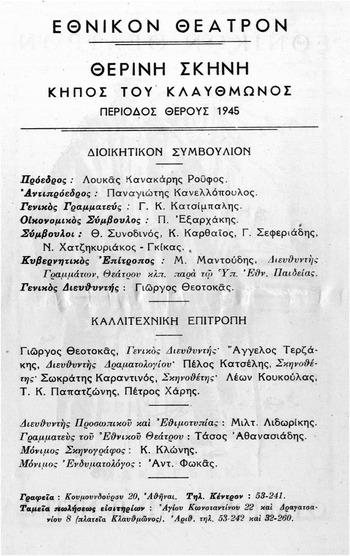
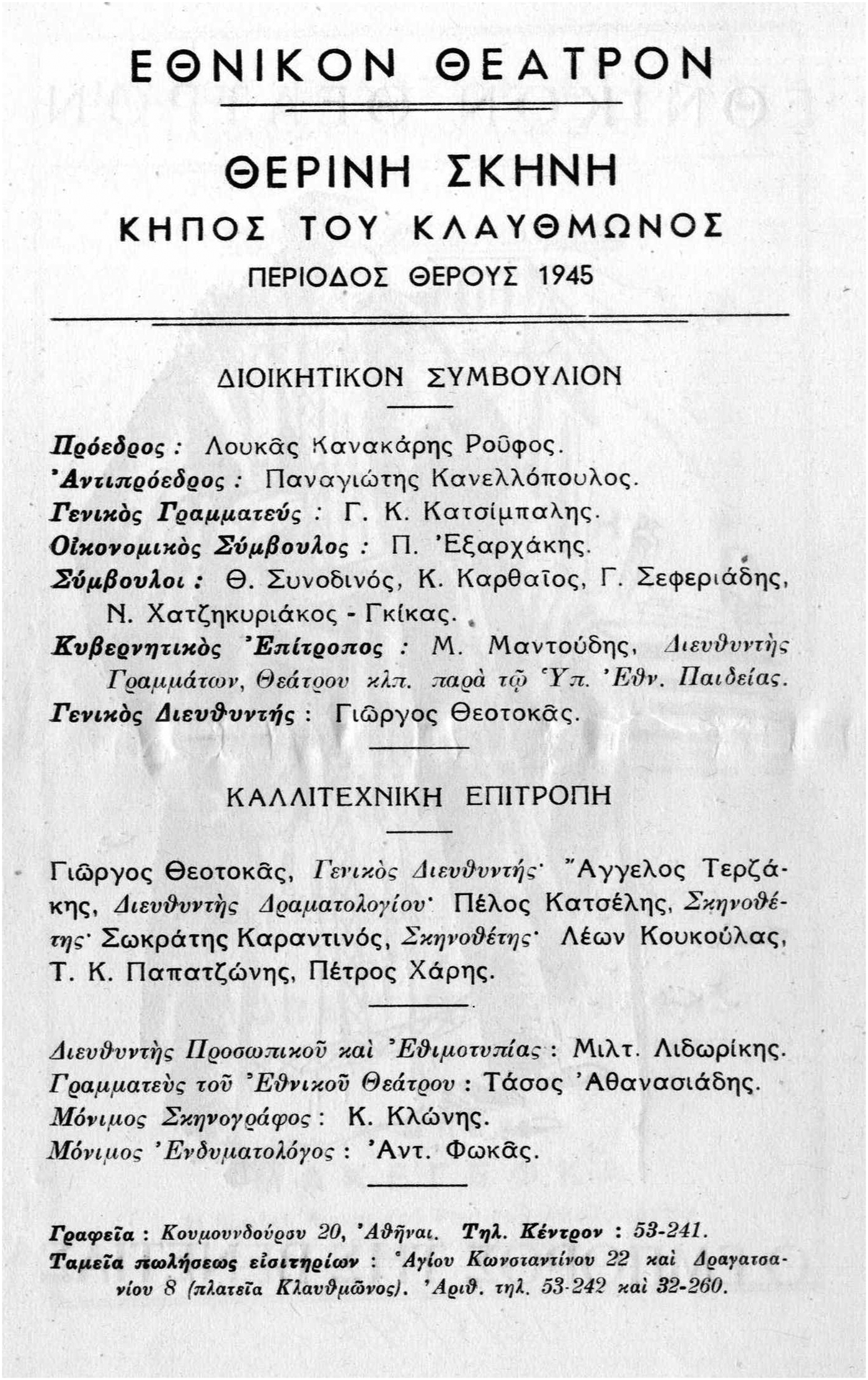
In particular, the members of the NT's Administrative Board included Panagiotis Kanellopoulos (vice-president), G. K. Katsimbalis (secretary-general), Theodoros Synadinos, Kostas Karthaios, Nikos Hadjikyriakos-Gkikas, and George Seferis (members). In the Artistic Committee we encounter Angelos Terzakis (director of repertoire), Petros Charis, Leon Koukoulas and Michael Rodas (who later resigned and was replaced by Takis Papatsonis),Footnote 24 as well as the NT's directors, Sokratis Karandinos and Pelos Katselis (fig. 1). With regard to the project under discussion, the programmes of the ‘Literary Evenings’ reveal that the following were responsible for arranging the repertoire: Theotokas, K. Th. Dimaras, and the poets Odysseus Elytis and Nikos Gatsos. Also, it was under Theotokas that the NT began recruiting painters, such as Nikos Engonopoulos and Yannis Tsarouchis, as set and costume designers. It comes as no surprise, therefore, that Theotokas insisted on portraying his term at the NT as a ‘collective intellectual endeavour’.Footnote 25
National Theatre Board/Artistic Committee, 1945. © National Theatre of Greece.
The marked presence of authors who are linked with the Generation of the 1930s should be viewed as part of the broader attempts of this literary group to shape national cultural politics after the Liberation. In addition to the NT, another site apparently associated with the post-Liberation activity of the Generation of the 1930s was the National Radio Foundation (EIR). In 1945, Seferis, at that time director of Archbishop Damaskinos’ political bureau, contributed to the reorganization of the national broadcasting network by preparing the new broadcasting legislation and serving as a member of EIR's first Administrative Board.Footnote 26 In the same period, both Elytis and the literary critic Andreas Karandonis joined EIR — ‘encouraged by Seferis’, as Elytis later admitted.Footnote 27 Parallel to their involvement in state cultural institutions, several members of this literary group collaborated with centrist newspapers of the day: Theotokas, Terzakis and Gatsos contributed to Καθημερινά Νέα,Footnote 28 and Elytis wrote a series of articles for the daily Ελευθερία, published by Panos Kokkas.Footnote 29
A central (and common) aspect of their newspaper contributions was their condemnation of political polarization; speaking of the current responsibilities of Greek intellectuals, Elytis argued that ‘escaping the clashing orthodoxies (‘Συμπληγάδες των ορθοδοξιών’) is the primary goal that every bright mind needs to accomplish’.Footnote 30 Similarly, Gatsos concluded that youth would find its way to freedom by ‘ignoring and bypassing the dogmas and orthodoxies of our times which are suitable only for the Middle Ages’.Footnote 31 Equally appalled by the ‘two abnormally swollen political extremes’, Theotokas declared that ‘we do not want violence, we do not want fanaticism. We refuse to accept that, in order to straighten out the affairs of this ill-fated country, a huge amount of hate, madness and blood needs to be expended’.Footnote 32 According to Theotokas, it was the same desire to appease political passions that primarily informed his policy as director-general of the NT:
Everyone should feel that a spirit of justice, impartiality and freedom prevails within the workplace, and that no one will be sidelined for ideological, partisan or personal reasons […] It is the simple, healthy method of applied Democracy, which we wanted to transfer, without any distortion, to this small sector of public life.Footnote 33
This claim of commitment to democracy was evidently matched by a series of analogous actions. In early 1945, as the NT troupe reassembled after the Dekemvriana, Theotokas decided to rehire three leftist actors (Tzavalas Karousos, Andonis Giannidis and Giorgos Pappas), despite the reservations expressed by some members of the Administrative Board.Footnote 34 Moreover, a leading figure of the Greek Left, Kostas Varnalis, was also recruited by the NT as a translator of Aristophanes’ Clouds.Footnote 35 Lastly, the Board rejected a request to install a wall plaque to commemorate the death of the NT actress Eleni Papadaki, who was murdered during the Dekemvriana, finding this gesture ‘premature’.Footnote 36
Despite this evidence of a moderate policy, it was not long before the NT was accused of promoting particular political agendas; the NT took the first blow in June 1945, when the on-stage appearance of Karousos provoked violent reactions from members of the anticommunist ‘X’ organization, who were among the audience. This incident was part of a coordinated attack which was mainly directed against the leftist ‘United Artists’ theatre company.Footnote 37 Still, the fact that these assaults reached the national stage implies that, within this electrified political atmosphere, the NT's moderate agenda ran the risk of being interpreted as pro-communist.
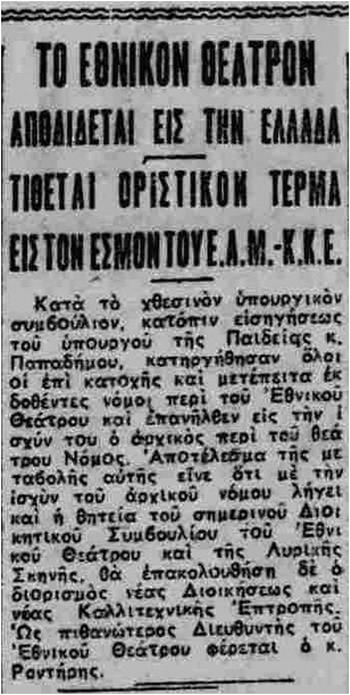
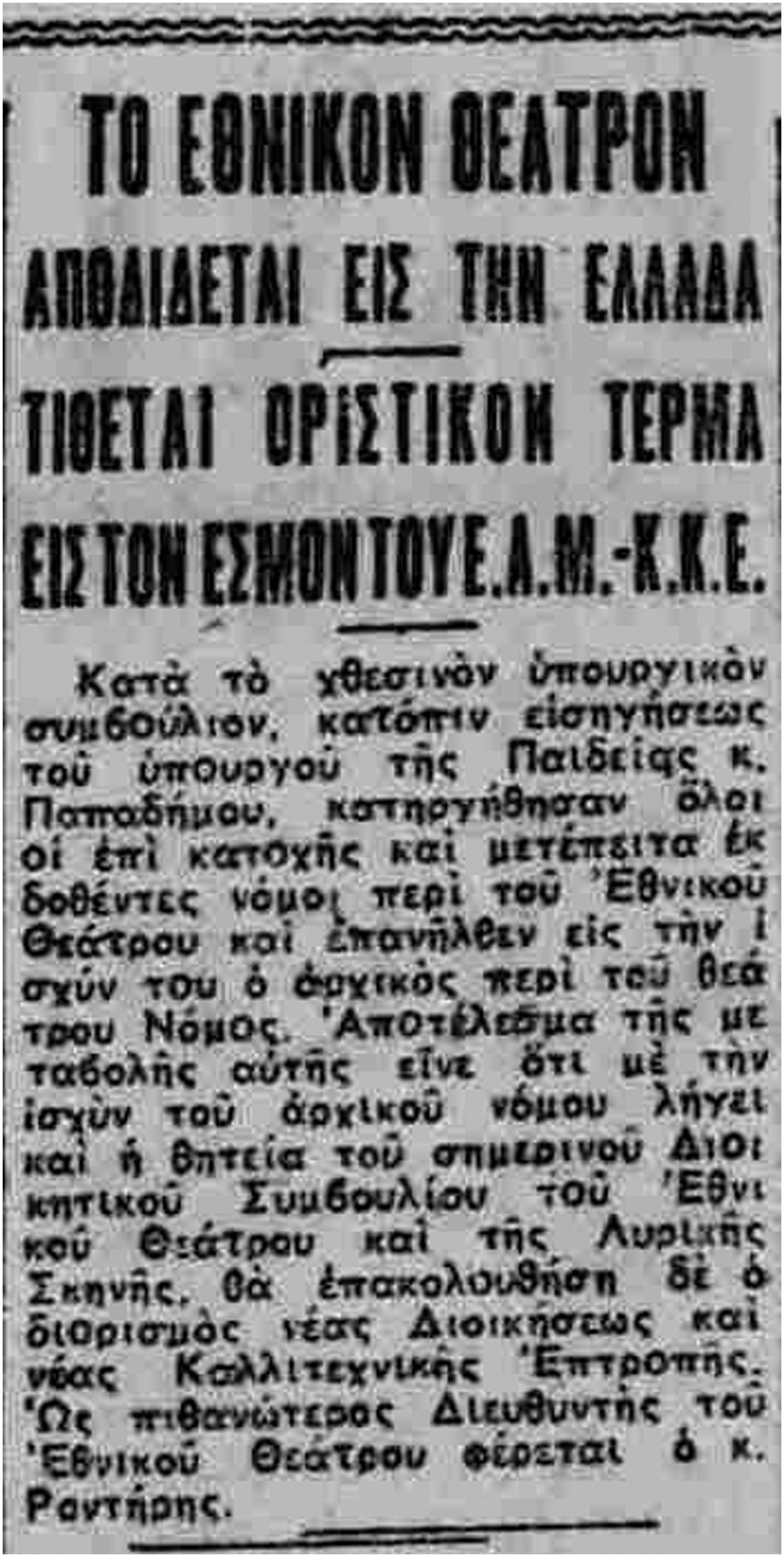
The noose tightened even more around the NT after the elections of March 1946, from which the Communist Party abstained, leading to a distinct victory for the royalist People's Party (Λαϊκόν Κόμμα). From its new position of strength, the right-wing press unleashed a harsh polemic against the NT, accusing it of promoting alleged communists, such as Nikos Kazantzakis and Angelos Sikelianos. For instance, the daily Εστία objected to the staging of Kazantzakis’ play Καποδίστριας, expressing concerns about the next steps of the NT: ‘Will the meagre resources of the people continue to be wasted on [the production of] ridiculous plays of “comrades” who praise each other?’.Footnote 38 Under these suffocating pressures, Antonios Papadimos, Minister of Education in the new government, reinstated the 1930 National Theatre Act, with the excuse that all subsequent laws had been enacted by authoritarian regimes. On a practical level, the return to the prewar legislation led to the immediate dismissal of the NT administration.Footnote 39 Ιn May 1946, Theotokas was replaced by the former NT director Dimitris Rondiris, who was favoured by the new government.Footnote 40 The right-wing press greeted this development with satisfaction, as is evident in pompous headlines such as: ‘The National Theatre returns to Greece. The communist mob is permanently dismissed’ (fig. 2).Footnote 41
‘The National Theatre returns to Greece’. Ελληνικόν Αίμα, 30 April 1946.
At the final meeting of the outgoing administration, Seferis referred to this headline, in order to condemn the blatant intrusion of party politics into essentially intellectual matters:
Nobody has the right to monopolize Hellenism, and, all the more so, as happens in some cases of this nasty polemic, when the monopolizers are a disgrace to this nation. This is not real public opinion, but a tactic that aims to subordinate the function of art to party fanaticism; […] Hence I believe that I am obliged to react […] against a system which I regard as destructive to all intellectual activity.Footnote 42
In spite of its short duration, however, this ‘collective intellectual endeavour’ managed to introduce some innovative concepts into Athenian theatrical culture, including the ‘Literary Evenings’. In the following sections I will show how the aims of this project exemplify the demand for popular culture that prevailed in the post-Liberation era, starting with a comparison between the ‘Literary Evenings’ and their immediate model, the ‘Matinées poétiques’ of the Comédie-Française.
The European model
When, in February 1945, Theotokas took up his duties, he promptly announced his intention to place the state theatre at the service of cultural diplomacy. He specifically argued that, under the present circumstances, the NT too was required to contribute to the strengthening of Greece's international image:
Nowadays, when Greece, with both its heroism and its suffering, has become one of the centres of international attention of this great War, the National Theatre, parallel to its distinct artistic and educational purpose, is required to contribute, with all the means at its disposal, to the elevation and maintenance of our national status among the United Nations.Footnote 43
This desire to raise the theatre's international profile was perhaps to be expected as both Theotokas, and other members of the Generation of the 1930s who joined him at that venture, shared a strong internationalist outlook that was already evident in their writings from the 1930s.Footnote 44 In 1942, Theotokas spoke of the possibility of a ‘Federal Union of European Nations’, while Kanellopoulos envisioned the post-war rise of a ‘new Europe’, founded upon a ‘supranational political system’.Footnote 45 Motivated by these ideals, the NT administration attempted to elevate the Greek state theatre to the level of its European counterparts and, to this end, it imported several concepts which had already been tested abroad, such as the ‘Alternating Repertoire System’ and the ‘Literary Evenings’.
The latter was directly modeled after the ‘Matinées Poétiques’, a series of poetry readings which occupied a permanent place in the repertoire of the Comédie-Française ever since its launch during the 1920–1 season. Theotokas personally suggested the transposition of this concept to the Greek NT, and the Board accepted his proposal.Footnote 46 It is worth noting that both Theotokas and Seferis were particularly familiar with the French ‘Matinées’ from the years they had spent in Paris back in the 1920s.Footnote 47 By the mid-1940s, the ‘Matinées’ was a long-running project, which showed all the characteristics of a well-grounded tradition, and yet its organizers decided it was time to redefine its mission and redesign its structure. Not coincidentally, this happened right after the Liberation.
More specifically, introducing the new cycle of ‘Matinées’, scheduled for the 1944–5 season, the Administrator-General of the Comédie, Pierre Dux, argued that the content of these productions would no longer resemble a haphazard mixture of poems chosen to match the skills of the actors/reciters, for it would now be arranged by a specialized committee, according to a broader plan (‘un plan général’). By doing so, the organizers hoped to redirect audiences’ attention from the famous performers to the performed texts, and ultimately present high-quality productions of a pronounced pedagogical character.Footnote 48 Closing his brief note, Dux referred to the public as the ultimate judge of this experiment: ‘The public will tell us if it approves of us’.Footnote 49 In short, the changes in the structure of the ‘Matinées’ primarily intended to benefit the audience—the noun ‘public’ itself appearing four times in Dux's one-page note.
Although it might be expected that a state theatre highlights its service to the people, it would be interesting to look at the way in which the aims of the ‘Matinées’ were summarized by Louis Payen, under whose management this project was launched. Introducing the publication Anthologie des Matinées Poétiques de la Com é die Fran ç aise, Payen stated in 1927: ‘The poetry matinees have so nobly served the poets, revealed the great reciters (‘diseurs des vers’), and added the finial jewel to the artistic crown of the Comédie-Française, which will be preserved and further embellished’.Footnote 50 Thus first came the poets, then the masterly reciters and, finally, the institution itself, whose prestige was augmented by this project. The lack of reference to the audience implies that the ‘Matinées’ were not originally conceived as an educational project, or, at least, that their organizers were not so concerned with stressing that aspect, as they were in 1945, when the French Ministry of Education was developing new strategies to ensure that ‘culture and people will finally be reconciled’.Footnote 51
Popularization
In Greece, Theotokas employed a similar rhetoric when he claimed that the main objective of the ‘Literary Evenings’ was to make literature accessible to the masses. In his words:
The aim of the Literary Evenings is easily understandable. We want to assist in making the treasures of our literature the property of the wide popular masses; so that they cease to be confined to a few connoisseurs, and become, as far as it is possible nowadays, intellectual nourishment for the masses.Footnote 52
In the same article, eloquently titled ‘Literature to the people’, Theotokas further elaborated on the popularizing character of this project, pointing to the affordable ticket prices and the inclusion of explanatory comments that would facilitate audience understanding (‘a speaker […] will explain in a few words the performed texts […] and will highlight which parts deserve most attention’). Lastly, Theotokas called on other intellectuals for their assistance in advertising this project (‘We are making an effort to bring literature closer to the people, but people should be aware of it’).
One of the first bodies that responded to Theotokas’ call was the left-wing journal Ελεύθερα Γράμματα, which, in November 1945, note: ‘We congratulate those who conceived this worthy initiative […] because it will contribute to a broader understanding of our literature from our audience’.Footnote 53 This is admittedly strange, considering that the ‘Literary Evenings’ was a product of the official state, whereas the Ελεύθερα Γράμματα often voiced harsh criticism of the post-Dekemvriana state policies. Yet the philosophy of the ‘Literary Evenings’ was so astonishingly close to the theoretical proclamations of the Greek Left that this seems to have outweighed any reservations relating to the institutional profile of this project.
As far as educational policy is concerned, the position of the Left was clearly articulated in May 1944, at the first meeting of the Political Committee of National Liberation (PEEA) which was established in 1944 to administer the liberated areas controlled by EAM. The views expressed back then by PEEA's Secretary of Education were later reproduced in the pages of Ελεύθερα Γράμματα, under the heading ‘Popular Education’: ‘In the emerging people's state, which is founded upon the heroic struggle of the Greek people, education should be the property of the people’.Footnote 54 As was seen above, the claim to make knowledge accessible to the public (‘κτήμα του λαού’) was also invoked by Theotokas as the aim of the ‘Literary Evenings’ (‘κτήμα των πλατύτερων λαϊκών στρωμάτων’). This coincidence cannot be interpreted as evidence of EAM's influence on Theotokas, for equality of educational opportunity was high on the agenda of Greek radical liberals even before the war.Footnote 55 Accordingly, when, in November 1944, Papandreou announced his intended educational reforms, he affirmed that his programme aimed at ‘elevating the intellectual level of the large masses’.Footnote 56
After the collapse of the Papandreou cabinet, the succeeding Plastiras government moved in the same direction in terms of its educational policy. As Minister of Education, Amantos prepared a draft bill for the establishment of local libraries throughout rural areas.Footnote 57 A few months later, the same issue would be taken up by the left-wing Ελεύθερα Γράμματα: ‘Today, even in the smallest mountain villages, there is a true thirst for knowledge and learning’.Footnote 58 Having previously observed the developments at the NT, it comes as no surprise that Amantos’ bill elicited mocking responses from the right-wing press.Footnote 59 These examples aptly illustrate that, despite their profound ideological differences, both the centrist governments of the post-Liberation period and the Left argued for the democratization of education—a cause which made them a common target for the Right.
Alongside the demand for popular education, left-wing intellectuals similarly underlined the need to popularize literature and the performing arts; ‘people are thirsty for spectacles’, as the leftist author and playwright Giorgos Kotzioulas wrote in 1944.Footnote 60 However, the conviction that the war had brought about a change in the relationship between art and the public was at the time shared by numerous intellectuals, regardless of their ideological background. In 1945, for instance, Sikelianos declared, through an allusion to the ‘Ode to Joy’ from Beethoven's Ninth Symphony, that the end of the war signalled the beginning of an era in which the gap between artist and society was being bridged: ‘the Craftsman will be the first to announce […] the beginning, the triumphal inner route, the genuine culmination of the long-awaited Universal Social Symphony: Joy! Joy!’.Footnote 61 In the same vein, Elytis maintained that ‘his [intellectual's] engagement to the state is now confirmed’.Footnote 62 Elias Venezis sounded equally optimistic when arguing that, in 1946, theatre held unprecedented sway among popular audiences: ‘Now that, for the first time, the popular masses have moved to the front line of public life, this brings them closer to theatre, where they seek joy and emotion’.Footnote 63
Theatre's growing popularity, observed from mid-1943 onwards,Footnote 64 was intertwined with the spreading of the resistance movement, and was heightened by the fact that theatrical performances offered a rare opportunity for collective gatherings in occupied Athens. The renewed social function of theatre might explain why many members of the Generation of the 1930s, who joined the NT in 1945, started their involvement with theatrical affairs during the war. Besides Theotokas, and his wartime turn towards dramatic form,Footnote 65 Gatsos too was preoccupied with translating Lorca's Blood Wedding, which was published by the Ikaros publishing house in 1945.Footnote 66 As for Dimaras, he taught literature at the NT's Drama School (1941–6),Footnote 67 while both Theotokas and Elytis gave seminars at the private drama school of Giannoulis Sarandidis,Footnote 68 which operated from 1940 to 1944.Footnote 69
Meanwhile, EAM also placed considerable weight on organizing and financially supporting various theatrical enterprises. Apart from the itinerant troupes performing in the mountains of rural Greece,Footnote 70 EAM was also involved in the operation of the Athenian ‘People's Theatre’ (November-December 1944),Footnote 71 and its successor, the ‘United Artists’ (June 1945-October 1946). In line with EAM's educational policy, these troupes programmatically aimed at popularizing the art of theatre; the mission of the ‘United Artists’, for instance, was clearly outlined in the organization's Statute:
(a) to reach large popular masses, (b) to offer intellectual nourishment on the basis of true art, (c) that the essence of this art should conform to the local and international reality.Footnote 72
The role of theatre as ‘intellectual nourishment’ echoes Theotokas’ statements quoted at the outset, where this metaphor was used to describe the ‘Literary Evenings’. Yet, even though the NT and the ‘United Artists’ built on the same rhetorical ground, an essential difference lies in the means by which they sought to achieve their popularizing purposes. As will be shown, whereas the ‘United Artists’ presented a type of spectacle imbued with allusions to ‘local and international reality’, the NT chose to reintroduce the literary past or, to quote Theotokas, ‘the treasures of our literature’.
Canonization
The ‘Literary Evenings’ of the season 1945–6 consisted of four performances (numbered A΄ to Δ΄), which were all restaged for at least a second evening.Footnote 73 The literary texts were recited by students of the NT Drama School, whereas the intervening introductory notes were read by senior members of the NT troupe. According to the printed programme of the first Literary Evening:
The programmes are arranged by the Directorate-General in cooperation with Mr K. Th. Dimaras, professor at the [National Theatre] Drama School, and authors, Mr Odysseus Elytis and Mr Nikos Gatsos. The artistic supervision of the Literary Evenings has been assigned to the director, Mr Sokratis Karandinos. Responsible for the [mode of] recitation of the poems included in the first Literary Evening is Mrs Elli Grigoriadi, professor at the [National Theatre] Drama School.
Not all of the above contributors receive mention in the programmes of the next Literary Evenings; only Karandinos and Grigoriadi are credited in the programme of the second Evening, while the two remaining programmes mention (besides Karandinos and Grigoriadi) that ‘the introductory notes are drawn up by the Directorate-General and Mr K. Th. Dimaras, professor at the Drama School’.Footnote 74 One can only speculate either that Elytis and Gatsos dropped out of this project after its premiere, or that their names were merely effaced from the programmes as their involvement in the NT had attracted some negative attention, which will be discussed below.Footnote 75
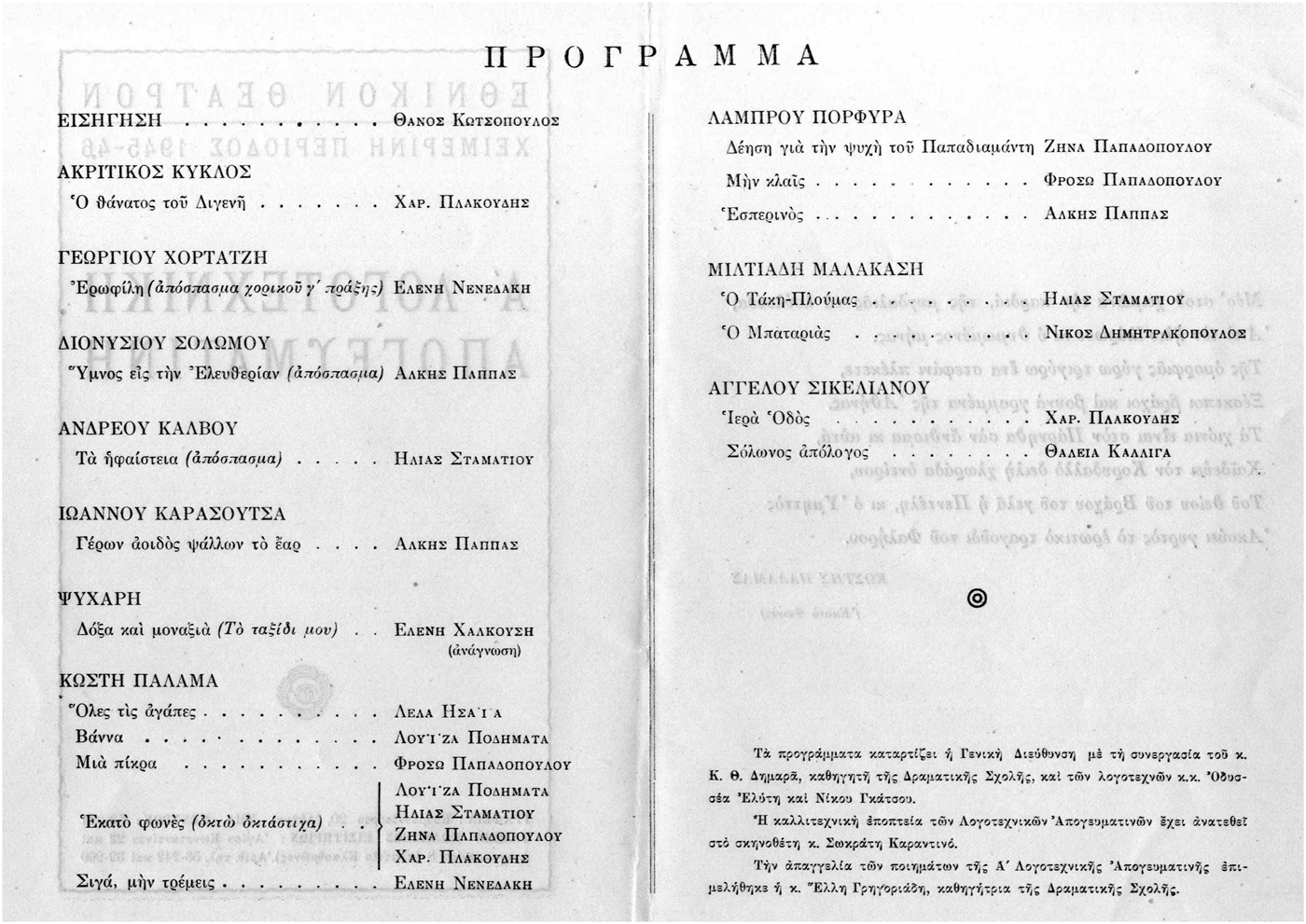
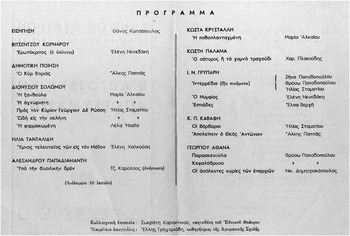
In terms of overall design, the basic difference between the French ‘Matinées Poétiques’ and their Greek version is already evident in their respective titles: from ‘poetry’ to ‘literary’ evenings. This hints at the inclusion of prose in the ‘Literary Evenings’ which, in turn, reflects the organizers’ intention to offer a panoramic image of modern Greek literary tradition. As Theotokas put it, ‘all timbres of Greek literature will be heard, from the Akritic cycle to the present day’.Footnote 76 This broad chronological spectrum was not divided into four sequences/Evenings, but each Evening comprised exemplary texts drawn from all stages in the development of modern Greek literature (figs. 3, 4). In particular, each Evening was divided into two parts, of which the first opened with a folk song, followed by an excerpt from a Cretan Renaissance play, and poems representative of the School of the Ionian Islands and the Old Athenian School. The first part of each Evening closed with a prose text, dating from the nineteenth and early twentieth centuries. As for the second part, it covered the poetic production of a much shorter period, stretching roughly from the 1880s to the 1920s.
Printed programme of the first ‘Literary Evening’, November 1945. © National Theatre of Greece.
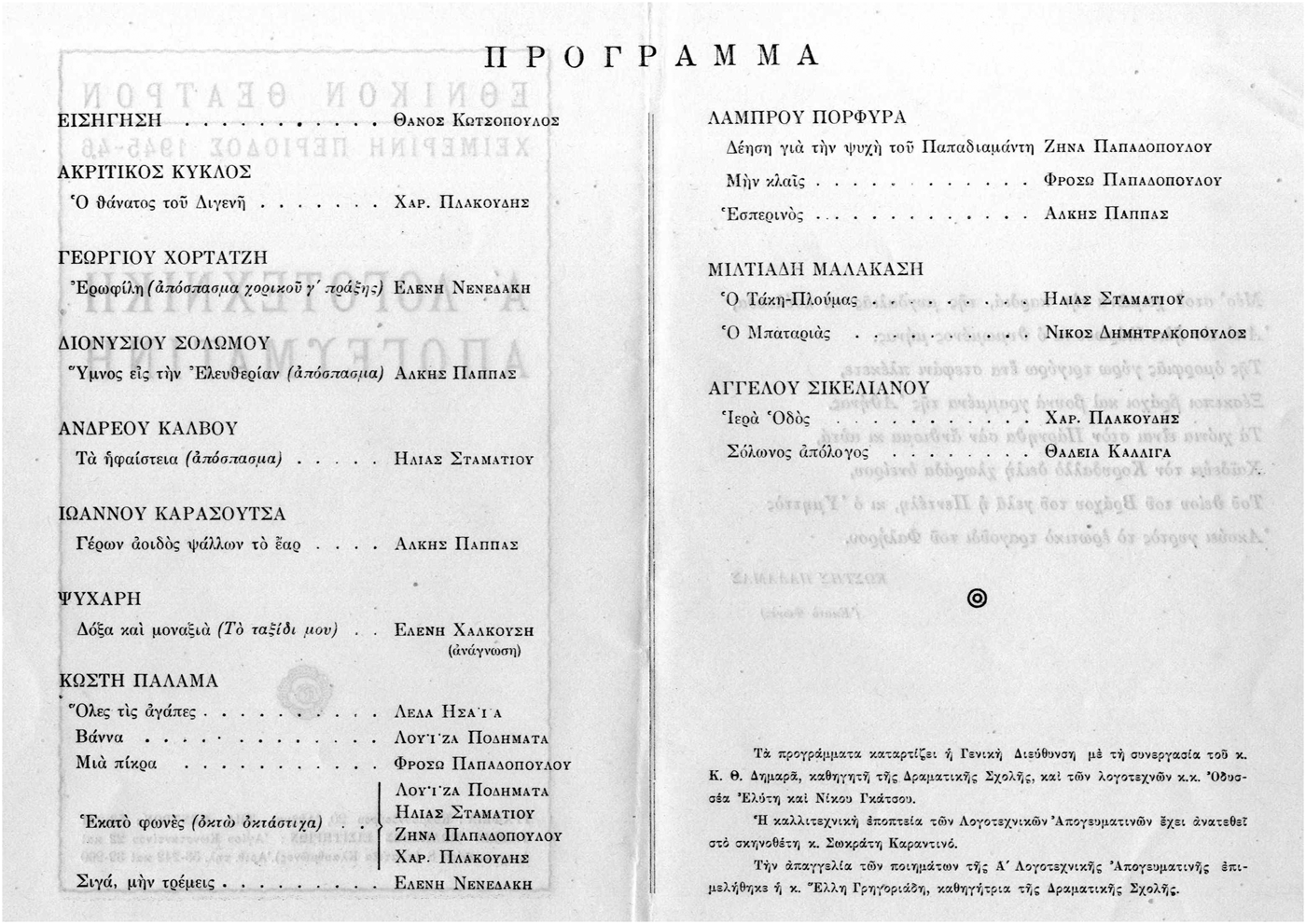
Printed programme of the second ‘Literary Evening’, January 1946. © National Theatre of Greece.

Leaving aside folk poetry and three other anonymous texts,Footnote 77 the series presented the work of 36 individual authors. The following table lists these authors, according to the number of performed texts corresponding to each, starting from the ones who enjoyed greater visibility in these events:

The largest group consists of authors represented by one text (nineteen authors), followed by those represented by two texts (seven authors), three texts (six authors), and more than three texts (four authors). However, the impression of a certain hierarchy is undermined when taking into account the varying length of the performed works. For, while the majority of these texts were poems of relatively short length, there were also many excerpts drawn from verse plays, prose texts or much longer poems.Footnote 78 Thus, although Mavilis, for instance, was represented by three sonnets and Kazantzakis by one passage from his epic poem The Odyssey, one can imagine that equal stage time was given to both. Such a balanced arrangement draws our attention to the prominence given to the poets who rank first (Palamas, Solomos, Cavafy and Sikelianos), whose work featured in more than one Evening.Footnote 79
Another notable feature of the above table is the complete absence of women authors; yet the dominance of male voices was mitigated during the actual events, where an almost equal number of texts were assigned to female and male performers (forty-seven and forty-five texts, respectively). Moreover, out of a total of thirty-six authors, only eight were alive at the time these events took place (22%). Most of them, however, were in their sixties, and thereby belonged to older literary generations. The absence of younger authors had obvious consequences for both the form and content of the performed texts. In terms of form, free-verse poetry was left out of this project altogether; even the youngest poet featuring in the series, Georgios Athanas, was stylistically tied to the past, using traditional metre throughout his work. In addition, since none of the anthologized works was written after 1940, the series was devoid of poems that thematized recent experiences of war and resistance. This put the ‘Literary Evenings’ into sharp contrast with a current trend in public poetry speaking, evident both inside and outside Greece, according to which contemporary poems with a powerful topical dimension were favoured as recitation pieces.
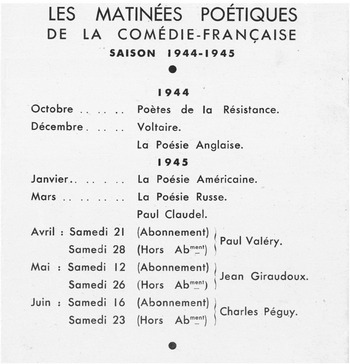
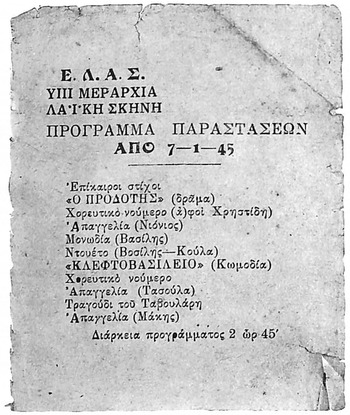
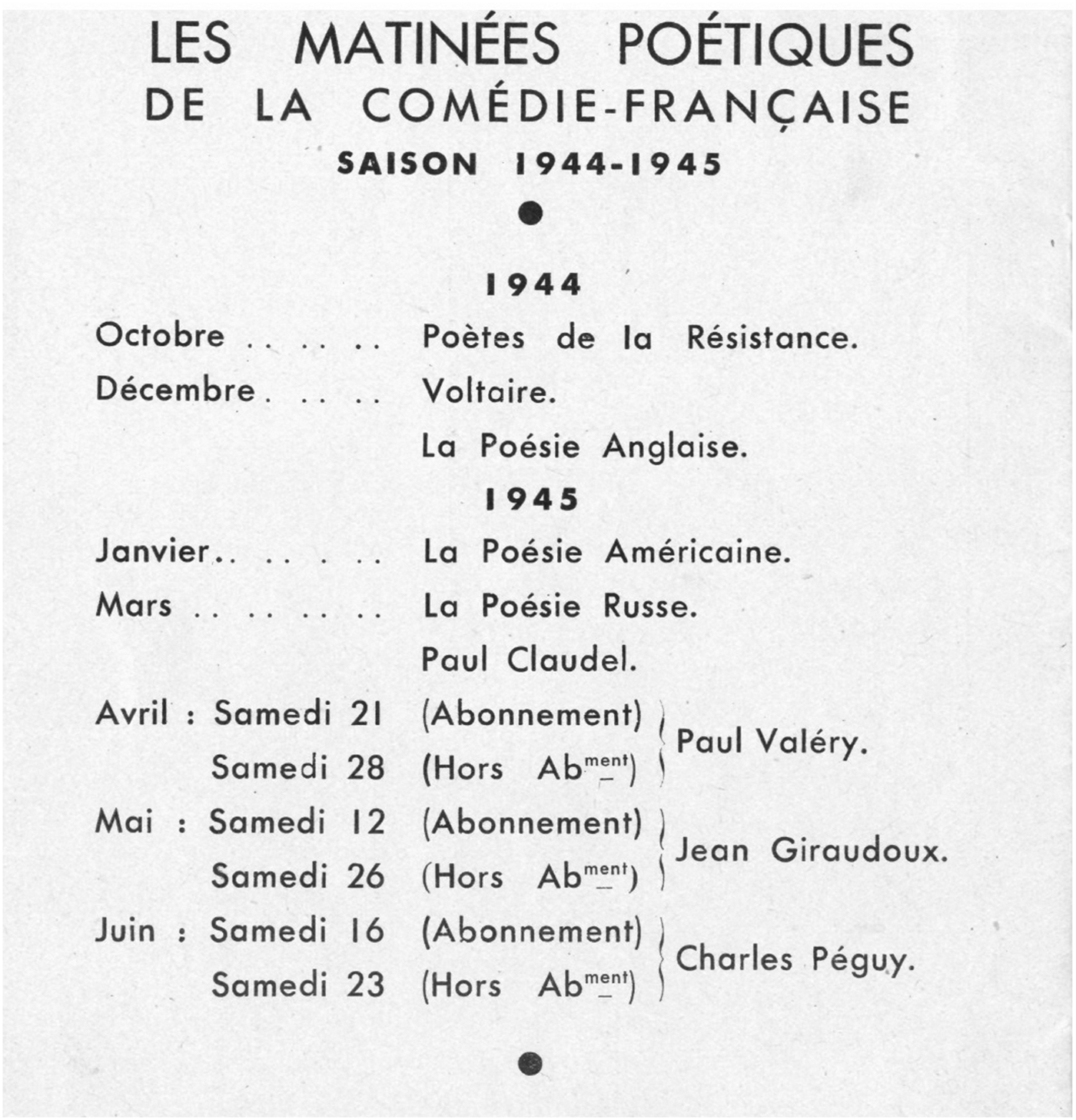
The ‘Matinées poétiques’ of the 1944–5 season, for instance, commenced with a performance devoted to the ‘Poètes de la Résistance’ (fig. 5).Footnote 80 In Greece, Kotzioulas’ EAM-funded theatre troupe (‘Popular Stage’), which continued its tours in the first months after the Liberation, regularly performed poems inspired by contemporary events, marked in the programme as ‘occasional verses’ (‘επίκαιροι στίχοι’) (fig. 6).Footnote 81 More tellingly though, in 1946, EAM attempted to put forward its own canon through a recitation anthology titled Small Anthology: Poems of Struggle for Recitation.Footnote 82 A comparison between the contents of this book and those of the ‘Literary Evenings’ shows that, while the NT was preoccupied with the literary past, EAM concentrated on the literary present. In particular, of the twenty-two authors included in the Small Anthology, only one (Palamas) was not alive at the time of its publication. Women poets were also represented, albeit to a limited extent (9%). The main thread that tied the anthologized poems together was their occasional character, evident already in their titles, which alluded to sites of massacres or executions by the Nazis (e.g. ‘The song of Distomo’, ‘Kaisariani’, ‘Kokkinia cries out’).Footnote 83 The emphasis on thematic over stylistic criteria explains why, next to well-known leftist authors such as Markos Avgeris or Nikiforos Vrettakos, we encounter amateur poets such as the actors Aimilios Veakis and Dinos Dimopoulos.
Performance dates and contents of the 1944–5 ‘Matinées poétiques’ of the Comédie-Française. Published in Les Matin é es Po é tiques de la Com é die-Fran ç aise: Programme de la saison 1944–1945 (Paris [n.d.]).
Printed programme of the ELAS ‘Popular Stage’ touring troupe, January 1945. Reproduced in G. Kotzioulas, Θέατρο στα βουνά (Athens 1976) 48.

By contrast, the modernist writers behind the ‘Literary Evenings’ viewed the resurgence of occasional poetry with overt scepticism. Theotokas, for instance, clearly distinguished between ‘great popular art’ and works imbued with topical references:
Tomorrow's society will most likely turn to a similar ideal of great popular art. I use the adjective ‘popular’ here in its broad and essentially intellectual sense, in the sense that the tragedies of Aeschylus or Shakespeare constituted ‘popular’ art […] As for the works of sociopolitical topicality, preaching, polemic, and propaganda, […] every well-informed individual knows that they are destined to quickly fall into oblivion.Footnote 84
Likewise, Gatsos noted that ‘our Albanian war and the Greek people's struggle for resistance should not end up being themes — as they are about to — for ephemeral successes or political exploitation’. Instead, Gatsos pointed out that what Greek intellectuals have yet to accomplish is to introduce the national literary tradition to a wider public: ‘It was the duty of our intellectuals to familiarize thirsty audiences with the most enduring values of our land; Kalvos, Solomos, Papadiamantis, Karkavitsas, Makriyannis, Dragoumis, Palamas, and so many others’.Footnote 85 The remainder of this section shows how the image of literary tradition created through the ‘Literary Evenings’ represents a new approach, one that embodies the conception of the canon put forward by the Generation of the 1930s.
Although the great variety of texts that marked the programmes of the ‘Literary Evenings’ may give the impression that this project conveyed a conventional image of the canon, it appears that this image did not match any of the versions of the canon already in place. The literature curriculum at school and university level offers a useful benchmark against which the contents of the ‘Literary Evenings’ can be contrasted. Unfortunately, the outbreak of the war suspended the publication of the University of Athens yearbook for most of the 1940s (1940–8); still, the pre-1940 issues provide an adequate picture of the courses in modern Greek literature taught by Nikos Veis, Professor of Medieval and Modern Greek Literature (1925–46), whereas the post-1948 yearbooks outline the courses designed by Georgios Zoras, holder of the second chair in this subject from 1942 to 1982. Thus the surviving yearbooks dating from 1930 to 1950 reveal that the literature curriculum hardly extended beyond the production of the Generation of the 1880s. Τhe only references to twentieth-century literature appear as part of two courses on Greek prose writers, given by Veis in 1936–7 and 1937–8.Footnote 86 In October 1945, most faculty members voted against the conversion of the second chair in Medieval and Modern Greek into a chair devoted exclusively to Modern Greek, one of them arguing that ‘modern Greek literature has been scantily cultivated’.Footnote 87 Perhaps it was the limited scope of the university canon that urged Gatsos to make the rather exaggerated claim: ‘Τhe School of Philosophy of the University [of Athens] does not even really acknowledge Solomos’.Footnote 88
Turning to the school textbooks of the same period (Νεοελληνικά Αναγνώσματα), published by the state-run Organization for the Publication of School Books (OESV), their broad chronological scope, which embraced the post-Palamas literary generation, brought them closer to the ‘Literary Evenings’. Yet two of the most visible authors in the ΝΤ productions, Cavafy and Sikelianos, were absent from the literature textbooks of the mid-1940s, and would enter the school canon as late as 1976.Footnote 89 Similarly, the only left-wing poet presented by the NT, Kostas Varnalis, was also excluded from school textbooks until 1976, a year in which the school canon opened up to include other authors whom we encountered in the ‘Literary Evenings’, such as Kazantzakis and Karyotakis.Footnote 90
A different take on the canon can be traced in the literary histories published before the war. The two most comprehensive endeavours of this kind were the histories written by Elias Voutieridis (1924–7 and 1933) and Aristos Kambanis (1925), which both covered the period up to the 1930s.Footnote 91 Even though these publications agree, in terms of their scope, with the ‘Literary Evenings’, their adherence to the agenda of demoticism distances them from the canonical scheme proposed by the NT. Kambanis, in his preface, stated that ‘the main subject of this work is demotic [literary] production’, paying scant attention to works written in the purist (katharevousa) language.Footnote 92 Voutieridis appeared to be less militant, claiming that he made no discrimination based on linguistic criteria.Footnote 93 This statement is undermined, however, by his negative stance towards poets who wrote in a more idiosyncratic language, such as Kalvos and Cavafy. Commenting on the latter, for instance, Voutieridis found his philosophy to be ‘shallow and trivial’, and went on to interpret his widespread fame as ‘merely a trend, which will soon fade away’.Footnote 94
As Giorgos Kechagioglou notes, the first literary history to reinforce Cavafy's canonical status and overcome the ‘demoticist syndrome’ was Dimaras’ Ιστορία της νεοελληνικής λογοτεχνίας, published two years after the project under review (1948–9).Footnote 95 This brings more attention to the role of Dimaras in arranging this project, which becomes particularly apparent in the way the NT presented poets who wrote in katharevousa; introducing Ioannis Karasoutsas, for instance, the NT underlined the poet's ‘subtlety of emotions’ and ‘delicate appreciation of the natural world’,Footnote 96 in a manner echoing the way the same poet was portrayed in Dimaras’ History: ‘The new element which he [Karasoutsas] introduces is a true sensitivity towards nature’.Footnote 97 The inclusion of katharevousa in the staged events extended the vocal palette of the series, generating audible contrasts between the performed works. In the first Evening, for instance, Karasoutsas’ poem ‘Γέρων αοιδός ψάλλων το έαρ’ was delivered immediately before the manifesto of the demoticist movement, Psycharis’ Το ταξίδι μου.
By combining katharevousa with demotic, prose with poetry, and oral with written literature, the ‘Literary Evenings’ proposed a version of the canon that defied generic, linguistic or stylistic oppositions. According to Theotokas, this new approach to the canon should be entirely attributed to his own generation; in reviewing the first volume of Dimaras’ History, Theotokas regarded it as evidence that ‘our generation has apparently reached intellectual maturity’.Footnote 98 Also, when, in 1947, Theotokas gave his first lecture on the Generation of the 1930s, he noted among its achievements:
[…] assimilation and appropriation of the modern Greek intellectual past in its entirety. Overcoming the old antitheses. Merging them into a broad modern Greek synthesis which harmonically combines: demotic tradition, Solomos and Kalvos, Makriyannis, Psycharis and Papadiamantis, Palamas and Cavafy. Hence: a synthesis of modern Greek intellectual traditions which, till yesterday, seemed incompatible.Footnote 99
The concept of a ‘broad modern Greek synthesis’ was already implied in Theotokas’ landmark essay Free Spirit (1929), where he argued that the essence of the modern Greek character would be best captured by ‘a cluster of contradictions: Korais-Solomos-Psycharis-Palamas-Dragoumis’. To these names he then added Cavafy,Footnote 100 but rushed to clarify that ‘this catalogue should by no means be restrictive’ but ‘open to the unexpected possibilities the future holds’.Footnote 101 Seferis, in his influential essay ‘Dialogue on poetry’ (1938), leaned towards an equally ‘open’ approach to the canon; denying the validity of stable aesthetic principles, Seferis argued in favour of the ‘constant renewal’ of art, as ‘every work of art that comes to be added to the series [of great works of art] affirms and at the same time modifies the meaning of the older masterpieces’.Footnote 102 The question that arises at this point is whether, in their plea for an open-minded approach to literary tradition, the members of the Generation of the 1930s intended to create a canon flexible enough to later accommodate their own modernist output.
In this respect, the period examined here has a twofold significance for our understanding of the relationship of the Generation of the 1930s to the literary canon. For this period not only saw core members of this literary group publicizing their readings of the canon,Footnote 103 but also witnessed a series of attempts to present this generation as the newest addition to the canon. For instance, while the modernist writers engaged with the NT popularized Cavafy and Sikelianos through the ‘Literary Evenings’, Andreas Karandonis, in the pages of the Anglo-Greek Review, portrayed the same modernists as ‘the Palamas, Cavafy and Sikelianos of our times’.Footnote 104 This article gave rise to the earliest attacks against the Generation of the 1930s and its networking strategies; the theatre and literary critic Michael Rodas, a former member of the NT's Artistic Committee, wrote an the article entitled ‘A new kind of… “intellectual collaborators”. The “heirs” of Solomos’, which appeared on the front page of the widely circulated daily Τα Νέα.Footnote 105 Using the heavily charged term ‘collaborator’,Footnote 106 Rodas targeted Seferis, Gatsos, Embiricos and Engonopoulos, pointing both to their strong presence in the public sphere (‘they penetrate into esteemed intellectual and artistic institutions’), and their representation as legitimate successors of canonical poets (‘[they] will be “incorporated” into the modern Greek poetic tradition!’). Speaking of Gatsos, Rodas referred to him as a co-organizer of the ‘despicable Literary Evenings’, ironically suggesting that his poems might as well be presented at the NT.
Despite a tone of bitterness stemming from Rodas’ recent departure from the NT,Footnote 107 there may be an element of truth in the allegation that the ‘Literary Evenings’ implicitly paved the way for the canonization of modernist works. The appearance of prose texts in these events supports this hypothesis, given that a common complaint about modernist verse was that it blurred the boundaries between poetry and prose. The ‘Literary Evenings’ too undermined rigid distinctions between these genres, not simply by juxtaposing them, but also by smoothing out their differences at an auditory level. This brings us to another aspect of this project which further validates its modernist profile: the mode of oral delivery. This aspect was briefly touched upon by Theotokas, who argued that it was the NT's responsibility to establish a normative manner of reading poetry aloud:
The National Theatre should thus be the place […] where Greek verses are performed in an exemplary way. […] The main tendency will be towards simplicity. The old-fashioned pomposity will be abandoned.Footnote 108
Rendered in a ‘simpler’ manner, metrical verses lost something of their sing-song effects, thereby assuming more prosaic overtones. At the same time, this kind of vocal rendering was diametrically at odds with the ‘musical’ approach to recitation cultivated by the NT's former (and succeeding) director, Rondiris.Footnote 109 Themistoklis Athanasiadis-Novas, an eyewitness to the ‘Literary Evenings’, objected to the actors’ performance style, arguing that it aurally equated traditional and modernist poetry. As he remarked in 1949:
If we are to exchange heated pomposity for the coldness of prosaicness, then it is a thousand times better to stick to the pomposity. […] Modernist poetry is cold, and so is its recitation. But what about the old poetry of the heart? I've heard an artist reciting in a ‘conversational’ manner ‘Mesolongitiko’ by Malakasis, a poet whose verses should not be recited but almost sung!Footnote 110
Thus, far more than the individual texts performed, it was the idea of synthesis underpinning this project, as well as the style of oral delivery, that reflected the modernist aesthetic of its organizers.
As the new director-general of the NT, Rondiris recommended that the ‘Literary Evenings’ be discontinued, despite their low production costs and the considerable audience numbers they were beginning to attract. Unfortunately, the NT's Archive records the total revenue from ticket sales but not the number of tickets sold. The latter can be estimated only with regard to the first Evening, for which we know the exact price per ticket.Footnote 111 Thus the opening Evening, as well as its restaging, gathered an audience of approximately 500 each, which is a low turnout by the standards of the NT, but a rather satisfactory one, if we take into account the specialized nature of this project as well as the severe crisis faced by all Athenian theatres.Footnote 112 This project would enjoy impressive commercial success in its subsequent form, the ‘Poetry Evenings’, launched during Theotokas’ second tenure of the same position (1950–2), and permanently discontinued after his final departure. However, as the change in the project's title already implies, the ‘Poetry Evenings’ of the early 1950s lacked the broadened scope of their predecessor, each Evening being devoted to a specific poet or school of poets, with no ambition to introduce an alternative approach to the literary canon.Footnote 113
Conclusion
Using the ‘Literary Evenings’ as a paradigm, I have tried to show that, despite the possibility of civil war lurking in the background, Greek cultural life of the years 1945–6 was marked by the same ‘oddly optimistic mood’ that, according to Tony Judt, transpired across Europe in the aftermath of Liberation.Footnote 114 The European origins of the ‘Literary Evenings’, alongside the general international orientation of the NT, reflect the hopes for a new era in international relations exemplified by such bodies as the United Nations. The popularizing nature of this project embodies the post-war quest for the democratization of culture, while the medium of performance itself points to the renewed significance of the spoken word as a means to reach, guide and enlighten popular audiences.
As a mechanism of canonization, the ‘Literary Evenings’ capture the desire to rewrite literary history after the end of the war, and may be retrospectively identified as heralding iconic canonizing projects, like Dimaras’ 1948 History of Modern Greek Literature. Though certainly not exhaustive, the content analysis of the ‘Literary Evenings’ has revealed that the programmes exemplified the broadened approach to the literary canon endorsed by its modernist organizers. On the whole, the appearance of leading exponents of the Generation of the 1930s, such as Theotokas, Seferis, Elytis, and Gatsos, as popularizers, canonizers, but also alleged communists, paints a profoundly different picture of this generation than that of a bourgeois literary group, aloof from the popular aspirations of its time. The ‘Literary Evenings’ thus open up an important and hitherto unexplored chapter in the history of Greek modernism, inviting further investigation into post-war modernist practices.