Introduction
Everybody in life wants to win. At its most basic, this must stem from the survival instinct: in a battle against predators, winning means survival; defeat means death. In a social context, however, obviously not everyone can win, and we have to learn to accommodate defeat, whether our own or that of others. Hence, in a competitive society, defeat presents a challenge. Usually, if an observer sympathizes with the defeated, there is an impulse to dress up the defeat in various guises; or, if the defeated party is scorned, the defeat is presented in the most humiliating terms possible. In a gladiatorial context, the attitudes of the observer, not to mention the gladiators themselves, are hard to recover. Recent work has focused on the ‘affective dispositions’ of the spectators, drawing analogies with modern combat sports.Footnote 1 Yet, modern spectators do not have to decide whether the defeated party deserves to live or die, whereas, for a Roman spectator, defeat was to be calibrated on a scale of life and death. The ancient protagonists themselves will obviously share impulses with their modern equivalents, although, when the contest is potentially fatal, the drive to win must take on an urgency surpassing pure ambition. When a modern athlete dies on the sports field or in the boxing ring, it is an accident, however tragic, whereas a gladiator who lost a fight could suffer the penalty of losing his life as well. Defeat was in deadly earnest.
The identity of some athletes who were defeated on the prestigious games circuits in Greece are known to us, because athletic contests were high-prestige events honoured in epinician poetry and frequently mentioned by historians and other authors.Footnote 2 Gladiatorial combat, on the other hand, was a low-status activity despised by the educated classes, so that we lack literary evidence for stories of victory and defeat in the arena and must instead fall back almost exclusively on the epigraphic register – chiefly gladiators’ epitaphs – and visual representations. A special caveat applies to epitaphs, in that the fraction of gladiators so commemorated is probably very small and necessarily excludes the least successful, and the dating is too approximate to yield evidence for chronological development in the attitudes displayed. A different caveat applies to visual representations: the image may be purely generic and considerably idealized, especially if there is no accompanying inscription supplying circumstantial details, and when images survive deracinated from their original context, it is impossible to determine their purpose and impact. Bearing those limitations in mind, some conclusions can nevertheless be drawn.
Missio
A gladiator who had technically been defeated could be granted a reprieve, if he were deemed to have fought bravely enough to deserve it. The reprieve, missio, was a grant of mercy, and a gladiator who received it was ‘reprieved’, missus; he did not die.Footnote 3 But missio is predicated upon defeat, and to record a gladiator's status as missus is to acknowledge, however indirectly, that he had been defeated. Since gladiators were slaves or assimilated to the status of slaves, it may seem surprising that, in a society in which a slave's life was expendable, defeated gladiators were subject to a stay of mercy at all. But the reasons may have been primarily economic. The jurist Gaius illustrates the difference between hire and purchase with the example of a sponsor who acquires gladiators for a show; if a gladiator is killed or even maimed so severely that he cannot fight again, the price is fifty times higher than if he were returned to barracks with a prospect of fighting again (Gai. Inst. 3.146).
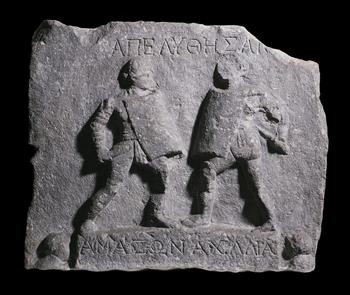
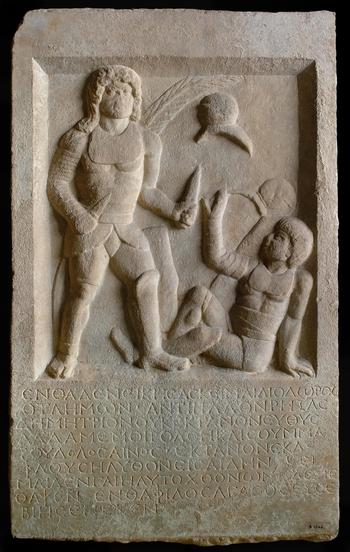
Fights could sometimes be conducted sine missione, without a reprieve for the defeated, which suggests an intransigent attitude towards defeat. Augustus is said to have banned engagements of this type out of his general concern (cura) for the people responsible for putting on spectacles (Suet. Aug. 45.3). This ban may be further evidence that fights to the death were exponentially more expensive for the person staging them. Sometimes, however, the result was inconclusive. In these circumstances, a double missio could be granted: both parties were determined to be stans missus, not just ‘reprieved’ but ‘reprieved standing’.Footnote 4 Such an outcome must have been a cliff-hanger that earned commemoration: on terracotta appliqué medallions from the Rhône valley, individual grants of missio are not recorded, but in three instances named pairs of gladiators are accompanied by an umpire and the legend (stantes) missi.Footnote 5 The most famous pair of gladiators who fought to a draw like this were Amazon and Achillia, the only pair of female gladiators known to us by name – their professional names, obviously, given the appropriateness of their nomenclature to the context (figure 1).Footnote 6 Their monument is not a tombstone but, probably, a plaque recording a remarkable outcome in the track record of a single troupe. The superscription, ἀπελυθήσαν, would be missae sunt in Latin, ‘they were granted a reprieve’; Greek renders missio by ἀπόλυσις.
Halicarnassus, relief. Amazon and Achillia fight to a draw. CIG 6855f. Trustees of the British Museum.

The status of having been granted missio is almost invariably attributed to gladiators by a third party, chiefly either in records of this type or else in graffiti representing the outcome of a fight. It is extremely rare to find grants of missio recorded on a gladiator's tombstone. An epitaph from Sicily (possibly Panhormus) from the second century ad mentions quite frankly that, in addition to having fought to a draw nine times, the deceased received four grants of missio outright: Flamma s[e]c(utor) uix(it) an(nis) XXX | pugna <ui > t XXXIIII, uicit XXI | stans (scil. missus) VIIII, mis(sus) IIII, nat(ione) S[y]rus | hui <c > Delicatus coarmio merenti fecit, ‘Flamma, secutor, lived thirty years, fought thirty-four times, won twenty-one times, stood to a draw nine times, won a reprieve four times. Of Syrian extraction. To his well-deserving fellow-combatant Delicatus raised this monument’ (CIL X 7297 = ILS 5113 = EAOR III 70). Flamma fought a remarkable thirty-four engagements, winning twenty-one and drawing nine. Hence, he was defeated in little more than ten per cent of fights over his entire career, which may be why he admits to these four instances of what was technically defeat.
Apart from Flamma's epitaph, however, I know of only two other instances that acknowledge an individual grant of missio to the deceased, thereby implying the prior condition of defeat.Footnote 7 One of these, from Herakleia Salbakes near Aphrodisias, states that the deceased, Eidomeneus, who is depicted in an attack pose, was reprieved by the decision of the proconsul (ἀπελύθη = missus est): Εἰδομενεὺς [ | ἀπελύθη κελεύσ[αν]|τος ἀνθυπάτου Ἀρρίο[υ] | Ἀντωνείνου, ‘Eidomeneus was granted a reprieve by the proconsul Arrius Antoninus’ (MAMA VI 122).Footnote 8 As far as I know, this is the only time that an agent is specified for a grant of missio; perhaps the grant is recorded precisely because the involvement of the governor reflects some glory that dissipates the shadow accompanying the reality of Eidomeneus’ defeat. The other instance is the most startling (and touching), but also the most suspect: this inscription was seen in 1828 at Atripalda, near Avellino in Campania, in the garden of a Signore Cinnamo, but is now lost: Ca]llicarpus, t(hraex), m(issus) X, d(eceptus) XI, ỌḲ C̣Ạ[, ‘Callicarpus, Thracian gladiator, reprieved ten times, cheated (of life) the eleventh time’ (CIL X 780 = EAOR VIII 31). The recorded version seems to say that Callicarpus, a Thracian gladiator, was granted missio ten times and died in his eleventh fight, although normally the numeral would precede the relevant abbreviation. If this is authentic, it is the only instance known to me where a gladiator is recorded as having lost every bout that he fought. Even if this were true, it would seem a most demeaning detail to include in an epitaph, and so I regard it with scepticism, since the testimony cannot be verified and seems incredible.
On a generous estimate, the combined total of surviving gladiatorial epitaphs approaches five hundred. Hence, of these, discounting the perpetually defeated Callicarpus, I have discovered only two – those of Flamma and Eidomeneus – that admit that the deceased had ever lost a fight. But if the evidence is so sparse, why do we get the impression that missio was much more prevalent? That impression comes from inscriptions and relief sculptures (like that commemorating Amazon and Achillia) that record the results of individual troupes, and from graffiti. A series of inscriptions from Thasos record the results of engagements between gladiators belonging to a woman named Hecataia, who held the high priesthood of the imperial cult with her husband, Euphrillos (IG XII/8 547, 549–51).Footnote 9 Beneath each gladiator's name is a tally of his results to date (victories and wreaths), followed by the outcome in the most recent combat, either ἐνίκα (equivalent to uicit) or ἀπελύθη (missus est), as in the following extract:
Θρ(ᾷξ) Μορ(μίλλων)
Ναρκίσσος Ἑκαταίας Κέρασος Ἑκατ[αίας]
[νι. α΄] στε. α΄ ἐνίκα νι. α΄ στε ἀπελύθη
Thraex Murmillo
Narcissus, belonging to Hecataea, Cherry, belonging to Hecataea,
[(?) victories,] eleven crowns. Won. one victory, (?) crowns. Reprieved.
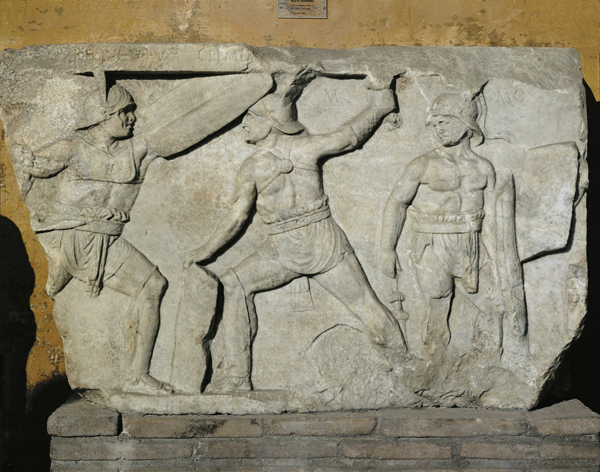
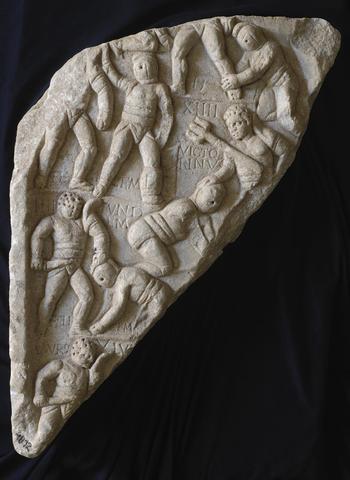
(IGRom. I 1504 = IG XII/8 549)Footnote 10Surviving reliefs and mosaics also record particular spectacles, with the results inscribed above the gladiators’ heads, with V (uicit), M (missus est), and either P (periit) or the fatal theta nigrum, whether it originally stood for θανών/θάνατος (‘dead’, ‘death’) or was derived from o(biit), with a diagonal stroke through it signalling the abbreviation.Footnote 11 In one instance, M and a theta nigrum appear together, possibly indicating that, although the defeated gladiator had been granted missio, he died of his wounds all the same; there may be a gash on his left thigh, but it is hard to be sure (EAOR I 101; figure 2).Footnote 12 Some slabs record the results of a single gladiator's string of engagements, in numerical order, such as those of a retiarius (nameless, now) who defeated Felix in his third fight (CIL VI 33988 = EAOR I 109; figure 3).Footnote 13 Felix must have been granted missio, because the retiarius defeated him again in his fourth fight, and this time Felix was executed. In his fifth fight the retiarius defeated Ursulus, and in his fourteenth he defeated Victorinus and executed him. We have only a small piece of this monument, but it seems to have been designed in two columns. Conceivably every single fight in the subject's entire career was represented. But we do not know whether he was ever granted missio; maybe only his victories were shown.Footnote 14
Fragmentary marble slab recording the result of combat between Iulianus (left), ‘won’, u(icit), and Clemens (centre), ‘reprieved’, m(issus est). On the right, the visible gladiator was also reprieved, m(issus est), but the theta nigrum shows that he died (of wounds?). Museo Nazionale Romano, Chiostro di Michelangelo, III, 27, inv. 126119. Photo Erich Lessing / Art Resource, NY (ART41373).

Relief sculpture in multiple registers recording the individual engagements of a single retiarius against various named opponents. Rome, Musei Capitolini, Palazzo Nuovo, Magazzino Sculture, inv. MC 1812/S. Archivio Fotografico dei Musei Capitolini, photo Zeno Colantoni. © Roma, Sovrintendenza Capitolina ai Beni Culturali.

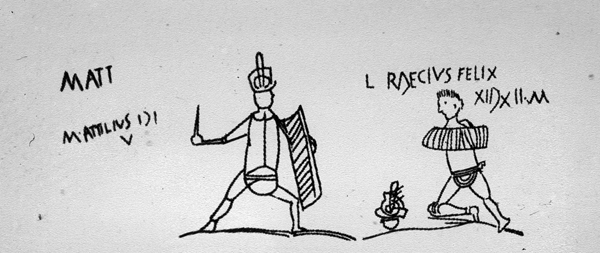
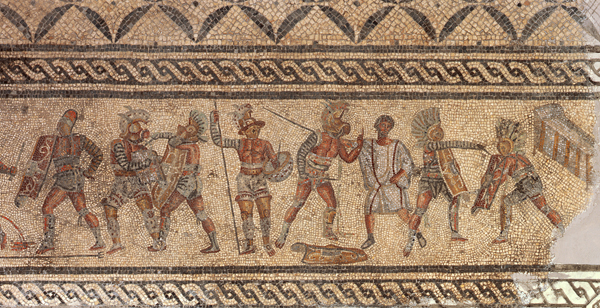
The other fertile source for records of missio comprises graffiti recording individual engagements. These regularly depict a pair of gladiators, either both in combat pose or with one clearly defeated (kneeling, lying on his back, or separated from his shield or helmet), with a tally of their results to date and a label of the outcome of the most recent engagement – again, via V, M, or P (figure 4).Footnote 15 The attitude of the outside observer who scratched these tallies – whether the owner of the ludus or the fan in the stands or someone else – was one of detached interest, recording the details of victories won, reprieves earned, and defeats sustained. This transparent accounting contrasts strikingly with the almost total elision of defeat from gladiators’ epitaphs in the West, which I have just described; as we shall see, it also contrasts with the strenuous efforts employed on epitaphs in the East to disguise defeat or explain it away.
Tomb 19 outside Porta Nuceria, Pompeii, graffito. M. Attilius, one fight, one wreath, ‘won’, u(icit); L. Raecius Felix, twelve fights, twelve wreaths, ‘reprieved’, m(issus est). CIL IV.10236.

If gladiators’ tombstones avoid admitting that they ever received missio, we should also consider whether a victorious opponent explicitly states that missio was the outcome for the man whom he defeated. This is the case with M. Antonius Exochus, whose tombstone, though now lost, is partially preserved in a sixteenth-century drawing in the Codex Coburgensis from the Kunstsammlungen der Veste Coburg.Footnote 16 When the drawing was made, the lower portion was already broken off, so that Exochus’ feet are missing, and his epitaph breaks off in the middle of recording his third fight; we do not know how many more fights were originally recorded. Exochus made his debut in the arena on the occasion of the games celebrating the posthumous triumph of Trajan over the Parthians in ad 117, when on the second day he fought to a draw, st(ans) miss(us), with an imperial slave, Araxes. On the ninth day, he fought again, this time against Fimbria, who was of free status (liber, hence a ‘contract’ gladiator), and he evidently won, although this victory is presented not as defeating Fimbria but as reprieving him:
…Rom(ae) ob triump(hum) | diui Traiani die II | tir(o) cum Araxe Cae(saris) (scil. seruo) | st(ans) miss(us) | Rom(ae) mun(eris) eiusd(em) die VIIII Fimbriam | lib(erum) VIIII (pugnarum) miss(um) fe(cit).
At Rome, for the triumph of the divine Trajan, on the second day, he fought to a draw as a novice against Araxes, an imperial slave. At Rome, during the same spectacle, on the ninth day he caused Fimbria, a man of free status with nine fights to his credit, to be reprieved.
(CIL VI 10194 = ILS 5088 = EAOR I 92).Footnote 17The locution missum facere, ‘to render someone reprieved’, suggests that, just as missio implied a type of qualified defeat, so it also implied a type of qualified victory, otherwise we might expect an unequivocal statement that Exochus won against Fimbria. In that case, we may infer that there was less kudos in defeating an opponent who earned a reprieve than in defeating one who lost his life as a result. This distinction, however important to the gladiators themselves, may have escaped the layman, for whom a grant of missio meant one victor and one loser. This is implied by the juxtaposition of V and M on graffiti tallying the results of individual encounters, and by the metaphor of fighting to a draw that Seneca uses to illustrate his contention that there is no possibility of being happy without being virtuous (the subject is uirtus): stans non potest mitti: aut uincatur oportet aut uincat, ‘It is not possible [for virtue] to be reprieved standing: she should either be defeated or win’ (Sen. Ep. 92.26).
It is noteworthy that, in listing individual engagements against named opponents, Exochus’ monument is unusual in the West, where the regular format supplies mere statistics, like the epitaph for Flamma discussed above. A detailed list of victories against named individuals is occasionally found in the East, where it is apparently modelled upon epitaphs for athletes, such as the sarcophagus for Polos at Gortyn, the surviving portion of which evidently presents his achievements in chronological order, naming both the city where each fight took place and his opponent.Footnote 18 He says that he won seven times (νεικῶ, unqualified by an adverb); won once more in a victory that apparently ‘took’ his opponent, νεικῶ λαμβά(νων);Footnote 19 won twice more in a specific manner that is no longer legible but allows us to conjecture νεικῶ + participle λαμβά(νων), as above, or νεικῶ + adverb λαμ(πρῶς), ‘brilliantly’; fought to a draw once, στάς; and once took a respite, σχολάζω.Footnote 20
Defeat that does not end in missio ends in death, either death as a result of wounds sustained in combat or, when an appeal for missio has failed, by execution afterwards, as on the explicit relief sculptures described above. We can therefore infer that a bald νεικῶ on Polos’ sarcophagus resulted in missio for his opponent, whereas νεικῶ λαμβά(νων) implies that the opponent lost his life. Defeat can also be inferred when an epitaph records the number of engagements fought, and specifies that the deceased fell in the next one, as in two epitaphs from Verona, both now lost. One of these, from the second or third century ad, states that the deceased, Glaucus, engaged in seven fights and died in the eighth: …pugnar(um) | VII (theta nigrum) VIII…in | Nemese ne fidem | habeatis: | sic sum deceptus | aue uale, ‘…seven fights, died in the eighth…Don't trust Nemesis: that's how I was cheated. Hail! Farewell!’ (CIL V 3466 = ILS 5121 = EAOR II 47). The other epitaph, from the first or second century, is for Pardon, who fought ten times and was likewise deceptus, ‘cheated (of life)’, the eleventh time (CIL V 3468 = ILS 5122 = EAOR II 52).
If the restorations of the lacunae in the epitaph of a certain Rapidus at Salona in the second or third century are correct, he too was ‘cheated’ (a common euphemism) in his sixth fight, this time as a result of medical ineptitude: Rapido retiar[io] | A <q > u(i)leie(n)sis ann(orum) [ | d]omo Bellu[no] | pug]na VI occid[it] | [in me]dicina dec[eptus(?)] | [a m]edic[o, ‘To Rapidus, retiarius, from Aquileia, aged [ ], domiciled at Bellunum, died as a result of his sixth fight while under medical treatment, cheated by the doctor’ (CIL III 12925 = ILS 5119). The cause of Rapidus’ death is safely attributed to a third party, the physician evidently tending to the wounds that he sustained in combat. We do not know the official result of the fight, although we may infer that Rapidus’ opponent won. In other cases, however, the subject's defeat was unambiguous, and yet the epitaphs employ various strategies to avoid admitting this. Under such circumstances, polytheism affords multiple opportunities for shifting the blame, but still the range of guilty parties mentioned in gladiators’ epitaphs is remarkably limited.
Blame
It is extremely rare for gladiators’ epitaphs in the West to specify the manner of death, but there is one interesting example from the territory of Beneventum, datable on palaeographic and onomastic grounds c. ad 150–200, which commemorates two gladiators. One, Purpurio, was commemorated by his conuictores, and the other, Filematio, by his wife, Aurelia Aphrodite. Purpurio, a retiarius, died in his eleventh fight, mo(rmillone) adu(ersario) occi(sus), ‘killed by the murmillo who was his opponent’ (AE 1960, 139–40 = EAOR III 69). It is just possible that this detail is added because the usual opponent of the retiarius was not the murmillo but the secutor, though the difference boiled down to the murmillo’s elaborate crest, which was missing from the secutor’s helmet to reduce the risk that the retiarius’ trident would get caught in it.Footnote 21
In the East, on the other hand, gladiators’ epitaphs frequently address the manner of their death and explain the circumstances, and the epitaphs themselves are cast in an entirely different mode from those in the West. Western epitaphs for gladiators are in terse bureaucratic prose, whereas the more elaborate epitaphs in the East are usually metrical, conforming to the canons of funerary epigram, and accompanied by a relief sculpture. The sculptures show the deceased either standing in frontal pose, often with his shield beside him and his helmet placed on top, or else lunging forward to attack; neither pose, obviously, gives any hint of defeat, even if there is a whiff of it in the epitaph. To get the full effect conveyed by the combination of text and image on the stone, the epitaphs discussed below should ideally be studied in a photograph. Accordingly, I have indicated available images in the footnotes.
Only very rarely is a gladiator's defeat transparent, as with Sulpicius, who died ἐν ὅπλοις, ‘under arms’, in Beroia at the age of seventeen,Footnote 22 or Melanippos, who fought twelve times and died in his thirteenth fight, enabling the epitaph to reach a climax with a comparison to Herakles:
Traveller, you see me, a corpse, brave in the stadia, the retiarius Melanippus from Tarsus, second grade. No more do I hear the voice of the bronze trumpet, nor do I rouse the sound of the unequal pipes in contests. They say that Heracles accomplished twelve labours. I accomplished the same number; in the thirteenth I met my end.
(CIG II 3765 = IGRom. III 43)Footnote 23Otherwise, blame is deflected onto an ineluctable force, such as Tyche, who features prominently in Greek funerary culture to represent the inexorability of death.Footnote 24 Or the deceased is ‘afflicted by (his) own apportioned lot’, ὑπὸ τῆς ἰδίας εἱμαρμένης ἐνοχλῄθην, as happened to Polyneikes, also known as Marcianus, at Marcianopolis.Footnote 25 Sometimes death is attributed to a vague βία, ‘force’, as with Flammeatis (formerly known as Zosimus), at Beroia, who was killed ‘not by an opponent but by force’, οὐχ ὑπὸ ἀντιδίκου ἀλλὰ ὑπὸ βίας.Footnote 26
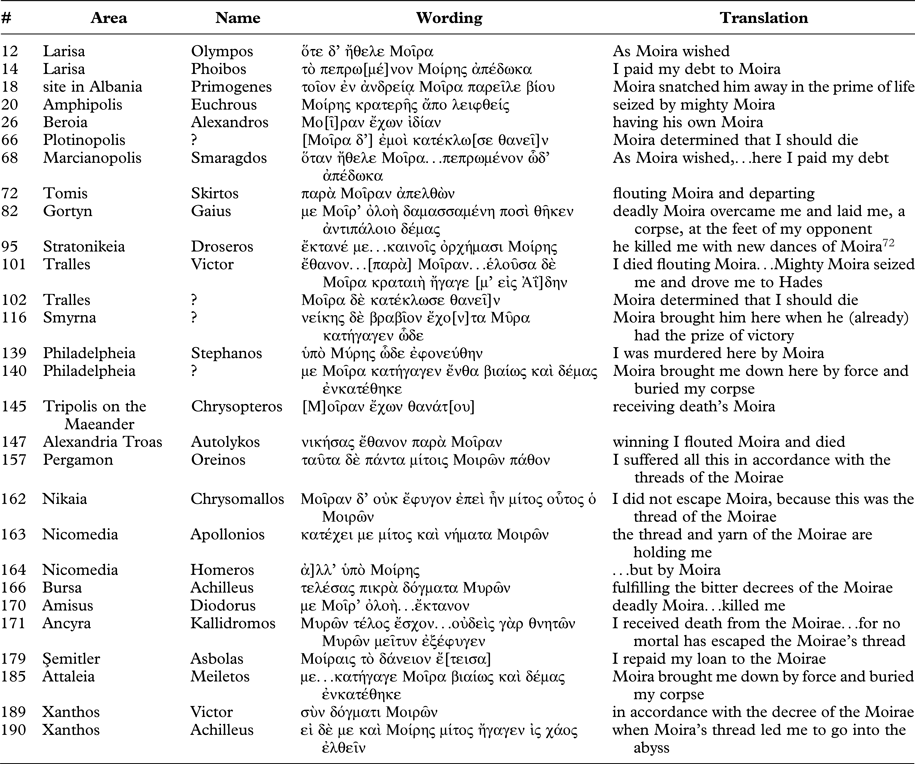
Most frequently, however, the fatal agent is Moira. She is often associated with premature death, a circumstance clearly relevant to a gladiator who was still fit for a fighting career.Footnote 27 The wide variety of metaphors and other expressions – some trite, some ingenious – that the epigrammatists employ in attributing the initiative to her are set out in the appendix. When she is adduced in the singular, it is debatable whether she is a personification and therefore to be capitalized or an abstraction to be left in lower case, but sometimes she is adduced in the plural, where capitalization seems de rigueur. The original sense appears to have been ‘apportioned lot’, evolving to the sense of ‘decent limit’.Footnote 28 As in the Homeric epics, in funerary epigraphy the abstraction and the personification are both deployed, with the personification playing an active role, while the norm represented by the abstraction is somehow flouted.
On one occasion, defeat is attributed to Moira in the form of an illness that weakened the protagonist Stephanos in his last fight: οὐ γὰρ ἀντί|παλος ἔδα<μ>έν με τὸν | ἄθλιον οὐδ’ ἐδύνατο. | / εἰ δὲ νόσῳ προδο|[θ]εὶς ὑπὸ Μύρης ὧδε | ἐφονεύθην, / ὄγδον πυ|κτεύσας ἔσχα τέ|λος θανάτου…, ‘No opponent overcame me, worn down with toil as I was, nor could he do so. Betrayed by an illness, I was murdered here by Moira; having fought eight times, I suffered the deathly end’ (TAM V/3 1906).Footnote 29 It was not a teammate, σύνζυγος, who snatched away a certain Victorius at Amaseia; rather, an illness killed him, νόσος…κατέκτανε (CIG 4175).Footnote 30 An unknown gladiator at Cyrene was saved from the sword, but died of illness.Footnote 31 Even a beast-fighter, a category of performer not – to my knowledge – graced with a single epitaph in the West, claims in propria persona in an inscribed epigram from Philippopolis that he ‘was overcome not by the jaws of beasts, but by a mortal illness’, [μ]ὴ θηρῶν γενύεσσι δ[α]μέις, νούσῳ δὲ βροτείῃ,Footnote 32 while at Amaseia another beast-fighter, Troilos, who fought bears, was ultimately overcome by a fever: Τρωίλος ἐν σταδίοις | πάσας ἄρκους ὑποτάξας | / νικηθεὶς πυρετοῖς | πρὸς νέκυας κατέβη, ‘Troilos, having subordinated all the bears in the stadia, was conquered by a fever and went down to the corpses’.Footnote 33
Death tends to come when a gladiator is on the point of victory: [πυκτεύ]ων Βίκτωρ ἔθανον στα[δί|οις παρὰ] Μοῖραν, / νεικήσας μὲν π[άν|τας…, ‘I, Victor, died flouting Moira while fighting in the stadia, having defeated everybody’ (CIG 2942c).Footnote 34 Dying a natural death, expressed as ‘having one's own Moira’, Μο[ῖ]ραν ἔχων ἰδίαν,Footnote 35 or ‘dying one's own death’, ἰδίῳ ἔθανον,Footnote 36 is emphasized; Pardus from Rome ‘died his own death’, sua morte obi(i)t.Footnote 37 And dying unbeaten (ἄλ[ε]ιπτος) is something to emphasize, also.Footnote 38 Polyneikes, probably from Alabanda, who was famous for his invincibility, implies that he was the better fighter, but his opponent's youth gave the young man an inevitable advantage; the implication, laced with pathos, is that the disgrace of Polyneikes’ defeat is thereby mitigated: Πολυνείκης ὁ θρασὺς δόξαν ἔχων ἔνοπλον | / πᾶσαν ἐπαρχείαν ἐν σταδίοις ἔσχον ἄλειπτος, | / εἰκοστὸν πυκτεύσας, | οὐχὶ τέχνῃ λειφθείς, | / ἀλλὰ νέος γεραρὸν σῶ|μα κατειργάσατο, ‘I, Polyneikes the brave, glorious in combat, reigned supreme in the arena, undefeated. I was not taken by skill, but a young man forced my old body down below.’Footnote 39
Sometimes it is not just a matter of paying a debt to Moira; rather, the opponent's success is explicitly conceived as her will, as with Chrysopteros from Tripolis on the Maeander, who was pitted against the mighty Eteokles: δώδεκα νεικήσας Χρυ[σό]|πτερος ἐν σταδίοισι[ν], | / πυκτεύων τρισκαιδέκ[α]|τον σθεναρῷ Ἐτεοκλ[εῖ], | / [Μ]οῖραν ἔχων θανάτ[ου] | κεῖμαι νέκυς ἐνθά[δε τύμβῳ], ‘I, Chrysopteros, having won twelve times in the stadia, in the thirteenth engagement fought mighty Eteocles, and, receiving the lot of death, here I lie, a corpse, in my tomb’.Footnote 40 Chrysomallos from Nicaea was killed by Tydeus, because he was trapped by the threads of fate: ἦν μίτος οὗτος ὁ Μοιρῷν, ‘this was the thread of the Moirae’.Footnote 41 A murmillo whose name has not survived was killed in combat against the prouocator Hyakinthos, having fought eleven times, but it was no mortal who snatched victory from him; Moira was responsible: [ἐνθάδε], μυρμύλλων, Ζμύρνης | [κλέος?, ὦ] παροδεῖτα, / κεῖμ[ε], θανὼν πυγ|μῇ προβοκάτορος Ὑακίνθου, / ἕν|δεκα πυ|κτεύσας· νείκην | [δ’ ἀπ’ ἐμοῦ?] λ[ά]βε οὐδίς, / [Μοῖρα δ’] ἐμοὶ κατέκλω|[σε θανεῖ]ν, ἐπέπρωτο γὰρ | [οὕτως], ‘Here lies the murmillo, glory of Smyrna, passer-by, who died at the hands of the prouocator Hyakinthos, after eleven fights. Nobody snatched victory from me, but Moira determined that I should die, for so I paid my debt.’Footnote 42 Sometimes the gladiator's end is expressed with epigrammatic virtuosity, as with the epitaph for Autolykos from Tenedos, which stresses the paradox that, although he had the upper hand, he wanted to spare his opponent, and so, at his moment of victory, he flouted Moira: θαυμάζις με θανόν|τα τυχόν, φίλε, τὸν Αὐ|τόλυκον· / οὕτως πῶς | προλαβών, σῶσαι δὲ θέλω<ν>· | / νικήσας ἔθανον παρὰ | Μοῖραν, ‘Perhaps you are astonished, dear [passer-by], that I, Autolykos, have died. I was ahead, but I wanted to save [my opponent]; and, in the act of winning, I flouted Moira and died.’Footnote 43
Despite these avoidance tactics, occasionally the opponent is credited – albeit obliquely – with the demise of the deceased, as with Rhodios at Ephesus, whose strength killed many, but who was himself ‘overcome by the hands of Hermeias’, χερσὶ δ’ ὑφ’ Ἑρμεὶου δμήθην.Footnote 44 The deceased sometimes claims to have killed the man who slew him, a somewhat ironic outcome: a sagittarius killed Decoratus, but he could not escape Decoratus’ left hand.Footnote 45 A gladiator from Smyrna whose name is unfortunately corrupt was killed by an opponent called Pardus, who suffered the same death.Footnote 46
The opponent, however, is sometimes specifically mentioned as not responsible: Victor, from Thessalonica, was killed by a daimon, not by ἐπίορκος Πίννας, ‘perjured Pinnas’; his epitaph goes on to say that Victor was avenged by his σύνοπλης Polyneikes (his ‘comrade-in-arms’), who killed Pinnas in revenge.Footnote 47 Gaius from Gortyn fought for his life, not for a wreath; no opponent ever beat him, but cruel Moira overcame him and laid his corpse at the feet of his defeated opponent (or possibly the corpse is the opponent's): οὐ κότινος τὸ θέμα, | ψυχῆς δ’ ἕνεκεν μαχόμεσθα· | / οὔποτ’ ἐ[λ]είφθην | (ἔ)κ τινος ἀντιπάλοιο, | / ἀλλά με Μοῖρ’ ὀλοὴ | δαμασσαμένη πο|σὶ θῆκεν | / ἀντιπάλοιο δέμας | ὑπ’ ἐμεῖο δαμέντος, ‘An olive-wreath is not the prize; we are fighting for our lives. I was never taken by any opponent, but deadly Moira overcame me and laid me, a corpse, at the feet of my opponent, who was himself overcome by me.’Footnote 48 There is a curious inversion of this pattern in an epitaph, headed Βιτᾶλις | πᾶ(λου) ά (‘Vitalis, first palus [ = grade]’), commemorating Vitalis at Stratonikeia, whose opponent, Polydeukes, bore the name of one of the Dioscuri: [ὁ θ]ρασὺς ἐν πυγμαῖς Βιτάλιος | ἐνθάδε | [κε]ῖται / ὃν κτάνεν ἐν σταδίοις | [ἰδ]ίαις παλάμαις Πολυδεύκης / [πὺξ ἀ|γα]θός, κρατερός, ἄξιος οὐνό[ματος], ‘Vitalius, brave in combat, lies here. Polydeukes killed him in the stadia with his own hands, good at fighting, strong, and worthy of his name’ (SEG LII 1113 bis A).Footnote 49 Here the intention seems to be to vindicate Vitalis’ defeat by emphasizing that he had a worthy opponent, whose heroic name made his victory inevitable.Footnote 50
Sometimes when the opponent is named, his success is attributed to the intervention of Moira, whom we have already seen adduced as the ineluctable force controlling the gladiator's destiny. This was the case with Victor at Tralles (cited above), who had defeated everyone, but Moira caught him and took him to Hades, when he met his end at the murderous hands of Amarantos.Footnote 51 Another example from Tralles employs the same trope, but the identity of the opponent is unfortunately hidden from us by damage to the stone.Footnote 52
In a unique instance, defeat is attributed to the coincidence of pernicious fate and a tricky umpire, and both parties are shown on the stone prior to the debacle, Diodorus of Amisus in triumphant pose, his opponent gesturing for mercy (figure 5): ἐνθάδε νεικήσας κεῖμαι Διόδωρος | ὁ τλήμων· / ἀντίπαλον ῥήξας | Δημήτριον οὐκ ἔκτανον εὐθύς, | / ἀλλά με Μοῖρ’ ὀλοὴ καὶ σουμμάρου δόλος αἰνὸς / ἔκτανον, ἐκ δὲ | φάους ἤλυθον εἰς Ἀΐδην, ‘Here I lie, stout-hearted Diodorus the winner. Having defeated my opponent Demetrios, I did not kill him immediately, but deadly Moira and the terrible trickery of the umpire killed me, and I came out of the daylight down to Hades.’Footnote 53 Stephanos at Hierapolis, ten times victorious, went to Lethe, tricked after killing an irrationally angry opponent:
To be sure, I, who was once celebrated in the stadium, have received oblivion, having killed my opponent, who was full of irrational bitterness. My name is Stephanos. When I was crowned in the contest for the tenth time, I died, and I am nourished after a long time fettered in the bosom of the earth. My strength never left me, until someone, plotting against my life, killed me with a trick.Footnote 54
Funerary stele of Diodorus from Amisus, in triumphant pose, brandishing two daggers and standing over his defeated opponent. Musées royaux du Cinquantenaire, Brussels, inv. A 1562. © RMAH, Brussels.

Blaming defeat upon trickery or fraud on the part of the victor is a classic tactic to avoid shouldering responsibility for failure. It is a standard element in Roman narratives of military defeat, although such defeat may also be blamed on treacherous terrain or bad weather – excuses that are not available in cases of failure to win a gladiatorial contest. There is no mention of cowardice or incompetence on the part of the Roman army. This silence in battle narratives is replaced in the gladiatorial record by strident denial, as we have already seen.Footnote 55
Shame
A heroic death is a trope on these monuments. Sometimes it is expressed obliquely via a comparison with the labours of Herakles, an analogy that is particularly appropriate when the deceased fell in his thirteenth fight. This was the case with Melanippos, near Alexandria Troas,Footnote 56 and Hilaros, from Troy.Footnote 57 Sometimes the heroic identification is explicit: Amarantos at Tomis died ἐν ἡρώων μάχαις, ‘in heroes’ battles’;Footnote 58 on the island of Cos, Zeuxis, alias Kinyras, who died in the process of killing his opponent, was a ‘noble hero’, ἥρως χρηστός;Footnote 59 a very lacunose epitaph for an anonymous gladiator at Hierapytna includes the phrase ὡς ἥρως κατέχω, ‘I stand my ground like a hero’.Footnote 60
In these epitaphs, defeat is presented in such ingeniously oblique ways as to be almost unrecognizable. As Christian Mann has noted, the heroic presentation of gladiators on their tombstones in the Greek East is very similar to the presentation of athletes, who are often portrayed as heroes.Footnote 61 Fifty years ago, Louis Robert analysed some of the satirical epigrams on athletes by the Neronian epigrammatist Lucillius, to show that every detail in the parody is an inversion of a standard trope in an athletic epitaph.Footnote 62 This parodic treatment makes it clear that, in the world of the athlete, defeat could not be countenanced.
The shame of athletic defeat goes all the way back to the archaic period. Celebrating the victory of Aristomenes of Aigina in wrestling in 446 bc, Pindar recounts the reaction of four opponents whom Aristomenes defeated one after the other:
Similarly, in celebrating Alkimedon, also of Aigina, who won the boys’ wrestling contest in 460 bc, the victor's defeated opponents are imagined returning home in disgrace. Pindar describes Alkimedon as the person
The athlete's shame in defeat, transferred from the athletic context to the gladiatorial arena, helps to show why Greek funerary epigrams are so concerned to explain away the circumstances of the gladiator's death. In the West, on the other hand, while missio is very rarely mentioned in a funerary context, gladiators’ epitaphs almost never try to explain away the circumstances of death in combat. And even after the founding of Greek agonistic festivals – such as the Sebasta at Naples or Domitian's Capitolia at Rome – had familiarized western audiences with the eastern image of the athlete, this does not seem to have affected the presentation of the gladiator in the West.
End game
Gladiatorial epitaphs in the East blame fate; in the West, they ignore her. But texts tell only part of the story. As we have already seen, images are eloquent, too. An inscription is sometimes accompanied by a relief sculpture (see figure 5), or the two are inextricably combined (see figures 1–3), or, in some cases, a relief has no text to explicate it. Like inscriptions, the repertoire of gladiatorial representations is revealing of attitudes towards defeat, at least on the part of the people who commissioned them.
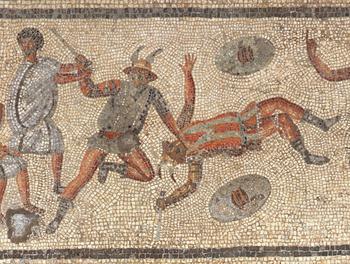
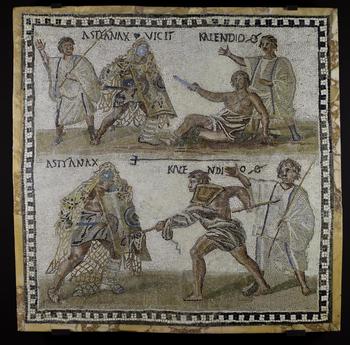
It has often been observed that the greatest number of gladiatorial representations depict not the combat itself but the moment of suspense when the defeated party is awaiting the verdict that will either grant him missio or send him summarily to Hades. He generally signals surrender by standing, kneeling, or reclining, gesturing eloquently for his release with one arm raised and the index finger pointing upwards.Footnote 65 Clearly this is a moment of humiliation, whatever the outcome, and the defeated gladiator is frequently shown to be in the power of his opponent, whether, for example, the opponent is standing on his hand to prevent him from snatching up his weapons and using them against the victor (figure 6), or the victor is being restrained by the umpire from dispatching his vanquished opponent then and there (figure 7). Sometimes the defeated gladiator may be bleeding, a sign of his powers of endurance (figure 8). In a mosaic from the Via Appia, now in Madrid, the presence of the theta nigrum next to Kalendio's name both predicts and confirms the fatal narrative sequence, read from the lower to the upper register (figure 9).
Lucus Feroniae (Fiano Romano), funerary relief. (a) Segment showing defeated gladiator gesturing for mercy, his right hand immobilized under the foot of (presumably) his opponent. Museo Nazionale Etrusco di Villa Giulia, Rome, inv. 261838. (b) Segment showing victorious gladiator standing behind defeated opponent, his right foot (fragmentary) immobilizing his opponent's sword hand (also fragmentary). Museo Nazionale Etrusco di Villa Giulia, Rome, inv. 261855. Photos Mauro Benedetti. © Ministero per i beni e le attività culturali.

Villa of Dar Buc Amméra, Zliten, Libya, amphitheatre mosaic, north-west frieze. A summa rudis restrains the hand of a victorious eques kneeling beside his defeated opponent. Assaraya Alhmara Museum, Tripoli. Photo © Gilles Mermet / Art Resource, NY (ART416022).

Villa of Dar Buc Amméra, Zliten, Libya, amphitheatre mosaic, north frieze. Centre: murmillo raises finger in surrender to hoplomachus, attended by summa rudis. Photo © Gilles Mermet / Art Resource, NY (ART416021).

Via Appia, mosaic. The secutor Astyanax, ‘won’, vicit, against the retiarius Kalendio, who died (theta nigrum). Museo Arqueológico Nacional, 3600. Photo Jordi Moliner Blanch. Museo Arqueológico Nacional, Madrid.

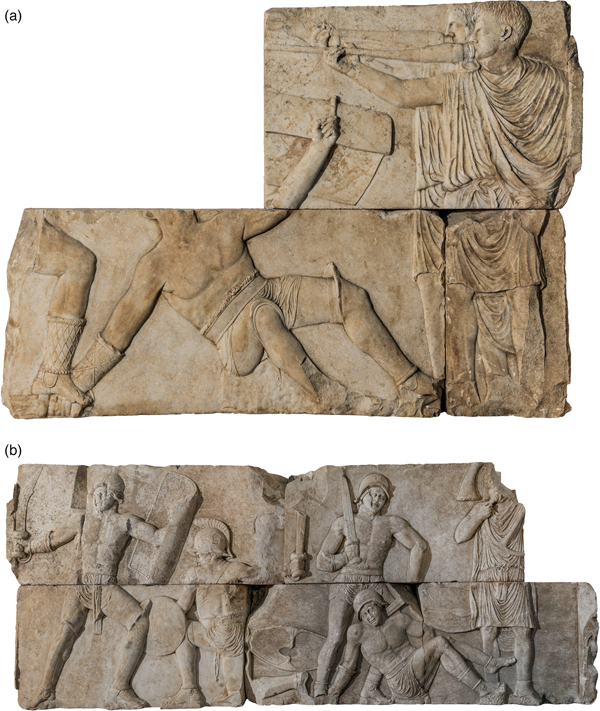
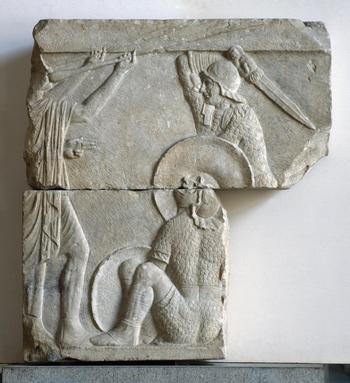
The defeated party is often shown impassively – one might say ‘stoically’ – waiting for his fate to be decided, as on a fragmentary relief from the end of the first century ad from Rome, on which a victorious eques is waiting for the verdict of the editor with his sword at the ready, while his defeated opponent sits on the ground, his shield beside him (figure 10). The head of the defeated gladiator is tilted back, which most immediately suggests that his opponent would wield the deathblow by plunging his sword into the loser's throat. It strikes me, however, that the victor may be bracing his shield against his opponent's head with the intention of striking it with the full force of his body weight just at the point where the shield rests against the man's temple. This would have the effect of crushing his skull in the manner seen on three of the cranial remains from the gladiatorial graveyard at Ephesus, which show traces of ‘massive blunt force’ that the forensic archaeologists have ascribed to impact from a shield.Footnote 66
Relief sculpture from the environs of Rome. Gladiator about to despatch defeated opponent to musical accompaniment. Late first century bc. Staatliche Antikensammlungen und Glyptothek München, inv. Gl. 364. Photo Renate Kühling.

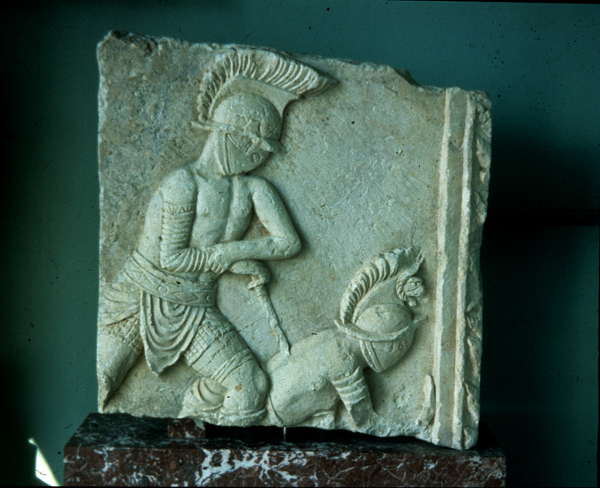
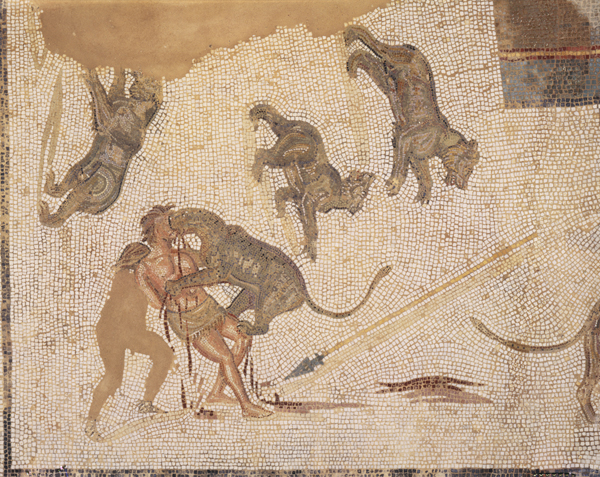
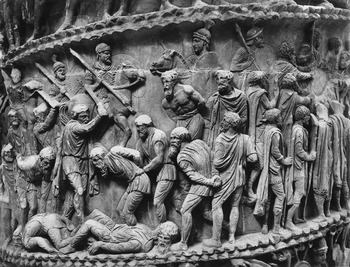
The actual moment of the dispatch of a gladiator who has been denied missio is often depicted with a brutal frankness that nevertheless preserves a certain dignity in his portrayal, as he readies himself to receive a sword strike in the back from his victorious opponent (figure 11).Footnote 67 Some of the depictions of the execution of defeated gladiators are very savage, such as a series of reliefs from Hierapolis recording highlights from the games put on by a certain Cn. Arrius Apuleius Aurelianus, priest, and his wife, where brutally frank legends like ‘Odysseus was slaughtered’, Ὀδυσσεὺς ἐ[σ]φάγη, accompany images of vanquished opponents being stabbed to death by the victors (figure 12).Footnote 68 But they do not bleed: as far as I can tell, defeated gladiators only bleed as a sign of brave conduct (see figure 8); no gladiator bleeds in the process of suffering his own execution. This is in stark contrast to the depiction of criminals condemned to the beasts, where bloodshed may be depicted in graphic detail (figure 13). It also contrasts with the dispatch of prisoners of war on monuments like the Column of Marcus Aurelius, where beheadings are often shown with unmistakable clarity (figure 14). In depicting the death of a defeated gladiator, decorum of a sort is observed.
Apollonia, relief sculpture. Gladiator about to despatch defeated opponent. Muzeu Historik Kombëtar, Tirana, Albania, inv. 1317. Photo Martin Ferguson Smith.

Hierapolis, relief sculpture. Lower panel illustrates slaughter of the gladiator Odysseus in spectacles sponsored by Cn. Arrius Apuleius Aurelianus and his wife. Odysseus’ name and the last four letters of the word Ἐ[Σ]ΦΑΓΗ (‘was slaughtered’) are legible above his head. Photo Susanne Muth.

Domus Sollertiana, Thysdrus (El Djem), mosaic (detail). Condemned prisoner mauled by leopard. Photo © Gilles Mermet / Art Resource, NY (ART157143).

Column of Marcus Aurelius, Rome. Execution of German prisoners. Alinari / Art Resource, NY (ART70496).

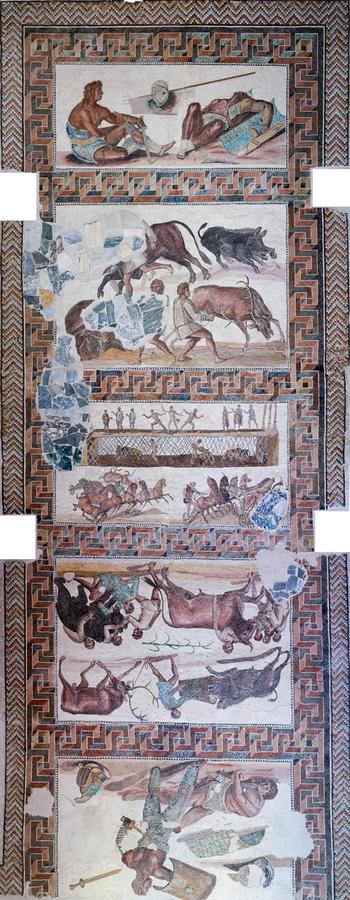
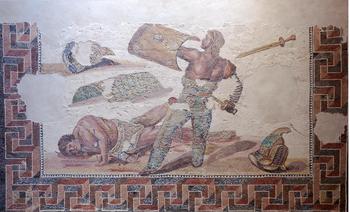
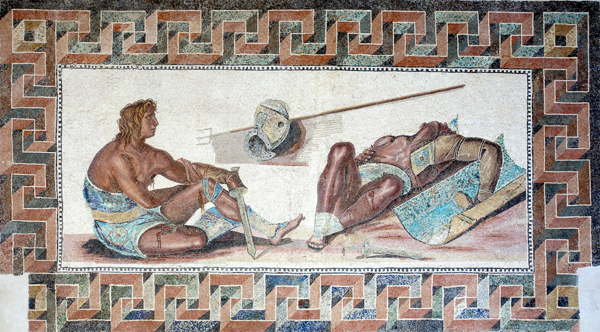
One final image captures the ambiguity of victory in the arena. It occurs on a mosaic found recently at Wadi Lebda in Libya, the site of ancient Lepcis Magna (figure 15).Footnote 69 The mosaic consists of five panels: in the middle is an elaborate circus scene (comprising a chariot race, mimes, acrobats, and a damnatio ad bestias), flanked by two scenes of beast-baiting, with the outcome of a gladiatorial fight depicted at either end. At one end, although the view of the victorious thraex from the rear is unusual, his posture, planted in front of a crumpled murmillo, is exactly what we would expect (figure 16): he is brandishing his shield aloft in a triumphant gesture, his sica at the ready in his other hand, just in case. The corresponding panel at the other end, however, defies our expectations (figure 17): the retiarius on the right, remarkably foreshortened to fit our frontal view, has obviously been defeated and is either dying or already dead; but the secutor who defeated him looks far from triumphant.Footnote 70
Lepcis Magna (Wadi Lebda), mosaic depicting spectacles in the arena and the circus. Photo Fabian Baroni, Missione Archeologica dell'Università Roma Tre in Libia, courtesy of Luisa Musso.

Lepcis Magna (Wadi Lebda), mosaic: panel depicting the victory of a thraex over a murmillo. Photo Fabian Baroni, Missione Archeologica dell'Università Roma Tre in Libia, courtesy of Luisa Musso.

Lepcis Magna (Wadi Lebda), mosaic: panel depicting the victory of a secutor over a retiarius. Photo Fabian Baroni, Missione Archeologica dell'Università Roma Tre in Libia, courtesy of Luisa Musso.

As we have seen, victors are regularly shown standing (or, occasionally, kneeling) over their vanquished opponent, often trying to prevent them from retrieving their weapons until the editor has announced his verdict. But if the retiarius here is already dead, there is no verdict to be awaited. The secutor has sunk to the ground, suffering from exhaustion, although ‘catatonic shock’ might be a better definition, a state documented for modern soldiers who kill in battle. A further twist is that the defeated retiarius may have been someone whom the victor knew very well; we know that sponsors hired gladiators from a single troupe to put on a display, and so gladiators fought in public against people with whom they lived and trained, only (potentially) to wound them or even (occasionally) to kill them.Footnote 71
There are no inscriptions on this mosaic to indicate specificity; it might conceivably be a generic image out of the artist's imagination, although the blond hair of the victor – and of his counterpart in the corresponding panel – is curiously particular, suggesting a Germanic origin. If the panel showing the defeat of the retiarius does record a specific incident, the representation may have been commissioned precisely because the death of a gladiator in combat, occurring so seldom, invited commemoration. But whether the representation is specific or generic, its ambiguous portrayal narrows the gap between victory and defeat.
Conclusion
In gladiatorial combat, defeat was the inevitable outcome for one of the parties; the only exception was a fight that ended in a draw. How it is represented in the surviving sources is a question of focalization. Sponsors, trainers, and fans freely admit it; it is part of their accounting system. In the West, the associates of gladiators who composed their epitaphs elide it; those in the East rewrite it in accordance with the heroic treatment of athletes, deflecting responsibility onto an ineluctable force to preserve the reputation of the deceased. Pictorial representations are usually unsparing in showing the defeated appealing for mercy, and generous in depicting the losers steadying themselves unflinchingly for the end. The proportion of healed wounds on gladiators’ skeletons suggests that endurance prevailed, even when wounds were sustained to the bone, it being a reasonable assumption that a gladiator so badly wounded cannot have won. In such circumstances, physical and psychological pain must have blended, mitigated only by survival and, ultimately, recovery. At least on the surface, missio qualified the disgrace and humiliation of defeat.
Moira in gladiatorial epitaphs from the Greek East, numbered according to Mann (n. 18)