The balsam twig aphid Mindarus abietinus Koch (Hemiptera: Aphididae) is found notably on balsam fir Abies balsamea (Linnaeus) Miller and Fraser fir Abies fraseri (Pursh) Poiret (Pinaceae) in commercial Christmas tree plantations of southern Québec, Canada, where its colonies can cause aesthetic damage to trees. Eggs of M. abietinus overwinter in an obligate diapause, starting with their deposition by the oviparous sexual females onto fir shoots in early July (Deland et al. Reference Deland, Berthiaume, Hébert and Cloutier1998; Fondren and McCullough Reference Fondren and McCullough2003; Doherty et al. Reference Doherty, Guay and Cloutier2017). As an overwintering egg, M. abietinus spends approximately nine months in a dormant state until the end of March or earlier. This is when the obligate diapause is terminated and embryogenesis is thought to resume and the development of the immature stem mother progresses further, ending with eclosion of the egg in late April or early May (Deland et al. Reference Deland, Berthiaume, Hébert and Cloutier1998).
Freeze avoidance based on supercooling is a well-known overwintering strategy adopted predominantly by insects in cold climates (Turnock and Fields Reference Turnock and Fields2005), where winter deep frost periods are regularly encountered (Leather et al. Reference Leather, Walters and Bale1993; Denlinger Reference Denlinger2002; Danks Reference Danks2007). Insect eggs usually have lower supercooling points than other life stages (e.g., larvae and pupae), which could favour winter survival for northern insects overwintering as exposed eggs on tree branches such as M. abietinus (James and Luff Reference James and Luff1982; Sømme Reference Sømme1982). Egg desiccation may decrease the supercooling point by concentrating cryoprotective body fluids such as polyols (Zachariassen Reference Zachariassen1985), which is a likely strategy in a very dry environment, presumably like the microhabitat surrounding M. abietinus overwintering eggs (Danks Reference Danks2000). Here, we report data on late winter changes in form and water content of overwintering eggs of M. abietinus, collected in parallel to a recent study of early season phenology of this aphid in southern Québec (Doherty et al. Reference Doherty, Guay and Cloutier2017).
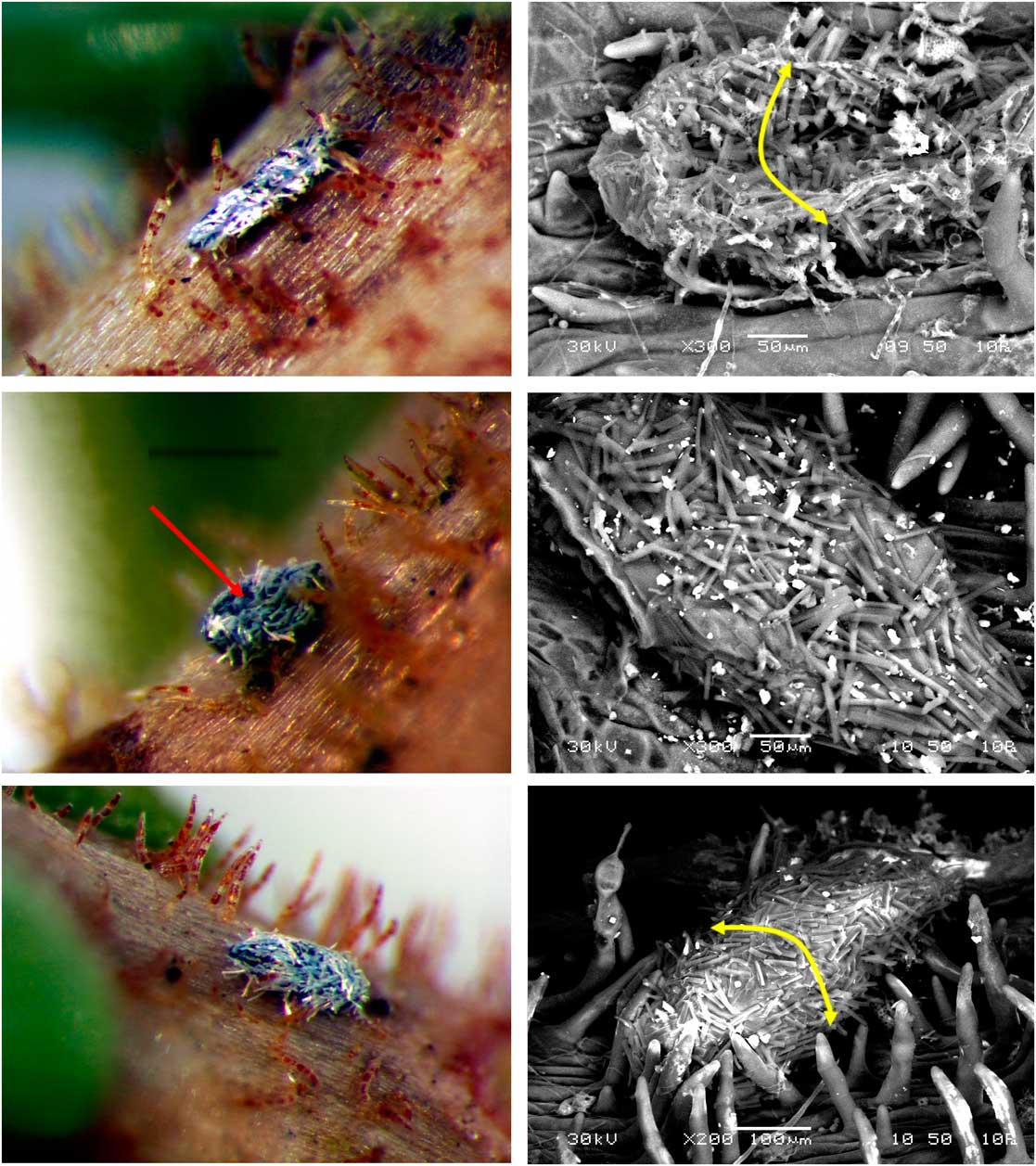
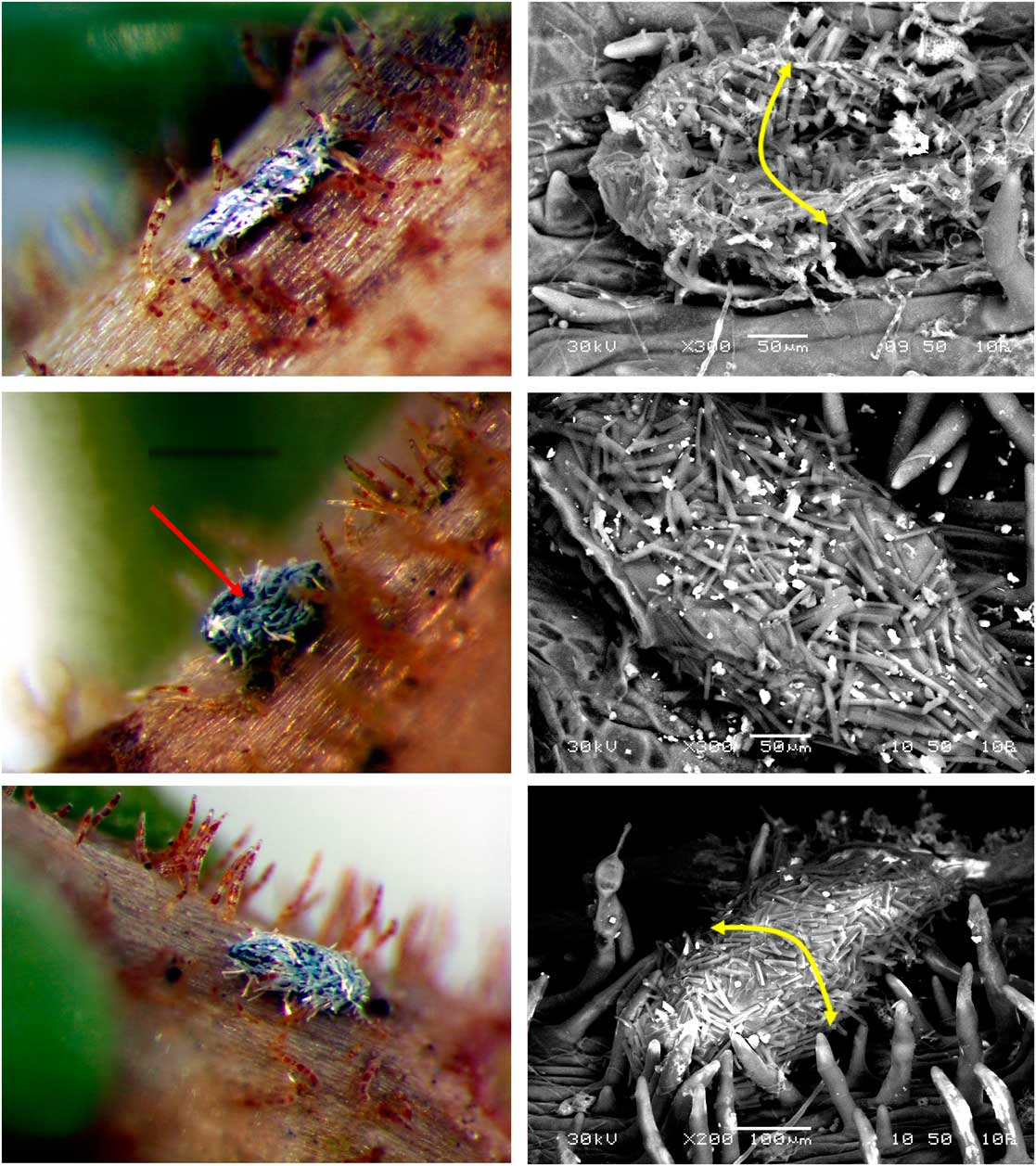
Overwintering eggs were collected in the late winter and early spring of 2015 in a commercial Christmas tree plantation (45.905°N, 71.036°W) near Courcelles, in the Estrie administrative region of Québec, during which morphological differences between eggs collected on different dates were noted. In late February, despite being otherwise intact, the majority of eggs were slightly flat in appearance, sometimes with a visible depression on their top, exposed surface. However, almost all of the eggs similarly collected later in early April were uniformly turgid and had taken the undepressed shape of a lemon. For all three collection dates in 2015, a small percentage of eggs were completely flat and were apparently dead as no vitellus was contained within the relatively soft black eggshell. For observational purposes, egg shape was divided into three distinct categories: C1 eggs are completely flat and presumably nonviable; C2 eggs are semi-flat, sometimes with a slight depression on the top surface; C3 eggs are uniformly round and turgid (Fig. 1). These preliminary observations led us to hypothesise the role of water content in egg shape change.
Mindarus abietinus overwintering eggs on balsam fir shoots. Eggs in left column pictured using a stereomicroscope (≈120×) and eggs in right column with a scanning electron microscope (200× or 300×). From top to bottom: C1 (flat), C2 (semi-flat with depression, pointed by red arrow), and C3 (round and turgid) categories. Linear light structures on egg surface are wax fibres glued to eggs following oviposition by females. Trichomes are visible beside eggs on shoots. Yellow arrows were added to scanning electron microscope images to better visualise the curved shape of top surface of eggs.
In order to document seasonal changes in egg mass and water content in the field during the entire overwintering period, eggs of M. abietinus in a commercial fir plantation were collected bimonthly from the period when they were deposited onto fir shoots in early July 2015, until just before egg eclosion in early May 2016. Around 20 eggs were collected on balsam fir shoots at intervals of about two weeks in the plantation described above. Eggs were visually categorised on the shoot as shown in Figure 1, then were carefully removed and weighed on a XP2U Ultra Micro Balance (Mettler Toledo, Mississauga, Ontario, Canada). Starting in late November 2015, freshly collected eggs were heated at 70.0±1.0°C for 72 hours, after measuring fresh mass, in order to dehydrate them and measure dry mass. In early March 2016, supercooling points were determined for seven freshly collected eggs. They were fixed individually to thermocouples (CHROMEGA®/constantan Type E; OMEGA Environmental, Laval, Québec, Canada) inside a freezer which provided a mean cooling rate of 0.1 °C per minute around the eggs. When thermocouples measured the release of latent heat from crystallisation, the supercooling point was considered to be the lowest temperature measured just before (Lee Reference Lee1991). Mean fresh egg mass was relatively stable during summer and fall 2015, but started to increase remarkably towards the end of January 2016. An inflexion point was arbitrarily set at the 3 February 2016 collection date, in order to statistically model variation of fresh egg mass, before and after said point.
Data were analysed with SAS 9.4 (SAS Institute, Cary, North Carolina, United States of America) using PROC MIXED. Fixed effects were collection date, overwintering period (i.e., before and after the inflexion point) and their interaction, with egg nested within date as random effects. In order to analyse the effect of dehydration, fixed effects were collection date, dehydration, and their interaction, with egg nested within date as random effects. The relation between egg category and fresh egg mass was analysed with all eggs pooled together, regardless of collection date, with egg category as the fixed effect, and egg nested within date as random effects. Square root transformations were applied when required, in order to meet the normality criterion of residuals underlying linear regression analysis.
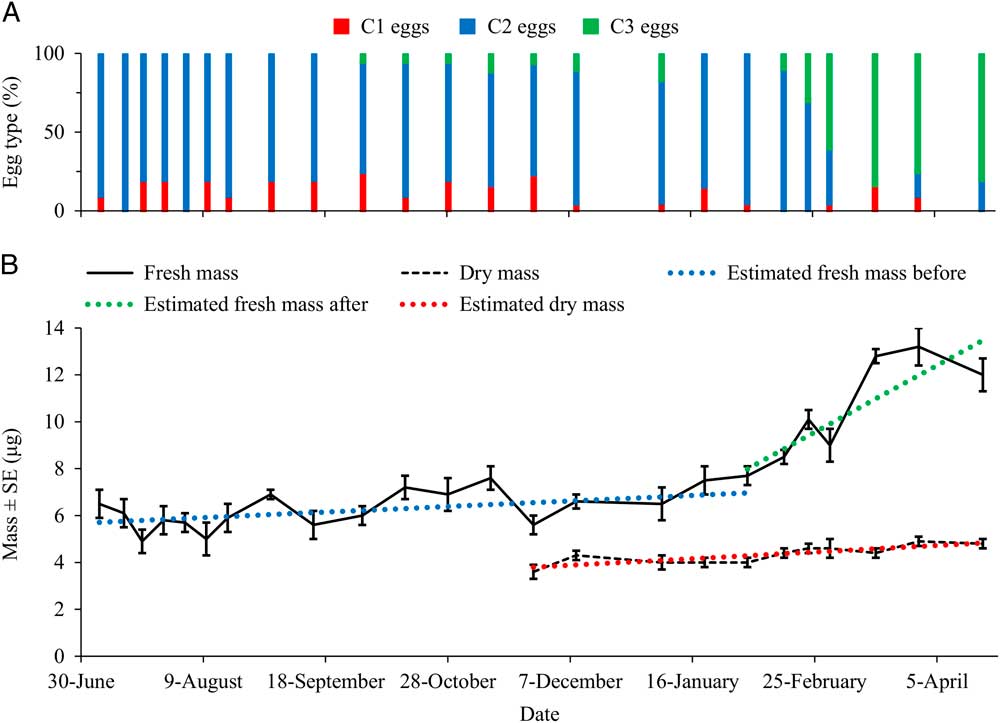
The difference in rate of change of fresh egg mass before and after the 3 February 2016 (i.e., the interaction collection date×overwintering period) was highly significant (F(1,297)=24.78, P<0.0001) as fresh mass after the inflexion point increased very significantly (t 297=5.76, P<0.0001) over 12 times the rate estimated before said inflexion point (t 297=2.09, P=0.0371) (Fig. 2). Collection date (F(1,297)=37.33, P<0.0001) and the overwintering period (F(1,297)=15.43, P=0.0001) were also significant. Dehydration at 70 °C had a highly significant overall effect on egg mass as expected (F(1,176)=24.90, P<0.0001), with highly significant effects of collection date (F(1,176)=110.04, P<0.0001) and their interaction (F(1,176)=145.02, P<0.0001). Average water content (mean±95% confidence interval) increased gradually from 34.8±3.9% in late November 2015 to 57.3±5.8% by mid-April 2016 (Fig. 2).
A. Mindarus abietinus egg shape category composition at different collection dates (n=24), where the C1 (flat), C2 (semi-flat), and C3 (round and turgid) eggs are present. B. Fresh and dry mass (mean±standard error (SE)) of M. abietinus eggs throughout the overwintering stage from July 2015 to April 2016. Linear regressions were fitted to the fresh mass data to relate egg mass to date, before and after the 3 February 2016.
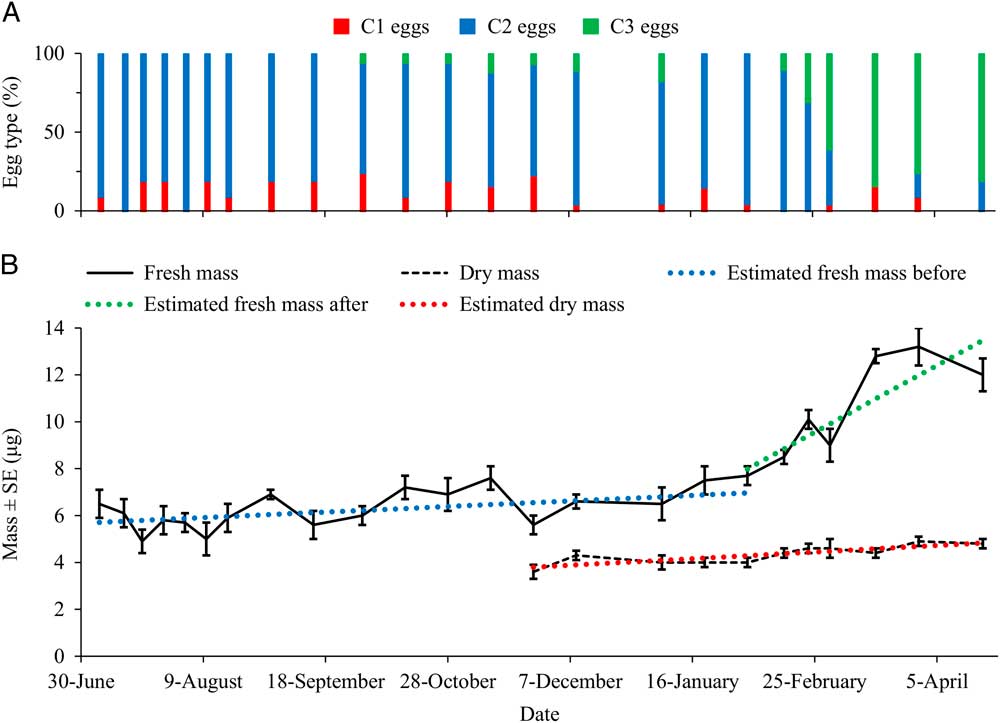
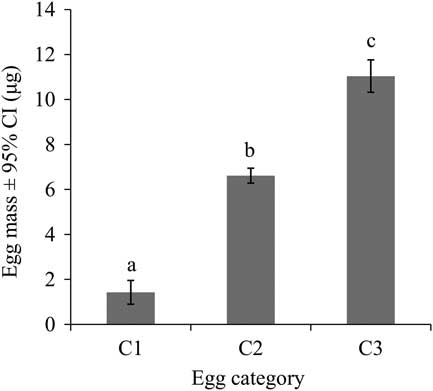
Egg shape assessed visually was highly significantly related to fresh egg mass, which very significantly differed between categories (F(2,331)=359.84, P<0.0001) (Fig. 3). The C2 eggs represented the majority of them until mid-February 2016, when C3 eggs became predominant and mean fresh egg mass increased (Fig. 2). The supercooling point for C2 eggs collected on 1 March 2016 (n=7) was estimated at −40.7±0.4 °C (mean±95% confidence interval).
Mindarus abietinus fresh mass of C1 (flat), C2 (semi-flat), and C3 (round and turgid) eggs. Different letters indicate a highly significant difference between categories (P<0.0001). CI, confidence interval.
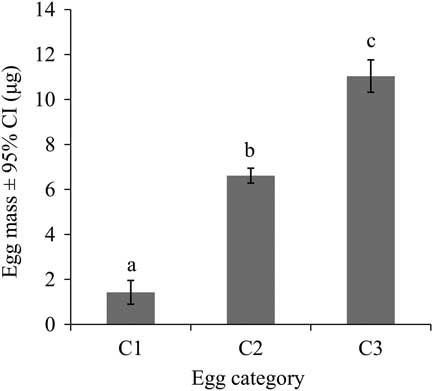
Overall, our data and observations suggest that M. abietinus diapause eggs laid in early July on new fir shoots have a relatively low water content, presumably to better survive both the mid to late summer high temperatures and the harsh coldest winter conditions, until they start to absorb water in February of the following year. Our categorisation of egg shape into three distinct groups of increasing mass is consistent with changes over the winter in egg condition and viability. C1 eggs were nonviable, with no apparent live content, and their smaller mass suggests that it is mainly the eggshell that was measured. The C2 eggs hypothetically represent the overwintering deep diapause state, with only slight variations in fresh mass throughout the summer, fall, and early winter, probably due to the rarity of water in their immediate surroundings on fir shoots (e.g., rainfall and possibly ambient relative humidity). Finally, C3 eggs most likely represent the actively developing eggs that progressively absorb water, presumably after completing winter diapause (Moriarty Reference Moriarty1969).
Interestingly, minimum temperatures below −25 °C were recorded in the plantation where eggs were collected during both years, although rarely so (data not shown). During this period, the persistent relatively low water content of eggs, followed by late winter and early spring absorption of extra water, could be part of the supercooling strategy here, as dehydrated eggs of some insect species are known to have lower supercooling points when water contents are relatively low (Gehrken and Sømme Reference Gehrken and Sømme1987; Qi et al. Reference Qi, Wang, Xu and Kang2007), suggesting that a similar mechanism is possible for M. abietinus eggs.
When eggs were collected during March of both years, the accumulated snow that partially covered fir trees had started to melt, associated with frequent precipitation and bouts of snowmelt, resulting in fir branches being often drenched in water. Fir shoots usually retained part of the water runoff on branches, suggesting that liquid water persists on them during snowmelt, submerging any M. abietinus eggs present, as freshly collected eggs were generally covered with free water adhering to the shoot by surface tension. In addition, warmer temperatures could have increased ambient humidity during this period, increasing the vapour pressure around eggs, thus hampering desiccation. These factors could explain why M. abietinus eggs increase in mass during the transition between winter and spring, when they are in close contact with water as the snow melts. However, further study would be needed to better understand how water is acquired in the spring by overwintering eggs.
It is possible that water, alongside photoperiod and temperature, could be part of a signal complex for egg diapause termination in M. abietinus, as for eggs of Homichloda barkeri (Jacoby) (Coleoptera: Chrysomelidae) (Nahrung and Merritt Reference Nahrung and Merritt1999). For this to happen, water absorption would begin before the start of embryogenesis. However, it is also possible that water absorption takes place after egg diapause is terminated and embryogenesis has resumed (Yoder and Denlinger Reference Yoder and Denlinger1992; Bethke and Redak Reference Bethke and Redak1996; Niikawa and Takeda Reference Niikawa and Takeda1996). In this case, water would be actively absorbed through the eggshell by the early developing embryo. In both scenarios, we hypothesise that water uptake is critical in M. abietinus diapause termination and/or subsequent egg development. Experimentally soaking C2 eggs in water before uptake occurs in the field could support this hypothesis. If water requirements for M. abietinus eggs are not met during this period, for example in years of low precipitation, lower survival of the overwintering eggs could occur and affect future population densities in the plantation.
Acknowledgements
The authors thank Martin Charest (Université Laval) for his help in measuring supercooling points, and Valérie Fournier (Université Laval) for allowing them to weigh and take pictures of M. abietinus eggs in her laboratory. They also thank Gérald Couture (Québec Balsams Export) for allowing them to sample in his plantations. This study was supported by the Ministère de l’Agriculture des Pêcheries et de l’Alimentation – Programme Innov’Action agroalimentaire grant #IA113043 to Conrad Cloutier.