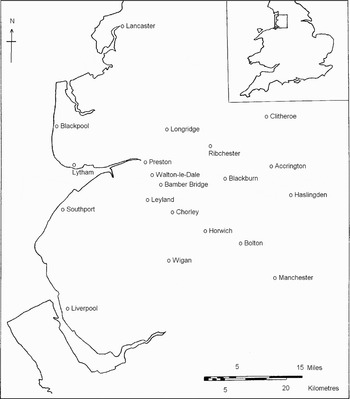


There is very little literature on the activities of early terminating building societies. The fact that they were designed to terminate rendered their records ephemeral, but, as they emerged contemporaneously with friendly societies, they are frequently viewed as organisations for promoting thrift and workers' housing.Footnote 1 This view places them in the context of provision made for times of economic hardship, in what Joanna Innes calls ‘the mixed economy of welfare’. Within this, member-serving self-help bodies like friendly societies functioned alongside commercial provision of education or health services, the non-profit sector comprising voluntary hospitals, and the household sector, where women cared for children and the sick or disabled. Martin Daunton suggests that historians should devote more attention to the changing proportions of this mixture, seeking an explanation for the changing proportions and the precise relationships between the parts.Footnote 2
With regard to motives for membership of contributory schemes, G. R. Searle suggests that cooperation, based on altruism and benevolence rather than the greed and acquisitiveness of a capitalistic society, won much respect during the nineteenth century because it seemed to be a morally superior activity. He uses contemporary commentaries to demonstrate the attractions of entities like benefit clubs, friendly societies and savings banks in promoting self-reliance and discouraging dependency. While some like Francis Place wanted this to be self-generated and not imposed from above, others such as Samuel Smiles felt the habit of thrift was not innate among the humbler classes and had to be cultivated. Searle establishes the point that cooperation was thought by Victorians to be an activity morally superior to individualistic capitalism.Footnote 3
The literature therefore locates housing provision by mutual aid within the context of thrift and self-help, accompanied by Victorian middle-class perceptions of paternalism and social responsibility. In general, however, detailed studies of building society activities have been limited by a scarcity of original source material, and evidence of their existence has to be searched for elsewhere. Using alternative sources, this article first explores issues raised by historians relating to financial networks and mutuality. It then examines surviving documentary evidence to establish the level of building society subscriptions, the types of people contributing to them and returns available to subscribers. It concludes by demonstrating that, in Lancashire, early terminating building societies made a substantial contribution to the county's industrial development.
Lancashire

I
The late eighteenth and early nineteenth centuries, a period with relatively few formal financial institutions, saw much economic activity among networks in the wider community. As P. H. J. H. Gosden notes, friendly societies flourished in Lancashire towns like Preston and Lancaster. Local poor law authorities encouraged their formation to reduce demands for poor relief, since societies generally used members' savings to support them during periods of sickness, to cover burial costs, and provide payment for widows and orphans.Footnote 4 In this era of rapid industrial expansion and urban development, another type of society appeared which also offered members the benefits of mutuality. This was the terminating building society, which drew members from among those able to save surplus income. Savings were placed with a club which built rows or blocks of houses on a single site. Geoffrey Timmins identifies early terminating building societies as providers of several clusters of handloom weavers' housing in Lancashire, and has suggested that, in some cases, these houses were built for investment purposes.Footnote 5 Such developments formed a striking new feature in textile Lancashire during the late eighteenth and early nineteenth centuries, reflecting both the surge in growth of textile production and the lagging mechanisation of the weaving sector.
By contrast with the motive of investment, Seymour Price, the primary chronicler of the building society movement, identifies members as artisans whose purpose was self-help towards owner-occupation. Price lauds their achievements thus:
They were the creation of ordinary men, artisans and craftsmen who realised the virtue of self-help, and appreciated that by unity and co-operation they could make provision for help to one another in times of necessity … These early societies existed for one purpose only: to provide each and every member, and no-one else, with a house erected by the society, and paid for out of its funds.Footnote 6
Yet Price ignored his own evidence from Longridge, near Preston, his major case study, where building club members owned more than one house, belonged to more than one club, and where the handloom weaver occupants were not the owners. Therefore case studies are used hereafter to shed further light on how this important aspect of Lancashire's economic infrastructure was funded, that of housing provision for handloom weavers, by far the largest sector of the county's workforce.
Geoffrey Timmins estimates the number of handloom weavers in Lancashire at 170,000 by 1820, when the trade was at its peak. The county's population had just exceeded one million at this date, and housing provision for this largely home-based workforce must have had a marked effect on the landscape. The total cost of constructing cottages with loomshops is estimated at between £3.6 million and £6.8 million.Footnote 7 However, determining the sources from which such sums were drawn is problematic, as literature on the workings of building societies is elusive. Therefore, in exploring the contribution they made to funding Lancashire's housing, evidence is drawn principally from scanned images of property deeds held at the Land Registry, complemented by contemporary newspapers, early Ordnance Survey maps and field observation. Property deeds are particularly useful, because recitals of what led to the acquisition frequently summarise a club's activities, and state the name and job title of the transferee, enabling an assessment to be made of the type of person involved in membership. Lancastrian societies are investigated to identify their membership, to consider their attractions for subscribers, and to discover how funds were channelled into construction.
Although clubs and societies discovered from such sources differed in size, their methods of operation were broadly similar. Having attracted the requisite number of shareholders and acquired the site, an inaugural meeting was held, generally at a local inn. This meeting elected the club's secretary/treasurer, with a management committee drawn from the membership. It also established articles of agreement like those which survive for the first Longridge club.Footnote 8 The Longridge committee's duties included contracting for the site, procuring building materials, and letting completed houses to tenants.
The secretary/treasurer collected monthly subscriptions from members. These were about £1, with an extra three or four pence for expenditure on monthly meetings. The Longridge rules stipulate that a ballot should be held on commencing the project, to determine the order in which houses were allocated. Members could transfer their shares to others, but those not continuing their subscriptions faced expulsion, forfeiting sums already paid. If all went well, a member of a successful club running for ninety months in Blackburn received two houses per share for a monthly outlay of £1. In smaller developments, one house per share was typical. One example is Club Row, Ribchester, south-east of Longridge, where seven houses were built in 1793 (Ordnance Survey Map reference SD 652 350).Footnote 9 Individual examples of their operation are explored further, following consideration of the debate among historians about the motivation members had for joining.
II
In his history for the Building Societies Association published in 1959, Seymour Price states that such societies began in Birmingham in the 1770s.Footnote 10 Christopher Chalklin enlarges upon Price's assessment as follows:
The geographical distribution of early building societies suggests that they were all the creation of the industrial town. In the north, societies existed in Manchester, Leeds and Sheffield before 1793. None has been discovered in Hull or Newcastle before 1820, and only one has been found in Liverpool. They were almost unknown in the south before 1820.Footnote 11
Early building societies therefore appear to be associated not only with areas which, from the late eighteenth century onwards, underwent rapid industrial expansion, but primarily with metalworking and textile districts.
Maurice Beresford's work on building clubs in Leeds found that they began in the later 1780s in the east end of the city. Much of his evidence is taken from property deeds and newspaper advertisements, since just one rule book survives to give an insight into the workings of clubs. In Lancashire there is a similar dearth of documentary evidence. Nevertheless, Seymour Price devoted an entire chapter of his work to the first club active in Longridge, near Preston (OS: SD 308 674), because the rule book and associated legal papers are held at the Lancashire County Record Office. The Longridge rule book, dating from 1793, is one of only two survivors from those clubs which actually constructed cottages in Lancashire, the other being the New Town society, also at Longridge.Footnote 12
However, Price's claim that this club was formed to provide its members ‘and no one else with a house erected by the society’ has been denounced by Maurice Beresford as a ‘myth’. Beresford's work on building societies clearly demonstrates an investment motive among members in Leeds.Footnote 13 Other evidence from Lancashire led Geoffrey Timmins to question Price's claims. His reasons include the socio-economic status of owners, citing entrepreneur Edmund Ashworth's comment in 1841 that building societies ‘prevail considerably among the working people, but more fully among the shopkeepers and better class of people’.Footnote 14
The case against Price's interpretation is made by examining occupations of members of the first Longridge society. At the time of its formation in 1793, Price assessed the combined population of Longridge and its neighbours Alston and Dilworth to be about a thousand, ‘of whom all but a few were poor hand-loom weavers’.Footnote 15 Although this was indeed a project to build handloom weavers' cottages, as the surviving physical evidence reveals, the largest occupational grouping among the 20 original members of the society comprised nine yeomen (farmers). The building trade was represented by two stonemasons and a carpenter, who may have secured work for themselves on the project, while another four were either small businessmen or artisans. These were a shopkeeper, a travelling dealer, a cotton spinner and a clogger, though the latter may have used the loomshop for his own workspace. The remaining four members were weavers, but their income could be twice that paid in agriculture, and with initial subscriptions of a guinea and regular monthly subscriptions of 10s 6d, they do not merit the appellation ‘poor’.Footnote 16
The high subscription level of building clubs was noted by S. D. Chapman and J. N. Bartlett in their work on Birmingham, from which they concluded that the clubs they studied ‘clearly excluded all but those whose income consistently allowed a comfortable margin above subsistence’.Footnote 17 To appreciate this point more fully, it is instructive to compare Longridge building society subscriptions with those of the friendly society founded in Croston, near Chorley, in 1825. This society required an initial payment of between five shillings and £1, depending on age, followed by quarterly subscriptions of 2s 6d.Footnote 18 A further contrast between the resources of members of the two types of society may be drawn. Once the ballot to determine the order of building was conducted at Longridge, weaver Richard Hayhurst sold his share, drawn in nineteenth place, and acquired those drawn in fifth and sixth place. Able to afford two lots of subscriptions, he evidently intended to let at least one of the properties, in accordance with the club's Rule Five permitting members to do this. Another, Joseph Walmsley, a Ribchester yeoman, drew seventh place and acquired that drawn in eighth place. Price's conclusion of an owner-occupation motive is odd since he notes the establishment of a second club in 1778 while the first was still active, when several of the first club's members also joined the newer one.Footnote 19
As the Longridge members' purpose was clearly not owner-occupation, activities of clubs elsewhere in Lancashire are now explored, to consider issues raised by Price and his critics in more detail. In doing so, the identity of building society members is investigated, and consideration given to their potential investment motives as being either ‘speculative’ (merely seeking a return on financial input) or ‘strategic’ (aiming to promote industrial expansion) as defined by John F. Wilson.Footnote 20 Discussion begins with the activities of those societies which constructed housing in the Blackburn area, one of the county's major weaving centres, for which much information is available.
III
Building societies reached Lancashire in the 1780s; the earliest found to date is that at Union Street, Blackburn, in 1788 (SD 685 284). Maurice Beresford suggests this choice of name was influenced by the friendly society, in that the terms ‘union’ and ‘friendly society’ were interchangeable, and several clubs in Lancashire adopted the name. The Witton Stocks Building Society commenced before 1807, when its committee acquired land fronting the Blackburn to Preston turnpike (SD 668 274). After seven years of successful operations, the club terminated in May 1814, when deeds conveyed the finished houses to each member. Recitals to each deed narrate events preceding the transaction, including names of committee members. These were John Thompson and Robert Woolfall, both joiners, George Read Clegg, a grocer, William Duckworth, a warper, and John Salisbury, a sizer, five members selected by their fellows to act on behalf of all.Footnote 21 Also stated is the fact that money was raised by monthly subscriptions, and that each time sufficient finance had been collected to build a house, it was set aside for one of the members, who was allocated a plot on which to build. Thus the usual procedure of building societies was adopted, with agreed sums paid over to members to erect a property, and not simply lent on mortgage. This accords with the principle of terminating the society once all properties were completed.
In addition to the committee of the Witton Stocks society, others named as members in the deeds of 1814 were shopkeeper Henry Mullineaux, gentleman Henry Sudell, yeomen Roger Crook and John Hartley, spinster Jane Aspden, alehouse keeper Thomas Kay, cotton manufacturer Robert Boardman, and calico printer John Bilsborough, together with Ellen Hargreaves and John Prince whose occupations are unknown.Footnote 22 It is clear from the deeds that club members were not weavers, yet from their design features the properties have been identified as handloom weavers' cottages.Footnote 23 The answer to this contradiction is provided by the deeds, which show that some members received more than one house, and confirm that they were occupied by tenants, whose names are also recorded. The presence of two cotton manufacturers among the members suggests that their interest in the venture extended beyond mere speculative investment, to include employment of the weaver tenants, a strategic interest. Henry Sudell was Blackburn's main employer of handloom weavers, perhaps employing over one thousand of them from his warehouse in Ainsworth Street.Footnote 24
The type of housing at Witton is confirmed by advertisements in the Blackburn Mail, for the club's shares were seen by some members not only as a profitable investment, but also a tradeable asset. One original member, Thomas Rishton, a slater listed as Thomas Rushton in the 1818 trade directory, acquired three shares and was drawn early in the ballot. This allowed him to advertise his newly built houses for sale at auction in May 1808. All had a cellar weaving shop for four pairs of looms, and were already let to tenants at sums ranging from six to seven guineas a year, with those facing the main road commanding the highest rents. Moreover, each share comprised two houses, and Rishton's rental income amounted to £40 9s 0d annually. To finance his investment, Rishton paid £1 0s 4d monthly for each of his three shares.Footnote 25
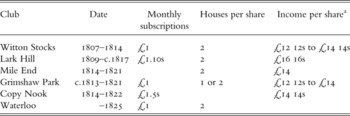
A comparison of known costs and income receipts is shown in Table 1. As can be seen, a handloom weaver's cottage in Blackburn at this period generated a yearly rental income of £6 6s or £7 7s, giving an impressive 14 to 15 per cent return on a £45 house. For each share, Witton Stocks members paid £1 0s 4d a month, or £90 over ninety months for two houses, to cover construction costs. Female participation at Witton Stocks is noteworthy, in view of their limited appearance in existing studies of nineteenth-century wealth holding. Yet their presence in Lancashire's early building societies is unsurprising, for one study of women's investment strategies shows that perhaps half of women testators studied in Stockport left freehold or leasehold property.Footnote 26 Josephine Maltby and Janette Rutterford suggest that the role of women investors attracts so little attention because of an assumption that they were neither interested in nor capable of appreciating financial matters.Footnote 27 Nevertheless, studies have been confined to investment by middle-class women, and the status of those participating in building clubs is less clear. Certainly investment motives of women building society members would have been speculative, in that acquiring a portfolio of tenanted properties provided a regular and safe supplementary income.
Cost comparisons of Blackburn club houses

aAnnually, for two houses.
One speculative investor was Alice Howson, a widow, who acquired a block of four houses in Moor Street in 1813, as part of a club constructing handloom weavers' cottages at Lark Hill, Blackburn (SD 687 283). Alice was clearly a woman of means, for she was also concurrently a member of the club building handloom weavers' housing in Manor Road, Blackburn (SD 667 282). Indeed her will, proved in 1832, shows that she accumulated a portfolio of tenanted properties by the time of her death.Footnote 28
Maurice Beresford questions why someone wishing to own a cottage should enter a ‘union’ with others in a subscription club. He explains that there were few opportunities to acquire single properties at this time, for most newly built terraces were retained for letting to tenants, not built speculatively for sale. Even where these were marketed by bankruptcy assignees or by executors of a will, a block of houses formed a single lot, affording little opportunity to purchase one house. Clubs therefore gave access to the land market for anyone with surplus income but too little capital to deal with a landowner.Footnote 29 Most Lancastrian societies acquired sites for no financial outlay. Instead development plots were offered in consideration of a leasehold ground rent, or a freehold burdened with a rent charge, with covenants controlling aspects of the development. This minimised the cost to club members, who would otherwise pay charges for servicing a mortgage, as happened at Longridge. The landowner received an income in perpetuity, for rents charged on the whole of a site were apportioned among members on completion.
Many individuals maximised their investment by not only taking more than one share in a club, like Thomas Rishton at Witton Stocks, but by joining two or more clubs simultaneously, like Alice Howson of the Manor Road and Lark Hill clubs in Blackburn. They could assemble a small portfolio of rented property by regularly investing surplus income, rather than expending capital, for example at an auction. However, not all members were as astute as Alice Howson. One investor joined three building clubs simultaneously, taking multiple shares in each. Stonemason William Crook subscribed to the Seven Acre and Revidge Building Club, which constructed a row of fourteen double-fronted weavers' cottages at Lammack Road, on the town's northern edge (SD 672 303). Crook had two houses completed by 1818, for which he received seven guineas apiece in annual rental income.Footnote 30 However, prior to termination of this club, he joined two other Blackburn societies, namely Chadwick's Club at Copy Nook on the turnpike road to Accrington (SD 694 282), and the Grimshaw Park Club at Kemp Street, near the turnpike road to Haslingden in Rossendale (SD 686 269). As well as a speculative motive, another reason for Crook's multiple investments may have been the opportunity for employment which membership afforded him.
These multiple commitments appear to have left Crook financially overstretched for he became bankrupt, and assignees advertised his assets for sale on 5 August 1818, outlining his rental income and subscriptions due. He had two houses at Lammack Road, two at Grimshaw Park, another pair at Copy Nook, and two more at Moor Street, Lark Hill, possibly from the building society there. All were handloom weavers' cottages. From figures given in the advertisement it may be determined that Crook's annual rental income from all properties totalled £59 1s 0d, while his outgoings on building society subscriptions were lower at just £51 16s 0d. The discrepancy in his finances may be explained by Crook's membership of the Grimshaw Park Club. The £90 valuation of one share comprised two houses which had already been built and let to tenants, one paying £7 a year and the other six guineas. The subscription for this share was £1 0s 4d monthly. Thus with a receivable rental income of £13 6s 0d and club subscriptions of £12 4s 0d annually, this particular lot more than paid for itself, for the further £55 in outstanding subscriptions would be covered by receivable rents.
Crook had been lucky and had been drawn early in the ballot. However, he also had two other unbuilt shares, and had also paid £35 for these without yet seeing the four houses built, with a further £110 due in future subscriptions, but no rental income from them. He also had an undeveloped plot at Lark Hill, on which he stored building materials, in addition to his commitments at the Copy Nook club.Footnote 31 The wording of the newspaper advertisement suggests that club members like Crook received rents from tenants as soon as their property was completed, rather than having to wait until all houses in the scheme were finished. Whether other clubs retained rental income for their scheme's funds is unknown, as their rule books have not survived.
Crook's difficulties may have been exacerbated by the trade downturn of 1818, which would have cut the demand for his skills as building work dried up. Nevertheless, he returned to property investment, as records for 1821 show him renting an unspecified number of dwelling houses on the Blackburn to Bury turnpike road. It can be assumed that with more than one house he was subletting at least one of them, though with a smaller portfolio than before.Footnote 32
While the investment horizon of small savers like Crook was limited at this time, alternatives were available. Phyllis Deane notes the increase in working-class thrift during the Industrial Revolution. In addition to a national membership of 600,000 in friendly societies in 1801, savings banks attracted some 380,000 depositors by 1830, each maintaining an average balance of £33.Footnote 33 Other opportunities in Lancashire included lending small sums to a local turnpike trust. Among those supplying loans secured on mortgages of the tolls of the Heywood turnpike, part of the road from Rochdale to Bury, were local cotton manufacturers Ralph Ashton and John, Ralph and William Gee, who supplied £52 10s 0d each. Another mortgage of the Heywood tolls changed hands on 31 May 1830. Coal merchant Andrew Knowles, gentleman James Knowles, cotton spinner Thomas Yates and Yates's wife Mary assigned a mortgage of two sums of £64 11s 6d to cotton spinner John Kershaw of Heywood. Although such sums might appear insignificant, 24 small investors brought in capital of over £4,260 in 1798.Footnote 34 The security of these government-backed investments offering an annual return of 5 per cent was equally attractive to women of independent means. Examples include Margaret Law and Ann Carlile, who each lent £100 to the Doffcocker Trust near Bolton. Among smaller investors was Mary Foulds, who advanced £27 to the Blackburn to Addingham road in the 1850s.Footnote 35 For those lacking capital, building society subscriptions offered an attractive alternative.
The cost of building cottages by subscription compares favourably to other types of housing development. A comparison of building costs over the first two decades of the nineteenth century has been undertaken by L. D. W. Smith, who studied housing provision in factory settlements. Smith concluded that a substantial plain brick cottage cost about £45 to £50 in labour and materials in the mid 1790s, which matches the aims of those clubs building in the first decade of the nineteenth century in Blackburn. However, costs rose during the French wars to £84 per house, principally because, in Lancashire, wages rose by 50 per cent between 1795 and 1815. The price of bricks also doubled, as did that of imported timber. These figures are derived from sources such as Thomas Eccleston's costs of constructing two cottages at Scarisbrick, near Southport, cited by R. W. Dickson.Footnote 36
How club members came into contact with each other is not certain, but it is likely that the solicitor drawing up deeds for many of the town's schemes, James Neville, was the hub of a major investor network, given the scale of such contacts commented upon by B. L. Anderson.Footnote 37 Neville played a major role in developing the handloom weavers' colony at Mile End, Blackburn, which was constructed on his own Beardwood estate to the north-west of the town. He achieved development at no cost to himself, and secured an income from an annual rent charge. Fifteen members subscribed to build 33 cottages on Mile End Row and West View Place, with end properties facing Revidge Road (SD 666 286).
This club's inception was recorded in a notice in the Blackburn Mail in 1814, which sought someone to extract stone from a quarry on ‘Billinge Hill, proper and necessary for the erection of a number of CLUB HOUSES, on the north side of the said hill’. Further details could be obtained from Robert Boardman of Cow Hill near Blackburn, implying that Boardman would supply stone from his own quarry, and that only the work was to be tendered for.Footnote 38 Boardman was a member of the Witton Stocks Building Society referred to earlier, and as a putting-out cotton manufacturer would have taken a keen interest in schemes to locate handloom weavers en bloc in easily accessible locations. This arrangement to supply much of the building materials would have partly offset the rise in costs identified by L. D. W. Smith. Boardman seems to have been rewarded by the allocation of plots facing Revidge Road, a prime location which is unlikely to have been achieved simply by random selection in the ballot.Footnote 39
As Table 1 shows, rents at Mile End mirror those of other Blackburn clubs, generating £7 per year for a similar style of property, with a cellar loomshop housing four pairs of looms. This rental figure and comparable seven-year lifespan suggests that monthly subscriptions were similar, at an estimated £90 for two properties, paid for at a monthly rate of £1 0s 4d.Footnote 40
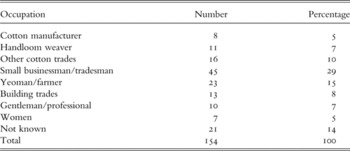
On completion in 1822, club members enacted a Deed of Covenant with James Neville, which names the owners and those occupying the cottages. The two sets of names differ, confirming that here again the motive was investment in tenanted property. Census schedules and physical evidence have been used to identify the cottages as a notable handloom weaving colony.Footnote 41 Yet only one club member, William Riley, was a weaver. Riley lived at Witton, and two tenants occupied his properties, one, John Riley, an apparent relative. Of the other members, six were yeomen, three were in the building trade, two were shopkeepers, and two were innkeepers, with Robert Boardman describing himself as a gentleman.Footnote 42 As Table 2 illustrates, this broadly matches the membership pattern encountered in other building clubs in the Blackburn area.
Occupations of Blackburn Building Society members

Table 2 is compiled from the occupations of every Blackburn club member known to date. It also includes those whose occupations are not known, in order to minimise distortions in the other figures. Almost half the membership was drawn from the agricultural (yeoman/farmer) or small business/tradesman sectors. The latter includes shopkeepers, innkeepers, watchmakers, and local brewers William Dutton and Daniel Thwaites. While it is not certain whether someone described, for instance, as a cordwainer, owned his own business or worked for an employer, this long-term commitment may denote self-employment. Building trades, while properly part of the small business/tradesman sector, are listed separately to show the relatively low percentage involved in fairly substantial building schemes. Nevertheless, a joiner or stonemason may have played a key role, ordering materials or acting as site supervisor.
The cotton sector provides less than one quarter of the membership, with weavers shown separately. This reveals their low numbers and negates the notion of self-help. The ‘other cotton’ group encompasses warpers, sizers and textile printers. Attorneys, a clerk and a land surveyor are included in the ‘gentleman/professional’ sector. Women are described simply by their marital status, however in some cases those acquiring property left a will, enabling additional personal details to be discovered.
John Haworth's will shows something of his investment motives. Haworth, landlord of the Bird in Hand in Darwen Street, Blackburn, owned three properties as a member at Mile End, together with two others acquired through his membership of the Waterloo Building Society on the town's southern perimeter (SD 665 258). Like Mile End, Waterloo has also been identified as an important handloom weavers' colony,Footnote 43 and was constructed on land belonging to Robert Boardman's father. In addition, Robert. Haworth's will shows that after his death he wanted his properties to be sold and the proceeds divided amongst his family. In contrast to William Crook's example, Haworth made sound speculative investments.Footnote 44
One question arising from the identification of so many handloom weavers' cottages is for whom their occupants produced cloth. The involvement of textile manufacturers in building clubs, as members or as landowners promoting the project, indicates that this benefited their putting-out activities. Two manufacturers were members at Witton Stocks; Henry Sudell, with a warehouse at Ainsworth Street, and Robert Boardman, whose business address is unknown. Boardman was also involved with Billinge Hill Building Society to the west of Blackburn (SD 652 283) and those at Mile End and Waterloo. Two more were found at Manor Road; Peter Smalley, of 8 Brown Street, and Thomas Cavis from Osbaldeston, north-west of Blackburn, and one, Robert Chadwick, of unknown address, at Copy Nook, east of the town centre (SD 694 282). The manufacturer at Seven Acre Brook, William Heskin, ran his firm from Thunder Alley in Blackburn, while four were connected with the development of 82 houses at Fisher Street, Daisyfield (SD 688 287), north-east of the town; William Alston, George Illingworth, Joseph Edmondson, who are not listed in the local trade directory, and landowner James Fisher whose firm operated from Old Chapel Street.Footnote 45
Subscribing to societies building handloom weavers' cottages was therefore a strategic investment for textile manufacturers, as defined by John F. Wilson.Footnote 46 Given the numbers of weavers and costs of housing them, building clubs offered the shrewd manufacturer an effective way of procuring the necessary labour and workshop capacity. As a consequence, manufacturers benefited from a form of fixed capital expenditure which was largely financed by the subscriptions of their fellow club members. Moreover, in contrast to their predecessors in earlier decades, who used the services of a more scattered workforce, manufacturers employing weavers in colonies close to the commercial centre would gain from closer supervision of product quality and delivery timings.Footnote 47
IV
Findings from societies active in Blackburn are supported by evidence of investment in other Lancashire textile towns. Chorley had several house-building schemes designed to meet the needs of the town's growing population. The local trade directory of 1793 explained these developments thus:
The increase of inhabitants for several years past has been very great; a building club has lately been established with success; and for the still further improvement of the town there is a tontine, the produce of which is intended for building.Footnote 48
Whilst the location of the building club referred to in the directory remains to be confirmed, one club built Long Row, a terrace of 21 houses in Bagganley Lane, north of Chorley, but no details of the club's membership are known (SD 595 188). A substantial development off Bolton Street at the southern end of town was built by the Duke of York Building Club (SD 587 169). Many of its 31 members received more than one plot, collectively constructing some 80 handloom weavers' cottages on King Street, Queen Street and Princess Street. Members comprised a cross-section of the community, including Reverend Oliver Cooper, calico printer David Duxbury, surgeon Charles Hill, clockmaker Thomas Houghton, innkeeper Thomas Green and ironmonger Thomas Troughton. The building trade was represented by Thomas Tassiker, a plumber and glazier, and stonemasons William and Edward Fairclough. Innkeeper Elizabeth Bradley was one of four women members, while Robert Lightoller, was master of the cotton spinning factory at Standish Street.Footnote 49
Two members of the Duke of York society also belonged to another venture in the vicinity. Calico printer David Duxbury and gentleman Roger Anderton also joined William Leigh's Building Field Society, recorded in solicitor William Hough's minute book on 18 August 1808 as having one share each.Footnote 50 This society constructed handloom weavers' cottages on Leigh Street and Leigh Row, to the west of Bolton Street, completing the project in November 1814 (SD 584 172). Hough took ten of the 29 shares, augmenting his portfolio of tenanted properties, with multiple shares taken by yeomen Thomas Hindle and Richard Johnson, and clogger Samuel Mills. Other members included cordwainer James Whittaker and gentleman John Harrison. Weaver John Jolly appears to have been the sole owner-occupier. Investors from further afield included Leyland innkeeper Edward Barnes, Pilkington print cutter William Appleby, and Coppull shopkeeper John Ryding.Footnote 51
As noted earlier, club house developments of handloom weavers' cottages offered manufacturers reduced outlay on fixed capital expenditure. Table 1 shows other benefits. For example, club members retaining property for the longer term could recoup their outlay over seven years, taking a profit in the form of rental income thereafter. That the sale of completed weavers' cottages was also profitable is revealed by another entry in William Hough's notebook. This minutes his sale of a share in the Duke of York society while the club was still active. Hough purchased this for £40 in 1805, and after paying into the club £18 16s 3d for monthly subscriptions (and ale), sold it in 1808 to liquor merchant Thomas Coward for £84 9s 3d, giving him a profit over three years of £25 13s 0d.Footnote 52 Whether this single example was typical is unclear, but the fact that Coward was willing to pay such a price suggests that it was not unusual.
Clitheroe, like Longridge and Chorley, also hosted three building club ventures. One built a long row of 35 handloom weavers' cottages on Whalley Road (SD 741 410).Footnote 53 This commenced soon after the neighbouring Primrose factory was acquired for calico printing by Messrs. Thomson, Chippendale and Burton in about 1810. Calico printer and merchant James Thomson and John Lofthouse, a local draper, took a 999-year lease of the site for the club in 1816.Footnote 54
The involvement of Thomson, managing partner at Primrose printworks, in procuring land for this development demonstrates the value to entrepreneurs of having a colony of weavers located close to their business, for this would provide for the firm an element of vertical ownership. Indeed, the Primrose ledger lists six club houses retained among the firm's assets. Their initial appearance in the stock figures for 1 January 1821 suggests that they were newly completed, for their value of £90 each was marked down to £87 10s 0d a year later, falling to £85 in subsequent years. Rental income fluctuated between £142 13s 0d in 1822, £112 17s 0d in 1823 and £129 3s 0d in 1824, perhaps because good tenants were more difficult to find in some years.Footnote 55
Another society promoted by an entrepreneur in the finishing trade was the first club in Horwich, west of Bolton, recorded in Thomas Hampson's history of the town, published in 1883 (SD 645 114). He associated the development with Thomas Ridgway, owner of the nearby Wallsuches bleachworks, and concluded that Ridgway's purpose was ‘to inculcate lessons of thrift’ by offering parts of his own Stocks estate ‘on long leases on easy terms’.Footnote 56
However, those identified as owners by Hampson were clearly not employees of Wallsuches. The committee comprised three farmers, a shopkeeper, the local vicar and a whitster (bleacher) from Anderton near Chorley. Leases show that when the club terminated in 1809, the houses were already let to tenants, and purchasers included vicar Leonard Redmayne, John Lowe, a farmer from Hulton, south of Bolton, and William Pass, a Horwich publican.Footnote 57 Nor were they let to bleachworkers, for the houses are identified from their physical characteristics as handloom weavers' cottages by Geoffrey Timmins.Footnote 58 Like those at Clitheroe and Bamber Bridge, the club at Horwich was designed to construct homes for handloom weavers, producing woven cloth for finishing, probably at Wallsuches.
The Ridgways were closely involved with the club, for Thomas Ridgway leased the site to the building society committee. His son Joseph was a committee member, and Thomas himself was its treasurer. The club's method of operation differed radically from those clubs encountered further north in the county for they began to transfer legal title by granting underleases as soon as the first houses were built in 1803, rather than waiting until all were completed, as happened with other societies. Indeed, Hampson's claim that the club was formed ‘to inculcate lessons of thrift’ is plainly wrong, for an enigmatic phrase in leases enacted in 1809 states that properties were sold ‘in order to liquidate the debts and for the General Purposes of the said Society’.Footnote 59 Moreover, six of the 46 cottages were sold for between £160 and £175 each, considerably more than the building costs incurred by the Blackburn clubs identified earlier. These sums also exceed prices achieved at auctions in nearby Bolton, although the size and quality of the Horwich club houses may have accounted for the difference.
Circumstances leading to the sale of the properties are unknown, as the leases only recite that the purchaser had a contract with the committee. Indeed, some of the committee were among the purchasers. The range of dates quoted by Hampson may indicate that there was an intention to sell the houses from the outset, with members taking a share of the proceeds rather than a completed house. This was a form of dividing society similar to the tontine schemes building houses in Blackburn and Chorley,Footnote 60 and three building societies in Bolton also used this procedure.
Thomas Ridgway's involvement suggests strategic self-interest rather than Victorian perceptions of paternalism and social responsibility. Like calico printer James Thompson at Clitheroe, Ridgway played a key role in a club designed to site a handloom weaving colony close to his business. Anthony Howe observes that before the intervention of commission agents in the 1840s, most large firms purchased the cotton goods they printed and were responsible for the sale of finished items, so it would make commercial sense to promote the construction of homes with workshops for those producing their cloth.Footnote 61 Like the handloom weaver colony at Clitheroe, that at Horwich would have offered some of the benefits of economic integration to the Wallsuches bleachworks.
The building societies formed in Bolton followed the passing of an Act of Parliament for enclosing Bolton Moor in 1792. The enclosure was intended to house Bolton's expanding population, and proceeds of the sale of building plots were applied to public improvement of existing streets, for example paving, lighting and widening. Three textile manufacturers, John Ridgway, John Pilkington and John Makinson, took 5,000 year leases of plots to the south west of the town centre. It is not clear how plots were allotted, but the three acquired adjacent sections along roads leading from the south-west into Bolton. That three adjacent club house projects were sustainable demonstrates a keen interest among prospective investors.
John Ridgway, brother and former business partner of Horwich's Thomas Ridgway, was a cotton spinner, merchant and fustian manufacturer who formed Ridgway's Building Society, constructing close to the junction of Deane Road and Derby Road (SD 709 085). Trustees included retired surgeon John Popplewell, Ridgway's son John, a merchant, his brother Thomas, liquor merchant William Wilkinson, and cotton manufacturer John Kenworthy. The 38 members named in an Agreement dated 1 January 1797 included local businessmen and professionals like Halliwell bleachers Peter and Richard Ainsworth, textile manufacturers George Escrick, William Platt and Thomas Rothwell, grocer John Cron and attorney Ralph Boardman.Footnote 62
A plan of the development drawn by local surveyor John Albinson shows that 44 houses were constructed, and 34 plots remained unbuilt upon. Completed houses in James Street and Kay Street were sold at auction on 28 May 1807, on underleases of 4,500 years. Widow Ann Brown acquired one for £120 16s 0d. Corn dealer Thomas Holden, a club member, was another successful bidder, taking two houses and two vacant plots for £205 16s 0d. As a subscriber to this dividing society, Holden would have received a share of the auction's proceeds, but elected to bid at the auction and reinvest his profits in his own choice of property. These were already let to tenants. Holden's will of 22 August 1817 reveals that like many successful investors he had accumulated a portfolio of tenanted property.Footnote 63 The sale of 46 houses for between £100 and £120 each generated a minimum of £120 for each of the 38 club members. Although subscription costs are unknown, membership was evidently a profitable investment.
John Pilkington, another member of Ridgway's Building Society and also an improvement trustee, leased five plots from the commission. The site selected for Pilkington's club houses lay to the south of Ridgway's on four enclosure plots. Names of club members are unknown, but a total of 55 houses was constructed, with a further 64 plots unbuilt upon. The reason for leaving so many for future development is unclear, but may have optimised income for the membership. Seven successful bidders in 1805 were muslin manufacturers, one of whom, John Horrocks, purchased two of the lots. Thomas Holden, a subscriber to Ridgway's Building Society, purchased four of Pilkington's properties, and again these were let to tenants.Footnote 64 Local historian Allen Clarke describes them as handloom weavers' cottages with loomshops.Footnote 65
Muslin manufacturer John Makinson, who had a warehouse in Bolton's Deansgate, leased two enclosure plots just to the west of those developed by John Ridgway. Makinson's Building Society constructed 39 houses on Punch Street, and these were auctioned in October 1807. Successful bidders for the tenanted properties included farmers James Ryley and Jonathan Morris both of Heaton near Bolton, baker James Haslam, heald cutter Jeffrey Scholes, reed maker Phineas Elton, bleacher Thomas Morris and muslin manufacturer James Robinson, all of Bolton. Ryley paid 114 guineas for his property, suggesting that most Bolton club houses had a similar value.Footnote 66
These building society projects in Bolton enabled subscribers to share the proceeds of a property auction, when they might reinvest by bidding for tenanted property. Any member wishing to live in a house constructed by a Bolton building society needed to attend an auction, and the prices raised would severely restrict artisan ownership. This method of housing finance excluded those having no capital to buy at auction, leading to the conclusion that societies offered investment opportunities rather than self-help towards owner-occupation.
V
Housing provision by terminating building societies in the late eighteenth and early nineteenth centuries was largely confined to English industrial regions. Their role, particularly in the regional socio-economic context, has hitherto been somewhat understated, as evidenced by the number of societies that were active in Lancashire. Throughout textile Lancashire the need to provide housing for the major sector of the labour force offered investment opportunities for those seeking a secure home for surplus income. Providing homes with workspace for a weaving workforce of some 170,000 by 1821 is estimated to have involved the construction of between 39,525 and 79,330 loomshops and/or specialist cottages. This number of new loomshops alone perhaps cost between £1 million and £2 million, while purpose-built cottages with loomshops to house the same number required expenditure of £3.6 million to £6.8 million.Footnote 67
Terminating building societies clearly offered excellent investment opportunities, particularly to those constructing homes for a specialist workforce of handloom weavers, at a time when their skills were at a premium, and the conversion of existing buildings was insufficient to cope with demand. The great majority of society members were not owner-occupiers, but rather those seeking a rental income from high-earning tenants. The cooperation evidenced among club members was that of small-scale venture capitalists, drawn from industrialists, small businessmen, artisans and women, whose investment horizons were otherwise limited. Lancashire's building clubs thus offered opportunities for the wider community to engage in financial networking and share in the profits generated by industrial and consequential urban expansion.