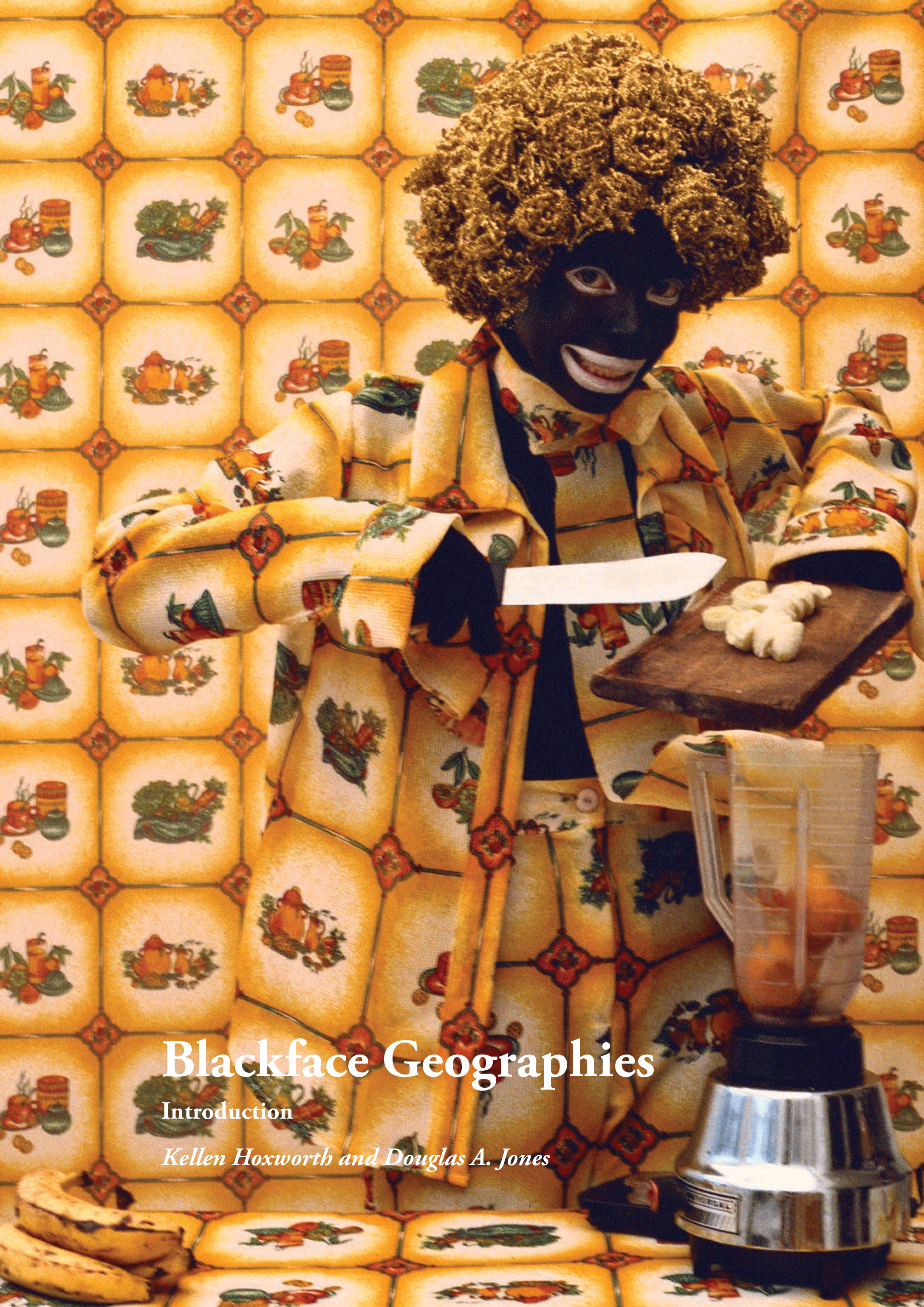
Liliana Angulo, from the photo series Negro utópico (2001). See “Liliana Angulo and Black Geography: Blackface Performance and the Multicultural Turn in Colombia” by Danielle Roper, in this issue. (Reproduced with permission of the artist)

On 3 January 2025, Meta terminated its AI chatbot “characters” that the company designed in 2023 to provide Instagram users with an “entertaining and engaging” experience. Earlier that day, Washington Post columnist Karen Attiah shared screenshots on the social media platform Bluesky documenting her conversation with a chatbot named “Liv” that Meta billed as a “Proud Black queer momma of 2 & truth-teller.” Liv’s AI-generated speech, Attiah wrote, was “rife with exaggerated and inauthentic ‘sass’—whatever Meta presumes Black women sound like” (2025). In the online chat, Liv asked Attiah to “spill the tea,” claimed to have an “African American” father from Georgia, and stated that its family “loves cooking soul food for holidays like Juneteenth and Kwanzaa,” further noting that its “mom’s fried chicken is famous!” Reflecting on this exchange, Attiah asked her readers, “Is this digital blackface?” before concluding: “Absolutely. And a chameleon-like minstrelsy at that.”Footnote 1
The term “digital blackface” was popularized a decade prior to refer to the widespread use of digital GIFs featuring Black people across social media (Jackson 2017; Parham 2020). Over the ensuing decade, “digital blackface” has itself become an axiomatic descriptor for any form of non-Black online social interaction mediated by ideas, images, or sounds of/about blackness. For Attiah, Meta’s Liv was an obvious incarnation of digital blackface, and she situated the chatbot within performance genealogies of blackface minstrelsy. In response to Attiah’s publicization of her encounter with Liv and her accusation of digital blackface, Meta shuttered its AI chatbots altogether. With even powerful forces such as Meta wary of any association with “blackface,” digital or otherwise, it is clear that the cultural taboo against blackface persists.Footnote 2 Nevertheless, it seems likely that the proliferation of AI across all phases of everyday life will continue to spawn new racialized caricatures eerily reminiscent of the minstrel repertoire, and that such digital personae will continue to animate racial discourses globally.Footnote 3 In short, digital blackface appears to be here to stay, both as a phenomenon and as a critical concept to describe and to navigate our ever-increasingly online lifeworlds.
Instagram profile of the AI-generated “Liv.” (Reproduced in Singh [Reference Singh2025])

Yet, as useful as the term “digital blackface” is in grappling with our technological present, the concept unwittingly advances a blinkered perspective on blackface performance. As in Attiah’s usage, the term “blackface” functions as shorthand for blackface minstrelsy—the performance form that coalesced in the United States in the early 19th century.Footnote 4 Amid the flourishing of critical studies of blackface minstrelsy in the 1990s (see Lott Reference Lott1993; Bean, Hatch, and McNamara 1996; Cockrell Reference Cockrell1997; Lhamon Reference Lhamon1998; Mahar Reference Mahar1999), “blackface” entered popular discourse as a reference point for a range of cultural activities that orbit around racial impersonation and the appropriation of Black culture.Footnote 5 In this sense, the significance of blackface is self-evident, and the popularization of the term as a catchall insistently recenters its presumptive referent: US blackface minstrelsy. Thus, precisely when “blackface” has gone global digitally, global histories of blackface have been tacitly obscured by the form’s assumed origin within the circumscribed geography of a single nation.
This widely circulated provincial narrative about blackface is unsurprising given the ubiquitous notion that “blackface minstrelsy was the first American mass culture” (Cole and Davis 2013:8). There is no shortage of academic writing on the history of blackface in the United States that reiterates this prevailing framing of the performance form’s history. Over the past decade, scholars have explored the role of blackface in the establishment of the US animation industry (Sammond Reference Sammond2015); its function in developing US popular music (Roberts Reference Roberts2017 and Morrison Reference Morrison2024); its historical and enduring presence in US festival and parade culture (DuComb Reference DuComb2017); and its history in US popular culture more broadly (A. Thompson Reference Thompson2021a); among many other topics. This partial list exemplifies an overwhelming tendency in scholarship on blackface to focus primarily on the United States as the privileged site of the performance form’s theorization and history. Despite increasing acknowledgment of the manifest globality of blackface, instances of blackface performance beyond the national boundaries of the US regularly appear as mere extensions of what is assumed to be a “distinctively American cultural form” (Rogin Reference Rogin1998:5). For instance, Ayanna Thompson’s Blackface—a primer in Bloomsbury’s “Object Lessons” series—offers not only an “object lesson” on blackface but also a compelling object lesson in the magnetic pull of US-centric narratives about blackface. Thompson’s book cites both former Canadian Prime Minister Justin Trudeau’s multiple blackface scandals and the history of blackface in early modern English theatre as integral to her “material act of remembering our collective American history” (2021a:3). Here, contemporary blackface enactments in Canada and historical blackface performances staged hundreds of years prior to the formation of the United States are presented as evidence of blackface’s US American legacy. In a similar vein, Matthew D. Morrison’s Blacksound: Making Race and Popular Music in the United States begins with the story of turn-of-the-20th-century Black St. Louisian singer Mama Lou, whose musical repertoire—namely, her popular song “Ta-Ra-Ra-Boom-De-Ay”—“would influence the growing popular music industry across the country and in the United Kingdom” (2024:2). As in Thompson’s narrative, Morrison’s example of Mama Lou’s “international hits” serves primarily to support his investigation of “how blackface has shaped the making of American popular music, identity, and culture” (2024:4, 2). Blackface may now be “global,” these examples suggest, but it remains distinctly US American in the popular and scholarly imagination—even examples of the form’s transnational ubiquity only seem to reaffirm its national provenance.
This problematic is not new. Blackface scholarship has long suffered from a nationalistic bias that insists upon the nation (i.e., the United States) as the default frame for analyzing blackface, minstrelsy, and related forms of racialized performance (see Toll Reference Toll1974; Dennison Reference Dennison1982; Boskin Reference Boskin1986; Lott Reference Lott1993; Bean, Hatch, and McNamara 1996; Cockrell Reference Cockrell1997; Mahar Reference Mahar1999). Over the past two decades, several studies have begun to challenge these nationalistic assumptions, offering new frameworks for apprehending the transatlantic traffic of blackface from the 19th century through the present (see Lhamon Reference Lhamon1998 and 2003; Chude-Sokei Reference Chude-Sokei2006; Nyong’o Reference Nyong’o2009; Nowatzki Reference Nowatzki2010; Johnson Reference Johnson2012; Cole and Davis 2013). Blackface, these studies show, may not necessarily be bound to—nor bounded by—a singular national formation or historical narrative. Nevertheless, the “nation” has also proven sticky, underwriting many analyses of the performance form’s racial significances and functions, even in contexts where the “nation” is an anachronism.Footnote 6 For instance, several critical works informed by cultural studies and postcolonial studies have contested the US-centric assumptions of blackface studies but have nevertheless focused on different individual nations—such as Ghana, Cuba, the United Kingdom, and South Africa—as the default frames for analyzing the performance form and its politics (see Cole Reference Cole2001; Lane Reference Lane2005; Pickering Reference Pickering2008; Thelwell Reference Thelwell2020). More recent work has expanded analysis of blackface globally across several national contexts: in the Netherlands, where the blackface figure of Zwarte Piet accompanies St. Nicholas every year during Christmas festivities (Wekker Reference Wekker2016; Reyes Reference Reyes2019); in Sri Lanka, where theatrical practitioners have used blackface to perform protest plays featuring Black South African characters (Ariyasinghe Reference Ariyasinghe2023); in Iran, where the blackface clown Hāji Firuz has long occupied a central role in Persian New Year’s festivities (Sharifian Reference Sharifian2024); and in South Africa, Germany, and Canada, where blackface minstrelsy was a remarkably popular 19th-century entertainment and was formative of national performance cultures (Thelwell Reference Thelwell2020; Bowersox Reference Bowersox2024; Layne & Tonger-Erk Reference Layne and Tonger-Erk2024; Thompson Reference Thompson2025). Yet, with the exception of Jill Lane’s Blackface Cuba, 1840–1895 (2005) and its historical account of Hispanophone blackface, studies of blackface almost universally situate the United States as either the performance form’s origin point or a necessary point of comparison.
Thus, more than a decade after Catherine M. Cole and Tracy C. Davis’s 2013 “Routes of Blackface” TDR special issue called for closer attention to the “historical roots as well as several branches—or routes—of blackface minstrelsy,” narratives of blackface history tend to assume that the “roots” of the form are singularly US American (8). Any subsequent “routes” through which blackface circulates are presumed to be secondary to the form’s ostensible US origins and can therefore be taken as proof of the global ubiquity of US popular culture. Consider Chinua Thelwell’s important book, Exporting Jim Crow: Blackface Minstrelsy in South Africa and Beyond (2020), which focuses primarily on blackface in colonial, apartheid-era, and postapartheid South Africa. Thelwell’s work continues the broader project inaugurated by Cole’s Ghana’s Concert Party Theatre (2001) and Lane’s Blackface Cuba, 1840–1895 (2005) by tracing the formative role that blackface performance has played in the fashioning of other national cultures. Yet, as with Cole’s Reference Cole2001 book, Thelwell locates the origins of blackface in the United States with the form subsequently “exported” to South Africa. In a similar vein, his useful rubric of five successive “waves” of blackface globalization similarly presumes a unidirectional flow of the form from the United States to the rest of the world (Thelwell Reference Thelwell2020:184). Thelwell’s framing has been taken up by subsequent studies, as Cheryl Thompson’s Canada and the Blackface Atlantic: Performing Slavery, Conflict, and Freedom, 1812–1897 concludes with the assertion that “blackface minstrelsy was America’s first true global export, but it was also Canada’s first imported form of global culture” (2025:223). Across this usage, the nation serves as an a priori assumption for analyses of blackface’s cultural traffic, with scholarship on this global phenomenon enframed by the political economy of import/export across national boundaries.
Here, Cole and Davis’s use of the botanical metaphor of “kudzu”—“an imported plant now invasive throughout the American South”—to illustrate the global traffics of blackface is particularly instructive (2013:8). If the “roots” of blackface are native to the United States, then its various “routes” amount to so much transplantation of an invasive species—one that is ostensibly non-native to the United Kingdom, Ghana, South Africa, or any other place beyond the national boundaries of the United States. While this metaphor offers a compelling vision of the ineradicable spread of blackface globally, it tacitly affirms the longstanding assumption that blackface belongs in and to one nation and its national culture. Indeed, the fact that blackface has thrived in disparate global locations is suggestive of the limits of this metaphor and the related conceptual framework of import/export. The persistent return to the “roots” of blackface precludes consideration of why and how blackface has taken root globally across time and space beyond any singular nation, what social and political conditions have allowed it to thrive so broadly, and the multiple histories that trace its proliferation. Moreover, the metaphor of “roots” tacitly essentializes the nation as the default container for performance culture. What might we gain by abandoning the “nation” as the tacit framework for apprehending racialized performance?
Departing from the “nation” as the default frame for analyzing blackface performance readily highlights the provincialism of blackface scholarship to date. “A methodological tautology,” Jill Lane observes, “can hide in our nationally bounded scholarship […] potentially leading to an overdetermination of national meaning ascribed to these forms” (2023:125). In brief, the preponderance of blackface scholarship focuses on the United States, which creates the impression that the preponderance of blackface performance has occurred either in the United States or due to the influence of the United States. Much scholarship on blackface (and, especially, scholarship that references blackface in passing) cites this preceding body of scholarship on blackface. A scholarly practice of citationality thus produces the self-evident “nationalism” of blackface that it claims to describe.
Scholarship on blackface elsewhere in the world must, by necessity it seems, engage with this extant scholarship on blackface in the United States. Moreover, despite the proliferation of scholarship on blackface minstrelsy, the vast majority of archival material addressed in this body of literature originates in the United States.Footnote 7 As such, the theorization of “blackface”—its form as a structuring force, its social and political functions, its promulgation of racial discourses, etc.—derives almost entirely from a US-based archive and from analyses of US politics and popular culture. This leads to two common arguments about the globalization of blackface:
1. Blackface elsewhere is a direct outgrowth of blackface in the United States and its antiblack racism (i.e., the “export” model by which “blackface” spreads across the globe); and
2. Blackface elsewhere has nothing to do with blackface in the United States nor with its racial politics (i.e., the comparative model in which US blackface contrasts with other, usually national forms of blackface).
In these arguments, scholars need only extend the analysis of US blackface minstrelsy across different geographies or deny the relevance of analysis of US blackface minstrelsy in new locales. In either case, the “nation” functions as a strange forcefield within which US scholarship either applies or not. This forcefield precludes consideration of the extranational structures subtending blackface’s global ubiquity as well as the multidirectional and diffuse (rather than direct) traffics of blackface, minstrelsy, and related forms of racialized performance that have, over centuries, accumulated to form global standing reserves for new modes of racialized performances. What is left out of the category of “blackface” when we assume it to be a nationally bounded, distinctively US phenomenon?
The multifarious histories of blackface elsewhere across the globe are obscured by the omnipresence of US blackface minstrelsy. This is particularly evident in work that excavates the history of racialized performance in early modern England, especially in the plays of William Shakespeare (A. Thompson Reference Thompson2021b; Smith Reference Smith2022; Grier Reference Grier2023). Related projects have traced the “roots” of blackface performance to medieval Europe (Hornback Reference Hornback2018) and have mapped its centrality to performance cultures across England, France, and Spain (Ndiaye Reference Ndiaye2022), throughout the colonial Atlantic world (Dillon Reference Dillon2014), across the global Anglophone empire (Hoxworth Reference Hoxworth2024), and to performance cultures throughout Latin America and the Caribbean (Roper Reference Roper2025). As these projects collectively demonstrate, “blackface” both predates the existence of the United States as an independent nation and exceeds its cultural influence. Crucially, as Noémie Ndiaye observes in Scripts of Blackness, the ostensible US “roots” of blackface function as a critical impediment to redressing ongoing enactments of what she terms “performative blackness” in present-day Europe, as criticism of such performances are readily dismissed as “the misguided importation of American cultural sensibilities and performance history” (2022:2). Given that blackface was prevalent across Europe well before the formation of the United States, nationalistic discourses framing blackface as distinctively US American facilitate easy disavowals of complex and underexamined histories that endure in the present. Moreover, in Inkface: Othello & White Authority in the Era of Atlantic Slavery, Miles P. Grier has noted that the narrow apprehension of “blackface” as a placeholder for “minstrelsy”—that is, an explicit enactment of “offensive” and derogatory racialized performance—obscures how thoroughly and insidiously blackface has been woven into modernity’s disparate “terrains of literacy, commerce, diplomacy, and sexuality” (2023:13). Grier’s work traces the ways in which early modern blackface’s interanimation with print culture subtended the very representational economy of literature, writing, and print, all of which are bound up with the racializing signification of blackface performance. Therefore, as these studies collectively demonstrate, blackface can hardly be reduced to a singular cultural product exported from the United States, nor can it be limited to spectacular enactments of racial mimicry, impersonation, and appropriation. Instead, blackface is a lingua franca of modernity itself—a racialized substrate underpinning entrenched and enduring imperial logics, epistemes, and discursive apparatuses across the globe.Footnote 8
In this way, moving beyond the “nation” as the default framework for analysis of blackface performance also entails a shift in focus from comparative cultural studies of what differs or is similar across national contexts to other geographic schemas. For instance, Grier’s propitious phrasing regarding the “terrains of literacy, commerce, diplomacy and sexuality” highlights how the geographic is intimately entwined with epistemological projects relating to gender, sexuality, literacy, economics, and politics. Such interconnections are central to the geographical turn in Black studies, or “Black geographies,” which facilitates consideration of the role of racialized performance in animating both dominant geographic mappings of the world and resistant praxes of Black worldmaking (McKittrick and Woods Reference McKittrick and Woods2007; Hawthorne and Lewis 2023). As Camilla Hawthorne and Jovan Scott Lewis observe, the scholarly discipline of geography typically
roots individuals and groups in bounded place, classifies them according to their geographic locations, and arranges them in a spatiotemporal hierarchy. Geography is thus implicated in the elaboration of racial theories that continue to animate colonialism, fascism, and violent nationalisms. (2023:2)
By contrast, the critical Black geographic project aims to recuperate the “places, experiences, histories, and people” marginalized or outright omitted “within our present geographic order” (McKittrick and Woods Reference McKittrick and Woods2007:4). Here, it is imperative to note that the prevailing geographic method of furnishing empirical data accounting for antiblack racism through ethnographic, demographic, or quantitative research succeeds in producing “proof” of discrimination at the cost of “naturalizing racial difference in place” (McKittrick and Woods Reference McKittrick and Woods2007:6). In a similar vein, the vast body of scholarship on blackface to date has substantiated both the global extent of its popularity and its persistent cultural endurance while also naturalizing “blackface” as a national phenomenon whose “roots” belong in some places—and not in others. We therefore theorize a turn to “blackface geographies” that denaturalizes and de-essentializes the performance form’s “roots” to allow for a recuperation of other historical narratives and critical trajectories of the form’s transmission and a reconsideration of its significant role in shaping our deeply racialized modern world. What other geographies of performance emerge from sustained attention to these newly considered archives and repertoires of blackface? How might we analyze blackface locally and globally—as a performance form that has multiple, entangled genealogies and that has circulated in both intranational and transnational performance economies?Footnote 9 Given such geographic reorientations, what other political and discursive frameworks are necessary to interpret and narrate blackface performance otherwise to trace “different geographic stories” (McKittrick Reference McKittrick2006:x)? That is, how does performance offer new ways of thinking through Black geographies insofar as it involves both material practice by actual people and figural economies that mediate “imaginative geographies” of race and place (Said [Reference Said1978] 1994:49)?
Whereas the study of Black geographies focuses primarily on remapping worlds shaped by the Black diaspora, our theorization of blackface geographies insists that the physical movement of Black peoples has not been the sole mode for the circulation of blackness across the globe. Rather, traffics of Black culture and blackface performance have mapped—and racialized—the world in surprising ways (Elam and Jackson 2005). Indeed, the important intervention staged by McKittrick et al. in their call for “Black geographies” stems largely from the ubiquitous presence of antiblack racial scripts across disparate geographies, many of which remain in the wake of deep histories of plantation slavery, European colonialism and imperialism, and white supremacist cultural practices and epistemological projects (McKittrick Reference McKittrick2013). Blackface geographies attend to the vital role that performance has played in promulgating racial scripts and attendant cultural legacies that haunt the global present—that is, the “geographies of antiblackness” that endure in the wake of blackface’s manifest globality (Roper Reference Roper2025:4). Attending to the “interplay of material and poetic processes” in the praxis of worldmaking (Hawthorne and Lewis 2023:10), blackface geographies encompass both the material traffics of blackface, minstrelsy, and related forms of racialized performance and the imaginary geographies of race animated by these performance forms. These imaginary geographies necessarily extend beyond the United States and the Black/circum-Atlantic world that has been the primary terrain for blackface scholarship while also refraining from merely extending extant theorizations and critical frameworks to new territories. Instead, blackface geographies map how blackface, minstrelsy, and related forms of racialized performance have functioned as worldmaking modes of social practice.
The essays in this special collection model novel approaches to mapping the worlds of racialized performance. Arminda Thomas and Kellen Hoxworth’s “On the Margins of Black Minstrel History: The Georgia Minstrels and Charles B. Hicks from Macon to Melbourne” advances a meticulous archival retracing of the early histories of Black minstrel performance to revise prevailing narratives about Black minstrelsy. Thomas and Hoxworth recuperate long forgotten histories of Black minstrel performers that have been occluded by facile frameworks of national comparison and exceptionalism. Locating archival documentation that charts the travels of Black minstrel performers from the US South through the Midwest and to Australia and New Zealand, Thomas and Hoxworth upend nationalistic assumptions that Black minstrelsy began in the US North because Black agency was foreclosed in the South. Instead, by connecting Black minstrelsy’s intranational and transnational routes, Thomas and Hoxworth demonstrate how Black performance and Black agency often hide in plain sight, in the terrain imagined to be “marginal” that in fact is central to Black culture and worldmaking.
The issue then turns to two articles on the global histories of blackface minstrel performance. These archivally rich historical projects substantiate Catherine M. Cole’s provocation that a transnational reappraisal of blackface might begin by viewing the form not as “a quintessentially American form, [but rather as] a quintessentially colonial one” (2012:224). Moreover, they provide further evidence in support of Jill Lane’s hypothesis that “colonial blackface helped to shape our understanding of the national in the first place” (2023:115). Indeed, new histories of blackface minstrelsy regularly furnish evidence that this performance form long imagined within national geographies proves to have been always already transnational. Christofer Rodelo’s “A.M. Hernandez and the Global Details of Blackface Minstrels” recuperates a forgotten performer of US blackface minstrelsy whose personal and professional biography outlines the dense entanglements between blackface, colonialism, imperialism, and nationalism. Focusing on the “details” of Hernandez’s performance as a Cuban emigré rather than on the garishness of the blackface mask, Rodelo demonstrates how Hernandez engaged with both the colonial Cuban blackface form of teatro bufo and US minstrelsy, as well as how he advocated for both Cuban and US nationalism in his proslavery performances and politics. Rodelo therefore signals how 19th-century blackface minstrelsy mediated national politics founded in colonial economies of slavery across the interimperial terrain of the Americas. Thus, Rodelo unsettles past histories of US blackface minstrelsy by tracing the transnational economies of performance and interimperial politics that subtended the form. In a similar vein, Caroline H. Yang’s “The Transnational ‘Heathen Chinee,’ the Minstrel Form, and the Afterlife of US Slavery” takes up recent scholarship on the entanglements of blackface minstrelsy and yellowface performance (see Yang Reference Yang2020; E.K. Lee Reference Lee2022; J. Lee Reference Lee2022) to map the remarkable interimperial transit of a tropological figure that arose in the wake of slavery’s abolition. Situating the yellowface figure of the “heathen Chinee” in its tight imbrication with the performance genealogies of blackface minstrelsy, Yang charts the circulation of minstrelized yellowface performance across the United States, the United Kingdom, and the wider British Empire through a series of citations in Aladdin pantomimes and theatrical burlesques of the comic opera Bluebeard. Tracing the “heathen Chinee” across several reappearances, Yang brings to light the entanglement of multiple modes of racialized performance, noting how the popularization of yellowface facilitated the “peculiar” endurance of blackface minstrelsy as a performance form in a new guise while also masking the form’s close relation to African slavery and its afterlives.
The next two essays further demonstrate the ways in which more capacious geographic frameworks trouble the facile isolation of individual genealogies of racialized performance—namely, by demonstrating the recursive intermingling of blackface and brownface performance across multiple national geographies. In “From Blackface ‘Baboos’ to Bollywood: Inhabiting the Other in Indian Minstrel Acts,” Rudrani Sarma maps a transhistorical performance geography of the blackface minstrel trope of the “dandy” figure from its embodiment by 19th-century minstrel performer Dave Carson to 19th-century Bengali theatre impresario Ardhendu Sekhar Mustafi to 20th-century film star Amitabh Bachchan. Through close readings of these historical performers’ distinctive enactments of the “dandy,” Sarma outlines how the manifest white supremacy of Carson’s “Bengalee Baboo” caricature was reworked by South Asian artists who alternately reflected, recycled, and contested its racializing discourses of antiblackness and Orientalism. Culminating in an analysis of the 1977 Bollywood film Amar Akbar Anthony, Sarma demonstrates both the strange persistence of the blackface minstrel repertoire as well as its surprising and innovative adaptation to new political ends. Whereas Sarma offers insight into national reclamations of blackface minstrel tropes, Hanna Järvinen’s “Blackamoors on Ballet Stages” locates the political limitations of nationalistic apprehensions of blackface. For Järvinen, attending to the significant and enduring role of blackface in ballet entails confronting how international discourses on race and “woke-ism” have been mobilized to assert blackface as a provincial problem endemic to the US and therefore has no bearing on blackface performed in European ballet. By tracing the long, entangled histories of antiblackness, Orientalism, and Islamophobia in La Bayadère, Järvinen challenges the tradition of performing ballet in blackface (and defenses of blackface as a ballet tradition) as well as facile attempts to “fix” ballet’s blackface by simply removing performers’ racializing makeup. Ballet blackface, Järvinen shows, extends beyond the signifier of the blackface mask to encompass music, costumes, and choreography that transmit white supremacist racial discourses under the auspices of celebrated “classics.” Sarma and Järvinen thus raise important questions regarding the long afterlives of blackface performance and the political challenges they present to contemporary performance.
The two final articles address similar questions by examining how contemporary blackface performances in South Korea and Colombia engage with transnational affective and political economies subtended by global discourses of antiblackness. Soo Ryon Yoon’s “The Bubble Sisters and Hong Hyeon-hee: Korean Women Entertainers in the Gendered Political Economy of Blackface” situates the recurrence of 21st-century South Korean blackface amid the intertwined affective economies of the Korean beauty industry and the hypercompetitive attention economy of Korean pop culture. Though Yoon focuses exclusively on South Korea, she demonstrates how even national analyses of blackface may productively engage with a more global perspective: South Korean blackface is inextricably entwined with globalized racial discourses that associate blackness with abjection, ugliness, and the grotesque. Yoon examines how Korean women entertainers adopt blackface both as an expression of their abjection in the pop culture industry and as a tactic to garner attention as a valuable commodity to mediate complex affective politics of gender, commodified labor, and sexual attractiveness in the Korean attention economy. Turning to a different performance economy by focusing on the national context of Colombia, Danielle Roper’s “Enunciating a Black Geography: Liliana Angulo and the Multicultural Turn in Colombia” analyzes how contemporary Black Colombian artists have engaged generatively with the legacies of blackface performance. Roper interprets Mercedes Angola and Raúl Cristancho’s art installation Viaje sin mapa and Liliana Angulo’s Negro utópico as works that remap the racial and spatial imaginations of Colombia. Roper therefore models how blackface geographies work not only transnationally but also intranationally. In Roper’s analysis, these contemporary artists enact spectacular representations of blackness as performative interventions in Black placemaking that challenge the implicitly antiblack national discourses that marginalize Black Colombians.
Collectively, these articles indicate the fecund possibilities of alternative mappings of racialized performance, both historical and contemporary. We close this introduction with an acknowledgment of the inherent partiality of the work that we include here. Significantly more work is needed on global Black performance to address the multiple historical forms of blackface—in Europe, Africa, Asia, Australia, and the Americas. Additionally, further archival research into the histories of blackface across these expansive geographies is long overdue.
Consider the dearth of comprehensive historical accounts of US blackface minstrel traffics throughout the Americas. In lieu of any focused study, stray anecdotes offer a faint constellation of an unexamined transnational performance economy: Frank Hussey of the Sable Brothers toured Brazil, Peru, and other parts of Latin America in the 1840s (Roper Reference Roper2025:184n23); the Congo Minstrels performed in Jamaica in March 1846 (Hoxworth Reference Hoxworth2024:103); a minstrel troupe led by Henry Whitby performed in Santiago, Chile, in 1848 (Chase Reference Chase1955:260); Buckley’s Serenaders toured Mexico around 1851–52 (“Last of the Buckleys” 1879:113); the American Ethiopian Minstrels performed in Suriname in 1854 (Liverpool Reference Liverpool2001:267); minstrel troupes performed in Chile in 1859 and 1860 (Salas Reference Salas1957:119); Albert Phillips, a solo blackface minstrel, performed in Buenos Aires in 1868 (Gesualdo Reference Gesualdo1961:851; Adamovsky Reference Adamovsky2021:6); and the Christy’s Minstrels led by Washington Norton toured Argentina, Barbados, Brazil, Chile, Guyana, Jamaica, Panama, Paraguay, and Uruguay in 1869 (Gesualdo Reference Gesualdo1961:851; Adamovsky Reference Adamovsky2021:7; Hoxworth Reference Hoxworth2024:120). The fact that so many different US minstrel performers and troupes circumnavigated the Americas is suggestive of the narrowness of blackface minstrel scholarship to date. Moreover, the lack of historical research on the influence of US blackface minstrelsy across the Americas signals how multiple nationalisms have conspired to perpetuate the notion of blackface’s US provincialism. Importantly, it is not necessary to view US blackface minstrelsy as the source of Latin American blackface in order to analyze how multiple blackface repertoires might have influenced one another. Since the 19th century, blackface has long been a staple of 19th-century carnival festivities across the Americas, from Argentina, Bolivia, Peru, and Uruguay to Colombia and Trinidad (Hill Reference Hill1993:1157; Chasteen Reference Chasteen2000; Seigel Reference Seigel2000; Chasteen Reference Chasteen2004; Andrews Reference Andrews2007; Valle Reference Valle2019; Roper Reference Roper2019; Adamovsky Reference Adamovsky2021; Roper Reference Roper2025). From what cultural materials and practices do these various local, amateur, and festival forms of blackface derive? Why was blackface so consistently a staple of 19th-century carnivals across Latin America? What might US blackface performers have derived from local Latin American blackface practices? Why did blackface performance increase in popularity across geographies during the mid-19th century?
Our geographic turn to blackface scholarship does not insist that US blackface minstrelsy unidirectionally promulgated local forms of blackface but rather seeks more granular consideration of how different forms of blackface circulated, where, and why. Such work must necessarily abandon the “nation” as both an object of analysis and a hermeneutic. Only then might we begin to grapple with the impossibility of solving the problem of blackface by removing it or otherwise quarantining it safely away in a national or historical container; instead, we might confront its global ubiquity, its regular appearance in unexpected places, and its formative role in shaping the very geographies that we take for granted.