The history of portraiture is a gallery of poses, an array of types and styles which codifies the assumptions, biases, and aspirations of society.
—Harold Rosenberg
Introduction
Belle vue zoo, founded in 1836, both celebrated and replicated the industrial surroundings of Manchester. Looking at the Zoo from a distance, people in the mid-nineteenth century would have remarked upon the establishment's dazzling grounds, illuminated either by Belle Vue's own gas works or by the electricity powered by its robust generators. They also would have caught sight of the zoo's buildings, humming with the action of the steam-driven machines within. By utilizing the most up-to-date technology, Belle Vue was an extension of its neighboring manufacturing city.
For all its dramatic presentation, however, commentators on Victorian zoos have paid minimal attention to Belle Vue – indeed, this establishment also tends to be overlooked by those fascinated with Victorian Manchester.Footnote 1 Compared to the more established and intellectually prominent London Zoological Society Gardens, this provincial and transparently commercial institution, once located just two and a half miles from the center of industrial Manchester, is regarded as being relatively inconsequential. Its displays did not rival the scientific achievement associated with the more famous London organization, for example, nor the Bristol Zoo, which emulated the Zoological Society's avid interest in taxonomy and anatomy.
Rather than compete with this kind of scientific organization, Belle Vue chose to present itself as an institution primarily dedicated to an eclectic celebration of its industrial and imperialistic context. To this purpose, Belle Vue's grounds and exhibits were constructed so as to show off the power of industry as well as to display the reach of empire. Throughout Belle Vue, a series of exhibit rooms gave prominence to new technologies as well as to pictures of contemporary heroes and the spoils of empire. Wandering throughout the various buildings, visitors would have admired one engineering feat after another, glanced at sequences of heroic personages, and then, after reaching the menagerie, as well as the Museum, they would have stood enthralled before the living representatives or the stuffed remains of creatures collected from various corners of the globe. Belle Vue was unique, for, contrary to most establishments in Manchester, it combined the mechanical life of the machine with the rhythms of organic life.Footnote 2
What follows is a discussion of how Belle Vue represented its celebration of industry and empire. To accomplish this task, I shall be considering the ways in which the Belle Vue Zoo, both literally and metaphorically, transformed its grounds and exhibits into a site of portraiture dedicated to promoting and glorifying Britain's achievements. Indeed, Belle Vue was a kind of National Portrait Gallery.
In order to explore this analogy between the Zoo and portraiture and to demonstrate Belle Vue's inimitable celebration of its milieu, I have divided the essay into three sections: In Part One, I shall examine the ways in which this institution, as a whole, presented a portrait of its age. In Part Two, I shall leave this panoramic perspective and enter the Zoo itself in order to consider those exhibitions and spectacles featuring portraits of industrial and colonial leaders. In Part Three, I shall expand the Zoo's relationship to the portrait gallery by focusing on Belle Vue's Menagerie and Museum – spaces which emblematically portrayed Belle Vue's dedication to empire and technology.
Part One: A Portrait of its Age
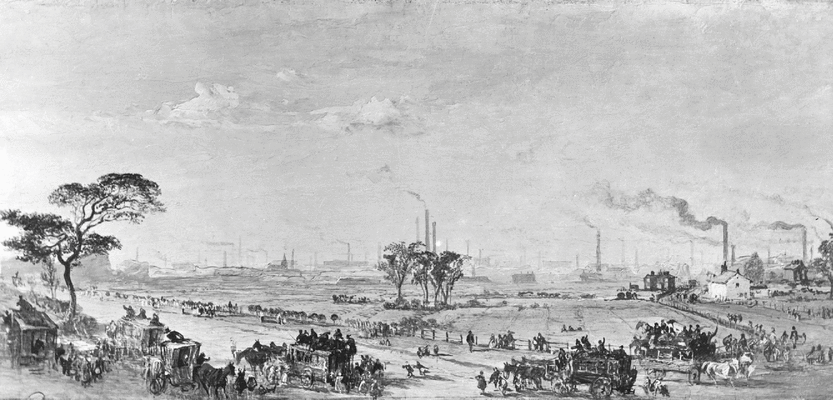
To begin with, the belle vue institution itself can be regarded as a vivid portrait of its time. Through its ostentatious displays of the latest machinery, gadgets, and devices, as well as through its spectacular exhibitions of mock battles, Belle Vue reflected the energy of its manufacturing environment and glorified the reach of empire. This perspective is visible in one of the few remaining pictures of Belle Vue: George Danson's Manchester from Belle Vue, 1861 (Figure 1).
George Danson. Manchester from Belle Vue, 1861. Watercolor. Courtesy of Chetham's Library, Manchester.

Danson's painting situates the institution within its immediate surroundings. With its recurring references to the smoke spewing from the towering factory chimneys, the image's horizon encroaches upon the foreground's sparse traces of a more pastoral era. The stunted pale-green fields are suffering.Footnote 3 The carriages and carts that wind through Danson's canvas transport the noise and business of an industrial town into the forefront of the viewer's consciousness. Like the serpentine smoke from the chimneys, the crowded road coils round the canvas and seems to suffocate whatever quiet stillness had once been part of the landscape.Footnote 4
Upon first glance, Danson's picture revives a memory of the “interminable serpents of smoke” smothering Dickens's Coketown (Hard Times 27; bk. 1, ch. 5).Footnote 5 The painting also recalls the opening pages of Elizabeth Gaskell's Mary Barton in which working-class families amble through “some [idyllic] fields near Manchester” and notice, by contrast, the distant smog hanging over the manufacturing town (5; ch. 1). The filthy smoke and dust that literally and metaphorically smudge these families’ lives seem also to hover over Danson's prospect.Footnote 6 Danson's painting, however, does not unreservedly subscribe to Gaskell's conventional comparison between the restorative countryside and the harsh industrial town, nor does it unconditionally emulate Dickens's sense of industry's intrusive harm. Rather, the painter's intentions were quite different. Instead of criticizing such a prospect, Danson, who, with his two sons, was a long-standing employee of Belle Vue, chose to celebrate the Zoo's proximity to the industrial city. In his picture as well as in the owner's eyes, Belle Vue's grounds lead directly to the factory chimneys, to a landscape that for him and the Zoo's founder, John Jennison, a former silk weaver from Macclesfield, reflects the institution's commitment to the positive power and progressiveness of industry. For them it was quite literally a “belle vue.”
Within the Zoo's boundaries, this manufacturing context was not a cause of despair but an occasion for wonder, a source of amazement. Belle Vue was a showground of the nineteenth-century technology driving the manufacturing towns of northern England. Its monstrous polished and oiled machines associated with Dickens's Coketown became emblems of entertainment as well as extensions of the zoo's living exotic creatures. They were not, as they are in Hard Times, in direct opposition to the fanciful world of the circus. Instead, they became as magical as the horses riding around the center ring.
At Belle Vue the pulsating engines were as much on display as were the animals. This industrial apparatus transformed the zoo's buildings into kinds of “Fairy palaces” or fanciful places where the working men and women (the “Hands” in Hard Times) could escape the monotony and harshness of their long hours in the mills.Footnote 7 Those who labored in the mills or in the manufacturing sites could meander through the gardens, the grottos, the refreshment rooms, and the menageries.Footnote 8 They could also enter Belle Vue's Museum, which, with its display of stuffed animals, insects, and birds, replicated the pastimes of those who, as a diversion from their labors, took an avid interest in natural history. Like the elderly self-educated spinner Job Legh in Mary Barton, many of these visitors would have been “warm and devoted followers” of the “more popularly interesting branches of natural history.” They would have known “the name and habitat of every plant within a day's walking from their dwellings” (Gaskell 39; ch. 5).Footnote 9 As Léon Foucher observed in 1844: “Science which is so often developed by the progress of industry [had] fixed itself in Lancashire” (Kargon 3). It is common knowledge that in Manchester, a number of mill owners and enlightened businessmen endeavored to include their employees in recent discoveries in technology and science. For instance, in 1821, a group of entrepreneurs established the Manchester Mechanics’ Institute. In addition more established organizations, such as Manchester's exclusive Natural History Society, occasionally invited non-subscribers and working men to special exhibits.Footnote 10
In a sense, the Zoo's proprietor, John Jennison, transplanted the population of the manufacturing towns to another kind of industrial site. Indeed, Jennison literally incorporated the Lancashire mills into his enterprise, for he bought and dismantled disused mills so he might use their rough timber to construct some of his own buildings. In this respect, it is significant that when the Belle Vue Zoo fell on hard times during periods of industrial unrest in the 1840s, as well as during the period of the American Civil War, there was a diminution in the cotton trade, which affected textile manufacture.Footnote 11Industry and Zoo were not alien to one another. It is also interesting to note that Belle Vue was periodically associated with the trade unionists and chartists, who marched from surrounding communities to the zoo and gathered for meals in the establishment's extensive tearoom (the refreshment room eventually seated five hundred customers).Footnote 12 As Jennison's grandson remarks: “A great deal of Trade Union solidarity in Manchester has been laid by the processions to Belle Vue, and cemented over the teacups. Nearly ever Saturday in the season these great processions marched through the gates to their plain but ample banquet; the last extension of the tearooms, the old 2d tea room was due entirely to them” (Jennison 80). He continues: “The Trade Union Local Branches used to say that they could not do without us, and there is at least one very important socialist club, the Clarion, that has not missed its Belle Vue meeting for 20 years or more” (Jennison 81).
When Jennison opened the Zoo in 1836, he began with a modest collection of animals. As the years passed, he developed not only the menagerie and the grounds but also the machinery that made everything run. Jennison was intent upon transforming the Zoo into a self-sufficient, efficiently managed manufacturing site. He wanted to show off the achievements of British technology. As a result, by the end of the nineteenth century, Belle Vue had its own printing press, a large brewery, a bakery, a ginger beer company, an elaborate firework factory, its own butchery, a steady supply of hot water heated by steam, a dairy, its own ice production, a brick works, a Daguerreotype studio, an “Eccolobium” – a device in which eggs were hatched by steam, and, in 1897, a Kinematograph for the display of animated pictures. Wanting to be self sufficient, the Zoo also had its own staff of blacksmiths, wheelwrights, joiners, boat builders, painters, and plumbers. Furthermore, Jennison built his own gas works, which were independent of the city supply; he created his own waterworks from a deep spring so that water ran abundantly, via buried pipes, throughout Belle Vue, feeding fountains that were fueled by powerful steam engines that sprayed the water as high as thirty feet. Through the power of steam, a rackety “velociped” (an early type of bicycle made of cast iron fixed to a round wooden platform) whizzed around at great speed; a merry-go-round, which formerly had been pushed by boys, spun by steam propulsion; and, in 1894, a steam driven “Ocean Wave” offered its spectators, who stood on a raised platform, the sensation of being at sea during a raging storm.Footnote 13
Not only did Belle Vue embrace the latest machinery associated with its environs; it also pioneered certain technologies, particularly when Jennison's company reputedly introduced the first electric lights to the Manchester area. Belle Vue presented the apparatus as if it were another splendid, exotic animal for the public to view and admire. Significantly, the electric generators were initially housed above the elephant house. These two powerful entities, the mechanical and the organic, joined to represent something splendid. Eventually, in 1897, these generators were moved to another building. The 1897 Guide boasts of their ability to yield more than 500 h.p., and, hence, fully illuminate the Gardens “with arc and incandescent light” (Nicholls 25). Crowds gathered to marvel at these generators, which seemed to be polished and cared for as if the Zoo's animal keepers were anointing the skin of some rare creature. Animal and machine were connected in thrilling ways.Footnote 14 The Guide explains:
The great dynamo was roped off so that people could pass and admire the throbbing monster of the new age; the miracle which supplied light without fuel. Every piece of brass was burnished to a brilliant gold. The plant became a tremendous attraction, vying in interest with the strangest animals or the most alluring side-shows. (The Belle Vue Collection. Chetham's Library, Manchester)
Encouraging this association between manufacturing and the animals on display, throughout other sections of Belle Vue, living creatures worked various mechanical devices and labored alongside the workmen: the elephants learned to put a penny in a box in order to receive a cake; the baboons drew water for themselves from a pump; one of the zoo's chimpanzees worked a chocolate machine, and, in 1853, elephants hauled bricks produced at the Zoo's brickworks.
As a portrait of its time, Belle Vue not only incorporated the machinery of its manufacturing surroundings. It also populated its grounds with powerful reminders of Britain's economic, military, and political campaigns throughout the globe. By the early nineteenth century, the British Empire extended over more than a fifth of the world's land area and affected more than a quarter of the world's population. Belle Vue displayed the spoils of such expansion. The “Monster Terrestrial Globe,” constructed out of zinc and 20 feet in diameter, functioned as a grand monument to this reality.Footnote 15 The Zoo's collection of exotic beasts from Britain's colonial territories also reminded the visitor of this larger international context. Like other zoos of the time, Belle Vue was indebted to the infrastructure and routes associated with the industrial trade to gather its creatures. Shipped back to Britain, its exhibited animals and birds could be viewed as trophies of conquest. Sequestered behind bars, they stood for what Harriet Ritvo refers to as a “subjected foreignness”; they were a popular representation of human domination over the animal kingdom as well as over the colonial territory (The Animal Estate 206). In the mode of other Victorian menageries, Belle Vue served as a kind of repository, dedicated to symbolically acknowledging Britain's powerful international position (Ritvo, “The Order of Nature” 50).
Belle Vue's official publications encouraged this sense of dominion by exaggerating the dimensions of what was on display. Guidebooks not only highlighted the colossal size of the powerful machines responsible for running the Zoo but also referred to its caged animals as “monsters.” Visitors were invited to enter the “Monster Monkey House” and to gaze at the “Monster Orang-Utan,” on view in Moorish style buildings or in Indian grottos and temples; moreover, the public was encouraged to walk through Chinese style gardens and take refreshments in a Pagoda restaurant. Reminders of a supposedly tamed or conquered empire were ever-present.Footnote 16
Belle Vue's imperialistic portrait, though, was even more visible to its public through its spectacular evening reenactments of recent battles, which demonstrated Britain's military superiority. Significant skirmishes during the Crimean War (events that were fresh in the public's memory), conflicts in India, as well as victorious scenes from the Boer War were often featured. “The Bombardment of Algiers,” “The Fall of Sebastopol,” “The Battle of the Nile,” “The Defense of Lucknow,” “The Battle of Alma,” and “Matabele War” were presented respectively in 1852, 1855, 1862, 1863, 1896, and 1897. Begun in 1852, these shows distinguished Belle Vue from its competitors and insured the Zoo's financial success.Footnote 17 With their display of technological wonders, they must have been extraordinary to watch. The first, and least ambitious, of these productions, “The Bombardment of Algiers,” for instance, used “one thousand guns and fireballs, three hundred rockets, twenty five large shells and fifty candles” (Jennison 61–62). Featuring a different subject each season, these reenactments brought thousands to Belle Vue's grounds.Footnote 18 Together with Belle Vue's celebration of manufacturing, these performances, with their glorified imperialistic agenda, added to Belle Vue's offering of a vital portrait of its times.
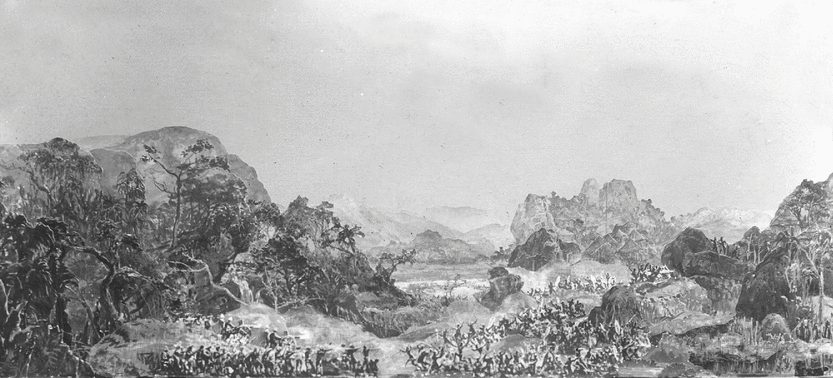
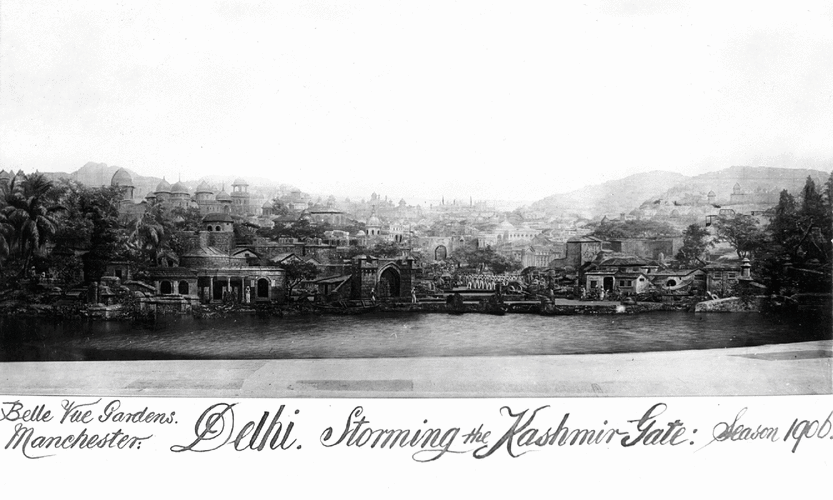
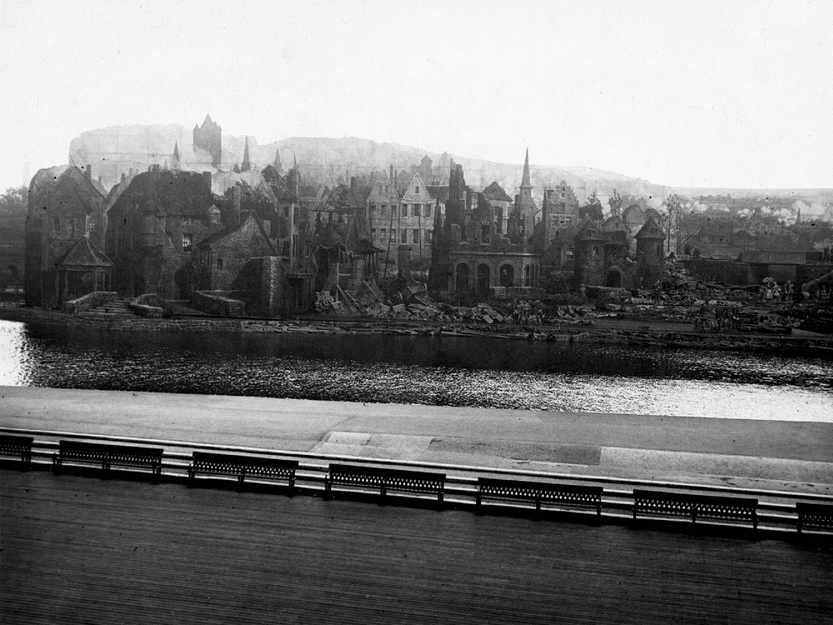
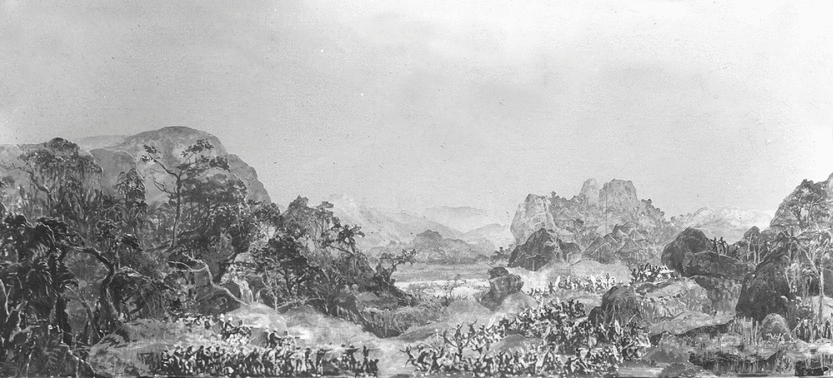
Continuing the impulse to demonstrate dominion by exaggerating the power and “monstrous” dimensions of its machinery and its menagerie, the official guide referred to these spectacles as “monster pictures,” a term which refers to the huge panoramic backdrops initially painted by George Danson, the same artist responsible for Manchester from Belle Vue, 1861. Photographs of the painted sets, taken around the turn of the nineteenth century, give some sense of just how splendid these presentations must have been. A glance at the panoramas for “Matabele War,” “Delhi. Storming the Kashmir Gate,” and “Mons” (Figures 2, 3, 4) reveals that the sets share the gigantic dimensions of the “monsters” in the menagerie as well as the generators labeled the “throbbing monster of the new age” (1897 Guide). Danson with his sons rendered these canvases in a large room. When finished, they would let them down through trap doors in the floor so the backdrop could be transported to and erected on an island in the “Firework Lake.” Spectators, as many as four thousand an evening, safely gazed at the spectacle from across a body of water that because of demand for more production space was enlarged twice over the years, as was the island. The photograph of “Mons” (Figure 4) shows this platform facing both the lake and the panorama.Footnote 19
“Matebele War.” Photograph. Courtesy of Chetham's Library, Manchester.
“Delhi. Storming the Kashmir Gate.” Photograph. Courtesy of Chetham's Library, Manchester.
“Mons, 1914–1918.” Photograph. Courtesy of Chetham's Library, Manchester.
The set for the 1897 production of “Matabele War” (Figure 2) features the Matoppo [now referred to as Matobo] Hills where the Ndebele were overcome by the British, using their European-produced weapons, among which was the famous technological wonder, the Maxim gun. Men, paid to act the role of these fighters, charged each other with spears and guns; they moved through the set while fireworks, rockets, and smoke replicated the ammunitions’ fire.Footnote 20 The photograph shows how realistically the painters reproduced the granite hills, the wooded valleys, the strewn boulders, the thick vegetation, and the mist arising from the swampy valley as well as from the headwater of the river. Moveable wings added to the realism, and so too did the sight of moving water and fog, produced by machinery attached to a water tower on the firework island. During this production's five-minute intermission, weather permitting, a large balloon, inflated with gas, floated up, and then ignited and exploded to produce colored lights, which fell in celebration of the British victory.Footnote 21
Similarly, the photograph of the 1906 “Delhi: Storming the Kashmir Gate” (Figure 3) gives a sense of the painted panorama's meticulous detail.Footnote 22 This still image, however, does not allow the viewer fully to understand just what would have taken place during the display. Among various kinds of machines, moving wings, fireworks, collapsible buildings and bridges, as well as explosives, a large number of “supers,” playing the role of either the outnumbered but “grimly courageous” and “determined” English or the “native” mutineers, replicated the storming by the third column of the Kashmir Gate. The English clambered over a broken bridge, dropped into ditches, darted among buildings, and exchanged multi-rounds of fire. With a loud explosion, machinery blew up the gateway, so that the column of English soldiers could rush to the assault.Footnote 23 Once more, in addition to the moving scenery, fireworks, rockets, and other explosives contributed to the drama. The fireworks, especially, were technologically advanced. After Jennison quarreled with an outside manufacturer, he assigned the task of producing and designing the fireworks to his youngest son, James. James took the assignment to heart, experimented with the new ways to make and display pyrotechnics, and became the outstanding pyrotechnist of his day. In the spirit of Lancashire manufacturing and mettle, he set up his own Firework Factory on Belle Vue's grounds and produced the most technically advanced displays. No insurance company would cover these exhibits. During performances the workmen soaked the wooden boards with water and had on hand thirty hydrants to extinguish flames, for inevitably parts of the scenery would catch fire.
The latest in technological advances enhanced all the reenactments produced at Belle Vue. Each monster picture was manipulated and illuminated by elaborate lighting and fireworks. Reflected in the lake, these colored lights set the static scene in motion. Jennison, the Zoo's founder, however, was not content merely to illuminate the panorama, and thereby, give an illusion of movement. He wanted the thrill of adding live action to it. Consequently beginning in 1852, he engaged men to re-enact the battles and shoot thousands of guns, fireballs, rockets, large shells, and Roman Candles. At times Jennison even included marching columns of camels and elephants from the zoo.Footnote 24 Weeks of training were required to prepare the animals for these events. These amazingly successful displays also featured, in addition to pyrotechnical and hydro engineering, the most up-to-date magic lantern projection. Appropriately one of the spectacles, “The Port of Manchester” (1894), glorified the latest in machinery and the triumph of modern science and technology.
As the years passed, the action and machinery grew more sophisticated and elaborate. With the help of a moveable 50,000-foot backdrop, as well as pyrotechnic devices, in 1854 the city of Moscow burned and fell before the audience's eyes.Footnote 25 By 1856, the sets had even more moveable wings or appendages composed of ten-foot square sheets supported on poles, the largest of which reached a height of sixty-five feet. And by 1896, still more action and additional dramatic effects vividly replicated “The Battle of Alma.” Watching water fireworks, as well as firework rockets and bouquets of colored stars shoot out from a hot-air balloon, spectators below imagined themselves watching the famous battle from the deck of an Allied ship.
Part Two: A National Portrait Gallery
Even more momentous than the mock battles played against a panoramic backdrop were the series of gigantic, luminescent portraits (many over fifty feet high) depicting leading figures associated with the spectacles’ subject. Bringing the show to a resounding close as well as participating in the conventional connection between war and portraiture, these heroic pictures gathered the glory of industrial and imperialistic Britain into their frames. Reflecting Belle Vue's projection of itself as a site of portraiture, they collectively formed a kind of national portrait gallery, dedicated to generating the illusion or the ideal of a national community. The solid stillness of these pictures functioned as a synecdoche for the nation's ideal body.
In the early performances, a long roll of painted portraits, illuminated from behind, would terminate the show. By the 1860s, at the close of each production, parts of the central stage were removed, then wagons with powerful magic lantern apparatus would roll up and superimpose, onto the darkness, a colossal transparency exhibiting a portrait of a distinguished person: a military leader, a reigning monarch, a politician, or, significantly, an inventor. Distributed programs added to the authority of these individuals by devoting several paragraphs to the projected person's accomplishments – all calculated to prompt enthusiasm or tutor the audience's understanding of the individual, and all programmed to offer the spectator what Cynthia Freeland characterizes as a “feeling of contact with . . . respected and revered predecessors” (Freeland 47).
Imposing portraits of military leaders, such as Osman Pasha (the head of the Turkish troops in Crimea), Marshal Macmahon, and Admiral Codrington loomed before Belle Vue's astonished spectators. These portraits had the final word and advanced a distinctive national identity and ethos. Colossal portraits of the Duke of Wellington and Queen Victoria also functioned in these shows as a sort of semiotic system, giving an emblem of the phrase “God Save the Queen,” which would have been written on the sky in colored fire. In yet other displays, concluding magic-lantern transparencies, revealing a pantheon of the new industrial heroes, such as Daniel Adamson, Leader Williams, and Lord Egerton, attached a face and a name to the idea of the “great triumph of Modern Science and Engineering.” These figures’ portraits functioned as allegorical representations of desired national characteristics, as well as those admired in Manchester, such as “PERSERVERENCE, LABOUR, and INGENUITY,” featured in many of the spectacles (The Belle Vue Collection. Chetham's Library, Manchester).
From the turn of the century, a program describing the closing moments of “The Siege of Ladysmith” (The Boer War) gives a vivid sense of how central these portraits were to these productions as well as to the Zoo's imperialistic agenda. The program reads:
Next are seen illuminated portraits, framed in
Shamrock, Rose, and Thistle, of our victorious Commander-in-Chief.
LORD ROBERTS, and the HEROES OF LADYSMITH and MAFEKING,
Supported by representative figures of our home and colonial forces, and surmounted by the motto, in dazzling point and variegated fire
FOR QUEEN AND COUNTRY
Then in the final glory of soaring rockets and bursting shells, a myriad of electric lights flash forth the honoured title: “Defenders of the Empire” (Nicholls 83)
Portraiture was not just confined to these magnificent displays. It also held a central position in other parts of Belle Vue. For this reason, in its own publicity, Belle Vue advertised itself as a place where there was a “regard to the combinations of Zoology, Ornithology, Botany, Sculpture, and Painting” [italics mine] (The Belle Vue Collection. Chetham's Library, Manchester). As a consequence, Belle Vue's nineteenth-century guidebooks drew attention to the various paintings and busts of important individuals to be viewed in such places as the Music Hall, where decorative shields displayed framed portraits of Sir Robert Peel and the Duke of Wellington. There the visitors could also stand before painted portraits of such notable mechanical engineers and industrialists as Richard Arkwright, Thomas Newcomen, Thomas Savery, George Stephenson, and James Watt.Footnote 26 The public was encouraged to be as attentive to these as, for instance, to a newly arrived Orangutan.
Through its deliberate focus on portraiture in its buildings as well as in its spectacles, Belle Vue was participating in the mid-century vogue among weekly and monthly publications to reproduce portraits, which, in the spirit of the concluding transparencies, gave a human face to the accomplishments of the nation and represented an historical event through a recognizable human being. Thanks to the evolving technologies of print and the subsequent emergence of illustrated newspapers, journals regularly published engravings of distinguished individuals accompanied by lengthy biographies and lists of achievements – a practice that recalls the extensive explanations in the Belle Vue guides describing the figures featured in the spectacles. The Illustrated London News (founded in 1842) regularly mixed portraiture and biography. Other journals followed suit and often presented their own series of what they termed “National Portrait Galleries” in which accounts of leaders’ accomplishments surrounded a collection of the celebrities’ engraved portraits.Footnote 27
It is interesting to note that in 1852, when Belle Vue began concluding its productions with colossal transparencies of heroes and was simultaneously featuring portraits of significant people throughout its grounds, a movement was also underway to found a National Portrait Gallery in London so as to assemble those distinguished individuals who represented the power of the nation. Partially motivated by the success of the 1851 Great Exhibition, Prince Albert had campaigned for a portrait gallery to be erected to commemorate scientists and technologists whose innovations had brought about the modern age. At the same time, individuals, such as Thomas Carlyle, were expressing their hope that the government might finance a “Pantheon, or home of all the National Divinities” (Barlow 221). Eventually, thanks to the efforts of Lord Stanhope and to the support of Disraeli, the National Portrait Gallery, as we know it today, was officially established in 1856.
In a sense Belle Vue was part of this momentum. Through its series of portraits and accompanying life stories, Belle Vue assembled its own sequence of officially sanctioned celebrities. It joined the nineteenth-century popular genre of biography, which reads history through the individual. Like the National Portrait Gallery, Belle Vue displayed images of the nation's leading figures so as to mark an historic moment and champion those qualities which contributed to the nation's strength. Many of these figures personified courage, perseverance, and ingenuity.
Belle Vue's portraits, however, differed from those on view in London. Rather than presenting a realistic picture of the person's actual dimensions and/or irregularities, Belle Vue emphasized the figure's heroic affect and relied more heavily upon generalized or stereotypical images of the hero. In this sense, Belle Vue was not interested in being “authentic.”Footnote 28 It was not as intent as were the directors of the newly founded National Portrait Gallery upon making sure that the displayed portrait was actually rendered in the presence of the subject and hence depicted a true likeness of its subject. Rather, the directors at Belle Vue wanted their subjects to be readily identifiable and, therefore, part of an already accepted cultural language. For this reason they seem to have selected familiar portraits – those immediately recognizable to the public because they had already been reproduced in popular publications, such as the ones mentioned above. Most of these pictures reinforced a general impression of the heroic figure and functioned simply to offer a recognizable link between an historical event and a well-known name. For instance, Jacques-Louis David's portrait of Napoleon crossing the Alps, which concluded the 1872 production featuring Napoleon's expedition over towering and terrifying mountain scenery, was not only already known to the public through magazine reproductions but also “heroic.” (Surprisingly, in Victorian Britain, there were many admirers of Napoleon who associated his memory either with enlightened progress in opposition to reactionary monarchy or alternatively with military genius.Footnote 29) In a stereotypical valiant pose, replete with indexical properties, the figure of a uniformed Napoleon sits astride his rearing horse. His posture and affect exude a sense of daring and control; they visually replicate the show's concluding motto: “Napoleon honour to the brave.” When assembling its version of a National Portrait Gallery, Belle Vue featured portraits which conformed to cultural expectations and bridged the gap between the populace and the abstract. Like the popular and authoritative images of Queen Victoria and the Duke of Wellington, these paintings or photographs participated in what Richard Brilliant identifies as a “consensual ritual” between the subject and the political agenda surrounding a public figure.Footnote 30
Part Three: The Menagerie and The Museum
So far the focus of the discussion has been on the more familiar or conventional modes of portraiture at Belle Vue: those renderings of a public figure which issue from a palette, an engraver's pen, a slab of marble, or a transparent slide. There were, however, other modes of portraiture at the Zoo, which relied, almost exclusively, upon the display of stuffed animals and animal skins – a perspective which the Belle Vue guidebooks encouraged by repeatedly remarking on the stripes, spots, or density of a mammal's fur, the slipperiness or coarseness of animal's epidermis, and the vivid arrangement of a bird's feathers. An 1896 Belle Vue guide, for instance, points out that the Hippopotamus is “much hunted for the tough hide” and that the Rhinoceros carries a “thick and almost impenetrable hide” (The Belle Vue Collection. Chetham's Library, Manchester).Footnote 31
Featuring the feathers, fur, and dens of exotic captives, Belle Vue's menagerie displayed an analogous relationship to the portrait gallery. In the chapter, “Why Look at Animals?” from About Looking, John Berger makes a passing reference to the parallel between the art gallery and the zoo. He remarks that, “Visitors visit the zoo to look at animals. They proceed from cage to cage, not unlike visitors in an art gallery who stop in front of one painting, and then move on to the next or the one after next” (23). Indeed, people do progress sequentially from cage to cage, as if pausing in front of one picture before passing on to the next – perhaps spending a longer period gazing at one particular species rather than at another. Extending this analogy to Belle Vue, it is easy to imagine its animal enclosures as a series of framed pictures. A description of the Belle Vue's “The Menagerie” from the 1872 Guide helps the reader visualize this sequence:
Near the Monkey House is the entrance to a long building, on the ground storey of which are twenty dens occupied by South American and African lions, a Ceylon elephant, a dromedary, an ostrich, specimens of panther, leopard, hyaena, jaguar, porcupine, etc. (The Belle Vue Collection. Chetham's Library, Manchester)
Wild, yet “tamed” and “civilized” within their cages, these exotic captives, routed through the channels of empire to Manchester, assembled in the Menagerie not only to fashion an emblematic portrait of empire but also to render a panorama of Britain's political, military, and economic dominion.Footnote 32
Once members of the public had completed viewing the live creatures framed within their dens, they would have walked either upstairs or through the Zoo's grounds and eventually reached the Belle Vue Museum in which stuffed skins and collections of specimens composed a still-life menagerie, reminiscent, perhaps, of a sculpture gallery. (Victorian zoos often featured museums.) As such, this attraction at Belle Vue offered an additional emblematic site of portraiture not only dedicated to portraying the spoils of empire but also beholden to the international and commercial exchange of skins. Throughout nineteenth-century Britain, the “skin trade” was enormous.Footnote 33 Shops receiving and mounting exotic species were common in cities, villages, and towns near ports of entry. One of the most famous places was in Lancashire: William Cross's of Liverpool imported wild animals and functioned as an intermediary between traders and zoos.Footnote 34
A photograph in the Belle Vue Collection in Chetham's Library, taken at the end of the nineteenth century, gives some sense of what it must have been like to step inside Belle Vue's Museum. In the picture, the keeper stands behind a mounted tiger – its stuffed striped fur, prepared by a taxidermist, lurks behind the railing.Footnote 35 In front of the tiger, between the elephant's front legs, recline the taxidermy models of a dog and a lion. When alive, the two had befriended each other and shared a cage at Belle Vue. Strangely silent, they rest uncannily.Footnote 36
Beginning in 1856, visitors to the Museum willingly spent an extra penny so as leisurely to examine such images. In addition to gazing at these stuffed creatures, patrons passed by random groups of curiosities, trophies of foreign campaigns, and, significantly, various “Busts of Heroes” (see poem quoted below). Here a person could not only regard the sculptured face of a triumphant national figure but also view (perhaps even touch) the modeled beast, a preserved emblem of conquest, and a spoil of a foreign campaign. As it had in the Menagerie, empire once more fused with natural history. A verse from an 1861 poem catches one person's enthusiasm for Belle Vue's “splendid museum.”Footnote 37
Belle Vue's collection of taxiderny not only profited from and showed off its connection to empire but also put new technologies on view. The Belle Vue Museum offered a modest exposition of technological progress – many of them by-products of Manchester's innovative manufacturing skills.Footnote 38 In particular, its exhibits benefited from superior methods of skinning a beast, of preparing skins so that they were not only more supple (some of these methods would have borrowed techniques developed in the Lancashire tanneries) but also more resistant to insect infestations than at the beginning of the century (the traditional system of treating the hide with arsenic was being replaced by newer and experimental chemical applications). Furthermore, thanks to these improvements, the Museum's stuffed specimens more than ever replicated the contours of the creature's appearance: its folds, bumps, and swellings. No longer were “stuffers” (as they were then called) merely packing these skins with some soft material around supporting wires, which, more or less, rendered the specimen's shape; instead, they were beginning to construct meticulously measured artificial bodies (made of such materials as wood, papier-mâché, and peat) to which taxidermists could bind cotton (a by-product of the Lancashire cotton mills) and to which they could add more stuffing before enveloping or enclosing it with the treated skin. Gone was the false coloring. Better methods developed through industry permitted improvements in painting the stuffed model's beak or lips, and advanced technologies allowed stuffers to replace the ill-shaped, opaque eyes with those constructed from multi-layered glass, which were more correctly formed; they caught the light and illuminated the eye's depth.
Significantly, many among Belle Vue's public, including people such as Gaskell's Job Legh, not only would have possessed scientific knowledge about the exhibited specimens but also would have been cognizant of the skills needed to perform the art of taxidermy. They would have looked appreciatively at the Museum's stuffed creatures, for these were professional renditions of their amateur and less ambitious attempts at home. Tutored by self-help books and instruction manuals, such as William Bullock's A Concise and Easy Method of Preserving Objects of Natural History (1817), Montagu Browne's 1876 Practical Taxidermy, as well as J. Gardner's manual of taxidermy for amateurs (Bird, Animal, and Fish: Stuffing & Preserving, 1866), these individuals would have filled their shelves with curiosities from foreign lands (and, occasionally, stuffed pets) in order to fashion their own miniature museum. The following poem, in Gardner's amateur taxidermy handbook, demonstrates that taxidermy was not just an art for the professionals; it was also a domestic hobby. The verse, moreover, suggests that taxidermy did not interfere with feelings of sentimentality toward a creature – indeed, the art seems to have extended the sense of attachment to what was being stuffed:
Taxidermy belonged to a popular culture; it was a familiar form of portraiture.
Conclusion and Decline
With the passage of years, the Belle Vue Zoo was necessarily subjected to the vagaries of time. In the twentieth century, the Museum, discussed above, suffered from neglect. A popular interest in acquiring natural history specimens had declined – most definitely taxidermy had gone out of style.Footnote 39 Eventually in 1937 the Museum closed, and the few unspoiled specimens were sent to the Manchester Museum.Footnote 40 The Menagerie, on the other hand, continued, but, as might be expected, in the 1940s the ravages of war took their toll and compromised the Menagerie's former aura of imperialistic control and authority.Footnote 41 No bombs fell directly on Belle Vue (there was a plan to arm guards in case dangerous animals got out during a raid). After the War, the Zoo's menagerie recovered in number and quality; the public flocked back.Footnote 42
Intermittently there seems to have been an impulse to retain an attachment to the previous century's glorification of empire. For instance (with the exception of the war years), Belle Vue persisted in producing spectacular firework displays, many of which repeated those created during the 1800s, such as the 1906 “Delhi during the Indian Mutiny” (originally produced in 1858), and the 1954 “The Storming of Quebec” (originally produced in 1870). In 1936, Belle Vue also replicated its 1836 “San Sebastian: the Great Dramatic Story of the First British Legion,” which featured two hundred and fifty actors, as well as “the largest open air landscape” (a copy of the one executed by George Danson and his sons a century before). As if acknowledging the decline of empire, however, these shows did not realize a profit. Consequently, from 1956 until the late 1960s, Belle Vue merely presented what the management appropriately labeled “Ordinary Displays” (Nicholls 67).
There were occasions when the Belle Vue Zoo quoted from its past as a “National Portrait Gallery.” Among the archives are two photographs of Syd Lane, official resident scenic artist, who in May 1953 was working on gigantic portraits of the Queen and the Duke of Edinburgh. These, displayed in honor of the coronation, resurrect memories of the oversized magic lantern slides of Queen Victoria and other national figures once projected for the Belle Vue public to admire.
To some degree, Belle Vue continued to celebrate its alliance with the mills and manufacturing. In 1932, the Zoo hosted a spectacular Cotton Pageant, which, with the support of over 12,000 people, celebrated King Cotton and presented scenes replicating “The Age of Invention,” “The Progress of Transport,” “Lancashire at Work,” and “Lancashire Cotton for the World” (Nicholls 33–34).Footnote 43 Later Belle Vue's extensive exhibition hall housed the annual Textile Recorded Exhibition (the largest in the world), which presented the latest in textile machinery. Belle Vue also continued to be a place delighting in the latest technological developments and engineering devices: such features as its speedway, its motorcycle races, its stock car racing, its water chute, the entertainment park's thrilling rides, its sixty-foot high cable car, as well as its “V2 Rocket Man,” who shot out of a barrel at 120 m.p.h., carried on the earlier excitement associated with such highlights as the former steam-driven velocipedes or “The Ocean Wave.” These and other such devices recalled the exhilaration once experienced in the presence of the various steam-powered machines and “monster” generators that had lit, heated, and empowered Belle Vue in the nineteenth century.
The older Belle Vue of the Jennisons, however, ultimately disappeared. Caught in the demolition of the passing years, the old pumphouse, for instance, which the Jennisons had proudly erected, was knocked down in 1961, and so were many other features of that time. The management also changed character. By degrees a corporate leadership replaced what had been a local family business. (The same, of course, is true of Manchester's manufacturing trade.) The animals were gradually sold off in 1977 to make more room for a profit-making leisure complex. But, after the post-war boom slackened, the plan for such a facility failed, and in 1982 Belle Vue closed down completely, with the exception of its exhibit halls, which remained open until 1987.
Belle Vue exists now only in its archives. There one can find traces of the biases, preoccupations, and assumptions of its beginnings. In Chetham's Library, Manchester, the nineteenth-century Belle Vue's ledger books, letters, notes, photographs, maps, accounts, and typescripts paint a remarkable portrait of a place once dedicated to the celebration of its industrial milieu and to a display of empire. Papers from the 1800s remind one that the Museum, the menagerie, the spectacles, and the machinery at Belle Vue assembled to create an energetic, eclectic, and unique site of portraiture, merging the mechanical and the organic. It blended science and engineering with art, and, in addition, embraced empire, nation, and home. In the nineteenth century, the people of Manchester who passed through Belle Vue's gates marveled at a world outside their immediate boundaries and gazed, as well, at the powerful technological innovations radiating from their own surroundings.