Napoleon's military and political career famously—and forcibly—spread Enlightenment and French Revolution ideas across Europe. From a legal perspective, this included new laws and notions of codification; the promise of rights, civil liberties, equality before the law, and freedom of worship.Footnote 1 Napoleon sloganized “liberté, ordre public,”Footnote 2 but his legal impact went beyond liberty and public order. His most formidable achievement was the 1804 Code Civil des Français, better known as Code Napoléon. Codes of civil procedure (1806), commerce (1807), criminal procedure (1808), and criminal law (1810) followed—all of which outlasted their sponsor.
In this article I analyze artwork contemporary with those legal transitions. I endeavor to deepen our understanding of a formative chapter in the history of freedom of worship, a right that was, and still is, central to libertarian thought. By focusing on painters’ strokes and engravers' etchings, what emerges is an image not of a lofty ideal but of how freedom of worship functioned in the service of Napoleon's rule. Analysis of the contemporary artwork reveals that the ideal of freedom of worship was not about religion but about Napoleon—first as the mediator of religion, and later as the object of worship. Ultimately, Napoleonic freedom of worship was the freedom to worship Napoleon.
In this examination of artistic representations of freedom of worship and their underlying legal narrative I aim to enrich the portrait of the legal, artistic, and intellectual history of the Napoleonic era. Furthermore, I illustrate the importance of art as a fertile, untapped source for scholars of legal history and of law and religion.
LAW, ARTS, HISTORY: MÉNAGE À TROIS
My analysis of the history of Napoleonic freedom of worship is plotted in relation to three areas of scholarship: law in art, Empire style art, and, to a lesser extent, Judaica Napoleonica.
“Napoleon and the Jews” has long been a subject of scholarly interest.Footnote 3 Inspired by French revolutionary ideals, Napoleon promised rights to Jews in France and in other lands that he conquered; for many Jews this reflected a significant change in their lot. The 1806 convening of the Grand Sanhédrin captured the imagination. This historically unique legal body evoked memories of the sages of Jewish law in the Land of Israel from the Hasmonean period through Roman rule.Footnote 4
From the perspective of law-in-action, scholars have explored how Napoleonic law affected Jews in France and in states that came under varying degrees of Napoleonic influence. Ronald Schechter has critiqued the scholarship in this field, noting, “[h]istorians have tended to neglect Napoleon's encounter with the Jews or to relegate it to the status of a curiosity worthy of a line or two. Those who have examined it at any length have tended to reduce their analysis to praise or blame for the emperor and/or the Jews.”Footnote 5 Schechter sought to remedy this by exploring the relationship toward Jews in France from 1715 through the fall of Napoleon in 1815. Taking stock of Schechter's critique, I add to the conversation by analyzing artistic representations from the Napoleonic era, thereby lending an additional, humanistic perspective to Judaica-Napoleonica scholarship, and augmenting the conversation about Napoleon and the Jews.Footnote 6 To be sure, Napoleonic freedom of worship did not apply solely to Jews; indeed, many of the legal developments focused on other confessional groups. Yet underscoring the Jewish perspective is particularly illuminating because of the singular use of Jewish symbols and because of a unique set of art pieces that feature Jews.
Empire style art—a neoclassical style that flourished in France under Napoleonic rule—is criticized for its unabashed partisanship and its bald attempt to fashion the Napoleonic myth. Although art scholars may question the value of these works, from the historian's perspective, Empire style art communicates an accessible, relatively unambiguous visual language. Yet the rich studies of Napoleonic art have only partially focused on representations of law. Whereas scholars have tracked Napoleon's exploitation of art and craft, they have not brought the legal perspective into sharp relief.Footnote 7 Focusing on visual arts provides a unique lens on changes in law and rights during Napoleon's regime.
This discussion emphasizes art that was concurrent with the events depicted. As opposed to art created at a later time, which provides a window on the legacy of historical events, I focus on contemporary perceptions and narratives of freedom of worship. Thus paintings by artists who were not contemporaneous with events lie beyond the scope of this article.Footnote 8 This methodological limitation allows me to go beyond an interrogation of law in arts, and it places this study at the nexus of a ménage à trois of law, art, and history.Footnote 9
The use of visual arts has already been applied to scholarly studies of medical history, with rich results.Footnote 10 Visual arts have also been analyzed in order to gain insight into the history of environmental law.Footnote 11 In this article, I continue in this scholarly vein, but instead of trying to recover history (as in the medico-artistic studies), my goal here is to discern legal narrative, which cannot be culled from reading the law. Examining contemporaneous art is one means of reading the undercurrent, backdrop, atmosphere, and subtext of the law.
The relationship between law and the arts can take various forms.Footnote 12 In Napoleon's case, art was pressed into the service of law, filling a function that law can never achieve: by using visual images to stir emotions, art can create a narrative of legality that allows law to function.Footnote 13 Herein lies the importance of this study for scholars of law and religion: artistic representations complete the story—or in some cases, even tell the “real” story—of the objectives and achievements of historic laws granting rights to religious minorities.
NAPOLEON AND THE ARTS
Napoleon recognized the communicative power of the arts and its ability to fashion narrative. His attitude toward cultural treasures can be summed up as plunder and preservation, patronage and propaganda.
As a notorious looter of artwork from around the world, Napoleon acquired prizes both as spoils of war or through treaties with vanquished foes. The plundering that was part of the Italian campaign (1796–1797), whose prizes were carted to Paris, culminated in the Treaty of Tolentino, concluded between France and the pope on 1 Ventôse Year V (February 19, 1797). This treaty granted “legal” status to the confiscation of Vatican treasures.Footnote 14
Napoleon's campaign in Egypt and Syria (1798–1801) was accompanied by art scholars and scientists, whose orientalist mission included recording, classifying, and analyzing Egyptian culture, geography, history, and art. Valuable items were collected and shipped back to France. This campaign had a far-reaching impact on art; among other things, it influenced the development of the survey museum and resulted in Egyptian art becoming part of the Western art canon.Footnote 15
Besides its intrinsic worth, Napoleon understood the persuasive value of the loot, as he used art to garner support in Paris for his military escapades abroad. For instance, during his Italian campaigns, Napoleon dispatched convoys of plunder to France, leaving the Directory little choice but to support his decisions.Footnote 16 Most importantly, Napoleon was cognizant of art's utility for narrative formation. As part of a concerted effort to create a victorious narrative of the failed Egyptian campaign, Mamelukes were brought back to Europe, paraded around, and immortalized in contemporary art.Footnote 17 Indeed, art and propaganda were virtually inseparable in Napoleonic France. Thus, Napoleon cultivated a new style in art—Empire style—employing ancient motifs in a bid to link his rule to the Roman imperial regime and its military prowess.Footnote 18
As he curated the booty in Paris, Napoleon became a patron of the arts, and, in deference to his efforts, the enriched Louvre became known as the Musée Napoléon.Footnote 19 Napoleon's 1812 campaign was documented by artists fighting as part of the Grande Armée, bequeathing a unique graphic record of this campaign.Footnote 20 Finally, Napoleon's weapon for his last “battle” was the pen, as he fought valiantly from the remote island of Saint Helena in a bid to depict his legacy.Footnote 21
The message was not monolithic: at different stages and in varying circumstances, art was co-opted into an array of at times contradictory roles, as determined by the situation at hand.Footnote 22 Thus, shrewdly recognizing its potency, art was central to Napoleon's military ventures, political career, legislative activity, and the legacy he sought to cultivate.
Unsurprisingly, the charismatic leader was celebrated in the arts. Much of this creative expression focused on Napoleon's gallant military career and audacious political achievements. Nonetheless, changes in law were also noticed (though not to the same extent as Napoleon's other accomplishments) in contemporary creative works by famous poets across Europe, such as Lord Byron (1788–1824), Heinrich Heine (1797–1856), and Alexander Sergeyevich Pushkin (1799–1837).
It bears noting that scholars have demonstrated the role of printing—the printed word and the printed image—in fashioning eighteenth-century identity, culture, sensibilities, and empathy. Epistolary novels, newspapers and pamphlets, visual images reproduced in the form of prints, lawyers’ accounts, Diderot's Encyclopédie (which included 2,885 plates), and other treatises—all furthered by new, faster, and more economically viable reproduction technologies—played significant roles in creating mimetic capital, shaping public opinion, and forging unified national projects.Footnote 23
Among the images discussed in this article are prints from engravings that were part of the phenomenon of popular visual discourse that portended the era of mass media. The images were not publicly exhibited at the Salon; rather they were part of “the hurly-burly of working-class history.”Footnote 24 In contrast to the limited circulation of fine arts, widely distributed printed images were potent tools for narrative formation and propaganda dissemination.Footnote 25
Did Jews feature in Napoleonic artwork? At first glance, the question appears incongruous: Jews were a statistically tiny, largely irrelevant population in France and in most of the lands Napoleon conquered. In fact, considering Napoleon's military feats and political career, that Jews appear at all in Napoleonic artwork is surprising. While the question perhaps seems absurd, the fact is that philosophes, encyclopédistes, and other writers devoted a disproportionate amount of wordage to Jews,Footnote 26 and there is indeed a body of French visual art from the Napoleonic era that depicts Jews.
Artistic representations of Napoleonic freedom of worship can be divided into two groups. The first group, from 1800 to 1801, focuses on art that depicts religious groups including Jews. The second group, from 1806, deals with art where Jews are the subject.Footnote 27 This study focuses on these two categories of artwork that treat aspects of freedom of worship and seeks to reconstruct the artists’ visual message and their narrative of law. For the backdrop of Napoleon's legislation and accompanying artwork, I begin with General Bonaparte's exhortations to his soldiers regarding treatment of religious figures they were encountering.
FREEDOM OF WORSHIP
On June 22, 1798, General Bonaparte issued a proclamation to his Egypt-bound troops. He opened by reminding them of the importance of the campaign as part of the economic war being waged against England. Napoleon then spoke of the local Muslim population whom the soldiers were about to encounter, explaining some tenets of Islam and issuing instructions as to how the locals were to be treated: “Behave to them as you behave to the Jews—to the Italians,”Footnote 28 referring to the Italian Jews and the Catholics encountered during the Italian campaigns of the French Revolutionary Wars against the First Coalition (1792–1797). In March 1796, Napoleon was appointed commander-in-chief of the Army of Italy—the most disordered of France's thirteen field armies—which he led with resounding success. Napoleon's battles in northern Italy included encounters with papal forces and staunchly Catholic soldiers and civilians. Indeed, the pope was seen as the inveterate ideological enemy of the French Revolution.Footnote 29
In Napoleon's eyes, cunning military strategy, gallant bravery on the battlefield, and eventual victory over the enemy need not entail incivility and disrespect. Thus on the eve of the Egyptian Campaign, Napoleon urged his troops to
[p]ay respect to their muftis and their imaums [sic], as you did to the rabbis and the bishops. Extend to the ceremonies prescribed by the Koran and the mosques the same toleration which you showed to the synagogues, to the religion of Moses and Jesus Christ.Footnote 30
Contemporary memoirs of Italian Jews vividly record the respect accorded them by Napoleon's conquering forces.Footnote 31
Alas, the reality experienced by the Egyptian Muslim population was a far cry from Napoleon's grand declarations. In some cases, Napoleon's forces were simply unable to live up to the standard that their leader had set: How could the army honor Islamic law that forbade non-Muslim subjects from riding horses with decorated saddles, carrying swords, or holding posts of authority?
Yet even in other situations, the French did not necessarily heed Napoleon's lofty exhortation, as the land they encountered was far from the exotic and fertile paradise they had imagined. One French soldier wrote in a letter to his mother that was intercepted by the British: “La peste y est très-commune; le peuple y est barbare; leur dieu est Mahomet, ils n'en connoîssent pas d'autres” (“The plague is very common here; the people are barbarians: their God is Mahomet—they know no others!!!”).Footnote 32 It was therefore no surprise that the French response to the bloody Revolt of Cairo included desecration of holy sites. As one Muslim chronicler vividly described,
[t]hen those wild goats [that is, the FrenchFootnote 33] rode into the mosque on horses, entering through the big gate and going out from the other to the place where the donkeys were tied. And the French trod in the Mosque of al-Azhar with their shoes, carrying swords and rifles. Then they scattered in its courtyard and its main praying area (maqṣūra) and tied their horses to the qibla. They ravaged the students’ quarters and ponds (baḥarāt), smashing the lamps and chandeliers and breaking up the bookcases of the students, the muj āwirūn [students living in the mosque precinct], and scribes. They plundered whatever they found in the mosque, such as furnishings, vessels, bowls, deposits, and hidden things from closets and cupboards. They treated the books and Qur’ānic volumes as trash, throwing them on the ground, stamping on them with their feet and shoes. Furthermore they soiled the mosque, blowing their spit in it, pissing, and defecating in it. They guzzled wine and smashed the bottles in the central court and other parts. And whoever they happened to meet in the mosque they stripped. … [T]hey are enemies of the Religion.Footnote 34
The discrepancy between the stated ideals and facts on the ground is not cause for discussion here. I point out the chasm only as a reminder that I am discussing legal narrative, not law-on-the books or law-in-action.
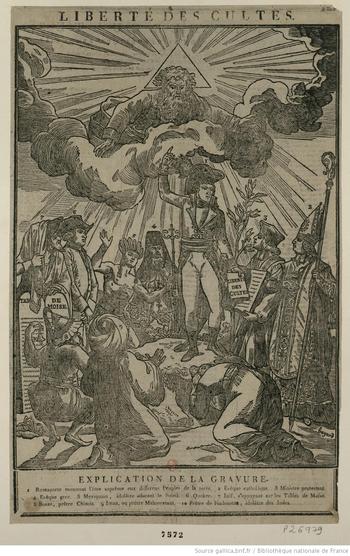
The religious tolerance expressed by General Bonaparte was continued in the policies of First Consul Napoleon following the coup d’état of 18 Brumaire (November 9, 1799). Subsequent decrees rolled back the Revolution's harsh anticlerical stance. Thus, a decree on 8 Frimaire Year VIII (November 29, 1799) provided for the release of clergy detained after refusing to take the oath to the Constitution civile.Footnote 35 A month later, a decree from 7 Nivôse Year VIII (December 28, 1799) annulled the regulations that had closed churches in order to prevent Mass from being said.Footnote 36 The spirit of these events is depicted in a print from a woodcut titled Liberté des Cultes (figure 1). For the English reader it bears noting that the French word culte does not carry the negative connotations of the English term cult; it simply means form of worship or religion.
[Signed “Bayard”], Liberté des Cultes [Freedom of worship]. Print from woodcut, 37 x 24.6 cm. Bibliothèque nationale de France, département Estampes et photographie, Reserve QB-370 (55)-FT 4. Reproduced by permission.

The print was part of a report by the minister of police from 27 Nivôse Year VIII (January 17, 1800). Two texts appear on the back of the print.Footnote 37 The first is an anonymous poem, written in alternating rhyme sequence (ABAB), celebrating the recent decree and trumpeting Napoleon's promotion of religious freedom. The heading makes it clear that, although the specific context was Catholicism, the policies of First Consul Napoleon were “à la religion catholique et aux autres cultes” (for the Catholic religion and other religions). Jews were one of the groups that received specific mention in the poem:
The anonymous poet invokes the theme of Napoleon as Messiah, a recurring trope in the contemporary Jewish and Christian writing.Footnote 38 Although messianic hope can be seen as a central theme of Judaism, it is not mentioned in the “law of Moses”: not in the Ten Commandments, nor elsewhere in the Pentateuch. Nonetheless, by describing it as a pledge of Mosaic law, the poet cast messianic hope in a legal light.
The second text on the back of the Liberté des Cultes print is a circular dated 22 Nivôse Year VIII (January 12, 1800). Signed by the minister of police, Joseph Fouché (1759–1820), the circular “sur le retour des prêtres, et sur la tolérance des cultes” (on the return of priests, and on the tolerance of worship), clarifies the government's intentions, and was published in the following day's Le Moniteur.Footnote 39 It invited certain priests to return and repatriated church-owned buildings. Although Catholicism was specifically singled out, the circular had broader implications. Thus it declared, inter alia, “[q]ue tous les cultes soient donc libres et égaux” (that all forms of worship are therefore free and equal).
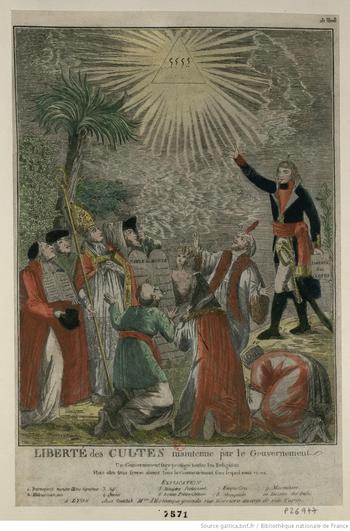
Before examining this Liberté des Cultes print, I point out the existence of a strikingly similar younger sibling, issued about a year and a half later in response to another legislative event (figure 2).
Liberté des Cultes maintenue par le Gouvernement [Freedom of worship maintained by the government]. Print from etching, colored, 28.5 x 21.5 cm. Bibliothèque nationale de France, département Estampes et photographie, Reserve QB-370 (55)-FT 4. Reproduced by permission.

On July 15, 1801, Napoleon signed a concordat with Pope Pius VII, in which Catholicism was recognized as the religion of the majority of French citizens, but not of the French state. This concordat and subsequent French legislation paved the way for religious freedom in France.Footnote 40 The outcome of these legislative events was depicted in a hand-colored print by an unknown artist. Its caption reads, “Liberté des Cultes maintenue par le Gouvernement” (Freedom of worship maintained by the government), followed by “Un Gouvernement sage protège toutes les Religions / Vous êtes tous frères aimez tous le Gouvernement sous lequel vous vivez” (A wise government protects all religions / You are all like brothers; love the government under which you live).Footnote 41
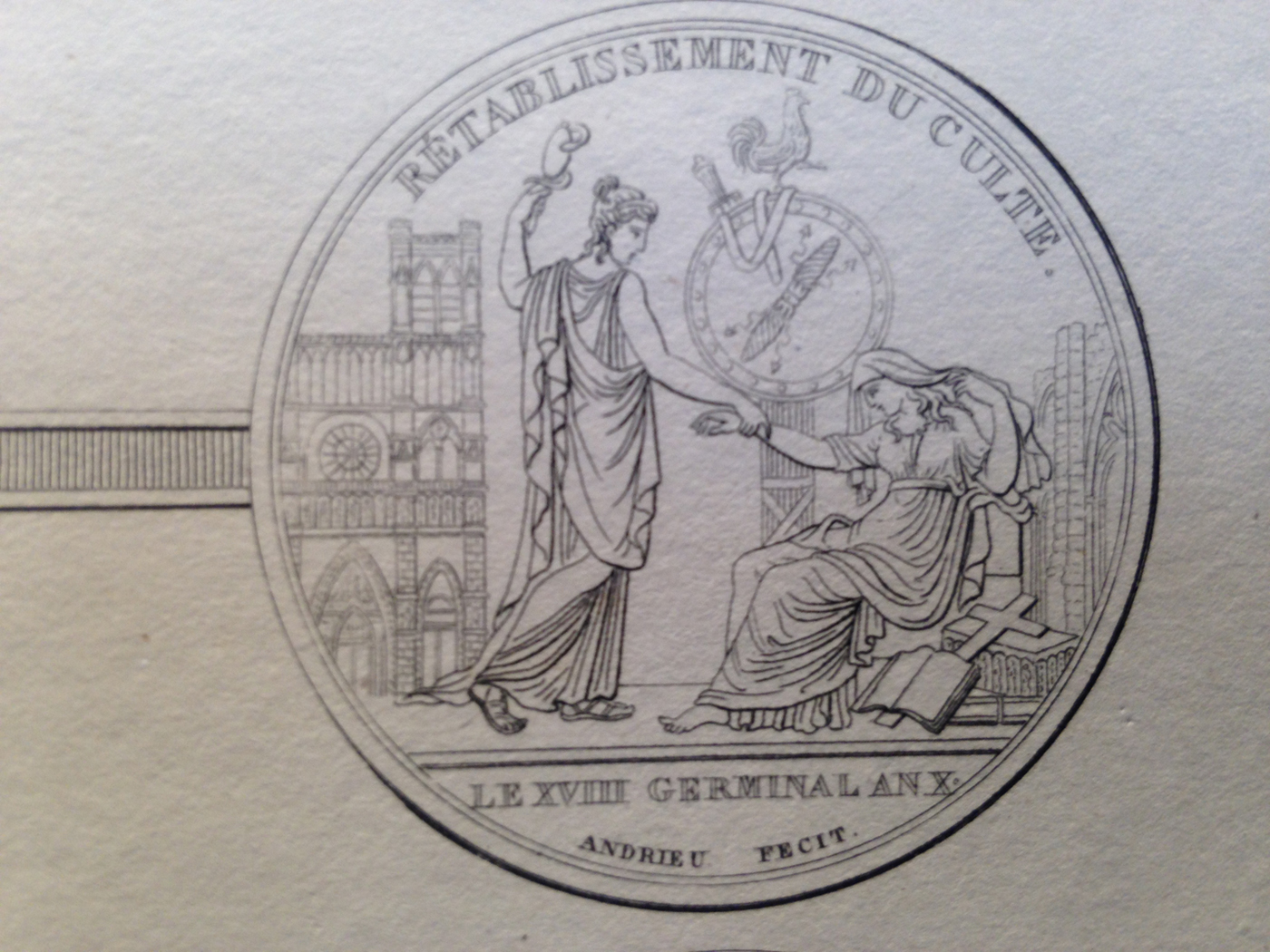
Because of the similarities in appearance and narrative, the two prints are treated together here, even though they are the work of different artists and were sparked by different legislative moments. Note that both events—and hence both prints—were connected to changes in the legal status of the Catholic Church in France. Yet in both cases, the artists took the opportunity to make a broader statement about religious freedom under Napoleon's rule. This was not inevitable: other legislative events were artistically commemorated solely in terms of the Catholic Church, even if they applied to other religious groups. For instance, on April 8, 1802, the Corps législatif sanctioned the 1801 Concordat and passed a law allowing public worship.Footnote 42 On the very same day, a parallel law was enacted regarding Protestant sects.Footnote 43 A medallion struck to commemorate the occasion features a bareheaded bust of Napoleon on the obverse and the words “Napoleon Bonaparte Premier Consul.” On the reverse is “Rétablissement du Culte” (Restoration of worship) at the top, and across the bottom is “Le XVIII Germinal an X,” the date in the French Revolutionary calendar when the legislation was passed (figure 3).Footnote 44
Bronze medallion, inscribed “Rétablissement du Culte” [Restoration of worship], diameter 51.5mm, in Aubin Louis Millin and James V. Millingen, Medallic History of Napoleon (London: J. F. Dove, 1819), page 23, and plate XXIX, no. 61. Photograph by Levi Cooper.

A maiden representing the church sits in a limp, mournful pose, head bowed; next to her, on the ground, are a book and a crucifix. Prudentia, the allegorical female figure who represents the virtue of prudence, holds in one hand a mirror and a snake. With her other hand she lifts the maiden's hand, as if to help her rise. Although this image could apply to any Christian confession, two aspects of the medallion focus on Catholicism. The left side of the reverse features part of the western façade of Cathédrale Notre Dame de Paris. More subtly, the background includes fasces, the Roman symbol of authority, together with a sword and shield, and a rooster, a symbol of dawn and vigilance, sits on top of the shield. The rooster, gallus in Latin, was the ancient Roman term for Gaul. Visually, the medallion suggests that, despite the new legislation, France remains superior to the Catholic Church in Rome.
To clarify: It is entirely appropriate for the medallion to focus on Catholicism, for the legislation was triggered by the 1801 Concordat. Indeed, ten days later, the Te Deum—a thanksgiving hymn to GodFootnote 45—was performed at Notre Dame in celebration of the reconciliation between Revolutionary France and the Catholic Church. This is precisely what makes the two Liberté des Cultes prints that include other religions so interesting: their narrative of sweeping affirmation of freedom of worship, rather than a narrow statement about Catholicism in France.
The artists portray ten figures and a numerical key for their identification. Figure number one is Napoleon, who stands on a mound, towering over all the others. In one hand, Napoleon holds an object with the words “Liberté des Cultes” (Freedom of worship); his other hand points at a triangle in the sky that radiates beams of light. In the colored print, the triangle has an unintelligible inscription; in the non-colored print, a hairy, bearded figure extends from inside the triangle. The triangle surrounded by rays of light together with the Eye of Providence had already been used in the eighteenth century—in the seal of the fledgling United States of America and by Freemasons a few years later. It was common in French revolutionary artwork.Footnote 46 The use here of the radiant triangle—albeit without the eye—bespeaks divine providence and enlightenment. In the colored print, the rays reach Napoleon's outstretched arm but not the other figures. In the black-and-white print, the rays reach all the figures, although only Napoleon is reaching up to the bearded figure. Napoleon faces the representatives of the religions, gesturing toward the light, as if to instruct the clerics. Napoleon is cast as God's messenger and intermediary, a teacher and guide, a link between temporal religions and the divine.
The other nine figures are identified as different faiths: a Catholic bishop, a Quaker, a Jew, a Protestant minister, a kneeling “good Chinese priest” representing Confucianism, a Greek Orthodox bishop, a Mexican idolatrously worshipping the sun and representing religion in the Americas, a Muslim imam, and an “idolâtre des Indes” bowing down and averting his eyes, probably signifying Hinduism. The figures are drawn to Napoleon and to the rays of light. The prints evince equality between the religions; no particular confessional faith is privileged. Regardless of religious affiliation, Napoleonic rule grants freedom of worship to all.
The Jew is depicted as a bearded figure with his head covered and what is presumably a prayer shawl draped over his hat. Next to him is a large stone slab, identified by the caption “Table de Moyse” (Tablet of Moses).Footnote 47 According to a rabbinic tradition, each tablet was six handbreadths long, six handbreadths wide, and three handbreadths thick.Footnote 48 As in the present case, however, artistic depictions are often different sizes. The writing on the tablets is deliberately illegible, though in the colored print one tablet has ten discernible lines, perhaps evoking the Ten Commandments. According to Jewish tradition the tablets were written in a Semitic script, yet the artist avoided using that visual medium. Hebrew script in non-Jewish art was not unheard of and could conceivably have been used here, as in Rembrandt's famous 1659 painting Moses Breaking the Tablets of the Law.Footnote 49 Perhaps the picture was directed to viewers who might not be able to identify the writing as Hebrew graphemes; perhaps the artist was unable to write Hebrew. Moses and the tablets is a recurrent theme in French Revolution artwork, though—as I demonstrate below—the theme has a special iteration in Napoleonic art.
The prints narrate details of what the granting of freedom of worship by Napoleon meant. Like the Catholic bishop holding a cross and crosier, people may continue to fervently grasp items of religious significance. Like the Greek Orthodox bishop wearing his klobuk, people may continue to wear their sacred vestments. Like the queue of the “good Chinese priest,” people may wear their hair according to the dictates of their religion. Similarly, the Jew may hold his tablets, cover his head, wear his prayer shawl, and grow his beard, all thanks to the freedom of worship mediated by the enlightened Napoleon.
These two prints can be better understood when we contextualize them by considering other contemporary prints. For example, the artwork taps into the images, conventions, and inclusive themes of the monumental Cérémonies et coutumes religieuses de tous les peuples du monde by bookseller and publisher Jean-Frédéric Bernard (1683–1744) and engraver Bernard Picart (1673–1733).Footnote 50 Thus, for instance, on the richly decorated frontispiece of the 1727 Dutch edition and subsequent French editions, the Jew is depicted as a bearded figure with his head covered and a prayer shawl draped over his hat. Picart also labeled his images and provided a key to assist their decoding, a convention that anticipated the graphics in Diderot's Encyclopédie.
Bearing this backdrop in mind suggests that designating religious figures “idolaters” would not necessarily have been perceived as pejorative, since Bernard and Picart used this term in a tolerant sense. Yet there is a marked difference between the visual message of Cérémonies and that of the Liberté des Cultes prints. Both sets of artwork proposed that religions could be compared on equal terms, and both acknowledged something higher than specific religious affiliation and practice. Whereas that proposition led Bernard and Picart to profess religious toleration, the same proposition led Napoleon to demand acknowledgment of his rule. Picart's engravings (together with Bernard's text) suggest belief in a universal truth that transcends any particular religion; the Liberté des Cultes engravings suggest fidelity to Napoleon that transcends any single religion.
A second point of visual comparison that can help us understand the Liberté des Cultes prints is a 1794 colored etching (artist unknown) captioned “Fête célébrée en l'honneur de l’Être suprême” (figure 4), produced in honor of the inauguration of Le culte de l’Être suprême (Religion of the Supreme Being) on 20 Prairial Year II (June 8, 1794). The new deist worship established by Maximilien Robespierre (1758–1794) was a civic religion offered as a replacement for Catholicism, and as an alternative to the revolutionary Culte de la Raison (Religion of Reason) instituted instead of Catholicism. Although the Religion of the Supreme Being was later outlawed, when the two Liberté des Cultes prints were produced, Robespierre's deism was still legal (even though Robespierre himself had been guillotined), and the two prints were pointedly replacing some of the themes.
Fête célébrée en l'honneur de l’Être supreme [Celebration in honor of the Supreme Being], 1794. Colored print from etching, 31.5 x 26 cm. Bibliothèque nationale de France, département Estampes et photographie, Reserve QB-370 (46)-FT. Reproduced by permission.

The 1794 print features symbols from the inaugural festival. Although some of these symbols appear in other artistic renditions of the festival, the Liberté des Cultes prints seem to be in direct conversation with this particular print.Footnote 51 Thus, the radiant triangle adorns the top of the 1794 print, as it does the Liberté des Cultes prints. Also featured in the 1794 print (and other artwork related to the event) is the venue: the man-made mound at Champ de Mars in Paris. In the Liberté des Cultes prints, Napoleon stands on such a mound. In the 1794 print, a tree symbolizing liberty was planted atop the mound; the Liberté des Cultes prints feature a tree in the background. Also atop the mound are two tablets inscribed with the words “Droits de l'homme” (Rights of man). In contrast, Napoleon permits the Jew to hold on to his tablets. It seems that the prints are suggesting that Napoleon's Liberté des Cultes is not just the granting of a right; rather, Napoleon has replaced the previous religions of the French Revolution. What then was Napoleon proposing as a replacement for existing—new and old—religions? This question can be answered after examining the second set of Napoleonic artwork: compositions from 1806 where Jews are the subject.
JEWISH WORSHIP
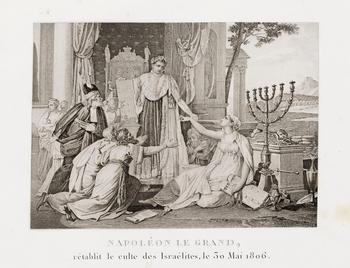
In 1806, the Parisian draughtsman and artist François-Louis Couché (1782–1849) produced an engraving depicting the relationship between Napoleon and the Jews in terms of a legal narrative (figure 5).Footnote 52
François-Louis Couché, Napoléon le grand rétablit le culte des Israélites, le 30 Mai 1806 [Napoleon the great restores the worship of the Israelites, May 30, 1806]. Copper engraving, printed on vellum paper, leaf 30.6 x 20.2 cm. Musée d'Art et d'Histoire du Judaïsme, Inventory number 2010.19.001. Photo © mahJ/Christophe Fouin. Reproduced by permission.

Couché’s engraving was printed together with a text hailing Napoleon's treatment of the Jews, “une antique nation gouvernée par la divine législation de Moïse” (an ancient nation ruled by the divine law of Moses). The caption of the picture clarifies the immediate context; May 30, 1806, the date on which Napoleon convoked the Assemblée des Israélites.
The following year, the image was included in a collection of prints and texts titled Fastes de la Nation Française, whose title page explained that the work was “destinés à perpétuer la mémoire des Hauts faits militaires, des Traits de vertus civiques, ainsi que des Exploits des Membres de la Légion d'Honneur” (designed to perpetuate the memory of lofty military deeds, traits of civic virtues, and the memorable feats of the members of the Legion of Honor).Footnote 53 The inclusion of the print in this work suggests that, notwithstanding its specifically Jewish theme, it was thought to be of general French interest. Since the image did not depict military escapades—unlike the majority of the pictures included in the volume—it apparently reflected civic virtue.
Couché’s depiction personifies the Jewish people as a maiden holding the tablets. In Napoleonic France, women's active public roles were rolled back to prerevolutionary times. Thus, for instance, the 1804 Constitution—the legal document that turned the Consulate into the Empire—denied women the right to imperial succession, regency, or even guardianship of a minor emperor.Footnote 54 The feminine personification—in contrast to the Jewish men seen in the artwork—suggests instrumentalization rather than action.Footnote 55
The tableau's central figure is Napoleon—not in military attire, but as emperor. Napoleon stands in front of a throne, dressed in royal robes, crowned with a laurel wreath. The stance recalls the portrait by Robert Lefèvre (1755–1830) of Napoleon standing next to his throne in his coronation robes; one of only two imperial portraits exhibited at the 1806 Salon.Footnote 56
In one hand Napoleon displays a document titled “Loix données à Moïse” (Laws given to Moses), once again a reference to Moses. It is unclear what exactly Napoleon is doing with the ancient law: is he acknowledging, affirming, or confiscating Mosaic law? Napoleon looks down benevolently at the maiden. Behind the woman, the picture is populated with Temple artefacts, most prominently the Ark of the Covenant and the Candelabrum. This contrasts with Lefèvre's portrait, which is filled with regal, specifically Napoleonic, symbols: in the background a gallery of statues of great leaders; in the foreground two Roman winged victory figures, scepter, globus cruciger, and two prominent “N”s on the throne.
The Israelite relics are stacked together rather than housed in the Temple, perhaps hinting at the relationship between Jews and imperial Rome, and hence Napoleon as the professed heir to the Roman Empire. In 70 CE, following a siege of Jerusalem, Roman legions took the city and destroyed the Second Temple. Napoleon—crowned with a golden laurel wreath, a Greco-Roman symbol of victory—may be returning the captured temple vessels to the Jews. The candelabrum is lit, suggesting that Jews might once again kindle the lights of the temple. The accompanying text refers to Napoleon as a new Cyrus: the sixth-century BCE Persian king who repatriated the Jewish people to the Land of Israel and allowed them to rebuild the temple.Footnote 57 Indeed, Napoleon famously declared that if he was to govern the Jews, he would rebuild the temple.Footnote 58
The maiden sits at Napoleon's feet with her arm outstretched; Napoleon's extended hand is gently touching her arm. The royal, saintly, divine, thaumaturgic touch had been celebrated in Antoine-Jean Gros's (1771–1835) 1804 canvas of Napoleon visiting the pesthouse in Jaffa and touching the bubo of a plague victim.Footnote 59 In Couché’s print, the gesture is reciprocated as the maiden looks up to the ruler longingly with her hand extended, wrist limp, and fingers angled. The expectant posture of her hand is reminiscent of Adam's hand in Michelangelo's The Creation of Adam fresco: the forlorn maiden looks to God-like Napoleon for the spark of life. Indeed, the identification of Napoleon with the divine was gaining currency.Footnote 60
The maiden's eyes are wide open as she looks up: a reconfiguration of the Christian Ecclesia and Synagoga motif. The allegorical Synagoga representation depicts the Jews as a dispirited maiden with covered eyes and downcast head.Footnote 61 Synagoga's blindfold follows the description in Paul's Second Epistle to the Corinthians:
And not as Moses, which put a vail over his face, that the children of Israel could not stedfastly look to the end of that which is abolished. But their minds were blinded: for until this day remaineth the same vail untaken away in the reading of the old testament; which vail is done away in Christ. But even unto this day, when Moses is read, the vail is upon their heart.Footnote 62
Synagoga is often depicted with a fallen crown at her feet, after the biblical passage at the end of Lamentations:
The crown is fallen from our head: woe unto us, that we have sinned!
For this our heart is faint; for these things our eyes are dim.Footnote 63
The eyes of Couché’s maiden are not dim, nor is she blind to her savior, Napoleon.
Synagoga is also classically depicted holding the Old Testament in the form of a book or tablets that appear to be slipping out of her hand or carried as a burden, often held upside down.Footnote 64 In contrast, Couché’s maiden has the tablets by her side, placed right side up. The writing on the tablets is illegible, save for Roman numerals that designate the Ten Commandments and a mirror image of the tetragrammaton at the top of each tablet.
The maiden's gaze, however, is not directed at the tablets but at Napoleon. This, too, is reminiscent of Paul, who explained how Israel would remove the blindfold: “Nevertheless when it shall turn to the Lord, the vail shall be taken away. Now the Lord is that Spirit: and where the Spirit of the Lord is, there is liberty.”Footnote 65 Couché’s maiden, turning to the Lord-like Napoleon, has the veil removed. There is liberty.
It is likely that Napoleon was aware of the Ecclesia and Synagoga motif, as Couché certainly would have been. At the very least, as Napoleon entered the central portal of the western façade of Notre Dame for his coronation on December 2, 1804, he might have seen Ecclesia on the left and Synagoga on the right.Footnote 66
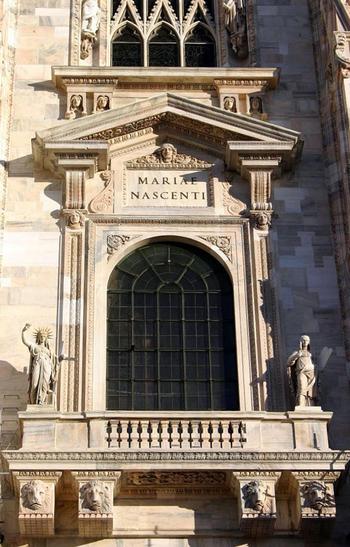
Napoleon had recast the Ecclesia and Synagoga motif in a historic act that continues to bear witness to his legacy. On May 20, 1805, days before Napoleon was crowned king of Italy in the Milan Cathedral, he ordered the completion of its façade.Footnote 67 To this day, the central balcony of the façade is flanked by statues of two women: modified versions of Ecclesia and Synagoga. On the left, La Legge Nuova (The New Law; Ecclesia) is cast as the Lady of Liberty, while on the right La Legge Vecchia (The Old Law; Synagoga) is no longer blindfolded and downcast. Synagoga is garbed in one of the biblical priestly vestments, comfortably and proudly holding the tablets (figure 6).Footnote 68
Milan Cathedral, façade, central balcony. At left, Ecclesia as La Legge Nuova [The New Law]; at right, Synagoga as La Legge Vecchia [The Old Law]. Wikimedia Commons. Photo credit and copyright: Giovanni Dall'Orto. Image reprinted pursuant to a license for reuse.

Returning to Couché’s print: Two bearded men bow before Napoleon, with their gaze directed at the junction of Napoleon's hand and the maiden's hand. Each man's arm is outstretched; possibly in what became known as the “Roman salute,” a pose of allegiance that gained prominence in the work of Jacques-Louis David (1748–1825).Footnote 69
A third man, respectably clothed and with a distinctive hat, looks toward the document in Napoleon's hand. This figure is reminiscent of a portrait of Rabbi Yosef David Sintzheim (ca. 1745–1812), the president of Napoleon's Grand Sanhédrin, who then served as the chief rabbi of the newly formed Consistoire. In that portrait, Sintzheim is famously depicted with just such a double-horned or double-humped hat.Footnote 70 Another portrait of Sintzheim by an anonymous painter, dated to the early nineteenth century, also shows the rabbi with this hat.Footnote 71 The double-horned head covering is similar to the medieval bishop's side-horned miter. This headwear developed from the iconography of two biblical images: the ceremonial head covering of the high priest and the glow (Hebrew: karan) of Moses's countenance, which was translated in the Vulgate as “cornutam” (horned).Footnote 72 An image that suggests the medieval miter, and Sintzheim's hat appears in eighteenth-century Jewish books in title-page artwork depicting Aaron the high priest.Footnote 73 This headgear, therefore, was a symbol of honor and would have indicated the status of the figure depicted as the high priest or bishop of the Jews. Moreover, including a Sintzheim figure invoked the significant Jewish legal body that Napoleon was convening at that time—the Grand Sanhédrin.
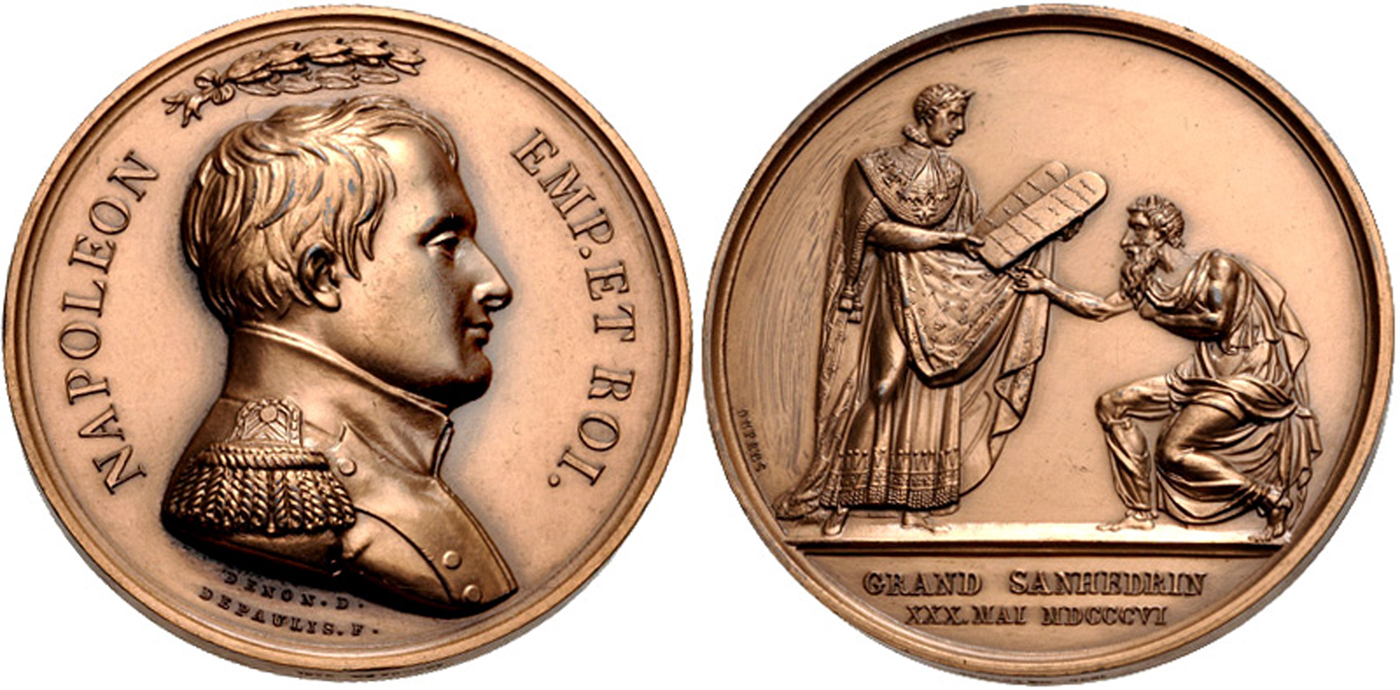
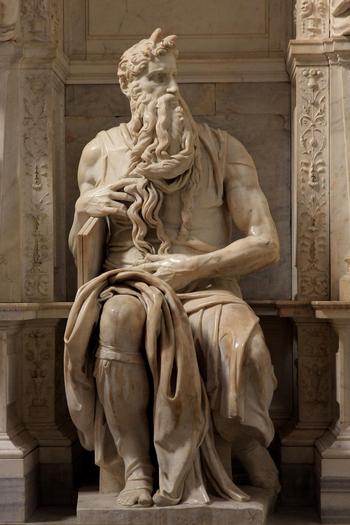
Contemporaneous with Couché’s print but with a more specific focus, a die was designed and cast for a medallion commemorating the Grand Sanhédrin (figure 7).Footnote 74 The obverse features a bust of Napoleon in military uniform with a laurel wreath above his head and the words “Napoleon Emp. Et Roi.” (Napoleon emperor and king). On the reverse, Napoleon, crowned with a laurel wreath and wearing royal robes, holds two tablets with indecipherable writing. A barefoot, bearded Jew with a mop of hair and a horn protruding from his head partly kneels before the ruler, his hand stretched toward the tablets. The bare left arm exposed by the draped clothes displays physical strength. The image is reminiscent of Michelangelo's Moses—a masterpiece that continued to capture attention (figure 8).Footnote 75 The exergue states “Grand Sanhedrin XXX. MAI MDCCCVI” (May 30, 1806). Once again, the use of tablets imagery and Moses—this time together with the exergue referencing a bona fide legal body—evokes images of law.
Bronze medallion commemorating the creation of the Grand Sanhédrin in 1806. Inscribed “Grand Sanhédrin XXX. MAI MDCCCVI,” diameter 41mm. 1975 restrike. Courtesy of Classical Numismatic Group, Inc. Terms of permission for use of this image specified attribution to owner and inclusion of url: https://www.cngcoins.com/Coin.aspx?CoinID=252121

Michelangelo, Moses. Tomb for Julius II, commissioned in 1505, completed in 1545. Church of San Pietro in Vincoli, Rome. Photo Credit: Jörg Bittner Unna. Image reprinted under the terms of Creative Commons Attribution 3.0 Unported License.

Michelangelo's Moses clutches the tablets, protectively holding them close to his chest; on the medallion, the tablets are in Napoleon's hands. Although Napoleon is not subject to Mosaic law, he seems to respect the ancient legal tablets. It is unclear, however, whether Napoleon has just received the tablets from, or is proffering them to, the Jew, and scholars remain divided on this point.Footnote 76
The Grand Sanhédrin was charged with the task of submitting responses to questions regarding the interface between Jewish and French law. The actions of the figures in the scene on the medallion are open to interpretation. The Moses-like Jew in the medallion may be submitting his law to Napoleon. Alternatively, the cowering Moses-like Jew may be submissively surrendering his ancient legal code to Napoleon. Indeed, elements within the French leadership hoped and planned for Jews to forsake Jewish law and take up French law as full citizens. A third possibility is that Napoleon is depicted as granting the tablets, in order to demonstrate the freedom of worship bestowed by his regime. Finally, the medallion may be suggesting a legal re-enactment—or more aptly the French Revolution notion of régénération—where a God-like Napoleon was granting the Moses-like Jew a new law.
MOSES'S TABLETS
As we have seen, Napoleonic artistic representations of Jews—either on their own or together with other confessions—consistently employed imagery associated with Moses and the tablets. To be sure, in the revolutionary era this visual and rhetorical imagery was ubiquitous in depictions of constitutions and lists of rights: tablets, Moses, and Mount Sinai were all pervasive icons. The imagery was allegorical—tablets indicated foundational law, Sinai suggested grand constitutional moments, and Moses was evoked as the archetypical lawgiver.Footnote 77 Occasionally tablets were featured specifically as the Mosaic tablets, albeit as part of an allegorical narrative.Footnote 78 Tablets were abundant in patriotic artwork and were even used in satirical drawings in France and in England.Footnote 79 Yet the depictions were severed from any link to contemporary Jews. This disconnection was later captured by French poet Alfred de Vigny (1797–1863) when he wrote about his 1822 poem Moïse:
Oui, le vrai Moise peut avoir regardé au delà de la tombe, mais le mien n'est pas celui des Juifs. Ce grand nom ne sert que de masque à un homme de tous les siècles et plus moderne qu'antique. (Yes, the true Moses may have looked beyond the grave, but mine is not that of the Jews. This great name only serves as a mask for a man of all centuries, and more modern than antique.)Footnote 80
Thus the use of tablet imagery was part of the romantic notion of Mosaic law and the ancient Hebrews.Footnote 81 In this vein, a relatively sympathetic artist like Picart, on his aforementioned frontispiece, depicts the Jew holding a scroll with Hebrew words denoting the Pentateuch. In medieval Christian art, a scroll in the hands of a Jew suggested the scroll of law; that is, the Old Testament that was replaced by the New Testament. I doubt the image had the same negative connotation in Picart's ecumenical frontispiece, yet the Jew was identified by a scroll, not tablets.
In contrast, the Napoleonic artwork resituated the tablets in the hands of the descendants of the Ancient Hebrews, identifying contemporary Jews with biblical Moses. The shift was repeated two years after the Grand Sanhédrin medal was designed: In 1808, Napoleon's youngest brother and King of Westphalia, Jérôme Bonaparte (1784–1860), issued a medal commemorating the enfranchisement of Jews in his realm. The medal featured the tablets of law on both the obverse and the reverse.Footnote 82
Napoleonic artists did not create a new iconography ex nihilo. Rather, they pressed existing symbols into new roles. This artistic inflection has, thus far, escaped attention. What is the significance of this artistic move?
Tablets of Law
In Jewish sources the tablets are not designated as being “of Moses”; pentateuchal texts refer to them as luhot ha-’even (the tablets of stone), luhot ha-‘eidut (the tablets of testimony), and luhot ha-berit (the tablets of the covenant).Footnote 83 Here the artists may be specifically identifying the tablets as “of Moses” in a bid to contrast them with tablets of law that were pervasive in early nineteenth-century French awareness as images of foundational law. Several examples follow.
The August 1789 Déclaration des droits de l'homme et du citoyen (Declaration of the rights of man and of the citizen) was a watershed in the history of rights. With regard to religion, Article 10 of the 1789 Déclaration states, “Nul ne doit être inquiété pour ses opinions, même religieuses, pourvu que leur manifestation ne trouble pas l'ordre public établi par la Loi” (“No one may be disturbed on account of his opinions, even religious ones, as long as the manifestation of such opinions does not interfere with the established Law and Order”).Footnote 84 In the present context, I am focusing not on the content of the 1789 Déclaration as a seminal legal text, but rather on its artistic representation.
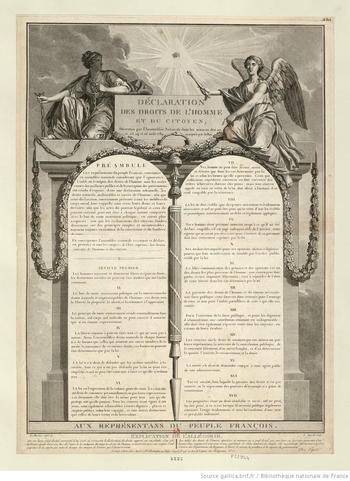
Soon after the National Assembly adopted the Déclaration, Jean-Jacques-François Le Barbier (1738–1826)—a writer, illustrator, and painter of French history—produced what would become his most famous work, a painting of the Déclaration.Footnote 85 The painting and popular prints fashioned after it (figure 9), are laden with symbolism: allegorical figures personifying France and Fame, the red Phrygian cap atop a spear, a snake biting its tail symbolizing eternity, a laurel wreath, broken chains indicating victory over despotism, and the radiant triangle with the Eye of Providence at its top.
L. Laurent and [?] Dien, after Jean-Jacques-François Le Barbier, Déclaration des droits de l'homme et du citoyen: Décretés par l'Assemblée Nationale dans les séances des 20, 21, 23, 24 et 26 août 1789, acceptés par le Roi [Declaration of the rights of man and of the citizen: Decrees issued by the National Assembly at the meetings of August 20, 21, 23, 24 and 26, 1789, accepted by the king]. Etching, 53.5 x 39 cm. Bibliothèque nationale de France, département Estampes et photographie, Reserve QB-370 (25)-FT 4. Reproduced by permission.

In the present context, it appears significant that Le Barbier chose to portray the seventeen articles of the Déclaration in the form of two tablets. Other artistic renditions of the 1789 Déclaration also chose tablet imagery, suggesting that Le Barbier was not alone in visualizing the Déclaration as tablets of law. There were, however, artistic representations of the Déclaration that did not employ this imagery, meaning that its use was a conscious artistic decision.
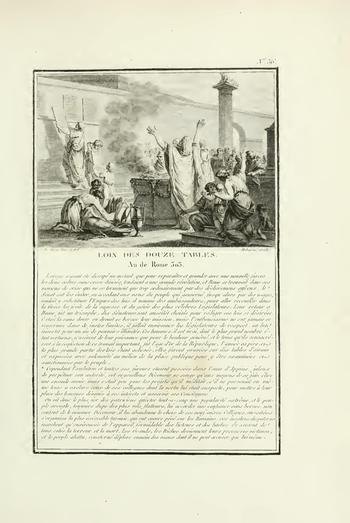
A second set of tablets relevant to the discussion are the Duodecim Tabulae (twelve tables) that served as the foundation of Roman and, therefore, French, law. In 1799, a government-sponsored work on the history of the Roman Republic was published. According to its subtitle, this work was intended “pour servir à l'instruction publique” (to be used in public education). The work included a drawing, Loix des douze tables (Laws of the twelve tables), referencing the Latin Leges Duodecim Tabularum (figure 10).
Drawing by Silvestre David Mirys (1742–1810), engraving by Claude-Nicolas Malapeau (1755–1803), Loix des douze tables [Laws of the Twelve Tables], in Figures de l'histoire de la République romaine, accompagnées d'un précis historique: ouvrage exécuté par ordre du gouvernement pour servir à l'instruction publique [Figures of the history of the Roman Republic, accompanied by a historical review: a work executed by order of the government to be used in public education] (Paris: Panthéon, 1799/1800), image no. 36. Digital image courtesy of the Getty's Open Content Program.

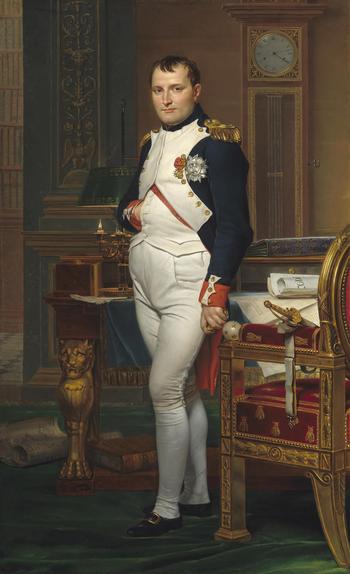
This brings me to paintings that depict Napoleon and the Code Civil des Français. The most famous portrayal of Napoleon writing the Code is the 1812 painting by Jacques-Louis David, where Napoleon stands after a night spent writing the Code (figure 11).
Jacques-Louis David, Napoléon dans son cabinet de travail / The Emperor Napoleon in His Study at the Tuileries, 1812. Oil on canvas, 204 x 125 cm. Samuel H. Kress Collection, National Gallery of Art, Washington, DC. Courtesy National Gallery of Art, Washington.

Although not an official commission—it was commissioned by the Scottish politician and art collector Alexander Hamilton (1767–1852)—the portrait reportedly met with Napoleon's approval: he told the artist, “[v]ous m'avez deviné, mon cher David; la nuit je m'occupe du bonheur de mes sujets, et le jour je travaille à leur gloire” (You have understood me, my dear David; at night I am occupied with my subjects’ happiness, and during the day I work for their glory).Footnote 86 Behind Napoleon, the clock shows 4:13 a.m., and the candles have burned low. There is an ink-stained quill, and a stack of papers, where the only recognizable word is “Code.” Wearing his military uniform and with his sword in view, Napoleon has worked through the night for his subjects’ legislative welfare. In David's painting, the Code—as one would expect—is written on paper.Footnote 87
David's painting can be contrasted with Antoine-Jean Gros's 1811 sketch for the dome of the Panthéon, then known as the Church of Sainte-Geneviève (figure 12). The original plan for the dome was an apotheosis of Saint Geneviève, but this Old Regime idea was replaced with images more suited to the Napoleonic narrative. In the center, angels carry the saint's reliquary to heaven. Around the dome there are four groups of figures, one of which is Napoleon, his second wife, Marie Louise (1791–1847), and their son (figure 12, bottom right).Footnote 88 Gros would complete the dome in 1824, in an entirely different political climate and with a significantly different design. Gros's original sketch suggests the legitimacy of Napoleon's rule, placing him alongside other great royal houses recognized by the Catholic Church. Napoleon is dressed in coronation robes, and behind him a slab, engraved with the words “Code Napo[leon],” uses tablet imagery to depict the code.
Antoine-Jean Gros, Sketch for the Dome of Sainte-Geneviève, ca. 1811. Oil on canvas, 73 x 73 cm. Petit Palais, Musée des Beaux-arts de la Ville de Paris. Photo Credit: The Yorck Project, © Zenodot Verlagsgesellschaft mbH. Image reprinted under the terms of the GNU Free Documentation License.

Thus, in French awareness, foundational constitutions, comprehensive codes, and bills of rights were depicted in the form of tablets. Historically significant law also took this form: ancient Roman law in the form of the Duodecim Tabulae or ancient Jewish law in the form of the Mosaic tablets. If the Napoleonic artists are indeed comparing ancient Jewish to ancient Roman law, then this is a double-edged sword. Ancient legal traditions are to be respected, yet the time has arrived for these laws to be updated. In 1789 the new foundational legal text, the Déclaration des droits de l'homme et du citoyen, was portrayed as tablets: two new tablets to replace the two biblical Mosaic Tablets. Napoleon's great legislative endeavor, the 1804 Code Civil des Français, was a more comprehensive replacement of these ancient tablets. Of course, no Romans who held onto to the Duodecim Tabulae existed, and the legislative body that was responsible for the 1789 Déclaration was no more. Only one people continued to cherish their hallowed tablets. In the spirit of Liberté des Cultes, the artists had room for the Mosaic tablets, yet it was the destiny of the enlightened legislator-benefactor Napoleon to grant new tablets: the Code Napoléon.
Moses
In the two Liberté des Cultes prints, the Jew holds large tablets that are identified as the Mosaic tablets. In their explanatory keys, the figure is identified as a Jew, but the earlier of the two prints explicitly draws a link to Moses's tablets: “Juif, s'appuyant sur les Tables de Moïse” (Jew, leaning on the tablets of Moses). That print also has a reference to Moses in the poem on the reverse side, where Napoleon's status as savior is recognized “Par la loi de Moïse” (by the law of Moses). In Couché’s print, Napoleon holds a document identified as “Loix données à Moïse” (laws given to Moses) and the Jew on the medallion is reminiscent of Michelangelo's Moses. The prominence of Moses follows the nostalgic idea of ancient Jewish law—as opposed to the rabbis and talmudic law—as a pure form of worship.
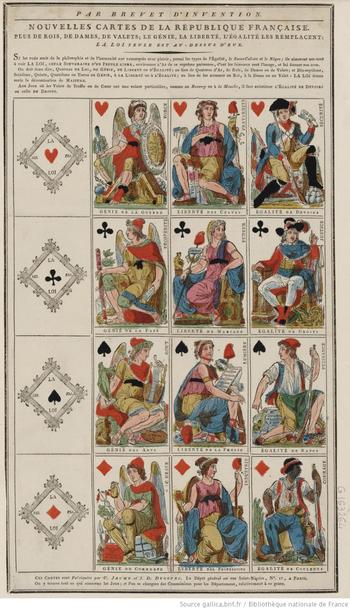
As noted, Moses figures prominently in French Revolution artwork, but the Napoleonic artists tweaked this theme by using Moses as a symbol for contemporary Jews. The repositioning of Moses can be contrasted with an earlier depiction of the Liberté des Cultes theme on a fascinating deck of cards produced in the early years of the French Revolution (figure 13).Footnote 89
[Urbain Jaume and] Jean-Démosthène Dugourc, Nouvelles cartes de la Republique française [New playing cards of the French Republic], 1793. Advertisement of patent, woodcut with stencil coloring, 40.5 x 23 cm. Bibliothèque nationale de France, département Estampes et photographie, Reserve FOL-QB-201 (134). Reproduced by permission.

The stated aim of the deck of cards was to reinforce revolutionary ideals through everyday items. The court cards provided a ready target for tearing down the Ancien Régime with its privileged classes; thus the picture cards needed to undergo a facelift. A prospectus printed in Paris in 1793 advertised the new deck, displayed the new face cards, and offered a few words of explanation for each. The designers, Urbain Jaume (d. 1816) and Jean-Démosthène Dugourc (1749–1825), boasted that they had “brevet d'invention” (a patent) dated February 17, 1793, to produce the cards for five years.Footnote 90
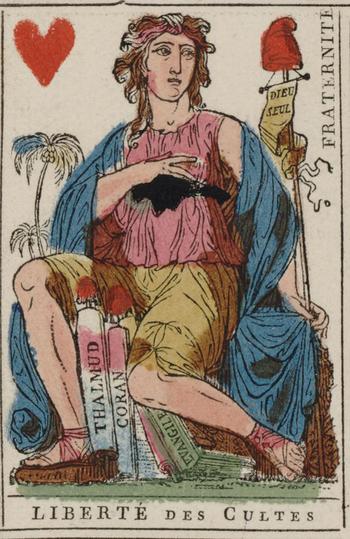
The aces in the pack all carried the words “la Loi” (law). The kings were replaced with “la Génie” (spirit); queens with “la Liberté” (liberty), and jacks with “l'Egalité” (equality). The deposed royals were each pictured with a personification of one aspect of the ideal. The four former kings were now the spirit of war, peace, the arts, and commerce. The four former queens were now freedom of worship, marriage, the press, and the professions. The four former jacks were now equality of duties, rights, class, and race. Each card was decorated with symbolic images and words. In the present context, the card that interests us is the former queen of hearts (figure 14).
Liberté des Cultes playing card, formerly the queen of hearts, detail from Nouvelles cartes de la Republique française. Bibliothèque nationale de France, département Estampes et photographie, Reserve FOL-QB-201 (134). Reproduced by permission.

The queen of hearts is depicted as a female figure; the words “Liberté des Cultes” appear at the bottom and the word “Fraternité” on the side. The figure's right hand is placed over her heart, while her left hand holds a staff or spear. The top of the staff is covered by a red Phrygian cap: the French revolutionary symbol of freedom modeled after the felt cap of manumitted slaves in ancient Rome. The bonnet rouge atop a spear had been proposed as part of the French national seal at the National Convention, on September 22, 1792.Footnote 91 On the playing card, the staff has a pennant with the words “Dieu Seul” (Only God). At her feet, three books representing three religions are juxtaposed: “Thalmud” (Talmud), “Coran” (Koran), and “Evangile” (Gospel).
In eighteenth-century France, the Talmud—that is, the law of the rabbis—reflected all that was wrong with Judaism. Although the queen of hearts is replaced by freedom of worship, she still associates Judaism with the Talmud. In contrast, the Napoleonic Liberté des Cultes artwork consistently features an image that conjures up more positive associations: Moses and the ancient law of Israel.
LEGAL NAPOLEON
French visual arts expressed the connection between Napoleon and his Jewish subjects as an essentially legal relationship. Jews are depicted together with the tablets of the Covenant, in a conscious choice to use the ancient, foundational legal text in order to place religious affiliation in a positive light. Napoleon is depicted first as the intermediary, and then as the benevolent lawgiver himself. He is a student of the Enlightenment who grants civil liberties, equality before the law, and in particular freedom of worship. The Grand Sanhédrin—a unique episode that I have only hinted at in the present discussion—further broadcast that Napoleon afforded legal autonomy under the aegis of French rule.
It has been argued that Christian art has defined Christianity through representations of Judaism.Footnote 92 Whereas this claim may be farfetched, a more modest stance can be taken: where Christian art includes Jewish references these contain additional layers of meaning about the Jewish-Christian relationship, beyond the subject of the artwork itself. Napoleonic art related to freedom of worship follows this convention by using Jewish subjects to convey Napoleon's position regarding Jews, while providing an additional statement about freedom of worship.
It would appear that the images discussed here go beyond Judaism as a specific religious confession, and even beyond freedom of worship for all religions. Scholars have demonstrated that Christian artists employed Jewish subjects to communicate messages that bear scant connection to Judaism.Footnote 93 It is my contention that the images are aimed at presenting a narrative of law and freedom of worship that was only incidentally or instrumentally connected to Jews.
Before I spell out that narrative, I should acknowledge that it is possible to read the images of Jews as part of a broader narrative of religious tolerance afforded to all confessions, not just Jews. Certainly the Napoleonic Liberté des Cultes prints that feature Jews place them on a par with other religious groups. Indeed, some fifteen years later, Napoleon would look back and cast his actions in this light.
Napoleon's personal physician on Saint Helena, Dr. Barry O'Meara, wrote that on November 2, 1816, he asked Napoleon about “his reasons for having encouraged the Jews so much.”Footnote 94 Napoleon knew that those around him were recording his words and that he was presented with an opportunity to fashion his legacy. Napoleon responded that his goal was to “make them become good citizens, and conduct themselves like the rest of the community.” To this end he sought “to make them leave off usury, and become like other men.” Undeniably, Napoleon stood to benefit from his plan: “By this I gained many soldiers. Besides, I should have drawn great wealth to France, as the Jews are very numerous, and would have flocked to a country where they enjoyed such superior privileges.” But alongside the utilitarian angle, Napoleon saw Jews’ rights as part of a broader picture, and the conversation with O'Meara shifted in that direction:
I wanted to establish a universal liberty of conscience. My system was to have no predominant religion, but to allow perfect liberty of conscience and of thought, to make all men equal, whether Protestants, Catholics, Mahometans, Deists, or others.Footnote 95
Napoleon's stirring words bespeak an ideal of freedom of worship; no religion was to be favored. Napoleon then boasted to O'Meara, “I made every thing independent of religion.”Footnote 96
Yet Napoleon's Saint Helena narrative is unconvincing. For one, Napoleon did not fully account for the events (and consequent artwork) of 1806, in which Jews received particular attention. More importantly, Napoleon's religious tolerance does not appear to have been born from altruism, nor was it motivated by lofty ideals. Rather, his professions of open-mindedness toward religion were driven by a utilitarian approach, which was facilitated by a lack of conviction of the importance of faith. On 28 Thermidor Year VIII (August 16, 1800), at the meeting of the Council of State, Napoleon reportedly stated,
Ma politique est de gouverner les hommes, comme le grand nombre veut l’être. C'est là, je crois, la manière de reconnaitre la souveraineté du peuple. C'est en me faisant catholique que j'ai fini la guerre de la Vendée, en me faisant musulman que je me suis établi en Egypte, en me faisant ultramontain que j'ai gagné les esprits en Italie. Si je gouvernais un peuple de Juifs, je rétablirais le temple de Salomon. (My policy is to govern men as the greater number wish to be governed. That, I believe, is the way to acknowledge the sovereignty of the people. It was by making myself Catholic that I ended the war in Vendée; by making myself a Mussulman that I established myself in Egypt; by making myself ultramontain that I won over the minds of the Italians. If I had to govern a nation of Jews, I should rebuild the temple of Solomon.)Footnote 97
Vendée refers to the uprising in western France by staunch Catholics against the Revolutionary government, that began in 1793 and ended in 1796. Ultramontain refers to supporters of the Catholic Church who championed the superiority and power of the pope. Indeed, a chronicler in Egypt—who would not have been familiar with Napoleon's 1800 remarks—recorded Napoleon's words: “I have told you many times that I am a Muslim and I believe in the unity of God, I glorify the Prophet Muhammad and I love the Muslims.”Footnote 98
Napoleon proudly described himself as a human chameleon, blending in and becoming like the surrounding peoples.Footnote 99 Thus he boasted that if he had the opportunity “to govern a nation of Jews” he would have become their hero by fulfilling their ancient dream of rebuilding the Temple. Napoleon unabashedly admitted that his course was dictated by a practical outlook. Even when he sought “to acknowledge the sovereignty of the people,” he was motivated by utilitarianism.
Alas, Napoleon never had an opportunity “to govern a nation of Jews,” so why do they feature disproportionately in Napoleonic artwork? What utilitarian gain was there for the emperor? If we accept the premise that Napoleon was not trying to win over the miniscule Jewish community in his empire, and that he was not driven by an altruistic notion of tolerance, what was his—and by extension his artists’—objective?
It appears that the issue at stake was broader than Napoleon and the Jews, and more far-reaching than Napoleon's attitude toward religious freedom. The French ruler—as always—was focused on Napoleon and, in this particular iteration, Napoleon and the law.
Ronald Schechter questions whether French writers in general, and Napoleon specifically, were interested in Jews as Jews, or whether Jews served as totems for broader issues. Schechter cogently argues that the revolutionary thinkers used Jews to consider a range of ideas and ideals.Footnote 100 Building on Schechter's work, I suggest that the artwork is particularly focused on law and legality.
Secularized French revolutionaries saw Jews as a litmus test for France's promise of liberty and civil rights and used them to define key concepts such as “man” and “citizen.” Napoleonic art used Jews to talk about Napoleon and the meaning of freedom of worship in a realm under Napoleonic rule. Jews, therefore, were an object—a showground where the sovereign could demonstrate his juridical authority, his commitment to legal rights, and his understanding and sponsorship of freedom of worship.
The artwork examined here suggests that Napoleonic artists depicted Jews and Mosaic law within the context of a broader narrative of legality. This message may have been particularly important for Napoleon, whose very throne was established by a coup d’état in legally questionable circumstances. Although the Brumaire Decree of November 10, 1799 sanctioned the coup ex post facto, a cloud of illegality continued to hover over Napoleon, which, for his part, Napoleon consistently attempted to dispel.Footnote 101 Fine art had proven remarkably effective in combating negative rumors, such as Napoleon's misdeeds during the Egyptian campaign, or the dubious victory at Eylau.Footnote 102 When it came to establishing Napoleon's right to rule, this narrative-creating medium was pressed into the regime's service with gusto. In a similar vein, the artistic prints discussed in this study—as well as other mediaFootnote 103—aimed to fashion a narrative of legality: Napoleon's regime is legally just; the Enlightened ruler affords rights and liberties to all his subjects; divine Napoleon is the new lawgiver.
The prints were not just about the sweeping issue of Napoleon's legality; they contained an additional subtext that specifically addressed freedom of worship. As noted, the artwork related to freedom of worship shifts from Napoleon as intercessor to Napoleon as lawgiver—a transition that mirrored Napoleon's move from a soldier fighting for the enlightened Republic to the very embodiment of France. All the while, the goal was less about worship or the worshippers, and more about the object of worship. These artistic depictions broadcast the message that Napoleonic freedom of worship was the right—granted to all confessions, even to Jews—to worship Napoleon.
Acknowledgments
The study that informs this article was conducted while I was a postdoctoral fellow with the Israeli Inter-University Academic Partnership in Russian and Eastern European Studies. I completed much of the research while an academic visitor at the Faculty of Law at the University of Oxford. I am grateful for these opportunities, for the assistance afforded me in the Bodleian Libraries, and to my genial host, Professor Joshua Getzler. I presented this research and received valuable feedback on a number of occasions: the Tager Family Jewish Law Program at the Faculty of Law of Bar-Ilan University, Israel; the 19th International Conference of the Jewish Law Association, Tel Aviv University, Israel; the Intercontinental Academia on Human Dignity, Zentrum für interdisziplinäre Forschung, Universität Bielefeld, Germany; the Religion, Society, State Conference, Ben-Gurion University of the Negev, Israel; and the 14th Annual Conference of the Israeli History and Law Association, Jerusalem, Israel. It is my pleasure to thank Asher Benjamin, Michael J. Broyde, Thierry Depaulis, Yona Guagnin, Anita Guttel, Amihai Radzyner, Daria Vasyutinsky Shapira, and Faustine Sigal for their gracious assistance, including vetting and correcting my translations from the French and the German, as well as providing sage advice at various stages of this project.