Introduction
Avascular necrosis is death of the bone tissue as a result of reduced blood supply. This has many causes, including corticosteroids and chemotherapy.
Recently, there have been reported cases of avascular necrosis in patients receiving bisphosphonate therapy. This appears to be due mainly to second or third generation bisphosphonates given intravenously, or to previous dental tooth extraction. The current case highlights the need to be aware of the risk of avascular necrosis in patients receiving oral bisphosphonates, even without recent dental work, who present with symptoms suggestive of a neoplastic process.
Case report
A 62-year-old woman presented to the ENT clinic with a five-month history of intermittent nasal obstruction and pain and swelling in the left maxilla. Her past medical history was limited to a fractured neck of femur, with subsequent avascular necrosis of the femoral head, and osteoporosis, diagnosed in 2003 using a dual energy X-ray absorptiometry scan. She was a non-smoker. Her only medication was alendronic acid 70 mg once weekly, which she had commenced following the diagnosis of osteoporosis.
On examination, the patient was found to have significant swelling of her left cheek and an ulcer in the left upper alveolus.
Rigid nasal endoscopy revealed a polyp in the left nasal cavity.
Investigative blood tests revealed a normal full blood count, urea and electrolyte concentrations, and liver function test results. The patient's total calcium was slightly elevated at 2.62 mmol/L (normal range 2.15–2.56 mmol/L), as was her corrected calcium, at 2.58 mmol/L (normal range 2.15–2.56 mmol/L).
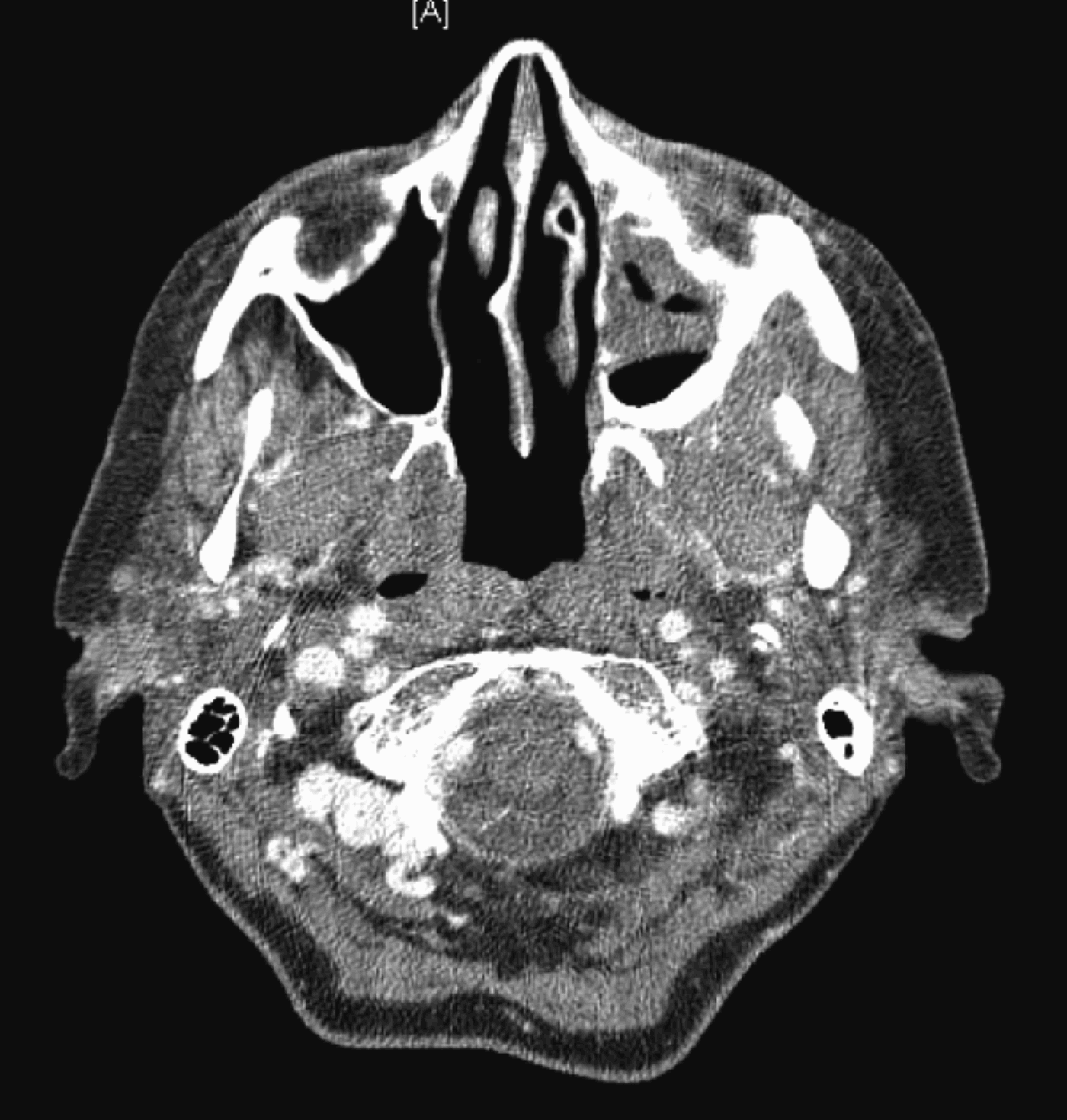
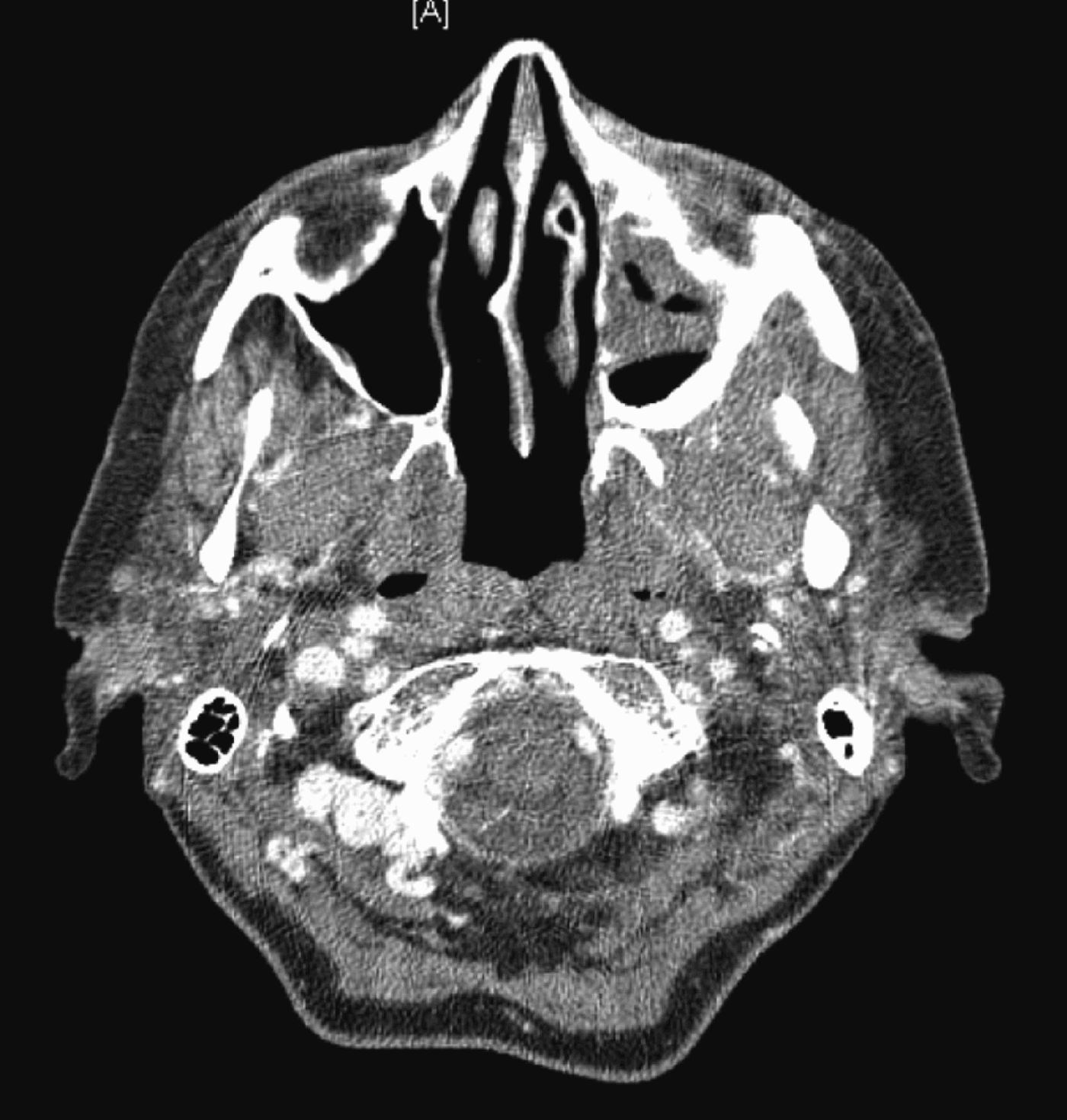
A computed tomography scan of the patient's neck and thorax showed an irregular soft tissue prominence with bony destruction related to the base of the left antrum and the left side of the hard palate. There were several associated small reactive nodes (see Figure 1).
Computed tomography scan of the head, neck and thorax showed an irregular soft tissue prominence with bony destruction related to the base of the left antrum and left side of the hard palate. There were several small reactive nodes.
The patient underwent an examination under anaesthesia, which revealed a loose left maxillary alveolus and evidence of dental caries. The maxillary sinus was inspected with a rigid endoscope and found to be normal, although there was reactive polypoid tissue in the floor of the nasal cavity. Biopsies were taken, which revealed necrotic trabecular bone fragments with areas of acute inflammatory cell accumulation in between the trabeculae, with no evidence of malignancy.
A diagnosis of avascular necrosis secondary to oral bisphosphonates was made. The patient subsequently developed an oro-antral fistula and underwent debridement of the necrotic bone and extraction of her remaining upper teeth. Due to the oro-antral fistula, which at the time of writing was too large to close, she was fitted with an obturator and remained under follow up.
Discussion
Bisphosphonates inhibit bone reabsorption through many mechanisms. Bone has a constant turnover, which is kept in balance by osteoblasts (creating bone) and osteoclasts (digesting bone). After digesting bone, osteoclasts also release growth factors which in turn induce local stem cells to differentiate into osteoblasts and form new bone. Osteoclasts have a constant turnover, and normally destroy themselves by apoptosis. Bisphosphonates encourage osteoclasts to undergo apoptosis.Reference Weinstein, Robertson and Manolagas1
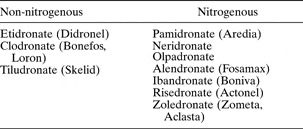
There are two types of bisphosphonates: those containing nitrogen and those without (Table I).Reference Farrugia, Summerlin and Krowiak2 The newer generation, also called third generation bisphosphonates, contain nitrogen and as a rule have higher potencies and accumulate in the body (the nitrogen side chain prevents them from being metabolised, and they therefore accumulate in the body).
Types of bisphosphonate

There are several indications for bisphosphonates: (1) prophylaxis and treatment of osteoporosis; (2) Paget's disease; (3) hypercalcaemia of malignancy; and (4) bone metastases in breast cancer.3
Several case reports and case series have highlighted the association between bisphosphonates and avascular necrosis in the mandible and maxilla. In contrast to our case, this has usually been seen following intravenous administration of bisphosphonates and/or after a dental extraction.
Farrugia et al. retrospectively reviewed patients with avascular necrosis of the mandible or maxilla who had received bisphosphonates.Reference Farrugia, Summerlin and Krowiak2 They identified 23 patients over a 12 month period who were all prescribed third generation bisphosphonates. Of these, only five were taking oral medication, and all 23 presented with involvement of the alveolar ridge. Thirty-nine per cent of patients had undergone a recent dental extraction. Most patients responded to local debridement, antibiotics and hyperbaric oxygen, but one required a near-total maxillectomy.
Mortensen et al. reviewed seven patients all of whom had been or were being treated for non-oral malignant neoplasms with bone metastases.Reference Mortensen, Lawson and Montazem4 All these patients presented with non-healing ulcers in the mouth. In all patients, the precipitating factor for ulcer formation had been recent tooth extraction. The removal of a tooth can expose the bone to sudden bacterial colonisation. The bone of the mandible is poorly vascularised, and since bisphosphonates reduce bone's capacity for repair, this leads to necrosis. Marx and Bagan et al. have respectively reported that 77 and 70 per cent of patients with avascular necrosis in their studies had undergone recent tooth extraction.Reference Marx5–Reference Bagan, Murillo, Jimenez, Poveda, Milian and Sanchis7
Treatment methods for avascular necrosis of the mandible or maxilla include the conservative approach of using antibiotics to prevent the development of osteomyelitis, hyperbaric oxygen, and local measures such as irrigation or mouth washes. If there is extensive necrotic bone, local debridement or more radical resection may be required.Reference Murray, Vesely, Novak, Irish, Crump and Neligan8
A number of recommendations have been made for patients about to commence bisphosphonate medication. A screening dental examination prior to commencement is essential, and any teeth requiring removal should be dealt with. Patient education is also very important regarding gingival health and regular mouth-washing, especially with chlorhexidine as this reduces the overall bacterial count.Reference Herrera, Roldan, Santacruz, Santos, Masdevall and Sanz9
Patients needing dentures should be assessed to ensure adequate fit. Any extensive manipulation of the dentoalveolar structures should be avoided whilst these patients are receiving bisphosphonates.Reference Murray, Vesely, Novak, Irish, Crump and Neligan8
All patients should be informed of the risks before initiation of bisphosphonate therapy.
Otolaryngologists should be aware of the condition (avascular necrosis of the maxilla) because of the possible side effects in the nasal cavity, sinuses and ears.
• Bisphosphonates can cause avascular necrosis of the maxilla and mandible
• The majority of cases involve the mandible and are due to intravenous bisphosphonate treatment and/or recent tooth extraction
• Avascular necrosis of the maxilla is possible in patients taking oral bisphosphonates, even in the absence of previous dental treatment
• Avascular necrosis of the maxilla can present with symptoms suggestive of malignancy
Our case was quite unusual as the patient was receiving oral bisphosphonates due to osteoporosis, had not had any recent dental extractions, and had presented with symptoms suggestive of malignancy. Whilst the mandible is at higher risk of osteonecrosis due to its end-artery system, the maxilla has a better vascular supply and the risk of osteonecrosis is therefore much lower. In our patient's case, there was unfortunately no dental screening prior to commencement of bisphosphonate treatment, nor any patient education regarding dental hygiene and mouth-washing.
This case highlights the need for careful monitoring of patients taking oral bisphosphonates. There are no national guidelines on the monitoring of patients receiving bisphosphonates. The British National Formulary states that osteonecrosis of the mandible has been reported in patients receiving intravenous bisphosphonates and, rarely, oral bisphosphonates.3 It states that adequate oral hygiene should be maintained during and after treatment with bisphosphonates, and that patients with concomitant risk factors (e.g. cancer, chemotherapy treatment, corticosteroid treatment or poor oral hygiene) should ideally undergo remedial dental work before starting bisphosphonate treatment.