INTRODUCTION
Cotton is attacked in the field by a plethora of insect pests (Matthews, Reference Matthews1989; Obeng-Ofori, Reference Obeng-Ofori and Obeng-Ofori2007; Thirasack, Reference Thirasack2001). Among these, the bollworm complex comprising the African bollworm, Helicoverpa armigera (Hubner); Spiny bollworm, Earias spp.; Pink bollworm, Pectinophora gossypiella (Saunders); Sudan bollworm, Diparopsis watersii (Rothschild); and the False codling moth, Thaumatotibia (=Cryptophlebia) leucotreta Meyrick are the most destructive insect pests of cotton in Ghana and in many West African countries (Abudulai et al., Reference Abudulai, Abatania and Salifu2006; Badii and Asante, Reference Badii and Asante2012; Obeng-Ofori, Reference Obeng-Ofori and Obeng-Ofori2007; Sadras, Reference Sadras1995). The adults of these insects invade cotton fields for oviposition from the late vegetative stage. The emerging larvae, which are the destructive stage, damage plant terminals and also chew into squares and developing bolls, resulting in abscission of these floral parts or damaged bolls and loss in seed cotton yield (Obeng-Ofori, Reference Obeng-Ofori and Obeng-Ofori2007). The feeding damage caused by these insects also predisposes the fruiting structures to infection by rot organisms (Gore et al., Reference Gore, Leonard, Church, Russell and Hall2000). Yield loss of over 70% has been recorded in unprotected fields in Ghana (Abudulai et al., Reference Abudulai, Abatania and Salifu2006).
Average seed cotton yields on farmers plots in Ghana are low and often below 500 kg ha−1 compared to over 2000 kg ha−1 in fields where bollworms are properly managed (Hillocks, Reference Hillocks2005; Salifu, Reference Salifu, Quarshie, Marfo, Owusu and Langyintuo1996). Insecticide application is the most common and also the most effective means of control for these insect pests in cotton in Ghana and many other cotton growing areas (Abudulai et al., Reference Abudulai, Abatania and Salifu2006; Hillocks, Reference Hillocks2005; Yadouleton et al., Reference Yadouleton, Vodounon, Chabi, Agbanrin, Badirow, Attolou, Ursins, Allagbe and Akogbeto2015). However, while endosulfan was the most effective and widely used insecticide for pest control in cotton in Ghana, it was banned in 2009 due to its abuse and hazard to the environment (Anonymous, 2012). Since then, cotton companies and their contract farmers have not found a suitable insecticide replacement (IPEN, 2009; Anonymous, 2012). Currently, the cotton companies use dursban + lambda super, which farmers claimed were not effective for bollworm control. Therefore, the objective of this research was to determine the efficacy of some insecticides against the bollworm complex in cotton and their impact on non-target organisms. The ultimate aim was to find the most suitable insecticide(s) for control of cotton insect pests in Ghana.
MATERIALS AND METHODS
Field experiments were conducted at the research field of the CSIR-Savanna Agricultural Research Institute near Nyankpala (9°42ʹN, 0°92ʹW and 184 m altitude) and on a farmer's field at Walewale (10°21ʹN, 0°48ʹW and 166 m altitude) in the Northern Region of Ghana from 2012–2013 cropping seasons. The soils at both locations were of sandy loam texture.
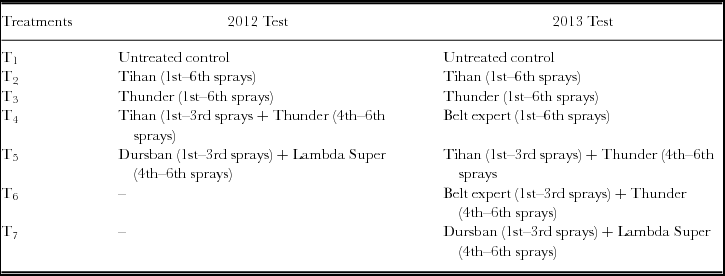
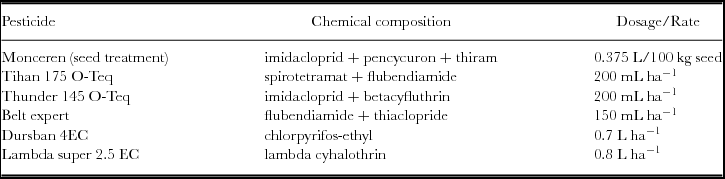
The treatments comprised of single insecticide formulations or two applied in alternation. There were five treatments (T) in 2012: T1 – untreated control, T2 – tihan, T3 – thunder, T4 – tihan + thunder and T5 – dursban + lambda super (Table 1). The treatments were modified in 2013 as T1 – untreated control, T2 – tihan, T3 – thunder, T4 – belt expert, T5 – tihan + thunder, T6 –belt expert + thunder and T7 – dursban + lambda super (Table 1). Cotton seeds were treated with the fungicide/insecticide mixture monceren before planting to provide protection against soil insects and sucking pests on young plants and soil diseases. All the pesticides, except dursban and lambda super, were supplied by Bayer CropScience (Bayer CropScience, France). Dursban and lambda super were obtained from the market as it was the source for cotton companies and farmers. The active ingredients of the pesticides and applications rates used are listed in Table 2. The insecticide applications begun at 35–40 days after planting (DAP) at the square initiation stage and continued at two weeks intervals for a total of six sprays in a season. The treatments were applied using a CP-15 knapsack sprayer with water delivery rate of 225 L ha−1.
Insecticide treatments in 2012 and 2013.

Seeds were treated with monceren before planting to provide protection against soil insects and sucking pests on young plants and soil diseases.
Pesticides, active ingredients and dosages/rates used in tests.

In both years, the treatments were arranged in a randomized complete block design and replicated four times. Plots consisted of 10 rows 10 m long, with spacing of 0.75 m between rows and 0.30 m between plants in a row. Plots were planted to the cotton (Gossypium hirsutum L.) cv FK 290, which is a commercial but insect susceptible cultivar. In 2012, the plots were planted on 25 June at Nyankpala and 29 June at Walewale. They were planted in 2013 on 04 July and 23 June, respectively. Nyankpala and Walewale are important cotton growing areas in Ghana. The plots were weeded twice at four and six weeks after planting. The plants were fertilized with 250 kg ha−1 Activa (23-10-5 NPK, 3% S, 2% Mg and 0.3% Zn) after the first weeding and with 125 kg ha−1 Sulfan (24%N, 9% S) after the second weeding.
Data collection and analyses
The plots were sampled for bollworms before the first spray and subsequently at two weeks intervals until harvest. Because they inflict a common damage to bolls, the different bollworm species were sampled together as one pest guild. On each sampling day, 20 plants were randomly sampled along the two diagonals of each plot. The samples were taken on each plant by observing and searching carefully the leaves, squares and bolls to count and record the numbers of bollworms present. Insect predators were recorded along pest samples when observed. The numbers of bolls per plant and bollworm damage were recorded near harvest on 10 plants per plot. Dry and green bolls with insect chewed or exit holes were considered damaged by bollworms. Plants were harvested by hand picking lint from opened bolls from the eight middle rows of each plot, leaving the outer two guard rows. Yield loss due to bollworms was calculated as follows:
 $$\begin{equation*}
{\rm{Yield}}\ {\rm{loss}}\ \left( \% \right) = \ \frac{{\ {\rm{TB}} - {\rm{UB}}}}{{{\rm{TB}}}}\ \times 100\%
\end{equation*}$$
where TB = Total number of bolls on plants and UB = Number of undamaged bolls.
The data collected were subjected to analysis of variance (ANOVA) using the general linear models procedure of SAS statistical software (SAS Institute, 1998). When a significant treatment effect was found, means were separated with Fisher's protected LSD test at P < 0.05. Data for each year were analysed separately because the insecticide treatments for each year were slightly different. However, because of non-significant location effect, data for the two locations in each year were pooled for analysis. Pearson correlation analysis (SAS Institute, 1998) was used to determine the relationships among bollworm densities, percentage boll damage, seed cotton yield and yield loss.
RESULTS
Bollworms species recorded
The bollworm complex recorded during the two years of the study at both Nyankpala and Walewale included H. armigera, D. watersii, P. gossypiella and Earias. sp. The different species were considered together as one pest guild inflicting a common damage to fruiting structures. However, H. armigera was the most dominant bollworm species (data not shown).
Effect on bollworm densities, boll damage and seed cotton yield in 2012
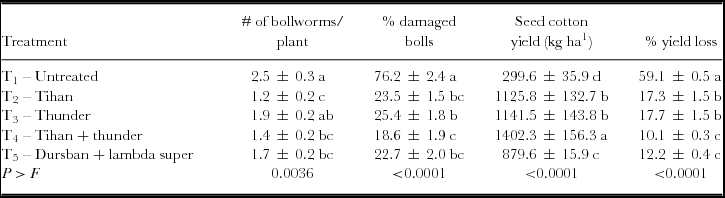
Bollworm densities and percentage damaged bolls were significantly lower in treated than in untreated control, except the treatment with thunder (T2) that did not significantly lower bollworm densities (Table 3). The pest densities and damage were similar when tihan, tihan + thunder and dursban + lambda super were used. Seed cotton yield was significantly improved in insecticide treatments compared with untreated control, with plots treated with tihan + thunder (T4) showing the highest yield. Higher yields were recorded in T2 – tihan and T3 – thunder compared with T5 – dursban + lambda super. Percentage yield loss was lowest in T4 – tihan + thunder and T5 –dursban + lambda super and highest in T1 –untreated control. Correlation analyses showed that bollworm densities and percentage damaged bolls were both negatively correlated with seed cotton yield (r = −0.40, P = 0.0011; r = −0.75, P < 0.0001, respectively). Also, percentage yield loss was negatively correlated with seed cotton yield (r = −0.76, P < 0.0001). However, a positive correlation was measured between bollworm densities and percentage damaged bolls (r = 0.55, P = 0.0003), and percentage yield loss (r = 0.50, P = 0.0011). Percentage damaged bolls also was positively correlated with percentage yield loss (r = 0.96, P < 0.0001).
Field efficacy of insecticides for control of bollworms in cotton in 2012.

Values are pooled means from Nyankpala and Walewale in 2012. Means (±SE) within a column followed by different letters are significantly different according to Fisher's protected LSD test at P < 0.05. Yield loss was calculated as a percentage of number of damaged or unopened bolls relative to the total number of bolls formed.
Effect on bollworm densities, boll damage and seed cotton yield in 2013
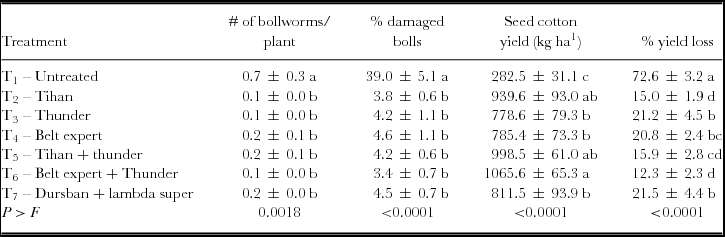
The population densities of the bollworms were lower for this year when compared to 2012 (Table 4). Pest densities and percentage damaged bolls were similar and were significantly lower in treated plots compared with untreated plots and then significantly higher seed cotton yields were recorded in treated plots. Application of belt expert + thunder (T6) gave the highest yield but this yield was not significantly higher than T2 – tihan and T5 – tihan + thunder. Consequently, percentage yield loss was lowest in T6, T2 and T5. However, the yield loss in T5 was not lower than that in treatment with belt expert (T4). As in 2012, bollworm densities and percentage damaged bolls were both negatively correlated with seed cotton yield (r = −0.30, P=0.0228; r = −0.61, P < 0.0001, respectively). Also, percentage yield loss was negatively correlated with seed cotton yield (r = −0.64, P < 0.0001). However, bollworm densities and percentage damaged bolls were positively correlated with percentage yield loss (r = 0.36, P = 0.0063; r = 0.88, P < 0.0001, respectively). There were no significant correlations between bollworm densities and percentage damaged bolls (r = 0.24, P = 0.0763).
Field efficacy of insecticides for control of bollworms in cotton in 2013.

Values are pooled means from Nyankpala and Walewale in 2013. Means (±SE) within a column followed by different letters are significantly different according to Fisher's protected LSD test at P < 0.05. Yield loss was calculated as a percentage of number of damaged or unopened bolls relative to the total number of bolls formed.
Effect of insecticide treatments on predator densities
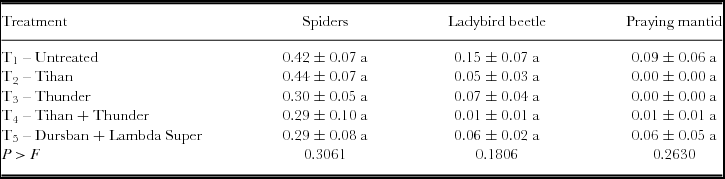
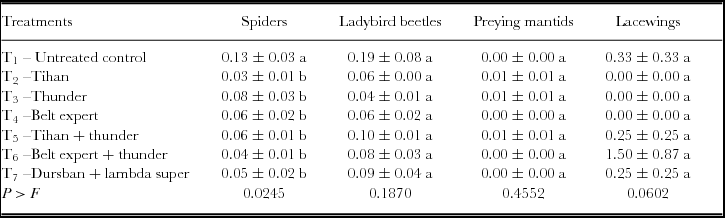
The predators recorded on the field included the ladybird beetle Coccinella undecimpunctata L., lacewing chrysoperla sp., spiders Chiracanthium mildei L., Koch and the praying mantid Mantis religiosa L. With the exception of spiders, predator densities were not significantly lowered by insecticide treatments (Tables 5 and 6).
Effect of insecticide treatments on predator densities in cotton in 2012.

Values are pooled means from Nyankpala and Walewale in 2012. Means followed by the same letters are not significantly different according to Fisher's protected LSD test at P < 0.05.
Effect of insecticide treatments on predator densities in cotton in 2013.

Values are pooled means from Nyankpala and Walewale in 2013. Means followed by the same letters are not significantly different according to Fisher's protected LSD test at P < 0.05.
DISCUSSION
Cotton bollworm management in Ghana relies heavily on insecticide-based crop protection strategies. Endosulfan had been the most commonly used insecticide until it was banned in 2009, without any suitable replacement insecticides (Anonymous, 2012). The results from the present study showed that the insecticides tested were efficacious as their applications generally lowered bollworm densities and their damage to cotton bolls compared with untreated control. Seed cotton yields also increased in these insecticide treatments. The results further showed that alternate application of tihan and thunder was the best in terms of improved seed cotton yield in 2012. This treatment proved superior to the cotton companies’ practice of alternate application of dursban and lambda super. In 2013, the best yields were obtained with the treatment using belt expert alternated with thunder, but this was not better than the tihan and thunder alternated treatment. The treatment with belt expert alternated with thunder gave a better yield than the dursban alternated with lambda super. These results agree with those of Gondwe et al. (Reference Gondwe, Meke and Wakudyanaye2008) in Malawi and Elégbédé et al. (Reference Elégbédé, Glitho, Dannon, Kpindou, Akogbéto and Tamò2014) in Benin, when tihan and thunder treatments were effective for controlling bollworms and increasing seed cotton yield.
In the present study, however, the tihan or belt expert alternated with thunder did not lower bollworm densities or percentage damaged bolls when compared to the treatment with dursban alternated with lambda super. The increased yields in these treatments could be attributed to perhaps higher retention of bolls, which opened to produce seed cotton (Abudulai et al., Reference Abudulai, Abatania and Salifu2006). General field observations (data not shown) showed that plants in these treatments carried more bolls than those in the dursban alternated with lambda super treatments. Perhaps the combined effect of the chemical mixtures in tihan or belt expert and thunder (Table 2) suppressed feeding of bollworm larvae at the early square and boll formations stages. Bollworm attack during early square and boll formation stages causes shedding of these floral structures, which can reduce yield (Abudulai et al., Reference Abudulai, Abatania and Salifu2006; Farrar and Bradley, Reference Farrar and Bradley1985; Gore et al., Reference Gore, Leonard, Church, Russell and Hall2000; Sadras, Reference Sadras1995). This was suggested by consistently negative correlations of bollworm densities and percentage boll damage with seed cotton yield.
The application of insecticides may cause the mortality of both target and non-target species. Herein, predator densities except that of spiders were not significantly lowered by insecticide treatments. Gongwe et al. (Reference Gondwe, Meke and Wakudyanaye2008) evaluated insecticides against cotton insect pests in Malawi and reported that thunder treatments did not lower densities of the predators’ coccinellids and syrphids. With the exception of syrphids, coccinellids were also recorded in the present study and their densities were not significantly lowered by the insecticides. The selectivity to predators may be due to the mode of action of the insecticides tested in this study. The insecticides tihan, thunder and belt expert each has two active ingredients that combine systemic and ingestion or contact activity (Table 2). These properties give the insecticides excellent biological efficacy against insect pests, particularly bollworms that feed on and within cotton squares and bolls. The apparent selectivity of the insecticides to predators may be due to less contact of the predators to the insecticides or because most predators do not feed on plants (Fernandes et al., Reference Fernandes, Bacci and Fernandes2010).
In conclusion, the results from the present studies showed that all the insecticides tested lowered bollworm densities and boll damage resulting in increased seed cotton yield when compared to untreated control. However, tihan or belt expert applied during the first three sprays followed by thunder during the next three sprays were the most effective treatments as their applications resulted in the greatest seed cotton yield. These treatments generally increased yields higher than the cotton companies’ practice of dursban alternated with lambda super. The insecticides did not significantly lower populations of beneficial predators such as the ladybird beetle C. undecimpunctata and the lacewing Chrysoperla. sp. Thus, these results showed that tihan or belt expert applied in alternation with thunder was the most promising and can be recommended as replacement for endosulfan, which has been banned due to its high toxicity to the environment. The treatments can also be part of integrated pest management programs that involve the conservation of beneficial organisms such as insect predators.
Acknowledgements
The authors are sincerely grateful to the field staff at the Entomology Section of CSIR-Savanna Agricultural Research Institute, especially Fredrick Anaman, Kwabena Yaw James, Rebecca Kaba and Soweibatu Abdulai for their assistance in the field data collection. The authors also acknowledge the support by Bayer CropScience for the study.