


Introduction
The use of metaphor in psychotherapy has been a topic of research for a number of years. Recently, cognitive behaviour therapy (CBT) experts have advocated a collaborative approach to developing client metaphors on the basis that if a metaphor comes from the client, rather than the therapist, it is thought to have personal meaning and resonance (Kuyken et al. Reference Kuyken, Padesky and Dudley2009). Socratic questioning has been suggested as a way to explore client metaphors (Blenkiron, Reference Blenkiron2005) and third-wave CBT approaches such as ACT also encourage an interactive approach to developing metaphors (Stoddard & Afari, Reference Stoddard and Afari2014). This stance is aligned to the work of Kopp (Reference Kopp1995) who has also suggested that metaphors should ideally be a collaborative venture, with therapist and client actively incorporating, extending and altering each other's metaphors to establish a shared therapeutic vocabulary that serves to organize and link large amounts of knowledge and experience. Previous research has also shown that metaphors in therapy tend to occur in bursts: elaboration via bursts of metaphoric language or development of a metaphor over time have been found to be more consistently present in successful cases of therapy (McMullen, Reference McMullen1989). Moreover, novel metaphors, as opposed to conventional metaphors, tend to occur in extended bursts (Barlow et al. Reference Barlow, Kerlin and Pollio1971).
Clients often reveal a great deal about their major concerns, their perceptions of self and others, and their affective experiences in their metaphoric language. For example, Angus & Rennie (Reference Angus and Rennie1989) found that metaphors (excluding common, everyday figures of speech) emerged from the associated meaning context when participants attempted to verbally depict felt experiences during therapy sessions. The metaphors symbolized inner experience by (1) providing an associative link to experience, (2) representing aspects of self-identity, and (3) depicting role relationship patterns. The view of co-construction of metaphors as beneficial in creating a shared language is shared by Angus & Korman (Reference Angus and Korman2002) who concluded, based on their study of themes in therapy transcripts, that:
it appears that the re-use and co-creation of metaphoric themes creates a mutually understandable terminology and context of meaning between the therapist and client (p. 160).
Little is known about how use of metaphoric language by therapists and clients actually evolves in the therapeutic dialogue. While an early paper by Barlow et al. (Reference Barlow, Pollio and Fine1977) described how a therapist and client repeatedly used, responded to and built upon each other's metaphors, evidence of co-construction, or joint sharing of metaphor, is not very common in the existing literature. For example, Hill & Regan (Reference Hill and Regan1991) reported in their single case study of a therapist and client, that the client repeated only 3% of therapist-introduced metaphors within the same session, while the therapist repeated 13% of client-introduced metaphors. The extent to which clients in successful cases ‘took up’ therapist-introduced metaphors was found to be minimal.
Some attempts have been made to describe the responses made by therapists to client metaphors during therapy. Ferrara (Reference Ferrara1994, p. 134) describes the following response types: comprehension without comment; misunderstanding; failure to comprehend or get the point; ratification (by comment, repetition, or use of associated word in later discourse); and extending the metaphor jointly (weaving an elaborate web of correspondences, teasing out additional ramifications, adding new dimensions). In another study (Sims & Whynot, Reference Sims and Whynot1997), therapists working with families were found to: assume meaning, ignore or miss the occurrence of metaphor, express curiosity about the metaphor, praise the metaphor's expressive power, and explore imagery or feelings associated with the metaphor.
A range of therapist responses to client metaphors was described by Strong (Reference Strong1989): explicating what is implicit in the metaphor (i.e. reflective listening, focusing attention on the metaphor and exploring the personal meaning, creating a shared understanding of the metaphor); therapeutically extending or modifying the metaphor (modifying metaphoric conceptions of problems, situations or experiences) and responding to a client metaphor with a metaphor of their own which is isomorphic (i.e. corresponds in form and in the relationships between the elements) to the client's metaphor in order to reframe the problem. A further therapist response was recognizing and remembering a client's metaphor for possible future use (Bayne & Thompson, Reference Bayne and Thompson2000).
The studies described above, of how therapists respond to client metaphors, are limited in that the methods for identifying metaphors are not clearly specified, and neither is the process of categorizing responses made explicit. In a previous paper (Mathieson et al. Reference Mathieson, Jordan, Carter and Stubbe2015), we described how a method developed by linguists Cameron & Maslen (Reference Cameron and Maslen2010), was used to identify metaphors in 48 CBT sessions. This is the most clear, operationalized approach to date for identifying metaphors in conversations. In our analysis, we found that metaphors occurred at a rate of 31.5 per thousand words in CBT sessions and that therapists used metaphors more frequently than clients in 46 out of 48 CBT sessions. Cameron notes that spontaneous talk is dynamic, with metaphors being introduced, adjusted and developed as an interaction proceeds. As speakers pursue their discourse aims and topics, connections are ‘sparked in their minds, which may divert them sideways’ (Cameron, Reference Cameron, Zanotto, Cameron and Cavalcanti2008, p. 60), linking to other concepts. Types of ‘metaphor shifting’ that can occur in conversation are grouped into four categories by Cameron (Reference Cameron, Zanotto, Cameron and Cavalcanti2008): (1) VehicleFootnote † redeployment: where the same or semantically connected metaphor is re-used with a different topic; (2) Vehicle development, where the metaphoric vehicle term is repeated or relexicalized (i.e. a near synonym or equivalent is used); (3) Vehicle explication (i.e. the metaphor is exemplified, elaborated, expanded or contrasted); and (4) Vehicle ‘literalization’, i.e. where the metaphor is connected to life experience (Cameron, Reference Cameron, Zanotto, Cameron and Cavalcanti2008). For example in a classroom discussion the atmosphere might be described as a blanket of gases, and later in the discussion someone says ‘when you are in bed, you've got a blanket protecting you from the cold’ (a literalization).
Collaboration in metaphor development between therapist and client was operationalized in three ways by Hill & Regan (Reference Hill and Regan1991): (a) a correlation between the number of metaphors used by the therapist and client within sessions; (b) a repetition, using the exact wording introduced by the other person during the same session; (c) an elaboration of the content of the metaphor, i.e. the contiguous use of different but conceptually related metaphor. The related metaphor had to occur within three speaking turns after the initial metaphor and only one elaboration was counted no matter how many metaphors were in the sequence. These authors also looked at the ‘direction’ of the collaboration (in one therapy session, one therapy dyad) and found that the main direction involved the therapist picking up on the client's metaphors, often repeating it.
The current study drew on the work of Cameron (Reference Cameron2007) and Hill & Regan (Reference Hill and Regan1991) to describe the responses used by therapists and clients to each other's metaphors in early CBT sessions, and explored whether the client or therapist metaphors were developed. Our aim was to shed light on the process of co-construction at the time a shared language may be developing.
Method
The 12 transcripts of CBT sessions used in this study were collected for an earlier psychotherapy process study, which did not have a specific focus on metaphor (Carter et al. Reference Carter, Crowe, Carlyle, Frampton, Jordan, McIntosh, O'Toole, Whitehead and Joyce2012). Three therapist–patient dyads were randomly selected from 48 transcripts coded in the previous study mentioned above (Mathieson et al. Reference Mathieson, Jordan, Carter and Stubbe2015). Therapy sessions 1–4 were selected to explore co-construction of metaphors in early therapy sessions. The transcripts were from three clients with depression, undergoing individual therapy in a clinic setting, in a New Zealand urban centre. The three therapists were all female, experienced in treating depression and with at least 2 years’ experience using CBT. Two clients were female (aged 32 and 48 years); one client was male (aged 28 years).
Metaphors had been identified in our previous study (Mathieson et al. Reference Mathieson, Jordan, Carter and Stubbe2015), using the discourse dynamics approach (Cameron & Maslen, Reference Cameron and Maslen2010). The approach was found to have adequate reliability, metaphors were found to be relatively common in 48 therapy sessions examined (31.5 metaphors per thousand words), and therapists used metaphors twice as often as clients (therapists: 21.2, range 7–36; clients: 10.3, range 3–24).
Our focus for this study was on the initial responses clients and therapists make to each other's metaphors. We therefore focused on the first three speaking turns after an identified metaphor, as in the approach taken by Hill & Regan (Reference Hill and Regan1991). Limiting the coding to three speaking turns also increased coders’ confidence in the connections between vehicles and responses. We coded both therapist and client responses to each other's metaphors to explore the developing interaction.
Iterative development of categories
-
(1) F.M. (a clinical psychologist) examined several transcripts, looking at client and therapist responses within three speaking turnsFootnote † of each identified metaphor. The following trial categories were used: Repetition, Re-Phrasing, Exploration, Development, Disagreement, No response, Other response. These trial categories drew on the existing literature and clinical experience, while allowing for other possible categories.
-
(2) The categories were discussed and refined by M.S. (a linguist) and J.J. (a clinical psychologist). For this study, it was decided that rather than coding at the level of the initial metaphor and coding every metaphor whether or not there was a response, we would trial coding only where there was a clearly identified orienting response to a previous metaphor (or metaphors). Our rationale was that the focus of the analysis was on the interaction, not the occurrence of metaphor per se. In addition, it was decided that metaphoric rephrases (where a different metaphor vehicle is used in a rephrase), would be included as a form of rephrasing.
-
(3) J.J. then coded samples of transcripts using the categories identified and the categories were discussed and refined further. We initially created a category for literalizations (i.e. taking the metaphor into the real world, such as an extended conversation about learning a new therapy skill being like learning to drive a car), but subsequently decided that literalizations should be included as a form of elaboration/extension of the metaphor vehicle, because it was not possible to clearly delineate these from other extensions. We added a category we observed in our data: ‘explicit praise of the metaphor’, for example, the client saying ‘that's a really good metaphor’.
-
(4) F.M. coded all 12 transcripts and refined the categories further after discussion with M.S. and J.J. The trial category of ‘disagreeing’ was removed because it did not occur. Only one code was given per response, even if the response was linked to more than one metaphor vehicle by the other speaker. Where two codes seemed to apply we used the more elaborated code (e.g. coding ‘elaboration/extension’ rather than ‘exploration’). If there were several responses to one metaphor vehicle, these were all coded.
-
(5) J.J. cross-coded all 12 transcripts and met with F.M. several times to compare notes and make final decisions, using a consensus approach. J.J. and F.M. then checked six sessions each to ensure the correct revised coding was used.
-
(6) M.S. did a final check of all 12 transcripts, in order to check coding consistency and review the robustness of the categories. In response to her feedback, we changed the name of the category ‘Exploration’ to ‘Clarification’ as this specified the category more clearly.
Final response categories
Responses were only coded if they were clearly orienting responses to a metaphor vehicle, rather than simply responding to the general topic by the other speaker (therapist/client).
For each identified metaphor vehicle the coder looked at the next three speaking turns, systematically looking for a response by the other speaker in the following categories: (C indicates spoken by client and T spoken by therapist). Underlined words and phrases are identified metaphors.
C1/T1: Repetition of metaphor vehicle, using same or similar words
Similar words example:
C: Even the remotest suggestion I feel like I freeze up.
T: So you mention freezing up. . .
C2/T2: Rephrasing of metaphor vehicle, using simple rephrasing, synonym, differentmetaphor or simple metaphorical expansion
Simple expansion example:
C: make my circle [of friends] wider
T: increase your circle.
Rephrase with different metaphor vehicle example:
C: it is kind of a steady improvement, but it has got lumps in it.
T: Yeah a few dips here and there, I can imagine
C3/T3: Clarification of meaning of metaphor vehicle, so as to create a shared understanding.(Response does not have to include metaphoric language.) May include askingquestions re associated imagery, thoughts or feelings, where referring to the metaphor(possibly implicitly – i.e. can include anaphoric referencesFootnote †. Can include answers toquestions if the answer has an exploring quality.
Clarification example:
C: I guess the nightmare is my house, having to pack it all up and leave.
T: Oh, so that is the downside, the whole hassle of shifting.
C4/T4: Elaboration/extension of metaphor: teasing out additional ramifications anddimensions, extending or modifying it; includes literalization (i.e. taking it into thereal world) or extended analogy.
Can include extended related metaphor that is associated with the same topic. Incases of literalization, the whole speaking turn was coded as one literalization.
Elaboration/extension example:
C: It's like bases. You know first base, second base, third base . . . So obviously he played this all the way.
T: How are you going to make sure that he plays this game with you?
C5/T5: Explicit praise of/agreement with the metaphor. Must be explicitly in relation to the metaphor itself, not just general content.
Explicit praise/agreement example:
C: You know, it is like before I even get out the doors I sabotage myself . . .you want to win the race but you take the engine out of the car.
T: Yeah that is a really good analogy.
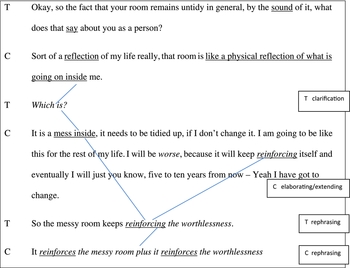
Metaphor vehicles with identified responses were underlined in the Word document and linking lines were drawn to assist visual identification in the text. The response code was noted in a comments box. A conservative approach to coding was taken: because we only had access to written transcripts, responses were not coded in some cases, for instance where the intonation could affect how the response might be categorized.
Figure 1 is an example of how the final coding was conducted. The underlined words are identified metaphors, the italicized sections are identified responses and the linking lines show the links between metaphor vehicles and responses. Comment boxes show how italicized responses were coded.
Coding example. T indicates spoken by the therapist and C spoken by the client.

‘Who started it?’ analysis
The coded transcripts were examined next for whether metaphoric exchanges were initiated by the client or therapist. As noted earlier, it was decided that we would only code metaphor vehicles that occurred at the start of metaphoric exchanges, where there was a response within three speaking turns. Coding of the initial metaphor in an exchange occurred at the first speaking turn in a burst of metaphoric language. Where the first vehicle in a burst had been observed to occur earlier in the session as well (which happened reasonably often), this was noted separately, at the point where it occurred, along with whether it was first used by the therapist or the client.
Results
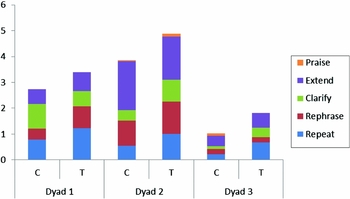
Figure 2 shows the range and proportions of response types to each other's metaphors (within the next three speaking turns) used in the three therapy dyads (therapist–client pairs). The third dyad had a lower rate of metaphors across most categories. Explicit praise of/agreement with the metaphor was the least frequent response overall. The use of metaphor was highly variable across dyads, with Extension/elaboration used relatively frequently.
Frequency of response types.

The ‘Who started it?’ analysis results indicated that bursts of metaphoric language were initiated by therapists and clients at a similar rate (therapist 170 vs. clients 168 in total across all sessions); which also means that clients and therapists took up each other's metaphors at a similar rate. The first metaphor in a burst was often a recurrence of a previous metaphor (44%). Bursts initiated by therapists were more likely to be a recurrence of a metaphor previously used by the therapist, than of a metaphor previously used by the client (49 vehicles were previously used by therapists vs. 23 vehicles previously used by clients). Bursts initiated by clients were almost equally distributed between recurrences of therapist or client metaphors (35 were re-use of client metaphors while 33 were re-use of therapist metaphors).
Discussion
The metaphor of communication as a dance is a widely used figure of speech in everyday conversation and in psychotherapy research (Lippe et al. Reference Lippe, Monsen, Ronnestad and Eilertsein2008; Bucholz & Reich, Reference Bucholz and Reich2014). This study found a range of common initial responses (or dance moves), within three speaking turns made by therapists and clients to each other's metaphors occurring in early sessions of treatment for depression. These were categorized as: repetition, rephrasing, clarification, elaboration/extension and praise of/agreement with the metaphor. The frequency of different response types varied across the three dyads (therapist–client pairs). Elaboration/extension was used relatively frequently. This category is the one that is likely to be more clinically productive because it may facilitate an interesting, vivid creative process with potential for new understandings.
Extended literalizations (taking a metaphor into the real world) were classified as a form of elaboration/extension. Speakers’ metaphoric responses to each other also often involved a synonymic metaphor vehicle. For example, a client is talking about not giving a clear commitment to going for a visit home and the therapist says: ‘So you can have an out’. The client responds: ‘Yeah a back door’.
Therapists and clients ‘took up’ each other's metaphors at a similar rate, suggesting a collaborative interaction was occurring, consistent with suggestions from Kopp (Reference Kopp1995), Stott et al. (Reference Stott, Mansell, Salkovskis, Lavender and Cartwright-Hatton2010) and Blenkiron (Reference Blenkiron2005). This may be due to the emphasis on collaboration in the CBT approach, though it is also possible that this result may have been influenced by the coding methodology used and coding of some highly conventionalized metaphors such as ‘homework’ and ‘goals’.
In this study there was clear evidence of metaphors being appropriated (i.e. adopted), by the other speaker. The term ‘appropriation’ comes from socio-cultural theory (Wertsch, Reference Wertsch1998). Cameron (Reference Cameron, Zanotto, Cameron and Cavalcanti2008) notes that the appropriating and sharing of metaphors across speakers is a significant indicator of achievement of discourse goals, particularly where the vehicle expressions are emotive: ‘an important signal and measure of increasing alignment between participants’ (p. 50), and thus has potential relevance for the use of metaphor in therapy. This interpretation is supported in our study by the fact that dyad 3 showed a lower frequency of co-construction of metaphor. Dyad 3's sessions also had a disproportionate amount of therapist talk vs. client talk, suggesting opportunities to engage the client in collaborative discussion, including metaphoric exchanges, may have been missed. Use of transcripts rather than videotape or audiotaped data, and lack of ethnographic information made it difficult to ascertain the reason(s) for this pattern of interaction. This pattern could have been due to therapist style or perhaps the client was unresponsive due to depression, or other factors.
A limitation of this study was that it was based on written transcripts, meaning other aspects of metaphoric communication, such as tone of voice and gesture were not captured. The coding was complex, requiring close attention to cohesive links between text. The main coding challenge was deciding whether a response was simply a general response to the topic being discussed or whether it was a response to a metaphor vehicle. This was dealt with by coding conservatively, i.e. only coding those instances where there was a clear link between metaphor and response. The coding was limited to three speaking turns after a vehicle occurred, so did not capture instances where the metaphor vehicle was ‘saved up for later’, which is a further potential therapist or client response. The co-construction identified does not necessarily indicate a productive process in all cases. Although extended bursts of metaphoric language by clients have been found to relate to problem solving (Pollio & Barlow, Reference Pollio and Barlow1975), other studies have found a more complex picture (Rasmussen & Angus, Reference Rasmussen and Angus1996; Rasmussen, Reference Rasmussen2000). This complexity may occur because metaphoric language serves a range of functions, including, enabling intellectualizing or a focus on cognitive content to avoid emotional distress.
The frequent use of synonyms, often metaphoric synonyms that we observed (e.g. client describes anger as ‘boiling over’; therapist responds ‘you explode’) is not consistent with recommendations made by advocates of therapies with a strong emphasis on metaphor, who advocate exploring, developing and transforming a particular metaphor vehicle (Kopp, Reference Kopp1995; Sims & Whynot, Reference Sims and Whynot1997; Ronen, Reference Ronen2011). However, the use of synonyms fits with the results of another study that concluded that successful therapy cases include (a) the elaboration of major therapy themes in terms of bursts of figurative language or the development of a single metaphor over time and (b) the existence of a central metaphor, evidenced by several conceptually related figures that fit the metaphor (McMullen, Reference McMullen1989). Our results suggest that synonyms can be productive in the development of shared language, supporting McMullen's finding.
An observation during coding was that in almost half the cases (44%), the first utterance in a burst of metaphoric language between client and therapist was actually a recurrence of a metaphor vehicle used previously in the session, or even echoing a metaphor from a previous session. Further, some bursts of metaphoric language were much richer and more extended than others. These observations fit with clinical understandings about therapists and clients picking up on and developing shared understanding of the problem that becomes a reference point within and across therapy sessions. Although these phenomena were not the immediate focus of our analysis and require separate investigation, we observed that shared metaphors, like other kinds of shared language, become fine-tuned or whittled into their final form through such repeated iterations and elaborations.
If therapists attend to the occurrence of metaphor and are aware of the range of potential responses, they can be selective in their choice of response, depending on the desired communication or therapeutic outcomes. While it is unlikely to be helpful for therapists to respond metaphorically to (or ‘pounce on’) every metaphor clients utter, responding by applying the same metaphor vehicle to key metaphoric descriptions in order to develop a stable metaphoric theme may be beneficial. If embarking on extended literalizations, there is potential to lose the thread, so we suggest therapists continue to ensure there is mapping back to the original topic. Responding to clients’ metaphor vehicles with a different metaphor vehicle has potential to negatively affect rapport, potentially implying ‘my metaphor is better than yours.’ Conversely, intentionally responding with repetition, clarification, elaboration or extension to the client's metaphor has the potential to assist rapport and align the therapist more effectively with the associated feelings, physiological responses and beliefs associated with the client's metaphor.
Summary of main points
Metaphoric language can be part of the shared language that develops in CBT. Bursts of metaphoric language are facilitated by repetition, rephrasing, clarification, agreement, or praise and elaboration. CBT may be enhanced by therapists attending to metaphoric language and being intentional in their choice of response.
Ethical standards
Ethical approval for this study was received from the University of Otago Category A ethics committee (reference 13/140). The authors assert that all procedures contributing to this work comply with the ethical standards of the relevant national and institutional committees on human experimentation and with the Helsinki Declaration of 1975, as revised in 2008.
Acknowledgements
The authors thank the Christchurch Psychotherapy for Depression research group from the University of Otago Christchurch New Zealand, and all the participants in the study.
This research was supported by a University of Otago PhD scholarship awarded to Fiona Mathieson.
Declaration of Interest
None.
-
• Increase awareness of co-construction of metaphors as part of shared language development.
-
• Increase awareness of potential therapist and client responses to metaphors.
-
• Consider clinical applications: attending to metaphor and selecting an appropriate response.



Comments
No Comments have been published for this article.