I. INTRODUCTION
Magnesium and its alloys are the lightest structural metal materials with attractive properties including high specific strength and good electrical and thermal conductivity, and for this reason they are of great interest to the automotive and aerospace industries. However, due to low hardness and poor resistance to wear, their application is limited; they are not suitable for moving parts. Insufficient corrosion resistance is another serious impediment to their widespread application.
Various surface engineering methods have been used to solve the problem. Reference Gray and Luan1–Reference Hsiao and Tsai3 Surface alloying of Mg and its alloys seems a promising approach to improve their corrosion and wear performance. Alloyed layers can be formed on the Mg substrate using the following techniques: laser surface alloying, Reference Galun, Weisheit and Mordike4–Reference Singh and Harimkar9 gas tungsten arc surface alloying, Reference Elahi, Sohi and Safaei10 thermal spraying and subsequent laser re-melting, Reference Ye, Zhang, Chang and Chen11 cold spraying followed by heat treatment, Reference Spencer and Zhang12,Reference Bu, Yandouzi, Lu and Jodoin13 electrodeposition, Reference Yang, Guo, Wu, Ding and Birbilis14 PVD combined with annealing, Reference Zhu and Gao15 diffusion treatment in molten salts, Reference He, Liu, Wu, Tang and Hu16–Reference He, Liu, Wu, Zhong, Hu and Pan19 and diffusion treatment in metal powders. Reference Shigematsu, Nakamura, Saitou and Shimojima20–Reference Mola30 The most common alloying elements are pure Al or its binary combinations with other elements, i.e., Al + Si, Al + Cu, Al + Ni, and Al + Zn.
A relatively new and cost effective method for surface alloying of Mg is to heat an Mg component surrounded by a tightly packed powder material. The heating process, performed in an inert atmosphere, allows the diffusion of atoms from the outside source to the substrate material. Alloyed layers can be produced from pure Al powder or an Al + Zn powder mixture. Shigematsu et al. Reference Shigematsu, Nakamura, Saitou and Shimojima20 obtained an alloyed surface layer on the AZ91D substrate by heating specimens at 450 °C in contact with Al powder using argon as the shielding gas. The heat treatment process was carried out at a temperature higher than the eutectic temperature (437 °C) of the Mg–Al system. Under such conditions, the layer formation process proceeded through partial melting at the AZ91-substrate/Al-powder interface. The produced 780 µm thick layer with a hypoeutectic structure consisted of an Mg17Al12 intermetallic phase and a solid solution of Al in Mg. Zhu and Song Reference Zhu and Song21 carried out heat treatment of AZ91D magnesium alloy in contact with Al powder at 420 °C for 1.5 h in protective gas. Although the heating was performed at a temperature below 437 °C, dendrites of the Mg17Al12 phase were observed in the alloyed layer, which indicates that the layer formation occurred through partial melting at the reaction interface. The resultant layer was not defect-free; its thickness was not uniform (ranging from 10 to 200 µm) and some pinholes were observed. The researchers suggest that it was due to imperfect contact of Al powder with the AZ91D substrate in some local areas during heat treatment. They report that the coated specimens were more corrosion resistant and harder than the uncoated one. Liu and colleagues Reference Liu, Li, Liang, Zhao and Zhang22,Reference Liu, Liang, Li, Zhao, Zhang and Wang23 studied the effect of temperature on the microstructure and properties of the aluminized coatings on Mg. The specimens in contact with Al powder were heated in a vacuum furnace at 400 °C for 120 min, 420 °C for 90 min, and 445 °C for 90 min. The layer produced at 400 °C contained Mg2Al3 and Mg17Al12 intermetallic phases and a solid solution of Al in Mg; it was not uniform in thickness (50–100 µm). The layer fabricated at a higher temperature (445 °C) had a eutectic structure (an Mg17Al12 phase and a solid solution of Al in Mg). As suggested by the authors, during the alloying treatment at 445 °C, the surface of the specimens melted heavily and the outer layer separated from the specimens after cooling. The most uniform and dense layer with a thickness of about 250 µm was produced at 420 °C; it had a typical hypoeutectic structure, consisting of Mg17Al12 and a solid solution of Al in Mg. The results also show that the Al-rich layer significantly improved the hardness and corrosion resistance of the Mg substrate.
An Al–Zn powder mixture can be used in place of pure Al powder as the source of diffusion elements during the heat treatment process. As a result, an Al/Zn-enriched layer forms on the Mg substrate. Zhang and Kelly Reference Zhang and Kelly24 produced a thick layer (1–2 mm) on AZ91D alloy by heating the specimens at 430 °C for 12 h in contact with an Al + 30 wt% Zn powder mixture. The hardness of the layer was 4–5 times higher than that of the substrate. Mg17Al12 and Mg11Al5Zn4 intermetallic phases were identified in the alloyed layer. Youping et al. Reference Youping, Kewei, Weixin, Xipeng and Pengfei25 used an Al + 50 wt% Zn powder mixture to produce an alloyed layer on ZM5 alloy, which was composed of Mg–Al–Zn intermetallic phases. The heat treatment process was performed at 470 °C for 12 h. Even though the heating temperature was much higher than the eutectic temperature, the resultant layer was very thin, with the thickness ranging from 35 to 75 µm. This was probably due to insufficient contact between the source of diffusion elements and the Mg alloy substrate during the heat treatment. Hirmke et al. Reference Hirmke, Zhang and StJohn26 report that the addition of Zn into the diffusion powder significantly promotes the formation of an alloyed layer at temperatures below 420 °C. For example, they fabricated a 550 µm alloyed layer on the AZ91D substrate using an Al + 20% Zn mixture through heat treatment at 400 °C for 18 h. The resulting layer had a multi-phase structure; it was composed of Mg17(Al,Zn)12, Mg11Al5Zn4 and a solid solution of Al and Zn in Mg. Their results show that the alloyed layer is four times harder than the AZ91D substrate and provides effective protection against corrosion. It is important to note that none of the above research works considers the effect of alloyed layers on the wear resistance of Mg.
In this and previous papers, Reference Mola28,Reference Mola and Jagielska-Wiaderek29 the author demonstrates that, in the case of alloyed layers fabricated by thermochemical treatment of Mg in pure Al powder or an Al + Zn powder mixture at a temperature slightly higher than the eutectic temperature of the Mg–Al system (437 °C), it is possible to produce thick, dense and continuous layers in a short heating time (1 h) if the right process parameters are used. The results suggest that a key factor affecting the formation of Al-enriched and Al/Zn-enriched layers on Mg with this method is good contact between the source of diffusion elements and the substrate material. Since adequate contact facilitates diffusion of alloying elements from the outside source to the Mg substrate and the subsequent layer formation, it is necessary to maintain powder under pressure throughout the heating process. This paper focuses on the properties of Al- and Al/Zn-enriched layers formed on Mg. The work discusses not only the microstructure and microhardness of the alloyed layers but also their corrosion resistance and wear resistance under dry friction conditions. It is noteworthy that, until now, there have been no studies exploring the wear properties of an Mg-based substrate protected by an alloyed layer fabricated through thermochemical diffusion of elements from the powder pack to the substrate. The results of the wear tests presented here contribute to the knowledge on the properties of this type of layers.
II. EXPERIMENTAL PROCEDURE
40 mm × 20 mm × 10 mm specimens were sectioned from a pure Mg ingot (99.9% Mg), ground with abrasive papers up to 800 grit SiC, cleaned with ethanol and finally dried in air. To produce an Al-enriched layer, an Mg specimen was embedded in a dry Al powder in a steel container. After the powder was compacted, the container was closed and placed in a vacuum furnace. The furnace was equipped with a pressure pad, which enabled the lid of the container to keep the powder under pressure. During the heat treatment process, a pressure of 1 MPa was applied to ensure good contact between the source of diffusion elements and the Mg substrate. The specimens were heated up from room temperature to 445 °C for 30 min, kept at that temperature for 60 min, cooled down in the furnace to 150 °C for 2 h, and finally cooled in air. The Al/Zn-enriched layers were produced from 80 wt% Al + 20 wt% Zn and 60 wt% Al + 40 wt% Zn powder mixtures using the same preparation and heat treatment procedures.
The heat treated specimens were cut, mounted in epoxy resin, and then ground and polished using a STRUERS (STRUERS GmbH, Willich, Germany) automatic machine. The polishing was performed on a rotating wheel using colloidal silica suspension. In the final polishing stage, only water was applied. Specimen preparation for the microscopic analysis did not involve etching. The final polishing revealed the microstructural details of the layer. Corrosion attack during polishing with water was rather slow for the intermetallic phases and very rapid for the solid solution. The structure of the layers was studied using a Nikon ECLIPSE MA 200 (Nikon Corporation, Tokyo, Japan) optical microscope (OM) and a JEOL JSM-5400 (JEOL Ltd., Tokyo, Japan) scanning electron microscope (SEM) operating in the secondary electron imaging (SEI) mode at 20 keV. SEM was also used to examine the wear tracks and worn surface morphologies. Phases were identified by means of an x-ray energy dispersive spectrometer (EDS) attached to the SEM. The X-ray diffraction (XRD) analysis was conducted with a Seifert 3003T/T x-ray (GE Inspection Technologies GmbH, Ahrensburg, Germany) diffractometer using a Cu anode to determine the phases present in the alloyed layers.
The microhardness of the alloyed layers was measured with a MATSUZAWA MMT (Matsuzawa Co., Ltd., Akita, Japan) Vickers microhardness tester at a load of 100 g.
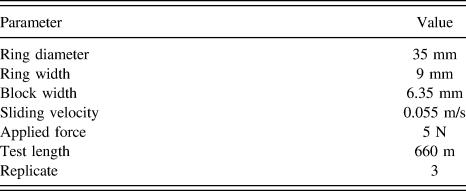
The wear tests were carried out under dry sliding conditions using a block-on-ring configuration. Blocks with dimensions of 15.75 mm × 6.35 mm × 10 mm were cut from the pure Mg and heat treated Mg specimens. The ring, i.e., the counter body, was made of 100Cr6 bearing steel (65HRC). The blocks were prepared by grinding the working surface (15.75 mm × 6.35 mm) with progressively finer SiC papers to a 1000 grit finish. The wear tests were conducted for surfaces in linear contact. The block specimens were pressed against the ring rotating at a given speed. The wear test conditions are presented in Table I. The specimens were weighed before the test and again after every 66 m. Each time loose debris was removed to determine the weight loss per unit sliding distance. The tests were terminated after a total sliding distance of 660 m was achieved.
Parameters of the wear test.

The corrosion properties of the specimens were investigated using a CHI 1130A (CH Instruments Inc., Austin, Texas) electrochemical analyzer. The potentiodynamic polarization measurements were conducted at room temperature in a conventional three-electrode cell with the AgCl/Ag electrode as the reference electrode, the platinum wire as the counter electrode and the specimen as the working electrode. The specimens in the form of discs with a working surface of 0.25 cm2 rotated with a speed of 12 revolutions/s. The polarization tests were carried out in a 3.5% NaCl solution at a scan rate of 1 mV/s. Prior to the tests, the specimens were immersed in a 3.5% NaCl solution for 1 h to obtain a stable open circuit potential.
III. RESULTS AND DISCUSSION
A. Microstructure of the alloyed layers
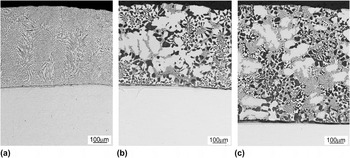
Figure 1 shows cross-sectional optical micrographs of the alloyed layers produced by heating Mg specimens surrounded by pure Al powder [Fig. 1(a)], an Al + 20% Zn powder mixture [Fig. 1(b)], or an Al + 40% Zn powder mixture [Fig. 1(c)] at 445 °C for 60 min. Layers fabricated with pure Al powder or a powder mixture containing 20% of Zn had a similar thickness of about 600 µm. A much thicker layer of about 900 µm was produced on the Mg substrate by applying a powder mixture containing 40% of Zn.
OM images of the alloyed layers formed on Mg through heat treatment at 445 °C for 60 min using (a) the pure Al powder, (b) the Al + 20% Zn powder mixture, and (c) the Al + 40% Zn powder mixture.

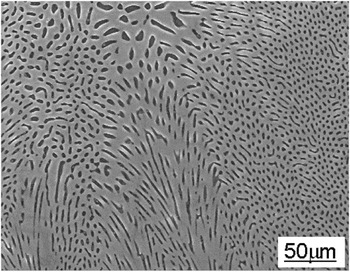
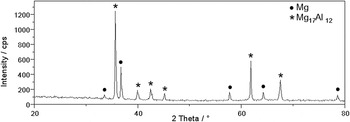
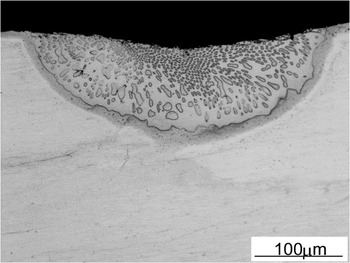
Details of the microstructure of the layer produced from the Al powder are shown in higher magnification SEM images in Fig. 2. The alloyed layer had a eutectic structure consisting of gray and dark phases. The eutectic structure suggests that the layer formation occurred during the liquid phase stage at the Mg-substrate/Al-powder interface. The quantitative EDS analysis revealed the chemical composition of the gray phase: 62.99 at.% Mg and 37.01 at.% Al. It indicated that one of the eutectic phases was Mg17Al12. The chemical composition of the dark phase (85.67 at.% Mg and 14.33 at% Al) showed that the other phase was a solid solution of Al in Mg. The XRD data (Fig. 3) confirmed the presence of the Mg17Al12 intermetallic phase and the solid solution in the alloyed layer. It is worth noticing that in their previous work, Reference Dziadoń, Mola and Błaż31 the author and co-workers studied the growth rate of the reaction products at the Mg/Al interface during heat treatment at 445 °C. The experimental results showed that at this temperature the liquid phase formed at the interface and the structural transformation processes occurred much faster. During solidification, the transition layer with a eutectic structure is formed between the Mg and the Al plates. The transmission electron microscopy analysis confirmed that Mg17Al12 and a solid solution of Al in Mg were the eutectic phases. Moreover, the investigations showed that the reaction front moved into Mg rather than Al. The propagation of the reaction front into the metal with a lower melting point was also reported in Ref. Reference Dziadoń, Konieczny, Gajewski, Iwan and Rzączyńska32. The results of the present study show that there was a clear migration of the reaction front into the Mg substrate. Figure 4 presents an Mg specimen in contact with Al powder heat treated at 445 °C for about 10 min. The reaction at the Mg-substrate/Al-powder interface was triggered and the eutectic area migrating into the Mg substrate was observed. The eutectic was separated from the substrate by a thin zone, which also covered the Mg surface. The quantitative analysis revealed that the Al content in the thin zone was 7.8–12.4 at.%, which indicated a solid solution of Al in Mg. The analysis of the above results based on the phase equilibrium of the Mg–Al system suggests that the following structural transformations occurred at the Mg-substrate/Al-powder interface at a temperature of 445 °C. During the first stage of the heat treatment process, Al atoms diffused into the Mg substrate and a thin zone of a solid solution of Al in Mg formed on the Mg surface. When the concentration of Al in this zone exceeded the solid solubility limit, a locally liquid phase with a content of Al higher than that at the eutectic point formed. The appearance of the liquid phase accelerated the diffusion of the elements. During cooling, the liquid solidified on the Mg substrate, forming a layer with a eutectic structure consisting of an Mg17Al12 phase and a solid solution of Al in Mg. The growth front of the transition layer at the Mg-substrate/Al-powder interface migrated into Mg. Additionally, the consumption of Mg by volume was higher than that of Al. As a result, the phases rich in Mg represented the major fraction of the synthesized structure.
SEM image of the Al-enriched layer.

XRD pattern of the Al-enriched layer.

Al-enriched area with a eutectic structure formed on the Mg surface after heat treatment at 445 °C for about 10 min.

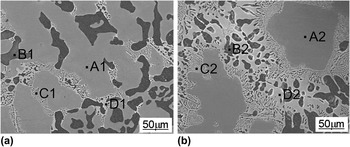
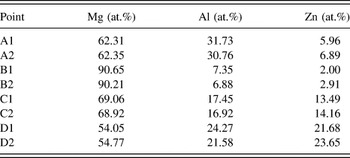
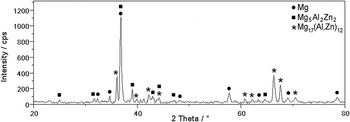
As shown in Fig. 5, the microstructure of the layers fabricated by applying Al + Zn powder mixtures was more complex; it consisted of large, gray, single phase regions [marked as A in Figs. 5(a) and 5(b)], smaller single phase regions of the dark phase (marked as B) and a eutectic structure (marked C), which was a mixture of the dark and light phases (with the latter marked as D). The results of the quantitative EDS analysis for the points marked in Fig. 5 are given in Table II. The composition of the gray phase suggests the presence of the Mg17Al12 phase, where some of the Al atoms were replaced by Zn atoms. This phase is defined in the literature as Mg17(Al,Zn)12. Reference Czerwiński33 The dark phase was a solid solution of Al and Zn in Mg. In the eutectic areas, coarse and fine eutectic morphologies were observed. It was possible to determine the chemical composition of the light phase in the areas with a coarser structure. The literature data shows that there is a ternary phase in the Mg–Al–Zn system, which has the nominal formula Mg6(Al,Zn)5 or Mg5Al2Zn2, with the composition variation being 53–55 at.% Mg, 18–29 at.% Al, and 17–28 at.% Zn. Reference Donnadieu, Quivy, Tarfa, Ochin, Dezellus, Harmelin, Liang, Lukas, Seifert, Aldinger and Effenberg34 From the stoichiometry of elements it is evident that the light phase was an Mg5Al2Zn2 phase and that the eutectic was composed of an Mg5Al2Zn2 phase and a solid solution of Al and Zn in Mg. The XRD analysis (Fig. 6) of the Al/Zn-enriched layer produced from a powder mixture containing 20% of Zn confirmed that the layer consisted of Mg17(Al,Zn)12, Mg5Al2Zn2 and a solid solution of Al and Zn in Mg. As shown above, Zn was present in the alloyed layer when Al + Zn powder mixtures containing 20% or 40% of Zn were used. This additional element was responsible for the formation of Mg–Al–Zn intermetallic phases in the surface layer. According to Ref. Reference Czerwiński35, the presence of up to 4% of Zn in ternary Mg–Al–Zn alloys does not lead to the generation of new phases; the phases are the same as those known from the Mg–Al binary phase diagram. If the content of Zn exceeds 4%, a three phase region containing a ternary intermetallic phase (Mg5Al2Zn2) occurs in the Mg–Al–Zn system. Comparing the microstructures of the two Al/Zn-enriched layers, we can see that in the layer fabricated from the Al + 40%Zn powder mixture, the areas with a eutectic structure were much larger and there were fewer regions of the gray phase. When the amount of Zn in the powder mixture was higher, there was an increase in the volume fraction of the Mg5Al2Zn2 phase in the layer microstructure and, simultaneously, a decrease in the volume fraction of Mg17(Al,Zn)12. The heat treatment process performed for the Al + 40% Zn powder mixture using the same temperature and the same length of time, resulted in a much thicker alloyed layer. As shown in Ref. Reference Ohno, Mirkovic and Schmid-Fetzer36, the phase transformation was shifted to a lower temperature range with increasing the Zn content in the Mg–Al–Zn system. The presence of a high amount of Zn in the powder mixture led to the formation of a low melting eutectic with Mg and Al. For the powder mixture containing 40% of Zn, the reactions at the interface between the Mg-substrate and the powder caused that the liquid phase started at a lower temperature. Accordingly, the layer formation process proceeded much faster. The results presented in other research papers pertaining to the formation of layers by diffusion treatment in Al powder also indicate that Zn added to Al powder significantly promotes the formation of an alloyed layer on Mg or its alloys. Reference Zhang and Kelly24,Reference Hirmke, Zhang and StJohn26
Higher magnification SEM images showing the microstructure of the Al/Zn-enriched layers fabricated from: (a) the Al + 20% Zn powder mixture, (b) the Al + 40% Zn powder mixture.

Results of the quantitative EDS analysis.

XRD pattern of the Al/Zn-enriched layer.

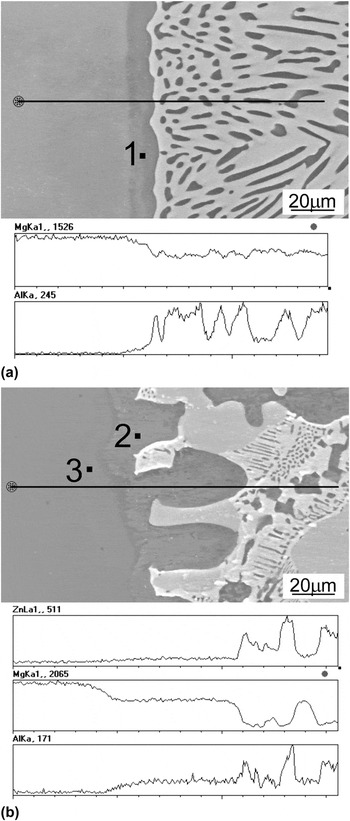
As can be seen from Figs. 1(a)–1(c), there is a transition zone between the alloyed layers and the substrate. Figure 7 shows the zone microstructure observed at high magnification by SEM and the element concentration profiles for the layer–substrate interface. During the analysis of the Al-enriched layer [Fig. 7(a)], a solid solution of Al in Mg was detected in that region. The results of the quantitative analysis obtained for point 1 were: 92.85 at.% Mg, and 7.15 at.% Al. The EDS profiles reveal that the concentration of Al in this zone dropped with a decrease in the distance from the Mg substrate. For the Al/Zn-enriched layers [Fig. 7(b)], the narrow zone close to the substrate was characterized by a solid solution of Al and Zn in Mg. The results of the quantitative analysis reported for point 2 were: 89.92 at.% Mg, 7.28 at.% Al, and 2.8 at.% Zn, while those recorded at point 3 were: 93.20 at.% Mg, 5.86 at.% Al, and 0.94 at.% Zn. The concentrations of Al and Zn in this zone also dropped with a decrease in the distance from Mg. During the cooling process, which followed the heat treatment at 445 °C, there was a diffusion of the alloying elements, i.e., Al and Zn, from the layer to the substrate, resulting in the formation of a thin zone of a solid solution at the interface.
Microstructure of the transition zone near the Mg substrate observed by SEM and the corresponding EDS line scans for: (a) the Al-enriched layer, (b) the Al/Zn-enriched layer.

B. Hardness of the alloyed layers
The microhardness measurements were conducted on polished cross-sections. The microhardness values reported for the Al-enriched layer with a eutectic structure ranged from 183 to 201 HV. The microhardness of the Al/Zn-enriched layer was measured in some characteristic regions and the values obtained for the Mg17(Al,Zn)12 phase, the fine eutectic structure, and the solid solutions of Al and Zn in Mg were 220, 180, and 80 HV, respectively. The microhardness of the Mg substrate was 36 HV. The results of the microhardness tests indicate that the alloyed layers containing hard intermetallic phases possessed much higher hardness than the Mg substrate.
C. Wear behavior
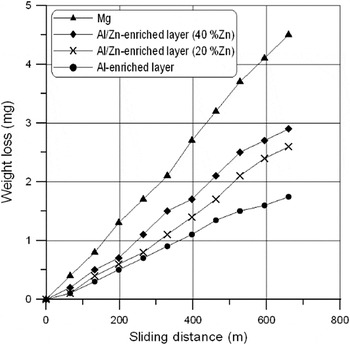
Changes in the weight loss of the specimens, reported as a function of sliding distance, are shown in Fig. 8. Obviously, in each case, the weight loss increased with increasing the sliding distance. However, the values obtained for the Mg with alloyed layers were much lower than those achieved for the bare Mg. The lowest weight loss was observed for the Mg with an Al-enriched layer, which had a eutectic structure. As shown above, the microstructure of this layer was more uniform and more fine-grained than those of the Al/Zn-enriched layers. The microhardness of the Al-enriched layer was high and almost uniform over the whole cross-section. In the Al/Zn-enriched layers, the eutectic regions with a fine structure were surrounded by a coarser eutectic structure and components with large dimensions, which had either high or low hardness. Thus, the microhardness values were nonuniform over the whole layer. It is commonly accepted that the morphology of the structure constituents affects the mechanical properties of the material. The results presented in this paper confirm the above thesis; they indicate that the Al-enriched layers with a uniform fine-grained structure had better wear resistance than the Al/Zn-enriched layers with a nonuniform coarser structure.
Weight loss versus sliding distance for the bare Mg and the Mg with alloyed surface layers.

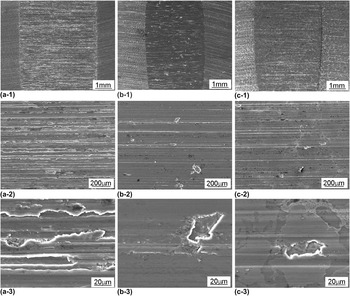
Figure 9 shows SEM micrographs of the wear tracks and worn surface morphologies after a sliding distance of 660 m for the bare Mg, the Al-enriched layer, and the Al/Zn-enriched layer fabricated from a powder mixture containing 20% Zn. The wear track in the Mg specimen [Fig. 9(a-1)] was wider than those in the specimens with the alloyed surface layers [Figs. 9(b-1) and 9(c-1)]. The narrowest track was observed on the Al-enriched layer, with this finding being in agreement with the results of the tribological tests. At high magnification it can be seen that the worn surface of Mg was covered with long and deep grooves parallel to the sliding direction [Fig. 9(a-2)], which indicates typical abrasive wear. This was due to the fact that the Mg specimen was much softer than the steel ring. The hard asperities on the steel counter surface microcut and microploughed the Mg surface. The material was removed from the wear tracks or pushed into ridges on either side and then deformed plastically. Figure 9(a-3) shows the characteristic tongues near the grooves testifying to the plastic deformation of the excess material due to microploughing. The worn surfaces of the specimens with alloyed layers also had features typical of abrasive wear but the surfaces were smoother and the grooves were more shallow [Figs. 9(b-2) and 9(c-2)]. On the worn surfaces of the alloyed layers, there were sparse microcraters formed by broken off hard structural components—intermetallic phases [Figs. 9(b-3) and 9(c-3)]. During the sliding process, the hard debris particles became gradually finer and polished the surface in the friction area, as indicated by the details of the microstructure of the alloyed layer visible in Figs. 9(c-3).
SEM micrographs showing the wear tracks and worn surface morphologies of (a-1), (a-2), (a-3) the bare Mg; (b-1), (b-2), (b-3) the Al-enriched layer; and (c-1), (c-2), (c-3) the Al/Zn-enriched layer (20% Zn), obtained at a sliding distance of 660 m.

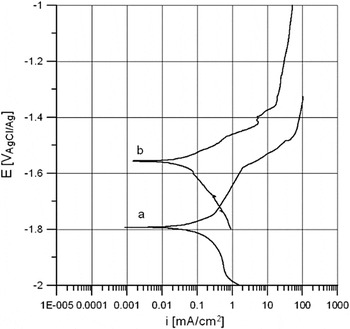
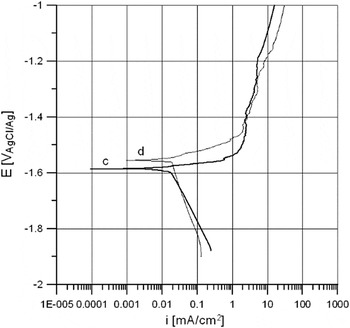
Potentiodynamic polarization curves for the bare Mg and the Mg with alloyed surface layers are shown in Figs. 10 and 11. The corrosion potentials (E corr) of the Mg with alloyed layers containing intermetallic phases were higher than that of the bare Mg. The E corr value obtained for the bare Mg was −1.79 V. The specimens with Al-enriched layers and Al/Zn-enriched layers, with the latter containing 20% Zn or 40% Zn, had corrosion potentials of 1.53, −1.59, −1.55 V, respectively. The comparative analysis indicates that both the bare Mg and the Mg with alloyed layers exhibited similar corrosion current densities (I corr). However, from the anodic branches of the polarization curves it is clear that the specimens with alloyed layers had lower anodic current densities than the bare Mg.
Polarization curves of the bare Mg (a) and the Mg with the Al-enriched layer (b).

Polarization curves of the Al/Zn-enriched layer produced from: (c) the Al + 20% Zn powder, (d) the Al + 40% Zn powder.

There are many papers concerned with the electrochemical properties of Mg–Al intermetallic phases and the influence of these phases on the corrosion resistance of Mg alloys. Südholz et al., Reference Südholz, Kirkland, Buchheit and Birbilis37 for example, report that the Al3Mg2 and Mg17Al12 phases displayed some electrochemical stability/passivity in 0.1 M NaCl. In Refs. Reference Song, Atrens, Wu and Zhang38 and Reference Song, Atrens and Dargusch39, Song and colleagues analyze the polarization curves for the Mg17Al12 phase and they point out that Mg17Al12 was very stable in a solution of NaCl and that it was resistant to corrosion. The literature dealing with the corrosion resistance of Mg–Al alloys shows that the Mg17Al12 phase is cathodic to the matrix and it can either increase or decrease the corrosion rate of alloys, Reference Song, Atrens, Wu and Zhang38–Reference Singh Raman41 depending on the amount and distribution of the phase. Song et al. Reference Song, Atrens, Wu and Zhang38–Reference Song and Atrens40 reveal that if the volume fraction of Mg17Al12 in the alloy microstructure is high, the phase may act as a corrosion inhibitor. The literature data concerning the corrosion resistance of alloyed layers containing Mg–Al or Mg–Al–Zn intermetallic phases produced on Mg or its alloys by heating the substrate in contact with powder material shows that the alloyed surface layers improve the corrosion potential from a dozen to several hundred mV and that they decrease Reference Zhu and Song21–Reference Liu, Liang, Li, Zhao, Zhang and Wang23,Reference Youping, Kewei, Weixin, Xipeng and Pengfei25–Reference Hirmke, Zhang and StJohn27,Reference Zhong, Liu, Wu, Le, Liu, Me, Zhu and Hu42 or increase Reference He, Wu, Tang and Hu43 the corrosion current density. The above works indicate that the corrosion properties of an alloyed layer depend on the process parameters and the resulting structure. Surface layers with a microstructure composed of a continuous intermetallic phase produced by the solid state diffusion process offer better corrosion protection to the substrate than surface layers with a multi-phase structure formed at a temperature near or above the eutectic temperature of the Mg–Al system. The results reported by Yang et al. Reference Yang, Guo, Wu, Ding and Birbilis14 are in agreement with these findings. In their study, the Al coatings were electrodeposited on an AZ91D surface and then heat treated. Coatings composed of two continuous intermetallic layers, i.e., Al3Mg2 (outer) and Mg17Al12 (inner), produced at 200 °C provided better corrosion protection to the substrate than two-phase coatings (Mg17Al12 + a solid solution of Al in Mg) produced at 420 °C.
The results of the corrosion tests obtained in this paper are in agreement with the literature data discussed above. They demonstrate that the Al- and the Al/Zn-enriched surface layers containing intermetallic phases provided some corrosion protection to Mg. The corrosion potential for the surface alloyed Mg specimens shifted toward the more positive potential region; yet, the corrosion current densities remained at the same level, as was the case of the bare Mg. The layer formation process took place through partial melting at the reactive interface; as a result, the solidified layers had a two-phase structure (Mg17Al12 + a solid solution of Al in Mg) or a multi-phase structure (Mg17(Al,Zn)12 + Mg5Al2Zn2 + a solid solution of Al and Zn in Mg). The corrosion tests did not show significant differences in corrosion resistance between the alloyed layers produced from pure Al powder and those produced from the Al + Zn powder mixtures.
IV. CONCLUSIONS
The alloyed layers were fabricated on Mg by heating the elements in contact with the powder material (pure Al or Al + Zn powder mixtures) at 445 °C for 60 min. At that temperature the layer formation process took place through partial melting at the reaction interface. During the heat treatment process, the powder material was held under pressure, which enabled the formation of thick, uniform, dense, and continuous layers in short heating time.
The main conclusions of the study are as follows:
-
(1) The Al-enriched layers with a thickness of about 550 µm were characterized by a eutectic structure composed of an Mg17Al12 intermetallic phase and a solid solution of Al in Mg.
-
(2) The Al/Zn-enriched layers produced from the two powder mixtures contained Mg17(Al,Zn)12 and Mg5Al2Zn2 intermetallic phases and a solid solution of Al and Zn in Mg. An increase in the content of Zn in the powder mixture caused an increase in the volume fraction of the Mg5Al2Zn2 phase in the layer microstructure and consequently a decrease in the volume fraction of Mg17(Al,Zn)12. The thickness of the layers produced from the powder mixture containing 40 wt% of Zn (about 900 µm) was higher than that of the layers produced from the Al + 20 wt% Zn powder mixture (about 600 µm).
-
(3) The microhardness of the surface alloyed layers containing intermetallic phases was much higher than that of the Mg substrate.
-
(4) Under dry friction conditions, the weight loss of the specimens with alloyed layers was much lower than that of the unalloyed Mg. The specimens with Al-enriched layers characterized by a uniform fine-grained structure exhibited better wear resistance than those with Al/Zn-enriched layers with a nonuniform coarser structure.
-
(5) The results of the polarization tests suggest that both the Al-enriched and Al/Zn-enriched layers can offer a certain level of protection to Mg against corrosion. The corrosion potential for all the alloyed layers shifted to more positive values but their corrosion current densities were at a level similar to that reported for untreated Mg.
ACKNOWLEDGMENTS
The author wishes to express her appreciation to Dr. Karina Jagielska-Wiaderek of the Czestochowa University of Technology for her assistance in the electrochemical tests and analysis.