Introduction
It goes without saying that a common culture and a common language make trade easier between individuals and countries, and for this reason the human being has always tried to find a way to communicate with foreign people in order to buy and sell goods and services. But learning as many languages as the market requires has always been a rather difficult issue, so since ancient times some languages have played the role of lingua franca Footnote 1. Throughout history there have been various lingua francas in the world, used as working languages or bridge languages, based on the prestige and economic relevance of some countries in particular phases of history, as is the case with Latin in the Roman Empire; in the Eastern provinces of the Empire Greek served the same purpose (De Houwer & Wilton, Reference De Houwer and Wilton2011).
The fact that, nowadays English has become essential in international (business) communication cannot be denied; also that English may be linguistically associated with globalization is hardly questionable. However, as globalization is opposed by localization, which consists in the tendency to an increase in nationalisms, regionalisms and anti-global attitudes, ‘a good number of researchers and authors cast today's linguistic world in the mould of a cold warfare, which breeds a fierce and bitter contestation between the global and the local’ (Agbedo & Eze, Reference Agbedo and Eze2012: 10). This fact seems to affect the use of English in business contexts in which, a tendency towards using the indigenous language of the target market country, appears to become more and more important for businesses who want to penetrate foreign markets. This emerging trend shows some factors that are equivalent to patterns of local resistance to economic and cultural globalization (ibid.). Englishization is
the process of making use of the English language as a lingua franca and converting material in the local language into English in an international corporation or other organization [and] the process of rapid growth of English and increase in the variety of functions performed by the language in different speech communities of the world (Agbedo and Eze, Reference Agbedo and Eze2012: 14).
As outlined by Kachru (Reference Kachru2005: 116), Englishization may be used as a positive word when English is regarded as ‘a gracious “giver” language being received with gratitude [or] the side of linguistic schizophrenia [with] the attitudes and reactions to it’.
In this paper I wish to analyse the phenomena of Englishization and multilingualism with reference to a specific case: the Italian wine producers and exporters. Principally, I aim to see whether in their operations English is still used as a major means of communication, seeing that some scholars recognize a new tendency in international business based on the use of local languages.
A few words about globalization
Of course, I am not going to explain what globalization is and what it involves in every aspect of human life, but because this extraordinary process has been gaining momentum as the energy source of communication all over the planet, some general remarks are useful for an understanding of Englishization as opposed to multilingualism in business contexts.
From a sociological perspective, globalization has to do with ‘all the processes by which the people of the world are incorporated in a single world society’ (Albrow, Reference Albrow, Albrow and King1990: 9). Another definition of the term describes it as ‘the compression of the world and the intensification of the consciousness of the world as a whole’ (Robertson, Reference Robertson1992: 8). As Agbedo and Eze state,
‘the social scientist [regards globalization as] the process of continuum with component sub processes, [three of which are] information technology revolution, the restructuring arising from the economic crisis of capitalism and statism and […] the upsurge of such social movements as human rights and feminism’ (Agbedo & Eze, Reference Agbedo and Eze2012: 11).
Linguistically speaking globalization is defined by the Oxford English Dictionary (OED) as follows:
The action, process, or fact of making global; esp. (in later use) the process by which businesses or other organizations develop international influence or start operating on an international scale, widely considered to be at the expense of national identityFootnote 2.
The word seems to have a negative connotation, since it is ‘…widely considered to be at the expense of national identity’; the OED cites the first use of the word in the 1930 book by W. Boyd and M.M. Mackenzie called Towards a New Education, in the following context:
Wholeness, .. integration, globalization .. would seem to be the keywords of the new education view of mind: suggesting negatively, antagonism to any conception of human experience which over-emphasizes the constituent atoms, parts, elements, […].Footnote 3
The phenomenon of globalization is usually connected with modern times, though many scholars maintain that the process is much older, as throughout history there have been some examples of global processes. Nonetheless, I am interested in describing the sociolinguistic aspect of the fact, since it has often been said that the ‘global village’ has a ‘global language’ and this language would be English. I will see its present role in a chief sector of international business (Italian wine exports) and whether the emerging tendencies towards multilingualism in business are already an alternative source of business vehicle worldwide.
Englishization versus multilingualism
I have already observed that the need for an international language has always been felt around the world. In fact, international auxiliary languages have always existed throughout history in order to facilitate trade and communication among peoples. Natural languages such as Arabic, Chinese, Spanish, Russian and French have been used as lingua francas for international communication, while artificial languages – Esperanto and Volapuk to name just two – have been suggested as a way of bypassing the problems aroused by the adoption of a natural language rather than another. But since artificial languages do not express any culture their diffusion has always been hindered or neglected, though their apparently neutral feature should have been their strong point. Consider that the data related to the number of Esperanto users in the world are not clear and are rather old. They could vary between 2 and 3.5 million (Janton, Reference Janton1977: 112), so it is of little significance to this issue.
Conversely, the data about the use of English as an international language prove the fact that its role as the leading tongue of international communication is undisputed and give it a position of supremacy. Even though they cannot be precise and accurate, recent estimates report that circa 1.5 billion people in the world can use English (Crystal, Reference Crystal2012)Footnote 4.
The evidence of the internationalization of English is also given by both the changes it has created/undergone in the last few decades; on the one hand, it has become familiar and used all over the world, but on the other hand, it has lost connections with the culture of which it is a natural expression. This is already evident in the standard varieties, but especially in new varieties or ‘distorted’ forms of the language arising from the use by non-native speakers. As McMaster (Reference McMaster2007) suggests, ‘there is currently no clearly defined model of international English. Instead, the term is used to cover a number of very different concepts’.
Setting aside the issue of which form of English is used internationally, I will now move on to analyze multilingualism in business, described as an alternative to the use of English and which seems to become more and more important for those businesses who want to enter foreign markets. Dor's idea is that
the forces of globalization do not have a vested interest in the global spread of English. They have a short-term interest in penetrating local markets through local languages and a long-term interest in turning these languages in commodified tools of communication. (Dor, Reference Dor2004: 98)
If this is so, the result could be ‘neither Englishization nor negotiated multilingualism but a specific pattern of imposed multilingualism’ (ibid.). Even though the expansion of English still correlates to the process of economic globalization, the Internet has become a showcase for companies and a multilingual arena; the non-English based Internet community is now larger than it used to be in the early 2000s and it now exceeds the English speaking counterpart (Agbedo & Eze, Reference Agbedo and Eze2012: 10). In this view, competition in local markets is going to be based on a multilingual approach. Global businesses are abandoning the utopian view of an international lingua franca and are finding new ways to penetrate local markets in the indigenous language since “global capital needs local languages and cultural codes to penetrate local markets” (ibid.). As Davis (Reference Davis2003) reports ‘English […] only accounts for around 30% of the world Gross Domestic Product (GDP), and is likely to account for less in the future. Neglecting other languages means ignoring quite significant potential markets‘Footnote 5.
It cannot be denied that a multilingual approach could increase a company's chances of finding new markets, at least according to some research works. For example, in Bel Habib's study on multilingualism as a key for better access to new emerging markets, the author analyses the linguistic approach of some European small-and-medium-sized enterprises (SMEs) to exporting to new markets. The analysis of the surveyed companies – Swedish, Danish, German and French – show that English is no longer the dominant language in world trade and internet traffic. In fact the companies who have a multilingual approach to exports are the most successful in closing contracts and data confirm that the percentage of firms missing contracts vary from 20% in Sweden, 4% in Denmark, 8% in Germany and 13% in France. Whilst ‘Swedish SMEs only use three market languages […], German SMEs make use of most market languages, up to 12, while the French SMEs use about 8 market languages” (Bel Habib, Reference Bel Habib2011: 3). This may even seem paradoxical as Sweden is believed to be a highly multilingual country, but results show that such a low level of multilingual approaches in international business is the cause that “makes Swedish exports more vulnerable and inhibits the export performance’ (ibid.).”
In 2006 a study was conducted by ELANFootnote 6 about the foreign language skills in European enterprises and the effects of foreign language speaking on the European economy. The survey involved about 2,000 SMEs from 29 European countries and outlined a general awareness among companies that a lack of language skills resulted in the loss of contracts and the inability to establish relationships with new potential clients. What was mainly outlined is that 11% of the companies surveyed had lost contracts due to this, though nearly 50% of the sample was going to enter new markets in the following years. Most SMEs showed that they needed further language skills if they wished to trade with new countries.
In another survey study made by the European Commission (2011)Footnote 7 one of the key points stated in the document was that a ‘multilingual company has a competitive advantage when selling its products and services. Language skills and socio-cultural aptitudes must be taken into consideration at each operating level of a company’.
The Italian case: choice of the product and the market
In deciding the economic area to analyse the attitude of Italian companies towards Englishization and multilingualism in business communication my choice fell on a primary product of the Italian lifestyle which represents an important landmark of Italy in the world: wine. Thanks to the data provided by Wine Monitor, the observatory on the wine market managed by NomismaFootnote 8, set up and developed to support the companies and institutions operating in the wine sector, we can better understand the market trends both nationwide and internationally.
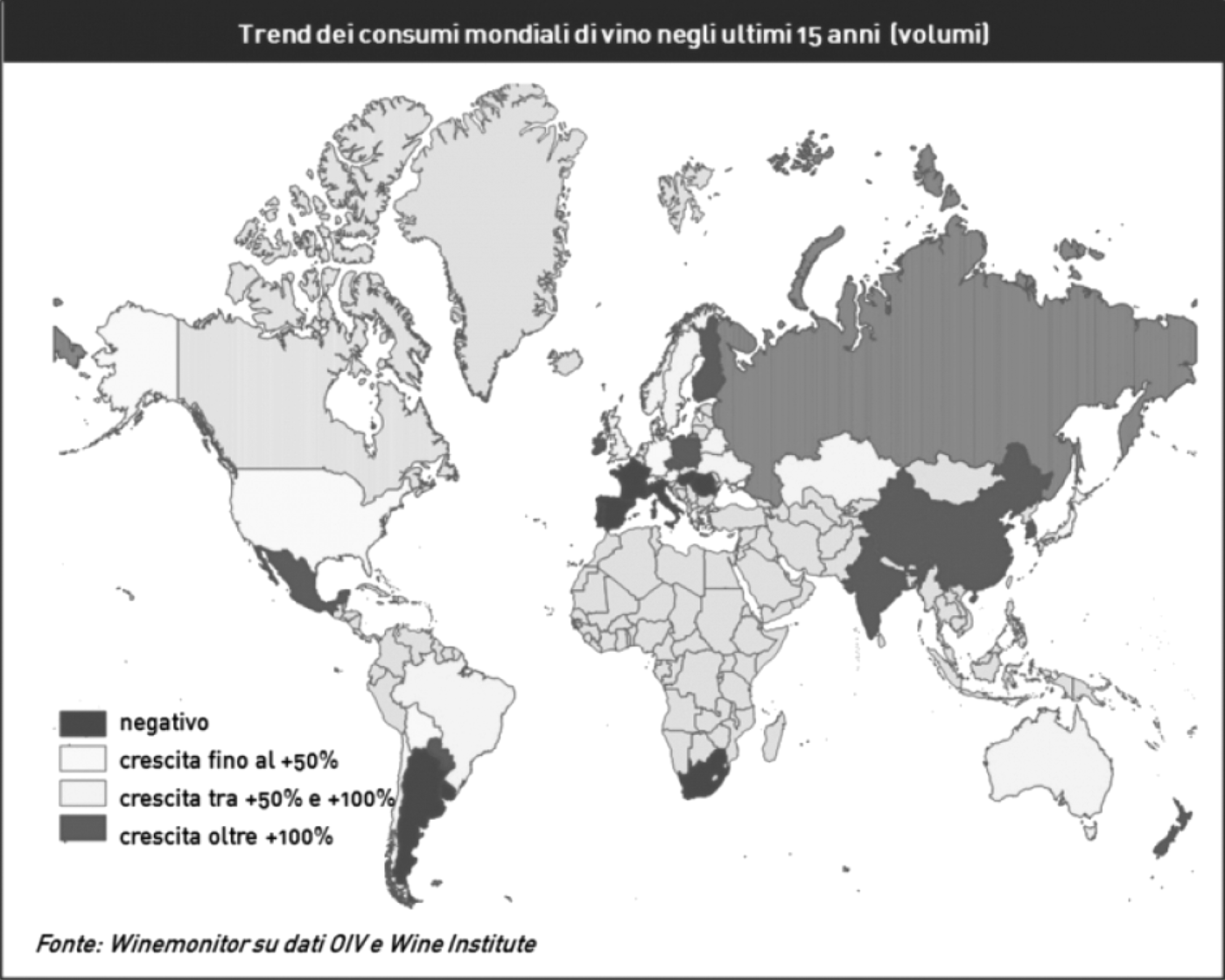
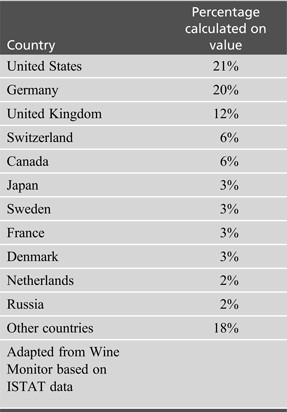
Table 1 and Figure 1 I show some information regarding the Italian biggest export markets in 2012 as well as the trend of the global wine consumption over the last 15 years.
Trend of the global wine consumption over the last 15 years (volumes)

Main outlet markets of Italian wine exports – 2012 (% calculated on value)
Table 1 outlines that the US is the first wine importer from Italy (21%), just before Germany (20%). So, the first international market for Italy is an English speaking country. We can also notice that the UK accounts for 12% and Canada for 6%Footnote 9. That means that almost 39% of the Italian wine market abroad is made up of English-speaking countries. If we further assume that another 18% of foreign markets are included in the item “Other countries” we could easily reach a higher percentage of clients in the Anglosphere.
Figure 1 outlines that the consumption of wine in traditional producing countries has generally gone down, e.g. in Italy, France and Spain, but in the emerging economies, such as the BRIC countries, it has increased by 50% (Brazil) and over 100% (Russia, India and China). Moreover, in other rich areas of the world such as the US, Australia and New Zealand as well as Canada, growth rates have been very high. Table 1 and Figure 1 help clarify why English is the main working language between Italian wine producers and foreign markets and whether this habit might change in the future as a consequence of the new growing economies that have entered the consumer market.
Wine Monitor was also used to find the companies to be interviewed in order to collect the data I needed for my research. The selected companies were contacted directly in order to organize interviews with the most suitable people in each company. I drew up a concise questionnaire that was sent to the member companies of the observatory based on the main points I wanted to analyse. The questionnaire presented open-ended questions in order to leave the companies free to answer, and possibly add further details. These were the questions:
• What foreign languages does your staff speak?
• What languages do you use when you want to enter a new market and why?
• How do you cope with intercultural issues when operating in foreign markets?
• Has the role played by English in your international business changed in the last years?
With regard to the SMEs I have interviewed this is what I have obtained:
For Marchesi De Frescobaldi, a company based in Tuscany with about 150 employees, I received information from Sales Manager G. Bertolini. He divides the company policy towards foreign markets into four main actions:
1 The human element: their foreign markets department is made up of people who have at least an excellent knowledge of English and in several cases of another foreign language, such as French, German, Danish or Chinese. Employees are hired based on this prerequisite for the job so they do not give them any further language training.
2 Web communication: they develop their websites in several languages; at the moment the Frescobaldi website is available in English, German, Japanese, Chinese, Russian and Italian.
3 Information and communication material: they are always drawn up in at least four languages: English, German, French and Italian.
4 Labels: the back labels on the majority of their products are at least bilingual: Italian and English. By law, in some countries it has to be translated into the local language (China, Canada, etc.)
Cavit is a cooperative owned by 500 partners located in Trentino. Ms Conni Tenaglia informed me that the export area managers and the marketing manager speak fluent English as well as the Managing Director and the CFO. Moreover export area managers can avail themselves of the back office staff who speak good English and German.
As regards new markets, they have interests in Russia, China and South America. The way to approach the Chinese market is to turn to linguistic mediators who speak Mandarin, whereas for the other markets English is adequate. Although linguistic advice is often useful when dealing with Russian clients, English is still used to get in touch with most international markets with the only present exception of China. The company maintains that the role of English has not changed much in the last years as it remains the most used means of business interaction, followed by German. Most of their present major markets belong to the Anglo-Saxon world. They also add that emerging markets might become more important, but only in the medium/long term.
As regards the creation of an Internet website, they believe it is not enough, although they acknowledge it is essential for spreading information about the product and the brand. Of course, proficiency in other languages favours the initial approach but penetration and consolidation of a new market is the effect of the quality of the product and the ability to supply effective and continuous support (information, logistics and retail).
In Cavit they are convinced that cultural differences in the target country are overcome by the image of the product itself which is conveyed by the Italian food and way of life. It is a well-known product and it must be promoted and proposed with an eye to local customs.
Cantina Due Palme is a cooperative based in Puglia made up of 1200 partners. Ms Paola Costantino, from the Sales and Marketing Department informed me that the knowledge of English is a preliminary condition for filling the position of sales representative in their company, seeing that 80% of their turnover is destined for overseas markets and, as a result, proficiency in a second language is also necessary. Outside the sales department, the employees of administration, purchasing and logistics, if necessary, are supported by those units capable of interacting with foreign speakers. Currently, the languages spoken in the company are English, French, Spanish and German.
They maintain that before starting to operate in a new market, it is essential to carry out a study on the market in which you are going to operate. Information can be collected through web searches, contacts with people known locally or through companies in the sector who have already had the opportunity to work in that market. Partnerships and relationships with the local people are frequent. The most used language is English, while still offering the opportunity to use French, Spanish and German. The company hardly ever makes use of an of interpreter or a translator. They speak English with customers and if their customers do not speak English but only their mother tongue, these customers make use of an interpreter themselves, though this happens very rarely. Surely, English is at the basis of all their commercial relations with foreign markets, despite the fact that they recognise it would also be important to have qualified staff with diverse language skills, such as Russian or Chinese; this would make the relationship with new markets more direct.
Cultural differences are managed through adequate information collected in advance and through continuous updating. The creation of a website in the language of the target country can be overcome by the use of the English language, which is habitually known by the importer who serves as a liaison with the end consumer. The latter will often refer to the website of the importer himself, translated into the native language. As regards the use of English in international business they do not think that any change has taken place given that in their company its role has remained predominant and is well-consolidated.
Botter, an industrial and commercial company with around 80 employees is located in Veneto. Mr Michele Fornasier, Chief Financial Officer of the company, answered that the sales department is the engine of their company. There, some ten people work in the back office and share their work with the international markets based on the language they know. All of them speak English and a second language, such as French, German and Spanish. In other countries like Russia, China and Japan, they work with local agents who speak the local language. In order to enter a new market initial contacts with prospects usually take place in English, as when they attend international exhibitions or through contacts with companies of the same or other sector who are rooted in the country.
If the business opportunity seems attractive and if considered appropriate they may resort to native speakers. They have never taken into consideration a website in other foreign languages, though they affirm that communicative skills in other languages are indispensable to the opening of new markets. Cultural differences should be dealt with by trying to satisfy the country's customs and habits as much as possible, but also presenting the company's habits in a sort of mutual cultural growth that seems to be appreciated. They do not think that the role of English has changed in favour of other languages compared to a few years ago, as it remains the language of reference. Though, as business goals have been moving towards the Asian areas, they have been forced to look at Russian and Chinese with renewed interest.
Conclusion
The research, although based on a small sample of respondents and, for this reason limited in the generalizability of the analysis, provides preliminary evidence that Englishization is still a leading aspect of international business, at least in the sector of Italian wine producers and exporters. Italian SMEs seem to show that English is still the language on which most business relations are based and that a multilingual approach to foreign business is still in its infancy or not considered to be so important in the short term. All the surveyed companies agree on the fact that English is the primary and essential linguistic resource for a company to go global. Company departments dealing with foreign customers are made up of people who speak excellent English and in most cases this is a precondition in order to work in the sector. All the interviewees also said that most human resources involved in sales to foreign markets can also speak a second foreign language. German is spoken by staff in all the surveyed companies, since Germany is the second Italian foreign market after the US, and also Switzerland and Austria are ranked among the first ten importers. Spanish and French are also spoken in some companies, whilst Danish was mentioned as a work language by one of them only.
The companies’ websites are available in various languages. All of them are accessible in both Italian and English, and some add German; surprisingly, none of them presents either French or Spanish versions, but one (Marchesi de’ Frescobaldi) also gives descriptions in Russian, Chinese and Japanese. This fact explains that though emerging markets are important, English is still widely used as the main vehicular language between non-English speaking countries/operators. Of course, businesses are aware that proficiency in the language of a target market may be useful but most of them state that they still use English and in very few cases they resort to interpreters or agents who speak the local language, e.g. Chinese.
Furthermore, as outlined by the interviewees, intercultural communication seems to be based more on culture than on language. English can be used in most business interactions because it is accepted as the language of business communication, and all the companies are convinced that its role is still leading and strong, at least in the short-term. cultural differences are kept in high consideration by most of them but the Italian wine is a symbol of the Italian style, so appreciated in the related countries, that helps overcome differences. Of course local customs and culture are chief so that prior information and steady updating about the countries’ main cultural characteristics are a part of the business process.
Overall, it is difficult to say whether English – and which of the Englishes spoken today – will remain a language for international communication in future. Graddol thinks that English might continue to be one of the world's major languages in the near future though he sees new language hierarchies in the world, with the inevitable result of English losing its position as the world language (Graddol, Reference Graddol1996). Crystal is convinced that – far from making predictions about the future – English ‘has already grown to be independent of any form of social control’ (Crystal Reference Crystal2012: 190) and in the subsequent edition of the book he affirms that ‘the momentum of growth has become so great that there is nothing likely to stop its continued spread as a local lingua franca, at least in the foreseeable future’ (Crystal, Reference Crystal2012: X).
Acknowledgments
I would like to thank the companies that kindly supplied me with information and answered the questionnaire through which the research was made possible, notably Mr Giampiero Bertolini from Marchesi de’ Frescobaldi, Ms Conni Tenaglia from Cavit, Ms Paola Costantino from Cantina Due Palme and Mr Michele Fornasier from Botter. Some data are also available in the following websites: www.frescobaldi.it; www.cavit.it; www.cantinaduepalme.it; www.botter.it.
FRANCESCO PIERINI is a researcher in English Language at the Department of Political Science of the University of Genoa (Italy). His research interests are intercultural communication in English, analysis of specialized discourse (politics, diplomacy and business), and English loanwords in Italian. He has taught English language at the University of Genoa for both BA and MA courses since 2005. He also taught English language at the School of Architecture of the same university from 1996 to 2010. He graduated in modern languages and literatures with full marks and took a postgraduate specialization in English language teaching. Email: francesco.pierini@unige.it