Introduction
Demographers have anticipated that global fertility rates will decline to as low as 2.17 children per woman by 2050, irrespective of any possible lag in economic development (Cleland et al., Reference Cleland, Phillips, Amin and Kamal1994; Caldwell et al., Reference Caldwell, Khuda, Caldwell, Pieris and Caldwell1999); so far the decline has been steady in most parts of Asia, North Africa and Latin America (Bongaarts, Reference Bongaarts2008). A few countries within these regions still remain as outliers, including Bangladesh where fertility started to decline in the mid-seventies and continued to decline steadily until the mid-nineties (Islam & Islam, Reference Islam and Islam1993; Bairagi & Datta, Reference Bairagi and Datta2001; Islam et al., Reference Islam, Islam and Chakraborty2001) from 6.3 to 3.3 children per woman, along with an increase in modern contraceptive use from 5% to 45% (NIPORT et al., 2005). The recent estimates from the 2007 Bangladesh Demographic and Health Survey show a fertility rate of 2.7 children per woman with considerable variation at the regional level (NIPORT et al., 2009). The observed reduction in fertility levels is primarily attributed to a successful implementation of family planning programmes at the national level; however, the impact has not been seen uniformly across the regions. For example, fertility levels remained high at around three to four children per woman in Chittagong and Sylhet divisions (Islam et al., Reference Islam, Islam and Chakraborty2001; Rahman et al., Reference Rahman, Da Vanzo and Razzaque2004; NIPORT et al., 2009) and above five children for illiterate women (Nesa, Reference Nesa2008). These two divisions together constitute about 27% of the overall Bangladeshi population. Female literacy rates continue to be relatively much lower in Sylhet division when compared with other regions in the country, although Chittagong has shown some progress in recent years. However, many girls in Sylhet and Chittagong drop out of school, partly influenced by the purdah culture which not only involves covering oneself in a veil, but also refraining from education after puberty (Shafiq, Reference Shafiq2009). Also, contraceptive use is lowest in Sylhet (32%) followed by Chittagong division (43.9%) compared with the national average of 55.8%, and has actually declined over time (NIPORT et al., 2005, 2009). Adolescent fertility rates are also stagnantly high in these regions (Nahar et al., Reference Nahar and Min2008). The 2007 BDHS data show considerable difference between wanted and actual fertility for Sylhet and Chittagong regions, which may be associated with comparatively higher levels of unmet need for contraception in these divisions (NIPORT et al., 2009). High levels of under-five mortality in these divisions may also instigate high fertility in these regions. On the other hand, Sylhet and Chittagong have slightly higher ages at first marriage compared with the rest of Bangladesh, which does not match with current fertility levels in these regions (NIPORT et al., 2009). The aims of this paper are to: (i) investigate how fertility patterns in Sylhet and Chittagong differ from those in the rest of Bangladesh through a marriage cohort analysis of the parity progression ratios and (ii) identify the factors determining the transition rates to higher parity in Sylhet and Chittagong divisions.
Most couples in Sylhet and Chittagong divisions desire more than three children, while the Bangladesh government preferred norm has been ‘two children’ since 1978. Although there has been a slight decline in overall fertility rates in these regions, it remains unclear as to how these changes are reflected in the reduction in third-, fourth- and higher-order births compared with first- and second-order births. The total fertility rate estimates from the Bangladesh Demographic Health Surveys (BDHSs) are useful to understand the levels of fertility, but they do not offer any explanation for the patterns, specifically the ordering and distribution of higher order births. However, it is easy to compute parity progression ratios from individual birth history data disaggregated by different marriage cohorts. The marriage cohorts are extracted from three consecutive BDHSs conducted during 1996–1997, 1999–2000 and 2004. To the best of the authors' knowledge, an analysis of this kind has not been carried out in these two high fertility regions of Bangladesh. From a policy perspective, this paper will contribute to a better understanding of the patterns and factors associated with high fertility in Sylhet and Chittagong, which lag behind other regions of Bangladesh in terms of socio-cultural development and reproductive well-being.
Background
The economic motive for having large families ‘in modern settings’ supposedly no longer exists (Keilman, Reference Keilman2003), although the importance of social and cultural factors, especially in less developed countries, cannot be ignored (Caldwell et al., Reference Caldwell, Khuda, Caldwell, Pieris and Caldwell1999). For example, previous studies have shown that even in low fertility societies, the sex composition of living children could influence the progression to higher order births (Wood & Bean, Reference Wood and Bean1977; Bongaarts & Potter, Reference Bongaarts and Potter1983; Pollard & Morgan, Reference Pollard and Morgan2002). In many European countries there is a preference for mixed sex composition and in some cases a girl is preferred to a boy (Gray & Evans, Reference Gray and Evans2004). In high fertility societies, on the other hand, son preference is dominant although most couples prefer to have a mixed sex composition (Williamson, Reference Williamson1976; Islam et al., Reference Islam, Padmadas and Smith2006; Dahal et al., Reference Dahal, Padmadas and Hinde2008). Son preference has a positive relationship with desired fertility. In a traditional society like Bangladesh son preference is strong because sons are economically more productive in the long run than daughters. Sons provide money and security for parents in their old age, and bring a dowry to the family through marriage, although this is unlawful (Bairagi & Langsten, Reference Bairagi and Langsten1986; Karki, Reference Karki1988; Chowdhury & Bairagi, Reference Chowdhury and Bairagi1990; Rahman & DaVanzo, Reference Rahman and DaVanzo1993). Moreover, social and religious customs force couples to prefer sons over daughters (Karki, Reference Karki1988). There is a general sense that sex preference might decline with modernization and increasing levels of education (Arnold & Zhaoxiang, Reference Arnold and Zhaoxiang1986; Hank, Reference Hank2007).
On the other hand, the relationship between female education and fertility is found to be negative in less developed countries, whereas the opposite is observed in more developed countries such as Sweden and Germany (Hoem & Hoem, Reference Hoem and Hoem1987). Wright et al. (Reference Wright, Ermisch, Hinde and Joshi1988) reported that education has no net effect on birth rate. Fertility levels could be brought down by enhancing female empowerment through increasing levels of female education (Rahman et al., Reference Rahman, Da Vanzo and Razzaque2004), but this has not necessarily been a prerequisite for the fertility transition that has occurred in Bangladesh (Cleland et al., Reference Cleland, Phillips, Amin and Kamal1994). Increasing the primary school enrolment rates for girls may not be sufficient, whereas ensuring more years in schooling is important in reducing levels of future fertility (Rahman et al., Reference Rahman, Da Vanzo and Razzaque2004). Other potential influences on reproductive behaviour such as religion and demographic factors still persist in Asian societies (Yadava & Islam, Reference Yadava and Islam2000; Islam et al., Reference Islam, Yadava and Alam2005; Alagarajan & Kulkarni, Reference Alagarajan and Kulkarni2006), and Bangladesh is not an exception in this regard. So far, there has been little exploration of demographic data from the high fertility regions of Sylhet and Chittagong, particularly on the varying roles of social and economic factors in determining reproductive behaviour. This paper takes a step forward in understanding the cohort influence on fertility patterns and further explains the socio-demographic factors determining higher order births focusing on the Sylhet and Chittagong regions of Bangladesh.
Data and Methods
Data for this study were extracted from three consecutive BDHSs conducted during 1996–1997, 1999–2000 and 2004, and also from that conducted in 2007. The samples were drawn from the Integrated Multipurpose Master Sample (IMPS) created by the Bangladesh Bureau of Statistics (BBS). The sampling design of the four surveys is described in detail elsewhere (Mitra et al., Reference Mitra, Al-Sabir, Cross and Jamil1997; NIPORT et al., 2001, 2005, 2009). The analyses were carried out in three parts. First, parity progression ratios were estimated for different marriage cohorts. The marriage cohorts were chosen by pooling the BDHS data for the three consecutive surveys. Women who reported getting married during 1965–1974 were drawn from the 1996–97 survey. The other two cohorts, who married during 1975–84 and 1985–94, were drawn from the 1999–2000 and 2004 surveys respectively. The reasons for pooling three consecutive datasets were to obtain representative samples of women marrying at different points in time and to allow for sufficient exposure time for each member in the cohort to have completed their childbearing. For example, a woman married in 1995 would have had 10 years of exposure to childbearing, although some of the observations will be right-censored, especially for those with high parity (five children and above). These samples represented 19.3% of the BDHS 1996–97 survey who married during 1965–74 (n=9127), 32.4% of the BDHS 1999–2000 survey who married during 1975–84 (n=8288) and 31.4% of the BDHS 2004 survey who married during 1985–94 (n=11,440).
In the second part of the analysis, survival functions were estimated using data from the 2007 BDHS to determine the rate of third and fourth births in order to establish whether there has been any change in reproductive behaviour in recent years across divisions. Finally, Cox proportional hazard regression models were fitted to determine the factors associated with the progression to third and fourth births for Sylhet, Chittagong and the rest of Bangladesh. This part of the analysis considered only births that occurred during the last 10 years preceding the BDHS 2007 in order to capture recent trends. Births that occurred in the month of the survey were excluded. The exposures calculated in the denominator include both events (third or fourth births) and observations were right-censored at survey (those who had not experienced a third or fourth birth). The variables included in the regression models were initially tested for statistical difference and to ascertain the direction of relationship between the dependent variable and the explanatory variables.
The choice of explanatory variables is based on an extensive review of the existing literature. The demographic variables included are: age at first birth, average birth interval, open birth interval (duration since last birth until survey date to account for exposure), previous child loss experiences and number of sons in the family. It has to be noted that contraceptive use, unmet need and fertility intentions are recorded only at the survey date and need not correspond to past events in question. The selected socioeconomic variables include mother's education, current occupation, region, place of residence, household wealth index and religion.
Results
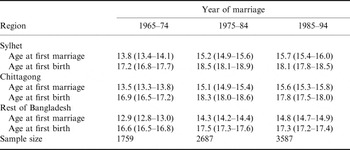
Table 1 shows the average ages at first marriage and first birth for women disaggregated by marriage cohorts and divisions. There is a gradual increase in the age at first marriage. Women in Sylhet and Chittagong marry about a year later than their counterparts from the rest of Bangladesh. The 95% confidence intervals show that the differences over time are significant (based on t-test), except for the recent cohorts in Sylhet and Chittagong. There has not been any change in the average age at first birth over time, although it is slightly higher in both Sylhet and Chittagong when compared with other divisions.
Average ages (95% confidence intervals) at first marriage and first birth (in years) by different marriage cohort and administrative division

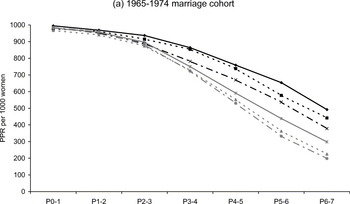
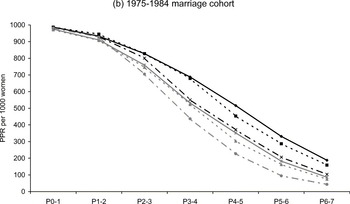
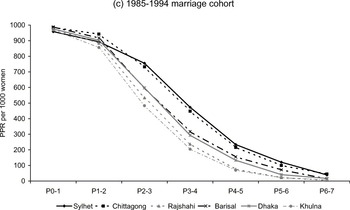
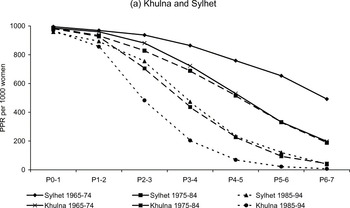
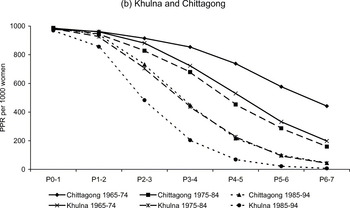
Parity progression ratios and cohort total fertility rates were estimated for three consecutive marriage cohorts in six administrative divisions (Figs 1 and 2). The progression ratios from marriage to first birth vary between 99% and 95% across divisions for the chosen cohorts suggesting that marriage and motherhood are universal in Bangladesh. The ratios are slightly lower in Sylhet for the most recent marriage cohort when compared with other two cohorts, which could be explained by either a possible increase in primary sterility or a delay in the timing of first births due to possible high male migration in the region (Zeitlyn, Reference Zeitlyn2006; Siddiqui, Reference Siddiqui2008).
Parity progression ratios by marriage cohorts and divisions.


Parity progression ratios by marriage cohorts: comparison.


The reductions in the progression from second to third and from third to fourth births between the most recent and the oldest marriage cohorts are less pronounced in Sylhet and Chittagong when compared with other regions. Clearly, there is evidence of uniform decline in the parity progression ratios over time in all regions. However, the ratios are relatively higher for Sylhet and Chittagong when compared with other regions. The decline is particularly noticeable in Rajshahi and Khulna. These regions apparently have the lowest fertility rates for the recent cohorts (2.73 and 2.61 children per woman respectively) when compared with other regions (for example Sylhet and Chittagong). Ironically, the cohort total fertility rates are only averages, which have the potential to mask the extremes or tails of the distribution. For example, the progression to fourth and higher parities is relatively greater in Sylhet and Chittagong than in other regions. An average Bangladeshi woman is inclined to stop childbearing after the third birth but Sylhet and Chittagong show evidence of continuation to higher order births. The results for the most recent cohort show that about 45% of women who had a third birth in Sylhet and Chittagong had a fourth birth, compared with 20.4% in Khulna and 23.7% in Rajshahi.
The comparison of the parity progression ratios by marriage cohorts and divisions suggests that though the parity progression ratios are higher in Sylhet and Chittagong divisions, with Khulna division having the lowest, the difference is narrowing among the younger marriage cohorts indicating faster fertility decline in Sylhet and Chittagong divisions (Fig. 1). Also, as evident in Fig. 2, the marriage cohorts in Sylhet are lagging behind those in Khulna division by about 10 years in terms of fertility behaviour. Similar patterns are observed in Chittagong division.
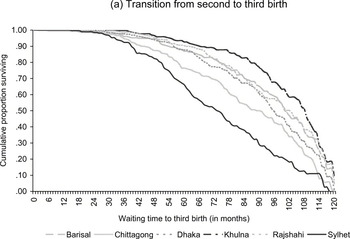
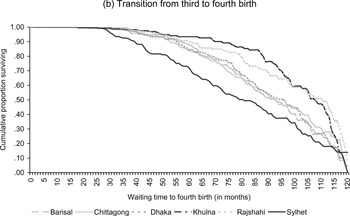
For all births that occurred during the 10 years preceding the 2007 BDHS, survival curves were plotted to show the rate of progression to third and fourth births (Fig. 3). Results based on the period data show that women in Sylhet division have a third birth much faster than those in other divisions. Chittagong is still relatively lagging behind other divisions but doing better than Sylhet division. As expected, the rate of a third birth is much lower for women in Khulna than other divisions. Similar patterns are observed for the rate of progression to fourth birth. However, Chittagong appears to be converging to the patterns observed in other divisions.
Survival curves showing the progression to third and fourth births for all births that occurred during the 10 years preceding the survey (excluding births in the month of survey), Bangladesh, 2007.


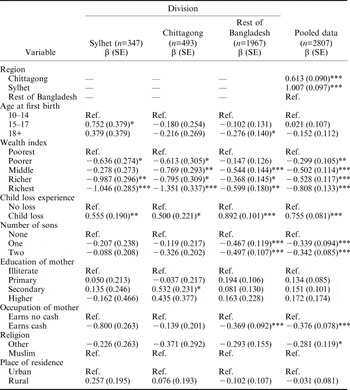
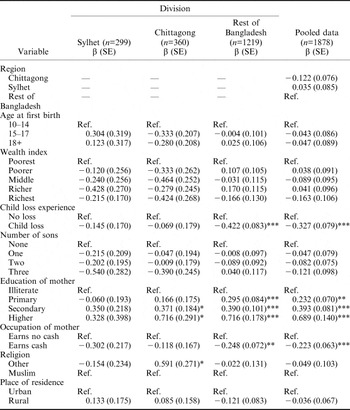
The results from hazard regression models show that women who had their first birth between 15 and 17 years of age in Sylhet were significantly more likely to have a third birth sooner than those who had a first birth between 10 and 14 years of age (Table 2). The direction of the effect is negative for Chittagong and the rest of Bangladesh, though statistically not significant. As household wealth increases, the rate of a third birth shows a decreasing trend; this pattern is significant across Bangladesh. In Sylhet, the difference between those in the middle and the poorest classes is not significant. Women who experienced a child loss tend to progress much faster towards a third birth when compared with their counterparts. The number of sons in the family had no significant effect on the progression to a third birth for Sylhet and Chittagong divisions, but the results are significant for the rest of Bangladesh. Generally, the transition to a third birth was slower for women who had one or two sons. Overall, education had a negligible effect on the rate of transition to a third birth. Religion was significant only for the pooled data suggesting that the rate of a third birth was higher among Muslim women when compared with their counterparts. The rural–urban difference was not significant. The effect of explanatory variables on the rate of progression to a fourth birth is reported in Table 3. Most variables showed identical directions and magnitude, although some of the variables were not significant, especially in the region-specific models, e.g. mother's age at first birth, household wealth, number of sons, religion and place of residence. The variables that were significant included child loss, mother's educational level and occupation. Mother's education was partly significant in Chittagong but not in Sylhet. Women with primary or secondary level education were generally significantly more likely to have a fourth birth sooner when compared with illiterate women. On the other hand, women who earned cash income were significantly less likely to have a fourth birth sooner, especially in the rest of Bangladesh. None of the interaction effects was significant in either the region-specific and pooled models. The lack of significance of interactions may be attributed to the small sample size and hence the results should be interpreted with caution.
Results from hazard regression models predicting the effect of selected demographic and socioeconomic characteristics on progression to third child among ever-married womena

Ref. refers to reference category; scale parameter was set as 1.
* p < 0.10;
** p < 0.05;
*** p < 0.01.
a Controlling for births that occurred in the last 10 years preceding BDHS 2007.
Results from hazard regression model predicting the effect of selected demographic and socioeconomic characteristics on progression to fourth child among ever-married womena

Ref. refers to reference category; scale parameter was set as 1.
* p < 0.10;
** p < 0.05;
*** p < 0.01.
a Controlling for births that occurred for the last 10 years preceding BDHS 2007.
Discussion and policy implications
Although there has been a sharp decline in fertility levels in Bangladesh over the last few decades, the patterns are not uniform across different administrative divisions, particularly in Sylhet and Chittagong. The present analysis shows evidence of cohort differences in the distribution of births, particularly the continuation to higher order births in Sylhet and Chittagong, which were relatively stagnant for the cohorts married before 1985. The probability that a woman from the recent cohort in Sylhet or Chittagong who had a third birth having a fourth birth is nearly twice that of her counterparts in other regions, for example Khulna and Rajshahi. Overall, the gaps in the parity progression ratios for Sylhet and Chittagong with the rest of the divisions are narrowing among women in recent cohorts. There is a clear indication that Sylhet and Chittagong are lagging behind the most successful division of Khulna by almost 10 years. In the absence of programmatic interventions, Sylhet region in particular is unlikely to attain replacement level fertility for another decade. Perhaps a comprehensive family planning programme is urgently needed in Sylhet and Chittagong, especially given the stagnant or reversing trends in modern contraceptive use in these two regions (NIPORT et al., 2005, 2009).
Analyses on the progression to third and fourth parity suggest that women in Sylhet and Chittagong divisions are having their third and fourth births sooner than those in Khulna and other divisions. Regression analyses confirm that the determinants of third and fourth birth rates in Sylhet and Chittagong are mediated by a combination of different factors that are consistent between the two divisions. From a policy perspective, women living in poorer households and those without any sons should be targeted, especially in Sylhet and Chittagong divisions. The findings suggest that interventions to reduce the levels of fertility in Sylhet and Chittagong divisions will require different policy approaches to the rest of Bangladesh.
Unfortunately, the effect of contraceptive use on fertility could not be examined because of the lack of correspondence between the events (births) in question and contraceptive behaviour (measured at the time of survey). Nevertheless, the role of modern contraception in accelerating the Bangladeshi fertility decline is widely recognized (Kabir et al., Reference Kabir, Amin, Ahmed and Chowdhury1994). The dominant method of family planning is the oral pill, rates of use of which vary from the highest (33.1%) in Rajshahi followed by 28.6% in Khulna to the lowest (9.6%) in Sylhet followed by 19.4% in Chittagong (NIPORT et al., 2005). On the other hand, data from the most recent BDHS show that many older women aged 40 years and above in Sylhet and Chittagong had about four children at the time when they first started using a modern contraceptive method (results not shown). Indeed our results show that women who had longer open birth intervals tend to have fewer children, which could be attributed to stopping behaviour by means of reversible modern method use. The use of irreversible methods such as female sterilization is not popular in Bangladesh, unlike in its neighbour India. The steady increase in modern contraceptive use also partly explains the observed inverse relationship between child survival and fertility. Previous studies have shown high perinatal mortality and maternal morbidity in Bangladesh among women who have shorter birth intervals (Razzaque et al., Reference Razzaque, Da Vanzo, Rahman, Gausia, Hale, Khan and Mustafa2005; Mamun et al., Reference Mamun, Padmadas and Khatun2006). The effect of son preference is also apparent, suggesting that fertility tends to be higher in families with two or three sons when compared with those with fewer sons.
The paradox of high fertility in Sylhet and Chittagong is the relationship between reproduction and wealth. These regions are not economically backward, as the primary source of income in many households is overseas remittances from males working in semi-skilled and skilled sectors in Middle Eastern and Western countries (Siddiqui, Reference Siddiqui2008), including the UK (Islam, Reference Islam and Cohen1995). There is little research on the high volume of male migration in Sylhet and Chittagong and its impact on fertility behaviour. Unfortunately, the present study could not incorporate the migration effect in the analysis due to paucity of data. Household wealth was not included in the analysis since household conditions pertain to the date of survey and need not necessarily correspond to past events (births), especially for mothers in the older cohorts. It is important to uncover these unobserved effects on reproductive behaviour in order to quantify the determinants of high fertility in these regions.
The foregoing cohort analyses of fertility data direct the need for designing appropriate policy interventions to tackle high fertility in Sylhet and Chittagong. In fact, the 2004 national population policy in Bangladesh has already considered taking adequate steps to delay the timing of first birth and ensuring adequate spacing between births by increasing female schooling and reducing early marriages (Government of Bangladesh, 2004). However, the target to attain replacement level fertility by 2010 is unlikely to happen in Bangladesh, although the current trends appear to be converging in the right direction. Concerted efforts are needed at the community level to ensuring gender equity and increased female education, as well as encouraging women to actively participate in the formal employment sectors. Reproductive health programmes should focus on educating young men and women of the consequences of early and shortly spaced pregnancies, highlighting the social and health benefits of family planning.
Acknowledgments
The authors gratefully acknowledge the constructive and thought provoking comments and suggestions from the anonymous referee, which contributed significantly to improving the revision of this paper. Thanks are also due to Measure DHS for making the BDHS datasets available for this research project. Sabina Islam worked on this paper while she was working as Visiting Researcher at the Southampton Statistical Sciences Research Institute. The authors gratefully acknowledge the UK Commonwealth Scholarship Commission for providing funding, which made her visit possible through the 2008 Commonwealth Academic Staff Fellowship (Grant Reference: BDCF-2008-14).