Introduction
Kamtok, an English-based expanded pidgin/creole in Cameroon, has many of the grammatical structures of its lexifier language. However, there are certain grammatical structures in this contact language which are not so obvious in its lexifier, though they may exist sparingly in spoken forms of the production of some native speakers. One of these is the serial verb construction (SVC). SVCs are ‘a series of two (or more) verbs [that] have the same subject and are not joined by a conjunction … or a complementiser … as they would be in European languages (Holm, Reference Holm1988: 183).
This paper seeks to describe both the functional categories and the grammatical structures characteristic of Kamtok SVCs. It is hoped that such descriptions would contribute to the knowledge of Kamtok syntax and that more knowledge of the structure of the language would encourage more use of the language in writing and thus raise the low prestige Kamtok presently suffers within Cameroon. The paper demonstrates that Kamtok relies heavily upon SVCs to express concepts such as location, valency increase, aspect and degree.
Definition of serial verbs
There is no single definition of SVC which can be applied to all languages that have the construction. For example, Muysken and Veenstra (Reference Muysken, Veenstra, Arends, Muysken and Smith1995: 290) define the SVC as a multiple verb construction that contains a single subject, a single object, a single TAM value (although possibly marked on both verbs), a single negation morpheme, and no pause, coordination marker or subordination marker intervening between the verbs. In contrast, Essegbey (Reference Essegbey2003: 476) adopts Ameka's (Reference Ameka2001) definition of the SVC as a mono-clausal construction that has a single syntactic subject but may have more than one object. Hagemeijer and Ogie (Reference Hagemeijer, Ogie and Lefebvre2011: 41) provide a definition that is essentially the same as that adopted by Essegbey (Reference Essegbey2003), but elaborate the definition to include the observation that objects can be extracted from either verb phrase in the SVC, a property that distinguishes SVCs from VP coordination structures.
Research questions
With data collected from researchers such as Todd (Reference Todd1982), Bellama et al (Reference Bellama, Nkwelle and Yudom1983), Ayafor (Reference Ayafor and Mesthrie2008) and Mbangwana and Sala (Reference Mbangwana and Sala2009), and with more data coming from a spoken corpus of Kamtok produced by various speakers of the language, this study sets out to address two main research questions:
1. What are the descriptive parameters of SVCs in Kamtok? What functional categories exist, what are their structural properties, and which of the (varied) criteria applied in the literature to this construction type can be applied to Kamtok SVCs?
2. How are Kamtok SVCs distinguished from other sentence types containing more than one verb, such as coordination and subordination constructions?
The corpus mentioned above was a pre-pilot study for a bigger project entitled A Spoken Corpus of Cameroon Pidgin English which is ongoing at the time of writing this paper.Footnote 1 With the help of my research assistant, I collected the data from naturally occurring Kamtok from speakers in three different locations in Cameroon, i.e. Bamenda, Buea (both regional headquarters for the two Anglophone regions of the country), and Yaoundé, the seat of government where many migrants from the rest of the country have settled. I tape-recorded the speakers (with their consent) and had their talk transcribed by a research assistant who is a native speaker of the language. Each recording was named in a manner to hide the identity of the informants. Thus Bamenda 1 to 7, Buea 1 to 4, and Yaoundé 1 to 6 are the 17 informants from these places. I also taped and transcribed Radio programmes in Bamenda. In addition to this corpus, the New Testament Bible in Kamtok produced in 2000 by The Bible Society of Cameroon and entitled Gud Nyus Fo Ol Pipul was also used as data source, as was the transcribed version of a 2005 Kamtok documentary, directed by Kim Longinotto and Florence Ayisi, entitled ‘Sisters-in-law’.
Serial verbs in Kamtok
Functional categories
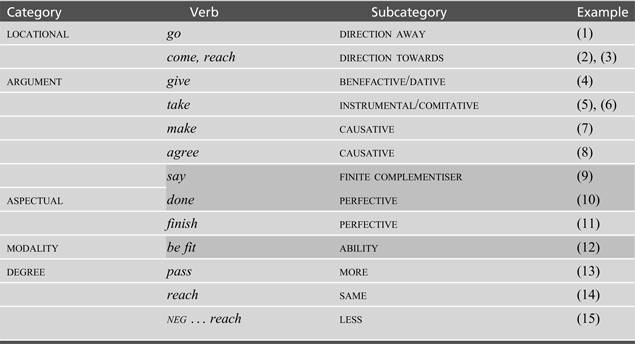
Table 1 sets out the functional SVC categories that exist in Kamtok (adapted from Muysken and Veenstra Reference Muysken, Veenstra, Arends, Muysken and Smith1995: 290–291). The fourth column of the table lists cross-referenced examples that illustrate each category. The shaded rows indicate those verbs that possibly originated as serial verbs in Cameroonian Pidgin English but are now fully grammaticalised into non-lexical categories.
SVC categories in Kamtok

Examples (1)–(3) illustrate locational SVCs containing the verbs go ‘go’, kam ‘come’ and rich ‘reach’.Footnote 2 Any example for which an author is not named was provided by me, the present author.
(1) i ron go fo dokta yi haus
he run go prep doctor 3s.poss house
‘He ran to the doctor's house.’ (Todd, Reference Todd1982: 128)
(2) sotei yu kam bring-am, na yu moni dis
until you come bring-it cop your money dem
‘Until you bring it back, your money stays here.’ (Todd, Reference Todd1982: 133)
(3) Dem bi waka sotee kam rich fo hea
They pst walk unti come reach prep here
‘They trekked until they reached this place.’ (Bamenda 1.txt)
Examples (4)–(8) illustrate various valency functions of SVCs in Kamtok. Example (4) illustrates the benefactive function of gif ‘give’. Example (5) illustrates the instrumental function of teik ‘take’, and example (6) illustrates the comitative function of the same verb. Examples (7) and (8) illustrate the causative functions of meik ‘make’ and gri ‘allow’.
(4) a bi go gif repot fo polis fo Fiango
I pst go give report prep police prep Fiango
‘I went and reported to the police at Fiango.’
(Sisters-in-law)
(5) yu go di teik am so gif am fo
you fut impf take 3S so give 3S PREP
pikin yi mop
child poss mouth
‘You would be taking it and putting it into the child's mouth.’
(Bamenda 2.txt)
(6) i teik mi go
he take me go
‘He took me with him.’ (Todd, Reference Todd1982: 153)
(7) meik a komot fo moto
make I come.out of car
‘Let me get out of the car.’ (Ayafor, 2004)
(8) if na mi, a no go gri meik i
If cop me, I neg fut agree make s/he
kam visit dat pikin dem
come visit dem child pl
‘If I were the one, I would not let him come and visit the children.’
(Radio Hot Cocoa.txt)
As the examples in (9) illustrate, sei (< ‘say’) no longer functions as a lexical verb in Kamtok (cf. 9a and 9b), but has fully grammaticalised into a complementiser (9b–9c). Example 9a and all other subsequent ungrammatical utterances are considered ungrammatical because such constructions are not found anywhere in the entire corpus of data used for this study, data collected from various speakers.
(9)
a. *i bi sei plenty ting dem
s/he pst say many thing pl
‘S/he said many things.’
b. sumo ting wei a wan tok bifo a
small thing REL Is want talk before 1s
go tok fo masef
FUT talk PREPmyself
‘The little thing that I want to say before I speak about myself …’
(Bamenda 1.txt)
c. Ardo Wami wi bi tok sei na
Ardo Wami we pst talk rel cop
pa for Sabga dem
father prep Sabga PL
Similarly, the examples in (10) illustrate that don (< ‘done) cannot function as a lexical verb in Kamtok, but is a fully grammaticalised TAM morpheme (perfective aspect).
(10)
a. *i don don yi wok
s/he pst done poss.3s work
‘S/he has done his/her work.’
b. i don do yi wok
s/he pf do poss.3s work
‘S/he has done his/her work.’
c. i don si dokta
s/he pf see doctor
‘S/he has seen the doctor.’ (Ayafor, Reference Ayafor and Mesthrie2008: 41)
Example (11) illustrates the aspectual (perfective) function of finish in Kamtok.
(11)
a. tifman kill-am sotei yi dai finish
thief kill-him until he die finish
‘The thief killed him stone dead.’
b. i don chop finish, i di krai daso
s/he pf eat finish s/he impf cry still
‘S/he has finished eating, yet s/he is still crying.’
(Bamenda 2.txt)
c. dei wei a go maket fain, a go sel am finish
day rel Is go market fine, 1s go sell it finish
‘When business is good, I would sell it all.’
(Bamenda 7.txt)
As the examples in (12) illustrate, Kamtok does not have a synchronic SVC with a modality function. The form fit (< ‘fit’) does not function as a lexical verb; speakers instead use koret ‘fit’, ‘be correct’ (12a); fit is a fully grammaticalised modality morpheme (12b).
(12)
a. dis kova koret fo dis botel
dem lid fit prep dem bottle
‘This lid fits this bottle.’
I len som wok o i du som
s/he learn sid work or s/he do sid
ting wei i go koret yi
thing REL it fut correct 3S
‘S/he learned a trade or did something that would fit her.’
(Bamenda 7.txt)
b. a fit kuk rais
I mod cook rice
‘I can cook rice.’ (Ayafor, Reference Ayafor and Mesthrie2008: 439)
Finally, examples (13)–(14) illustrate the degree-indicating functions of the verbs pas ‘pass’ and (neg) rich ‘(not) reach’ in Kamtok.
(13)
a. Susana di bay nyanga tin dem pas
Susana impf buy beauty thing pl pass
Mary
Mary
‘Susana buys beauty products more than Mary.’
(Ayafor, Reference Ayafor and Mesthrie2008: 447)
b. John yi fut dem bik rich Peter yi
John poss foot pl big reach Peter poss
on dem
own pl
‘John's feet are as big as Peter's.’
(Ayafor, Reference Ayafor and Mesthrie2008: 447)
(14) orenj no swit rich banana
orange neg be.sweet reach banana
‘Oranges are less sweet than bananas.’
(Bellama et al., Reference Bellama, Nkwelle and Yudom1983: 71)
In sum, the examples provided in the present section illustrate that Kamtok has SVCs that perform the functions of indicating location, argument, aspect and degree.
Structural properties
In this section, we set out the structural properties of SVCs in Kamtok. First, as the examples in (15) demonstrate, the SVC is restricted to a single subject, indicating a mono-clausal construction.
(15)
a. *i ron i go fo dokta yi
s/he run s/he go prep doctor 3s.poss
haus
house
‘He ran to the doctor's house.’ (Todd Reference Todd1982: 128)
b. *a wan a go a rich Bamenda
I want I go I reach Bamenda
‘I want to get to Bamenda.’
c. *yi sista bai klos i gif yi
poss.3s sister buy clothes she give him
‘His sister bought clothes for him.’
Second, each verb that occurs in a SVC must be able to function as an independent lexical verb in order for the construction to meet the criteria set out for SVCs in the literature. As the examples in (16) illustrate, this is the case for all the serial verbs illustrated in the preceding section, but recall the discussion of examples (9), (10) and (12) above.
(16)
a. dat pipul wei dey di go fo
dem people REL 3P impf go prep
Mecca
Mecca
‘Those people who go to Mecca.’
(Bamenda 1.txt)
b. waitman don kam fo insait kontri
whiteman PST come PREP inside country
‘A European has come to our land.’
(Bamenda 6.txt)
c. a no nou wusai yu don waka rich,
Is negknow where you pst walk reach,
bot a wan meik yu tel wi…
butIs want make you tell we…
‘I don't know how far you've travelled but I want you to tell us…’
(Bamenda 5.txt)
d. dey gif yu wata yu dring
3Pl give you water you drink
‘They gave you water and you drank.’
(Sisters-in-law)
e. as yu teik am yu ton fo bak sai
as you take it you turn PREP back side
yu trow am
you throw it
‘As you took it, you turned around and threw it behind the house.’
(Yaoundé5.txt)
f. a di meik ma koki sotei ma
1s IMPF make poss koki until poss
masa kam dai
master come die
‘I kept making bean cakes until my husband died.’
(Bamenda 2.txt)
g. wuman dem wuna gri?
women Pl 3Pl agree
‘Women, do you agree? (Radio Hot Cocoa)
h. so wuna finsih nomal sikul fo
so 3pl finish normal school prep
aftanun?
afternoon?
‘So you finshed normal schooling in the afternoon?’
(Sisters-in-law)
i. dog no di pas fo pleis wei
dog neg impf pass prep place rel
i pikin dei
poss child there
‘A dog does not pass near where his/her child is’
(Yaoundé 2.txt)
The third property of the Kamtok SVC is that it does not permit subordinating complementisers, conjunctions, infinitival particles or prosodic pauses indicating covert coordination. Therefore, the examples in (17) provide further evidence that the SVC is a mono-clausal construction, and it does not contain coordination, overt or covert. These are not found in the corpus since they are ungrammatical so not usually used. That is why they have no reference. They are my creations.
(17)
a. *go fain-am an/sei/fo bring-am nau
go find-it conj/comp/inf bring-it now
‘Go and look for it and bring it (here) at once.’
b. *i ron an/sei/fo go fo dokta yi
herun conj/comp/inf go prep doctor 3s.poss
haus
house
‘He ran to the doctor's house.’
c. *i tek me an/sei/fo go America
he take me conj/comp/inf go America
‘He took me to America.’
d. *ticha bi kam an/sei/fo tok fo
teacher pst come conj/comp/inf talk prep
Papa.
Papa
‘The teacher came and talked to Papa.’
e. *a wan waka an/sei/fo rich
I want walk conj/comp/inf reach
Mokolo Maket
Mokolo market
‘I want to walk to Mokolo Market.’
f. *i teik mi an/sei/fo go
he take me conj/comp/inf go
‘He took me with him.’
g. *yu di chop an/sei/fo pas mi
you impf eat conj/comp/inf pass me
‘You eat more than me.’
The fourth property of the Kamtok SVC is that the order of the verb phrases cannot be reversed. Example (18) illustrates that the order of coordinated VPs can be reversed, a well-known test for coordination structures. (As these examples show, Kamtok rarely requires overt coordination between VPs.) In contrast, the order of constituents in an SVC cannot be reversed as in (19)–(20) which shows that the SVC is distinct from a covert coordination construction (Sebba, Reference Sebba1987: 96–102).
(18)
a. i bi brok fayawud kuk chop bifo
s/he pst split firewood cook food before
i go maket.
s/he go market
‘S/he split the firewood and cooked the food before she went to the market.’
b. i bi kuk chop brok fayawud bifo I go
s/he pst cook food split firewood…
maket
‘S/he cooked the food and split the firewood…’
c. meik wuna kam si som man weh
make 3Pl come see SID man REL
e don tok ol ting dem weh
3S PST talk all thing PL REL
a don du-am
1S PST do-it
‘Come and see a man who told me everything I ever did!’
d. *meik wuna si kam som man weh ..
make 3Pl see come SID man REL
(John 4:29 in GUD NYUS fo Ol Pipul)
(19)
a. Susana di bay nyanga tin dem pas
Susana impf buy beauty thing pl pass
Mary
Mary
‘Susana buys more beauty products than Mary.’
(Ayafor, 2004: 447)
b. *Susana di pas Mary bay nyanga
Susana IMPF pass Mary buy beauty
tin dem
thing PL
(20)
a. weikop teik yua mat bigin waka
stand up take POSS mat begin walk
‘Stand up, pick up your mat and walk.’
(John 5:8 in Gud NYUS fo Ol Pipul)
b. * weikop bigin waka teik yua mat
stand up begin walk take POSS mat
The fifth structural property of the Kamtok SVC concerns object extraction, further evidence against covert coordination. It is well known that coordinated VPs create an island for extraction as illustrated by example (21), which shows that objects cannot be wh- extracted from co-ordinated phrases. The fact that SVCs allow object extraction (22) indicates that they do not contain covert coordination structures (Sebba, Reference Sebba1987).
(21)
a. John washed the dishes and changed the sheets
b. *What did John wash and change the sheets?
c. *What did John wash the dishes and change?
(22)
a. Susana di bai nyanga tin dem pas
Susana impf buy beauty thing pl pass
Mary
Mary
‘Susana buys more beauty products than Mary.’
(Ayafor 2004:447)
b. weiti Susana di bai pas Mary?
what Susana impf buy pass Mary1
‘What does Susana buy more of than Mary?’
c. hu Susana di bai nyanga tin
who Susana impf buy beauty thing
dem pas?
pl pass
‘Who does Susana buy beauty products more than?’
The sixth structural property of the Kamtok SVC is that the construction only permits one tense/aspect/modality/negation morpheme. These must precede the first verb (23)–(26).
(23)
a. yu go kam si som ting dem weh
3S fut come see sid thing pl rel
dem pas dis wan
3Pl pass dem one
‘You will see greater things than this.’
(John 1:50 in GUD NYUS Fo OL Pipul)
b. *yu kam go si som ting dem weh
3S come FUT see SID thing PL REL
dem pas dis wan
3Pl pass DEM one
(24)
a. a no bi chop rich yu
I neg pst eat reach you
‘I didn't eat as much as you.’
b. *a chop no bi rich yu
I eat neg pst reach you
‘I didn't eat as much as you.’
(25)
a. *yu go kam go si som ting dem
3S FUT come FUT see SID thing PL
weh dem pas dis wan
REL 3PL pass DEM one
b. *a no chop no rich yu
I neg eat neg reach you
‘I don't eat as much as you.’
(26) *yu di chop don pas mi
you impf eat pf pass me
‘You eat more than me.’
The seventh structural property of the Kamtok SVC is that each verb can take its own adverbial modifiers, which are typically post-verbal in Kamtok. This is illustrated by examples (27)–(28). However, I observe that adverbials cannot intervene between a transitive verb and its NP complement (28b).
(27)
a. i bi kam kwik-kwik tok fo Papa
s/he pst come quickly talk prep Papa
‘S/he came quickly and talked to Father.’
b. i bi kam tok kwik-kwik fo Papa
(28)
a. i bi kam kwik-kwik hol mi
s/he pst come quickly hold me
‘S/he came quickly and held me.’
b. *i bi kam hol kwik-kwik mi
c. i bi kam hol mi kwik-kwik
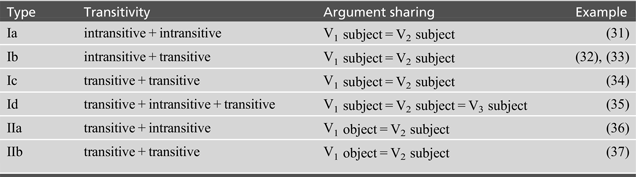
Finally, the SVC is characterised by argument sharing. Two main types of argument sharing have been identified in the Kamtok SVC: Type I, where the subject is shared between two or more verbs, and Type II, where the object of a transitive V1 simultaneously functions as the subject of V2. Table 2 summarises the argument sharing constructions in Kamtok SVCs.
Argument sharing in Kamtok SVCs
(29)
a. wan pikin ron go
one child run go
‘One child ran away.’ (Bamenda 7.txt)
b. a kam teik pikin i oya
I come take child poss oil
‘I came and took the child's oil.’ (Bamenda 2.txt)
c. yu teik galon go na blak bush wata
3S take gallon go COP black bush water
wan taim fo ron go
one time prep run go
kari water
carry water
‘Yu take a gallon and went instead to the black bush immediately to go and fetch water.’
(Yaoundé 2.txt)
d. wi di chop nyamangoro pas ol man
1PL IMPF eat snails pass all man
‘We eat snails more than everybody else.’
(Yaounde 2.txt)
e. man go kari wan tin oya pass go sel-am
man fut carry one tin oil pass go sell-it
‘A person would carry a tin of oil and go and sell it.’
(Bamenda 6.txt)
f. ano nou weiti meik mi fol
1S neg know what make me fall
‘I don't know what made me fall.’
(Bamenda 7.txt)
g. i bi meik de pikin chop de chop
s/he pst make def child eat def food
‘S/he made the child eat the food.’
h. Wen yu tok som ting meik yu du
When 3S talk sid thing make 3S do
de ting
def thing
‘Do what you say you would do’. (Yaounde 3.txt)
i. So dat kana ting di meik am
So DEM kind thing impf make it
hair di gro
hair IMPF grow
So that kind of thing makes hair grow. (Yaounde 4.txt)
Interim summary: a definition of the SVC in Kamtok
In sum, the Kamtok SVCFootnote 3 can be defined as having the following properties:
• Single subject
• Each verb can function as an independent lexical verb
• No overt conjunctions or subordinating complementisers
• No covert coordination: no pauses, no possibility of word order change
• Object extraction is possible
• One tense/aspect/modality/negation morpheme preceding the first verb
• Each verb can take its own adverbial modifiers
• Argument sharing (subjects, but not always objects)
Distinguishing SVCs from other multi-verb sentence types in Kamtok
In this section we show how SVCs are distinct from other multi-verb sentence types in Kamtok. First, subordination is characterised either by a complementiser like sei (declarative), if or weda (interrogative), or by the infinitive particle fo (30). Recall from example (17) that SVCs do not tolerate complementisers or infinitival particles.
(30)
a. i tok sei i no go kam
he say comp he neg fut come
‘He says that he's not coming.’
b. i as if/weda a go laik fo folo
s/he ask if/whether I fut like inf follow
i go
him go
‘He asked if I would like to go with him.’
c. dat man sabi fo meik yi
dem man know inf make poss.3s
wuman veks!
wife be.upset
‘That man knows how to upset his wife!’
Second, implicative verbs like trai ‘try, manage’ and mimba ‘remember’ show the greatest superficial similarities to SVCs (31). However, these verbs permit infinitive particles, an overt marker of subordination (32). Thus, sentences in (31) and (32) mean exactly the same thing. The verbs in these constructions can be negated independently (33) (Sebba, Reference Sebba1987: 88–90), another disqualifier for verb serialisation. Recall from examples (23)–(26) that SVCs only tolerate a single negation morpheme, which must precede the first verb.
(31)
a. i bi trai finish yi wok
s/he pst try finish poss.3s work
‘She managed to finish her work.’
b. i bi mimba finish yi wok
s/he pst remember finish poss.3s work
‘She remembered to finish her work.’
(32)
a. i bi trai fo finish yi wok
s/he pst try inf finish poss.3s work
‘She managed to finish her work.’
b. i bi mimba fo finish yi wok
s/he pst remember inf finish poss.3s work
‘She remembered to finish her work.’
(33)
a. i no bi trai finish yi wok
s/he neg pst try finish poss.3s work
‘S/he didn't manage to finish his/her work.’
b. i bi trai no finish yi wok
s/he pst try neg finish poss.3s work
‘She managed not to finish her work.’
c. i no bi trai no finish yi wok
s/he neg pst try neg finish poss.3s work
‘She didn't manage not to finish her work.’
Finally, control verbs like want ‘want’, promis ‘promise’ and convins ‘convince, persuade’ take overt markers of subordination (34), unlike SVCs. The verbs in these constructions also allow independent negation (35) (Sebba, Reference Sebba1987: 90–94). Therefore, they are different from SVCs.
(34)
a. Thomas want fo wok farm
Thomas want inf work farm
‘Thomas wants to work the farm.’
(Mbangwana and Sala Reference Mbangwana and Sala2009: 226)
b. i bi promis sei i go finish
s/he pst promise comp s/he fut finish
de wok
def work
‘He promised to finish the work.’
c. i bi convins mi sei mek a finish
s/he pst convince me comp make I finish
de wok
def work
‘He persuaded me to finish the work.’
(35)
a. i no bi promis sei i go
s/he neg pst promise comp s/he fut
finish de wok
finish def work
‘He didn't promise to finish the work.’
b. i bi promis sei i no go
s/he pst promise comp s/he neg fut
finish de wok
finish def work
‘He promised not to finish the work.’
c. i no bi promis sei i no
s/he neg pst promise comp s/he neg
go finish de
fut finish def
wok
work
‘He didn't promise not to finish the work.’
In sum, it is evident from the examples discussed in this section that SVCs show clearly distinct structural properties from other multi-verb constructions in Kamtok.
Conclusion
Though mostly used as a spoken medium of communication and having slight regional variations, Kamtok is a well-structured language with its own rules. Therefore, it is possible to have ungrammatical Kamtok sentences. The examples provided in this paper have illustrated that Kamtok has SVCs that perform the functions of indicating location, argument, aspect and degree. As far as their structures are concerned, Kamtok SVCs can be defined as having the following properties: they take a single subject; each verb in the series can function as an independent lexical verb; they have no overt conjunctions or subordinating complementisers; there are no covert co-ordinations: no pauses and no possibility of word order change; and they allow object extraction.
MIRIAM AYAFOR obtained a BA degree from the University of Yaoundé, an MA from the University of Leeds, and a PhD from the University of Ulster. She is presently full-time Senior Lecturer of English Language and Sociolinguistics in the University of Yaoundé 1, Cameroon. She is interested in research into falling standards of English, literacy problems among young educated people, and Pidgins and Creoles. Email: miriamayafor@yahoo.co.uk