Although much has been written about the effects of economic liberalism on international conflict, the relationship between economic openness and civil war has received less attention.Footnote 1 The relative neglect of this issue is surprising for two reasons. First, civil war, rather than interstate war, is now the dominant form of armed conflict. Second, during the past few decades, actors within the international arena have been pressing national governments to liberalize their economies. If, as a number of scholars and activists suggest, liberalization promotes conflict, the international community unintentionally may be sowing the seeds of civil war through its efforts to encourage states to open their economies.Footnote 2
This research note seeks to shed light on the relationship between economic liberalization and the onset of civil war. The limited number of quantitative studies that examine the impact of economic openness on civil conflict have found, variously, that a negative correlation, a positive correlation, or no relationship exists between economic openness and internal conflict.Footnote 3 We attribute the lack of robust results regarding the relationship between openness and civil war principally to measurement problems and endogeneity bias.Footnote 4 Measurement problems stem from scholars' use of aggregate economic indicators to reflect liberalization. Endogeneity bias arises as a result of analysts' failure to take into account characteristics of countries that may influence both government decisions regarding whether and how to liberalize their economies and the onset of civil war.Footnote 5
Our goals in this research note are threefold. First, we outline the implications that the measurement and endogeneity bias problems referred to above have for explanations of the relationship between economic liberalization and the onset of civil war. Second, we propose the use of an alternative indicator, the adoption by countries of International Monetary Fund (IMF) structural adjustment programs, as a means of examining the effects that one of the most prevalent means of attempting to liberalize economies has had on the onset of civil war. Finally, we test the effects of this measure on the onset of civil war, employing a bivariate probit model in order to address the issue of endogeneity bias.
Measurement Problems and Endogeneity Bias: Modeling the Relationship between Economic Openness and Civil War
Economically liberal, or open, economies are ones in which barriers to trade, capital flows, and foreign direct investment (FDI) have been removed, or at least greatly lowered, by national governments. Although economists have developed a number of comparative measures of openness, political scientists have tended to rely on readily available data about the external sector as a means of operationalizing economic liberalism.Footnote 6 The most commonly used indicator in studies of the relationship between economic openness and civil war has been the trade dependency ratio (defined as the sum of a state's total annual imports plus exports, divided by its gross domestic product (GDP)), although measures of FDI and foreign portfolio investment (FPI) also appear in some analyses.
Scholars generally have employed these indicators to test some variant of the Collier-Hoeffler thesis regarding the role that “greed” plays in civil war.Footnote 7 One line of argument is that economic liberalization has welfare-enhancing effects for society. By promoting development and reducing inequality, liberal economies are hypothesized to raise the opportunity costs of initiating civil war, thereby lowering the likelihood of its outbreak.Footnote 8 This claim has been challenged by scholars who note that the welfare-enhancing effects of liberalization and integration into the global economy are not evenly distributed. Because economic integration redistributes income within a domestic society, those groups that “lose” as a result of this process may well see the opportunity costs of engaging in civil conflict decline. As a result, the effect of this process is to make it more likely that civil war will occur.Footnote 9
The fact that the same measures of economic openness—trade dependency ratios, FDI, and FPI—have been used to test hypotheses that posit very different types of relationships between openness and civil war is one indication of the challenges scholars have confronted in their efforts to measure economic liberalism.Footnote 10 Of even greater concern is the fact that these indicators are not good proxies for the conflict-reducing or conflict-inducing processes at the core of analysts' hypotheses. Scholars use trade dependency ratios, for example, as a means of measuring the openness and efficiency of economies integrated into the global economic system. Countries can distort trade significantly, however, and still have a high trade dependency ratio.Footnote 11 This implies that countries with relatively similar trade dependency ratios may actually perform quite differently where trade distortion and welfare enhancement are concerned. Those governments that enact policy measures that reduce the costs of trade liberalization for some groups thus can minimize the number of losers created by this process who may otherwise be motivated to initiate armed conflict against the state.
Many of the models of the economic liberalization–civil conflict relationship that scholars have produced are also likely to suffer from endogeneity bias. Endogeneity bias occurs when one or more independent variables is correlated with the error term.Footnote 12 If an independent variable acts as a proxy for the unexplained or unobserved factors that have been subsumed into the error term, we cannot interpret its estimated coefficient as the effect of that regressor since the latter also captures part of the effect of omitted or mismeasured variables. The potential for endogeneity bias arises in our study because not all countries are equally “at risk” of participating in IMF structural adjustment programs. If the factors that influence IMF program participation are not randomly distributed across the population of countries, then the error terms associated with our efforts to account for the selection by countries into IMF programs and the onset of civil wars will be correlated. A significant correlation suggests that the same unaccounted-for factors that influence selection into IMF programs also have an impact on the onset of civil war.Footnote 13
One potential unobserved factor that may play a role in selection and the onset of intrastate war is the degree of legitimacy a government enjoys among its citizens. Governments perceived as illegitimate by significant segments of the population may be more likely to sign on to IMF agreements, reasoning that the programs will have little additional impact on their legitimacy and/or that any negative effects they generate will be felt principally by groups that already question the government's right to rule. Perceptions of government illegitimacy also may exercise an independent effect on the likelihood of civil war onset, with governments perceived as highly illegitimate at greater risk of being challenged by armed groups.Footnote 14 If the governments that opt to sign on to IMF agreements systematically experience higher levels of illegitimacy and that factor is one that has an impact on the onset of intrastate conflict, then government illegitimacy may affect both selection into IMF programs and the conflict-related effects of those programs.Footnote 15
An Alternate Measure: Economic Liberalization via IMF Structural Adjustment
If aggregate indicators of economic openness pose problems for the study of the relationship between economic liberalism and the onset of civil war, what alternative measure might be employed? We propose using a measure that indicates whether or not a country has signed on to an IMF structural adjustment program (SAP). We contend that these programs systematically create winners and losers, altering opportunity costs in such a manner as to motivate the latter to engage in civil conflict.
The most common means by which economies have been liberalized in recent decades is via a process in which international financial institutions (IFIs) dominate in decisions regarding how a country opens to the global economy. This process has often been referred to as “the Washington Consensus”—Williamson's characterization of a “standard” economic reform package for countries in economic crisis promoted by Washington, D.C.-based institutions including the IMF, the World Bank, and the U.S. Treasury Department.Footnote 16 Countries embark on this path to liberalization when they agree to adopt the structural adjustment programs of the IMF or the World Bank.Footnote 17 These programs call for a rapid and complete transformation of the economies of participating countries. Intended to correct balance of payments disequilibria and to generate sustainable growth, SAPs require countries to implement a variety of policies, including currency devaluation, trade liberalization, tight monetary policy, fiscal austerity (including reduced government services and subsidies), privatization of state-owned enterprises, and higher taxes.Footnote 18
Although SAPs are tailored to the circumstances of each borrowing country, there is a consistent pattern to the conditions the IMF requires in exchange for access to resources. The ultimate goal of the international financial institutions is to produce liberal economies, defined as those in which governments play a very limited role in both the internal workings of the economy (for example, setting wage rates) as well as in international economic activity (for example, setting import quotas). Although these programs may not set out to weaken established societal coalitions or create new ones, the nature of the reforms serves to alter fundamentally the character of both societal and state-society relations.
Economic liberalization via IMF structural adjustment programs has become increasingly prevalent in recent decades. While 172 IMF loan programs were approved for the period between 1970 and 1979, the 1980s saw 271 such programs approved with an additional 282 loan programs agreed to during the next decade. The fact that nearly all developing countries have received IMF financial support at least once since 1970 makes it increasingly important to discover whether SAPs have an impact on the onset of civil conflict.Footnote 19
We hypothesize that countries that adopt the IMF-induced process of economic liberalization have a higher likelihood of experiencing the onset of civil war than those that do not. This process is likely to produce actors that are negatively affected by the distributional consequences of policies used to achieve economic opening (for example, job losses in the industrial and service sectors as state-owned enterprises are sold off).Footnote 20 This path to liberalization also lessens state actors' ability either to compensate or confront the losers produced by economic liberalization through budget cuts and the loss of other forms of control over the economy. The effect of this process is to increase the potential for violence by actors reacting negatively to their changed circumstances.
There is anecdotal evidence suggesting that a relationship exists between a country signing an IMF SAP and an increased potential for civil violence. A case in point is Liberia. Although the country had been drawing on IMF finance since the early 1960s, under the dictatorship of Samuel Doe it agreed to five standby agreements with the IFI between 1980 and 1984 that sharply increased its dependence on that institution. Between 1980 and 1985, the country experienced a cumulative decline in real GDP of more than 18 percent. Although the failure of the Liberian economy to grow could have been the result of factors, such as the global economic recession in the early 1980s or the failure of the Liberian government fully to implement the measures it had agreed to, the SAPs also produced clear-cut groups of winners and losers. Among the latter were state employees who saw their salaries cut about 25 percent in 1983. Other measures intended to balance the budget, such as a national reconstruction tax and higher excise taxes, specifically targeted Liberian citizens while multinational companies investing in the Liberian economy were granted privileges, including tax exemptions and the freedom to repatriate profits.Footnote 21 Did the decade-long slide in the Liberian economy and the weakening of the state that occurred in tandem with the adoption of a new series of IMF SAPs play a role in the outbreak of civil war in that country in 1989? The purpose of this study is to determine whether examples like this one are indicative of a broader pattern in which states that opt for an IMF-designed path to liberalization have an increased odds of engaging in civil war.
To examine the effect that IMF agreements have on the onset of civil war, we employ a measure reflecting whether or not a government has agreed to participate in an IMF structural adjustment program.Footnote 22 We assume, as discussed above, that these programs will generate winners and losers, leaving governments with little leeway to compensate the latter. Conversely, states that have not signed such an agreement have abstained from the liberalization program favored by the IFIs; although these states may opt to liberalize their economies in some manner of their own choosing, they are considered to retain some ability to distribute the costs of adjustment across different groups in the economy. As such, they can attempt to minimize the potential losses incurred by any single group, thereby lowering the likelihood that they will engage in protest.Footnote 23
An objection that might be raised concerning the use of this indicator is that if governments that sign on to IMF SAPs fail to comply with the terms of the agreements, the adoption of an IMF program may mean that little liberalization is actually taking place. Yet even in the absence of full compliance with the IMF's terms, the process of IMF-guided reform generates groups of economic losers through other means. One such means is IMF lending. IMF loans' effect on the national debt, independent of the IFI's policy conditions, may serve to promote losers, at least some of whom might be motivated to engage in armed conflict.Footnote 24
A Bivariate Probit Model
In order to sort out the effects endogeneity bias may have on our estimates of the onset of civil war, we employ a bivariate probit model. The bivariate probit model, a simple generalization of the univariate probit model, consists of a system of two equations of univariate probit models that are simultaneously solved. In other words, the model estimates two potentially correlated binary outcomes—in this instance, the binary decision by a government regarding whether or not to sign an agreement with the IMF and the binary outcome of civil war onset. The bivariate probit model assumes that the random error terms in the equations are correlated, implying that the covariance of the random error terms equals a constant, ρ, rather than zero (as in univariate probit models). Correlation between the error terms suggests that the effects of unobserved variables such as perceptions of government illegitimacy are not random. If such a correlation between the error terms is found to exist, the bivariate probit corrects for it, eliminating the effects the nonrandom selection by countries into IMF programs has on civil war onset. The remaining difference in the probability of civil war onset between countries that sign agreements with the IMF and those that do not can be attributed to the effect of the IMF programs.
More formally, the model specification is given by the system of two equations:


0 otherwise (IMF agreement waas not signed),


and


Equation (1a) describes the probability of country i signing on to an IMF agreement in the jth year (πij1*) as a function of the vector of covariates X ij1. Equation (1b) describes the probability of the onset of civil war for country i in the jth year (πij2*) as a function of a vector of covariates X ij2 and the endogenous IMF agreement variable πij1 (signing on to an IMF agreement). The error terms ɛij1 and ɛij2 are bivariate normally distributed and have a correlation coefficient equal to ρ.
The log-likelihood function for the seemingly unrelated bivariate probit is given by

where N is the number of countries analyzed in year j, M is the number of years, and Φ2 denotes the standard bivariate normal cumulative distribution function, w ij1 = (2πij1−1)X ij1 β1, and w ij2 = (2πij2 − 1)(X ij2 β2 + πij1γ). The function is maximized by choosing the parameters β1, β2, γ, and ρ.Footnote 25
The inclusion of the dichotomous variable for the signing of an IMF agreement in the civil war onset equation makes this model recursive. The model is estimated by full information maximum likelihood estimation, thus allowing for all possible combinations of the dependent variables (civil war onset [πij2 = 1], signing of IMF agreement [πij1 = 1]; civil war onset [πij2 = 1], no signing of IMF agreement [πij1 = 0]; no civil war onset [πij2 = 0], signing of IMF agreement [πij1 = 1]; no civil war onset [πij2 = 0], no signing of IMF agreement [πij1 = 0]). Assuming bivariate normality, we rely on the functional form to identify the model. The model is identified as long as there is variation in the set of exogenous regressors; exclusion restrictions are not required.Footnote 26
Because it is likely that the decision by governments to sign on to IMF agreements and the decision by some set of actors to initiate civil war are shaped by many of the same conditions or causal factors, we include a number of identical covariates in both equations. We employ a series of economic variables in order to assess the financial conditions in which countries find themselves. Based on previous scholarship, we anticipate that countries experiencing positive economic conditions, as measured by high levels of gdp per capita, high economic growth rates, and large foreign currency reserves should be less likely to seek IMF loans and less likely to experience the onset of civil war.Footnote 27 An indicator that captures the extent of countries' dependence on oil as a source of export revenues also appears in both vectors of variables. We expect that countries with high scores on this measure, which proxies for low state capacity and for rent-seeking behavior, will have both a higher likelihood of signing on to an IMF agreement as governments seek help with economies compromised by corruption and be more likely to experience the onset of armed civil conflict as groups seek to capture control of this resource.Footnote 28
We also include in both equations a series of other variables we believe may impact both governments' likelihood of signing onto an IMF SAP and the onset of civil war.Footnote 29 Scholars have suggested that political factors may influence not only the likelihood of civil war onset but also government demand for IMF credit. We hypothesize that semidemocracies, countries with regimes intermediate between democracies and autocracies, will be most likely to experience civil war onset. Characterized by institutional incoherence, groups within these regimes take advantage of the level of openness that exists in order to organize and engage in antigovernment activities.Footnote 30 Because an environment of this nature is likely to discourage domestic and foreign investors, it should heighten the need for IMF credit, thus increasing the likelihood that the leaders of intermediate regimes will sign on to IMF agreements.Footnote 31 A final variable that appears in both equations is years under imf sap, the cumulative number of years a country has been under an IMF agreement. Governments that have already signed on to such agreements for a number of years should prove more willing to do so again as they have already paid the “sovereignty costs” associated with compromising the national patrimony.Footnote 32 Civil war onset should be more likely the larger the number of years a government has signed agreements with the IMF, as this reflects a persistent economic crisis that may well escalate tensions in the country.
The two vectors of equations also include an indicator focusing on population size. We expect that countries with relatively large populations face greater challenges to state capacity and control, thus raising the likelihood of the onset of civil war within a country.Footnote 33 We include a measure that focuses on countries' previous experiences with civil war (previous civil war). We anticipate that governments whose countries were the site of a civil war within the previous five years will be more likely to sign on to IMF agreements as they seek to expedite a process of economic recovery. Research has also shown that countries that recently have experienced civil wars have a high risk of falling back into the trap of civil conflict.Footnote 34
One independent variable appears in X ij1, the vector of explanatory variables in the IMF agreement equation, which does not appear in X ij2, the vector in the civil war onset equation. The variable number countries under imf sap, which is the total number of other countries in the world currently under IMF agreement, is one that has substantial predictive value for IMF loan participation and is exogenous with respect to civil war onset. We hypothesize that the larger the number of countries currently under an IMF agreement, the less likely a government will be to sign on to an IMF program, as it will have reason to doubt that the IFI's budget constraints will allow it to provide the country with the help it needs.
The independent variable that appears in X ij2 but not in X ij1 is mountainous terrain, which is the logged value for the percentage of mountainous terrain. This measure has significant predictive value for civil war onset and is exogenous with respect to government willingness to sign an IMF agreement. Because mountainous terrain provides rebels with relatively secure bases and places from which to retreat from government forces, we expect that countries with a higher percentage of such terrain should be at a higher risk for civil war onset.Footnote 35
Data
Our test of the relationship between the adoption of IMF programs and the onset of civil war employs Fearon and Laitin's cross-national, annual time-series data setFootnote 36 consisting of all countries for which data are available for the period 1970 to 1999. Our unit of analysis is the country year. Our dependent variable for the second stage of our model is onset of civil war. This dichotomous variable is scored “1” for each year in which a country meets Fearon and Laitin's criteria for the onset of civil war.
Agreement by a country to enter into an IMF structural adjustment program serves as both the dependent variable in the first stage of our analysis and our central explanatory variable in the second stage. This variable, which is also dichotomous, reflects whether or not a state signed onto an IMF program intended to encourage economic liberalization. The indicator signed imf agreements, developed by Vreeland,Footnote 37 is coded “1” for those years in which a government signed IMF letters of intent and “0” otherwise.Footnote 38
Table 1 provides an overview of the variables used in the first and second stages of the analysis, including how each was operationalized and the sources for the data.
Operationalization of independent and dependent variables for first and second stages of bivariate probit model

Results
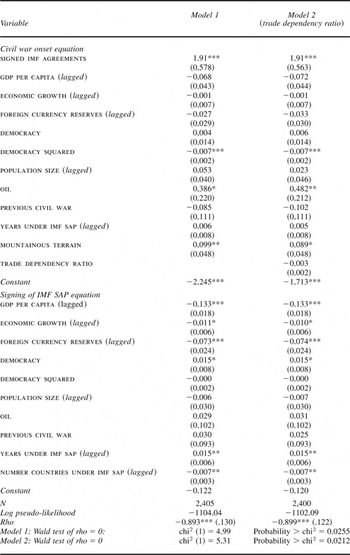
The first-stage results from the bivariate probit model predicting which governments will opt to sign on to an IMF SAP can be found in the bottom half of Model 1 in Table 2. Each of the three economic variables we employ in the model has a statistically significant impact on a country's decision to participate in an adjustment program. Countries with relatively high levels of GDP per capita and of reserves, as well as high rates of economic growth, prove less likely to sign on to IMF programs than do countries with low scores for these measures. This is consistent with the expectation that only countries experiencing an economic crisis are willing to meet the requirements mandated by an SAP.
Bivariate probit estimates

Notes: Robust standard errors, reported in parentheses, are adjusted for clustering over country.
Temporal dichotomous variables included in the analysis but not reported. SAP = structural adjustment program. In two-tailed tests: * p < .10; ** p < .05; *** p < .01.
The positively-signed coefficient for the variable showing the level of democracy (democracy) and the negative estimate for its square provide some evidence that semidemocracies are more likely to sign on to an IMF agreement than other regime types although the latter variable is not statistically significant. The cumulative number of years that countries participate in an SAP of some type proves to have a positive influence on government decisions to sign an agreement with the IMF. We also find that when large numbers of countries have signed on to IMF agreements, governments are dissuaded from seeking help from the institution.
The results of the second stage of the bivariate probit model appear in the top portion of Model 1 in Table 2. This stage of the test reflects the selection-corrected effects of IMF agreements on the onset of civil war. The Wald likelihood ratio test indicates that ρ ≠ 0, meaning that we can reject the null hypothesis that the error terms for our first- and second-stage equations are uncorrelated. The fact that selection bias is a problem for the sample of countries we analyze suggests that the bivariate probit model is the appropriate model specification.
What proves most notable about the results in Model 1 is the support the bivariate probit model provides for the hypothesized relationship between the adoption of IMF SAPs and the onset of civil war. Countries that sign on to an IMF program are more prone to civil war onset than those that do not. The estimated average treatment effect (that is, the effect of the treatment, signing on to an IMF agreement, on civil war onset) is 0.21.Footnote 39
As a means of determining the robustness of our results, we tested a series of alternative specifications of our model. First, we examine whether our results are robust when including additional variables in the analysis. Model 2 in Table 2 includes a new variable reflecting the trade dependency ratio. We include this variable as a means of checking our results against other studies of the economic openness–civil war relationship. As the results make clear, the influence of signed IMF agreements on the onset of civil war is robust to the inclusion of the trade dependency ratio in the model. Although not statistically significant, the negatively-signed coefficient for the trade openness variable lends some support to claims that higher levels of integration into the global trading system can have a dampening effect on the onset of civil war.Footnote 40
Second, we sought to determine whether our results remain robust when employing an alternative data set. We test our model using Hegre and Sambanis's data set.Footnote 41 The results prove statistically and substantively commensurate with those we generate using the Fearon and Laitin data set,Footnote 42 with the signed imf agreements variable proving significant at the p < .05 level.Footnote 43
Third, we address a potential problem posed by the issue of missing data. If certain types of countries—for example, poor, authoritarian countries and/or those that are not under the scrutiny of the IFIs—are the ones most likely to have missing data, civil wars initiated in these countries may well be dropped from the analysis. We deal with this issue by imputing missing values for a variable that has a significant number of missing values: the lagged measure of economic growth.Footnote 44 Use of this technique allows us to increase the number of observations from 2,405 in Model 1 to 2,689. In this revised analysis, the variable indicating whether or not a country has signed an IMF SAP remains a statistically significant predictor of civil war onset. The additional variables in the model that proved significant in the original analysis remain influential in the results for this test as well.Footnote 45
In addition to these tests, we also considered whether the results reported in Model 1 might be shaped by any influential and outlying cases. An analysis of deviance residuals identified Nepal 1997 as an outlier. Exclusion of this case from the model produces no substantive effects.
Conclusion
The results we present in this research note provide support for the claim that governments that adopt an IMF-led path to liberalization are likely to be at greater risk for experiencing the onset of civil war. This finding simultaneously builds on and adds complexity to earlier scholarly claims regarding the hypothesized relationships between economic openness and civil war. The argument that economic openness has some effect on the onset of civil war is premised on the belief that different economic structures—relatively closed economies versus more open economies—produce different sets of winners and losers within societies. What theories relating economic openness to civil conflict have not made clear, however, is why one should expect the mix of winners and losers characteristic of one type of economic structure to be the source of more (or less) civil war than the groups of winners and losers that are typical of the opposing type of economic structure. Rather than focusing on degrees or levels of openness, we contend that the IMF-guided process of liberalization generates new losers at a rate with which a state with weakening powers is incapable of contending. It is as these actors see the opportunity costs of conflict initiation decline that the risk of civil war onset rises.
Ultimately, this study emphasizes the need to identify a means of ensuring that the promotion of two important goals—economic development and civil peace—does not prove antithetical. In light of the problems that may be inherent in the liberalization programs promoted by the IFIs, there is a vital need to identify alternative means of promoting economic growth in states that are often desperate for development. Finding alternatives to the approach to economic liberalization favored by the IMF appears crucial to ensuring the success of efforts to escape the trap of grinding poverty and recurrent conflict in which so many countries find themselves mired.