Expressing emotion is critical to early development. An in-born adaptation, it is the principal means by which infants and young children elicit the caregiving, stimulation, and support essential to their survival and well-being. In the first few years strong expression of both positive and negative emotion is a marker for healthy parent–child relationships and healthy development. In the newborn period it is a sign of optimal neurobehavioral organization (Gunner, Porter, Wolf, Rigatuso, & Larson, Reference Gunner, Porter, Wolf, Rigatuso and Larson1995). With infants and toddlers it is associated with responsive parenting (Braungart-Rieker, Garwood, Powers, & Wang, Reference Braungart-Rieker, Garwood, Powers and Wang2001), secure parent–child attachment (Ahnert, Gunner, Lamb, & Barthel, Reference Ahnert, Gunner, Lamb and Barthel2004; Izard, Haynes, Chisholm, & Baak, Reference Izard, Haynes, Chisholm and Baak1991), and favorable cognitive, language, and emotional development (Gunner et al., Reference Gunner, Porter, Wolf, Rigatuso and Larson1995; Robinson & Acevedo, Reference Robinson and Acevedo2001).
Yet, when parents have depressive symptoms, the emotional communication that normally recruits parenting to the child's benefit may not emerge as it does in other dyads. As their depressive symptoms increase, parents respond less reliably to children's emotions and may actively suppress them (Feng, Shaw, Skuban, & Lane, Reference Feng, Shaw, Skuban and Lane2007; Garber, Braafladt, & Zeman, Reference Garber, Braafladt, Zeman, Garber and Dodge1991; Kochanska, Reference Kochanska1991; Shaw et al., Reference Shaw, Schonberg, Sherrill, Huffman, Lukon, Obrosky and Kovacs2006). As a result, children may learn to inhibit expressions of emotion and related attempts to elicit parents' support (Dix & Buck, Reference Dix, Buck, Campbell and Loving2011; Dix, Stewart, Gershoff, & Day, Reference Dix, Stewart, Gershoff and Day2007; Leadbeater, Bishop, & Raver, Reference Leadbeater, Bishop and Raver1996; Nolen-Hoeksema, Wolfson, Mumme, & Guskin, Reference Nolen-Hoeksema, Wolfson, Mumme and Guskin1995; Seligman, Reference Seligman1975). Over time this inhibition may interfere with parent–child relationships, retard socioemotional development, and contribute to subsequent adjustment problems (Feng et al., Reference Feng, Shaw, Kovacs, Lane, O'Rourke and Alarcon2008; Gianino & Tronick, Reference Gianino, Tronick, Field, McCabe and Schneiderman1988; Kochanska, Reference Kochanska1991). Based on theories of learned helplessness (Seligman, Reference Seligman1975), responsive parenting (Tronick & Gianino, Reference Tronick, Gianino, Tronick and Field1986), attachment (Ainsworth, Blehar, Waters, & Wall, Reference Ainsworth, Blehar, Waters and Wall1978; Cassidy, Reference Cassidy1994), and effectance (Dodge, Reference Dodge1990; Lamb & Easterbrook, Reference Lamb, Easterbrooks, Lamb and Sherrod1981; Leadbeater et al., Reference Leadbeater, Bishop and Raver1996), these ideas constitute what we refer to as the depression–inhibition hypothesis. We examine this hypothesis by addressing three questions: (a) by the second year, do children whose mothers have depressive symptoms inhibit emotional displays that in most dyads activate maternal attention and support? (b) Are their low rates of emotional communication mediated by their mothers' lack of responsiveness, that is, lack of investment in, and support for, children's interests? (c) Are low rates of emotional communication part of a pattern of general inhibition with mothers? In other words, do they reflect simply learned patterns of how specifically to express emotions with mothers or, instead, a general withdrawal from the system of mutual influence that characterizes well-functioning parent–child relationships (Kochanska, Reference Kochanska1997; Maccoby & Martin, Reference Maccoby, Martin, Mussen and Mussen1983).
Parenting in the Early Development and Regulation of Children's Emotional Expression
Emotional expression evolved in humans in part because it elicits the parental care and support infants need to survive (Ainsworth et al., Reference Ainsworth, Blehar, Waters and Wall1978; Izard, Reference Izard1991). Particularly in early development, the extent to which parents respond promptly, consistently, and appropriately to children's expressions of emotion is critical to conceptions of effective parenting. Within attachment theory, such parenting is thought to promote secure parent–child attachment (Ainsworth et al., Reference Ainsworth, Blehar, Waters and Wall1978); within the mutual regulation model, it is thought to promote children's ability to regulate their emotional states and cope with interactive stress (Gianino & Tronick, Reference Gianino, Tronick, Field, McCabe and Schneiderman1988; Tronick & Gianino, 1983); within effectance theory, it is thought to enable children to predict and control important outcomes and thereby promote their sense of competence or efficacy (Bornstein & Lamb, Reference Bornstein and Lamb1992; Lamb & Easterbrooks, Reference Lamb, Easterbrooks, Lamb and Sherrod1981; Lewis & Goldberg, Reference Lewis and Goldberg1969).
Even in the first half-year of life, infants display facial and vocal emotions that reflect their needs and regulate parent–child exchanges to their benefit. Their ability to control their displays of emotion, however, develops gradually. Izard (Reference Izard, Izard, Kagan and Zijonc1984) argues that the emotions children experience and those they express correspond in infancy, but by the end of the first year this changes (Malatesta, Culver, Tesman, & Shepard, Reference Malatesta, Culver, Tesman and Shepard1989). At this point children begin to inhibit expression of some emotions, to express emotion more often in the presence of others than when alone, and to express strong emotion, not indiscriminately, but to familiar others who are likely to respond to children's needs (Malatesta et al., Reference Malatesta, Culver, Tesman and Shepard1989; Stenberg, Campos, & Emde, Reference Stenberg, Campos and Emde1983; Jones & Hong, Reference Jones and Hong2001; Jones & Raag, Reference Jones and Raag1989). These developments mark the emergence of children's effortful control, the ability to inhibit dominant responses in the service of one's goals (Eisenberg, Reference Eisenberg, Hartup and Weinberg2002). This emergence is thought to reflect such developmental factors as awareness of self as distinct from others; implicit knowledge of goals, intentions, and emotions; and brain development, particularly maturation of the anterior cingulate cortex (Brownell & Kopp, Reference Brownell and Kopp2007; Posner & Rothbart, Reference Posner and Rothbart2000; Rothbart, Reference Rothbart, Mayr and Awh2005).
Theories of Mothers' Depressive Symptoms and Children's Expressions of Emotion
Several perspectives have been advanced to account for how and why depressive symptoms in parents may alter the development of children's emotional expression. First, consistent with emotion theories, emotion displays are thought to be linked to the outcomes children obtain. Children should display positive emotion when they get what they want and negative emotion when they do not (Dix, Reference Dix1991; Dix & Branca, Reference Dix, Branca and Kuczynski2003; Field, Reference Field and Bornstein1995; Frijda, Reference Frijda1986; Izard, Reference Izard1991; Lazarus, Reference Lazarus1991). Because depressive symptoms undermine mothers' support for children's interests (Dix, Gershoff, Meunier, & Miller, Reference Dix, Gershoff, Meunier and Miller2004; Downey & Coyne, Reference Downey and Coyne1990; Lovejoy, Graczyk, O'Hare, & Neuman, Reference Lovejoy, Graczyk, O'Hare and Neuman2000), they should reduce the extent to which children get what they want; therefore, children should display less positive and more negative affect. This idea underlies many studies that predict increased negative affect in children of depressed mothers.
Second, children are thought to display emotion based on the emotion displays of their mothers. Researchers have proposed that mothers' depressive symptoms influence children's emotion displays due to a contagion, modeling, or mirroring effect whereby mothers' depressed emotions promote comparable affective displays in children (Field, Reference Field and Bornstein1995; Tronick & Gianino, Reference Tronick, Gianino, Tronick and Field1986). It has been proposed that children display the emotions of their depressed mothers due to “mirroring or imitation” (Tronick & Gianino, Reference Tronick, Gianino, Tronick and Field1986, p. 9), that they “mimic their mothers' discrete expressions” (Field, Reference Field and Bornstein1995, p. 88). Similarly, the emotion displays of children whose mothers have depressive symptoms are thought to be reactions to the emotion displays of their mothers. This has been termed “a contagion effect of negative mood” (Field, Reference Field and Bornstein1995, p. 86). These perspectives imply that children's displays of emotion will resemble those of their depressed mothers; they should display low positive affect and high flat and negative affect.
Third, the depression–inhibition hypothesis, in contrast, proposes that children display emotion based on the reactions they have learned to expect from others. Because depressive symptoms lead mothers to ignore or respond negatively to children's expressions of need or interest, children may reduce their signaling to avoid aversive or unresponsive maternal reactions (Cassidy, Reference Cassidy1994; Dix et al., Reference Dix, Stewart, Gershoff and Day2007; Seligman, Reference Seligman1975; Tronick & Gianino, Reference Tronick, Gianino, Tronick and Field1986). When mothers consistently accept and support children's initiations and displays of emotion, children come to trust mothers, to expect maternal support, and therefore, to display emotion freely. When mothers ignore, punish, or respond insensitively, children become wary of mothers, expect them to respond aversively, and inhibit emotional displays (Ainsworth et. al., Reference Ainsworth, Blehar, Waters and Wall1978; Buss & Kiel, Reference Buss and Kiel2004; Eisenberg, Fabes, & Murphy, Reference Eisenberg, Fabes and Murphy1996; Feng et al., Reference Feng, Shaw, Skuban and Lane2007; Gianino & Tronick, Reference Gianino, Tronick, Field, McCabe and Schneiderman1988). From an attachment perspective, Cassidy (Reference Cassidy1994, p. 235) proposes that insecurely attached children minimize expression of negative emotions in order to minimize the relationship with the mother. This enables children to maintain proximity, and therefore the caregiver's protection, yet avoid the aversive experiences that active contact with insensitive mothers entails. In contrast to modeling-contagion or outcome-linked theories, the depression–inhibition hypothesis emphasizes that children inhibit displays of emotion, both positive and negative, as a means of reducing interaction with unresponsive mothers.
Studies of Mothers' Depressive Symptoms and Children' Emotional Communication
Studies of mothers' depressive symptoms and children's affective displays have been limited for the most part to infants under 1 year and, like the theories developed to understand them, are inconsistent. For positive emotions results are clear: in both the first and second years mothers' depressive symptoms predict low expression of positive emotion in children (Cohn, Matias, Tronick, Connell, & Lyons-Ruth, Reference Cohn, Matias, Tronick, Connell, Lyons-Ruth, Tronick and Field1986; Dix, Cheng, & Day, Reference Dix, Cheng and Day2009; Field, Reference Field1984; Field et al., Reference Field, Hernandez-Reif, Diego, Feijo, Vera and Gil2007; Redding, Harmon, & Morgan, Reference Redding, Harmon and Morgan1990). For negative emotion, some studies in the first year find no relation between depressive symptoms and children's affective displays (Cohn, Campbell, Matias, & Hopkins, Reference Cohn, Campbell, Matias and Hopkins1990; Mertesacker, Bade, Haverkock, & Pauli-Pott, Reference Mertesacker, Bade, Haverkock and Pauli-Pott2004); others report less distress and negative expression during Still-Face interactions and experimenter-manipulated maternal unresponsiveness (Field et al., Reference Field, Hernandez-Reif, Diego, Feijo, Vera and Gil2007; Nadel, Soussignan, Canet, Liver, & Gerardin, Reference Nadel, Soussignan, Canet, Livert and Gerardin2005); yet others report more fussing, anger, and negative affect (Field, Reference Field1984; Field et al., Reference Field, Sandberg, Garcia, Vega-Lahr, Goldstein and Guy1985, Reference Field, Healy, Goldstein, Perry, Bendell, Schanberg, Zimmerman and Kuhn1988, Reference Field, Hernandez-Reif, Diego, Feijo, Vera and Gil2007; Lundy, Field, & Pickens, Reference Lundy, Field and Pickens1996; Pickens & Field, Reference Pickens and Field1993). During the second year the one available study of negative emotion showed that at this age children of mothers in a clinical sample expressed less vocal distress during separation than did children of mothers with no current or prior depression (Dawson, Klinger, Panagiotides, Hill, & Sprieker, Reference Dawson, Klinger, Panagiotides, Hill and Spieker1992). Thus, how mothers' depressive symptoms relate to children's affective expression in the second year is largely unstudied and for negative emotion has been observed only during mother–child separation.
Several aspects of samples and methods may contribute to these diverse findings. First, in the first year inhibition of negative emotion may be limited by immaturity of the cognitive, emotional, and neurological processes it requires (Cohn et al., Reference Cohn, Campbell, Matias and Hopkins1990; Gianino & Tronick, Reference Gianino, Tronick, Field, McCabe and Schneiderman1988). Theories that stress links between emotions and the outcomes children achieve may account for greater fussing and crying by infants of depressed mothers in the first year, but be less successful at predicting the emotions of children who in the second year can now inhibit negative emotion effectively. Second, the depression–inhibition hypothesis suggests that mothers' depressive symptoms should inhibit discrete affective displays, which are those intended to elicit maternal attention, more than undifferentiated, diffuse mood states not directed at mothers for instrumental purposes. Nadel et al. (Reference Nadel, Soussignan, Canet, Livert and Gerardin2005) demonstrated that, when mothers have depressive symptoms, infants display emotions that are weaker, more delayed, and more persistent, that is, more like mood states than momentary affective signals. Children may inhibit discrete negative signals even if their negative moods are evident in other ways. Third, the common practice of rating children's emotions along a continuum from positive to negative implies that as positive emotion increases, negative emotion must decline. These ratings cannot detect reductions occurring in both simultaneously. Fourth, measures that aggregate negative emotions are uninformative about which emotional communications children may inhibit. An emotion of opposition and reduced connection, anger, for example, elicits maternal negativity even from mothers who have no depressive symptoms (Buss & Kiel, Reference Buss and Kiel2004). An emotion of contrition and connection, sadness, in contrast, elicits maternal sympathy and support (Abe & Izard, Reference Abe and Izard1999; Heubner & Izard, Reference Huebner and Izard1988). Depressed or unresponsive mothers may inhibit children's appeals for sympathy (i.e., sadness), but be less successful at inhibiting their expressions of opposition (i.e., anger). These considerations led us to examine the depression–inhibition hypothesis by observing four momentary, discrete facial displays during the second and early part of the third year.
In addition, the depression–inhibition position suggests that mothers' depressive symptoms will predict low rates of child facial emotion primarily when depressive symptoms undermine mothers' support for children's interests. That low support is a basis for the impact maternal depression has on children is widely proposed, but for affective displays has yet to be tested. Low support, depressive symptoms, and child emotions may co-occur, but mediational tests have yet to show that low support is the mechanism by which mothers' depressive symptoms might reduce children's affective displays.
Mothers' Depressive Symptoms and Children's General Inhibition
The depression–inhibition hypothesis implies that reduced emotional communication results from a general withdrawal from an unresponsive mother. This occurs, not because mothers display particular emotions or children obtain particular outcomes in an interaction, but because children come to expect that mothers will fail to respond, or will respond negatively, when children attempt to influence them. This implies that children who inhibit emotional displays should also be less likely to attempt to influence mothers in others ways (e.g., speak less to mothers, involve mothers less in play, engage mothers less to resolve conflict). Although this is as yet untested, mothers' depressive symptoms often do predict general inhibition in children. Children of depressed mothers display right frontal EEG asymmetry, thought to promote withdrawal from aversive stimuli (Field, Reference Field and Bornstein1995; Forbes et al., Reference Forbes, Shaw, Silk, Feng, Cohn, Fox and Kovacs2008). As infants, they display withdrawn-fear reactions to stressful stimuli (Pauli-Pott, Mertesacker, & Beckmann, Reference Pauli-Pott, Mertesacker and Bechman2004), and as toddlers, low exploration and inhibition to the unfamiliar (Kochanska, Reference Kochanska1991). In difficult situations, they tend to tolerate problem conditions passively (Feng et al., Reference Feng, Shaw, Kovacs, Lane, O'Rourke and Alarcon2008; Silk, Shaw, Skuban, Oland, & Kovacs, Reference Silk, Shaw, Skuban, Oland and Kovacs2006). Research on children's behavior specifically with mothers shows that, as toddlers, children of mothers with depressive symptoms initiate less positive interaction (Dix et al., Reference Dix, Cheng and Day2009) and are more passive when their mothers attempt to control them (Dix et al., Reference Dix, Stewart, Gershoff and Day2007; Kuczynski & Kochanska, Reference Kuczynski and Kochanska1990; Kuczynski, Kochanska, Radke-Yarrow, & Girnius-Brown, Reference Kuczynski, Kochanska, Radke-Yarrow and Girnius-Brown1987). In this study we examined whether the tendency for mothers' depressive symptoms to inhibit children's displays of emotion is mediated by children's general withdrawal from interaction with the mother.
This study addressed three predictions at the heart of the depression–inhibition hypothesis. First, in the second year, as mothers' depressive symptoms increase, children will exhibit fewer discrete emotion displays and more unemotional or flat displays when interacting with their mothers. Second, children's discrete displays of emotion should decline to the extent that mothers are unempathic, lack emotional investment in children's interests, and are unsupportive behaviorally. In fact, such low responsiveness should mediate relations between mothers' depressive symptoms and children's low affective communication. Third, children's tendencies to display few discrete emotions with mothers will be associated with tendencies to initiate little positive interaction and to be passive when being controlled by mothers. This general inhibition, in turn, should mediate the relation of mothers' depressive symptoms to children's low affective communication.
Method
Participants
Using birth announcements in the daily newspaper of a midsized city (60%) and advertisements in a widely read weekly paper (40%), we obtained a community sample of 94 mothers and their 14- to 27-month-old children (M = 20 months). Mothers' mean age was 31 years. A total of 41% had completed only high school, 14% had some college, 38% completed college, and 6% had graduate or professional training. Two-thirds worked outside the home (M = 20 hr/week). Ninety percent were Anglo American; 10% were African American. The study was part of a project that examined marital relations; thus, mothers had to be married and living with their husbands or to have lived with the same unmarried partner for more than 6 months (all but five were married). On a categorical scale, average annual family income was between $30,000 and $39,000. On Hollingshead's (Reference Hollingshead1975) index, 39% of families were working class (e.g., unskilled laborers), 40% were middle class (e.g., midlevel business jobs, minor professionals), and 21% were upper middle to upper class (e.g., major business jobs, professionals). Children were equally male and female. For their participation, mothers were paid $15 after a first session; $20 after a second session.
Procedure
Details of the procedures are reported in prior publications (e.g., Dix et al., Reference Dix, Gershoff, Meunier and Miller2004, Reference Dix, Stewart, Gershoff and Day2007, Reference Dix, Cheng and Day2009). Mothers and children interacted for 20 min in a small room that contained objects that required mothers to supervise children closely (e.g., tissues, a jar of candy, wall-mounted paper towels, a pitcher of water). Interactions were divided into three periods. For the first 5 min, the waiting period, mothers completed questionnaires and waited with the child for the experimenter to return with toys. During the free play period that followed, mothers and children played for 10 min with a variety of age-appropriate toys. As the play period began, the experimenter told the mother to try to keep her child from playing with four attractive, “forbidden” toys that were placed along one wall. During a 5-min final clean-up period, the experimenter asked the mother to see if she could get her child to help return the toys to the toy box. To permit detailed facial coding, one camera recorded the child's face close up, a second recorded the mothers' face close up, and a third recorded a global view of the interaction. When clean-up was over, mothers watched a videotape of their interaction, reported second to second the emotions they had experienced, and explained why each emotion had occurred. Finally, they completed depression and empathy questionnaires.
Observational measures
Facial emotion
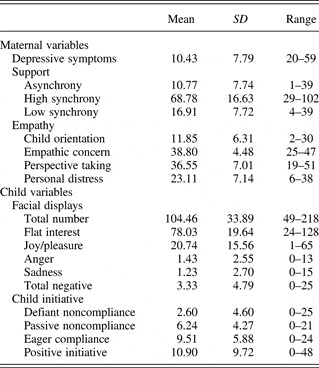
Mothers' and children's facial displays were coded using Izard's AFFEX system (Izard, Dougherty, & Hembree, Reference Izard, Dougherty and Hembree1983). Well validated, the AFFEX system enables coders to combine muscle configurations from two zones of the face to create discrete emotion codes. So that full facial displays can be observed, most research that uses precise facial coding requires children to sit in one place or restricts their movement in other ways, a condition contrary to the inclinations of children of this age. In contrast, we examined facial emotion as children interacted freely with their mothers. This increased the time in which cameras fail to capture a facial image adequate for reliable emotion coding, but enabled us to observe facial displays as they function in normal, relatively common mother–child interactions. To increase capture of facial images, we installed mirrors on the walls of the playroom. This enabled us to code faces reliably when mothers or children were not facing the camera. Children averaged 163 facial codes across the 20-min interaction, 104 (63%) of which were coded as emotions and 58 (36%) of which were obscured. Mothers averaged 155 facial codes, 106 (68%) of which were coded as emotions and 49 (32%) of which were obscured. To ensure that frequency of obscured faces did not bias our results, it was statistically controlled in all analyses.
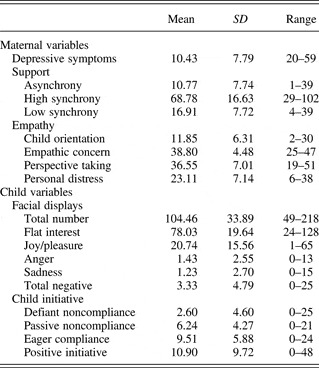
The AFFEX system yields scores for nine emotions. Consistent with prior research (Izard et al., Reference Izard, Fantauzzo, Castle, Haynes, Rayias and Putnam1995), displays of joy (19.86%), sadness (1.18%), anger (1.43%), and what we label flat interest (78.03%; others label this simply “interest”) constituted 98% of children's facial expressions in this study (see Table 1). Few children displayed disgust, surprise, startle, fear, or pain; thus, these displays were not analyzed individually. Disgust, fear, and pain were used, however, when all negative emotions were combined into a total negative emotion score. Following Huebner and Izard (Reference Huebner and Izard1988), we differentiated strong emotional displays (joy, sadness, anger) from control or flat-interest displays. Although as an internal emotional state interest is thought to be positive and to motivate attention and problem solving, as facial communication, interest displays are relatively uninformative; they convey primarily attention. In contrast to anger, joy, and other facial codes, which are characterized by facial tension, flat-interest displays are characterized for the most part by an absence of facial tension (although sometimes a small parting of the lips or slight concentration in the brow is included). For the most part they do not reveal children's positive or negative evaluations of events and do not signal children's intent to attract, resist, or withdraw from mothers. They are less likely to lead mothers to want to act, often eliciting inclinations to ignore, watch, or initiate no action (Huebner & Izard, Reference Huebner and Izard1988). Thus, analyzed in terms of what children's displays communicate to partners, an emphasis in most theories of emotion (Frijda, Reference Frijda1986; Izard, Reference Izard1991; Lazarus, Reference Lazarus1991; Fridlund, Reference Fridlund and Clark1992), flat-interest displays were considered here to be largely noncommunicative and in this sense unemotional. All other displays were considered communicative and emotional.
Descriptive statistics for the study's principal variables
Mothers' supportive behavior
A behavioral code was developed to assess mothers' support for children's interests during free play. Free play was chosen for this measure because it was the time when mothers had not been asked to focus on a parent-oriented agenda, that is, to complete questionnaires (waiting period) or get children to clean up (clean-up period). They could support the child's agenda freely. Every 5 s mothers' behavior was coded into one of five categories (for details, see Dix et al., Reference Dix, Gershoff, Meunier and Miller2004). Her behavior was coded highly synchronous when it was contingent on children's behavior and supported children's immediate interests (e.g., positive comments about child's behavior; supportive reactions to child's comments). It was coded asynchronous when it was either detached from (i.e., different focus of attention), or resisted (e.g., mother attempts to change child's focus), what children were doing. It was coded restrictive when mothers attempted to get children to conform to maternal standards (e.g., “be careful with the toy,” “keep the shovel in the sandbox”). It was coded low synchronous when mothers and children were attending to the same activity, but mothers' actions were not closely connected to children's interests within that activity. Mothers' behavior was coded watching when mothers watched children, but said and did nothing. To assess reliability, three coders examined 20% of the tapes. The code was reliable (k = 0.71). Using principal components factor analysis, we simplified these five categories by obtaining three factors with eigenvalues greater than 1. The first factor, Maternal Support, accounted for 35% of the variance and reflected strong negative loadings on asynchrony (−0.68) and low synchrony (−0.71) and strong positive loadings on high synchrony (0.85). Factor 2 was primarily watching. Factor 3 was primarily restrictiveness. Factors 2 and 3 did not clearly reflect mothers' sensitive or contingent responsiveness and thus were not analyzed.
Children's passivity when being controlled
Adopting a widely used five-category coding system (e.g., Crockenberg & Litman, Reference Crockenberg and Litman1990; Dix et al., Reference Dix, Stewart, Gershoff and Day2007; Kochanska, Tjebkes, & Forman, Reference Kochanska, Tjebkes and Forman1998; Vaughn, Kopp, & Krakow, Reference Vaughn, Kopp and Krakow1984), we assessed children's passivity by examining their reactions when mothers attempted either to get them to clean up during the clean-up period or to avoid forbidden toys in either the play or clean-up periods. These were the bulk of mothers' controls. Agreement across independent coders identifying when controls occurred was 84%. Following each maternal request, children's reactions were observed for 5 s. Four primary codes were used (for details, see Dix et al., Reference Dix, Stewart, Gershoff and Day2007). (a) Willing compliance was coded when children complied willingly, without resistance, or asking mothers to help. (b) Passive noncompliance was coded when children simply ignored mothers' requests. (c) Simple refusal was coded when children matter of factly demonstrated, vocally (e.g., “no”) or by shaking their heads, that they heard the request but would not comply. (d) Defiant noncompliance was coded when children, with assertion, refused mothers' requests. To assess the reliability of the compliance code, three coders examined 23% of the tapes. Agreement among coders was good (k = 0.65). Willing compliance was used to represent children's tendencies to comply with mothers. Two codes, passive noncompliance and defiant noncompliance, reflected either a passive or an assertive response when children did not want to comply. Given that the two scores reflecting the active–passive aspect of noncompliance were strongly related, B (0.699) = −3.27, p < .001, a single score reflecting passivity in reaction to control was created by subtracting defiant noncompliance from passive noncompliance.
Children's positive initiative
Children's positive initiative was examined across the entire 20-min interaction in sequences that began with children smiling at mothers. Examining smile-related interactions enabled us to measure tendencies to initiate contact with mothers at moments when children were focused on the mother and not fully and independently absorbed with toys (for details, see Dix et al., Reference Dix, Cheng and Day2009). First, using AFFEX facial coding (Izard et al., Reference Izard, Dougherty and Hembree1983), we recorded onset times for joy displays. Second, for 20 s following children's smiles, we examined whether in each 5-s interval children initiated positive contact with mothers spontaneously. Positive initiations were acts that indicated the child's interest in interacting with the mother, such as showing her toys or commenting on a toy. To be coded as positive initiations, behaviors could not be pulled from children either by their need for mothers' help or by mothers' asking for or encouraging interaction. Rather, initiations were actions intended to include mothers when behavior toward mothers was optional and of no instrumental value. They occurred, for example, when mothers were watching, attending elsewhere, or commenting on events (but not suggesting actions or asking questions). One-fourth of the tapes were coded by at least two coders. Agreement for coding initiations was good (k = 0.80).
Maternal report measures
Mothers' depressive symptoms
Mothers completed the Center for Epidemiological Study Depression Inventory (CES-D; Radloff, Reference Radloff1977). The CES-D elicits ratings of the extent to which 20 statements characterized mothers over the last week (e.g., “I had crying spells,” “My sleep was restless,” “I felt lonely”). The scale had excellent internal consistency in this sample (α = 0.84) and in other samples demonstrates good split-half reliability (0.78) and Spearman–Brown reliability (0.88). It distinguishes psychiatric from normal populations and is correlated with measures of psychopathology and negative affect (Radloff, Reference Radloff1977). Participants completed the CES-D at the end of the first session. Scores were similar to those obtained in other nonclinical samples. The mean depression score was 10.43 (SD = 7.74), with 20% of mothers reporting symptoms that were clinically significant (>16; see Radloff, Reference Radloff1977).
Mothers' child orientation
The extent to which mothers were emotionally invested in outcomes occurring to children was assessed by having mothers review videotapes of their interaction. They placed their hand on an emotion dial and moved the dial to correspond to each change in their emotional state (for details, see Dix et al., Reference Dix, Gershoff, Meunier and Miller2004). The dial depicted 11 points from −5 (extreme negative emotion) to 0 to +5 (extreme positive emotion). Each time mothers moved the dial the experimenter paused the tape, asked which of six basic emotions best described what they were feeling at this point in the interaction, and why. The six emotions corresponded to those stressed in Izard's emotion coding scheme that tend to occur in parent–child interactions (worry–fear, anger–irritation, sadness–disappointment, guilt, joy, interest). Mothers' explanations for why they experienced particular emotions were coded as either parent oriented or child oriented. Emotions were parent oriented when caused by outcomes occurring, or of primary interest, to the parent (e.g., “I was angry that he wouldn't do as I asked”). Emotions were child oriented when caused by outcomes occurring, or of primary interest, to the child (e.g., “I was worried that he wouldn't find a toy he liked”). Reliability across four coders was high (κ = 0.86).
Maternal empathy and empathic distress
To measure dispositional empathy, we had mothers complete Walker's (Reference Walker1993) parent-specific version of Davis's (Reference Davis1983) Interpersonal Reactivity Index (IRI). This instrument is the IRI reworded, with references to “people” or “others” replaced with references to “your child.” Like the IRI, it measures three aspects of empathy. (a) Empathic concern is the tendency to report empathic emotions (e.g., “When my child is having a bad day, I feel sorry for him/her”). (b) Perspective taking is the tendency to report seeking to understand the child's point of view (e.g., “Before I make a decision, I try to look at my child's point of view”). (c) Personal distress is the tendency to report negative emotions related to the child that are self-oriented (e.g., “When my child is sick or hurt, I feel apprehensive and ill at ease”). The parent version of the IRI yielded alphas of 0.77 for personal distress, 0.58 for empathic concern, and 0.77 for perspective taking. Prior data show that the perspective taking and empathic concern scales correlate with Water's Attachment Q-Sort and that the personal distress scale correlates with the total score of the Children's Behavior Checklist (Walker, Reference Walker1993). The original IRI has demonstrated validity when used with parents (Hastings & Grusec, Reference Hastings and Grusec1998; Kochanska, Reference Kochanska1997). Using principal components factor analysis, we simplified data from this measure by obtaining two factors with Eigenvalues greater than 1. The first factor, which we will call simply Empathy, accounted for 44% of the variance and reflected strong positive loadings on empathic concern (0.73) and perspective taking (0.87). The second factor, which we will call Empathic Distress, reflected strong loadings on personal distress (0.91) and empathic concern (0.56).
Demographic factors
Five demographic factors were used as control variables: child age, child sex, yearly family income, socioeconomic status (SES), and years of formal education completed by the mother. Hollingshead's (Reference Hollingshead1975) four-factor system was used to assess SES.
Results
Preliminary analyses
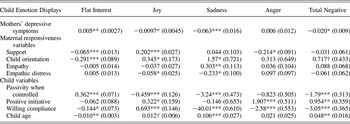
Descriptive statistics for the study's principal variables are presented in Table 1. Of primary interest, data on children's facial emotion showed that across the 20-min interaction children revealed a mean of 104 facial displays. About three-quarters were unemotional (flat interest) and one-quarter emotional (joy, anger, or sadness). Most emotional displays were joy. Displays of anger and sadness were less frequent, with 54% and 63% of children displaying no anger and sadness, respectively, in the 20-min observation. As shown in Table 2, children's facial displays were related to children's ages. The older children were, the less they displayed flat interest and the more they displayed sadness, joy (marginally), and overall negative affect. Maternal behavior during the interaction tended to be supportive. Children's reactions to being controlled were about equally compliant and noncompliant, with passive noncompliance the most common form of noncompliance. For most nonfacial data, interrelations among these variables are reported in detail in prior publications (Dix et al., Reference Dix, Gershoff, Meunier and Miller2004, Reference Dix, Stewart, Gershoff and Day2007, Reference Dix, Cheng and Day2009). These showed that (a) the two nonfacial behaviors that reflect inhibition, children's low positive initiative and passivity when being controlled, were significantly related (Dix et al., Reference Dix, Stewart, Gershoff and Day2007); (b) mothers' depressive symptoms predicted low child orientation and low behavioral support in mothers (Dix et al., Reference Dix, Gershoff, Meunier and Miller2004); and (c) mothers' depressive symptoms and low behavioral support predicted low positive initiative and high passivity in children (Dix et al., Reference Dix, Stewart, Gershoff and Day2007, Reference Dix, Cheng and Day2009). New to this article, bivariate analyses of empathy-related variables showed that, child orientation and maternal support were unrelated to empathy, B = 0.0568 (0.0368), p > .12, and −0.1290 (0.1148), p > .26, respectively; and empathic distress, B = −0.0045 (0.0340), p > .89 and B = −0.0070 (0.1054), p > .94, respectively; whereas depressive symptoms predicted empathic distress, B = 0.0368 (0.0146), p < .05, but not empathy, B = −0.0202 (0.0136), p > .14.
Bivariate relations between child facial displays and principal independent variables

Notes: Entries are unstandardized regression coefficients with standard errors in parentheses. Tests included child age, child sex, income, socioeconomic status, maternal education, and number of obscured facial images as controls.
†p < .10. *p < .05. **p < .01. ***p < .001.
Overview of analyses
Because facial emotions were counts and predictably skewed, we used Poisson regression analyses, the benchmark model for the analysis of count data (Cameron & Trivedi, Reference Cameron and Trivedi1990). In each analysis we controlled for amount of time interactions for each dyad were observed, which in the statistical package we used (STATA) is done with an exposure correction. The result is an analysis in which the log of the rates of the dependent variable are predicted by the independent variables.
To assess relations when unconstrained by other predictors, we first did bivariate tests. We predicted each child facial display from each independent variable with all control variables in the equation. Bivariate analyses were followed by a series of hierarchical regressions. These showed which variables predicted child facial displays independent of others and which mediated relations between mothers' depressive symptoms and child facial displays. For each analysis, as additional variables were added, we examined whether overall predictability of facial displays improved and whether coefficients for depressive symptoms declined.
Because depressive symptoms were our principal focus, they were entered in Block 1 in all analyses. However, given our relatively small sample, we could not include all other predictors within a single analysis. Number of predictors in each analysis was reduced, first, by including only control variables that significantly predicted the dependent variable and, second, by dividing analyses into two principal sets, each followed by a secondary or follow-up analysis. Beyond demonstrating that depressive symptoms in mothers are related to children's inhibition of emotion, our first priority was evaluating maternal responsiveness variables as possible mediators of these relations. The first principal set of regressions included all maternal responsiveness variables (i.e., maternal support, child orientation, empathy, empathic distress) as predictors of child facial displays and potential mediators of the relation of mothers' depressive symptoms to children's facial displays. To eliminate the alternate hypothesis that mothers' facial displays, rather than their responsiveness, were the principal mediators of such relations, we performed a follow-up analysis that evaluated whether maternal facial expressions could explain the effects observed in the principal analysis. Our second priority was to determine if children's general tendencies to inhibit behavior with mothers were related to their inhibition of facial emotions and mediated the relation of their facial displays to mothers' depressive symptoms. Thus, our second set of hierarchical regressions included all child predictors (i.e., children's positive initiative and passivity) as predictors of children's facial displays and possible mediators of the relation of mothers' depressive symptoms to these displays. To eliminate the alternate hypothesis that children's facial displays, particularly during compliance-related interactions, were responsible for depression–inhibition relations, we performed a follow-up regression analysis in which facial displays were controlled when examining the relation of mothers' depressive symptoms to children's passivity.
In all analyses, we first examined flat-interest displays. These indicated the extent to which children displayed relatively flat, uncommunicative (vs. emotional) facial configurations. Analyses of more strongly emotional displays (joy, anger, sadness) revealed which specific emotions were related to mothers' depressive symptoms, mothers' responsiveness, and children's behavioral inhibition. When coefficients for depressive symptoms were reduced by the addition of other predictors, hierarchical regressions were followed by tests of mediation. Using procedures outlined initially by Baron and Kenny (Reference Baron and Kenny1986), we use the term mediation when (a) addition of a mediating variable reduced the relation of mothers' depressive symptoms to children's affective displays, (b) the mediator significantly predicted these displays independent of depressive symptoms, and (c) Sobel tests verified that changes due to the addition of the mediator were statistically significant.
Depressive symptoms and responsiveness in mothers as predictors of children's facial displays
Bivariate analyses
Table 2 presents bivariate relations between children's facial displays and their mothers' depressive symptoms and responsiveness. Except for anger, all relations between depressive symptoms and children's facial displays were significant. As mothers' depressive symptoms increased, children, as predicted, displayed more flat interest and less joy, sadness, and overall negative emotion. Also as predicted, the more mothers' were high on maternal responsiveness variables, the more children displayed facial emotion. Of 16 primary relations, 9 were statistically significant; 8 of these demonstrated that children expressed more emotion when mothers' were high in responsiveness. The one exception was that, as mothers' support increased, children expressed less, not more, anger.
Multivariate analyses
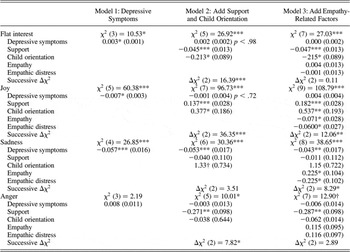
To assess whether maternal responsiveness variables (mothers' empathy, child orientation, and behavioral support) mediated relations between depressive symptoms and children's displays of emotion, four hierarchical regression analyses were preformed, one for each child facial display. In Block 1 depressive symptoms and significant controls were included; in Block 2, maternal responsiveness variables from the interaction were added (i.e., support, child orientation); in Block 3, the two factors from the empathy questionnaire were added. Results are presented in Table 3.
Hierarchical regression analyses predicting children's facial emotion from maternal variables

Note: Entries are unstandardized regression coefficients with standard errors in parentheses. Analyses included child age, child sex, income, socioeconomic status, and maternal education as controls only when these predicted dependent variables in bivariate tests. All analyses controlled for the amount of obscured facial images.
†p < .10. *p < .05. **p < .01. ***p < .001.
When predicting flat-interest displays, Block 1 relations between mothers' depressive symptoms and children's flat interest were eliminated when maternal support and child orientation were added in Block 2, whereas maternal support and child orientation predicted children's low rates of flat-interest displays independent of depressive symptoms and of each other. The addition of these responsiveness variables reduced the relation of depressive symptoms to flat-interest displays by more than half, taking its level of statistical significance from p < .05 to > .90. Sobel tests suggested that both maternal support (Sobel = 2.23, p < .05) and child orientation (Sobel = −1.94, p < .053) mediated the relation of depressive symptoms to flat-interest displays. This pattern suggests that mothers' depressive symptoms predicted children's flat-interest facial displays because depressive symptoms were associated with low maternal support and child orientation. Adding empathy and empathic distress in Block 3 did not improve overall fit.
For children's displays of joy, the significant Block 1 relation of mothers' depressive symptoms to children's low expressions of joy was no longer significant when maternal support and child orientation were added in Block 2, whereas maternal support and child orientation predicted displays of joy independent of depressive symptoms and each other (child orientation only marginally). The addition of these responsiveness variables reduced the relation of depressive symptoms to joy displays by more than two-thirds, taking its level of statistical significance from p < .05 to p > .90. Sobel tests suggested that maternal support (Sobel = −2.59, p < .01) and, marginally, child orientation (Sobel = −1.75, p < .08) mediated the relation of depressive symptoms to children's infrequent displays of joy. This pattern suggests that mothers' depressive symptoms predicted low facial joy in children because they were associated with low support and child orientation. Adding empathy-related factors in Block 3 significantly improved overall fit and demonstrated that empathic distress in mothers predicted infrequent displays of joy in children independent of mothers' depressive symptoms and other maternal variables. Contrary to prediction, empathy predicted fewer displays of joy. Because the relation of depressive symptoms to displays of joy did not decrease in Block 3, neither empathy-related factor could have mediated relations between depressive symptoms and infrequent displays of joy.
The relation of mothers' depressive symptoms to few displays of child sadness observed in Block 1 declined very little when maternal support and child orientation were added in Block 2. Furthermore, although mothers' child orientation marginally predicted frequent displays of sadness in their children, the addition of the Block 2 maternal responsiveness variables did not significantly improve the overall fit of the model. In Block 3 the addition of the two empathy factors did improve the overall model and was accompanied by a drop in the relation of depressive symptoms to children's displays of sadness. Sobel tests suggested that empathy did not mediate this drop (Sobel = 0.54, p < .59), but that, marginally, empathic distress did (Sobel = −1.70, p < .09). Results from Block 3 demonstrated that, as empathy increased and empathic distress declined, children displayed significantly greater facial sadness independent of maternal support, child orientation, and depressive symptoms.
Children's displays of anger were unrelated to mothers' depressive symptoms (Block 1). The addition in Block 2 of maternal support and child orientation improved fit and contrary to prediction, demonstrated that, independent of depressive symptoms, children whose mothers were high in maternal support displayed less, not more, anger. Adding the two empathy factors in Block 3 did not improve fit and showed no relation of empathy or empathic distress to children's displays of anger.
In summary, mothers high in depressive symptoms had children who displayed more flat interest and less joy, sadness, and overall negative emotion. Variables related to maternal responsiveness tended to predict high rates of facial emotion in children and, for displays of flat interest and joy, low maternal support and child orientation appeared to mediate the decline in these facial displays as mothers' depressive symptoms increased. Empathy predicted more frequent displays of sadness, and empathic distress predicted fewer displays of both sadness and joy. However, little evidence supported the hypothesis that these variables mediated maternal depression–child emotion relations. There were two principal exceptions to the tendency for maternal responsiveness variables to predict greater expression of emotion in children. As maternal support declined, children expressed more, not less, anger, and as empathy increased, children expressed less, not more, joy.
Follow-up tests: Examining mothers' facial displays
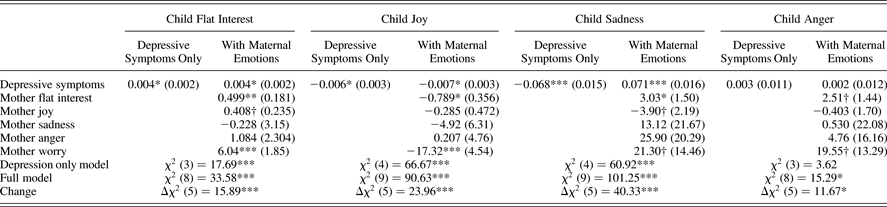
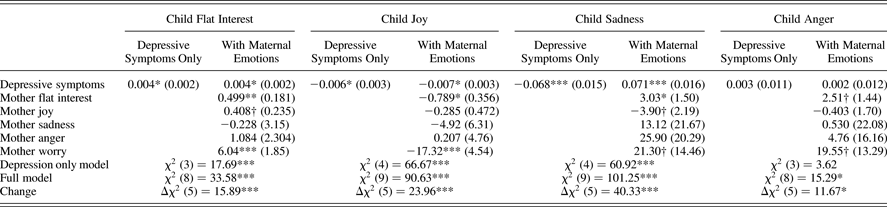
To determine whether mothers' facial displays account for the relation of their depressive symptoms to children's facial displays, as implied by contagion and modeling theories, we did a follow-up analysis that included the emotion displays of mothers. We performed four hierarchical regressions, one for each child facial display. In Block 1 mothers' depressive symptoms were entered with significant control variables; in Block 2 all five maternal affective displays were added. This enabled us to determine whether the total pattern of emotions expressed by mothers reduced the relation of depressive symptoms to children's displays and therefore could potentially be seen to mediate this relation. The results are presented in Table 4.
Relation of mothers' depressive symptoms to children's emotion displays with and without mothers' emotion displays entered as predictors
Note: Entries are unstandardized regression coefficients with standard errors in parentheses. Analyses included child age, child sex, income, socioeconomic status, and maternal education as controls only when these predicted dependent variables in bivariate tests. All analyses controlled for the amount of obscured facial images.
†p < .10. *p < .05. **p < .01. ***p < .001.
For each child emotion display, significant changes in chi squares from Block 1 (depressive symptoms only) to Block 2 (depressive symptoms and all maternal emotions) demonstrated that mothers' affective displays improved the prediction of children's displays over and above mothers' depressive symptoms. However, for each child display that was related to mothers' depressive symptoms, the relation of depressive symptoms to the child's displays increased, rather than declined, when maternal emotion displays were added (the one exception, child anger, was unrelated to mothers' depressive symptoms in bivariate tests). Thus, mothers' emotion displays predicted children's emotion displays, but were not responsible for relations between mothers' depressive symptoms and any child affective display.
Mothers' depressive symptoms and children's passivity and positive initiative in the prediction of children's facial displays
Bivariate analyses
Our second principal focus was determining whether mothers' depressive symptoms predicted the inhibition of emotion displays in young children because these symptoms promote general behavioral inhibition in children. Table 2 presents bivariate relations between child facial displays, passivity, and positive initiative. As predicted, children's passivity when being controlled by mothers predicted their low expression of emotion, specifically, high rates of flat interest and low rates of joy, sadness, and overall negative emotion. Children's low positive initiative was also associated with low expression of emotion, specifically, low joy, low anger, and low overall negative emotion.
Multivariate analyses
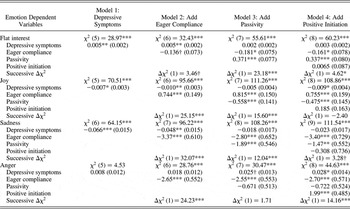
To assess whether relations between mothers' depressive symptoms and children's displays of emotion were mediated by children's passivity and low positive initiative, four sets of regression analyses were undertaken, one for each child display. For each set Block 1 examined the relation of children's affective displays to mothers' depressive symptoms and control variables. In Block 2 eager compliance was added. This enabled us to control for children's general tendencies to cooperate with parental requests when evaluating their positive initiative and passivity when not cooperating. In Block 3 we added passivity; in Block 4, positive initiation. Results are presented in Table 5.
Hierarchical regression analyses predicting child facial emotion from their initiative and passivity

Note: Entries are unstandardized regression coefficients with standard errors in parentheses. Analyses included child age, child sex, income, socioeconomic status, and maternal education as controls only when these predicted dependent variables in bivariate tests. All analyses controlled for the amount of obscured facial images.
†p < .10. *p < .05. **p < .01. ***p < .001.
The relation of mothers' depressive symptoms to children's flat-interest displays evident in Block 1 actually increased slightly when eager compliance was added in Block 2. Thus, although compliant children exhibited fewer flat-interest displays (evident particularly in Blocks 3 and 4), compliance did not mediate the relation of depressive symptoms to children's flat-interest displays. When added in Block 3, children's passivity when being controlled predicted flat-interest displays independent of mothers' depressive symptoms and eliminated the relation of depressive symptoms to these displays. This relation was cut by two-thirds and went from being significant at p < .01 to > .38. A Sobel test verified that mediation was significant (Sobel = 2.69, p < .01). This patterns demonstrates that mothers' depressive symptoms predicted flat-interest displays in children because depressive symptoms were associated with children's behavioral passivity and infrequent attempts to influence mothers during interactions in which such attempts are common. Adding positive initiative in Block 4 improved fit, but positive initiation itself was not a significant independent predictor of flat-interest displays.
The relation of mothers' depressive symptoms to children's low facial joy evident in Block 1 increased when willing compliance was added in Block 2. Thus, although compliant children expressed more facial joy, compliance did not mediate the relations of depressive symptoms to low joy. When added in Block 3, passivity when being controlled predicted low facial joy and eliminated the relation of mothers' depressive symptoms to children's infrequent displays of joy. The coefficient for depressive symptoms dropped by about half and went from being significant at p < .01 to > .17. A Sobel test demonstrated that passivity mediated the relation of mothers' depressive symptoms to low child joy (Sobel = −2.51, p < .05). Thus, the relation of mothers' depressive symptoms to children's low expression of joy occurred because depressive symptoms were associated with children's passivity. Adding positive initiative in Block 4 did not improve fit.
Analysis of children's sad displays showed that, as mothers' depressive symptoms increased, sad displays declined (Block 1). When added in Block 2, children's willing compliance predicted low facial sadness independent of depressive symptoms and reduced the relation of depressive symptoms to low sadness. Although depressive symptoms still predicted children's facial sadness (p < .01), eager compliance did in part mediate the relation of depressive symptoms to children's sad displays (Sobel = −2.58, p < .01). When added in Block 3, children's passivity predicted infrequent displays of sadness and eliminated the relation of depressive symptoms to low sadness. This relation was reduced by more than half from Block 2 and went from being significant at p < .01 to > .29. A Sobel test verified that this mediation was significant (Sobel = −2.37, p < .02). This pattern suggests that infrequent sad displays by children of mothers high in depressive symptoms occurred because depressive symptoms predicted children's passivity. Adding positive initiative in Block 4 improved fit only marginally.
Analysis of children's facial anger demonstrated that it was unrelated to mothers' depressive symptoms (Block 1). Adding compliance in Block 2 and positive initiative in Block 4 each improved fit. Children displayed low facial anger when they were generally compliant and low in positive initiative. Furthermore, when children's compliance, positive initiative, and passivity were controlled (Block 4), mothers' depressive symptoms predicted greater facial anger in children.
Follow-up tests: Examining child facial emotion as potential mediators
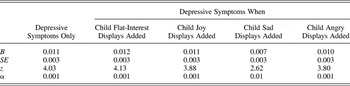
One possible explanation for the mediational role of passivity in these effects is that children expressed different emotions specifically during compliance-related interactions. Suppressed facial displays might be due, not only to general passivity or inhibition with the mother, but to facial displays being suppressed during defiant noncompliance, and flat-interest displays occurring at high rates during passive noncompliance. Were this the case, facial displays should account for or mediate the relation of mothers' depressive symptoms to children's passivity. To examine this, we performed a follow-up analysis. In four hierarchical regressions, one for each child emotion display, children's passivity was predicted from mothers' depressive symptoms, with child facial displays examined as potential mediating variables. In Block 1 passivity was predicted by control variables and mothers' depressive symptoms. In Block 2 we added a child's facial display. Results are presented in Table 6. Adding child facial displays in Block 2 did not substantially change the size and significance of the relation of mothers' depressive symptoms to children's passivity. Furthermore, in each case mothers' depressive symptoms predicted children's passivity independent of the emotions children displayed. This is in contrast to mediational analyses reported above in which no relation between depressive symptoms and children's emotion displays was independent of children's passivity. The only notable change in these coefficients occurred when sad displays were examined as mediators: sadness reduced the relation of depressive symptoms to children's passivity, but even in this case that relation remained significant. This pattern supports the view that children of mothers with depressive symptoms expressed relatively few emotions facially due to general inhibition or passivity and provides no evidence that facial displays that accompany compliance-related interactions account for these relations.
Relations between mothers' depressive symptoms and children's passivity when depressive symptoms are entered alone or in combination with children's affective displays

Note: Regression coefficients are unstandardized. Tests included child age, child sex, income, socioeconomic status, maternal education, and amount of obscured facial images as controls.
Discussion
Using microanalytic coding of children's facial movements, the responsiveness of mothers' affect and behavior, and children's passivity and initiative, this study evaluated whether in the second and early parts of the third year mothers' depressive symptoms suppress children's discrete displays of both positive and negative emotion. For the most part the findings are consistent with the depression–inhibition hypothesis and the three proposals that guided the research. First, at this age children of mothers with depressive symptoms displayed less facial emotion and thus communicated their ongoing needs, interests, and reactions to events less than other children. Four of five possible relations between depressive symptoms and child emotion displays were significant, and all demonstrated inhibition of facial communication (see Table 2). Second, children displayed relatively few emotions when their mothers were low in emotional and behavioral support. Furthermore, mediational tests demonstrated that mothers' depressive symptoms predicted low emotional expression in children (high flat interest and low joy) because depressive symptoms were associated with low maternal behavioral support and low emotional investment in children's interests (low child orientation). Third, in bivariate tests children's passivity and low positive initiative predicted tendencies to display few facial emotions. Furthermore, mediational tests demonstrated that mothers' depressive symptoms predicted low emotional expression (high flat interest, low joy, low sadness) primarily because depressive symptoms were associated with children's behavioral passivity. In contrast to the importance of maternal responsiveness and child passivity, mothers' facial emotions did not mediate relations between mothers' depressive symptoms and children's facial displays. This patterns is consistent with the proposal that low rates of child facial emotion as mothers' depressive symptoms increase result, not from mothers' emotional displays or the outcomes children obtain when interacting with mothers, but rather from a general reduction in those child behaviors that engage mothers and solicit their support.
Mothers' depressive symptoms and responsiveness in the prediction of children's facial affect
The relation of mothers' depressive symptoms to low rates of facial communication observed here with discrete facial coding is consistent with several studies that have examined global ratings of negativity and positivity in the second and third years. Previous research demonstrates that, as mothers' depressive symptoms increase, children of this age display less positivity (Field, Reference Field1984; Redding at al., Reference Redding, Harmon and Morgan1990) and in one clinical sample, less vocal distress upon separation from the mother (Dawson et al., Reference Dawson, Klinger, Panagiotides, Hill and Spieker1992). The present findings suggest that in the second year inhibition of both positive and negative emotion may be fairly general and can occur even when depressive symptoms are relatively mild. In this study it was observed in a nonclinical sample during ordinary play and clean-up interactions. This inhibition is occurring during a developmental period when for most children agency, initiative, and resistance to parental control are increasing (Brownell & Kopp, Reference Brownell and Kopp2007; Dix et al., Reference Dix, Stewart, Gershoff and Day2007; Dunn & Munn, Reference Dunn and Munn1987) and, as our data suggest, facial displays of emotion, themselves, may be increasing. Furthermore, the findings suggest that, as mothers' depressive symptoms increase, children do not inhibit all emotion; they appeared to inhibit joy and sadness, but not anger. By suppressing communication of emotion, children may become less able to elicit social input matched to their ongoing needs and may make it more difficult for mothers to understand from moment to moment the needs and states of action readiness of their children. Inhibiting emotion displays may often be adaptive with depressed and unresponsive mothers. However, if generalized to other partners, it may contribute to unresponsive and poorly coordinated social interactions and problems in children's emerging social competence.
Attachment, learning, and autonomy-related theories all imply that mothers' depressive symptoms should inhibit children's displays of emotion, and each does so by positing that the unresponsiveness characteristic of these mothers promotes negative expectations in children about the mother's likely response to children's attempt to elicit support. To date, however, empirical demonstration that low maternal responsiveness is responsible for the relation of mother's depressive symptoms to children's affective communication has not been tested directly. Our data demonstrate such mediation for two components of maternal responsiveness: (a) mothers' behavioral support for children's interests mediated the relation of mothers' depressive symptoms to both children's flat interest and their low joy displays, and (b) mothers' low emotional investment in the child's ongoing interests (low child orientation) appeared to mediate the relation of mothers' depressive symptoms to children's displays of flat interest and, marginally, low joy. The data support the proposal that it is depression's tendency to undermine mothers' empathic emotion and behavioral support for children's concerns that leads children to reduce the emotion displays that communicate these concerns.
One implication of this mediation is that mothers' depressive symptoms may have modest effects on their children's inhibition if reasonable levels of maternal responsiveness can be maintained. As noted by the National Institute of Child Health and Human Development (NICHD) Early Child Care Research Network (NICHD, 1999) and other researchers (e.g., Nolen-Hoeksema et al., Reference Nolen-Hoeksema, Wolfson, Mumme and Guskin1995; Teti, Gelfand, & Pompa, Reference Teti, Gelfand and Pompa1990), the impact of depressive symptoms on parenting is highly variable. Consider that in our sample, six (23%) mothers in the top third on depressive symptoms were nonetheless in the top third on maternal support; nine were in the top half. Our mediational analyses imply that, although high in depressive symptoms, these mothers had children who were probably expressing emotion and initiating behavior in ways likely to maintain the relationship and mitigate subsequent inhibition-related problems. Dix and Meunier (Reference Dix and Meunier2009) argue that, when depressive symptoms emerge, parents who are skilled at interacting with children may be able to maintain reasonable levels of responsive behavior, whereas parents who are unskilled may not. Research on moderating factors such as these holds promise for specifying when mothers' depressive symptoms are most likely to have adverse effects on children's initiative and emotional communication and how these effects might be minimized.
The findings did not support proposals that mothers' depressive symptoms predict children's affective displays because children model or mirror their mothers' affect or are affected more or less directly by mothers' affective displays. Adding mothers' facial displays to regression models typically increased, rather than reduced, relations between depressive symptoms and children's low facial communication, and these relations were significant even when controlling for all maternal facial displays. Furthermore, most proposals related to mothers' affective displays imply that, as mothers' depressive symptoms increase, children should express more negative emotion, whereas less negative emotion was observed here.
The findings also failed to support the idea that the outcomes children are obtaining control the facial emotions they display. The pattern of children's facial displays when mothers had depressive symptoms did not correspond to reasonable inferences about whether children were achieving, or failing to achieve, desired outcomes. As their depressive symptoms increased, mothers in this sample were more restrictive, experienced more parent- and less child-oriented emotion, and were less supportive and responsive (Dix et al., Reference Dix, Gershoff, Meunier and Miller2004). Given the difficulty children of this age have obtaining desired outcomes without parental assistance, the children of mothers with depressive symptoms must certainly have obtained the outcomes they sought less than other children. Yet they expressed fewer, not more, negative emotions. This may have occurred because, despite experiencing more negative emotion, they inhibited its expression. Consistent with this possibility, Ahnert et al. (Reference Ahnert, Gunner, Lamb and Barthel2004) found that early in the second year insecurely attached infants, common in samples of mothers' with depressive symptoms, expressed fewer negative emotions during separation than did securely attached infants, but had higher levels of the stress hormone cortisol (see also, Field et al., Reference Field, Healy, Goldstein, Perry, Bendell, Schanberg, Zimmerman and Kuhn1988). It is also possible, of course, that even the experience of emotion may at times be blunted. In either case children's displays of emotion appeared to depend more on maternal variables likely to predict expectations about their mothers' response to these displays than on variables related to whether children were obtaining positive or negative outcomes in the interaction.
Although relations between mothers' depressive symptoms and children's expressions of emotion were generally consistent with the depression–inhibition perspective, two findings were not. First, high maternal support was associated with low, rather than high, child anger. This may have occurred simply because, unlike sadness, anger is an emotion of opposition, not support, and supportive mothers give children fewer reasons to oppose them. This could also explain why, in contrast to the absence of depression–anger relations in most analyses, children displayed more anger as mothers' depressive symptoms increased when levels of compliance and passivity were controlled. Second, empathy predicted fewer, rather than more, displays of joy when depressive symptoms and child-orientation were controlled? This is difficult to understand. We can speculate that, when mothers are highly sensitive to children's perspectives, they may often promote children's interests without children needing to display positive signals to elicit that support. We suspect, however, that this finding is due simply to chance variation in the data.
Children's passivity and initiative in the prediction of children's facial affect
In a standard compliance task children who displayed few facial emotions were passive in response to maternal control. Bivariate tests showed that they also initiated relatively few positive interactions, although except when predicting children's facial anger, this relation was not independent of passivity. Mediational analyses demonstrated that mothers' depressive symptoms predicted children's flat-interest displays, low joy, and low sadness primarily because depressive symptoms were associated with children's behavioral passivity. This is not predicted by analyses that view children's facial displays as behavior modeled from the displays of depressed mothers or as expressions of whether children's interests are promoted in the interaction. Rather, the findings suggest that inhibition of emotion displays is part of a general adaptation in which children of mothers with depressive symptoms suppress actions that in other dyads involve and mobilize mothers' attention and support.
This is consistent with research on mother–child attachment. Attachment studies shows that children of unresponsive mothers are at risk for developing avoidant attachments and that avoidant children in turn display both low facial emotion and relatively passive behavior upon reunion with their mothers (Cassidy, Reference Cassidy1994). Because facial displays are critical to eliciting and coordinating parent–child interaction, their suppression may be a key second to second process that leads inhibition to undermine child development. That is, the data show how at a microanalytic level the inhibition associated with mothers' depressive symptoms may function to reduce second to second facial communication and, therefore, the likelihood that mother–child exchanges will be frequent, well coordinated, and responsive to children's needs. As inhibition increases, the relative absence of facial signaling may undermine children's ability both to control events to their benefit and to participate in mutually responsive relationships that in most dyads promote a range of developmental competencies (Kochanska, Reference Kochanska1997; Maccoby & Martin, Reference Maccoby, Martin, Mussen and Mussen1983).
Limitations
The study has notable limitations. First, like most observational studies, it did not examine twin pairs or extract genetic markers. We cannot determine whether genetic similarity between mothers and children contributed to relations between parent and child variables. Genetics may predispose children of mothers with depressive symptoms to inhibit emotion or to experience or express particular patterns of emotion. Note, however, that because mothers' depressive symptoms predicted fewer, not more, displays of negative emotion in children, the data did not support a genetic analysis that implies predispositions to experience or express negative emotional states directly. Genetic predispositions could promote activation of negative emotion, but children's environments might teach them to express or suppress displays of these emotions. Second, the study was based on a relatively brief observation in a university laboratory. This enabled us to obtain reliable facial codes, but it also may yield maternal behavior that is not a mother's usual performance; rather, it may be her best performance. Third, emotional expression and child care practices vary widely across cultures. Caution should be used when generalizing the findings to samples unlike the largely lower middle to upper class North American Caucasian sample used here.
Conclusion
Developmental theory suggests that the second year is particularly important for the development of initiative versus. inhibition (Brownell & Kopp, Reference Brownell and Kopp2007; Erikson, Reference Erikson1963). By observing children during this period, this study demonstrated that, even at levels common in the general population, mothers' depressive symptoms predict inhibition of the facial emotions children use to communicate their needs and interests and regulate interactions to their benefit. Facial inhibition was linked to children's passivity and low positive initiative and to mothers' lack of empathic emotion and behavioral support. In fact, in many cases, relations between mothers' depressive symptoms and children's low facial communication were mediated by low maternal responsiveness and high child passivity. That children of depressed mothers can generalize their “depressed” behavior to interactions with strangers (Field et al., Reference Field, Healy, Goldstein, Perry, Bendell, Schanberg, Zimmerman and Kuhn1988) suggests that this inhibition might interfere with interactions with peers, fathers, and other adults and thereby contribute over time to the developmental problems common among children of mothers with depressive symptoms. As Kochanska (Reference Kochanska1991) notes, “. . . findings indicate that extreme inhibition in the second and third years of life may predict patterns of withdrawn, restrained, and anxious behaviors later in development . . . “ (p. 250). The present study suggests that, even when depressive symptoms are at levels common in average populations, they may inhibit children's emotional communication during the second year and by doing so may set in motion moment to moment interactive processes that adversely affect their subsequent relationships and competencies.