


Staging is a proven strategy in general medicine where not only quality of life but also survival may depend on the earliest possible introduction of effective treatment. In breast cancer, the tumour-node-metastasis (TNM) staging model improves the utility of diagnosis in treatment selection by linking the clinical phenotype with the extent of disease progression across three axes (the TNM matrix). Importantly, clinical staging places an individual's current state on a continuum of disorder progression from stage 0 (an at-risk or latency stage, usually identified by genetic or biological markers) through to stage IV. Reference McGorry, Hickie, Yung, Pantelis and Jackson1 The heuristic concept of staging incorporates five testable assumptions:
-
(a) treatment of earlier stages is associated with better initial response or prognosis;
-
(b) earlier treatments have a more favourable risk-benefit ratio than later treatments;
-
(c) the impact of early intervention can be assessed against changes in the stage distribution of the disease over time;
-
(d) the provision of stage-appropriate treatment modifies the individual's risk of disease progression; and
-
(e) as knowledge of underlying disease mechanisms develops, more robust clinicopathological models of staging become achievable, within which ‘bio-signatures’ may be characterised to either validate or redefine stages. Reference Insel, Cuthbert, Garvey, Heinssen, Pine and Quinn2
Staging and psychiatry
Although support for the concept of staging was evident in the 1990s, and initially described for depression and anxiety disorders, Reference Fava and Kellner3 it has more recently gained favour across the spectrum of severe mental disorder. Reference McGorry, Hickie, Yung, Pantelis and Jackson1 In these models, stage 0 represents a pre-symptomatic vulnerability phase, and stage I encompasses the symptoms, disability and need for care that typically are below the thresholds required by current diagnostic systems, with the latter full-threshold syndromes regarded as middle to late stages of an underlying disease process (Table 1).
The challenge for psychiatry is to define earlier clinical phenotypes which indicate an enhanced risk for (though not inevitability of) progression to more severe, complex, persistent or recurrent mental disorders. Obviously, if the prognosis of a disorder is dynamic and variable, understanding the risk and protective factors influencing progression (transition from high-risk, subthreshold presentations to diagnostic caseness and beyond), stasis (progression to but stabilisation at a specific stage) or reversal, becomes critical. Current uncertainties in the proposed staging models that require active discussion and investigation include:
Proposed staging model for psychotic and severe mood disorders
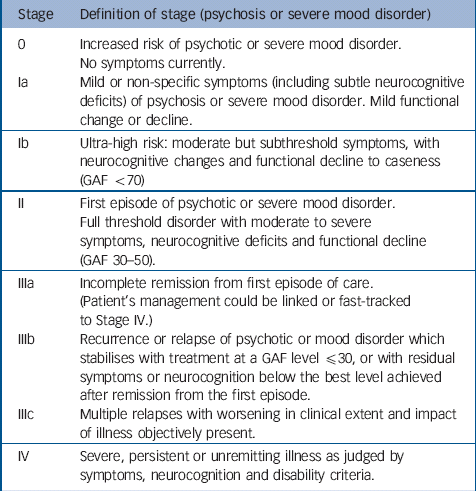
| Stage | Definition of stage (psychosis or severe mood disorder) |
|---|---|
| 0 | Increased risk of psychotic or severe mood disorder. No symptoms currently. |
| Ia | Mild or non-specific symptoms (including subtle neurocognitive deficits) of psychosis or severe mood disorder. Mild functional change or decline. |
| Ib | Ultra-high risk: moderate but subthreshold symptoms, with neurocognitive changes and functional decline to caseness (GAF <70) |
| II | First episode of psychotic or severe mood disorder. Full threshold disorder with moderate to severe symptoms, neurocognitive deficits and functional decline (GAF 30–50). |
| IIIa | Incomplete remission from first episode of care. (Patient's management could be linked or fast-tracked to Stage IV.) |
| IIIb | Recurrence or relapse of psychotic or mood disorder which stabilises with treatment at a GAF level ≤30, or with residual symptoms or neurocognition below the best level achieved after remission from the first episode. |
| IIIc | Multiple relapses with worsening in clinical extent and impact of illness objectively present. |
| IV | Severe, persistent or unremitting illness as judged by symptoms, neurocognition and disability criteria. |
GAF, Global Assessment of Functioning.
Adapted from McGorry et al. Reference McGorry, Hickie, Yung, Pantelis and Jackson1
-
(a) Can a single staging template be used to represent the progression of each disorder towards its end phenotype; alternatively, what are the benefits of separate staging models for each diagnostic subgroup?
-
(b) Can the boundaries between early, at-risk stages be reliably differentiated from normative developmental experiences or transient distress syndromes that do not progress, especially in the absence of valid endophenotypes or reliable biomarkers?
-
(c) If we wish to differentiate the earliest clinical phenotypes from each other syndromally prior to the first episode of threshold disorder, what are the agreed criteria for making this judgement (e.g. predictive power; emergence of differential treatment needs and responses)?
-
(d) Can the late stage (stage IV) be sufficiently differentiated syndromally or do the late stages for different psychiatric disorders, such as schizophrenia, schizoaffective and affective disorders, converge and resemble each other (in a similar way to that hypothesised for the earliest stages)?
-
(e) How is comorbidity to be dealt with in staging models? This includes substance use, physical illness and multiple syndromal expressions. Do the latter vary across stages? How do we capture the notion of ‘extension’? Do stages of mental disorder need to be defined as a matrix to reflect the multiplicity of pathways?
Staging and bipolar disorder
The key issue in broadening the scope of clinical staging from psychotic disorders to the more prevalent affective disorders is that it revives the age old dilemma of splitting v. lumping. The splitting approach proposes distinct staging models for anxiety, anorexia nervosa, schizophrenia, schizoaffective, unipolar and bipolar disorders, and/or conceptualises stages II-IV as identifying clinical subtypes within that diagnostic category rather than focusing on disease progression. Reference Kapczinski, Dias, Kauer-Sant'Anna, Frey, Grassi-Oliveira and Colom4 The difficulty with these ‘separate’ pathways is exemplified by bipolar disorder where depressive, psychotic or other symptoms may each represent either an early stage of a mood disorder (i.e. prior to the first syndromal episode of mania) or a late stage (or exit syndrome) of many depressive disorders. Reference Berk, Conus, Lucas, Hallam, Malhi and Dodd5
Many observers, especially experts in youth mental health, advocate lumping, principally because the early-stage clinical phenotypes of many severe mental disorders overlap substantially in late childhood/early adolescence, and remain relatively undifferentiated until the late adolescent/early adult developmental period is reached. It is argued that this approach is more consistent with evidence for shared genetic and familial vulnerabilities, common childhood precursors, shared environmental risk factors (e.g. traumatic experiences, substance misuse) and similar response patterns to common psychological and pharmacological treatments. Reference McGorry, Hickie, Yung, Pantelis and Jackson1,Reference Hickie, Scott, Hermens, Naismith, Guastella and Kaur6
Despite some conceptual differences, all staging models for bipolar disorder propose a latent or preclinical stage where enhanced vulnerability exists, which may or may not lead later to full syndromal presentations. The asymptomatic stage may or may not be followed by subthreshold clinical phenomena that incorporate some aspects of current diagnostic concepts (e.g. brief or recurrent hypomania, disrupted sleep-wake cycle, increased or decreased energy). The first sustained full-threshold stage (stage II) of, for example, mania, severe depression or psychosis, represents a putative watershed, with a substantial risk that persistent, recurrent or increasingly comorbid illness will follow. This is where the traditionally recognised diagnostic categories have greater clinical validity. Finally, progression to a stable poor outcome, with treatment-refractory symptoms, severely impaired functioning and heavy medical comorbidity represents an end-stage or final phenotype (stage IV). It should be emphasised that only a subset of cases move through the ‘gate’ at each stage: remission and recovery are possible at every stage, although, as in medical staging models, the chances of remission and recovery decrease with progression.
Future implications for bipolar disorder
Although there is growing interest in applying staging to bipolar disorder, knowledge and understanding of the end stages greatly exceeds that of the earlier stages. Reference McGorry, Hickie, Yung, Pantelis and Jackson1,Reference Kapczinski, Dias, Kauer-Sant'Anna, Frey, Grassi-Oliveira and Colom4,Reference Berk, Conus, Lucas, Hallam, Malhi and Dodd5 The challenge is to recruit appropriate clinical cohorts and then map prospectively the relatively uncharted transitions from asymptomatic vulnerability to first symptoms and impairment, and then on to threshold early episodes. Reference Hickie, Scott, Hermens, Naismith, Guastella and Kaur6 Some work on the latter has already been done, focusing on early-onset or first-episode mania cases – however, it is important to recognise that the individuals included in these studies have already made the transition across the diagnostic threshold. To genuinely understand risk architecture, we require a prospective and transdiagnostic approach. We need to know whether the earliest clinical stages of these disorders demonstrate pluripotentiality or whether there is a predestined pathway to develop a specific diagnosis. The latter is too easy to assume retrospectively or even prospectively with a traditional case-healthy control design since such approaches fail to illuminate other ‘roads’ that could have been travelled.
Studying the early evolution of syndromes will also provide insights into whether caseness and/or diagnostic differentiation is achieved by the accumulation of symptoms, the acquisition of new symptoms or the differential intensification of existing symptoms or temperamental styles. If we get the sequence right, we have a much greater chance of delineating those biomarkers (or endophenotypes) that reflect either shared (e.g. impaired brain development in childhood) or more distinct pathophysiological processes (e.g. disturbed circadian systems in bipolar disorders). Reference Leboyer, Soreca, Scott, Frye, Henry and Tamouza7 The first more detailed longitudinal reports utilising this transdiagnostic strategy are beginning to appear, Reference Hickie, Scott, Hermens, Naismith, Guastella and Kaur6 and seem to be supported by differential magnetic resonance imaging changes at earlier v. later stages of disorder. Reference Lagopoulos, Hermens, Naismith, Scott and Hickie8
Applying staging models to bipolar disorder also implies that treatments should be selected because they are stage-appropriate. There will be a need to clarify the optimum timing and use of stage-specific interventions compared with disorder-specific treatments (e.g. we need to avoid premature use of mood stabilisers in low-risk individuals, but also need to better understand how to identify the most effective timing of introducing such a treatment to maximise its benefits). Potentially beneficial and also harmful effects of treatment will need to be assessed, such as the indications for use of traditional antidepressants in young adults who may currently have depression but are deemed at risk of bipolar disorder (and without co-prescription may precipitate hypomanic symptoms).
A key proposition of staging is that early-stage treatments are less specific, more benign and, through their timing, more effective. It can be argued that the rationale for the use of broadly classified psychoprotective or neuroprotective interventions extends beyond superficial clinical pragmatism. For example, there is evidence that many cognitive processing errors which can be modified by cognitive–behavioural therapy are transdiagnostic, influencing the severity and maintenance of symptoms across a range of clinical presentations. Putative neuroprotective treatments such as omega-3 fatty acids, N-acetyl-cysteine and low-dose lithium may be non-specifically and transdiagnostically effective if given early enough or have some specificity later. Reference Berk, Kapczinski, Andreazza, Dean, Glorlando and Maes9
If these less specific treatments are equally effective in preventing transitions to bipolar or psychotic disorders, this would suggest that, in the early stages, the commonalities within the same stage between disorders may exceed differences that exist between stages within the same disorder – at least at that particular stage. Alternatively, if these generic approaches to more mercurial clinical presentations fail to halt transitions, it may be argued that the underlying pathophysiology is different for each disorder, which may point to a need for greater differentiation even at very early stages.
Finally, staging can inform late-stage treatment. Using staging to stratify selection of participants for clinical treatment trials, may afford critical insights into the dose-response characteristics of a specific treatment over time, which may lead to more informed stratified medicine approaches for established cases of bipolar disorder. Reference Kapczinski, Dias, Kauer-Sant'Anna, Frey, Grassi-Oliveira and Colom4,Reference Leboyer, Soreca, Scott, Frye, Henry and Tamouza7,Reference Scott, Paykel, Morriss, Bentall, Kinderman and Johnson10
Acknowledgement
This paper arose from discussions between the authors at a meeting on ‘Operationalizing Staging Criteria for Bipolar Disorders’ organised by Fondation FondaMental in Paris, France, on 4 September 2011.




eLetters
No eLetters have been published for this article.