Introduction
Infinitival clauses in early child grammar have been a long-standing topic, often studied from structural, frequency or cross-linguistic viewpoints. There has been a tendency to treat such clauses as errors, although in some languages (for instance, in German) subject-less infinitival clauses are a grammatical sentence pattern. In this research we take a language-specific and dialogue-oriented approach in order to gain novel insights regarding frequency effects and the pragmatic function of infinitival clauses in child-adult dialogue.
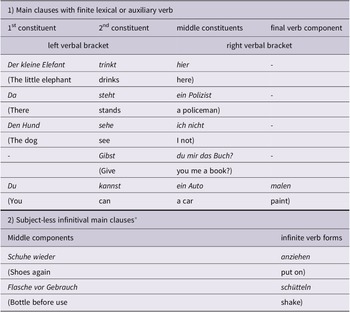
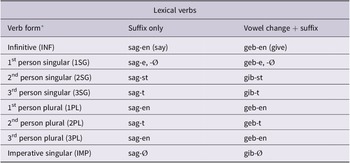
Several approaches have contributed to explaining the use of infinitival clauses in early child language. A generative approach proposed by Wexler (Reference Wexler and Rice1996) attributes early infinitival clauses to an immaturity of early grammar which operates under the restriction of allowing children to mark either tense or agreement, but not both. The restriction is seen to gradually vanish by the age of four, resulting in a disappearance of such ‘optional infinitives’. Regarding German, Clahsen (Reference Clahsen1986, Reference Clahsen1990) proposed a model allowing for the specifics of German sentence structure. In German infinitives occupy final, and finite forms second sentence position (see Appendices 1 and 2). The simultaneous setting of the verb-second and subject-verb agreement parameters is proposed as a mechanism which causes a sudden shift from the prevalence of sentence final infinitives to full productivity of finite forms in verb-second position (Clahsen, Reference Clahsen1990). A re-analysis of Clahsen’s (Reference Clahsen1986) data (Jordens, Reference Jordens1990) and more evidence from German-speaking children, however, demonstrates a gradual change rather than a sudden shift from frequent use of infinitival to sentences with finite verbs (Behrens, Reference Behrens1993; Bittner, Reference Bittner, Bittner, Dressler and Kilani-Schoch2003).
Approaches leaning towards a constructivist view explain the decrease in infinitival and increase in finite clauses by an emerging productivity of finite morphology. Studies of Dutch and German have shown that children use only a small set of mostly unproductive verbs with finite morphology in their early word combinations (Blom & Wijnen, Reference Blom and Wijnen2013; Ingram & Thompson, Reference Ingram and Thompson1996; Jordens, Reference Jordens1990; Wijnen, Reference Wijnen1998), and in Blom and Wijnen’s (Reference Blom and Wijnen2013) study the sets of verbs used with finite or non-finite morphology tended to differ. Over time, the overlap between verb types with finite and non-finite morphology increased and was related to a decrease in infinitival clauses. As this increase grew faster than the children’s verb lexicon, the authors concluded that emerging productivity in finite morphology leads to a decrease of infinitival clauses (Blom & Wijnen, Reference Blom and Wijnen2013).
Cross-linguistic studies have shown that the early prevalence of infinitival clauses in child language reflects structural and frequency properties of the input language (Freudenthal, Pine, Aguado-Orea & Gobet, Reference Freudenthal, Pine, Aguado-Orea and Gobet2007; Freudenthal et al., Reference Freudenthal, Pine and Gobet2010; Laaha & Bassano, Reference Laaha and Bassano2013; Räsänen, Ambridge & Pine, Reference Räsänen, Ambridge and Pine2014; Wijnen, Kempen & Gillis, Reference Wijnen, Kempen and Gillis2001). Computational modelling trained in languages with sentence final infinitives, such as Dutch and German, produces more infinitival clauses than those trained in Spanish which places non-finite verbs before an object argument, thus reflecting positional effects. Higher frequencies of infinitival clauses in Dutch than in German output reflect the higher frequencies of non-finite verb final sentences in Dutch.
A central controversy ranges around the question whether early infinitival clauses are used where in adult language a finite clause would be appropriate (Clahsen, Reference Clahsen1986, Reference Clahsen1990; Wexler, Reference Wexler, Lightfoot and Hornstein1994, Reference Wexler and Rice1996) or whether they are modal sentences with missing modals (Bassano, Laaha, Maillochon & Dressler, Reference Bassano, Laaha, Maillochon and Dressler2004; Freudenthal et al., Reference Freudenthal, Pine and Gobet2010; Ingram & Thompson, Reference Ingram and Thompson1996; Jordens, Reference Jordens1990; Laaha & Bassano, Reference Laaha and Bassano2013). The ‘missing modal’ position receives support from studies using different methodologies. Analyses of longitudinal spontaneous speech data of German-speaking and Dutch-speaking children show a decrease in infinitival clauses with a corresponding increase in periphrastic predicates combining modal + infinitive (ich will da gucken (I want to look there) and auxiliary + past participle (ich hab das schön gemalt (I painted that nicely) (Bassano et al., Reference Bassano, Laaha, Maillochon and Dressler2004; Jordens, Reference Jordens1990). This led to the conclusion that understanding the principle of periphrastic constructions may lead to a decrease in infinitival clauses (Bassano et al., Reference Bassano, Laaha, Maillochon and Dressler2004; Jordens, Reference Jordens1990).
Using the method of qualitative contextual analysis Ingram and Thompson (Reference Ingram and Thompson1996) and Lasser (Reference Lasser1997) found that more than half of German-speaking children’s infinitival clauses had a modal interpretation, often expressing wishes or intention. However, a smaller proportion could not be interpreted as modal with sufficient certainty (Ingram & Thompson, Reference Ingram and Thompson1996), and Lasser (Reference Lasser1997) presents examples of infinitival clauses which refer to ongoing events: a context in which simple present tense would be used in German (Lasser, Reference Lasser1997).
Within a constructivist framework Freudenthal et al. (Reference Freudenthal, Pine and Gobet2010) proposed a learning model in which child infinitival clauses – in their terminology ‘optional infinitive errors’ – are learned from periphrastic modal sentences in the input. This process is seen as lexically specific. Cross-linguistic evidence including Dutch, German, Spanish, English and French from computational modelling and from empirical data show that for utterances with the same verbs used by both speakers, proportions of child infinitival clauses are associated with proportions of adult periphrastic modal sentences. This applies at a level of sentence development when children use roughly the same numbers of lexical verb types in finite and in infinitival clauses. It is concluded that ‘optional infinitive errors’ are not used in place of simple finite forms, but are truncated MOD+INF constructions with missing modals (Freudenthal et al., Reference Freudenthal, Pine and Gobet2010; Freudenthal, Pine, Jones & Gobet, Reference Freudenthal, Pine, Jones and Gobet2015).
Previous analyses have focussed on structural and frequency properties of child and adult sentence types and have often taken a cross-linguistic perspective. There is also a marked tendency to view child infinitival clauses as errors, the so-called ‘optional infinitive error’ (Freudenthal et al., Reference Freudenthal, Pine and Gobet2010, Reference Freudenthal, Pine, Jones and Gobet2015; Räsänen et al., Reference Räsänen, Ambridge and Pine2014; Wexler, Reference Wexler, Lightfoot and Hornstein1994). In our view, these approaches have overlooked language-specific aspects which may shed a new light on the use of infinitival clauses by children and adults. In German, for instance, subject-less main clauses with final infinitives represent a grammatical sentence pattern (Gallmann, Reference Gallmann2016; Laaha & Bassano, Reference Laaha and Bassano2013; Lasser, Reference Lasser1997, Reference Lasser2002; Wöllstein, Reference Wöllstein2014; for exceptions allowing a subject, see Appendix 1). Infinitival main clauses are typically used for requests, instructions, and prohibitions, i.e., in modal contexts. Examples are: Flasche vor Gebrauch schütteln (shake bottle before use); nicht darauf treten (don’t step on it). In this study we use the neutral term ‘infinitival clause’ (INFC), as it designates the structural properties of such clauses but does not assume erroneousness per se. We view INFCs as one of the syntactic structures of the target grammar and will treat it accordingly in our analyses.
For learners of German, especially for young children with limited information processing capacity, INFC constructions may be the easiest to grasp, as they do not require subject-verb agreement or positional restrictions for finite verbs and meet children’s preference for utterance final elements (Mills, Reference Mills and Slobin1985; Slobin, Reference Slobin, Ferguson and Slobin1973). Their simple structure would make INFCs the ideal candidate for inclusion in a child-directed speech (CDS) register of German. One of the main motivations for using CDS is to ensure that the more competent speaker is understood (Brown, Reference Brown, Snow and Ferguson1977). In child-adult discourse adults tend to adapt their speech to the child’s, which includes simplifying syntactic structure (Snow, Reference Snow, Snow and Ferguson1977). Another characteristic of child-adult discourse is that adults tend to repeat correct structures but expand or ignore incorrect ones (Bohannon & Stanowicz, Reference Bohannon and Stanowicz1988). German-speaking children produce grammatical and ungrammatical infinitival clauses, the latter containing nouns or personal pronouns as sentence subjects. Examples are Anna Brötchen haben (Anna bread roll haveINF) and du auch mit mir Tee kochen (you also with me tea makeINF). There is currently no knowledge on whether adults respond to grammatical and ungrammatical child INFCs differently.
In this study we will investigate the role of INFCs in adult child-directed speech. A first step is to examine frequency relations between INFCs in adult input and in child output. Freudenthal et al. (Reference Freudenthal, Pine and Gobet2010) explicitly excluded INFCs from the input in their analyses. Here, we start from the premise that INFCs are part of adult grammar and should be included in the input. We also question Freudenthal et al.’s (Reference Freudenthal, Pine and Gobet2010, Reference Freudenthal, Pine, Jones and Gobet2015) conclusion that child INFCs cannot be used in place of simple finite clauses and are truncated MOD+INF constructions. We would argue that such a conclusion cannot be drawn on the basis of structural analysis alone, but requires qualitative contextual analysis. INFCs have no structural features which refer to their pragmatic function. Indeed, one of their most conspicuous features is their indeterminacy. Contextual information is required for their interpretation (Lasser, Reference Lasser1997). While available evidence suggests that child INFCs often have a modal meaning, a non-modal interpretation for a small but not negligible proportion of German children’s INFCs cannot be excluded (Ingram & Thompson, Reference Ingram and Thompson1996; Lasser, Reference Lasser1997; Wijnen, Reference Wijnen1998).
The present study looks at the role of infinitival clauses in dialogue context. We will use a large corpus of German child and adult speech which includes extensive sampling of child-directed speech (https://childes.talkbank.org). One aim is to examine frequency relations between adult infinitival and periphrastic modal clauses in CDS and child INFCs. Another aim is to specify the pragmatic function of INFCs in child-adult dialogue. This requires contextual analysis, as structural information alone does not allow the interpretation of INFCs as factual or modal.
The following research questions are asked.
-
1) Frequencies of adult INFCs: How frequent are INFCs in child-directed speech?
-
2) Associations between clause types in adult input and child output: We will test Freudenthal et al.’s (Reference Freudenthal, Pine and Gobet2010) learning model by performing an analysis similar to theirs but with the inclusion of adult INFC clauses. Like Freudenthal et al. (Reference Freudenthal, Pine and Gobet2010) we will use clauses in which both speakers use the same lexical verbs. We expect child INFCs to be associated with both clause types, INFC and MOD+INF, in adult speech. We question, however, if such associations may be interpreted as learning effects as long as a mutual influence of verb use cannot be excluded. We propose that such associations reflect the use of same verb vocabulary in child-adult dialogue. The two views will be tested in a cross-lagged panel correlational design which includes time-lagged and synchronous correlations.
-
3) Contextual analysis of child infinitival clauses: We will carry out a contextual analysis to determine if child INFCs occur in modal and non-modal contexts. A prevalence of modal over non-modal contexts is expected. Modal INFCs are analysed further to determine which modal meaning they express.
-
4) Contextual analysis of spontaneous adult infinitival clauses in child-directed speech: We expect adults to use INFCs in modal contexts mainly in imperative function expressing requests.
-
5) Adult sentence types in response to child INFCs: We assume that adults are sensitive to the grammaticality of child INFCs and therefore expect different responses to ungrammatical and grammatical child INFCs.
Method
Participants
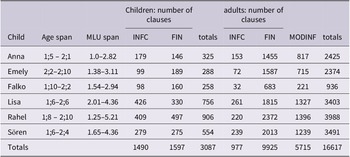
The corpora of 6 German-speaking children, 4 girls and 2 boys available on CHILDES (MacWhinney, Reference MacWhinney2000) were used for the present analyses. The data are longitudinal. Two hourly spontaneous speech samples in a free play situation were collected every 5-6 weeks between the ages of 1;4 and 3;8, rendering 22 speech samples per child. The participants were monolingual and were resident in Oldenburg, northern Germany. They were recruited from two day-care centres and a paediatrician’s practice in Oldenburg. Table 1 presents age, MLU spans and number of sentence types used for the present analyses per child; and, with respect to sentence types, per adult interacting with the child.
Child and adult data used for the present analyses: Age span, MLU span, number of data points per child, number of infinitival and simple finite clauses per child-adult pair

Data collection, transcription and coding of transcripts for data analysis
Data collection took place in a playroom at the Department of Psychology at the University of Oldenburg. The situation was free play with a parent and – most of the time – an investigator present joining in with the play. There were sets of toys such as: cars and garage, dolls, doll’s house, zoo animals, farm animals, forest animals, picture books, puzzles, medical kit, ambulance, fire-station. All play sessions were audio-recorded with additional video recordings for some data points.
Everything spoken by the child and all adult child-directed speech was transcribed. Transcription rules followed the general CHAT conventions (MacWhinney, Reference MacWhinney2000). Bracketing was used to reflect pronunciation in orthography. This concerns final consonants, e.g., nich(t) (not), jetz(t) (now) un(d) (and), final or initial consonant leading to contractions of words, e.g., kommt (d)er (comes he), contractions in inflectional endings, e.g., seh(e)n inf (see). Eight trained transcribers performed the transcriptions. Reliability checks on 7 % of the transcripts showed 96 % agreements between different pairs of transcribers.
The present analyses made use of morphosyntactic coding performed as part of previously published studies (Szagun, Reference Szagun2001, Reference Szagun2004). This included all verb inflectional marking and implied a distinction between infinitive, 1st and 3rd person plural all of which are marked with the suffix -en in German (see Appendix 2). Only sentences with formally correct verb inflectional morphology and correct positioning of finite and non-finite verbs were used for the present analyses.
For the present analyses main clauses were coded as follows:
-
1) infinitival clauses (INFC) with final infinitive including:
-
a) subject-less clauses as in Schuhe anzieh(e)n (shoes put on);
-
b) clauses with subject as in ich da gucken (I there look);
-
-
2) main clauses with a finite lexical verb (FIN) in second position allowing variations regarding the first sentence constituent (see Appendix 1);
-
3) main clauses with a finite modal in second position and a sentence final lexical infinitive (MOD+INF), allowing the same variations of constituents as in 2).
Reliability checks performed by two researchers on 19 % of the transcripts rendered 99 % agreement.
Coding schemes for child infinitival clauses
Child two-and multi-word main clauses with the syntactic structure of an INFC and correct infinitival –en inflection were used for the analyses. Verb forms ending in –e and bar stem in subject-less clauses and sentence final position were excluded, as they can be ambiguous with 1SG. Elliptical utterances were also excluded.
I) Grammaticality
All child infinitival clauses were coded for grammaticality.
Grammatical
A child INFC is subject-less with final infinitive, thus conforming to the syntactic structure of adult INFCs (see Appendix 1). INFCs containing other errors, i.e., omissions or case, were ignored: as they are irrelevant for the syntactic structure under consideration here. Examples (for INFCs the English translation keeps German word order):

Ungrammatical
The utterance contains a sentence subject and an infinite verb form thus violating subject-verb agreement (s. Appendices 1 and Appendices 2). Examples:

II) Contextual analyses – pragmatic function
Next, child infinitival clauses were coded for pragmatic function. Contextual analysis was used to determine whether an INFC had modal or non-modal meaning or was unclear with respect to either.
Modal
An INFC has modal meaning. Three different modal meanings were distinguished: wish/intention, request, suggestion. The interpretation was supported by the kind of modal verb that is used in the adult response, or would be used in adult German, or is implied by the general context.
Wish/intention
An INFC states the child’s wish and/or imminently intended action. It was not possible to distinguish reliably between wish and intention. Adults tended to respond with a modal verb used for wishes. Examples:

Request. An INFC has imperative function. It is directed at another person and requires action or refraining from action from the other person. Examples:

Suggestion: An INFC is interrogative seeking a response from another person. Examples:

Non-modal
The INFC is a comment on an ongoing action. In adult German a finite verb in the present tense would be used. The interpretation was supported by an adult finite clause in the present tense or the general conversational or situational context. Examples:

Unclear. Neither adult surrounding utterances nor situational context allow a decision with respect to modality or non-modality. Examples:

All child infinitival clauses were coded by one coder. A second coder categorized 41 % (604 utterances) of the clauses independently. When distinguishing the subcategories of ‘modal’ (‘wish/intention’, ‘request’, ‘suggestion’) .01 % of utterances could not be placed in any of the subcategories. Agreement for grammaticality was 100 %. Cohen’s kappa was used as a measure of interrater reliability for pragmatic categories. Kappas were: .78 for main categories modal, non-modal, and unclear, and .98 for subcategories of modality indicating very good agreement. Disagreements were resolved by discussion.
Coding schemes for adult infinitival clauses
Adult INFCs occurring spontaneously were coded for pragmatic function. INFCs following a child’s INFC were coded separately (see section II). Elliptical utterances and continuations of preceding non-completed MOD+INF sentences were excluded from the analysis.
I) Pragmatic function of spontaneous adult infinitival clauses
Modal
Adult INFCs occur with modal meaning. Three different modal meanings were distinguished: request, suggestion, intention/imminent action. The interpretation was guided by the kind of modal verb which would typically be used in a MOD+INF sentence in the same context.
Request
An INFC has imperative function. It required an action or refraining from action from the child. Often the utterance guided the child through a play activity. Examples:

Suggestion
An INFC is interrogative seeking a response from the child. It tended to follow a child’s wish which was not clearly expressed, or was a suggestion for a new activity. Examples:

Intention/imminent action
An INFC is declarative and expresses the speaker’s intention or imminent action. It was followed by immediate action.

Non-modal
Comment
A comment is made about an ongoing action. The INFC has a non-modal interpretation and could be replaced by a present tense clause. Examples:

Rest
Percentage of utterances which could not be placed in any of the categories was 1.6.
All spontaneous adult infinitival clauses were coded by one coder. A second coder categorized 33 % (258 utterances) of the clauses independently. A kappa of .85 indicated very good interrater reliability. Disagreements were resolved by discussion.
II) Adult responses to child infinitival clauses
Adult responses following a child INFC in the same turn were coded for their formal and discourse structure. Within the framework of our study the relevant sentence types were MOD+INF, FIN and INFC clauses. Discourse structures were coded as follows. For MOD+INF and FIN responses we distinguished expansion and continuing with the topic.
Expansion adds the formal elements of a MOD+INF or FIN structure in the present tense and possibly minor content information, e.g., an adverb.
Continuing with the topic provides these formal elements and adds substantial content information. For INFC responses we distinguish repetition and continuing with the topic. Repetition keeps the syntactic structure of a child INFC but may add a minor element, i.e., an adverb. Continuing with the topic is the same as for MOD+INF and FIN clauses.
Examples per discourse category are presented under the main heading of structural clause type.
MOD+INF clauses

FIN clauses

INFC clauses

All adult response clauses to child INFCs were coded by one coder. A second coder categorized 33 % (164 utterances) independently. There was 100 % agreement for the structural categories MOD+INF, present tense, and INFC. Regarding pragmatic function, kappas were: .97 for INFCs and .87 for MOD+INF and FIN categories. Disagreements were resolved by discussion. Altogether, kappa values indicated very good agreement. Additional examples are presented in Supplementary Material.
Design, statistical analyses, and language measures
Frequency of adult INFCs
Addressing research question (RQ) 1 cumulative frequencies of adult INFCs were calculated per individual corpus using data from the total time span. Proportional frequencies of INFCs were calculated out of the total of INFC + FIN + MOD+INF clauses.
Correlational analyses
Correlational analyses were performed to examine associations between relative frequencies of verbs in adult MOD+INF and INFC clauses and relative frequencies of these same verbs in child INFCs (RQ 2). This was done per individual child-adult pair. Variables were lexical verbs (types). Regarding the selection of verbs we used the method introduced by Freudenthal et al. (Reference Freudenthal, Pine and Gobet2010). All lexical verbs in child speech were used up to the data point when the cumulative number of verb types in child INFC and FIN clauses was fairly equal. The rationale was that at this point the chance of finding an association between adult non-finite input and child output was equally high for INFC and FIN clauses.
Calculation of verbs started at the age/data point when an individual child produced first word combinations and ended when almost equal numbers of verb types in the child’s INFC and FIN clauses occurred. Due to individual variation in the early period of high INFC use (Blom & Wijnen, Reference Blom and Wijnen2013; Clahsen, Reference Clahsen1986; Ingram & Thompson, Reference Ingram and Thompson1996; Wijnen et al., Reference Wijnen, Kempen and Gillis2001) this age/time span differed per individual child. Number of verb types are presented in Table 2. Per lexical verb, number of occurrences (tokens) in child INFC and FIN, and in adult INFC, FIN and MOD+INF clauses was summed up. This rendered a cumulative score per lexical verb used per clause type. Calculations were performed per individual child-adult pair. Next, shared verbs were selected. A verb type was shared when it occurred in at least one of the different sentence types in child and adult speech. Finally, proportion of tokens in child INFC clauses was correlated with proportions of tokens in adult INFC and MOD+INF clauses. The calculation of token proportions followed Freudenthal et al.’s (Reference Freudenthal, Pine and Gobet2010) method. Per verb type, proportions were calculated as follows:
-
– number of tokens in child INFCs / number of tokens in child INFC + number of tokens in child FIN clauses
-
– number of tokens in adult INFCs / number of tokens in adult INFC + number of tokens in adult FIN + number of tokens in adult MOD+INF clauses
-
– number of tokens in adult MOD+INF clauses / number of tokens in adult INFC + number of tokens in adult FIN + number of tokens in adult MOD+INF clauses.
Time spans, number of data points and verb types in child INFC and FIN clauses used for the different correlational analyses

a Note that data collection took place very 5–6 weeks, not every month.
Correlations between child and adult verb frequencies at the same time level, however, are insufficient to infer an effect of language input on children’s linguistic progress. Adult language has a delayed effect. Further, child and adult language are mutually influential (Snow, Reference Snow, Snow and Ferguson1977; Hoff, Reference Hoff2003). We therefore applied a cross-lagged panel correlational design in which adult or child language is given temporal precedence, and mutual effects are examined by synchronous correlations at the initial and later data point (Richards, Reference Richards1994). In order to infer a learning effect, time-lagged correlation between adult input and child output should be considerably larger than synchronous correlations.
We applied the cross-lagged design in the following way. Per child/adult the total time span was split in two (see Table 2). Cut-off point for time span 1 was the data point with the closest possible match between the cumulative number of verb types in child INFC and FIN clauses during the early data points. For three children it did not approach similarity. For time span 2 numbers of verb types was fairly equal.
The following correlations were calculated:
-
1. Time-lagged: Adult time 1 x child time 2 (A1 x C2)
-
2. Time-lagged: Child time 1 x adult time 2 (C1 x A2)
-
3. Synchronous: Adult time 1 x child time 1 (A1 x C1)
-
4. Synchronous: Adult time 2 x child time 2 (A2 x C2).
Verb types shared by children and adults were selected for each of the four combinations of time spans. Calculations of cumulative scores for verb tokens and proportion of verb tokens in child INFC and FIN and in adult INFC, FIN and MOD+INF clauses followed the same procedure as described above for the total time span.
Difference between contextual categories
Answering research questions (RQ) 3–5 all transcripts per child/adult were used. Per contextual category cumulative frequencies over the total time span were calculated. Dependent variables were frequencies per contextual category. Differences between frequencies of contextual categories were examined by non-parametric tests. This was done per group of categories depending on the research question: RQ3: per ‘child pragmatic categories’, RQ4: ‘adult pragmatic categories’, RQ5: ‘grammaticality of child INFCs’, ‘adult responses to child INFCs’.
Results
Frequencies of adult INFCs (RQ 1)
Adult CDS here comprises input from mother, father and investigator. As there was no significant difference between speakers (Kruskal-Wallis, p = .051) ‘adult’ refers to all adult speakers subsumed. Proportional frequencies of INFCs out of the total of INFC + FIN + MOD+INF clauses per adult are presented in Table 3. There was considerable variation between adults, ranging from .03 to .08.
Proportion of adult INFCs in CDS

Associations between clause types in adult input and child output (RQ 2)
Per individual child-adult pair Spearman rank correlations were calculated to examine associations between proportions of verb tokens in adult MOD+INF and INFC clauses and proportions of verb tokens in child INFCs when both speakers used the same verb types (see Methods Sections). Proportional scores were number of tokens per verb type.
Results based on data from the total time span
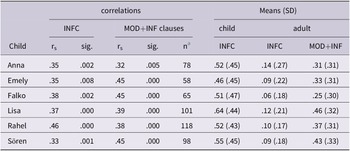
A first correlation used data from the total time span (see Table 2). For each of the 6 children the proportions of adult INFC and adult MOD+INF clauses correlated significantly with the proportion of child INFCs (Spearman, p < .000 – p < .008). Spearman rank correlation coefficients and means are presented in Table 4, ‘n’ equals the number of verb types used by both speakers. Mean frequencies of child INFC clauses were fairly similar across children, whereas adult INFC and MOD+INF mean frequencies varied more. The large SDs point to considerable differences in occurrences of different verb types. A comparison with means in Table 3 shows that adults used INFCs in clauses with shared verbs more frequently than in clauses with shared plus non-shared verbs.
Means and correlations for proportions of child INFCs and adult INFC and MOD+INF clauses with the same lexical verbs over the total age span

a n = number of verb types used by both speakers
Results for the cross-lagged design
a) Time-lagged correlations
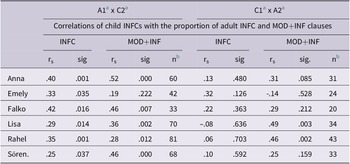
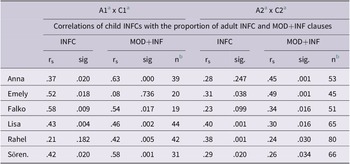
For each child-adult pair proportion of adult INFCs at time 1 correlated significantly with proportions of child INFCs at time 2 (A1 x C2, Spearman, p < .000 to p < .037, see Table 5). Proportions of adult MOD+INF and child INFC clauses correlated significantly for five children but not for Emely (Spearman, p <.000 to p <.012) Vice versa (C1 x A2), proportions of child INFCs earlier and adult INFCs later were not significantly correlated (Spearman, n.s.). Similarly, for four children INFCs earlier did not correlate significantly (Spearman, n.s.) with adult MOD+INF clauses later. For Lisa and Rahel, however, INFCs earlier correlated significantly with adult MOD+INF clauses later on. These were the two children with the highest number of verb types in INFC clauses initially (see Table 2).
Correlations for proportions of child INFCs and adult INFC and MOD+INF clauses with the same lexical verbs per time-lagged design

a Abbreviations for time spans: A1 = adult time span 1, A2 = adult time span 2, C1 = child time span 1, C2 = child time span 2
b n = number of verb types used by both speakers per time-lagged design
b) Synchronous correlations
At time 1 (A1 x C1) proportions of synchronous adult INFC and MOD+INF clauses correlated significantly with child INFCs for five children. At time 2 (A2 x C2) proportions of adult MOD+INF clauses correlated significantly with child INFCs for all children (Spearman, p < .001 to p < .034, see Table 6), but for the relation between adult and child INFCs this was true for only four children.
Correlations for proportions of child INFCs and adult INFC and MOD+INF clauses with the same lexical verbs per synchronous design

a Abbreviations for time spans: A1 = adult time span 1, A2 = adult time span 2, C1 = child time span 1, C2 = child time span 2
b n = number of verb types used by both speakers per synchronous design
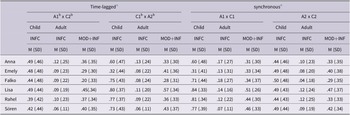
Mean proportions of the different clause types in time-lagged and synchronous designs are presented in Table 7. Child frequencies of INFCs decreased from time 1 to time 2 in both designs, except for Emely who showed the reverse pattern. Adult MOD+INF clauses hardly differed across designs, but showed some variation across adults. Proportions of adult INFCs remained fairly similar from time 1 to time 2 in the time-lagged designs, but varied most conspicuously in the synchronous designs. INFCs directed to Anna, Emely and Falko decreased sharply, and mildly for Lisa. This parallels the decrease in child INFCs for Anna, Falko and Lisa, but not for Emely. For Rahel and Sören mean frequencies were fairly similar.
Mean proportions of child INFCs and adult INFC and MOD+INF clauses with the same lexical verbs per time-lagged and synchronous designs

In summary, the results of the cross-lagged panel correlations showed that adult MOD+INF and adult INFC clauses that occurred with temporal precedence were related to subsequent child INFCs in clauses with the same verbs used by both speakers. While this may point to an effect of adult input on child output, a bi-directional influence could not be excluded due to the significant synchronous correlations at time 1 and time 2 and when the entire time span was used. Mean frequencies displayed patterns of change with child and adult INFCs decreasing from time 1 to time 2, with the exception of Emely.
Contextual analysis of child infinitival clauses (RQ 3)
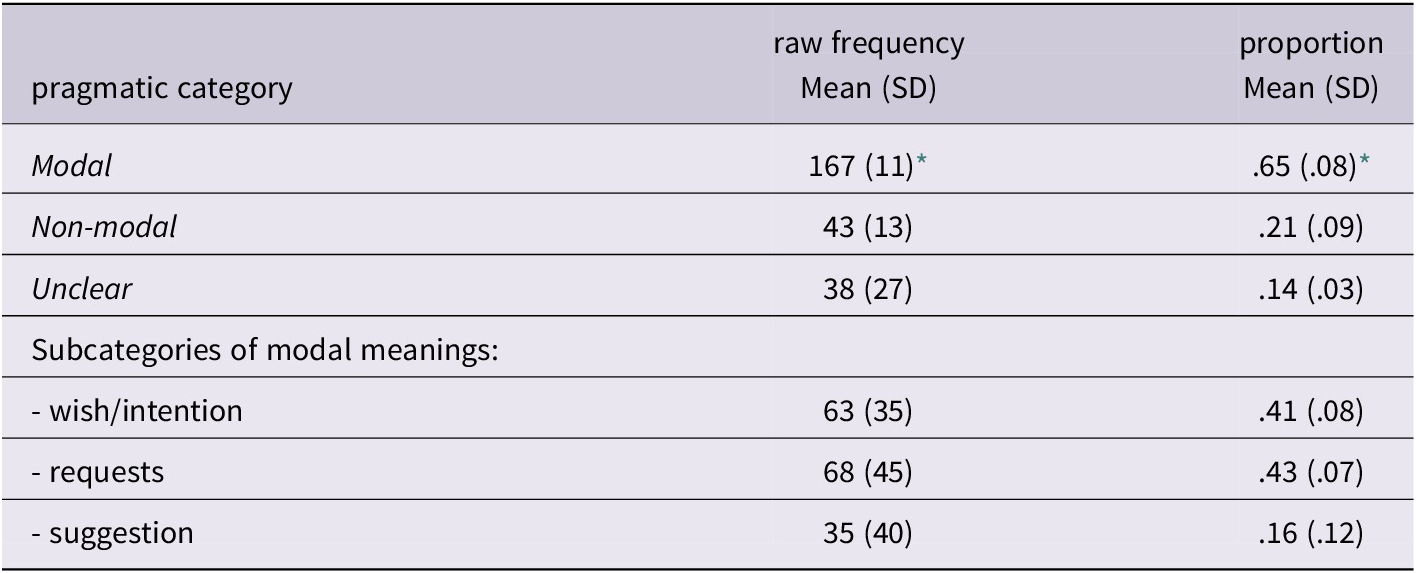
First, we compared frequencies of INFCs in modal and non-modal contexts. Overall, frequencies of the categories ‘modal’, ‘non-modal/present tense’ and ‘unclear’ differed significantly (Friedman, p = .009). For post-hoc pairwise comparisons with Bonferroni correction the value required for significance was p = .0167. No post-hoc comparison reached significance (Wilcoxon, p = .028). Raw frequencies and proportions are presented in Table 8. Out of the 1490 INFCs 1000 had modal meaning. Frequencies of these modal subcategories ‘wish/intention’ ‘request’ and ‘suggestion’ did not differ significantly (Friedman, n.s.).
Raw frequency and proportion of pragmatic categories of child infinitival clauses (n = 6)

* p = .009 (Friedman)
Contextual analysis of spontaneous adult infinitival clauses in CDS (RQ 4)
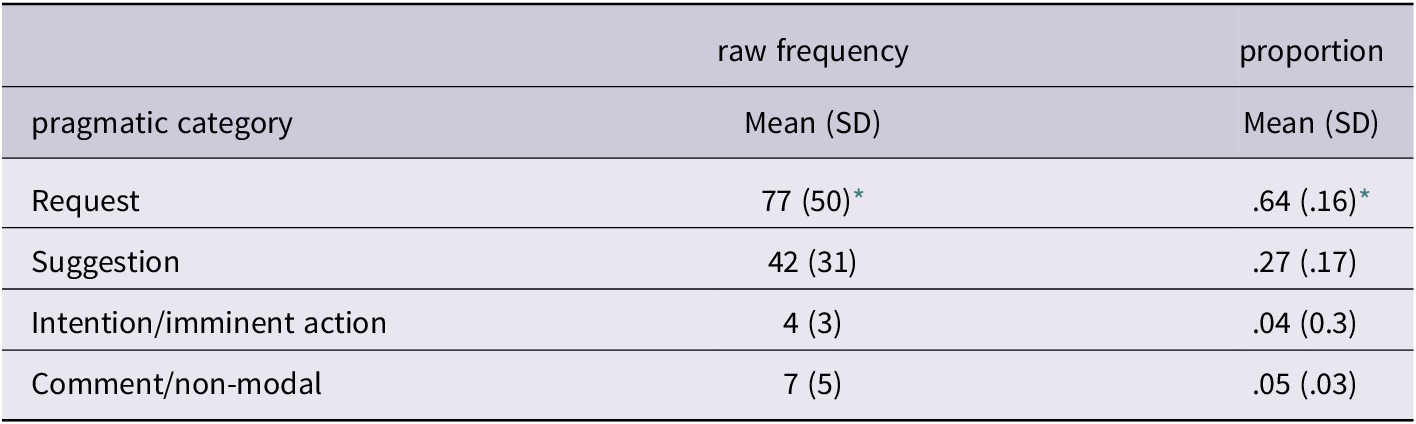
Next, we compared frequencies of the different pragmatic categories of adult INFCs which occurred spontaneously. The categories ‘request’, ‘suggestion’, ‘intention/imminent action’ and ‘comment’ differed significantly overall (Friedman, p = .005). Post-hoc pairwise comparisons with Bonferroni correction and a required significance level of p = .0125 did not reach significance (Wilcoxon, p = .027 and p = .043). Raw frequencies and proportions are presented in Table 9.
Raw frequency and proportion of pragmatic categories of spontaneous infinitival clauses used by adults (n = 6)

* p = .005 (Friedman)
Adult sentence types in response to child INFCs (RQ 5)
Before addressing adult responses to child INFCs we started by comparing frequencies of grammatical and ungrammatical child INFCs. Table 10 shows raw frequencies and proportions. Grammatical child INFCs were significantly more frequent than ungrammatical INFCs (Wilcoxon, p = .028).
Raw frequency and proportion of children’s grammatical and ungrammatical infinitival clauses (n = 6)

* p = .028 (Wilcoxon)
Raw frequency and proportion of adult sentence types in response to child infinitival clauses (n = 6)

* p = .008 (Friedman)
Adult responses to child INFCs were analysed at a structural level, i.e., whether adults respond with a MOD+INF, FIN or INFC clause, and at a discourse level (see: main headings under IV in the Coding Scheme).
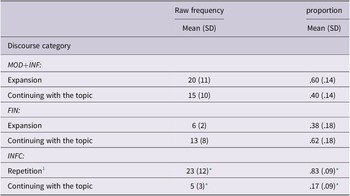
At the structural level adult responses were analysed for grammatical and ungrammatical child INFCs separately. Proportions were calculated out of the respective totals of MOD+INF, FIN and INFC clauses. Following grammatical INFCs frequencies of MOD+INF, INFC and FIN responses did not differ significantly (Friedman, n.s.). In response to ungrammatical child INFCs, however, they differed overall (Friedman, p = .008). Post-hoc pairwise comparisons with Bonferroni correction and a required significance level of p = .0167 did not reach significance (Wilcoxon, p = .027 and p = .043). Table 11 presents raw frequencies and proportions of the three clause types.
At the discourse level responses to grammatical and ungrammatical child INFCs were collapsed, as separate analyses showed the same trend and response frequencies to ungrammatical INFCs were very low. Proportions were calculated out of the respective totals per MOD+INF, FIN and INFC clause. There was no significant difference between the category ‘expansion’ and ‘continuing with the topic’ when adults responded with a MOD+INF or FIN clause. Adult INFC responses, however, showed a different pattern. Following child INFCs ‘repetition’ was significantly more frequent than ‘continuing with the topic’ (Wilcoxon, p = .028). ‘Repetition’ which followed an ungrammatical child INFCs involved modification to subject-less ones. Table 12 presents raw frequencies and proportions of discourse categories per adult clause type.
Raw frequency and proportion of discourse categories in adult responses to child infinitival clauses summed for grammatical and ungrammatical clauses (n = 6)

* p = .028 (Wilcoxon)
1 For ungrammatical INFCs repetition involves a modification to correct form.
Discussion
The aim of the present study was to examine the role of infinitival clauses in child-adult dialogue. Initially, we tested Freudenthal et al.’s (Reference Freudenthal, Pine and Gobet2010) learning model for child infinitival clauses by including adult infinitival clauses in the input and by using a cross-lagged correlational design. Results showed that for clauses in which both speakers used the same verbs proportions of child INFCs were associated with proportions of adult MOD+INF and adult INFC clauses. This was the case for time-lagged correlations when adult input preceded child output and for synchronous correlations at earlier and later times.
Next, we performed contextual analyses of child and adult INFCs. Child INFCs were used in modal contexts, expressing wishes, requests and suggestions. However, a still sizeable proportion occurred in non-modal contexts referring to ongoing events. Nearly all adult INFCs occurred in modal contexts expressing requests and suggestions.
The large majority of child INFCs were grammatical subject-less clauses. When responding to child INFCs with MOD+INF or FIN clauses adults used expansions and continuations of the topic with similar frequencies, whereas INFC responses occurred mainly as repetitions.
We first discuss whether the observed associations between child INFCs and adult MOD+INF and INFC clauses with same verb vocabulary may be interpreted as evidence for a causal effect of adult on child structures. In terms of Freudenthal et al.’s lexically specific learning model such associations are viewed as evidence for children learning INFCs from adult input, whereby our analyses would extend Freudenthal et al.’s (Reference Freudenthal, Pine and Gobet2010) model to include adult INFCs. An argument which weighs against an interpretation in terms of learning is that associations between adult and child grammatical structures, even if adult structures occur with temporal precedence, may only be interpreted as causal, if a bi-directional effect can be excluded. The present results cannot exclude bi-directional effects. This is due to the synchronous correlations between both adult non-finite clauses and INFCs at times 1 and 2 in the cross-lagged panel design and the synchronous correlations based on data from the entire time span which are no smaller than the time-lagged correlations. We conclude that a mutual influence of child and adult language cannot be excluded. This calls in question a learning effect.
In our view, the present finding of an association between adult and child INFCs also raises problems of conceptualisation regarding Freudenthal et al.’s (Reference Freudenthal, Pine and Gobet2010) model of lexically specific learning. One is their definition of child INFCs as errors (‘optional infinitive error’). It would make little sense if children learnt an erroneous syntactic structure from adult input. Another difficulty relates to the role of lexical specificity. Lexically specific learning has been observed at the very beginning of learning a grammatical structure when children use this structure with a small set of lexical items only (Lieven, Pine & Baldwin, Reference Lieven, Pine and Baldwin1997; Tomasello, Reference Tomasello2000). Such a learning pattern has, however, not been observed in German-speaking children’s use of INFCs. According to available evidence (Clahsen, Reference Clahsen1986, Reference Clahsen1990; Behrens, Reference Behrens1993; Ingram & Thompson, Reference Ingram and Thompson1996; Lasser, Reference Lasser1997, Reference Lasser2002) German-speaking children use infinitival clauses right from the beginning of their grammatical development plentifully and with a more diverse verb vocabulary than in clauses with finite verbs. Indeed, the proportions of verb tokens in child INFCs at time 1 in the present findings (see Table 7) corroborate previous findings. In view of these facts it is difficult to see how a concept of early lexically specific learning can be applied to children learning INFCs in German.
We interpret the observed correlations as reflecting the use of shared verb vocabulary in child-adult dialogue and, with respect to adult INFCs, as evidence for an adaption of adult CDS to child grammatical structure. This interpretation is supported by frequency patterns. Thus, proportions of adult INFCs in clauses with shared verbs exceed those in all, i.e., shared plus non-shared, adult INFCs. The decrease in adult INFCs in clauses with shared verbs from time 1 to time 2 parallels a decrease in child INFCs and suggests an adaptation to child INFC use.
Besides these overall tendencies, there is also individual variation – which in some cases parallels child INFC use; in others it does not. For example, for Anna and Falko the decrease in child INFC levels from time 1 to time 2 is paralleled by a decrease in adult INFCs. The drop in adult INFC levels may even explain the lack of a significant association between INFCs at time 2. A different pattern is observed for Rahel and Lisa who have very high levels of INFC use during time 1 which drop sharply at time 2. This change is not paralleled by frequencies of adult INFCs. The very high levels of Rahel’s and Lisa’s INFCs at time 1 may even lead to more MOD+INF clauses in CDS and explain the significant time-lagged correlations with adult MOD+INF clauses at time 2, although this is not supported by the respective means (see Table 7).
While there is considerable individual variation, this does not override the overall trend and, in most cases, does not affect the positive correlations between child and adult INFC use. We view the present results on the use of INFCs in German CDS as an adaptation to the prevailing grammatical structure in early child language. They add to the well-documented adaptations to child vocabulary and grammatical structure in child language research (Snow, Reference Snow, Snow and Ferguson1977; Hoff, Reference Hoff2003).
Regarding contextual analyses, the present results show that German-speaking children tend to use INFCs most frequently in modal contexts and thus confirm previous findings (Ingram & Thompson, Reference Ingram and Thompson1996; Lasser, Reference Lasser1997). However, a not significantly smaller number of INFCs refers to ongoing events and clearly has a non-modal interpretation. In the light of the controversy whether child INFCs are used instead of simple finite or periphrastic modal clauses (Clahsen, Reference Clahsen1986, Reference Clahsen1990; Freudenthal et al., Reference Freudenthal, Pine and Gobet2010, Reference Freudenthal, Pine, Jones and Gobet2015; Wexler, Reference Wexler, Lightfoot and Hornstein1994, Reference Wexler and Rice1996) the present results lead to the conclusion that these two options are not mutually exclusive. Structural analysis alone, however, does not suffice to infer either modal or non-modal meaning, as INFCs lack structural features which refer to their pragmatic function. This indeterminacy is underlined by a still sizeable proportion of child INFCs in our data which we were not able to classify as modal or non-modal unambiguously.
Subcategories of modal meanings differ somewhat between child and adult INFCs. Children express wishes and requests with similar frequencies, whereas adults tend towards expressing requests and suggestions. This would seem to reflect the asymmetrical situation in child-adult interaction. By requesting or suggesting, adults direct a child’s ongoing or wished-for activity. A small number of adult INFCs express an intention for imminent action or comment about ongoing events. In both contexts INFCs could be replaced by simple present tense in German. We interpret reference to impending action as modal, as it refers to a possible situation like wishes and requests. In contrast, statements about ongoing actions are facts and therefore clearly non-modal. The present finding corroborates Lasser’s (Reference Lasser1997) observation that non-modal reference of INFCs cannot be excluded in adult German, but even in our extensive sampling of adult child-directed speech such non-modal reference is rare.
In discussing adult responses to child INFCs it is important to note that the large majority of child INFCs are formally correct structures. Only around a quarter contain a sentence subject and are therefore ungrammatical. There is only weak support for our assumption of different adult responses to grammatical and ungrammatical child INFCs. While there is an overall trend for frequencies of MOD+INF, FIN or INFC clauses to differ significantly after ungrammatical child INFCs, the trend towards more MOD+INF clauses after ungrammatical child INFCs does not reach significance. The low frequencies of adult responses to ungrammatical child INFCs would suggest that adults tend to ignore ungrammatical child utterances as observed by Bohannon and Stanowicz (Reference Bohannon and Stanowicz1988).
Regarding discourse categories adults use expansions and continuations with the topic with similar frequencies. Thus, overall, adults do not seem to focus on formal modifications: only adult INFC responses display a different pattern in which repetition of the child INFC prevails. It is not quite clear why a merely rhetorical response is so much more frequent in this case. It could be due to the indeterminacy of INFCs or, conversely, the utterance might refer to such a simple situation that a continuation of the topic with new information is superfluous.
The present results contribute to several issues in research on infinitival clauses. One concerns the definition of child infinitival clauses as erroneous, the so-called ‘optional infinitive error’ (Freudenthal et al., Reference Freudenthal, Pine and Gobet2010, Reference Freudenthal, Pine, Jones and Gobet2015; Räsänen et al., Reference Räsänen, Ambridge and Pine2014; Wexler, Reference Wexler, Lightfoot and Hornstein1994). The bulk of our data does not support the use of this term for German. INFCs are used by adults and children alike and, what is more, the large majority of child INFCs are subject-less and thus conform to the structure of adult INFCs. In our view, focussing more on a language-specific perspective with the inclusion of the role of INFCs in adult input would avoid the over-generalising tendency to view child infinitival clauses as errors irrespective of the language studied.
As to the controversy whether child INFCs are related to incomplete development of finiteness (Blom & Wijnen, Reference Blom and Wijnen2013; Clahsen, Reference Clahsen1986, Reference Clahsen1990; Wexler, Reference Wexler and Rice1996) or constitute modal sentences with missing modals (Bassano et al., Reference Bassano, Laaha, Maillochon and Dressler2004; Freudenthal et al., Reference Freudenthal, Pine and Gobet2010, Reference Freudenthal, Pine, Jones and Gobet2015; Ingram & Thompson, Reference Ingram and Thompson1996; Jordens, Reference Jordens1990) the contextual analysis presented here provides evidence for both options, although a modal interpretation is more frequent. For German, however, this does not imply that child INFCs should generally be viewed as truncated periphrastic modal sentences with missing modals (Freudenthal et al., Reference Freudenthal, Pine and Gobet2010, Reference Freudenthal, Pine, Jones and Gobet2015). Such a characterisation may apply to ungrammatical INFCs containing a subject. Subject-less grammatical INFCs with modal reference, however, are a formally correct variant of expressing modality in German (Gallmann, Reference Gallmann2016; Laaha & Bassano, Reference Laaha and Bassano2013; Lasser, Reference Lasser1997, Reference Lasser2002; Wöllstein, Reference Wöllstein2014).
The present study has several limitations. Firstly, the low number of participants did not allow more powerful statistical analyses and limits generalisation of results. In this research area, however, even smaller sample sizes and considerably less sampled speech appear to be the rule (Clahsen, Reference Clahsen1986; Freudenthal et al., Reference Freudenthal, Pine and Gobet2010; Ingram & Thompson, Reference Ingram and Thompson1996; Laaha et al., Reference Bassano, Laaha, Maillochon and Dressler2004; Laaha & Bassano, Reference Laaha and Bassano2013; Lasser, Reference Lasser1997; Wexler, Reference Wexler, Lightfoot and Hornstein1994). The present study presents the most comprehensive sampling of infinitival clauses in German CDS. Secondly, splitting the database into two time spans presented the problem that it was not possible to have a similar number of verb types in INFC and FIN clauses during time span 1 for Lisa and Rahel who went through an extended period of high INFC use initially. This may have favoured finding associations between child INFCs and adult MOD+INF and INFC clauses in these two cases. Thirdly, applying the Freudenthal et al. (Reference Freudenthal, Pine and Gobet2010) paradigm of basing analyses on clauses with shared verbs only does not allow a definitive conclusion about lexically specific learning or not. This would require including clauses with non-shared verbs. It does, however, allow conclusions about a mutual influence of child and adult language or an effect of adult input alone.
In accordance with our aims we have shown how INFCs are used in child-adult dialogue in terms of frequencies, mutual influence and pragmatic function. On this basis future research could take the next steps and perform more fine-grained analyses using growth curve modelling by means of logistic regression (van Veen, Evers-Vermeul, Sanders & van den Bergh, Reference Van Veen, Evers-Vermeul, Sanders and van den Bergh2009). This statistical approach estimates tendencies in the entire data set and takes average change and individual variability into account. Several questions could be addressed. The effects of adult clause types on child INFC use could be assessed for shared and non-shared verbs in order to clarify the effects of lexically specific and structural learning. Growth curve modelling could also be applied to discourse categories. There may be a gradual increase of grammatical child INFCs and this process may be influenced by adult expansions focussing on formal modifications as well as children’s mastery of finiteness. Modal meanings in child speech may change over age to become fully identical with adult modal meanings. Further, growth curve modelling could be used to investigate the contribution of child and adult factors to the gradual increase in finite and decrease in INFC clauses in child speech. The extent of adult INFC use, children’s emerging productivity of finite morphology and their grasp of the principle of periphrastic constructions may all influence the decrease of child INFC use. Growth curve modelling may shed a different light on the long-standing controversy whether young children’s frequent use of INFCs is due to their incomplete development of finiteness or their inability to form modal constructions.
We hope to have shown that a language-specific and dialogue-oriented approach to the use of infinitival clauses by children and adults can deepen our insight on the role such clauses may have in language acquisition.
Acknowledgments
This study uses data collected as part of a larger research project funded by Deutsche Forschungsgemeinschaft (German Science Foundation), grants No. Sz 41/5-1, 2 and No. Sz 41/11-1, 2 to the first author. Sonja Arnhold-Kerri, Tanja Hampf, Elfrun Klauke, Stefanie Kraft and Claudia Steinbrink helped with data collection, transcription and analysis. We thank all co-workers and participants.
Supplementary materials
To view supplementary material for this article, please visit http://doi.org/10.1017/S0305000922000496.
Competing interests
The authors declare none.