INTRODUCTION
Pinnotherid crabs are small crustaceans distributed in neritic regions around the world. These crabs are found in a wide variety of hosts including mussels, oysters, scallops, polychaetes and echinoderms. There are some studies on different pinnotherids in various hosts. Orton (Reference Orton1921) for example worked on sex phenomenon and feeding behaviours in the pea crab Pinnotheres pisum Linnaeus, 1767. Atkins (Reference Atkins1926) discovered that adult females grow much larger than adult males. In a study of P. pisum in Mytilus edulis Linnaeus, 1758 (common mussel) and mussel Modiola vulgaris Fleming, 1828 (Lebour, Reference Lebour1928), male crabs were observed to change hosts and have a free swimming lifestyle, whereas female crabs were consistently parasitic on the same host individual. Haven (Reference Haven1958), Beach (Reference Beach1969), as well as Sandoz & Hopkins (Reference Sandoz and Hopkins1947) reported the occurrence of the pea crab Pinnotheres ostreum Say, 1817 in oysters in different regions. Seed (Reference Seed1969) and Haines et al. (Reference Haines, Edmuns and Pewsey1994) reported P. pisum found in M. edulis in the United Kingdom. Frey (Reference Frey1971) reported some pea crabs in the venerid clam Tivela stultorum Mawe, 1823. Pea crabs negatively affect the growth of their hosts (Krucyzynski, Reference Krucyzynski1972) because they consume their hosts' food (Cruz Kaled et al., 2004). Hickman (Reference Hickman1978) reported pea crab Pinnotheres novaezelandiae Filhol, 1886 and the trematode Cercaria haswelli Dollfus, 1927 in the green-lipped mussel Perna canaliculus Gmelin, 1791. To facilitate this lifestyle, female pea crabs have soft carapaces to reduce irritation and death of their hosts (Bell & Stancyk, Reference Bell and Stancyk1983). Pea crabs like Pinnixa tumida Stimpson, 1858 also occurred in the holothurian host Paracaudina chilensis Clark, 1907 (Takeda et al., Reference Takeda, Tamura and Washio1997). Hsueh (Reference Hsueh2003) found the pea crab Pinnotheres taichungae Sakai, 2000 in the bivalve host Laternula marilina Reeve, 1863.
Pea crabs of the genus Arcotheres are determined by subhexagonal carapace (Campos, Reference Campos2001) and live in mantle cavities of some bivalves (Gordon, Reference Gordon1936). Arcotheres tivelae Gordon, 1936 was reported for the first time by Gordon in its infaunal clam host Tivela ponderosa Philippi, 1844 (1936) in Muscat (Arabia).
During the authors' study of the venerid clam Amiantis umbonella Lamarck, 1818 on the Golshahr coast in Bandar Abbas, pinnotherid crab infestation of studied specimens was documented. This paper provides the first report of occurrence, abundance and fecundity of A. tivelae within A. umbonella, and its first distributional record of this pea crab species in Iran. Amiantis umbonella is an edible bivalve mollusc that inhabits sandy, muddy intertidal zones through the north-west and the south-east of the Persian Gulf and the Oman Sea (Bosch et al., Reference Bosch, Dance, Moolenbeek and Oliver1995). It is a region characterized by high sea temperatures in the summer (45°C) and mild sea temperatures in winter (16°C). Seasonal strong winds and water currents provide high nutrient concentrations, enabling marine organisms to adapt and live in this area. For this reason, pea crabs found this region suitable for inhabitation. In this area, some clam species such as Solen dactylus Von Cosel, 1989 (razor clam) and A. umbonella are over-fished due to a deficiency of effective management strategies and also due to the molluscs' ease of capture from natural beds. This study is important because it can show that overfishing of A. umbonella has an effect on both the clams and pea crabs, and can pose a threat to each species. Furthermore, the effects that pea crabs have on their hosts are very important and the present study provides some valuable results which may prove very useful for further studies.
MATERIALS AND METHODS
Study sites and sampling
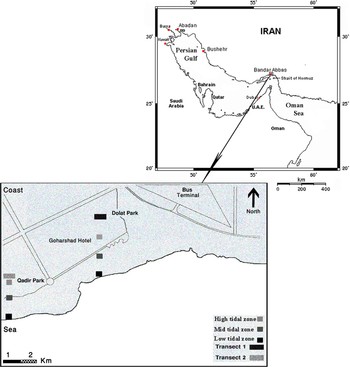
Amiantis umbonella specimens were collected monthly from April 2007 to March 2008 at Park-e-Dolat 56°21′E 27°12′N and Park-e-Qadir 56°20′E 27°11′N, on the Golshahr coast in Bandar Abbas (Figure 1). This station was selected because clam specimens were abundant and available for sampling in this area. Specimens of A. umbonella were infested by pea crab A. tivelae and the parasitic relationship and biology of A. tivelae were studied. Two transects (annual tidal range −0.1–3.88 m) were selected and specimens were collected by hand from stations at low, mid and high tide zones during low tide hours. Three replicates at each of these stations were undertaken using 0.5 m2 quadrats. All animals were fixed in 10% formaldehyde before transfer to the laboratory and routine examination for parasite infestation.
Study area in the Persian Gulf. Inset shows the sampling sites: ‘Dolat park’ and ‘Qadir park’.

Data analysis
BIOMETRY
Three morphometric characters were measured. These were the anterior–posterior length of the right valve (length), the dorso-ventral width of the right valve in A. umbonella and carapace length (carapace length and width were equal in this crab) in A. tivelae. Parameters were measured to the nearest 0.1 mm with Vernier calipers. Six weight measurements were used; total weight (TW), wet weight of the soft parts (SPW), dry weight of shell free of soft parts (SFDW) obtained by drying in 80°C for 24 hours following the methods used by Sejr et al. (Reference Sejr, Sand, Jensen, Peterson, Christensen and Rysgard2002) in A. umbonella and total weight consisting of egg mass (TW) and egg batches weight (EW) in A. tivelae. A digital balance was used for weighing allowing determination to the nearest 0.1 mg. Parameters of the relationship between length and the dry weight of A. umbonella were estimated by the following power regression analysis:

where Y is the dry weight (g), X is the shell size (mm), a and b are constant.
The nonlinear regression was used for evaluating the carapace width–total weight relationship for pea crabs by the following equation:

where W is the total weight (g), L is the carapace length (mm), a and b are constant.
Sex determination of clams was determined by the histological experiments. A small 2 mm section of the gonad was removed. It was then fixed in Bouin's fixative for 24 hours, preserved in 70% alcohol, dehydrated in an ethanol series and infiltrated with paraffin. Sections 5–7 µm were stained with haematoxylin–eosin as described by the methods of Darriba et al. (Reference Darriba, Sanjuan and Guerra2004). The Chi-square test was used for infested clam sex difference when occupied by pea crabs.
FECUNDITY OF CRABS
Atkins (Reference Atkins1926) distinguished five stages in the sexual growth of female pea crabs. These stages are: Stage I (the ovary is not visible externally); Stage II (spermathecae densely packed with sperm); Stage III (large abdomen in width); Stage IV (developmental ovary); and Stage V (ovigerous females).
In this study, the fecundity of female A. tivelae was evaluated by examining the numbers of eggs being carried by 30 ovigerous females in Stage V. Egg batches were easily removed from the abdomen and pleopods of each crab before being placed in a Petri dish filled with seawater. Eggs were separated by adding a solution of sodium hypochlorite (Litulo, Reference Litulo2004) and were counted under a loop. Linear regression analysis (Y = a X + b) was used to determine correlations between crab size and fecundity and crab weight and fecundity, as per the method of Litulo (Reference Litulo2004).
PHYSICAL AND CHEMICAL FACTORS AND THEIR CORRELATION TO PEA CRABS
Sea surface temperature was recorded monthly to the nearest 0.1°C by a thermometer. Salinity by refractometer, dissolved oxygen by Winkler titration method and pH by pH meter were measured monthly. All water measurements have been done during the low tide separately in both transects. The Pearson's coefficient was used to determine correlations between conditional factors and abundance of pea crabs in clams.
RESULTS
Occurrence, frequency and biometric analysis of the clam and the pea crab
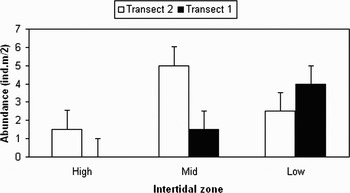
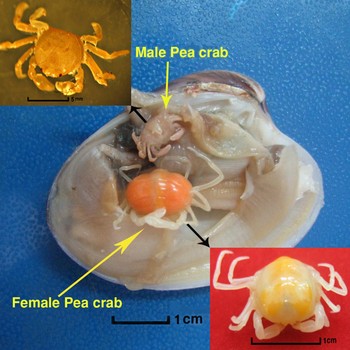
A total of 893 clams was collected from April 2007 to March 2008. In transects one and two (Figure 1), infested clams were found in the mid and low tidal zones (Figure 2). A total of 81 crab females and eight crab males were found. Seven of the eight pea crab males were found near females during the period February to early March. The remaining solitary pea crab found in the clam was immature (3 mm). The carapaces of female pea crabs were soft, white and orange in colour and circular in shape. Females had small eyes and large abdomens. The carapace of male crabs was circular, hard and light grey to brown in colour. The abdominal section of the male pea crab was found to be narrow and small (Figure 3). The infestation frequency of the pooled sample (893 clams), was 9.18%. Single pea crabs were observed in 82 clams. There was no significant difference in the frequency of infested male and female clams (χ2 = 0.0001, df = 2, P > 0.05) (Table 1). Since it was only possible to determine the sex of clams during the active part of the reproductive cycle, the number of infested clams of undetermined sex was more than the sex-determined clams. Maximum and minimum infestations were observed in May 2007 and November 2007, respectively.
Diagram of abundance of infested clams in different intertidal zones in two transects of Bandar Abbas coast.

Arcotheres tivelae in dissected specimen of Amiantis umbonella.

Relationship between sex of crabs (Arcotheres tivelae) and sex of host clams (Amiantis umbonella).

N, number.
The largest and smallest infested clams in the two transects were 61 and 19 mm, respectively. The largest and smallest pea crabs were 11 and 3.5 mm in females and 6.5 and 3 mm in males. The mean clam length, clam width and crab carapace width of infested clams were 39.84 ± 8.93, 36.31 ± 8.51 and 7.7 ± 1.7 mm, respectively. The mean total clam weight and total crab female weight of infested clams were 23.16 ± 11.49 and 0.42 ± 0.15 g, respectively.
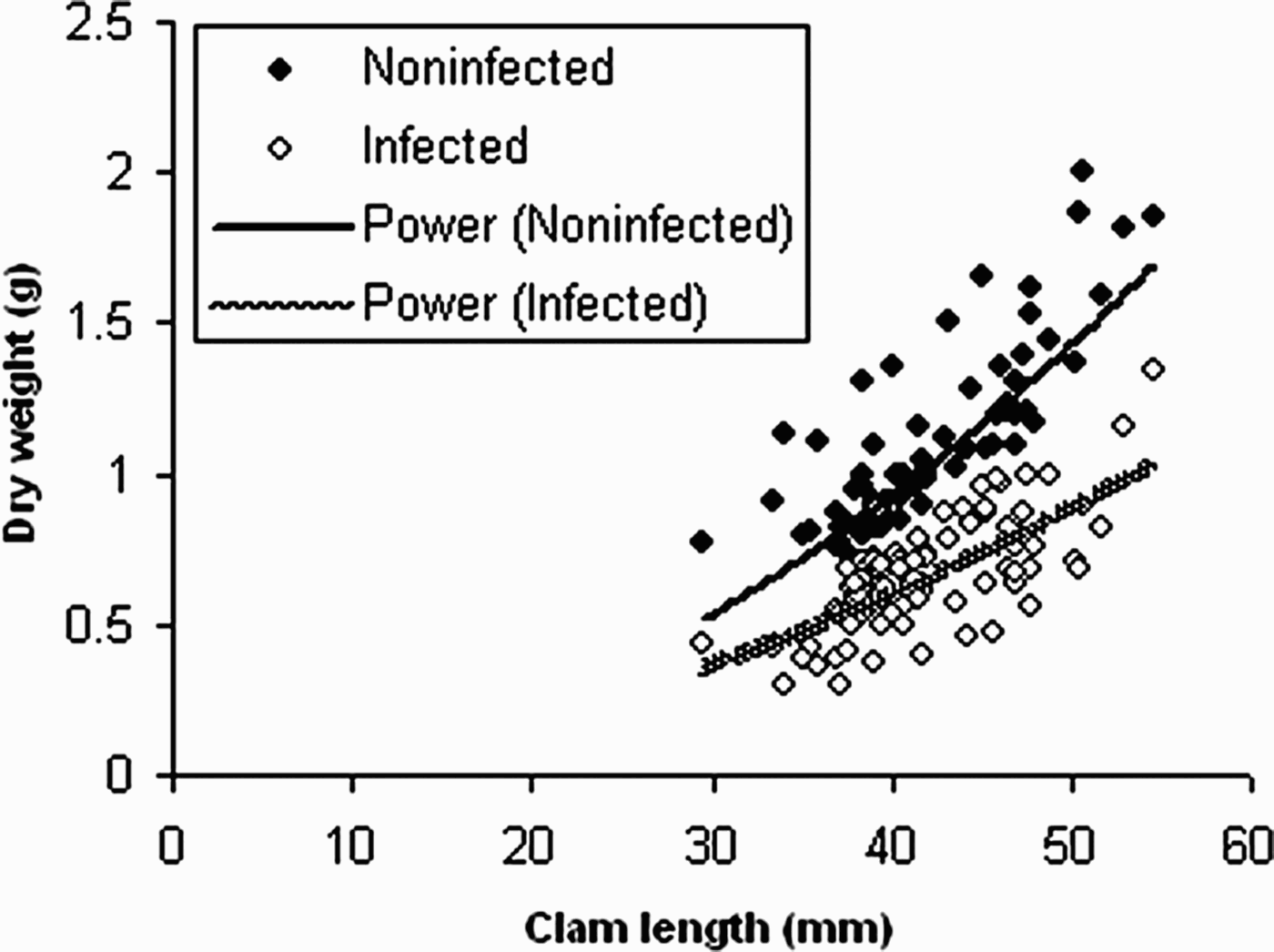
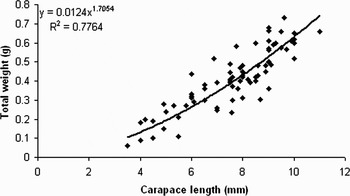
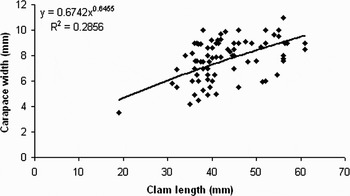
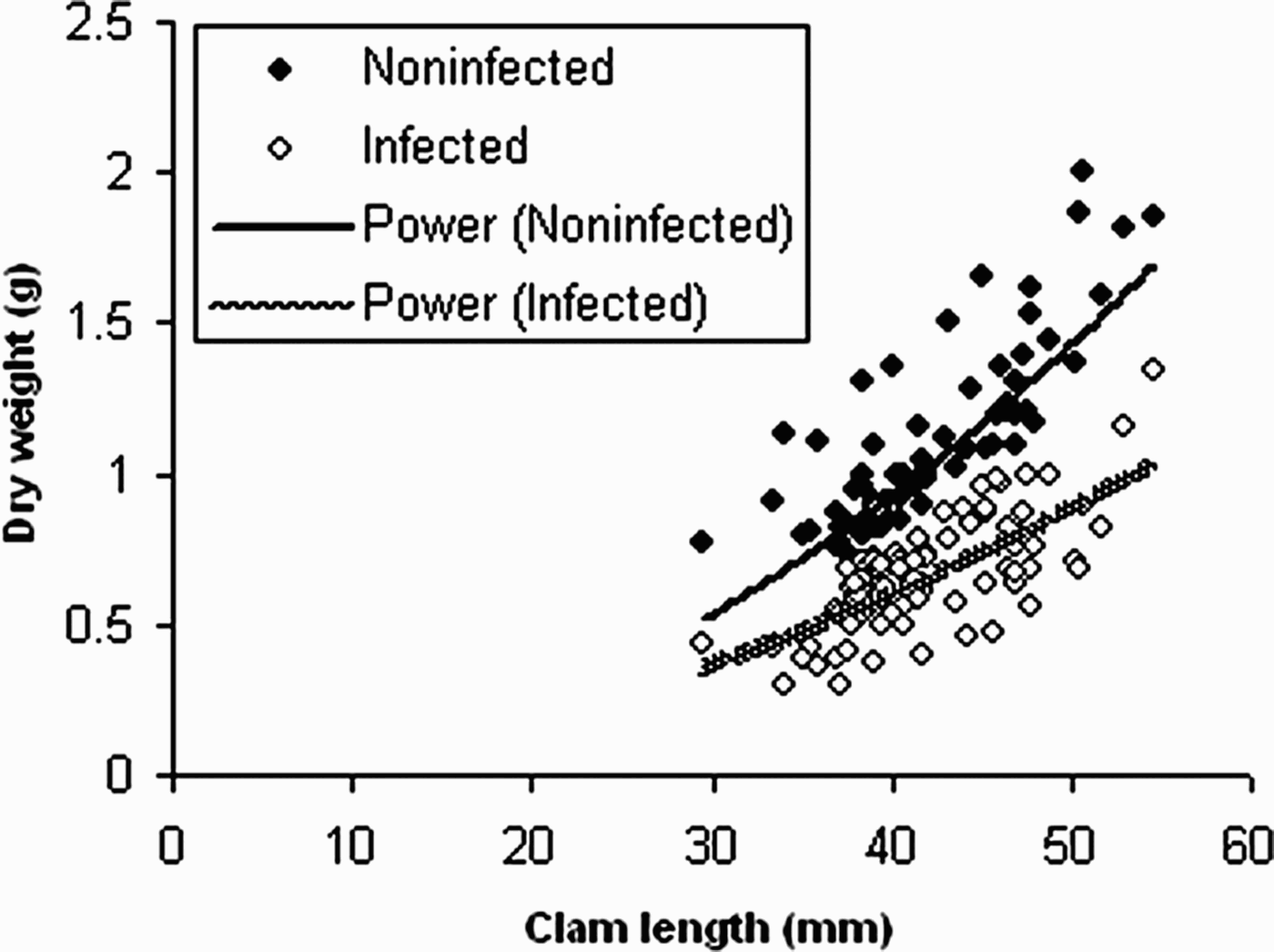
The non-linear regression between length and dry weight of soft tissues of infested and non-infested clams showed that infested clams weighed less than non-infested clams (P < 0.05) (Figure 4). The mean of dry weights for non-infested clams (1.04 ± 0.32 g) was more than infested clams (0.66 ± 0.17). The relationship between crab female carapace length and total weight of all specimens was found to be W = 0.0124 L1.7054 with a correlation coefficient of R2 = 0.77 (Figure 5). Non-linear regression, used to determine the relationship between clam length to female crab width correlation coefficients for these analyses was R2 = 0.28 (Figure 6).
Regression analysis of total length–dry weight of infested and non-infested clams' soft tissues.
The relationship between carapace length and total weight of the pea crab Arcotheres tivelae females.

The relationship between clam length and crab females carapace width.

Reproduction biology and fecundity of Arcotheres tivelae
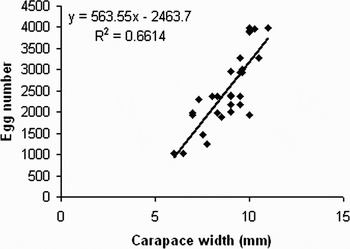
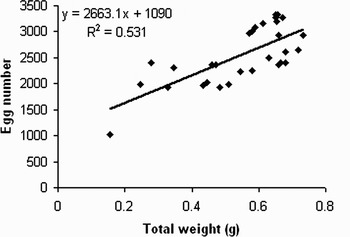
Pea crab females with orange coloured egg masses were observed in July, September and October 2007. No males were found during these times. However, in late February and early March 2008, some ovigerous females were found together with males. In late March, the egg masses in females changed colour to red-brown and by late April, 70% of females were without egg masses. Among 30 ovigerous females examined on fecundity (Table 2), one female 11 mm long had 3985 eggs, but a 6 mm long female had 1023 eggs. Mean fecundity of the females examined was 2518 ± 86.4 eggs and the size of eggs ranged from 6–11 mm. Correlations performed on the sample included carapace width to egg number and total weight to egg number (Figures 7 & 8). As was to be expected, the regression analysis between carapace width and egg number was significant and positive (EN = 563.55 CW −2463.7; R2 = 0.6614; P < 0.05). The relationship between total weight and egg number was also significant (EN = 2663.1 TW + 1090; R2 = 0.531; P < 0.05).
The relationship between carapace width and egg number in Arcotheres tivelae ovigerous females.

The relationship between total weight and egg number in Arcotheres tivelae ovigerous females.

The mean egg number, the mean total weight with egg mass and the mean egg batches weight of Arcotheres tivelae in size-classes of 30 ovigerous pea crab females.

N, number; SD, standard deviation.
The relation of Arcotheres tivelae infestation to sea physical and chemical factors
The annual means of water temperature, salinity, dissolved oxygen and pH were 27.07, 39.2, 5.91 and 8.3, respectively. Sea surface temperature (SST) and salinity decreased from April 2007 to December 2007 correlating with winter rains in the area, and increased from December to March 2008. There was no significant correlation between dissolved oxygen (R2 = −0.01), pH (R2 = 0.18), salinity (R2 = −0.07) and SST (R2 = 0.08) and abundance of pea crab females during one year of study (Pearson coefficient, P > 0.05). The results of this study appear to show that infestation is not dependent on physical or chemical factors and different seasons; however, more data is required before any conclusion can be made about the influence of these parameters.
DISCUSSION
Occurrence, frequency and biometric analysis
Infaunal genus Tivela from the bivalve molluscs' family Veneridae have been reported as a host for pea crabs (Frey, Reference Frey1971). Amiantis umbonella from the same family has similar characteristics in order to be a suitable host for these crabs on the northern coast of the Persian Gulf. Seasonal winds, current regimes and high concentration of nutrients provide an ideal place to live for marine organisms. Arcotheres tivelae lives on the northern coast of the Persian Gulf, Iran; and the species found A. umbonella to be a suitable host in this area because the clam is abundant and available. Arcotheres tivelae is found in some infaunal clams, including Tivela ponderosa (Gordon, Reference Gordon1936); however, a review of the literature could not find any reports of infestation in A. umbonella. Al-Khayat & Al-Mohannadi (Reference Al-Khayat and Al-Mohannadi2006) studied the biology and ecology of A. umbonella in Qatar, but they did not report occurrence of pea crabs in this clam in their investigation.
This study found infested clams in mid and low tidal zones in two study sites off the coast of Bandar Abbas in the Persian Gulf. Houghton (Reference Houghton1963) and Seed (Reference Seed1969) have reported that the depth of water occupied by a host bivalve is an important factor in controlling the distribution of P. pisum in English mussels M. edulis. Infested mussels were found predominantly in shallower areas off the shore. Krucyzynski (Reference Krucyzynski1925) found the mussels M. edulis infested with Pinnotheres maculates Say, 1818 mainly occupied the sub-tidal zone in Massachusetts coastal waters. Results of this study show that the present pea crabs also choose sub-tidal hosts in that infestation was greater in clams found in mid and low tidal zones than in high tidal zones. It can suggest that the pea crabs are not able to swim for long distances and prefer to locate in clams which live in low and mid tidal zones; furthermore, specimens of A. umbonella in these areas are more abundant. Pea crabs feed on particles filtered from water by the clam's gills and use oxygen from water inside the clam's mantle cavity. For this reason, the crabs may live in low tidal clams which are submerged for a longer period of time.
The infestation frequency of 9.18% in this study is very low compared to the infestation frequency (72.4–94.7%) of pea crab Pinnotheres sinensis Shen, 1932 in the bivalve host Septifer virgatus Wiegmann, 1837 in Uranouchi Bay (Asama & Yamaoka, Reference Asama and Yamaoka2008) and 31% of Pinnotheres novaezelandiae in green-lipped mussels Perna canaliculus (Hickman, Reference Hickman1978). It suggests that biological characters and regional ecological factors can play a noticeable role in infestation frequency rate in different places.
There was no significant relationship between clam length and crab carapace width; also no correlation could be found between the carapace width of P. sinensis and shell length of S. virgatus (Asama & Yamaoka, Reference Asama and Yamaoka2008), whereas Fabia insularis Melo, 1971 (Pinnotheridae) in Macoma constricta Bruguière, 1792 (Bivalvia) showed a positive correlation between shell length and carapace width (Cruz-Kaled et al., Reference Cruz-Kaled, Boehs and Absher2004). This suggests that A. tivelae females looking in the swarming stage for a host choose them rather accidentally; as a result, similar size-classes of crabs find different size-classes of clams.
In this study, infested clams weighed less than non-infested clams suggesting that infestation carries a negative consequence to the host bivalve. This finding is similar to that reported for P. pisum infesting M. edulis (Seed, Reference Seed1969) and P. maculatus infesting the bay scallop Crassostrea virginica Gmelin, 1791 (Krucyzynski, Reference Krucyzynski1972). The latter report also shows that pea crabs are able to steal phytoplankton from the hosts' gills leading to growth and weight reduction in hosts. Infested clams with the lower weight are more sensitive than non-infested clams in the unfavourable conditions which can lead to death of the clam. This weight reduction can also affect the commercial value of the clam in the global markets.
Reproduction biology and fecundity of pea crabs
This study found that mating of crabs takes place in winter when the males visit the females within the mantle of the host clam. Ovigerous females were found in several months during the one year study period, but mating was observed only in late March which led to hatching. Female crabs displayed a parasitic lifestyle during the one-year study period as found by Lebour (Reference Lebour1928), whereas free swimming males only occurred inside the clams in late February. Red-brown egg masses of females were observed in late March suggesting successful fertilization in late February after fertilization. It is speculated that adult pea crab males may find crab males within infested hosts via the release of pheromones since all mature male crabs were found near ovigerous females in hosts. Asama & Yamaoka (Reference Asama and Yamaoka2008) have suggested that pheromones attract males P. sinensis but repel females in bivalve S. virgatus. A similar finding has been reported by Bell & Stancyk (Reference Bell and Stancyk1983) in that the pitnnotherid crab Dissodactylus mellitae Rathbun, 1900 found on sand dollar host, Mellita quinquiesperforata Leske, 1778 (Echinodernata: Echinoidea) in southern Carolina (USA), mated in winter and released larvae in summer. Arcotheres tivelae in this study mated in winter but no berried female crabs were observed in the late spring; it is evident that they had already released larva in mid spring. The drop in sea temperature appears to trigger mating in the pea crabs. Sea temperature decline is an important factor for mating in many invertebrates that live in areas with high temperature ranges (Darriba et al., Reference Darriba, Sanjuan and Guerra2004). In Bandar Abbas, because the weather is relatively hot most of the year, temperature reduction can act as a biological shock and stimulate most marine animals such as some species of clam and crab to reproduce.
The abdomen of female pea crabs was enlarged to facilitate egg carrying and in this study carapace width was positively correlated to the number of eggs. Egg production in A. tivelae, like in most other decapods (Bell & Stancyk, Reference Bell and Stancyk1983), depends on the width and weight of crabs.
The relation of pea crabs infestation to sea physical and chemical factors
During this study, no correlation was observed between pH, salinity, and SSTs and dissolved oxygen content, and the presence of pea crabs in clams. It would appear that pea crabs select their hosts and settle irrespective of physical or chemical factors of seawater. Krucyzynski (1974) has also reported no correlation between salinity and temperature and the presence of P. maculatus in M. edulis.
The incidence of A. tivelae in A. umbonella may have some importance in fisheries management. The area of study is under a high degree of fishing pressure from local fishermen which could account for the reduced numbers of both clams and pea crabs. Absence of enough information on macro-benthic animals in some parts of the Persian Gulf make this area essential for study on biology and ecology of benthic animals that can provide a correct management and suitable plan to conserve marine organisms.
ACKNOWLEDGMENTS
Thanks to Dr E. Kamrani from Hormozgan University for his efficient help in Bandar Abbas and K. Jokar and other scientists from the Fishery Research Laboratory of Bandar Abbas, The Persian Gulf and Oman Sea Ecology Research Center. Special thanks to Ms J. Kallie for her critical review of this manuscript. Special thanks to Dr P.K.L. Ng for his essential help to identify the pea crab.