Introduction
The percutaneous osseointegrated bone conduction device is a well-established means of hearing rehabilitation in appropriately selected patients. In order to maintain the health of the peri-abutment skin, the patient has to undertake daily skin maintenance. However, adverse skin reactions can occur despite optimum care, which may prevent use of the device and can lead to fixture loss. This can usually be treated in the out-patient setting, but may require in-patient care in severe cases.Reference Desmet, Bouzegta, Hofkens, De Backer, Lambrechts and Wauters 1 – Reference Badran, Arya, Bunstone and Mackinnon 6
To overcome this, the magnetic transcutaneous osseointegrated bone conduction device was developed. The transcutaneous device uses an internal magnet attached to the skull via an osseointegrated titanium screw. The sound processor then attaches to the scalp through an external magnet, enabling the underlying skin to remain intact.Reference Calvo Bodnia, Foghsgaard, Nue Moller and Caye-Thomasen 5 – Reference Gillett, Fairley, Chandrashaker, Bean and Gonzalez 7
The transcutaneous osseointegrated bone conduction device has been associated with fewer skin-related complications when compared to the percutaneous osseointegrated bone conduction device.Reference Iseri, Orhan, Tuncer, Kara, Durgut and Guldiken 8 – Reference Powell, Rolfe and Birman 10 Thus, use of the transcutaneous device may result in fewer out-patient appointments and required treatments, and could represent a more cost-effective option long term when compared to the percutaneous device.
Our study aimed to compare post-operative complications and follow-up costs in the first six months following the implantation of percutaneous versus transcutaneous osseointegrated bone conduction devices.
Materials and methods
Ethical considerations
No ethical approval was required for this study.
Patient selection
This retrospective case note review included adult patients who underwent implantation with the transcutaneous Attract bone-anchored hearing aid (BAHA) (Cochlear, Mölnlycke, Sweden) (n = 22) or the percutaneous DermaLock BAHA (Cochlear) (n = 25) in a tertiary referral centre between September 2013 and December 2014.
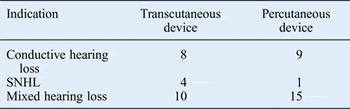
All patients underwent implantation for conductive hearing loss, mixed hearing loss or single-sided deafness, depending on their own device preference and suitability (Table I).Reference Powell, Rolfe and Birman 10
Indications for each device

Data represent numbers of recipients. SNHL = sensorineural hearing loss
Data collection
Patients were followed up over a six-month period. The number of post-operative clinic appointments, complications and treatments undertaken over this follow-up period were recorded.
Data analysis
Individual costs for each follow-up clinic appointment, procedure, prescription or ward admission were provided by the hospital finance department. An individual total cost for each patient over the six-month follow-up period was then calculated using these values. A total treatment cost and follow-up treatment cost average were calculated and compared between the two groups.
Results
None of the patients in either group had a skin condition that would complicate healing. Mean patient age was 56 years (range, 30–77 years) for those who received the transcutaneous osseointegrated bone conduction device and 58 years (range, 32–75 years) for those who received the percutaneous osseointegrated bone conduction device.
The initial outlay cost was slightly higher for the transcutaneous device than the percutaneous device (£5225.40 vs £5103.60). The cost of operating theatre time, follow-up appointments and individual treatments were the same for both groups.
The mean average total cost for the six-month post-implantation period was greater for the percutaneous device group than for the transcutaneous device group (£7523.49 vs £7243.91).
The patients with the percutaneous device required more out-patient appointments than those with the transcutaneous device (6.0 vs 3.5 appointments). This included appointments with doctors, nurses and audiologists.
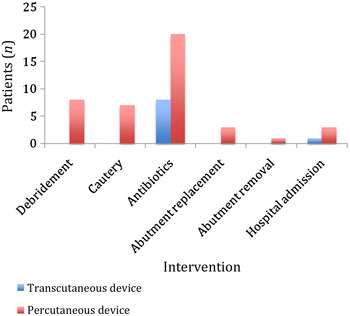
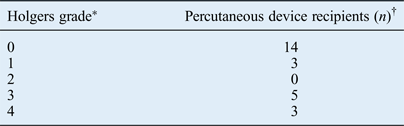
Overall, there were fewer patients with peri-abutment skin complications in the transcutaneous device group. The skin-related complications were assessed and graded using Holgers’ scoring system.Reference Holgers, Roupe, Tjellström and Bjursten 11 Specifically, each patient was graded from 0 to 4, with 0 reflecting skin that was free of complications and 4 representing infection that resulted in abutment removal (Table II). In the percutaneous group, there was a demonstrably higher rate of skin complications. Three patients (12 per cent) had minor skin irritation (Holgers grade 1), five patients (20 per cent) had a Holgers grade 3 skin complication requiring silver nitrate cautery, and three patients (12 per cent) had complications requiring removal of the abutment despite treatment with intravenous antibiotics (Figure 1). In comparison, one patient in the transcutaneous device group had a minor skin irritation, whilst the remainder had no skin complications.
Interventions required for the treatment of complications associated with the use of the transcutaneous (n = 22) and percutaneous (n = 25) osseointegrated bone conduction devices.

Holgers’ classification of soft tissue complications for percutaneous device recipients

*Whereby 0 reflects no complications and 4 represents infection resulting in abutment removal. †Total n = 25
Two patients in the transcutaneous device group experienced peri-abutment pain post-implantation, which resolved with a combination of simple analgesia and change in magnet strength. One of these patients was admitted overnight to investigate potential underlying infection as a cause for neuropathic pain, with no infective cause identified.
Some patients with the transcutaneous device experienced numbness to the skin around the abutment site, mainly in a superior distribution to the implant. For some patients, this sensory deficit resolved over six months; however, over half of the patients continued to experience some mild residual numbness. To date, none of the transcutaneous device patients in this cohort have required implant removal.
Although the transcutaneous device was slightly more expensive than the percutaneous device (£5225.40 vs £5103.60), the increased number of follow-up appointments and required clinical treatments for skin-related complications meant that the average total follow-up cost of the percutaneous device was much higher (£7523.49) than that of the transcutaneous device (£7243.91), with a difference in cost of approximately 4 per cent.
Here we show a worked example for calculating the cost of using the percutaneous osseointegrated bone conduction device: device cost (£5103.60) + cost of procedure (£1516.59) + doctor follow up (3 clinic appointments at £90 each = £270) + nurse follow up (1 clinic appointment at £90 each) + audiology follow up (2 clinic appointments at £90 = £180) + cautery (2 × £116.62 = £233.24) + debridement (2 × £81.71 = £163.42) = £7556.85.
The cost of using the transcutaneous osseointegrated bone conduction device was calculated as follows: device cost (£5225.40) + cost of procedure (£1516.59) + doctor follow up (1 clinic appointment at £90 each) + audiology follow up (2 clinic appointments at £90 each = £180) + suture removal (£80.66) + dressing (£103.36) = £7196.01.
Discussion
The current study demonstrated a greater complication rate with the percutaneous osseointegrated bone conduction device compared with the transcutaneous osseointegrated bone conduction device. Thirty-two per cent of patients (n = 8) experienced a soft tissue complication of Holgers grade 2 or above. The majority of these complications settled with out-patient treatment in the form of cautery and antibiotic ointment. Twelve per cent (n = 3) required implant removal because of wound complications.
There were no significant soft tissue complications associated with the use of the transcutaneous device. However, two patients had temporary post-operative neuropathic pain and one patient required hospital admission overnight because of severe pain. The increased frequency of soft tissue complications in the percutaneous device group (compared to the transcutaneous device group) led to increased post-operative costs over the six-month period.
Because the transcutaneous osseointegrated bone conduction device is a relatively recent development, few studies have assessed the complications associated with its use and analysed its cost in comparison with the percutaneous osseointegrated bone conduction device. These are important issues to consider when determining the cost-effectiveness of a new device.
The complication rates in patients undergoing implantation with a percutaneous device in the current study are comparable with other studies in the literature. In their study of 185 patients, Calvo Bodnia et al. demonstrated that 25 per cent of adult and elderly patients had skin complications of Holgers grade 2 or more.Reference Calvo Bodnia, Foghsgaard, Nue Moller and Caye-Thomasen 5 The implant was removed in 10 per cent of their patient group, which also included children.
In a study of 165 adults and children implanted with a percutaneous device, Badran et al. demonstrated soft tissue complications in 21 per cent of the patients and the implant had to be removed in 12 per cent.Reference Badran, Arya, Bunstone and Mackinnon 6 Gillett et al. demonstrated peri-abutment skin complications in 33 per cent.Reference Gillett, Fairley, Chandrashaker, Bean and Gonzalez 7
As the transcutaneous device is a new development, the experience of complications amongst other centres is limited. Briggs et al. performed a multi-centre study involving 27 patients who underwent surgical implantation of the transcutaneous device for conductive or mild mixed hearing loss, with a 9-month follow-up period.Reference Briggs, Van Hasselt, Luntz, Goycoolea, Wigren and Weber 9 All patients had satisfactory wound healing. No patients suffered with fixture loss and no implants needed removing. Mild erythema was reported in four patients. This resolved spontaneously in three patients; one patient required a reduction in magnet strength. In the current study, three patients suffered pain or mild erythema; this was resolved with a lower magnet strength in two cases, and was treated as neuropathic pain successfully with low-dose amitriptyline in the third case. In agreement with the current study, Briggs et al. reported peri-abutment numbness immediately following device fitting in 62.9 per cent of patients, which reduced to 22.2 per cent at nine months post-operatively.Reference Briggs, Van Hasselt, Luntz, Goycoolea, Wigren and Weber 9 In the current study, 48.1 per cent of patients reported peri-abutment numbness following surgery, which reduced to 29.6 per cent at six months.
A second multi-centre study, by Iseri et al., compared 21 patients implanted with a percutaneous device with 16 patients implanted with a transcutaneous device.Reference Iseri, Orhan, Tuncer, Kara, Durgut and Guldiken 8 Three patients in the percutaneous device group had skin reactions of Holgers grade 2, and two patients stopped wearing their implants (one because of psychological reasons and one because of feedback issues). In the transcutaneous device group, there was one case of mild erythema over the abutment site, which resolved with a reduction in magnet strength, and three patients who experienced peri-abutment pain, which resolved with conservative measures. The current study reported similar results in the transcutaneous device group, with only 14 per cent of patients (3 out of 22 patients) reporting peri-abutment pain or erythema, compared to 25 per cent (4 out of 16 patients) in the study by Iseri et al.Reference Iseri, Orhan, Tuncer, Kara, Durgut and Guldiken 8 In the current study, 32 per cent of patients (8 out of 25 patients) had skin-related complications of Holgers grade 2 or above over the six-month follow-up period; three patients were unable to wear their implant and exploration was ultimately required.
Powell et al. compared 12 patients who underwent implantation with either the BAHA Attract device (n = 6) or the Sophono Alpha device (Medtronic, Minneapolis, Minnesota, USA) (n = 6).Reference Powell, Rolfe and Birman 10 Of the 12 patients, 11 had issues with device retention because of magnet strength. One patient in the Sophono group developed a pressure sore from the device. Despite this, all patients reported that they would recommend the device to others with similar hearing problems. In the current study, no skin problems were reported. No patients reported issues with the device falling off once the correct magnet strength had been found; however, two patients reported peri-abutment pain as a consequence of a higher strength magnet. All patients reported that they would recommend the device to others in terms of hearing outcomes.
-
• Bone conduction devices are a well-established method of hearing rehabilitation in selected conductive, mixed or single-sided hearing loss patients
-
• Percutaneous bone conduction devices are associated with soft tissue complications and require daily skin hygiene practices
-
• Transcutaneous osseointegrated bone conduction devices are associated with fewer soft tissue complications
-
• The initial outlay cost is slightly higher for the transcutaneous device than for the percutaneous device
-
• The overall cost of the transcutaneous device was lower in this study because of fewer post-operative complications
Although the initial cost of the transcutaneous device is slightly higher than the percutaneous device, this study has demonstrated that this is offset by the reduction in the cost of follow-up treatment in the first six months following surgery. The initial outlay cost may decrease with time, reflecting a reduction in production costs as the device becomes more established.
Follow-up data for the transcutaneous device are limited as it is a new device. Longer-term follow up may reveal costs associated with the transcutaneous device that were not initially apparent. However, at this point in time, the results are promising.
Conclusion
In the current study, patients with a percutaneous osseointegrated bone conduction device had a higher rate of soft tissue related complications than those with a transcutaneous osseointegrated bone conduction device. This led to increased follow-up costs for the percutaneous device over the six months following implantation. Although the follow-up period was relatively short, the transcutaneous device appears to be a more cost-effective method for hearing rehabilitation.