INTRODUCTION
The phylum Mollusca form the second largest phylum of the kingdom Animalia, with about 80,000–100,000 species recorded from various parts of the world. About 3271 species of molluscs from 591 genera and 220 families are reported from India, of which 1900 are gastropods, 1100 are bivalves, 210 are cephalopods, 41 are polyplacophores and 20 are scaphopods (Abbott & Dance, Reference Abbott and Dance2000). Aplustrids, commonly known as bubble snails, are colonial individuals belonging to the family Aplustridae Gray, 1847 (Bouchet, Reference Bouchet2014). Aplustridae comprises four accepted genera, namely, Aplustrum Schumacher, Hydatina Schumacher, Micromelo Pilsbry and Parvaplustrum Powell, with 11 species widely distributed circumtropically in the Indo-West Pacific and Atlantic waters (Apte, Reference Apte2009). The genus Hydatina consists of those Aplustrids whose shell is disproportionately reduced in comparison to the mantle and whose soft parts are brightly coloured. At present there are seven species recorded from the genus Hydatina (Australian Museum, 2014).
The present paper documents the first occurrence of this species from the west coast of India. A preserved specimen of Hydatina physis at the Australian Museum, which was collected from Chennai, south-east coast of India, during 1877, has been cited in the Global Biodiversity Information Facility (Australian Museum, 2014). There is no other record of Hydatina physis from this part of the world thenceforth, i.e. for the past 137 years. Reports of the genus Hydatina have been made for the species Hydatina zonata (Lightfoot, 1786) from the Indian coast off Chennai, Pamban, Kundukkal point, Mandapam (Burn & Thompson, Reference Burn, Thompson and Rudman1998; Burn, Reference Burn2006; Ganesh et al., Reference Ganesh, Surya Rao and Raman2009; Bouchet & Gofas, Reference Bouchet and Gofas2014) along the south-east coast, off Koyyam (Burn & Thompson, Reference Burn, Thompson and Rudman1998) along the north-east and from the Gulf of Kutch (Gosliner et al., Reference Gosliner, Behrens and Valdes2008) along the north-west coast of India. Hydatina velum (later synonymized with Hydatina zonata) has also been observed from the coast of the Gulf of Mannar, south-east coast of India (Habe et al., Reference Habe and Kuroda1950), and also from the coast of the Lakshadweep islands (Hamel & Mercier, Reference Hamel and Mercier2006).
MATERIAL AND METHODS
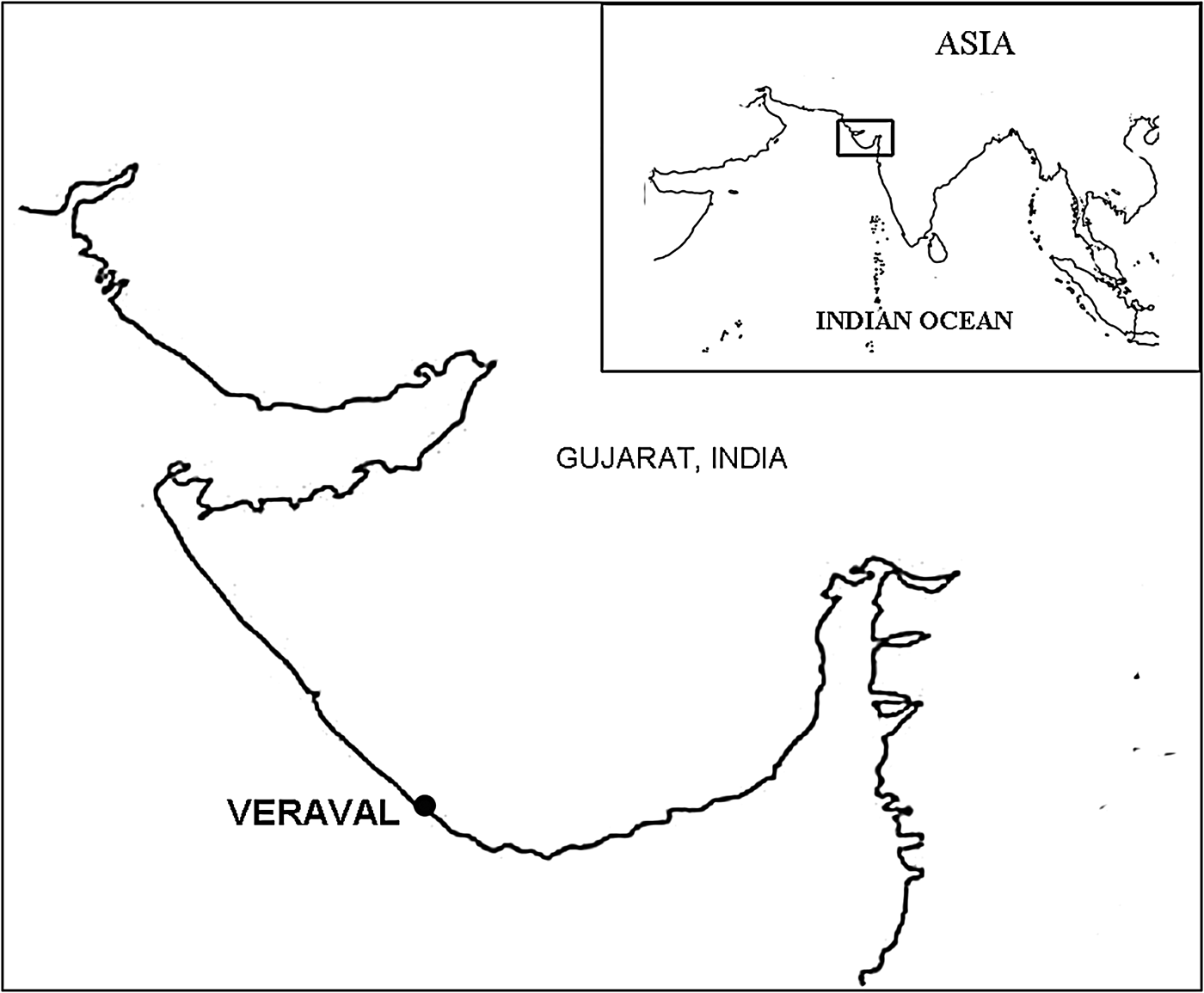
The description is based on a single specimen of Hydatina physis, which was observed at the rocky intertidal region of the Veraval coast, Gujarat, India (20°54.586′N, 70°21.135′E) on 6 January 2014 (Figure 1). The present specimen was from a new locality and the descriptions, comments and figure are presented in this article. The specimen was identified as H. physis (Kay, Reference Kay1979). Morphometric measurements were taken with a Mitutayo digital caliper to the nearest millimetre (0.01).
Map showing the location at which Hydatina physis was spotted.

Morphological features of actual specimen of Hydatina physis found on the veraval intertidal region.
Actual specimen of Hydatina physis found along Veraval inter-tidal region, Gujarat, India.
RESULTS AND DISCUSSION
Hydatina physis (Linnaeus, 1758)
SYSTEMATICS
Class GASTROPODA Cuvier, 1797
Subclass OPHISTHOBRANCHIA Milne-Edwards, 1848
Order CEPHALASPIDEA Fischer, 1883
Family APLUSTRIDAE Gray, 1847
Genus Hydatina Schumacher, 1817
Hydatina physis (Linnaeus, 1758)
Synonyms: Aplustrum virgatum Mörch, 1852; Bulla atrolineata Schröter, 1804; Bulla physis Linnaeus, 1758 (original combination); Bulla quoyana d'Orbigny, 1845; Bulla staminea Menke, 1835; Hydatina filosa Schumacher, 1817.
DIAGNOSIS
The shell with more than four, irregularly spaced, dark spiral lines, spire sunken, posterior margin of aperture not protruding above upper body whorl. No operculum.
DESCRIPTION
The shell is globose, ‘bubble’ type, thin, fragile and translucent white coloured. The body whorl is large enough to cover all other whorls. The spire is exposed, with 2.5–3 whorls and slightly risen. Aperture is very large and posterior apertural margin not protruding above upper body whorl. The height of the shell is 36 mm with a width of 30 mm and number of whorls is three.
Head bears two black eyes situated between the cephalic shield lobes. The front of the head shield is well developed into pair of large and lobe like tentacles. The foot is very large, broad and extends beyond the shell while moving. It has fleshy wing-like flaps, called parapodia (Figure 2). The complete body can rarely be retracted into the shell. This might have led to the loss of operculum during evolution. Parietal callus is broadly connected to columellar callus and well defined, forming a thin and clearly visible layer on the body whorl. It can grow to 60 mm (Kensley, Reference Kensley1973).
Colouration: Body colour is rose to reddish brown, shell translucent white with noticeable brown to black spiral lines, usually two slightly broader lines bordering one or more narrower lines. The foot and cephalic shield lobes have a vivid iridescent blue coloured margin (Figure 3).
The species is clearly demarcated from its counterpart, Hydatina vesicaria, which has a more slender shell with more irregularly spaced and thinner brownish spire lines (Kay, Reference Kay1979). Another species reported from Indian waters, Hydatina zonata, can be easily distinguished from Hydatina physis by the three dark bands on its body whorl. The anatomy of specimens of Hydatina amplustre (Linneaus, 1758) confirms that this species is congeneric with Hydatina physis. Hydatina amplustre can be distinguished from Hydatina physis by its thin inflated shell marked with broad flesh-coloured bands outlined in black (Kilburn & Rippey, Reference Kilburn and Rippey1982).
The species are commonly found in sandy bottomed areas and mainly feed on cirratulid polychaete worms (Kilburn & Rippey, Reference Kilburn and Rippey1982), a group in which chemical defence has been reported to reduce predation by fish (Menon et al., Reference Menon, Datta and Das Gupta1961) and its twisted egg ribbon is anchored to the sandy substrate at one end (Morris, Reference Morris1966). It is a nocturnal species that buries itself in sand during the day. Hydatina physis follows a 12 h nocturnal circadian rhythm mediated by light intensity and modulated by food availability. The courtship, copulation, egg-laying and hatching of Hydatina physis is primarily influenced by the lunar cycle (Murugan et al., Reference Murugan, Dhanaya, Sarcar, Nagnathan, Rajagopal and Balasbramanian2011). Its egg mass is similar to that of Hydatina amplustre (though usually more elongated) (Richards, Reference Richards1981).
Departing from the earlier reports that the species was observed in sandy areas, in the present study Hydatina physis (Linnaeus, 1758) was found to inhabit the rocky shores of Veraval along with other molluscs such as Patella sp., Turbo sp. and Chiton sp. The area is also characterized with zoanthid colonies and the seasonal occurrence of patchy algal communities.
Hydatina physis is widely distributed, and being a circumglobal species of warm and temperate waters (Rippingale & McMichael, Reference Rippingale and McMichael1961), it has been reported from the waters of Japan (Rudman, Reference Rudman1972), the Philippines (Satyamurti, Reference Satyamurti1952), Australia (Springsteen & Leobrfra, Reference Springsteen and Leobrfra1986; Short & Potter, Reference Short and Potter1987; Sethi, Reference Sethi2013) and South Africa (Sundaram, Reference Sundaram1969; Voskuil, Reference Voskuil1995; Venkatraman & Venkataraman, Reference Venkatraman and Venkataraman2012). These opisthobranch gastropods have been known to be found in the shallow tropical waters of the Atlantic and Indo-Pacific oceans (Kilburn & Rippey, Reference Kilburn and Rippey1982; Wells & Bryce, Reference Wells and Bryce1986; Wirtz, Reference Wirtz1999). Hydatina physis has also been reported Faial Island, the Azores (Yoshiyama & Darling, Reference Yoshiyama and Darling1982) and Sao Tiago Island, Cape Verde, where a morphological differentiation has been made by the author between the species found in the Atlantic region and that from the Indo-Pacific region. The detailed accounts of living species of the genus Hydatina (e.g. Hydatina physis, Hydatina vesicaria, Hydatina albocinata, Hydatina zonata and Hydatina amplustre), along with the description of a new species, Hydatina exquisite, have been reported from Marquesa Island (Kay, Reference Kay1979).
The current study reports the occurrence of Hydatina physis from India after a period of 137 years. This species is expected to be more abundant in tropical waters; however, there is no published research from Indian waters other than the recent identification and cataloguing made from pre-dated collections deposited in the Australian Museum.
ACKNOWLEDGEMENTS
The authors are grateful to Dr A. Gopalakrishnan, Director, Central Marine Fisheries Research Institute, for his support and encouragement.