Lben is an acid-alcoholic fermented milk, traditionally manufactured in North African and Middle East countries using raw cow and/or goat's milk (Benkerroum & Tamime, Reference Benkerroum and Tamime2004). To prepare the traditional Lben, milk is usually placed in an earthenware jar, or in a goat leather bag called ‘Checoua’, and left at room temperature for 24–48 h until souring and coagulation occurred (Samet-Bali et al. Reference Samet-Bali, Ennouri, Dhouib and Attia2012). After this step, carried out by the natural microbiota, a few litres of water were added to milk (e.g. in Moroccan Lben, approximately 1 over 10) and the mix is churned by vigorously shaking the container, or with the help of a wooden stick. During this phase the fluidisation of the contents occurred together with the coalescence of the fat globules and the consequent separation of Lben (the creamy liquid phase) from raw butter. Traditional Lben usually lasts for a few (2–3) days since afterwards it becomes too sour, acquires a strong yeast flavour and a bitter taste. This is generally due to the presence of undesirable microorganisms in the raw milk (as well as in the ‘Checoua’) and/or yeast overgrowth which are the main cause of spoilage and/or production of off-flavour(s) in traditional Lben (Benkerroum & Tamime, Reference Benkerroum and Tamime2004). Moreover, yeasts are commonly responsible for the production of carbon dioxide which results in the blowing of the packaging container (Jakobsen & Narvhus, Reference Jakobsen and Narvhus1996).
The pasteurisation of raw milk and the use of selected lactic acid bacterial (LAB) cultures can be effective means to standardise Lben production, extend its shelf-life and improve its safety while allowing its manufacturing at the industrial or semi-industrial scale where milk fermentation, coagulation and churning can be entirely mechanised (Benkerroum & Tamime, Reference Benkerroum and Tamime2004; Samet-Bali et al. Reference Samet-Bali, Bellila, Ayadi, Marzouk and Attia2010). Moreover, the addition of yeast enzymatic extract during Lben manufacturing could be a useful strategy in order to keep the typical features of the traditional product and allow for an extended shelf-life, which can hardly be attained by employing living yeast cultures. Such approach has been successfully applied in our laboratory to produce Gioddu, a traditional acid-alcoholic fermented milk manufactured in Sardinia, Italy (Deiana et al. Reference Deiana, Catzeddu, Caredda and Fois1991).
The aim of this study was therefore to investigate the microbial community associated with Moroccan Lben in order to select suitable LAB and yeast strains to be used in Lben manufacturing at the industrial or semi-industrial scale. The LAB starter effectiveness alone or in combination with yeast enzymatic extracts was assessed in experimental manufacturing trials and the Lben produced characterised with regard to its physicochemical, microbiological and sensory attributes during a shelf-life period of 15 d at 4 °C.
Materials and methods
Microbiological and physicochemical characterisation of traditional Moroccan Lben
Twenty-four (two days old) Lben samples from raw cow milk were collected from different Moroccan regions and investigated from a microbiological and physicochemical point of view. The ten-fold serial dilution and spread plate method (Madrau et al. Reference Madrau, Mangia, Murgia, Sanna, Garau, Leccis, Caredda and Deiana2006; Mangia et al. Reference Mangia, Murgia, Garau and Deiana2011) was used to enumerate total mesophilic microorganisms after incubation of PCA plates (Oxoid, Italy) at 32 °C for 48 h; presumptive lactobacilli and lactococci after anaerobic incubation (Gaspak, Oxoid, Italy) at 32 °C for 48 h of acidified (pH 5·4) MRS and M17 agar (Oxoid, Italy) respectively ; yeasts after incubation at 25 °C for 72 h of GYEP plates with chloramphenicol (100 μg/ml) at pH 4·5 (Garau et al. Reference Garau, Castaldi, Santona, Deiana and Melis2007) whilst staphylococci were enumerated on Baird Parker agar medium supplemented with Egg Yolk Tellurite Emulsion (Oxoid, Italy) after incubation at 37 °C for 48 h; presumptive colonies of coagulase-positive staphylococci were assayed for coagulase activity using the Staphylase test (Oxoid, Italy); presumptive enterococci were counted on Slanetz and Bartley medium (Oxoid, Italy), incubated at 37 °C for 48 h; coliforms were enumerated on MacConkey Agar (Oxoid, Italy) after incubation at 37 °C for 24 h; spores of sulphite-reducing clostridia were enumerated after heat treatment (80 °C for 10 min) of the samples, inoculation on DRCM Broth (Oxoid, Italy) and incubation at 37 °C for 48 h in anaerobic conditions (MPN method); Salmonella spp. were enumerated using the Mangia et al. (Reference Mangia, Murgia, Garau and Deiana2007) method.
Physicochemical parameters such as pH, lactose and lactic acid, fat, dry matter, ash, total nitrogen and casein nitrogen were determined as previously described (Madrau et al. Reference Madrau, Mangia, Murgia, Sanna, Garau, Leccis, Caredda and Deiana2006). Chlorides were determined following the IDF 88A Standard (1988) whilst ethanol and acetaldehyde were quantified using enzymatic assays (Boehringer Mannheim/R-Biopharm, Germany). Diacetyl and acetoin were quantified using the Beshkova et al. (Reference Beshkova, Simova, Frengova and Simov1998) method.
LAB and yeasts identification and characterisation for technological attributes
Random colonies were selected from M17 and MRS plates, purified with further streaking on the same medium of isolation and tested for Gram stain, catalase production and cell morphology (phase contrast microscopy; Zeiss, Germany). Gram-positive and catalase-negative rods were characterised and identified according to Kandler & Weiss (Reference Kandler, Weiss, Sneath, Mair, Sharpe and Holt1986) and using API 50 CHL test galleries (bioMerieux, France). Gram-positive and catalase-negative coccal shaped LAB were identified following Bridge & Sneath (Reference Bridge and Sneath1983). Presumptive Streptococcus and Leuconostoc strains were identified by using API 20 STREP test galleries, presumptive Enterococcus strains by using API 50 CHL (bioMerieux, France). Calcium Citrate Agar and X-gal were used to differentiate Leuconostoc spp. and citrate positive lactococci from Citrate negative lactococci (Vogensen et al. Reference Vogensen, Karst, Larsen, Kringelum, Ellekjaer and Nielsen1987; Friedrich & Lenke, Reference Friedrich and Lenke2006).
LAB cocci were tested for several attributes relevant for the production of fermented milks such as growth kinetic, acidifying and proteolytic activity and post-acidification capacity (Sanna et al. Reference Sanna, Mangia, Garau, Murgia, Massa, Franco and Deiana2005; Deiana & Torriani Reference Deiana, Torriani, Farris, Gobbetti, Neviani and Rozzano2012) on sterile skim milk (Oxoid, Italy). Growth kinetics, acidification and proteolytic activity were determined as described by Mangia et al. (Reference Mangia, Murgia, Garau, Sanna and Deiana2008) and viable counts performed at 0, 2, 4, 6, 8, 10, 12 and 24 h incubation at 32 °C. Viable counts were carried out on M17 agar using the ten-fold serial dilution method (Mangia et al. Reference Mangia, Murgia, Garau and Deiana2011). At every time-point the acidifying activity of each strain (i.e. the lactic acid produced) was determined as described in Sanna et al. (Reference Sanna, Mangia, Garau, Murgia, Massa, Franco and Deiana2005). LAB proteolytic activity was determined after 12 and 24 h incubation on skim milk using the spectrometric method described by Church et al. (Reference Church, Swaisgood, Porter and Catignani1983). Post acidification of each LAB (i.e. the lactic acid produced) was determined in fermented skim milk after 1, 5 and 15 d storage at 4 °C (Sanna et al. Reference Sanna, Mangia, Garau, Murgia, Massa, Franco and Deiana2005).
Yeast colonies were randomly collected from GYEP plates, purified as for LAB, and identified according to morphological and biochemical features following Kurtzman et al. (Reference Kurtzman, Fell and Boekhout2011) and using Api 20 C AUX (bioMerieux).
For the yeast enzymatic extract preparation, yeast strains were grown in GYEP liquid medium at 25 °C for 24 h. The cultures were then pelletted, re-suspended in 0·1 M citrate-phosphate buffer at pH 6·4 and cells were broken using an MSK homogenizer (Braun S.p.A., Milan). The lysate obtained was sterile-filtered with a Millipore vacuum system, using 0·45 μm-diameter filters, and then stored at −80 °C until use. Selected yeast strains and derived cell extracts were characterised for their enzymatic profiles using the API ZYM test system (bioMérieux, Italy).
Experimental Lben production
Lben was produced on a pilot scale using partially skimmed cow's milk (fat content 1·8 %), pasteurised at 82 °C for 2 min, cooled to 25 °C, and inoculated with a mixture of selected LAB plus yeast enzymatic extract or LAB alone. The incubation was carried out at 25 °C until coagulation (approximately 8 h). After breaking the coagulum and homogenisation, the dense creamy liquid (i.e. the Lben) was dispensed in sterile glass bottles and kept closed at 4 °C for 15 d. In particular, two batches were tested: batch A – Lactococcus lactis subsp. lactis (1·5 %) + Lc. lactis subsp. subsp. lactis biovar diacetylactis (1·5 %); batch B – Lc. lactis subsp. lactis (1·5 %) + Lc. lactis subsp. lactis biovar diacetylactis (1·5 %) + Kluyveromices lactis enzymatic extract (0·1 g/l). Lben manufacturing was carried out in triplicate independent trials for each batch.
Experimental Lben were analysed after 1, 5 and 15 d storage at 4 °C and total mesophilic microorganisms, coliforms, presumptive lactobacilli and lactococci, yeasts, staphylococci and spores of sulphite-reducing clostridia were determined along with pH, lactose, lactic acid, fat, dry matter, ash, total nitrogen, casein nitrogen, chlorides, ethanol, acetaldehyde, diacetyl and acetoin.
Sensory analysis
Lben samples, until the product was deemed not acceptable, were evaluated after 1, 5 and 15 d storage at 4 °C by 6 assessors trained in evaluating dairy products. The attributes considered were: odour and flavour intensity, fermented, milk and vegetable odour, dairy, sour, bitter and milk taste, astringency and viscosity. Each attribute was scored on an increasing scale of from 1 (not present) to 7 (very intense) following the procedure of Irigoyen et al. (Reference Irigoyen, Arana, Castiella, Torre and Ibanez2005).
Statistical analysis
Microbiological and physicochemical analyses were carried out in triplicate on Lben samples from each batch (n=3). Mean values of microbiological and physicochemical data and sensory evaluation were compared using the Student's t-test and differences were deemed statistically significant at P<0·05.
Results and discussion
Microbial and physicochemical characteristics of traditional Moroccan Lben
Several microbial groups were isolated from the traditional Moroccan Lben investigated with lactic acid bacteria (lactococci in particular) being the dominant microbial group with more than 109 CFU/g (Table 1). Although LAB numbers in fermented milks (and dairy products) can vary widely depending on the milk type/origin and treatment (e.g. pasteurisation), as well as the manufacturing environment and the transformation process applied (Sanna et al. Reference Sanna, Mangia, Garau, Murgia, Massa, Franco and Deiana2005; Mathara et al. Reference Mathara, Schillinger, Kutima, Mbugua and Holzapfel2004; Sulieman et al. Reference Sulieman, Ilayan and El Faki2006), LAB counts in the Lben analysed were basically in line with those reported for traditional Lben manufactured from raw cow milk both in Morocco and Tunisia (Tantaoui-Elaraki et al. Reference Tantaoui-Elaraki, Berrada, El Marrakchi and Berramou1983; Ouadghiri et al. Reference Ouadghiri, Vancanneyt, Vandamme, Naser, Gevers, Lefebvre, Swings and Amar2009; Samet-Bali et al. Reference Samet-Bali, Bellila, Ayadi, Marzouk and Attia2010). Interestingly, as reported by Tantaoui-Elaraki & El Marrakchi (Reference Tantaoui-Elaraki and El Marrakchi1987), the number of lactococci in the samples investigated consistently outnumbered that of lactobacilli (Table 1). As expected for acid-alcoholic fermented milks, a substantial number of yeasts were recovered in Lben (Tantaoui-Elaraki et al. Reference Tantaoui-Elaraki, Berrada, El Marrakchi and Berramou1983) together with an important presence of coliforms, enterococci and coagulase-positive staphylococci (Table 1). The abundant presence of these latter microbial groups indicated a poor hygienic quality of the milk employed and/or of the manufacturing/storage environment. However, this is not surprising since early reports highlighted a poor hygienic quality of the traditional product manufactured from raw cow milk, with coliforms reaching values up to 104 CFU/g (Benkerroum & Tamime, Reference Benkerroum and Tamime2004).
Microbial characteristics (average values±SD, cfu/g) of the traditional Moroccan Lben investigated

† Not present
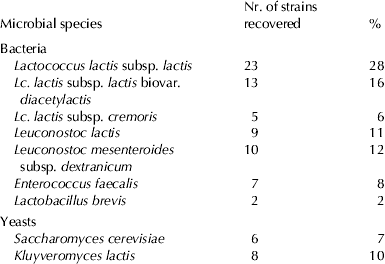
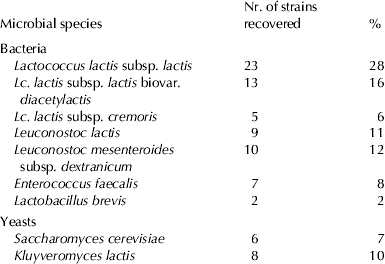
A total of 83 microbial strains were recovered and identified from traditional Lben, i.e. 69 bacteria and 14 yeasts. The mesophilic Lc. lactis subsp. lactis and Lc. lactis subsp. lactis biovar diacetylactis were the predominant LAB species (Table 2). Moreover, heterofermenting LAB were also recovered (e.g. Lactobacillus brevis and Leuconostoc species) together with Ent. faecalis. The recovery of enterococci could have significant implications in Lben since they contribute to the aroma development in dairy products and food healthiness. For instance, an enterocin produced by selected Ent. faecalis strains was active against Listeria monocytogenes and Salmonella spp. (Schirru et al. Reference Schirru, Todorov, Favaro, Mangia, Basaglia, Casella, Comunian, Franco and Deiana2012). The LAB species identified from Lben were essentially in agreement with those reported in earlier studies (e.g. Tantaoui-Elaraki & El Marrakchi, Reference Tantaoui-Elaraki and El Marrakchi1987) but quite different from those recovered from other traditional fermented milks such as the Sudanese Garris, the Kenyan Kule Naoto or the Mongolian Kurut. Although these latter fermented milks are manufactured from milk of different origin (e.g. cow, yak and camel respectively) their microbiota, as opposed to Lben, is consistently dominated by lactobacilli (∼107 CFU/g), Lb. paracasei subsp. paracasei, Lb. plantarum and Lb. helveticus respectively (Mathara et al. Reference Mathara, Schillinger, Kutima, Mbugua and Holzapfel2004; Sulieman et al. Reference Sulieman, Ilayan and El Faki2006; Bao et al. Reference Bao, Liu, Yu, Wang, Qing, Chen, Wang, Zhang, Zhang, Qiao, Sun and Zhang2012). Regarding the yeasts, 8 isolates identified as Candida sphaerica by API 20 C AUX were found to form ascospores and were identified as the telemorph form of K. lactis (Karasu-Yalcin et al. Reference Karasu-Yalcin, Senses-Ergul and Yesim-Ozbas2012). Together with Saccharomyces cerevisiae strains these were the only yeasts recovered identified (Table 2).
Occurrence of dominant microbial species in the traditional Moroccan Lben investigated
The average physicochemical composition of the Lben analysed is summarised in Table 3. The pH value and lactose content, and the lactic acid produced indicated that a strong fermentation occurred by the autochthonous microbiota (Benkerroum & Tamime, Reference Benkerroum and Tamime2004). Moreover, typical volatile carbonyl compounds which greatly contribute to the final aroma and flavour of Lben, i.e. ethanol, acetoin, diacetyl and acetaldehyde, were also detected (Table 3). We found the concentration values of these compounds quite different from those reported earlier (Boubekri et al. Reference Boubekri, Tantaoui-Elaraki, El Marrakchi, Berrada and Benkerroum1984; Samet-Bali et al. Reference Samet-Bali, Bellila, Ayadi, Marzouk and Attia2010). In particular, Samet-Bali et al. (Reference Samet-Bali, Bellila, Ayadi, Marzouk and Attia2010), found concentration values of carbonyl compounds in traditional Lben from 2·5 to 6 fold higher than those reported here while lower values were reported by Boubekri et al. (Reference Boubekri, Tantaoui-Elaraki, El Marrakchi, Berrada and Benkerroum1984). As stressed by Benkerroum & Tamime (Reference Benkerroum and Tamime2004), such differences, and more generally all those related to the physicochemical composition of Lben, could be attributed to the variability in the chemical composition of milk, to the inconsistency in the manufacturing procedures adopted and to differences in the fermenting microbiota.
Physicochemical characteristics and major volatile compounds (average values ±SD) of the traditional Moroccan Lben investigated

Technological characterisation of LAB and yeasts isolated from traditional Lben
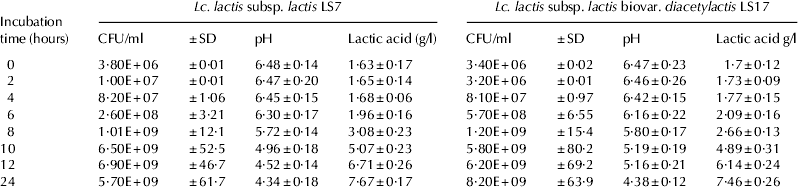
All the strains belonging to the dominant lactic and yeast species, i.e. 23 strains of Lc. lactis subsp. lactis, 13 strains of Lc. lactis subsp. lactis biovar diacetylactis and 8 strains of K. lactis, were characterised for technological attributes such as growth kinetics, acidifying and proteolytic activity and post-acidification capacity on sterile skim milk. Table 4 reports the growth kinetics and the acidifying capacity of Lc. lactis subsp. lactis LS7 and Lc. lactis subsp. lactis biovar diacetylactis LS17 which revealed the best performers and were subsequently employed as starter cultures in the experimental production of Lben (see next paragraph). The two strains grew well in skim milk reaching high numbers (∼109 CFU/g) already after 8 h of incubation. At the same time they were able to quickly acidify the medium by producing, after 24 h, substantial amounts of lactic acid (∼7·5 g/l). They also showed a poor proteolytic activity (A340 equal to 0·06 and 0·08 for LS7 and LS17 after 12 h incubation and to 0·09 and 0·12 after 24 h, OPA method) and moderate post-acidification capacities. After 1, 5 and 15 d incubation at 4 °C, the lactic acid produced was 8·1, 8·6 and 10 g/l for LS7 and 8·3, 10·3 and 12·2 for LS17. Taken together, these attributes can be considered ideal for LAB strains to be used as starter cultures in fermented milk manufacturing. A quick growth of LAB and a fast acidification are essential to overgrowth of other microbial groups, especially those which can have a health relevance, hence guaranteeing a certain product safety (Deiana & Torriani, Reference Deiana, Torriani, Farris, Gobbetti, Neviani and Rozzano2012). At the same time, the poor proteolytic ability (which however allowed for an optimal growth of lactococci) and limited post-acidification capacities can be considered as desirable features which can significantly contribute to the shelf-life extension of fermented milks as well as the maintenance of their sensory attributes and LAB viability (Sanna et al. Reference Sanna, Mangia, Garau, Murgia, Massa, Franco and Deiana2005; Damin et al. Reference Damin, Minowa, Alcantara and Oliveira2008).
Growth kinetics, pH and acidifying ability of Lc. lactis subsp. lactis LS7 and Lc. lactis subsp. lactis biovar. diacetylactis LS17 inoculated on skim milk

Only K. lactis strains were selected for further characterisation since, differently from S. cerevisiae, they were able to ferment and assimilate lactose. Such K. lactis ability is considered to be one of the key properties contributing to its growth in cheese and dairy products (Fleet, Reference Fleet1990). The enzyme profile of K. lactis AM4 was investigated and compared with that of the respective enzymatic extract to assess the biological effectiveness of this latter and, above all, its use potential in Lben manufacturing. The activity of esterase (C4), leucine, valine and cysteine arylamidase were very similar in yeast culture and in the extract. This was particularly relevant since arylamidases are involved in liberation of amino acids and development of the desirable flavours in dairy products (Herreros et al. Reference Herreros, Fresno, Gonzalez Prieto and Tornadijo2003).
Other enzymatic activities were only displayed by the living culture, e.g. esterase lipase (C8) and lipase (C14), while alkaline and acid phosphatases showed significantly higher values for the yeast enzymatic extract, i.e. ∼8 times higher with respect to living culture. The enzyme activity of the yeast extract was deemed as satisfactory when compared with the living culture and therefore the former was employed together with the selected LAB in the experimental trials of Lben manufacturing.
Experimental Lben manufactured at pilot scale
The experimental Lben manufactured with the addition of the selected LAB (Lc. lactis subsp. lactis LS7 + Lc. lactis subsp. lactis biovar diacetylactis LS17, batch A), and with LAB and K. lactis enzymatic extract (batch B), did not show the presence of contaminant microorganisms and were both characterised by the substantial abundance of lactococci (∼1010 CFU/g after 8 h incubation) indicating a good effectiveness of the LAB starter employed. LAB viability remained high in both Lben with lactococci reaching approx. 3·109 CFU/g after 5 d of storage at 4 °C and 1·9·108 and 8·8·108 CFU/g after 15 d for batch A and B respectively (P<0·05). These latter microbial counts seem to suggest a positive effect of the yeast enzymatic extract on lactococci viability. A similar synergic effect of living yeast on LAB counts was recently reported by Sudun et al. (Reference Sudun, Wulijideligen, Arakawa, Miyamoto and Miyamoto2013) who studied the interaction between lactic acid bacteria and yeasts in Airag, a Mongolian traditional fermented milk. However, this behaviour should not be considered as a general rule since opposite findings (i.e. a negative effect of yeasts on LAB count or no effects at all) have also been reported (Gadaga et al. Reference Gadaga, Mutukumira and Narvhus2001). In particular, it seems that the variability of such interaction, i.e. a positive or a negative yeast effect on LAB viability, is strongly species and strain-dependent as suggested in previous studies (Narvhus & Gadaga, Reference Narvhus and Gadaga2003). On the other hand, it should also be mentioned that the substantial production of possible LAB-inhibiting metabolites requires the concomitant presence of LAB and yeasts (i.e. growing yeast cells) which is not our case.
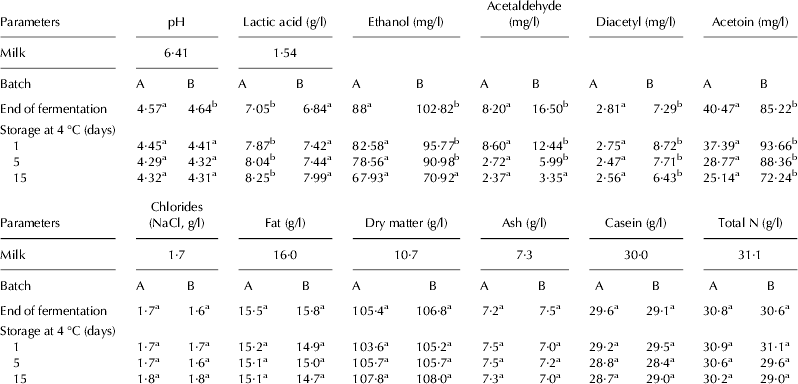
Table 5 presents the physicochemical features of milk and those of the experimental Lben manufactured using only the selected LAB cultures (batch A) and the LAB cultures together with the K. lactis extract (batch B). During fermentation a pH decrease occurred in both batches along with the increase of the lactic acid content. However, this was particularly evident for batch A (where only LAB were employed) which showed lower pH values and a higher lactic acid content compared with batch B (Table 5). Moreover, the pH and lactic acid values of batch A were similar to those of the industrial Lben described by Samet-Bali et al. (Reference Samet-Bali, Bellila, Ayadi, Marzouk and Attia2010) and manufactured by adding Lc. lactis subsp. lactis, Lc. lactis subsp. diacetylactis and Lc. lactis subsp. cremoris to a standardised cow milk (fat content 15 g/l). On the contrary, pH and lactic acid values of batch B were very similar to those reported for traditional Moroccan and/or Tunisian Lben (Samet-Bali et al. Reference Samet-Bali, Bellila, Ayadi, Marzouk and Attia2010, Reference Samet-Bali, Ennouri, Dhouib and Attia2012).
Physicochemical features of experimental Lben manufactured with Lc. lactis subsp. lactis LS7 + Lc. lactis subsp. lactis biovar diacetylactis LS17 (batch A) and with LS7 + LS17 and K. marxianus var. lactis cell extract (batch B). For each incubation time, mean values followed the same letter do not differ significantly (Student's t-test, P<0·05)
The amount of chlorides, fat, dry matter and ash, was very similar in the two batches and closely related to that displayed by the above mentioned industrial Lben described by Samet-Bali et al. (Reference Samet-Bali, Bellila, Ayadi, Marzouk and Attia2010). Also casein and total Nitrogen were similar among the two experimental batches and, in this case, both approached the values displayed by traditional Tunisian Lben rather than the industrial one (Samet-Bali et al. Reference Samet-Bali, Bellila, Ayadi, Marzouk and Attia2010). Excepting pH, lactic acid and fat, these values changed slightly during the 15 d storage (Table 5).
Four volatile compounds, most of them commonly found in Lben and fermented milks, i.e. ethanol, acetaldehyde, diacetyl and acetoin, were detected in both experimental Lben products (Table 5). Despite their amount, which can be variable within different fermented milks, these compounds contribute significantly to the aroma profile of products (Benkerroum & Tamime, Reference Benkerroum and Tamime2004; Pinto et al. Reference Pinto, Clemente and De Abreu2009; Tamime et al. Reference Tamime, Wszolek, Bozanic and Ozer2011; Samet-Bali & Attia, Reference Samet-Bali and Attia2012). Remarkably, at the end of fermentation the content of these volatile compounds was significantly higher in batch B. In particular, the acetaldehyde, diacetyl and acetoin content was two times higher in batch B than batch A, while ethanol was 15 % higher (Table 5). This could be due to a better nutrient availability and higher enzyme content in batch B, where yeast extract was added to LAB. As pointed out previously (Marshall & Tamime, Reference Marshall, Tamime and Law1997; Samet-Bali et al. Reference Samet-Bali, Bellila, Ayadi, Marzouk and Attia2010), acetaldehyde production is influenced by LAB abundance but also by the availability of specific precursors or enzymes such as threonine and threonine aldolase respectively. Moreover, this can also explain the higher presence of diacetyl, acetoin and ethanol in batch B (Samet-Bali et al. Reference Samet-Bali, Bellila, Ayadi, Marzouk and Attia2010).
Differently from the previous reported data on yoghurt (Pinto et al. Reference Pinto, Clemente and De Abreu2009), the concentration of all volatile compounds decreased substantially during the shelf life of both Lben products (Table 5). To our knowledge this is the first report on the changes of physicochemical features of Lben during storage and therefore it is difficult to know if this can be considered as a general trend.
Sensory analyses
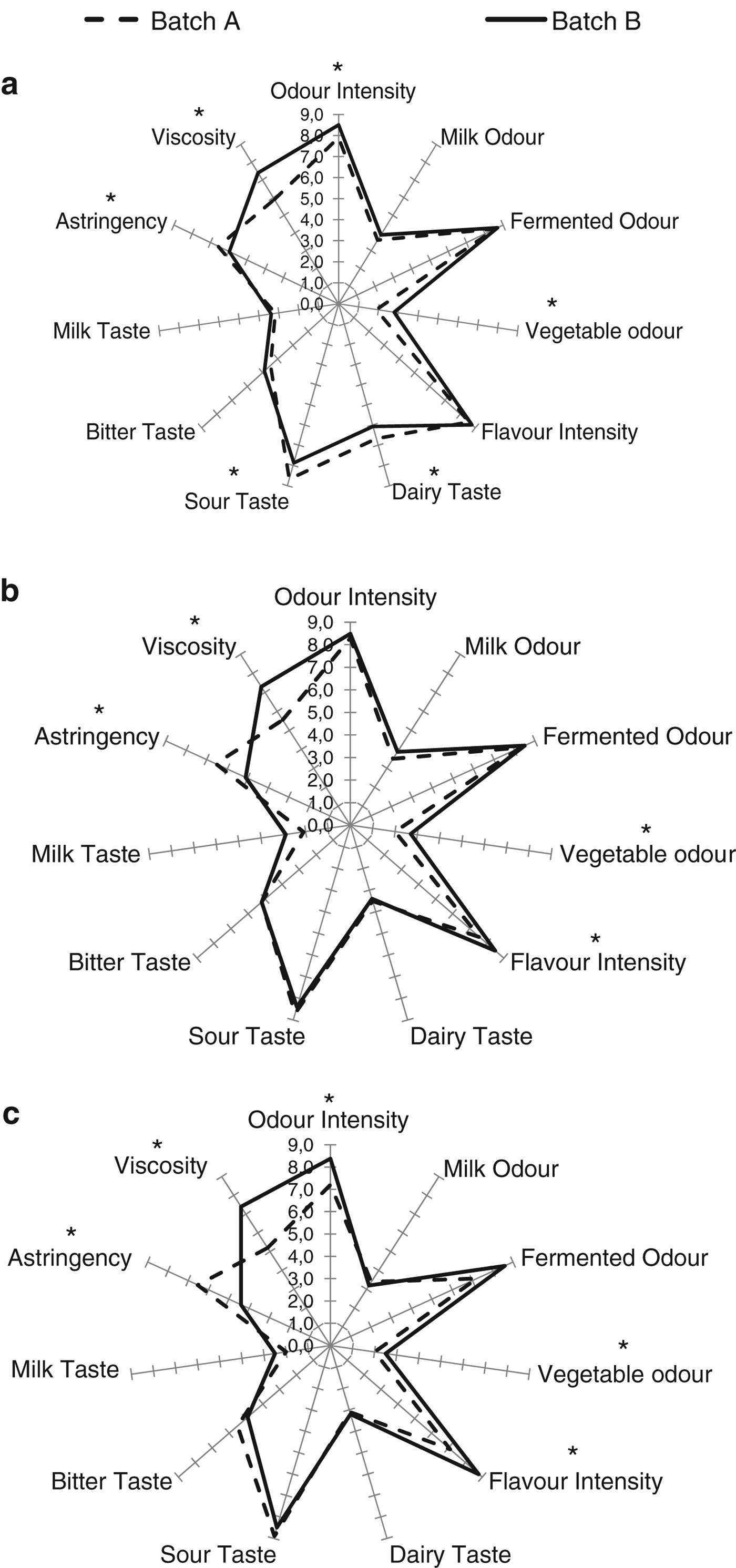
The sensorial analysis performed at 1, 5 and 15 d storage revealed that Lben batches differed markedly in many of the attributes considered. After 1 d storage, Lben from batch B was characterised by a significantly higher odour intensity, vegetable odour and viscosity, while Lben from batch A scored significantly higher values for dairy taste, sour taste and astringency (Fig. 1a). After 5 d storage these differences partly disappeared (Fig. 1b), while after 15 d batch B was still characterised by higher odour and flavour intensity, vegetable odour and viscosity with batch A displaying higher astringency (Fig. 1c). These results, especially the scores related to odour and flavor intensity, are supported by the chemical data which showed a higher content of the volatile compounds ethanol, acetaldehyde, acetoin and diacetyle in batch B. Therefore, the use of the yeast enzymatic extract appeared effective in the production of Lben with a substantial presence of odour active compounds which, as stressed by Benkerroum & Tamime (Reference Benkerroum and Tamime2004), are key factors characterising the product. Additionally, the yeast enzymatic extract employed seemed to have a positive effect on viscosity which is a highly appreciated characteristic of fermented milks such as Kefir (Irigoyen et al. Reference Irigoyen, Arana, Castiella, Torre and Ibanez2005).
Sensory analysis of Lben manufactured using only the selected LAB cultures (batch A) and the LAB cultures together with the K. lactis extract (batch B) at 1 (a), 5 (b) and 15 (c) days storage at 4 °C. For each parameter, the asterisks denote significant differences (P<0·05) between A and B batch.
Conclusions
This study showed the influence of a starter culture made up by lactic acid bacteria and enzymatic yeast extract in the production of Lben. The use of Lc. lactis subsp. lactis, Lc. lactis subsp. lactis biovar diacetylactis and of enzymatic extract from K.. lactis (all isolated and well represented in traditional Lben) allowed the preparation of a microbiologically-safe fermented milk with a good sensory profile and physicochemical features resembling those of the traditional product. Taken together, the results presented suggest that the use of yeast enzymatic extracts can be an effective strategy for the manufacturing, or the improvement, of traditional yeast-fermented foods even if a case by case evaluation is certainly needed. For instance, it is hard to foresee the effectiveness of a yeast enzymatic extract when used in the production of meat-based products in which the water activity becomes quickly very low, e.g. in fermented dry sausages. Moreover, it should be highlighted that it is currently uncertain how stable the enzyme activity is during time and this, of course, would be a key feature in all those processes characterised by a long fermentation time. Despite these possible shortcomings, the use potentialities of the yeast enzymatic extracts in food manufacturing seem promising, as highlighted in this work, and certainly deserve more studies.
This work was supported by the Italian Government, Ministero dell'Università e della Ricerca Scientifica e Tecnologica (MURST).