Introduction
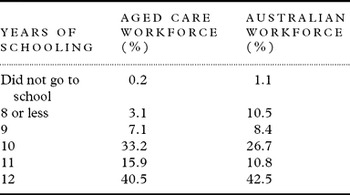
People with dementia living in Australian residential aged care facilities are cared for by a workforce whose education and qualifications compare quite well with the Australian workforce as a whole. More than 55% have 11 or more years of schooling and only 12% have no post-school qualifications with 29% having more than one such qualification (see Table 1; Richardson and Martin, Reference Richardson and Martin2004).
Aged care workforce: years of schooling

Source: Adapted from Table 4.8 in Richardson and Martin, Reference Richardson and Martin2004.
The staff who provide direct care are predominantly personal care workers (PCWs) and it is likely that their share of all jobs is rising from the 57% of all staff reported in 2004 (Richardson and Martin, Reference Richardson and Martin2004). The PCWs are very likely to have a post-school qualification, a large majority of which are in aged care. Fully four-fifths have a Certificate III in aged care, 10% have higher level qualifications in aged care and 14% have formal nursing qualifications.
However, the workforce is not young: only 5% of the workforce is aged 16–24, whereas the comparable figure for the Australian workforce as a whole is 20%. Compared with the Australian workforce, the aged care workforce has half the proportion of workers aged 25–34 (12%), and the majority of workers are more than 45 years old, with 17% being more than 55 years old. The typical worker is a female PCW, Australian born, aged about 50, married, in good health and working 16–34 hours per week during a regular daytime shift (Richardson and Martin, Reference Richardson and Martin2004).
PCWs are the people who deliver the great majority of care in Australian aged care services. They lay hands on the person with dementia. In some services they carry out their duties in a task-oriented fashion, in others they work alongside the person with dementia encouraging autonomy and assisting in maintaining the personhood of the person with dementia. As 44% of the people with dementia in Australia live in residential aged care facilities (AIHW, 2007) the PCW makes a vital contribution to the welfare of this group of people. The presence of dementia contributes to the range of difficult behaviors and problems that the PCW must help manage. These include problem wandering (31.7% of residents), verbal disruption (53.5%), physical aggression (26.1%), emotional dependency (65.5%), and being a danger to self or others (64.8%) (AIHW, 2007).
While the majority of PCWs do have an aged care qualification their qualifications were obtained at a time when the care of people with dementia was not recognized as a subject requiring much attention. In fact, it is only in the last four years that dementia care has been a compulsory unit in the basic aged care qualification, Certificate III in aged care. It is fair to say that their training has often not prepared them to provide the type of care desired in contemporary services in Australia.
The recognition by the Australian Government of dementia as a national health priority in 2005 resulted in the provision of a suite of interrelated projects aimed at improving the knowledge base and practice of the care for people with dementia. These included the establishment of (1) three Dementia Collaborative Research Centres with the task of identifying priority areas for research and undertaking projects that would lay a foundation for the inclusion of dementia research in the mainstream of Australian research activities; (2) four Dementia Training and Study Centres with the task of improving the education of tertiary qualified staff through the provision of scholarships, clinical workshops, guest lectures, new courses and educational materials for inclusion in the curricula of courses for nurses and allied health personnel; and (3) the commissioning of staff training in the essentials of the care of people with dementia under the Dementia Care Skills for Aged Care Workers project.
The objectives of the Dementia Care Skills for Aged Care Workers project are to:
1 increase the dementia care skills among aged care workers; and
2 develop and implement a four-year plan with a focus on meeting the identified dementia care skills needs of aged care workers by:
■ providing training for aged care workers in dementia care according to the standards in the competency-based unit in the Community Services Training Package, namely Provide Care Support which is Responsive to the Specific Nature of Dementia (CHCAC15A); and
■ assessing aged care workers in the workplace against the dementia competency.
At the time of writing this paper, the Dementia Care Skills for Aged Care Workers, which has become known as the Dementia Care Essentials program (DCE), is into its second year of operation and on target to provide training to 17,000 staff by June 2009. The training is provided by seven organizations that won tenders for the provision of training in particular States and Territories. Three of the organizations include state-based Alzheimer's Associations as principals, two are private for profit training organizations, one is a branch of the Royal District Nursing Service and the remaining organization is a not-for-profit Christian charity which has specialized in the provision of dementia specific residential and community care for a decade. The training leads to a nationally recognized qualification accredited within the vocational educational training (VET) framework.
The training covers the following topics:
• The nature of dementia
• Providing a person-centered approach to dementia care
• Effective communication skills for people with dementia
• Maintaining a supportive, friendly, calm and safe environment
• Providing appropriate person-centered activities
• Working in partnership with families
• Addressing the whole person: physical, emotional and spiritual needs
• Using a problem-solving approach in response to behaviors of concern in people with dementia
• Adopting a team approach to care
• Looking after yourself
• Contributing to assessment, case management and documentation
Each training provider has a different approach to the delivery of the training but the focus on the competencies required for a certificate of competency within the VET framework ensures a high degree of consistency in the quality and content of the training.
The provision of didactic training is not without its critics. A meta-analysis of the effects of staff training on professional practice in health care settings (O'Brien et al., Reference O'Brien, Freemantle, Oxman, Wolf, Davis and Herrin2008) concluded that didactic sessions alone are unlikely to change professional practice but interactive workshops can result in moderately large changes in professional practice. The importance of not depending exclusively on didactic training of direct aged care care staff was emphasized in a large well-designed study (Smyer et al., Reference Smyer, Brannon and Cohn1992), which showed that while the knowledge base of nurses aides was improved by five sessions of training, each of 1.5 hours' duration, there was no detectable improvement in practice. A combination of didactic training and follow-up meetings at which real life experiences were discussed was found to be effective in reducing agitation in long-term care facilities for the elderly (Landreville et al., Reference Landreville, Dicaire, Verrault and Levesque2005) and training employing an integrative approach, combining cognitive behavioral and experiential learning methods, was effective in producing an increase in knowledge and improvement in attitudes in residential care staff working with people with dementia (Featherstone et al., Reference Featherstone, James, Powell, Milne and Maddison2004).
The inadequacy of didactic training may be due to the lack of opportunity this form of training provides for the exploration of the relationship between staff and residents. The nature of dementia forces them into close and often intimate contact. There is a dynamic relationship between what staff do and feel, and what residents feel and do – including withdrawal and dependence, or its polar opposite of disruptive or challenging behavior. Training that provides opportunities for discussion about real issues and the practicing of skills via role play or simulated case conferencing can provide this opportunity. This approach has been adopted by several of the training providers and is reinforced during the visits to the work place to carry out the assessments of competency required for completion of the course.
Evaluation
The DCE program is being evaluated by an independent evaluator who will provide the Australian Department of Health and Ageing with feedback on the appropriateness of the program, i.e. was it needed, and what was its effectiveness, efficiency, quality, accessibility, impact on the collaboration between aged care providers, sustainability and outcomes? In short, did the workers and workplaces demonstrate an improvement in their dementia care practices?
While a definitive statement on the outcomes of the program must await publication of the evaluators' report, the experience of the authors suggests that participants are developing a greater understanding of, and an ability to apply, a person-centered approach to their care of people with dementia. This is an important first-line principle in the care of a cohort where presentation of the condition is variable and predicated on the type of dementia, its progress and the persons premorbid personality, and where effective responses to the behaviors and psychological symptoms of dementia are dependent on understanding the triggers that precede them.
The advantage of interactive workshops with assessments that are designed to connect theory with practice in a whole range of workplace contexts is that they allow participants to experience the benefits of a flexible approach to care based on a set of principles and a toolbox of possible responses consistent with the needs of the individual. Participants begin to understand the importance of deductive reasoning in relation to selecting care approaches based on what they know about the person, their family, their history and so on.
To illustrate the importance of an interactive approach in teaching about dementia one might contrast dementia care with the care of a person with a leg wound. Research with regard to wounds would lead us to adopt a specific type of dressing, recommend elevation to improve blood supply and so on. In other words, we would apply a straightforward set of rules for the care of this leg with reasonably predictable outcomes dependent on the age and health of the person. Unfortunately this is rarely the case in caring for a person with dementia. Carers are encouraged to adopt peculiarly individualized approaches based on their knowledge of the person.
A great deal of anecdotal evidence of the effectiveness of this approach is available from the feedback provided by managers. The following are typical comments drawn at random from the feedback files:
“The course taught participants to use validation with good effect. Instead of the usual attempts to distract one person who was intent on going home, the staff started to validate her feelings. The elder was so surprised at having their feelings of wanting to go home accepted that they calmed right down and began talking about their home and family in an animated way.” (Manager of a facility in Victoria)
“I have found that this training has improved the skills and knowledge in their practice and provided strong evidence of improved behavioral management. I believe that the course curriculum was excellent. However, as a trainer, Mandy's interaction and ability to maintain their interest and enthusiasm throughout played a huge part in the increase in staff requesting to attend the course. I personally believe that all staff should be required and encouraged to attend dementia training if they work in a dementia specific facility.” (Manager of a facility in NSW);
“We used to think Roy was being quite rude when he just ignored us. We'd say ‘Roy your lunch is ready’ and he'd just sit in his chair and wouldn't come to the table even though he was quite capable. Now we know that his frontal lobe is likely to be affected, that Roy is unable to get started unless we set him in motion. The attitude of the whole staff has changed. We know he is not being rude to us anymore.” (Facility in Victoria)
Specific benefits reported by managers in response to a course evaluation question include:
• a more relaxed and peaceful home environment for residents
• improved staff morale with the use of more effective responses to behaviors and psychological symptoms of dementia
• increase in the sharing of knowledge
• increased awareness of brain function and how to design care plans for specific needs
• improved communication skills, enabling improved client care.
The benefits of the training are not restricted to the PCWs. Analysis of enrollments in the first 18 months of the project indicates that 9% of the attendees are registered nurses (RNs). While the course is not specifically designed for RNs it is desirable that they attend because it is unlikely that they will have received much in the way of dementia-specific training during their training. RNs working in aged care in Australia tend to be older than other aged care staff, with 46% being over the age of 50 (Richardson and Martin, Reference Richardson and Martin2004). Many of them received their training before nursing became a degree course, and even those who completed a university degree would have had little formal education in the care of people with dementia. As there are approximately 21,000 RNs working in aged care services in Australia, there is a great need to provide this segment of the workforce with an update on dementia care.
The question arises as to whether DCE should be used to address the needs of RNs, and perhaps other allied health professionals, for education in this area. A strong argument can be made for this being the responsibility of the Dementia Training and Study Centres established as another arm of the “Dementia: a National Health Priority” program. However, in practice the ease of access to DCE training and the need for training felt by RNs in the aged care sector is resulting in many hundreds finding the time to take up the courses. As the DCE program evolves it is becoming apparent that it provides an opportunity for the work carried out in the Collaborative Research Centres and the Dementia Training Study Centres to be fed through to the nurses, and other tertiary-educated workers, via DCE training. This is currently being discussed further.
Obstacles
The delivery of training to 17,000 people spread across a continent is not without its problems. Clearly the distances between services and the low population density in some parts of Australia can have a significant effect on the practicality of providing a course and of attending a course. While it is tempting to try to solve this problem by the use of internet-based learning resources, the consensus of opinion among the training providers is that these are not as effective as face-to-face training. Some providers have made their materials available on the web but all have put a great deal of effort into providing courses in accessible locations. In New South Wales a very experienced trainer hitched a caravan to a four-wheel drive vehicle and travelled to the small towns in the far west and north-west of the state to deliver the three-day course at times and in places that suited the local services.
The Australian population is made up of a great many groups from different cultures. One trainer in NSW found herself presenting to people from 23 different countries in a series of three courses delivered in the same part of western Sydney. There is no substitute for well-trained trainers in these circumstances. They need to understand the various perceptions of dementia held by different cultural groups, and to be able to use simple language to relate the principles of good dementia care within a cultural context, for example by teaching the principles of reminiscence using culturally specific and age relevant examples and incorporating an understanding of the migrant experience. The training needs to be delivered using various modalities that do not rely heavily on reading and writing. These include discussion, experiential learning, role play, story-telling and case studies with cultural relevance. A style of training that does not set apart those classes with a high proportion of people from other cultures from “ordinary” training, that has a focus on practical examples and involves interactive discussions appears to work best with all groups.
In some states – Victoria, for example – expert advice from specialist cultural diversity staff and a series of pilot training sessions were used to refine the materials and processes used. This information was made available to all the DCE training organizations.
While the DCE training is free (i.e. no charge is made to the participants or their organizations), there is nevertheless a cost involved in sending people on the course. While some organizations encourage staff to go in their own time, many others pay staff for their attendance. When staff attend in work time the cost of their replacement must be met by their parent organization. This backfill issue has been an obstacle to attendance in some areas of Australia. The fact that the DCE program is on track to train 17,000 staff is testimony to the willingness of aged care providers in Australia to spend scarce resources on training. The obstacle is not so much finding the funds to replace staff who are attending the training, but, more usually, finding the staff who can provide the backfill. This is particularly the case in smaller services. Negotiating times for courses that will fit in with the local shifts and/or avoid busy periods have been found to be a partial answer to this problem. Giving a lot of advanced notice of the training dates also helps.
Conclusion
The DCE program is a work in progress. It is being closely monitored and evaluated by independent evaluators whose report is expected in 2009. However, it is also being monitored by the organizations who deliver the training. We meet biannually to discuss progress and obstacles. While there have been some problems, as is always the case in large projects, they have been minor and the project has been characterized by a high level of cooperation between training providers and the Department of Health and Ageing. The experience of delivering the training has convinced the training providers of the usefulness of this industry and country-wide approach – the key to which seems to lie in the ability of the training providers to deliver a standard, competency-based course in a manner that suits the local conditions.
The fact that DCE is reaching beyond the PCW segment of the workforce indicates a need for basic education in the care of people with dementia across the staff categories. It also indicates that the accessibility provided by large-scale training provides an opportunity for further education targeted at tertiary qualified staff.
Conflict of interest
None.
Description of authors' roles
Both authors undertook the preparation and writing of this paper.