INTRODUCTION
Trypanosoma evansi is the aetiological agent of the disease known as ‘Mal das Cadeiras’ or ‘Surra’ in horses. However, this parasite has also been reported to affect domestic and wild mammals (Maudlin et al. Reference Maudlin, Holmes and Miles2004) and, in rare cases, humans (Powar et al. Reference Powar, Shegokar, Joshi, Dani, Tankhiwale, Truc, Jannin and Bhargava2006). Trypanosoma evansi is the most widely distributed of the pathogenic African animal trypanosomes, affecting animals in Asia, Africa and Latin America and resulting in immeasurable economic losses (Luckins and Dwinger, Reference Luckins, Dwinger, Maudlin, Holmes and Miles2004; Dobson et al. Reference Dobson, Dargantes, Mercado and Reid2009). It is mechanically transmitted by haematophagous flies such as Tabanus spp. and Stomoxys spp. and/or vampire bats (Hoare, Reference Hoare1972). Infected animals showed typical clinical signs such as anaemia, oedema, weight loss and locomotor disturbance (Hoare, Reference Hoare1972; Maudlin et al. Reference Maudlin, Holmes and Miles2004).
Therapy for animal trypanosomiasis relies on the use of diminazene aceturate which is effective for treatment of the disease in cattle, buffalo, sheep, pigs and camels (Peregrine and Mamman, Reference Peregrine and Mamman1993; Sirivan et al. Reference Sirivan, Pramoolsinsap and Pemayodhin1994). However, a single dose is not effective for horses, mules and dogs (Tuntasuvan et al. Reference Tuntasuvan, Jarabrum, Viseshakul, Mohkaew, Borisutsuwan, Theeraphan and Kongkanjana2003; Colpo et al. Reference Colpo, Monteiro and Stainki2005), resulting in lack of efficacy of these drugs (Tuntasuvan et al. Reference Tuntasuvan, Jarabrum, Viseshakul, Mohkaew, Borisutsuwan, Theeraphan and Kongkanjana2003; Da Silva et al. Reference Da Silva, Tochetto, Zanette, Pierezan, Rissi, Santurio and Monteiro2008). In addition, the drugs used to treat T. evansi are considered hepatotoxic and nephrotoxic (Spinosa et al. Reference Spinosa, Górniak and Bernardi1999), and their prolonged use can cause worsening of the disease. Thus, it is important to investigate alternative therapies to improve the success of the treatment using new drugs, drug combinations and other components that could increase the curative efficacy. Accordingly, some studies have emerged suggesting new options of treatment for trypanosomiasis.
A recent study showed low therapeutic efficacy of the combination of cordycepin (3-deoxyadenosine) with the inhibitor of adenosine deaminase (ADA1) in mice infected with T. evansi (Da Silva et al. Reference Da Silva, Wolkmer, Nunes, Duck, Oliveira, Gressler, Costa, Zanette, Mazzanti, Lopes and Monteiro2011a ). However, studies have shown efficacy of treatment with cordycepin in T. brucei infection in mice (Rottenberg et al. Reference Rottenberg, Masocha, Ferella, Petitto-Assis, Goto, Kristensson, McCaffrey and Wigzell2005; Vodnala et al. Reference Vodnala, Fijolek, Rofougaran, Mosimann and Maser2008, Reference Vodnala, Ferella, Lunde´N-Miguel, Betha and Van Reet2009). The efficacy of the treatment is related to the protection of cordycepin against the enzyme adenosine deaminase (ADA), which is responsible for the deamination of the analogue adenosine (Rottenberg et al. Reference Rottenberg, Masocha, Ferella, Petitto-Assis, Goto, Kristensson, McCaffrey and Wigzell2005; Vodnala et al. Reference Vodnala, Fijolek, Rofougaran, Mosimann and Maser2008, Reference Vodnala, Ferella, Lunde´N-Miguel, Betha and Van Reet2009). However, this protocol requires the combination of cordycepin with an inhibitor of ADA1 and ADA2 known as deoxycoformycin (Rottenberg et al. Reference Rottenberg, Masocha, Ferella, Petitto-Assis, Goto, Kristensson, McCaffrey and Wigzell2005), a different inhibitor from that used in the study with T. evansi.
The trypanocidal potential of cordycepin was noticed in experiments performed in the 1970s (Williamson, Reference Williamson1972; Williamson and Macadam, Reference Williamson and Macadam1976). However, the administration of cordycepin did not result in a complete cure of infection (Aiyedun et al. Reference Aiyedun, Williamson and Amodu1973; Da Silva et al. Reference Da Silva, Wolkmer, Nunes, Duck, Oliveira, Gressler, Costa, Zanette, Mazzanti, Lopes and Monteiro2011a ). Cordycepin targets a vulnerable pathway in the trypanosomal metabolic economy in a way that is not targeted by currently available drugs (Rottenberg et al. Reference Rottenberg, Masocha, Ferella, Petitto-Assis, Goto, Kristensson, McCaffrey and Wigzell2005). Accordingly, the purine metabolism in trypanosomes and in other parasites presents a particular vulnerability because these parasites cannot engage in a new purine synthesis (James and Born, Reference James and Born1980; Hammond and Gutteride, Reference Hammond and Gutteridge1984; Hassan and Coombs, Reference Hassan and Coombs1988). Rather, they depend on the salvage pathway of nucleosides from the body fluids of the host (Agarwal et al. Reference Agarwal, Sagar and Parks1975). The inability of trypanosomes to engage in de novo purine synthesis has been exploited as a therapeutic target (Vodnala et al. Reference Vodnala, Ferella, Lunde´N-Miguel, Betha and Van Reet2009). Based on the aforementioned, we designed an experiment to evaluate the susceptibility of T. evansi in mice to treatment with a combination of 3′-deoxyadenosine and deoxycoformycin.
MATERIALS AND METHODS
Reagents
3′-deoxyadenosine (Cordycepin) was purchased from Sigma. Deoxycoformycin (Pentostatin; Tocris) was used as an inhibitor of ADA. Unless otherwise indicated, all reagents were diluted in PBS, aliquoted and stored at –20 °C until further use. The medium components used, except the antibiotics were purchased from Sigma.
Trypanosoma evansi isolate
Trypanosoma evansi was originally isolated from a naturally infected dog (Colpo et al. Reference Colpo, Monteiro and Stainki2005). Two rats (R1 and R2) were intraperitoneally infected with blood cryopreserved in liquid nitrogen. The strain was later reactivated to obtain a large quantity of bloodstream forms of the parasite for subsequent infection of mice that formed the experimental groups and also for use in in vitro tests.
In vitro tests
Culture medium
The cultivation for T. evansi was adapted from the method reported by Baltz (Reference Baltz, Baltz, Giroud and Crockett1985). To prepare the culture medium, minimum essential medium (MEM) without glutamine (0·376 g), glutamine (0·016 g), sodium bicarbonate (0·088 g), glucose (0·04 g), HEPES free acid (0·238 g), non-essential amino acid solution (200 μL), penicillin (1596 U mL−1) and estreptomicin (100 μg mL−1) were used. The components were dissolved and homogenized in 30 mL of water, after adjustment of the pH to 7·1 with NaOH. The volume of the solution was then raised to 42 mL with sterile distilled water at an osmolarity of 0·30. Later, the culture medium was sterilized by filtration at 0·22 μm and stored in a refrigerator. On the day of testing, 10 mL were separated into a Falcon tube to which were added 1 μl mL−1 of 50 mm hypoxanthine (dissolved in 0·1 M NaOH) and 2 μl mL−1 of 1·2 mm 2-mercaptoethanol. Subsequently, the complete culture medium was equilibrated in a CO2 incubator for 2 h (37 °C and 5% CO2).
Acquisition of trypanosomes
For the in vitro tests, the trypomastigotes were obtained from rat No. 1 (R1); when it showed high parasitaemia (107 trypanosomes μL−1), it was anaesthetized under isoflurane anaesthesia to aid blood collection by intracardiac puncture. The samples were stored in EDTA tubes at 13 °C.
For separation of trypanosomes, 200 μl of blood were diluted in complete culture medium (200 μL), stored and centrifuged at 400 g for 10 min. The supernatant was removed and the trypanosomes were counted in a Neubauer chamber.
In vitro assay
The culture medium containing the parasites was mixed on microtitre plates (270 μL) followed by addition of cordycepin at concentrations of 0·5, 1·0, 5·0 or 10 mg mL−1. The same concentrations of pentostatin were used in the tests that utilized a combination of cordycepin and pentostatin. For the control group, the highest concentration of PBS (diluent) was used. At 1, 3, 6 and 12 h after the onset of the experiment, counting of live parasites was performed in a Neubauer chamber. The tests were carried out in duplicate.
In vivo trials
Animals
A total of 49 female mice (mean age of 60 days) weighing approximately 25 ± 2·1 g were kept in cages (7 animals each), in a room with controlled temperature and humidity (25 °C; 70%). The animals were fed with commercial ration and received water ad libitum. All animals were submitted to an adaptation period of 10 days before the beginning of the experiment.
Experimental mice groups and trypanosomal infection
The mice were divided into 7 groups (A, B, C, D, E, F and G) of 7 animals each. Group A was not infected with the parasite and, thus, served as a negative control. Mice in groups B to G were infected intraperitoneally with 1·4 × 106 trypanosomes in 0·1 mL of blood from rat No. 2 (R2).
Parasitaemia evaluation
Parasitaemia was estimated daily by microscopic examination of blood smears from the mice. Each slide was prepared with mouse blood collected from the tail vein (Da Silva et al. Reference Da Silva, Doyle and Monteiro2006), stained by the Romanowsky method, and visualized at a magnification of 1000 × .
Experimental design
Group A mice were the negative control and group B mice (infected with T. evansi and untreated) were the positive control. Mice in groups C to G were treated intraperitoneally at 24 h intervals for 3 days post-inoculation (p.i.), as follows: group C was treated with cordycepin (3′-deoxyadenosine) (2 mg kg−1); group D was treated with pentostatin (deoxycoformycin) (1 mg kg−1); group E was treated with pentostatin (2 mg kg−1); group F was treated with the combination of cordycepin (2 mg kg−1) and pentostatin (1 mg kg−1); and group G was treated with the combination of cordycepin (2 mg kg−1) and pentostatin (2 mg kg−1). The effect of the treatment on the group was evaluated based on the parasitaemia levels, longevity, mortality of the mice and molecular analysis for T. evansi in infected mice that survived after treatment and thereby verify the trypanocidal effectiveness of the therapeutic protocol.
Collection of samples
On day 40 of the experiment, the survivor animals (in groups A, F and G) were anaesthetized with isoflurane in an anaesthetic chamber for collection of blood by cardiac puncture. The blood samples were collected in tubes without anticoagulant to obtain the serum. Thereafter, mice were euthanized in accordance with the recommendations of the Ethics Committee. The brains, livers and kidneys of the animals were removed for histological analysis.
Hepatic and renal function
The blood samples were centrifuged at 3500 g for 10 min to obtain serum. Liver function (alanine transaminase – ALT and alkaline phosphatase – ALP) and renal function (creatinine) were evaluated.
Histopathology
Evidence of drug-induced histopathological damage to the brains, livers and kidneys of T. evansi-infected mice treated with the drugs was investigated to detect the toxicity of the treatment. Samples of the organs were fixed in buffered formalin (10%), embedded in paraffin, sectioned at a thickness of 6 μm and stained with haematoxylin/eosin (H&E). The sections were qualitatively evaluated for differences in microarchitecture, organization and the presence of inflammatory cells. Measurements were made of the nuclear areas of hepatocytes and kidney corpuscles.
Molecular diagnosis
The brain and blood samples collected with EDTA (as anticoagulant) were preserved in ethanol for DNA extraction and posterior analysis using T. evansi-specific PCR (Ventura et al. Reference Ventura, Takeda, Silva, Nunes, Buck and Teixeira2002).
Statistical analysis
Data were submitted to analysis of variance (ANOVA) followed by Duncan test. The histological results were analysed by Student's t-test. Results were considered significant when P < 0·05.
RESULTS
In vitro tests
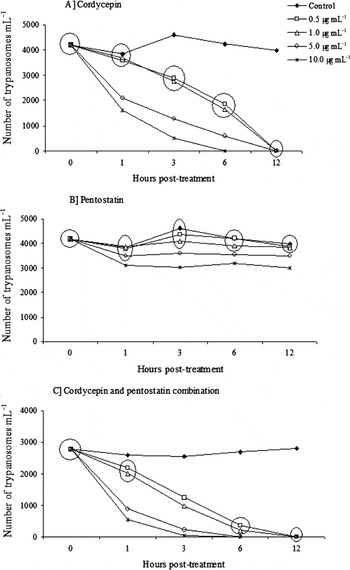
The results showed a dose-dependent trypanocidal effect of cordycepin (Fig. 1A), pentostatin (Fig. 1B), and cordycepin and pentostatin combination (Fig. 1C) on T. evansi trypomastigotes. At 1 h post-treatment, a reduction of 48% and 55% in the levels of live trypomastigotes was observed at cordycepin concentrations of 5 and 10 mg mL−1, respectively, when compared with the control group. The combination of cordycepin and pentostatin potentiated the trypanocidal effect. At 1 h after the beginning of the experiment there was a reduction of 69% (5 mg mL−1) and 81% (10 mg mL−1) in the number of live trypanosomes when compared with the control. At 3, 6 and 12 h post-treatment, a significant decrease (P < 0·001) in the levels of live parasites was observed at all the concentrations used of cordycepin and the combination of cordycepin and pentostatin. No live parasites were detected at 6 h of incubation of the drug at concentrations of 10 mg mL−1 and 12 h of treatments with cordycepin eliminated the parasite, unlike in the control group (Fig. 1A). Tests using pentostatin showed no significant reduction in the number of live trypomastigotes in most groups, except in those treated with concentrations of 5 mg mL−1 (3, 6 and 12 h) and 10 mg mL−1 (1, 3, 6 and 12 h).
Dose–response effect of cordycepin (A), pentostatin (B) and cordycepin and pentostatin combination (C) on the viability of Trypanosoma evansi in vitro compared with the control group. Means followed by the same letters within a column (circles) are not statistically different among themselves at 5% probability by Tukey's test.

In vivo tests
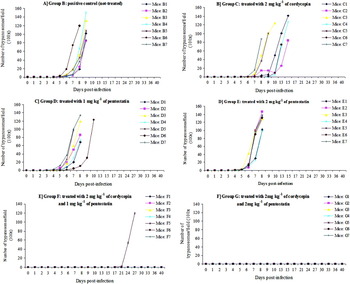
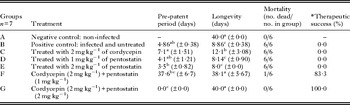
Data of the T. evansi-infected groups are presented in Table 1. Parasitaemia in mice of groups B, C, D and E increased with time until death of the mice (Fig. 2). One mouse in group F presented with positive blood smears at day 21 p.i., while the other mice in the same group remained negative (Fig. 2). Mice in group G showed no parasitaemia, with longevity of 40 days p.i. (Table 1).
Parasitaemia of Trypanosoma evansi-infected mice at day 40 post-inoculation (p.i.) in groups B to G. The treatment started at day 1 p.i. (3 doses at 24-h intervals).

Mean and standard deviation of the pre-patent period, longevity, mortality and success of therapy using treatment with cordycepin (3′-deoxyadenosine) combined with pentostatin (deoxycoformycin) in mice experimentally infected with Trypanosoma evansi
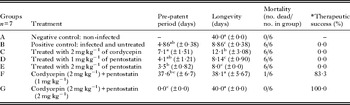
The mice that died during the experiment showed parasitaemia above 100 trypomastigotes per microscopic field (1000× magnification). In groups B, C, D and E all mice died, while in group F only 1 mouse died. Death did not occur in mice in groups A and G within 40 days post-treatment.
Hepatic and renal function
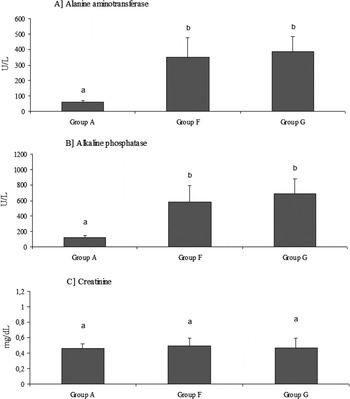
Results of the biochemical analyses of samples obtained from mice in groups A, F and G performed at the end of the experiment (day 40 p.i.) are presented in Fig. 3. A significant increase in the levels of alanine aminotransferase was found in the sera of mice treated with the combination of the two drugs, groups F and G (Fig. 3A). In the same groups a similar increase in alkaline phosphatase levels was observed (Fig. 3B). Serum creatinine levels in the mice did not show significant change compared with the control group (Fig. 3C).
Alanine aminotransferase, alkaline phosphatase, and creatinine in mice infected with Trypanosoma evansi treated with cordycepin combined with pentostatin (group F and G) compared with those not infected (group A).

Histopathology
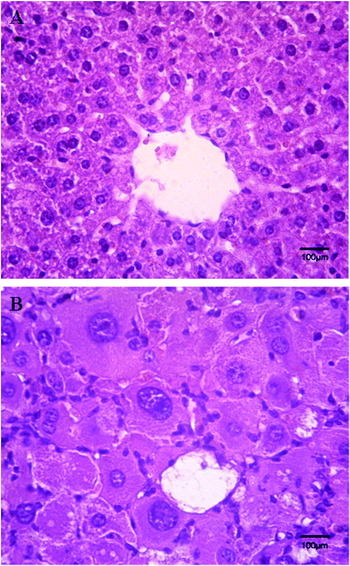
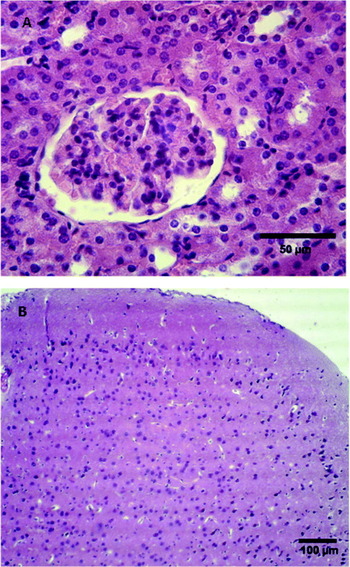
The liver indicated strong nuclear and cytoplasmic tumefaction and necrotic degeneration. Furthermore, intense congestion of the sinusoids by leukocytes was observed. Thus, the microarchitecture of the organ was lost. There were statistically significant differences (P = 0·0001) between the nuclear areas of the hepatocyte of the control and infected animals (Fig. 4). In the renal tissue, a significant increase in the glomerular area (P = 0·041) of the infected animals was observed (Fig. 5A). No changes were observed in the brain tissues of animals studied and treated with cordycepin and pentostatin combination (Fig. 5B).
Histological section of liver of healthy mice (A). Photomicrographs of liver sections of infected mice with Trypanosoma evansi and treated with the cordycepin and pentostatin combination showing a strong nuclear and cytoplasmic tumefaction and necrotic degeneration in the hepatocytes (B), haematoxylin-eosin stain.

Mice infected with Trypanosoma evansi and treated with the cordycepin and pentostatin combination. Photomicrographs showing the renal tissue that showed a significant increase in glomerular area (A), and cortical region of the brain without histological alterations, despite parasite infection and treatment (B).

PCR
The molecular analysis was performed to confirm the effectiveness of the therapeutic protocol used, since parasitaemia was not detected in the survivor animals in groups F and G. Specific PCR assays from blood and brain of these animals were negative for the presence of T. evansi. Therefore, treatment was 83·3 and 100% effective for groups F and G, respectively (Table 1).
Committee on ethics and animal welfare
The experimental procedures used in this study were approved by the Animal Welfare Committee of Universidade Federal de Santa Maria (UFSM), under number 026/2012.
DISCUSSION
In this study, a dose-dependent effect of cordycepin against T. evansi was observed in vitro in contrast to the relative susceptibility expressed in vitro to the same drug by T. congolense, T. vivax, T. brucei rhodesiense, T. evansi, T. brucei brucei, T. cruzi and Leishmania sp. in previous studies (Williamson, Reference Williamson1972; Aiyedun et al. Reference Aiyedun, Williamson and Amodu1973; Williamson and Macadam, Reference Williamson and Macadam1976; Maser et al. Reference Maser, Vogel, Schmid, Raz and Kaminsky2001; Rottenberg et al. Reference Rottenberg, Masocha, Ferella, Petitto-Assis, Goto, Kristensson, McCaffrey and Wigzell2005; Vodnala et al. Reference Vodnala, Ferella, Lunde´N-Miguel, Betha and Van Reet2009; Da Silva et al. Reference Da Silva, Wolkmer, Nunes, Duck, Oliveira, Gressler, Costa, Zanette, Mazzanti, Lopes and Monteiro2011a ). The susceptibility of T. evansi to this adenosine analogue is likely to be related to the parasite's inability to engage in de novo purine synthesis (James and Born, Reference James and Born1980; Hammond and Gutteridge, Reference Hammond and Gutteridge1984; Hassan and Coombs, Reference Hassan and Coombs1988). Our study showed that the ADA inhibitor exerts trypanocidal activity, in vitro. This effect was, however, seen only in the first evaluation post-treatment at 1 h, which can be explained by the short half-life of the inhibitor (McConnell et al. Reference McConnell, Suling, Rice, Shannon and Hill1978; Major et al. Reference Major, Agarwal and Kufe1981). Deoxycoformycin can be unstable in acid and neutral media but relatively stable in the vicinity of pH 9 (Bzowska et al. Reference Bzowska, Lassota and Shugar1985). However, in the in vitro tests, the culture medium was pH 7·1, which may have rendered the molecule pentostatin unstable over time and thereby reduced its trypanocidal action. But, the reduction in the number of parasites in the first hour of study suggests that the inhibitor (pentostatin) acts on the ADA present in T. evansi (Da Silva et al. Reference Da Silva, Bellé, Bitencourt, Souza, Costa, Oliveira, Jaques, Leal, Moretto, Mazzanti, Lopes and Monteiro2011b ) and thus kills the parasite. The use of inhibitors, such as anticholinesterase, explains the mechanism of action of some pesticides such as organophosphates (Santos et al. Reference Santos, Donnici, Dacosta and Caixeiro2007).
Pentostatin is an ADA inhibitor that can prevent degradation of cordycepin, and thus a combination of the two drugs has been used for the treatment of certain malignant tumours in humans, such as leukaemia and melanoma (Adamson et al. Reference Adamson, Zaharevitz and Johns1977). This combination has also been effective against T. brucei (Rottenberg et al. Reference Rottenberg, Masocha, Ferella, Petitto-Assis, Goto, Kristensson, McCaffrey and Wigzell2005; Vodnala et al. Reference Vodnala, Ferella, Lunde´N-Miguel, Betha and Van Reet2009); in this study, we observed that the highest dose used proved 100% effective against T. evansi. However, cordycepin when used alone was not curative in vivo, but rather increased the longevity of the treated animals. This was probably because of the rapid deamination of cordycepin (3′-deoxyadenosine) to 3′-deoxyinosine, which can then be inactivated by the trypanosomal enzymes inosine and deoxyinosine hydrolases (Rottenberg et al. Reference Rottenberg, Masocha, Ferella, Petitto-Assis, Goto, Kristensson, McCaffrey and Wigzell2005). Based on the in vitro results, we believe that the addition of pentostatin prevents the degradation of the adenosine analogue, and thus the combination of the two drugs produced a brief trypanocidal action. However, when cordycepin was used alone, it had no apparent effect on the parasitaemia and in the longevity of mice.
The anti-trypanosomal activity of cordycepin against T. brucei was noted to be enhanced by the addition of the ADA inhibitor EHNA (Williamson and Scott-Finnigan, Reference Williamson and Scott-Finnigan1978). However, in contrast, this combination failed to induce a curative effect in 42·5% of mice infected with T. evansi (Da Silva et al. Reference Da Silva, Wolkmer, Nunes, Duck, Oliveira, Gressler, Costa, Zanette, Mazzanti, Lopes and Monteiro2011a ). The combination of adenosine analogue 3′-deoxyadenosine and coformycin or deoxycoformycin produced a curative effect in T. brucei infection in mice (Rottenberg et al. Reference Rottenberg, Masocha, Ferella, Petitto-Assis, Goto, Kristensson, McCaffrey and Wigzell2005) as was similarly observed in the T. evansi-infected mice in our study. The difference in curative efficacy may be related to specificity of the ADA inhibitor, i.e. the inhibitor EHNA is specific for the isoform ADA1, since the other two inhibitors (coformycin or deoxycoformycin) are capable of inhibiting both ADA1 and ADA2. It should be remembered that tissue extracts contain predominantly ADA1, which is supposed to be derived mainly from injured tissues. ADA2 is found in serum and derived from stimulated T cells (Greiger and Nagy, Reference Greiger and Nagy1986; Franco et al. Reference Franco, Casado, Ciruela, Saura, Mallol, Canela and Louis1997).
The administration of cordycepin and coformycin/deoxycoformycin eliminated parasites in the brain parenchyma when administered after T. brucei brucei penetration into the brain (Rottenberg et al. Reference Rottenberg, Masocha, Ferella, Petitto-Assis, Goto, Kristensson, McCaffrey and Wigzell2005). This is a highly desirable outcome, because the difficulty of chemotherapy in T. evansi infections has been attributed to survival of trypanosomes in cerebrospinal fluid as trypanocidal drugs do not cross the blood–brain barrier or do so in insufficient doses to cure infection (Jennings et al. Reference Jennings, Whitelaw and Urquhart1977; Spinosa et al. Reference Spinosa, Górniak and Bernardi1999). Therefore, treatment with cordycepin can be a viable alternative for animals of high economic or sentimental value due to the high costs of cordycepin and ADA inhibitors in Brazil.
Apparently the mice of this study showed no clinical signs suggestive of intoxication. However, in the biochemical tests an increase in liver enzymes associated with histological lesions in the liver of animals in groups F and G was observed. The treatment also caused low intensity, histological renal lesions without impairment of the renal function given that the creatinine levels remained within normal limits. Thus, any application of the promising treatment results observed from our studies should be made cautiously to avoid untoward effects. Effects of toxicity of cordycepin in combination with the ADA inhibitor 2-deoxycoformycin in beagle dogs were also observed as well as when only the inhibitor was used. But the dogs which received only cordycepin showed no drug-related toxicities (Rodman et al. Reference Rodman, Farnell, Coyne, Allan, Hill, Duncan, Tomaszewski, Smith and Page1997). In a future study, we plan to investigate whether toxicity may be related to the ADA inhibitor.
Data from this study did not detect resistance of the parasite to cordycepin combined with the inhibitor except in 1 of the 7 mice of group F in which infection relapsed (and which died later). However, it has been reported that T. b. brucei developed resistance to cordycepin upon prolonged culture with low doses of the compound; such resistant parasites showed diminished virulence and reduced growth in vivo (Vodnala et al. Reference Vodnala, Ferella, Lunde´N-Miguel, Betha and Van Reet2009). In other studies, the cordycepin-resistant parasites showed a genetic defect in TbAT1 and surprisingly without cross resistance to other trypanocidal drugs (Maser et al. Reference Maser, Sutterlin, Kralli and Kaminsky1999; Koning et al. Reference Koning, Anderson, Stewart, Burchmore, Wallace and Barrett2004). Therefore, cordycepin combined with an ADA inhibitor may be an optimal treatment option when there is resistance to other anti-trypanosomal drugs. Results from our studies suggest curative efficacy of a combination of 3′-deoxyadenosine and deoxycoformycin in mice experimentally infected with T. evansi. Note that in vitro and in vivo the cordycepin and pentostatin combination potentiated the trypanocidal effect against T. evansi. Future studies are necessary to evaluate the effects of the treatment on haematological and biochemical parameters, enzymatic purinergic system, as well as to verify if pentostatin has the ability to inhibit the ADA of T. evansi.