Introduction
COVID-19 is an infectious disease caused by the SARS-CoV-2 virus, with its first case reported in China in late 2019. Its high transmissibility through saliva particles and other human secretions, led to the World Health Organization (WHO), to raise the status of the disease to pandemic level in the first part of 2020, given its rapid spread worldwide in a short period of time. Reference Daniel1
Its transmission occurs mainly when people breathe air contaminated by small particles that contain the presence of the virus. This contamination can also occur through contact with contaminated objects and surfaces. After contact with the virus, people who are infected may or may not develop symptoms of the disease and may also transmit the virus for up to 20 days, even with the slightest development of covid. Reference Menni, Valdes and Freidin2,Reference Nouvellet, Bhatia and Cori3
The most common symptoms reported in hospitalized patients are fever, dry cough, shortness of breath, and fatigue, as well as nausea, vomiting or diarrhea, and myalgia. Patients may also have non-classical symptoms, such as isolated gastrointestinal symptoms. Olfactory and taste disorders such as loss of smell and taste were also widely reported by covid patients. Reference Eastin and Eastin4–Reference Parmet and Sinha10
Among them, emotional, material, and physical health stand out. The feelings of affection and happiness when interacting with friends and family can be considered responsible for stimulating the production of neurotransmitters such as dopamine, oxytocin, serotonin, and endocannabinoids, as well as endorphins, epinephrine, and norepinephrine. Cortisol and melatonin can also be stimulated, and all are biologically responsible for the emotional well-being of humans. Reference Dsouza, Chakraborty and Veigas11
In addition to the economic damage caused by COVID-19, the measures of social isolation taken by governments in many countries and the absence of benefits arising from social relations, it is estimated that the prolonged period of isolation can trigger feelings of loneliness, and anxieties; these can have detrimental effects on quality of life and mental health. All these changes are also directly linked to people who have pets at home, since contact with these animals can increase during the isolation period. Reference Cauberghe, Van Wesenbeeck, De Jans, Hudders and Ponnet12,13
In recent studies, pet owners attributed different qualities to their animals such as fidelity, love, affection, and care, which demonstrates that they have a strong connection with their animals and perceive them as a source of emotional affection, which promotes the psychological well-being of these tutors. This affective perception between guardians and their pets is called the pet effect. Reference Kanat-Maymon, Wolfson, Cohen and Roth14
Although not typical, some studies demonstrate that domestic animals can also be infected by the SARS-CoV-2 virus through contact with humans, via transmission by reverse zoonosis. As a safety measure to avoid this type of infection, distancing between guardian and domestic animal is also recommended. Reference Scherer, Romero, Silito, Pearson and Marchi15
Although there are many advantages and benefits to physical and emotional health in having a pet, which can range from blood pressure control to a considerable reduction in stress levels, the importance of this relationship between guardians and pets during the pandemic period, and social isolation are still unknown because it is a unique and relatively complex situation. There is still a dearth of information and studies that seek to account for the experiences of how owners and their pets are dealing with long periods of confinement. Reference Chowdhury, Nelson, Jennings, Wing and Reid16–Reference Ramalhais and Nunes18
In view of all the bio-psychosocial change caused by the pandemic around the world, this article, through research with pet owners, aimed to assess how these relationships were established and their possible effects during the pandemic period of Covid-19 in Brazil.
Methods
As this is a study involving humans, this project was submitted to the Ethics Committee for Research Involving Human Beings at Universidade Paranaense/Plataforma Brasil, where it was approved under protocol CAE: 40960120.8.0000.0109.
To carry out this study, data were collected by completing an online questionnaire (developed and provided through the Google Forms® platform, disseminated throughout the Brazilian territory through various social networks and sending emails, while respecting social distancing from January 20, 2021, to March 20, 2021). Participants were over 18 years of age, irrespective of gender, sexuality, as well as educational and socioeconomic level.
The questionnaire was constructed with the aim of comparing the behavior of people who owned pets before and during the period of social isolation throughout the pandemic in Brazil, in order to verify the possible behavioral impacts of this relationship on those who owned animals/ pets throughout this period, which is 1 of the inclusion and exclusion criteria of this research.
For the present study, a questionnaire was developed containing 25 questions in accessible language, easily understood by anyone, so that it could be answered by several people considering the possible differences in cultural and educational language communication. The questions were created considering social isolation, the COVID-19 pandemic, as well as the online application method, to reach different regions of Brazil.
The data obtained were treated qualitatively through discourse analysis and content analysis, while the quantitative data were tabulated by the questionnaire application platform itself, Google Forms®, as well as by the TIBCO® Statistica™ software (TIBCO Software Inc., Palo Alto, California, USA).
Limitations
There were limitations in the present study that deserve discussion. The study was developed, and data was collected during the COVID-19 pandemic in Brazil, when social distancing was established as a measure to combat the increase in infection cases. To overcome the distance and collect data from the population participating in the research, it was necessary to prepare an online questionnaire for this data to be collected.
With the impossibility of face-to-face meetings, some important information to the scope of this research that could be obtained through observation and interview techniques could not be collected, making this a limitation of this study. To overcome this limitation in data collection, the elaboration of the questionnaire also considered cultural and regional criteria, as well as its distribution/ access by these populations to reach the target audience, and overcome social distancing, taken as a measure to combat infections in the COVID-19 pandemic in Brazil.
Results and discussion
The present study aimed to evaluate the impact of social isolation in the Brazilian territory during the Covid-19 pandemic on the relationship between guardians and domestic animals. This objective became necessary, since the health measures adopted by the Unified Health System (SUS), which is 1 of the largest, and most complex free public health systems in the world (established by the Brazilian government), changed the dynamics of relationships, keeping people at home, and consequently, closer to their pets. Thus, the present study sought to understand the impacts of this change in the relationship between tutors and their animals in their homes and these changes were described in the results of the present study.
The data were collected by completing an online questionnaire administered throughout Brazil, respecting the inclusion criteria. Of the survey participants who owned pets during the pandemic period in Brazil, 82.4% were female and only 17.5% were male, of which 51.5% had higher education, and 90.9% resided in an urban area.
When asked about the impact caused by the pandemic, 33.6% said they were directly affected by the pandemic, that is, they suffered some changes caused exclusively by the emergence of the pandemic and social isolation, and 60.4% were partially affected, through changes arising indirectly from the pandemic, such as the affectation of the stock market, and changes in work, social relations, to comply with sanitary standards. Only 6% said they were not affected at all (Table 1). 1 of the main characteristics that directly and indirectly influence people’s psychological well-being is linked to lack of freedom and of social contacts due to the social isolation, which were reported in different periods of epidemics such as HIV/ AIDS, H1N1 flu, and Ebola virus, as well as Zika virus. Reference Blakey, Reuman, Jacoby and Tracing19,Reference Wang, Pan and Wan20 In recent studies on social isolation in the Covid-19 pandemic period, emotional and behavioral consequences experienced in the period of distancing have been related. These studies found these worsening in relation to demographic, economic, and social conditions; an increase in sedentary lifestyle and a decrease in physical activity was also observed. Reference Islam, Ferdous and Potenza21–Reference Sultana, Tasnim, Bhattacharya, Hossain and Neetu24
Data on the time experienced in social isolation and the perception of the level of emotional affectation experienced during this period

When asked about social isolation, 95% of participants in this study reported having gone through this distancing in some way, and 52.4% said they were financially affected by the pandemic. 81.4% of the participants stated that they had not experienced financial difficulties to keep their animals, compared to 18.6% who reported this difficulty. Economic difficulties also contributed as an aggravating factor for psychological problems, with an increasing number of people inside the margin of poverty, and worrying about basic food. Others were concerned about issues such as unpaid rent and the risk of not having the resources to service their debts. In the US, while more than 30 million people applied for unemployment insurance in April, 2 large surveys showed that about 20% of children did not have access to sufficient food. In Brazil, the institution of emergency aid was 1 of its major interventions to minimize the economic effects of the COVID-19 pandemic for the most vulnerable part of the population. Reference Yang and Mutchler25–Reference Cénat, Dalexis, Kokou-Kpolou, Mukunzi and Rousseau28
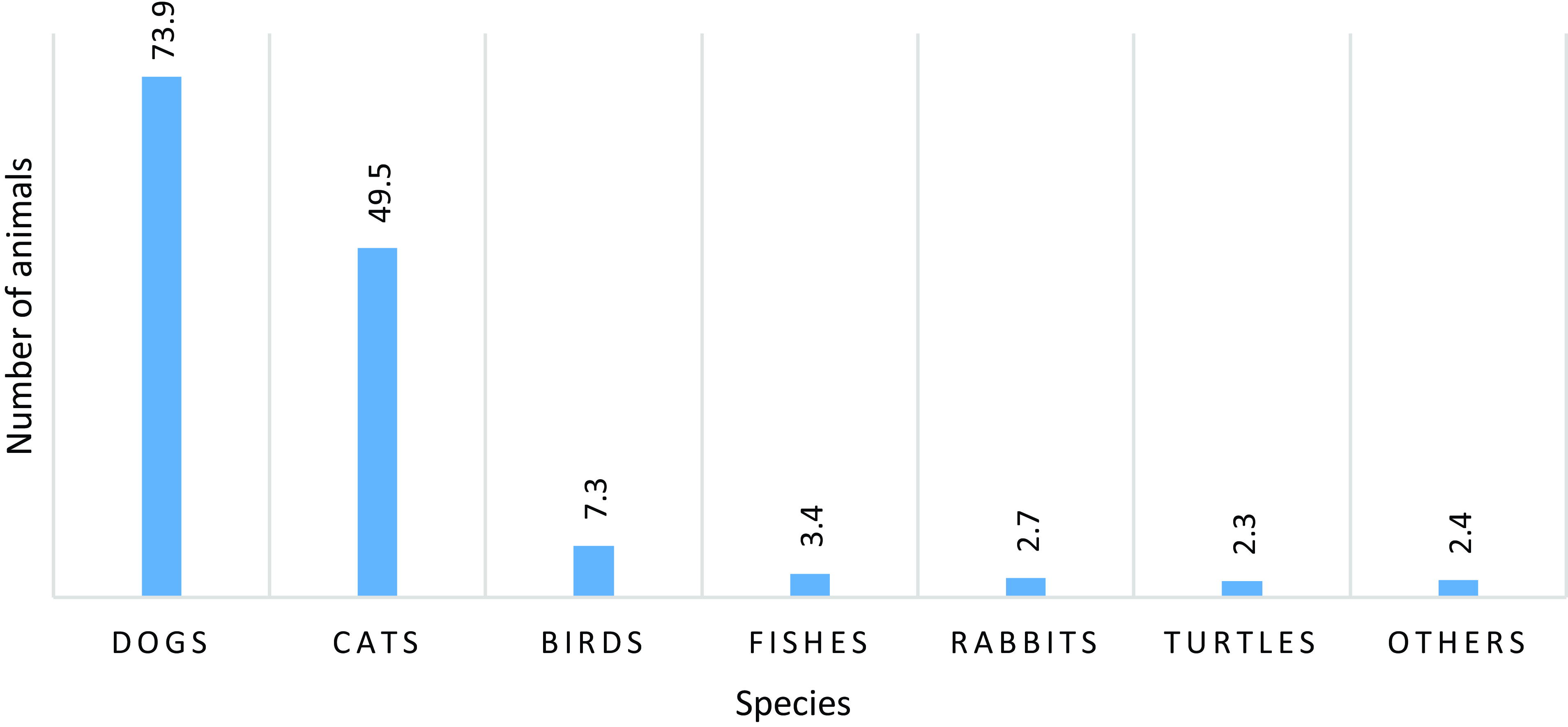
73.9% of the respondents said they had dogs, 49.5% felines, 7.3% birds, and 9.7% said they had other animal species (Figure 1). While it’s true that people with pets often have higher health and quality of life rates than those who don’t, a pet doesn’t necessarily have to be a dog or feline. The animal species can vary according to the need and availability of each tutor, with the main aspect to be considered as the way in which this relationship will be built. It is based on this that even the ownership of pets is also related to the improvement of cardiovascular disease in elderly and hypertensive people. Simply watching fish in an aquarium can help reduce muscle tension and lower stress levels. Reference Chowdhury, Nelson, Jennings, Wing and Reid16,Reference Giumelli, Pereira and Marciane29
Different species of animals belonging to guardians in the period of social isolation in Brazil.

It was found that, from the period of social isolation, 64.6% reported having increased hygienic care for their pets and 65.9% said that no greater efforts were needed in the care of their animals in this period. 87.5% also reported not having needed to leave their pets for any reason. These data suggest a link with the recommendations of the World Health Organization (WHO) on the importance of increasing hygiene care to combat the Sars-CoV-2 virus.
In a recent study on the perception of tutors about their pets titled ‘Tutors’ perception of the behavior of dogs and cats in the face of social isolation due to the COVID-19 pandemic,’ most respondents reported having noticed behavioral changes in their pets after the beginning of social isolation as a result of COVID-19, especially when related to the lack of affection between the animal, and its guardian; agitation being the most frequently observed change in behavior. This is possibly due to greater human-animal contact during the isolation period. This routine of care for a pet that exhibits these behaviors during social distancing seems to be of immense benefit to those dealing with issues such as loneliness, a feeling that can be frequent throughout the pandemic. Reference Silva, Dantas, Barbosa and Silva30
Emotionally, 85.9% said they had not faced any difficulty in relation to their animals, against 14.1% who reported some degree of emotional difficulty in the relationship, such as sadness/anguish, for having had an atypical situation during the period of social isolation. Even so, 95.5% stated that their pets were instrumental in overcoming bad feelings during the period of social isolation. This almost unanimous perception among guardians about the importance of their pets in overcoming bad feelings during isolation demonstrates how these animals can be a rich additional source of affective support while the world is facing emotional problems arising from the pandemic of COVID-19. Reference Hoy-Gerlach, Vincent and Lory Hector31
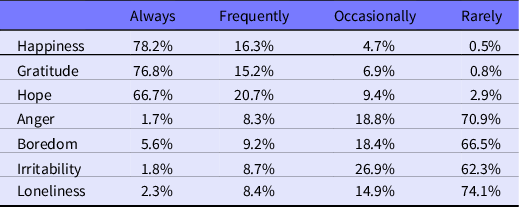
A recent study of treatment-resistant depression patients examined the therapeutic effect of having a pet on depression symptoms. The study compared 33 depressed participants who accepted the suggestion to adopt a pet against 33 depressed participants who did not. At follow-up, people who adopted pets had significant results in decreasing their depressive symptoms, in addition to showing an increase in rates of adherence and response to associated treatments, than participants who did not own pets. About the relationships with their pets, 98.8% said they had affectionate relationships of care, love, and affection with their pets, whereas 76.8% reported that this relationship was similar even before the coronavirus pandemic period in Brazil. About the predominant feelings felt by the pet owner in relation to their pets, happiness, hope, and gratitude were much more frequent than feelings of anger, boredom, irritability, and loneliness (Table 2). These results strengthen how interaction with and caring for pets are largely beneficial for emotional balance, and for the maintenance of the psychological health of their guardians. Reference Hoy-Gerlach, Vincent and Lory Hector31–Reference Vincent, Mamzer, Ng and Farkas38
Data on the influence of pets on feelings, and sensations from the perception of tutors in relation to their pets in the period of social isolation in Brazil

Our results are in line with other studies that present pets as 1 of the most important and valid therapeutic relationships that people can have during challenging times of any origin. Reference Barker, Schubert, Barker, Kuo, Kendler and Dick39–Reference Tanaka, Saeki, Hayama and Kass43
Conclusions
With this study, it was possible to identify that the relationship between guardians and their animals in the period of distancing and social isolation was important for psychological health. After the results obtained, further studies are still necessary to compare the difference between people who had and did not have pets over the course of social distancing due to COVID-19 in Brazil.
Availability of data and material
The datasets generated during and /or analyzed during the current study are available from the corresponding author on reasonable request.
Acknowledgments
We acknowledge: UNIPAR, for the funding provided for this research; CAPES, for the concession of the PROSUP school fee; and the respective Health Departments, for the authorization and constant collaboration.
Author contribution
All authors contributed to the study conception and design. Material preparation and data collection were performed by Ailton da Cruz Melo, Isabela Carvalho dos Santos, Adriane Cordeiro Trevisani Zilda Cristiani Gazim, Lidiane Nunes Barbosa, and Daniela Dib Gonçalves. The analysis was performed by Flávia Mayumi Tanaka Onaca, Laisa Marina Rosa Rey, Kariny Aparecida Jardim Rúbio, Juliana Aparecida Mendonça, Eloiza Teles Caldart, and Ranulfo Piau Junior. The first draft of the manuscript was written by Ailton da Cruz Melo, and all authors commented on previous versions of the manuscript. All authors read and approved the final manuscript.
Competing interests
Not applicable.
Funding information
We thank UNIPAR, the National Council for Scientific and Technological Development (CNPq - CP 09/2020 - Research Productivity Scholarships), and the Araucária Foundation (CP 10/2019 - Technical Scholarship to Support the Implementation of Multiuser Laboratories) for the funding granted to this research. We also thank CAPES for granting the PROSUP school fee.
Ethical approval
This study received exemption from consent as there was no patient interaction and the study was conducted as part of a Quality Improvement initiative; CAAE: 40960120.8.0000.0109.