Since 1978, constitutional designers in Latin America have introduced institutional innovations, such as more-than-plurality rules of presidential elections, which aim at diffusing power by promoting multi-candidate competitions for the presidency. Paradoxically, however, constitution makers in this region have also adopted institutions that work in the opposite direction. New constitutions tend to increase the legislative powers of presidents, in particular, the power to promote legislative change. Why would politicians want to diffuse and concentrate power at the same time?
I argue that this choice is a by-product of the short-term interests of the makers of constitutions in an institutional setting where party systems are increasingly fragmented and parties are frequently factionalized. In this context, the representatives of electorally weak parties are likely to favour inclusive electoral rules, such as more-than-plurality rules of presidential election. They support these institutions to promote multi-candidate competitions for the presidency and party pluralism. In the same context, however, members of parties which control or expect to control the presidency are likely to favour presidents with strong powers to promote legislative change. They do so to invest the president with the capacity to provide public policy when his or her party lacks the support of a disciplined majority in congress. In the absence of a dominant party able to impose the selection of institutions, these contradictory demands become part of a bargaining package which attempts to satisfy the interests of the main actors.
The argument proceeds as follows. The first two sections provide an overview of the most significant changes in electoral rules and presidential legislative powers during the twentieth century in Latin America. The next section develops an analytic framework and proposes a number of hypotheses on constitutional choice. Then there is a discussion of the operationalization and coding of the main variables and testing of the hypotheses with a statistical analysis of the determinants of constitutional choice in forty-six cases of constitutional change in Latin America from 1900 to 2001. The article concludes with a discussion of the implications of the findings for the study of presidential democracies.
Electoral rules: from restrictive to inclusive
Until the first decade of the twentieth century, most countries in Latin America elected representatives by plurality rule in single-member or multi-member districts, sometimes in combination with a limited vote. A few countries had experiences with majority run-off systems. As in Western Europe at the time, however, negotiations between old and new parties soon led constitutional reformers in Latin America to shift from plurality or majority rule to proportional representation (PR). The trend started with Costa Rica in 1913, followed by Uruguay in 1917 and Chile in 1925. By 1978, fifteen out of eighteen countries had adopted variants of proportional formulas. But except for the early reformers, systematic implementation of the new proportional formulas was infrequent. Repeated cycles and long periods of authoritarian rule in most countries prevented proportionality from making a full impact on party systems and party competition until PR formulas were restored in the early 1980s. By 2000, all Latin American democracies were using variants of PR formulas for electing deputies in single or multiple tiers.
The next important electoral change in Latin America took place after 1978. The period of re-democratization that began in 1978 led to a gradual abandonment of simple plurality for electing presidents. Most countries shifted to alternative rules such as qualified plurality – plurality with a minimum threshold to win in the first run – or majority run-off formulas. In addition, since the 1994 constitutional reform in Argentina, no country in Latin America has retained the typical nineteenth-century electoral system of electing a president indirectly by means of an Electoral College.
Eleven countries had experiences with plurality rule from 1900 to 1977. After 1978, however, the number of countries using plurality fell to eight during the 1980s and had dropped to five by 2000. During the same period, formulas other than simple plurality were on the rise. From 1900 to 1977, five countries had experiences with majority formulas (whether with a second round of elections or in Congress) and two countries with qualified plurality formulas in direct elections. After 1978, in contrast, ten countries adopted or maintained majority formulas and three utilized qualified plurality formulas.Footnote 1 By 2000, only five countries in Latin America retained direct presidential elections by simple plurality: Honduras, Mexico, Panama, Paraguay and Venezuela. The rest had adopted or maintained more-than-plurality rules.
The rules for electing presidents have potentially significant effects on party competition. These effects depend on the percentage of votes that a candidate must attain to win the election.Footnote 2 In the absence of a threshold, plurality rule provides small parties with an incentive to endorse, at least in the long run, presidential candidates from parties or coalitions whose expected electoral support is large enough to challenge an incumbent. Over time, this tends to restrict the entry of small parties and encourage the building of two large blocs, one behind the front-runner and another behind the main challenger.Footnote 3 By contrast, majority rule sets a threshold that is often too high for any party to achieve. Thus it does not force small parties with different ideologies or popular candidates to form electoral coalitions in the first round.Footnote 4 By running alone, relatively small parties can expect to pass through to the second round and either win with the support of first-round losers or negotiate their support to one of the main candidates.
Qualified plurality works as an intermediate formula between plurality and majority rule. As long as the presidential candidate of one party is expected to reach the threshold established by the rule, the other parties have an incentive, just as in simple plurality, to coalesce before the election in support of a single opponent. But, if there are many candidates, none of whom is expected to reach the threshold, qualified plurality works precisely like majority rule, leading to multi-party competitions for the presidency.
These expected effects have been generally confirmed in empirical studies. It has been shown that the effective number of candidates competing in a presidential election is higher under majority run-off than under plurality.Footnote 5 There is also evidence that on average, presidential elections under qualified plurality systems lead to an effective number of candidates that is slightly higher than with plurality, but lower than with majority rule.Footnote 6 Related research has also shown that the formula for electing presidents, in combination with the temporal proximity of presidential and legislative elections, has an indirect impact on legislative fragmentation. In particular, temporally-proximate presidential elections tend to reduce the effective number of parties competing in legislative elections if and only if the effective number of presidential candidates is sufficiently low.Footnote 7
Putting these findings together one can expect that compared to presidential elections by majority rule, presidential elections by plurality tend to reduce the effective number of candidates. In addition, if congressional elections are concurrent or close to the presidential election, plurality rule has, again compared to majority rule, an indirect reductive effect on the effective number of electoral parties. This suggests that in combination with the prior adoption of PR formulas for congressional elections, the recent shift from plurality to more-than-plurality rules for presidential elections in Latin America represents a shift from more to less restrictive rules on party competition.
The combined effect of the electoral rules for electing legislators and presidents has supported and reinforced multi-partism in the region. As of 2000, for instance, only six out of eighteen countries in Latin America had an effective number of parties in the single or lower chamber of congress less than 2.5. In most cases, the president’s party has had a minority status in congress. To overcome this situation, presidents have managed to form government coalitions or rely on legislative coalitions. Often, however, presidents have also been able to compensate the minority status of their parties with constitutional powers that give them influence over legislative bargaining. In fact, just as the proliferation of parties has made presidents more dependent on congress for implementing a legislative agenda, several constitutional changes have increased their formal powers to negotiate policy with legislators. I turn to the analysis of these transformations in the next section.
Policy-making rules: from reactive to proactive presidents
At the beginning of the twentieth century, most presidential regimes in Latin America maintained the US model of separation of powers that was adopted after the wars of independence.Footnote 8 The US Constitution invested the president with the power to preserve the status quo by means of a package veto, but it deprived the executive of any specific agenda-setting power, that is, the power to constrain the set of policy alternatives from which the assembly may choose, the timetable according to which these choices must be made, or both. This institutional arrangement was, however, gradually transformed.
Along with the traditional package veto, the 1949 Argentine Constitution and the 1967 Uruguayan Constitution invested presidents with the explicit authority to veto portions of a bill and promulgate the rest if congress did not achieve the majorities necessary to override the partial observation. In terms of agenda powers, the 1917 Uruguayan Constitution introduced the concept of reserved areas of exclusive initiative of the executive on important financial and economic matters. Some constitutions, like the 1925 Chilean Constitution or the 1946 Ecuadorian Constitution, increased the influence of executives on the drafting of budget bills by making the presidential proposal the reversionary outcome if congress did not decide within a time limit. Presidents also received the power to force a congressional vote on a government bill within a constitutionally defined time limit, as was the case of the 1925 Chilean Constitution, the constitutional reform of 1945 in Colombia, and the 1967 Uruguayan Constitution. The 1937 Brazilian Constitution invested the president with the explicit power to enact decrees of legislative content in cases of urgency. Later, this precedent was followed by the 1946 Ecuadorian Constitution and the constitutional reform of 1968 in Colombia.
A few countries revising their constitutions after 1978, such as Nicaragua and Panama, have reduced the presidential powers inherited from an authoritarian constitution. Other countries moderated presidential powers created by authoritarian constitutions while retaining important prerogatives for the executive, as was the case in Brazil and Paraguay. In most cases, however, constitutional changes since 1978 led to a net increase in the legislative powers of the president, particularly in the area of agenda powers.Footnote 9
The 1979 Constitution of Peru and the 1998 Constitution of Ecuador reinforced the agenda-setting powers of presidents over the budget by placing limits on the ability of legislators to increase the total level of spending authorized by the executive. The 1979 Constitutions of Ecuador and Peru, the 1988 Constitution of Brazil and the 1992 Constitution of Paraguay gave presidents the capacity to invoke urgency bills that must be voted on within a time limit. In some cases (Ecuador, Paraguay and Uruguay), the constitution even establishes that the bill proposed by the executive becomes law in the absence of congressional approval. The clearest example of the strengthening of the legislative powers of presidents in recent years is, of course, the growing number of constitutions that invest the executive with the power to enact decrees of legislative content. This is the case for the 1988 Constitution of Brazil, the 1991 Constitution of Colombia, the 1993 Constitution of Peru and the 1994 Constitution of Argentina.
This brief description is sufficient to show that changes in electoral rules and changes in the legislative power of presidents seem to have moved in rather opposite directions. While electoral rules have become less restrictive, legislative powers have become more concentrated in the executive office. These trends are probably related to region-specific factors. Decades of authoritarianism and limited democracy may have led voters and political elites to support more inclusive electoral rules. Growing demands for social and economic reform in countries where congresses have been unable or unwilling to respond to these demands may have convinced the makers of constitutions of the need to strengthen the legislative powers of the president.
Even so, electoral rules and legislative powers vary across countries. Thus, a crucial question for comparative analysis is what factors might explain the variation. The answer requires consideration and testing of the different theories that attempt to explain the choices made by the makers of constitutions.
Explaining constitutional choice
Decisions about rules of presidential election and presidential powers are made on the occasion of replacing or amending constitutions.Footnote 10 Constitutions have a unique position among formal rules. They are more general and usually more difficult to change than ordinary laws. Some aspects of constitutions, however, share similar explanations of their origins with other institutional rules. In particular, there are four common hypotheses of constitutional choice: historical legacy, diffusion, impartiality and strategic calculus. The first two are constraint-based and the latter two preference-based explanations.
A hypothesis of constitutional choice postulates that the makers of constitutions tend to follow the force of precedent. In this view, institutions structure the process of change such that marginal changes occur, while basic rules remain unchanged. This hypothesis is consistent with the fact that countries tend to stick to initial constitutional choices, such as the republican or monarchical form of government or the parliamentary or presidential structure of executive–legislative relations.Footnote 11 The main drawback of the ‘path dependence’ hypothesis is that, when changes do occur, the theory provides no mechanism to explain the direction of change. In other words, even if it is true that basic constitutional choices tend to persist and changes are often marginal, one still needs a causal explanation of choice.
Another common explanation is based on the idea of diffusion, contagion or imitation of constitutional models. The hypothesis here is that the adoption of a particular design by the makers of constitutions is influenced by how many nearby countries have already adopted it. This explanation finds empirical support in that certain constitutional regimes are often adopted in clusters during a specific period of time or within a particular region of the world. While Latin American countries have overwhelmingly opted for presidential-PR systems, parliamentary-plurality systems are concentrated in the United Kingdom and many former British colonies.Footnote 12 But the mere diffusion of a particular institution does not amount to a complete explanation of why it is chosen. It is necessary to know the reasons for imitation beyond the simple fact that a new constitutional model might become available at a certain point in time. Moreover, diffusion cannot account for certain models being adopted instead of others or for the makers of constitutions almost always making selective use of foreign designs, copying some but not all the components of a given model.
The hypothesis of impartiality postulates that political actors select constitutional rules based on the resulting collective benefits, such as the durability of democracy, effective government or political legitimacy. According to Ackerman, for instance, constitution making belongs to a ‘higher’ track of law making, in which actors are mostly motivated by impartial concerns.Footnote 13 This view often finds empirical support in the fact that political actors engaged in constitution making typically reveal their preferences for a given constitutional design in impartial terms, using arguments of efficiency or legitimacy. This is not, however, reliable evidence. Political actors often use impartial arguments strategically, under the constraints of publicity.Footnote 14 It should also be considered that efficient or fair institutions are public goods and, as such, subject to the well-known problems of collective provision. Unless the interaction is one of pure co-ordination or the makers of constitutions face specific constraints on a self-interested choice, those goods are not supposed to be provided by partisan actors.Footnote 15
One final explanation is based on partisan self-interest. In its standard version, this hypothesis postulates that political actors adopt a particular set of constitutional rules based on calculations of how those rules will affect their ability to win office and/or have influence over policy outcomes.Footnote 16 This model is limited as a descriptive account of individual motivations or as an explanation of all dimensions of constitutional choice. But it provides a reasonable assumption of the dominant goal of political actors when selecting ‘redistributive’ constitutional rules, such as the rules of election and the rules that allocate powers among policy makers.Footnote 17
I have shown elsewhere that partisan considerations play an important role in explaining the selection of electoral rules.Footnote 18 This makes sense because these rules determine the number of viable candidates and parties competing for office. A similar logic, however, may apply for explaining the choice of the rules that allocate powers among policy makers. These rules establish how many actors are allowed to participate in the policy-making process, who has the power to make proposals, who accepts or rejects them, and what the reversionary outcome is in the absence of approval. Since professional politicians cannot disregard the outcomes produced by these rules, it seems reasonable to hypothesize that their adoption also belongs to the operational or practical level of institutional design where decisions are primarily based on partisan considerations.Footnote 19
Like other hypotheses about constitutional choice, partisan self-interest attempts to account for the final selection of institutions. It does not explain why politicians may decide to replace or amend the existing constitution at some particular point in time. Given the costs of constitutional change, constitutions cannot simply be revised any time partisan actors might find it convenient to maximize their short-term interests. Constitutional change is often imposed by complex political events over which partisan actors have no control or only indirect control, such as regime transitions, a government crisis or the performance failure of existing institutions.Footnote 20
Based on these premises, I propose a strategic model to explain the decisions of constitution makers on the rules for electing presidents and on the allocation of legislative powers between presidents and assemblies. This model predicts the choice of these rules on the basis of two main factors: (1) calculation of how those rules affect parties’ chances to participate in elections and have an influence on policy, and (2) the bargaining power of institutional designers at the time when these choices are made. While the first factor explains the formation of preferences, the second explains the realization of those preferences in a constitution-making process.
According to the logic of this model, constitution makers, such as members of a constituent assembly, derive preferences for institutions based on their knowledge about the expected outcomes under alternative rules.Footnote 21 In democratic settings, these preferences are generally determined by party interests. Since party organizations help politicians to advance their careers, the makers of constitutions tend to have preferences for institutions that differ depending on how alternative rules affect the electoral and policy interests of their parties. I will assume that these partisan interests are discernible at the time of selecting institutions, based on the electoral support of the parties represented in the constituent body.Footnote 22
The final adoption of constitutional provisions depends on bargaining power, which can be defined as the ability of actors to control outcomes.Footnote 23 This power is based on the resources political actors have for making their preferences prevail over those of their opponents. I will assume that the main resources are the proportion of seats held by each party in the constituent body and the capacity of party leaders to control the vote of their representatives. Party leaders depend on these resources to have direct control over the decision rule for constitutional change and build coalitions to reach the necessary votes required by the decision rule or block decisions.
Based on this analysis, constitution makers who belong to parties that are dominant or electorally strong at the time of choice are likely to prefer restrictive electoral rules, such as plurality rule for presidential elections, anticipating that these rules would secure an electoral advantage for their presidential candidate and deter the emergence of second or third challengers. Conversely, constitution makers who belong to parties that are electorally weak at the time of choice are likely to prefer inclusive electoral rules, such as majority rule for presidential elections, so that candidates from small parties will be supported and multi-candidate electoral competitions will be promoted.
The realization of these preferences depends on whether the parties that have influence over constitutional design are electorally strong or electorally weak at the time when the formulas for presidential election are selected. This, in turn, depends on the level of party fragmentation in the constituent body and the number of votes required for adopting constitutional changes. All other things being equal, the more parties are necessary to pass constitutional changes, the more likely it is that parties in the coalition which are electorally weak will obtain an agreement shifting from more to less restrictive formulas of presidential election. We can synthesize this proposition in the following hypothesis:
Hypothesis 1 As the number of parties whose approval is necessary to pass constitutional changes increases, constitution makers are likely to opt for more-than-plurality rules of presidential election.
Because they are accountable to a national constituency, incumbent presidents and popular presidential candidates are the main actors with an interest in having more rather than less constitutional powers to provide public policies demanded by the electorate. Constitution makers will support or oppose this preference based on the present or expected position of their parties in relation to the executive office. Delegates in a constituent assembly will be more inclined to support strengthening the legislative powers of the executive if they belong to parties that control or expect to control the presidency than if they belong to opposition parties.Footnote 24 It is highly implausible that all the delegates in a constituent assembly will have the same preference ordering regarding presidential powers.Footnote 25
Constitution makers who belong to the president’s party, however, will also consider the present or expected position of their party in congress. Due to the structure of the separation-of-powers system, they are likely to prefer a president with strong legislative powers if their party does not count or does not expect to count on the support of a majority of representatives in congress. In this situation, strengthening the legislative powers of the president is the only means for the party to have influence on national policy. This decision is even more likely if the party of the incumbent or future president has a decentralized organization. When parties have a decentralized organization that promotes intra-party competition their members tend to cultivate personal reputations and have no interest in participating in the elaboration of national policies.Footnote 26
It follows from these arguments that the makers of constitutions should support strengthening the legislative powers of the president when they belong to parties that control or expect to control the presidency but cannot count on having a disciplined majority in congress. Proposals to strengthen the legislative powers of the president will be opposed by parties with no chance of winning the presidency. For several reasons, however, supporters of the incumbent president or of popular presidential candidates are likely to overcome this opposition when constituent assemblies are fragmented and parties are factionalized.
One reason is that when the field of party competition is fragmented, the number of parties that could potentially win the presidency usually grows. In this context, leaders of the larger parties may share the expectation that whoever wins the presidency will need strong legislative powers to compensate for the minority situation of his or her party in congress. This expectation may in turn facilitate the formation of a coalition of parties with enough votes to pass constitutional changes and an interest in strengthening the legislative powers of the president as a consensual solution to a common problem.
Fragmented constituent assemblies are also likely to be more vulnerable than assemblies under the control of just one or a few large parties to pressures from incumbent presidents or popular presidential candidates to increase their legislative powers. We can expect some parties, particularly those that oppose the incumbent president and/or have no expectation of ever winning the presidency, to reject these powers. In a fragmented assembly, however, collective action is more difficult, and these parties are likely to face severe barriers to forming a stable coalition against pro-presidential parties. The disadvantage of opposition parties is even more pronounced if they are also internally factionalized.
Finally, even if the party that controls or expects to control the presidency forms a coalition with parties that do not expect to win the presidency, the latter may be willing to accept a president with stronger legislative powers if in exchange they obtain concessions in other areas. Opposition parties may obtain, for instance, new offices to compete, limits to some of the government powers of the executive, or electoral reforms that improve their future electoral prospects. If these concessions improve their condition compared to the status quo, opposition parties will accept a compromise.
Taking these considerations into account, it seems reasonable to expect that, under conditions of party fragmentation and party factionalization, constitution makers who belong to parties that control or expect to control the presidency will propose an increase in the legislative powers of presidents and their proposals will pass. This leads to the following hypothesis:
Hypothesis 2 If the number of parties necessary to pass constitutional changes increases and parties are decentralized, constitution makers are likely to strengthen the legislative powers of the president.
The idea of a compromise between contradictory demands suggests a possible connection between the choice of electoral rules and the choice of presidential powers. In an institutional setting where party systems are fragmented and parties are factionalized, the representatives of electorally weak parties are likely to favour inclusive electoral rules. In the same context, members of parties which control or expect to control the presidency are likely to favour presidents with strong powers to produce legislative change. Since no party has the power to impose its preferences unilaterally, both demands may become part of a bargaining package that satisfies the interests of all the actors whose agreement is necessary to pass constitutional changes.
The determinants of constitutional choice in Latin America
In order to test the hypotheses outlined above I created a database of the most important instances of democratic constitutional revision that occurred in eighteen Latin American countries between 1900 and 2001. The sample includes forty-six observations: Argentina 1949, 1994; Bolivia 1961, 1995; Brazil 1946, 1988, 1994, 2001; Chile 1997; Colombia 1910, 1936, 1945, 1968, 1991; Costa Rica 1926, 1936, 1949; Dominican Republic 1963, 1966, 1994; Ecuador 1946, 1983, 1998; El Salvador 1983; Guatemala 1945, 1965, 1985; Honduras 1957, 1965, 1982; Mexico 1917; Nicaragua 1987, 1995, 2000; Panama 1946; Paraguay 1992; Peru 1979, 1993; Uruguay 1917, 1942, 1952, 1967, 1997; and Venezuela 1947, 1961 and 1999.Footnote 27
The database includes only constitutions and amendments approved by popularly elected political parties and in force between 1900 and 2001, in years where the executive and the legislature were elected and more than one party competed in elections. The observations that meet these criteria include all instances of democratic constitutional replacement and a selection of important amendments in which institutional designers considered revising central aspects of the electoral system, the distribution of powers between presidents and assemblies, or both.Footnote 28 These changes cover revisions made by both ordinary congresses and constituent assemblies operating under different decision rules.Footnote 29
Measuring Dependent Variables
Constitutional choice is analysed in this article in two different outcomes, the electoral formulas for electing presidents and the legislative powers of presidents. In one case we want to measure the degrees of restriction that electoral rules impose on the number of candidates competing in presidential elections; in the other, the degree of influence over policy making that constitutional provisions grant to the president.
As noted in the first section of this article, several empirical studies show that the electoral formulas for electing presidents have an impact on the effective number of presidential candidates (and, indirectly, on the effective number of electoral parties). Given this information, it is straightforward to measure how restrictive the electoral formulas for electing presidents are. We can use an ordinal scale ranging from 1 to 3, where 1 indicates the highest, 3 the lowest, and 2 an intermediate level of restriction. On this scale, plurality rule would receive a score of 1, and majority rule a score of 3. Qualified plurality would have an intermediate score of 2.
Measuring the legislative power of presidents demands a more detailed analysis. Shugart and Carey proposed an index of presidential power that is probably the best to date.Footnote 30 On an ordinal scale ranging from 0 to 4 (0 being the weakest and 4 the strongest power in each dimension), these authors evaluated the relative power of presidents by adding scores across the different categories of legislative and non-legislative powers.Footnote 31
This index has several limitations, however. The most important is the assumption that each instrument included in the analysis contributes equally to the overall power of the president.Footnote 32 This means, for instance, that having a veto is equal to the power to propose binding referendums, put forward urgent bills, or issue decrees with immediate force of law. The method disregards how a specific configuration of instruments, rather than their mere aggregation, contributes to the total power of the president. It also ignores the relative importance of each category of power within a particular dataset.
One way to solve the weighting problem is to make a qualitative assessment of how certain powers interact with each other so that their joint contribution to the overall power of the president is more than the mere addition of their separate scores. Veto and agenda powers are a case in point. In an additive index, a president with a score of 6 in veto and 0 in agenda powers is considered to have the same total power as another with a score of 3 in veto and 3 in agenda powers. Both spatial analyses and case studies, however, have shown that veto and agenda powers have interactive effects.Footnote 33 Thus a president with moderate powers in both veto and agenda should have more impact on policy outcomes than another with strong powers in only one of these dimensions. In order to capture this interactive effect, one can simply multiply the aggregate scores of veto and agenda powers to obtain an index of the overall legislative power of presidents.
Another option is to use principal component analysis (PCA). The appeal of this technique is that it allows the researcher to combine qualitative judgement in the coding of each variable with a weighting method that reflects the relative importance of each variable in explaining variation within a particular dataset. PCA describes the variation of a set of multivariate data in terms of a set of uncorrelated variables or components, each of which is a particular linear combination of the original variables.Footnote 34 The first principal component accounts for as much as possible of the variation in the original data, while the second component accounts for the remaining variation in the original data subject to being uncorrelated with the first component, and so on.
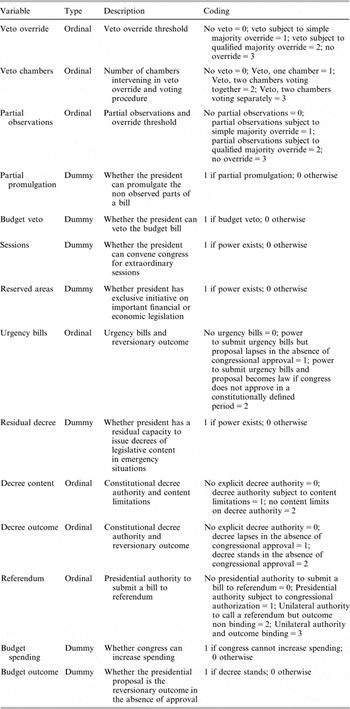
The first step in constructing an index of the legislative power of presidents using PCA is to enter into the analysis the different instruments that have been identified in the literature as relevant determinants of this power. Qualitative judgement is required to code each category of power. Each instrument is coded as a dummy or ordinal categorical variable, depending on the number of features that according to theory define the strength of that particular instrument in a single dimension. When more than one dimension is relevant, different scales should be used.
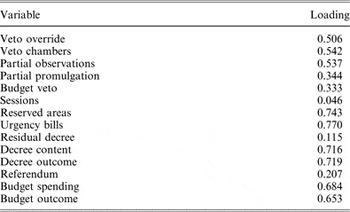
PCA transforms dummy and ordinal variables into continuous ones according to the loadings assigned in each component.Footnote 35 The first component is then used to derive an index that provides maximum discrimination between the legislative powers of presidents in each constitution, with those instruments that vary most within the sample being given the highest weight.Footnote 36 This process ensures that measurement of the legislative power of presidents is based not only on the researcher’s evaluation but also on the objective variation of presidential powers in a particular sample.
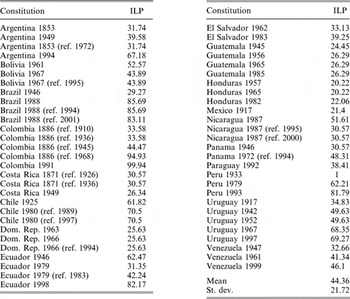
I have listed in the Appendix the variables included in the analysis, the coding of each variable, the scores derived from the first component, and the actual scores for fifty-three constitutions. To facilitate the analysis and use of the index, the original scores of PCA for each variable were transformed to a scale from 1 to 100.Footnote 37
To verify whether the index based on PCA deviates from a purely qualitative one, I compared it with one based on the interaction between the aggregate scores of veto and agenda powers. They show a correlation coefficient of 0.88. This provides reassuring evidence that the scale constructed by a quantitative method does not diverge substantially from an index based on qualitative judgement. Using the same database, however, the correlation between either of these indexes and Shugart and Carey’s index is relatively low.Footnote 38
Measuring Explanatory Variables
The first variable we use to explain constitutional choice is the number of parties with influence over the final selection of institutions. This variable reflects the electoral support and the relative size of parties at the time of choice, thus indicating the institutions that are likely to be proposed and accepted in a constitution-making process.
One possible measure of the number of parties with influence over the final selection of institutions is the effective number of parties (ENP) in the constituent body.Footnote 39 This measure, however, may be inaccurate as an indicator of the actual distribution of forces within the constituent body. An ENP of 1.92, for instance, is supposed to reflect the existence of two major parties.Footnote 40 But the same value may veil a distribution in which one party controls 70 per cent of the seats and three small parties 10 per cent each. An ENP of 2.93, while indicating almost three parties, may in fact correspond to a situation in which two large parties share 41 and 39 per cent of the seats each, followed by two small parties with 10 per cent each.
An alternative that may correct this problem is a qualitative counting rule that takes into account the actual share of seats of the main parties. This counting rule, however, may still be insufficient to capture the exact number of parties with influence on constitutional change. Since constitutional changes take place under different decision rules, such as simple or qualified majority, the number of parties that are necessary to pass constitutional changes may vary depending on these rules.
For this reason, I provide an alternative indicator. This is MNP, a discrete numerical variable indicating the minimum number of parties necessary to form a coalition able to pass constitutional changes according to the decision rule.Footnote 41 If one party controls 75 per cent of the seats, the minimum number of parties to pass constitutional changes will be one, whether under absolute or qualified majority. If, however, the constituent assembly is composed of five parties sharing, say, 49, 16, 13, 12 and 10 per cent of the seats, the minimum number of parties to pass constitutional changes is either two or three depending on whether the decision rule is absolute majority or two-thirds.
In the case of the legislative powers of presidents, the second relevant independent variable is party centralization. As a proxy, I used the ballot structure in force at the time of electing delegates to the constituent body. The ballot structure determines the degree of control exercised by party leaders over access to their party’s label and over ballot rank in electoral list systems. The party label matters most and parties tend to act as unitary actors when legislators are elected in single closed lists.Footnote 42 Following this logic, I have measured party centralization using PARTYCENTR, a dummy variable that distinguishes whether members of the constituent body were elected in single closed lists. While there is a wide range of rules that determine the degree of centralization of parties, this variable traces the basic difference between single closed lists and other alternatives, such as flexible lists, open lists or multiple lists.Footnote 43
Regression Analysis
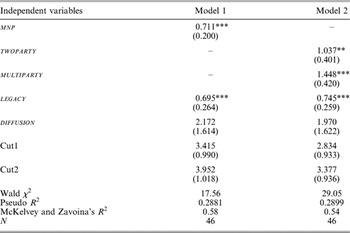
To test the determinants of electoral choice I used an ordered probit regression, with robust standard errors clustered by country to control for correlation among observations within each country. I designed two models for this test. Model 1 uses mnp to measure the impact of the number of parties with influence over constitutional choice on the selection of the electoral formulas for electing presidents.Footnote 44 Model 2 disaggregates mnp into twoparty and multiparty to capture the effect produced by increasing the size of the coalition that is necessary to pass constitutional changes.Footnote 45 Each is coded as a dummy variable which equals 1 when the number of parties integrating the coalition is two and more than two, respectively. Constituent bodies dominated by one party are used as the implicit comparison group.
Two additional independent variables control for alternative explanations of electoral choice. legacy traces the effect of the existing electoral rules on electoral choice. It reflects the lagged score of the dependent variable at the time of choice and attempts to determine whether the costs of institutional change constrain constitution makers to maintain or make only incremental changes in the existing electoral formula for electing president. diffusion traces the effect of the number of countries adopting an electoral rule on the probability that another country will adopt the same rule. The numerical value of diffusion is the percentage of countries in Latin America that had majority rule for presidential elections the year before a constitution is replaced or amended.Footnote 46
Table 1 shows the regression results. In Model 1 mnp is statistically significant at p < 0.01, indicating that as the number of parties necessary to change or amend the constitution increases, constitution makers opt for less restrictive rules of presidential election. diffusion has the expected positive sign but it is not statistically different from zero. legacy is significant and positive, suggesting that constitution makers either maintained existing electoral rules or moved gradually toward less restrictive ones.
Ordered Probit Estimates of the Determinants of Electoral Choice

Notes: The dependent variable is the electoral formula for president. Numbers in parentheses are robust standard errors clustered by country.
***p < 0.01; **p < 0.05; * p < 0.1
Model 2 explains, as McKelvey and Zavoina’s R 2 suggests, up to 54 per cent of the variation in the adoption of electoral formulas for president.Footnote 47twoparty and multiparty are statistically significant at the 0.05 and 0.01 level, respectively. There is no change in the effect of control variables. Compared to constituent assemblies dominated by a single party, constitution makers are likely to opt for less restrictive electoral formulas for presidents when at least two parties are required for approval of constitutional changes. This result probably indicates that when two parties have influence over constitutional changes, the party that is electorally weaker has enough bargaining power to demand inclusive electoral rules as part of the negotiation package.
As predicted, the probability of adopting more-than-plurality formulas of presidential election increases as the minimum coalition necessary to pass constitutional changes grows in size. This effect is seen best in the extreme cases.Footnote 48 All other things being equal, there is a 75 per cent probability that a dominant party would choose a plurality formula for presidential elections, but only a 25 per cent probability that it would choose more-than-plurality formulas. In contrast, multi-party assemblies would choose plurality with 26 per cent probability and more-than-plurality formulas with 74 per cent probability.
Following Duverger, most students of presidential regimes propose that like PR in congressional elections, majority run-off in presidential elections leads to multi-partism.Footnote 49 The analysis presented in this article does not contradict this hypothesis. But it shows that the causal relation between electoral systems and party systems is not unidirectional. Just as electoral rules may affect the number of viable parties or candidates competing in elections, the number of parties with control over constitutional design is a crucial factor for predicting in what direction electoral changes would occur once political actors decide to revise the existing institutions.
I used an ordinary least squares (OLS) regression with robust standard errors clustered by country to estimate the determinants of the legislative powers of presidents, coded as a continuous variable derived from principal component analysis.Footnote 50 The main independent variables are the number of parties with influence over constitutional change and party centralization.
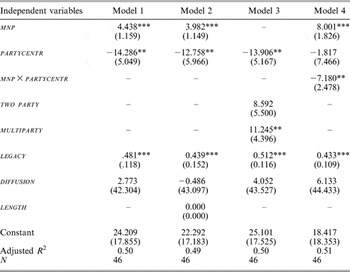
I designed four models for this test. Model 1 estimates the comparative effect of mnp and partycentr.Footnote 51legacy and diffusion are control variables. legacy is the lagged value of the dependent variable. diffusion is the percentage of countries with presidents whose legislative powers were above the mean of the whole region the year before a constitution is being replaced or amended. Model 2 adds length, a control variable which measures how detailed constitutions are by their total number of words. Since constitutions are increasingly prolific and detailed over time, it is possible that ‘constitutional expansionism’ also accounts for the variation in presidential powers.Footnote 52 Model 3 disaggregates mnp into the dummy variables twoparty and multiparty, to capture the effect produced by increasing the size of the coalition required to pass constitutional changes. Model 4 determines the effect of the interaction between the number of parties and party decentralization on the choice of legislative powers.
Table 2 shows the regression results. In model 1 mnp is statistically significant at the 0.01 level and positive, while partycentr is significant at the 0.05 level and negative. It shows that when the number of parties with influence over constitutional change grows and when parties are decentralized, constitution makers tend to strengthen the legislative powers of the president. Among the control variables, diffusion has the expected positive sign but it is not statistically different from zero. legacy is significant and positive, meaning that constitution makers either maintained previous scores on presidential legislative powers or moved gradually towards higher scores. Model 2 shows essentially the same results after adding length, indicating that presidential powers are not explained by the expansion of constitutions over time.Footnote 53
OLS Estimates of the Determinants of Presidential Legislative Powers

Notes: The dependent variable is the legislative power of presidents. Numbers in parentheses are standard errors clustered by country.
***p < 0.01; **p < 0.05; *p < 0.1.
Model 3 explains 50 per cent of the variation in the legislative powers of presidents. It shows that compared to constituent assemblies controlled by dominant parties, there is an increase in the legislative powers of the president as the number of parties with influence over constitutional change also increases.Footnote 54 The effect, however, is only statistically significant when the number of parties is greater than two. This suggests that in the case of legislative powers, the influence of second parties is not systematic. Constitution makers seem to have stronger incentives to strengthen the legislative powers of the president at higher levels of party fragmentation. The effect of party centralization is the same as in the previous models.
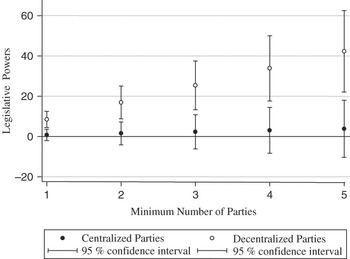
Hypothesis 2 suggests that party fragmentation and party decentralization may have interactive effects. Model 4 seeks to determine whether the impact of mnp changes by party centralization. The coefficient of mnp indicates that an increase in the number of parties with control over constitutional change leads constitution makers to strengthen the legislative powers of the president when parties are decentralized (partycentr = 0). However, we cannot directly interpret how the impact of every increase in the number of parties changes when parties are centralized (partycentr = 1). Figure 1 illustrates how the effect of mnp on the legislative power of presidents changes depending on whether parties are centralized.
Effect of MNP on legislative powers by party centralization

The lines represent the upper and lower bounds of 95 per cent confidence intervals. They determine the conditions under which the number of parties with control over constitutional change has a statistically significant effect on the legislative powers of presidents. The effect is statistically significant whenever the confidence intervals are both above (or below) the zero line.Footnote 55Figure 1 shows that while there is an increase in the legislative powers of presidents at every increase in mnp, the impact is only statistically significant when parties are decentralized. Thus the impact of the number of parties with control over constitutional change is conditional on parties being decentralized.
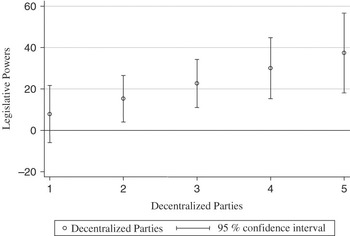
It should be noted, however, that when parties are decentralized, the effect of decentralization is not completely independent of the number of parties with control over constitutional change. Figure 2 illustrates the effect of party decentralization on the legislative powers of presidents as mnp increases.
Effect of party decentralization on legislative powers by MNP

This figure shows two things; first, that the impact of decentralization is only statistically significant when more than one party controls constitutional change; and secondly, that the impact increases as the number of parties with control over constitutional change also increases. This means that while the effect of mnp on the legislative powers of presidents is conditional on parties being decentralized, the impact of party decentralization tends to be reinforced with an increase in mnp.
Discussion
The results of the empirical analysis support the hypothesis that as the distribution of partisan power in the constituent body becomes less concentrated, constitution makers tend to opt for more inclusive electoral rules. It also supports the hypothesis that under conditions of party system fragmentation and party decentralization, constitution makers tend to strengthen the legislative powers of the president. The interaction between these two variables indicates that fragmented constituent assemblies increase the legislative powers of presidents in a systematic way only when parties are also decentralized. The effect of party decentralization, in turn, increases in magnitude as the number of parties with influence on constitutional change also increases.
The significant effects of existing electoral rules and presidential legislative power on subsequent choices also indicate that constitution makers are indeed influenced by previous choices. Path dependence, however, still requires an explanation of why constitutional changes take a particular direction. The findings of this article indicate that the most important variable in this explanation is the number and type of parties represented in the constituent body.
As argued above, the selection of electoral rules and policy-making powers may be part of the some process of choice. Given a multi-party constituent assembly, for instance, in 66 per cent of the cases delegates maintained an inclusive electoral system or made it more inclusive and maintained a strong president, or made him stronger.Footnote 56 In these cases, electoral rules and legislative powers are usually part of a bargaining package in which parties accept a relatively strong president in exchange for electoral rules that ensure inclusiveness. In other cases, however, either electoral change preceded a change in presidential powers or decisions occurred in the predicted direction but only in one of the two dimensions.
These results suggest an explanation of the recent shift in Latin America from more to less restrictive rules of election and from weaker to stronger presidents in policy making. Important aspects of this choice are related to the growing fragmentation of the party system. This is clearly the case in the selection of electoral rules. But it also applies to the allocation of legislative powers between presidents and assemblies. While about half of constituent assemblies have been under the control of decentralized parties both before and after 1978, the periods differ sharply in terms of the number of parties necessary to pass constitutional changes. Before 1978, the modal constituent body was one under the control of one party. After 1978, the modal constituent body was one in which no single party had control over constitutional change.Footnote 57
Three arguments can be offered to explain this phenomenon. The first is that several constitutions were created at the beginning of the transition to democracy, a time where the number of parties competing in elections tends to be high since both traditional and new parties attempt to test their support under the new political conditions. The second is that since 1978 most constituent bodies have been elected by PR rules of election, which tend to increase party fragmentation. Finally, as elections become more competitive and societies more pluralistic, dominant and even two-party systems tend to decline.
Where no single party has unilateral control over constitutional change, members of electorally weak parties are likely to propose and obtain an agreement in which electoral rules become more inclusive. In this context, particularly if parties are also decentralized, members of the party that controls or expects to control the executive are likely to propose and obtain an agreement in which the legislative powers of the president are increased.
Conclusions
Most constitutional changes in the last two decades in Latin America have involved a shift from plurality rule for presidential elections to an alternative rule, generally majority run-off, but also qualified plurality in some cases. This change has been coupled with the restoration or adoption of proportional rules for congressional elections. At the same time, constitutional changes since 1978 have reinforced the tendency to invest presidents with strong legislative powers to influence policy making.
I have shown that party competition and party organization are crucial variables for explaining the choice of electoral rules and the allocation of legislative power between presidents and assemblies. This finding reverses the conventional assumption that constitutions and their various designs are pre-existing structures that determine the preferences of political actors. Instead, it indicates that some aspects of constitutional choice are driven by the preferences of partisan actors.
This analysis suggests that the shift from more to less restrictive electoral rules and from weaker to stronger presidents in the legislative arena can be expected to persist as a frequent design among Latin American democracies. Given PR formulas of congressional election, the massive adoption of more-than-plurality electoral formulas to elect presidents since 1978 will maintain and reinforce the tendency towards multi-partism. As a matter of political survival, multi-party systems would typically block any attempt to restore restrictive electoral rules. At the same time, in a social and economic environment where policy reform is constantly required, fragmented and decentralized constituent assemblies would probably strengthen the legislative powers of the president or maintain a presidency that is already strong in legislative powers.
Most studies on political institutions use the electoral system and the distribution of powers between presidents and assemblies as independent variables to explain a wide range of relevant outcomes. This perspective is important but insufficient for a research agenda on institutions in changing political environments. When institutions themselves are in a flux, analysis of the underlying game that leads to institutional change provides a better and deeper understanding of the institutional setting than simply taking rules as a given from which outcomes are derived.
Appendix A: Categorical principal components analysis of presidential powers
Defining Variables of Legislative Powers

Component Loadings of Legislative Powers

Comparative Index of Legislative Powers (ILP)

Appendix B: Data sources on constitutions and constitutional change
Josep Colomer, ed., The Handbook of Electoral System Choice (New York: Palgrave, 2004).
Constituciones Hispanoamericanas, http://www.cervantesvirtual.com/portal/constituciones.
Country Profiles, http://lcweb2.loc.gov/.
Matt Golder, ‘Democratic Electoral Systems Around the World, 1946–2000’, Electoral Studies, 24 (2003), 103–21.
Mark Jones, ‘A Guide to the Electoral Systems of the Americas’, Electoral Studies, 14 (1995), 5–21.
Mark Jones, ‘A Guide to the Electoral Systems of the Americas: Un Update’, Electoral Studies, 16 (1997), 13–15.
Keesing’s Record of World Events On Line, http://libnet.ac.il/~libnet/keesings.htm.
Latin American Weekly Report, 1978–2000.
Laura Wills Otero and Anibal Perez Liñan, ‘La Evolución de los Sistemas Electorales en América’, University of Pittsburg, Colección, 16 (2005), 47–82.
Dieter Nohlen, ed., Elections in the Americas: Data Handbook, vols. 1 & 2 (Oxford: Oxford University Press, 2005).
Latin American Historical Dictionaries, various countries (Metuchen, N.J: Scarecrow Press, Inc., various dates).
Statistical Abstract of Latin America, various years (Los Angeles: UCLA Latin American Center).