Introduction
Ageing societies will almost certainly lead to ageing workforces. In almost every industrialised country, fewer children are being born and people are living longer, albeit with marked class-related inequalities. Early retirement is now viewed as being at odds with increased life expectancy, labour shortages and the drive to contain pension costs. This change in the age profile of industrialised societies has major implications for policies on employment, training and education, retirement and the overall economy. Until recently, labour market policies towards older people were overwhelmingly concerned with encouraging or facilitating early retirement, aided by support from employer organisations and trade unions. With the reduction of young people now entering the labour force, there are likely to be correspondingly fewer younger people supporting, through state contributions as well as their contributions to economic productivity, the growing number of older people in retirement or out of work. These demographic changes have been met by a shift in policies and attitudes favouring extending working life.
This article has three main objectives: first, to outline the scope of research in the field; second, to outline workforce age management issues; third, to identify critical policy and research agendas. While older workers are a well-established and high profile public policy target in many countries, it is argued that there has been insufficient research into their behaviours, expectations and motivations for engaging in paid work. Specifically, there has been a lack of critical attention to the heterogeneity of an older workforce, along with limited theorising about the issue, leaving significant gaps in knowledge about an important group within the labour force. This paper aims to help establish a new agenda for researching ageing and work, and, in so doing, challenges accepted assumptions underpinning mainstream management and social policy research.
Societal and demographic changes and the older worker: an historical perspective
Public policy makers have focused on the management of older workers and the ageing workforce for almost a century, their interest triggered by demographic challenges after wars and global economic crises. The research literature on older workers has dealt with issues such as: increasing or decreasing labour participation; workplace management practices; conditions of working; discrimination against older workers; unemployment and under-employment of older workers; skills development; gender and racial differences in the employment of older workers; and the nature and timing of retirement (e.g. Bancroft, Reference Bancroft1952; Belbin, Reference Belbin1953; Welford, Reference Welford1958; von Haller Gilmer, Reference von Haller Gilmer1961). These concerns have themselves been interpreted within a framework focused on questions relating to productivity, competitiveness and the sustainability of welfare systems.
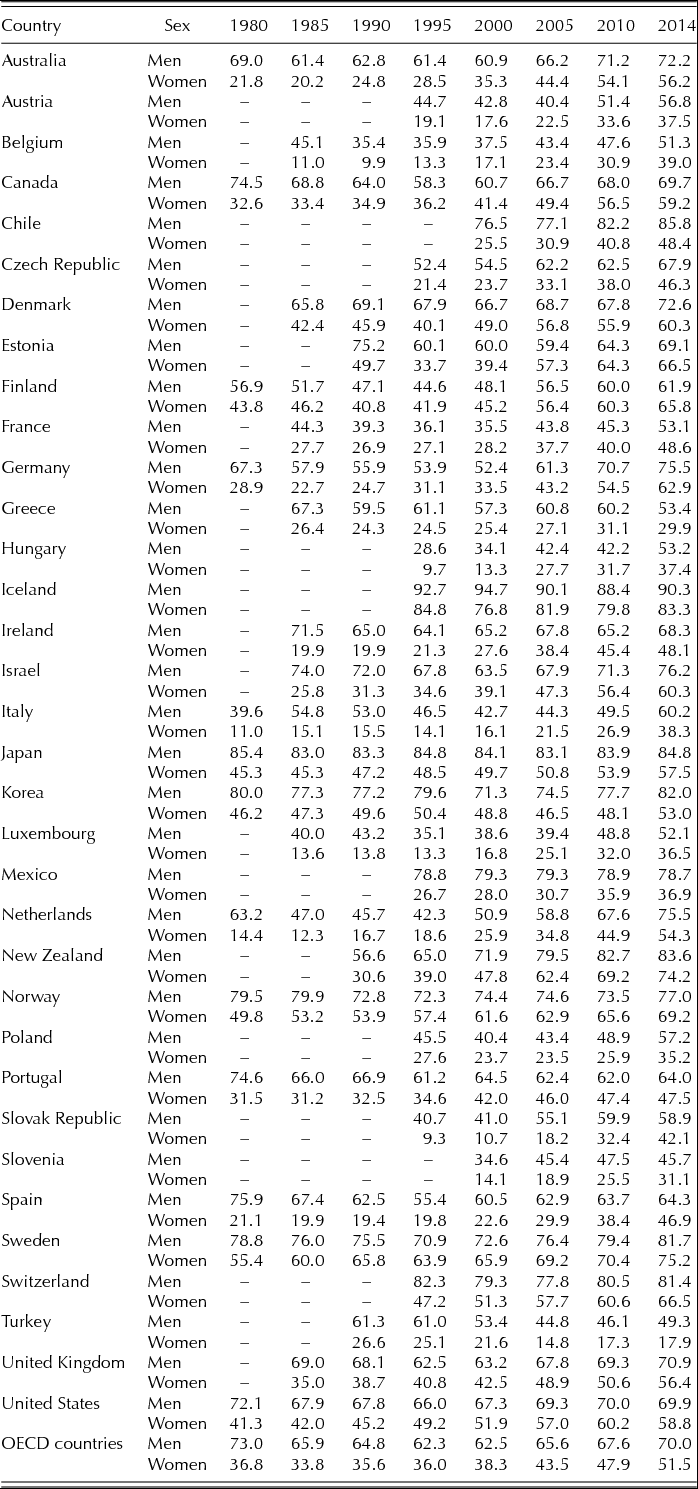
From the late-1970s through to the 1990s, the dominant policy discourse across much of the industrialised world concerned what came to be termed ‘early exit’, with those aged in their fifties and early sixties leaving employment by a variety of routes such as early retirement, disability benefits and unemployment. This was a period of declining full-time employment, but with a large number of younger people entering the labour force in many industrialised countries – trends which resulted in a steep decline in labour force participation rates among older workers. Table 1 presents labour force participation rates among men and women separately and combined for OECD member countries and the OECD overall since 1980, and illustrates the decline (extensive in many countries) in terms of the participation of men aged fifty-five to sixty-four in some countries between 1980 and the mid-1990s. By contrast, the broad pattern of older women's participation is of an increase over time, especially in part-time employment in service-related occupations.
Labour force participation rates over time among men and women aged 55-64 in selected countries and overall OECD rates

Source: OECD.Stat
Demand-side factors have been put forward as one important explanation for the downward trend in economic activity among older men. Trinder (Reference Trinder1990) suggests that economic restructuring in the 1970s and 1980s, especially in core manufacturing industries, was a key factor in removing large numbers of older men from the labour force for three main reasons. First, they were over-represented in industries that suffered the largest decline in employment over these decades. Second, they were more likely to be made redundant than younger workers and tended to experience long-term unemployment as a result (Bytheway, Reference Bytheway and Lee1986). Third, for firms needing to shed staff it was easy to negotiate early retirement arrangements (see also Laczko and Phillipson, Reference Laczko, Phillipson, Kohli, Rein, Guillemard and van Gunsteren1991). Casey and Laczko (Reference Casey and Laczko1989) argue that it is misleading to suggest that the fall in economic activity rates among older workers was indicative of a trend towards early retirement. An alternative explanation is that it was better understood as a form of unemployment than a form of retirement.
Solving the problem of youth unemployment was also given higher priority by governments in the 1970s and 1980s. As unemployment rose rapidly towards the end of the 1970s, a range of official and independent bodies advocated early retirement as the best approach for taking older people out of the labour market and allowing younger people back in (Kohli et al., Reference Kohli, Rein, Guillemard and van Gunsteren1991). It was facilitated by the use of a range of institutional arrangements for aggregate labour market management and was presented, according to Kohli and Rein (Reference Kohli, Rein, Kohli, Rein, Guillemard and van Gunsteren1991: 11), as a ‘“bloodless” ways of coping with unemployment’. This policy was given further impetus by ‘cultural norms and public opinion stressing both the responsibility for full employment in society and the belief that, given a scarcity of jobs, priority should be given to younger workers’ (Kohli and Rein, Reference Kohli, Rein, Kohli, Rein, Guillemard and van Gunsteren1991: 13). In this context, the pressure on older workers, exerted through the policies of employers, trade unions and government, was generally in the direction of their exclusion from the labour market in preference for employing younger workers (Kieffer, Reference Kieffer1986; Walker, Reference Walker1982, Reference Walker1985).
However, within a brief period attitudes were transformed, with bodies such as the Organisation for Economic Cooperation and Development (OECD, 1998, 2006) arguing that early retirement was unsustainable with an ageing population. Consequently, the thrust of public policy changed from targeting the removal of older workers from the labour market, to encouraging their continued participation (Loretto and Vickerstaff, Reference Loretto and Vickerstaff2015; Phillipson, Reference Phillipson, Chiva and Manthorpe2009). Referring to Table 1, it can be observed that since the mid-1990s there has been a broad increase in the labour force participation of older men, although levels for most countries remain well below those achieved in the period up to the early 1970s. This shift in patterns of participation in the labour market coincided with the implementation of a range of policy measures aimed at extending working life (Vargas et al., Reference Vargas, Fric, Curtarelli, Feifs and Weber2013).
Proposing an agenda for research on ageing and work
In this changing context, it is important to take a fresh look at the labour market experiences of older workers and the factors influencing their attachment to employment and their movement into or out of the labour force. In considering an agenda for research on older workers, our starting point is a 2014 editorial in the Academy of Management Journal (AMJ), a leading journal in its field, that makes claims that seem to imply that workforce age management is a ‘new’ field and, on that basis, asserts the need for a ‘new’ research agenda. However, it is unclear what is ‘new’ about many of the issues that are raised in the editorial, in particular issues such as the problem of the early exit of older workers, the ‘lump of labour’ fallacy, the removal of a ‘retirement age’ and the existence of media stereotypes of older people (Kulick et al., Reference Kulick, Ryan, Harper and George2014).
Amongst the research findings about the above topics, the notion that older workers might crowd out younger ones, once advanced as an argument for early retirement, has long since been rejected, with evidence indicating that, on the contrary, higher rates of labour force participation at older ages are associated with higher rates at younger ages (OECD, 2006; Sonnet et al., Reference Sonnet, Olsen and Manfredi2014). The editorial is also confused in terms of the terminology it deploys. For instance, it appears to conflate retirement and pension ages. Noting this is more than mere academic pedantry, given that the gap between pension ages and effective ages of retirement internationally has long been a topic of scholarly enquiry and policy interest (for example, Kohli et al., Reference Kohli, Rein, Guillemard and van Gunsteren1991; OECD, 2015). Additionally, Kulick et al. (Reference Kulick, Ryan, Harper and George2014: 931) state that in ‘many developed countries, unemployed people aged between fifty-five and seventy constitute a huge untapped resource’. Here again, a lack of specificity in the terminology used in the editorial raises difficulties. Their description is reminiscent of post-war interest in encouraging the employment of older workers, reflecting concerns about labour shortages during the economic boom of the 1950s and 1960s (Laczko and Phillipson, Reference Laczko, Phillipson, Kohli, Rein, Guillemard and van Gunsteren1991). However, the data on unemployment rates among older workers are unequivocal. In most countries, they are rather less likely to experience unemployment than younger workers, but when they do it is likely to be for a much longer period (OECD, 2006). In this regard, it is also notable that the article ignores the phenomenon of under-employment among older workers, which they are also more likely to experience for longer than younger workers (Taylor and Earl, Reference Taylor and Earl2016). Here, the considerable literature concerned with the early exit of older workers is instructive in mapping the changing contours of later working lives. For instance, research has shown that older workers not in paid employment may prefer to define themselves as disabled or early retired as they seek refuge from the labour market (Bytheway, Reference Bytheway and Lee1986; Laczko, Reference Laczko and Gregoria1987; Piachaud, Reference Piachaud1986; Rosenblum, Reference Rosenblum1975; Walker, Reference Walker1985). This body of work makes clear that official unemployment statistics do not reflect the untapped economic potential of non-employed older workers.
Arguably, Kulick et al. (Reference Kulick, Ryan, Harper and George2014) are also overly optimistic about the potential for what they describe as ‘encore careers’, given what is known, for instance, about the limited employment prospects of those from lower socio-economic groups at older ages. Moreover, while Kulick et al. (Reference Kulick, Ryan, Harper and George2014) refer to the potential benefits of flexible working practices for older workers, they ignore the potential for adverse consequences of older workers’ over-representation in precarious work (Taylor and Earl, Reference Taylor and Earl2016) and appear to assume that ‘flexibility’ is necessarily beneficial, which has also been questioned (Earl and Taylor, Reference Earl and Taylor2015). Their discussion of flexible work options and phased retirement also appears to assume that workers will be in permanent, continuing roles where there may be some potential to negotiate such transitions with employers. This is increasingly less likely to be the case for many workers, given the increasing casualisation of work (Cappelli, Reference Cappelli1999; Standing, Reference Standing2011).
Furthermore, Kulick et al. (Reference Kulick, Ryan, Harper and George2014) refer to organisational challenges in the form of ageism and age discrimination in the labour market. Once again, such issues have been the subject of significant research over several decades (see, especially, Macnicol, Reference Macnicol2006; Hedge et al., Reference Hedge, Borman and Lammlein2006; Slater and Kingsley, Reference Slater and Kingsley1976; Taylor and Walker, Reference Taylor and Walker1998). The editorial also considers the prospects for overcoming workplace age barriers, referring to the potential of wage subsidy schemes aimed at overcoming the apparent disinclination of some employers to hire older workers and suggesting that: ‘Management scholars could examine if such financial incentives make a difference to firms, or if these incentive schemes become viewed as a new form of affirmative action that stigmatises older workers’ (Kulick et al., Reference Kulick, Ryan, Harper and George2014: 932). However, once again, this is hardly a new area of enquiry. The utility of wage subsidies has been questioned previously on the grounds that older workers are a highly diverse group, and that such instruments may stigmatise and reinforce negative attitudes on the part of employers to hiring and retaining older workers, signalling that they ‘are generally less productive than younger workers’ (OECD, 2006: 135). In fact, the editorial makes contentious statements about the utility of older workers, drawing on age stereotypes to make its arguments: ‘Given the impending skills shortage that will affect many OECD countries, employers will be increasingly reliant on older workers’ expertise and experience’ (Kulick et al., Reference Kulick, Ryan, Harper and George2014: 932). However, importantly, the evidence indicates that older workers frequently lack the levels of educational attainment that could make them competitive in the labour market (OECD, 2012) and may be unable to access the learning opportunities that could help them overcome such barriers (Vickerstaff et al., Reference Vickerstaff, Phillipson and Loretto2015).
In addition, the review of Kulick et al. (Reference Kulick, Ryan, Harper and George2014) largely overlooks key areas of the empirical, theoretical and policy literature concerned with older workers that have emerged over the last two decades. Notably, this includes that relating to attitudes towards extending working life, training and education, and the nature and effectiveness of public policy targeting older workers (see, for example, Dychtwald et al., Reference Dychtwald, Erickson and Morison2004; Field et al., Reference Field, Burke and Cooper2013; Loretto et al., Reference Loretto, Vickerstaff and White2007; Scherger, Reference Scherger2015; OECD, 2006).
Offering an alternative agenda for research on the older worker
In offering an alternative agenda for research, we build on the assertion that, in contrast to ‘retirement’, later-life working has received insufficient attention from scholarly research in management and related fields, such as work and occupational psychology. Undoubtedly, while there is an eminent and growing body of work on age and employment or older workers, we argue that the main research focus to date tells us relatively little about the attitudes, motivations and behaviours of older people at work. The lack of in-depth knowledge arises from several inter-related shortcomings:
-
• Varying and imprecise definitions of ‘older’ workers
-
• Limited consideration of people aged over sixty-five
-
• Little disaggregation of age – ‘older workers’ treated as an homogeneous group (with the associated issue of relatively little attention to gender, socio-economic status, etc.)
-
• A focus on the end of working life (retirement) rather than on later-life working itself
-
• Attention to ‘bridge employment’, despite evidence that retention of mainly long-serving older workers may be the main issue for HR managers and employers.
The following discussion will outline the gaps and suggest how they can be addressed through a new research agenda for older workers. We will consider: Who might be researched? What the focus of the research might be? What theories might inform the research? How the research might be conducted?
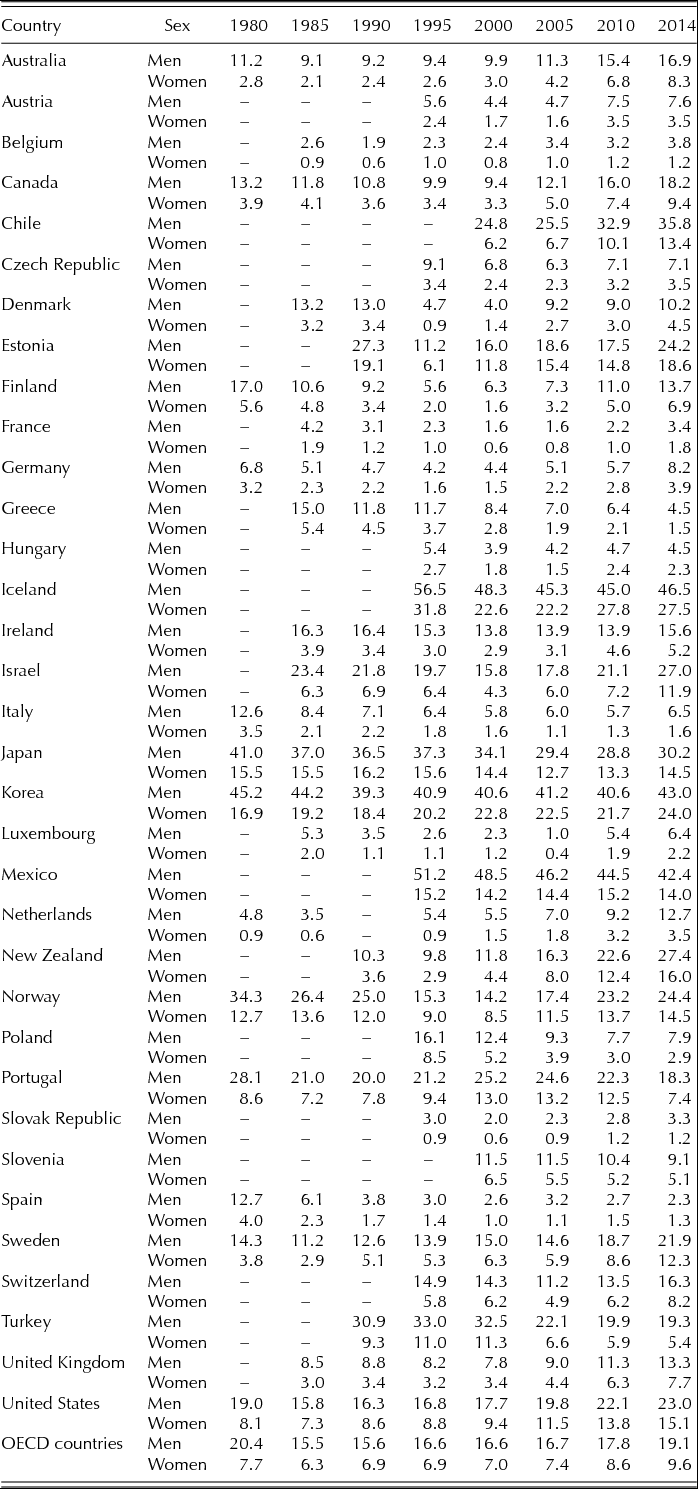
The first issue of ‘who might be researched’ is of concern to many researching issues of ageing and work, with unease at reliance upon the use of chronological age, despite its heuristic value (see, for example, Kooij et al., Reference Kooij, de Lange, Jansen and Dikkers2008). However, the use of chronological age leads to two further considerations: what age constitutes the entry threshold to the category of ‘older worker’, and where does the upper threshold sit? The former attracts much more explicit debate and attention, and varies substantially, from taking its authority in legal definitions, especially the following: the USA's Age Discrimination in Employment Act (ADEA) threshold of age forty, which has been adopted in some key meta-analyses (Kooij et al., Reference Kooij, de Lange, Jansen, Kanfer and Dikkers2011; Ng and Feldman, Reference Ng and Feldman2008, Reference Ng and Feldman2012); the OECD convention of ages fifty to sixty-four (OECD, 2006); the European Union convention of ages fifty-five to sixty-four (European Commission, Reference Commission2003); or other policy thresholds of ages forty-five, fifty or sixty (OECD, 2006). At the top end, mainly reflecting state or official retirement ages, age sixty-five has been the most common cut-off, with relatively little attention paid to people working beyond this age, partly because until recently there had been relatively few of them. However, as Table 2 demonstrates, rates of labour force participation among those aged sixty-five or over are on the rise in many countries, and other data from the OECD covering member nations illustrate an overall rise in effective retirement age, with the average retirement age in 2012 reaching sixty-five or over in thirteen countries, compared to ten countries in 2000 (OECD, 2015). Thus, there is a need for more information about workers in this age group (Ng and Feldman, Reference Ng and Feldman2012).
Labour force participation rates over time among men and women aged 65+ in selected countries and overall OECD rates

Source: OECD.Stat
A lack of precision in defining ‘older workers’ means we are not comparing like-with-like across studies. By implication, this means that, despite evidence to the contrary (Warr, Reference Warr, Snel and Cremer1994), ‘older’ workers are often considered a homogeneous category irrespective of their age (or gender, ethnicity, socio-economic status, employment status, migration status, etc.). The blunt delineation of this category obscures the qualitatively different needs, motivations and desires of older workers themselves. Moreover, given that this ‘older’ category can span some twenty-five years or more, it fails to acknowledge the extent to which older workers’ circumstances can undergo change. How realistic is it to assume that people's work attitudes, needs and behaviours will not change over a quarter of a century, and that the responses of employers and public policy makers will not need to either?
Second, the main focus over the past decade or longer has been on transitions between work and retirement, that is, a focus on end of working life, rather than on later-life working in itself. As Shacklock and Brunetto (Reference Shacklock and Brunetto2011) note, the majority of research focuses on decisions to retire, not on continuing working (see also Armstrong-Stassen and Schlosser, Reference Armstrong-Stassen and Schlosser2011; but for some attention to the issue of working, see Scherger, Reference Scherger2015). This is illustrated by the comprehensive review of retirement research carried out by Wang and Shultz (Reference Wang and Shultz2010); in comparison, later-life working has received much less treatment. Where working in later life has been considered, the key focus is on continuing to work, that is, on considering work relative to retirement, but not the work itself. For example, Kooij et al.’s (Reference Kooij, de Lange, Jansen and Dikkers2008: 367) study focused on the motivation of older workers to continue working, not on their motivation to work, based on the argument that with ageing the former becomes more relevant than, and starts to supersede, the latter. This gives rise to two limitations to our knowledge. The first is that with longer working lives, people are likely to be delaying decisions around retirement, and, as such, many more ‘older workers’ are focusing on work and their careers rather than on transitions to retirement. If their motivations to work are neglected, it not only does them a disservice, but also ignores a substantial, and arguably growing, section of the workforce.
The second limitation is that research has tended to focus on transitions to retirement including, for example, research on ‘delaying retirement’ (Flynn, Reference Flynn2010) or ways of making that transition via ‘downshifting’ or ‘bridge employment’ (Alcover et al., Reference Alcover, Topa, Depolo, Fraccaroli and Parry2014; Ruhm, Reference Ruhm1990, Reference Ruhm1991). While these are important issues, it is clear that in some countries the over-sixty-five workforce is constituted predominantly of longer-serving employees who have remained with their main employer, most often on the same basis of employment (Vickerstaff et al., Reference Vickerstaff, Phillipson and Loretto2015). As noted earlier, a focus on ‘flexible working’ as an approach to easing the transition to retirement also overlooks issues of the increasing casualisation of the workforce and long-term under-employment and, in particular, how these phenomena might influence patterns of later life working and retirement transitions (Taylor and Earl, Reference Taylor and Earl2016).
A third issue concerns the role of theory in research on older workers. Much research into the older workforce has been criticised for being ‘atheoretical and prescriptive in nature’ (Armstrong-Stassen and Schlosser, Reference Armstrong-Stassen and Schlosser2011: 320). However, the past decade has seen a resurgence in theorising the relationships between age and work. The most commonly used theories in the human resource/organisational behaviour (HR/OB) research are selection, optimisation and compensation (SOC) theory and regulatory focus theory (e.g. Kooij et al., Reference Kooij, Jansen, Dikkers and de Lange2010; Kooij et al., Reference Kooij, de Lange, Jansen, Kanfer and Dikkers2011), and socio-emotional theory (Kanfer and Ackerman, Reference Kanfer and Ackerman2004). Implicit in these is the notion of older age as a time of loss, decline and disengagement from work. This last point also draws on Super's (Reference Super1957) career stage model of trial, establishment, maintenance and disengagement. The shortcomings of these theories are that they: rest on outdated age stereotypes (Ng and Feldman, Reference Ng and Feldman2012); do not reflect the contemporary nature of careers; and are predicated on the stereotypical and outdated male model of continuous labour market participation across the life course.
In addition to the above three approaches that are rooted in the human relations tradition are more general theoretical perspectives that are helpful in addressing the concerns of this article, with the political economy and life course perspectives two such examples. The political economy perspective is relevant in explaining how social and political power groups use the reification of age categories to advance their own interests. An important contribution here is Townsend's (Reference Townsend1981) argument that old-age dependency is socially created, and that the social institution of retirement is a contributory factor in this development.
Estes (Reference Estes1979) has also linked the ‘social construction of reality’ with a ‘political economy perspective’ to call attention to the way in which social policies and programmes bolster existing power arrangements in society. Writing in an era when ‘adjustment to old age’ was a prominent research area, she argued that gerontological theories at that time (for example, both the disengagement and activity theories of ageing) supported the status quo by locating ‘the problem’ within the older individual rather than the socio-political production of the problem.
A further approach can be drawn from the life course perspective, one which has been embedded within the sociology and social psychology of work and retirement since its early formulation by Cain (Reference Cain and Faris1964), and subsequent conceptual development by European researchers. These include, Guillemard (Reference Guillemard2000, Reference Guillemard, Field, Burke and Cooper2013) in France and Heinz et al. at the Status Passages and Risks in the Life Course research centre (for example, Heinz, Reference Heinz, Marshall, Heinz, Kruger and Verma2001; Leisering and Schumann, Reference Leisering, Schumann, Heinz and Marshall2003). According to Guillemard, ‘a finding of the sociology of the life-course is that the institutionalisation of welfare systems has been a powerful factor that formatted the life-course into three periods by using age as a chronological marker for setting the thresholds for passing from one age of life to the next’ (2013: 64). Yet, she notes that the standardised biographical pattern that once organised the life course in industrialised society into periods of education, work and leisure has come under recent pressure and argues that flexible work, flexible life courses and, as a consequence, uncertain biographical pathways, are multiplying.
The reification of age categories has consequences for people's lives, as Townsend (Reference Townsend1981) and Walker (Reference Walker1981) have noted. This calls for a nuanced approach that never takes for granted that all people in a given age category are alike, while recognising that to the extent they are, this categorical similarity or likeness is a socially constructed product and not something inherent in the ageing individual. Outdated age stereotypes include the assumption of a specific age, usually sixty or sixty-five, as the ‘time for retirement’.
Turning, fourthly, to how older workers’ relationship with the labour market has been researched, there has been a recent dominance of quantitative approaches and especially meta-analyses. While helpful in developing theory, meta-analyses are a blunt instrument as regards disaggregation of age. One of their key strengths is high statistical power, which is also one of their key weaknesses, as it may lead to statistically significant but substantively small correlations (of 0.02 or thereabouts) between age and work-related motives – attitudes and outcomes being accepted as an absolute truth. Moreover, the measure of age considered is mean age of sample, not age of individual workers. This severely limits our understanding of how age (and ageing) is related to key work variables. More broadly, quantitative approaches struggle to attribute meaning to the sometimes counter-intuitive and contradictory findings they elicit. An example of the latter point is the question of whether human resource policies and practices should be contingent upon age. While work undertaken by Kooij et al. (Reference Kooij, Jansen, Dikkers and de Lange2014) in the public sector in the Netherlands supports age-tailoring, research amongst managers in France cautions against this as older workers ‘do not want to be treated according to their presumptive unique needs’ (Herrbach et al., Reference Herrbach, Mignonac, Vandenberghe and Negrini2009: 907). The key issue here is the lack of attention to older workers as people, situated within particular work, personal/domestic and employment contexts (Loretto and Vickerstaff, Reference Loretto and Vickerstaff2013). We need more qualitative approaches to test, explore and interpret the quantitative findings. Relating back to our other questions of ‘who might be researched’, ‘what might the research focus on’ and ‘which theories are helpful’, qualitative methods can be used to more fully understand how and why work attitudes and behaviours may change with age. Crucially, they can facilitate appreciation of the ways in which relationships between age and work are shaped by gender, previous work experience, life circumstances and choices, and constraints and opportunities posed by national characteristics of legal regulation or welfare regimes.
Also needed is more explicitly comparative research at the societal level and at the firm level, along the lines of the pioneering comparative collection of studies, Time for retirement (Kohli et al., Reference Kohli, Rein, Guillemard and van Gunsteren1991). That volume focused on how various public policies in Europe and the USA supported people leaving work ahead of normal pension age. A subsequent collection of articles published in The Geneva Papers on Risk and Insurance under the title, Age and Employment: The Firm and the State (Taylor, Reference Taylor2003; Guillemard, Reference Guillemard2003) provided an evidential base for a comparison of firm policies in France, Germany, the UK, Japan, Canada and the USA. Recently, major international programmes of comparative research concerned with exploring employer behaviours across countries have begun to emerge (Conen et al., Reference Conen, Henkens and Schippers2012). Also valuable would be studies comparing industry sectors and occupational groups in order that policy responses may be refined.
Conclusions
This article aimed to assist with establishing a new, critical agenda for research into the older worker. The issue of their continued employment can be expected to remain high on the political agenda over the course of the first half of this century given ongoing concerns about the sustainability of social welfare systems against a background of population ageing. It seems likely that workers will come under increasing pressure to work beyond the age of sixty-five. Here we agree with Kulick et al. (Reference Kulick, Ryan, Harper and George2014: 934) that ‘It would, indeed, be useful if management research can shed light on the future workplace and show how changes in the demographic profile will affect work and life’. However, where we diverge from them is in attempting to draw on the already extensive literature to map an agenda for research that looks beyond the present, narrow, economic imperative of prolonging working lives in order to provide deeper insights into changing patterns of work and retirement. Open to debate is who will benefit from working longer. In particular, with the benefit of a long view we may conclude that older workers could be forgiven for being sceptical about the motivations behind the latest interest among policy makers in later retirement, if this means its transformation from a reward bestowed on those ending their careers into a kind of unemployment as they face an obligation to remain economically active as the ages at which they can retire are pushed out by governments. While working longer has often recently been characterised as being both an individual and social good, this is questionable and perhaps the issue of greatest significance of all as tomorrow's older workers enter the uncharted territory of spending five decades or more in the labour force.
A more realistic appraisal of older workers will lead to a better foundation for policies. An appreciation of heterogeneity leads to differentiated policies and practices. For instance, research points to the absence of organisational policy making that considers the intersection of age and gender (Earl et al., Reference Earl, Taylor, Williams, Brooke, Bimrose, McMahon and Watson2015), with the consequence that the on-going labour force participation of women may be jeopardised. Also, for some older people, working may be considered impractical due, for instance, to serious illness or injury or marked skills deficits. There is, thus, a need for a reappraisal of public policy that has, recently, been couched primarily in terms of the need for older people's continued labour force participation, with the role of early retirement a neglected topic of recent inquiry (Taylor and Earl, Reference Taylor and Earl2016).
Considering the development of public policy from a theoretical perspective, present proposals, in the United Kingdom, for instance, to allow grandparents to be allocated a share of parental leave align with an intergenerational perspective arising from a life course approach. From this perspective, it is also apparent that as the nature of work and the characteristics of workers change there is an ongoing need for consideration of the long-run effects of this on the ability of workers to remain economically engaged at older ages and to achieve income security in retirement. This leads to a recognition that the parameters of older workers’ participation need to be continuously reassessed and policy responses adjusted accordingly. Finally, drawing on a political economy perspective might come the conclusion that currently popular policy approaches, such as offering wage subsidies to employers who hire older workers (Vargas et al., Reference Vargas, Fric, Curtarelli, Feifs and Weber2013), are firmly rooted in notions of older people as dependent. They are considered to have deficiencies that necessitate ongoing support from the state in order that they may maintain a foothold in the labour market instead of it being recognised that structural disadvantages such as a lack of careers advice and educational opportunities as people age may restrict choice in a rapidly changing economy.