1. Introduction
The Scott topology is the most useful topology in domain theory. In general, this topology is just
 $T_0$
. However, by taking the sets
 $\mbox{Max}(P)$
of all maximal points of posets
 $P$
, with the relative Scott topology, one can obtain all
 $T_1$
spaces (every
 $T_1$
space is homeomorphic to the subspace
 $\mbox{Max}(P)$
of some poset
 $P$
) (Zhao and Xi, Reference Zhao and Xi2018). In general, if a space
 $X$
is homeomorphic to
 $\mbox{Max}(P)$
of a poset
 $P$
, then we say that
 $P$
is a poset model of
 $X$
. The spaces with a domain model have been studied by many authors. Lawson proved that a space
 $X$
is a Polish space if and only if it has an
 $\omega$
-domain model satisfying the Lawson condition (Lawson, Reference Lawson1997). Moreover, if
 $P$
is an
 $\omega$
-domain that satisfies the Lawson condition, then the set
 $\textrm{Max}(P)$
is a
 $G_{\delta }$
-set of the Scott space
 $\Sigma P$
of
 $P$
. As pointed out by Martin, knowing that
 $\mbox{Max}(P)$
is a
 $G_{\delta }$
-subset of
 $\Sigma P$
is often useful in proofs: for instance, Edalat obtained the well-known connection between measure theory and the probabilistic powerdomain (Edalat, Reference Edalat1997) assuming a separable metric space that embedded as a
 $G_{\delta }$
-subset of an
 $\omega$
-domain. Martin has established several results on
 $G_{\delta }$
-subsets
 $E\subseteq \mbox{Max}(P)$
, including (i) if
 $P$
is an
 $\omega$
-domain such that
 $\textrm{Max}(P)$
is regular, then
 $\textrm{Max}(P)$
is a
 $G_{\delta }$
-set (Martin, Reference Martin2003b); (ii) if
 $P$
is an
 $\omega$
-domain that has a countable set
 $C\subseteq{\textrm{Max}(P)}$
such that
 ${\mathord{\uparrow }} x\cap C\neq \emptyset$
for each
 $x\in P\backslash{\textrm{Max}(P)}$
, then
 $\textrm{Max}(P)$
is a
 $G_{\delta }$
-set (Martin, Reference Martin2003a); and (iii) for any
 $\omega$
-ideal domain
 $P$
,
 $\textrm{Max}(P)$
is a
 $G_{\delta }$
-set (Martin, Reference Martin2003a).
However, as stated by Martin (Reference Martin2003a) [Section 8(1)], the answer to the following problem is not known:
-
• Is
 $\textrm{Max}(P)$
a
$G_{\delta }$
-set of
$\Sigma P$
for every
$\omega$
-domain
$P$


In this paper, we construct an
 $\omega$
-algebraic domain
 $P$
such that
 $\textrm{Max}(P)$
is not a
 $G_{\delta }$
-set, which gives a negative answer to the above problem. In addition, we also construct an
 $\omega$
-ideal domain
 $\widetilde{P}$
for our constructed
 $P$
such that their maximal points spaces are homoemorphic. Therefore,
 $\textrm{ Max}(P)$
is a
 $G_\delta$
-set of the Scott space of the new model
 $\widetilde{P}$
.
2. Preliminaries
This section is devoted to a brief review of some basic concepts and notations that will be used later. For more details, we refer the readers to Gierz et al. (Reference Gierz, Hofmann, Keimel, Lawson, Mislove and Scott2003) and Goubault-Larrecq (Reference Goubault-Larrecq2013).
Let
 $P$
be a poset. For a subset
 $A$
of
 $P$
, we shall adopt the following standard notations:
 \begin{equation*}{\mathord {\uparrow }} A=\{y\in P: \exists x\in A, x\leq y\};\,\,{\mathord {\downarrow }} A=\{y\in P:\exists x\in A, y\leq x\}.\end{equation*}
For each
 $x\in X$
, we simply write
 ${\mathord{\uparrow }} x$
and
 ${\mathord{\downarrow }} x$
for
 ${\mathord{\uparrow }}\{x\}$
and
 ${\mathord{\downarrow }} \{x\}$
, respectively. A subset
 $A$
of
 $P$
is called a lower (resp., an upper) set if
 $A={\mathord{\downarrow }} A$
(resp.,
 $A={\mathord{\uparrow }} A$
). An element
 $x$
is maximal in
 $A\subseteq P$
, if
 $A\cap{\mathord{\uparrow }} x=\{x\}$
. The set of all maximal elements of
 $A$
is denoted by
 $\textrm{Max} A$
. The set of minimal elements of
 $A$
, denoted by
 $\mathord{\min } A$
, is defined dually.
A nonempty subset
 $D$
of
 $P$
is directed if every two elements in
 $D$
have an upper bound in
 $D$
. For
 $x,y\in P$
,
 $x$
is way-below
 $y$
, denoted by
 $x\ll y$
, if for each directed subset
 $D$
of
 $P$
with
 $\bigvee D$
existing,
 $y\leq \bigvee D$
implies
 $x\leq d$
for some
 $d\in D$
. Denote

 $x=\{y\in P:x\ll y\}$
and

 $x=\{y\in P:y\ll x\}$
. A poset
 $P$
is continuous, if for each
 $x\in P$
, the set
 $x$
is directed and
 $x= \bigvee$
 $x$
.
An element
 $a\in P$
is called compact, if
 $a\ll a$
. The set of all compact elements of
 $P$
will be denoted by
 $K(P)$
. Then,
 $P$
is called algebraic if for each
 $x\in P$
, the set
 $\{a\in K(P):a\leq x\}$
is directed and
 $x=\bigvee \{a\in K(P):a\leq x\}$
. A continuous (resp., algebraic) dcpo is also called a domain (resp., an algebraic domain). A subset
 $B\subseteq P$
is a base of
 $P$
if for each
 $x\in P$
,
 $B\cap$
 $x$
is directed and
 $\bigvee (B\cap$
 $x)=x$
. If
 $P$
has a countable base, then
 $P$
is called an
 $\omega$
-continuous dcpo or
 $\omega$
-domain.
Remark 1.1.
-
(1) A dcpo is a domain if and only if it has a base.
-
(2) For each base
$B$
of a domain
$P$
,
$K(P)\subseteq B$
. As a consequence, every algebraic domain
$P$
has the smallest base, namely
$K(P)$
.


A subset
 $U$
of
 $P$
is Scott open if (i)
 $U=\mathord{\uparrow }U$
and (ii) for each directed subset
 $D$
of
 $P$
for which
 $\bigvee D$
exists,
 $\bigvee D\in U$
implies
 $D\cap U\neq \emptyset$
. All Scott open subsets of
 $P$
form a topology on
 $P$
, called the Scott topology and denoted by
 $\sigma (P)$
. The space
 $\Sigma P=(P,\sigma (P))$
is called the Scott space of
 $P$
.
Let
 $X$
be a topological space. A subset
 $G \subseteq X$
is called a
 $G_{\delta }$
-set, if there exists a countable family
 $\{U_n:n\in \mathbb{N}\}$
of open sets such that
 $G=\bigcap _{n\in \mathbb{N}} U_{n}$
.
3. A Counterexample for Martin’s Problem
We shall use the following notations:
 \begin{equation*}\begin {array}{lll} \mathbb {N}&:=& \text {the set of all nonzero natural numbers};\\ \omega &:=& \text {the ordinal (also the cardinal) of natural numbers};\\ \omega _1 &:=&\text {the ordinal (also the cardinal) of real numbers};\end {array}\end{equation*}
 \begin{equation*}\begin {array}{lll} \Sigma & :=&\bigcup \{\mathbb {N}^{k}:k\in \mathbb {N}\cup \{\omega \}\}. \text { In other words, } \Sigma \text { is the set of all nonempty finite } \\ && \text { or countably infinite sequences of } \mathbb {N};\\ \Sigma ^*&:=&\{{a^*}:a\in \Sigma \},\text { which is a copy of }\Sigma . \end {array}\end{equation*}
Each element
 $a\in \Sigma$
can be represented as
 ${\langle }a_1, a_2, a_3,\cdots , a_k{\rangle }$
if it is a finite sequence, or
 ${\langle }a_n{\rangle }_{n\in \mathbb{N}}$
if it is an infinite sequence. We use the notation
 $\ell (a)$
to denote the length of
 $a$
, which is defined as follows:
 \begin{equation*} \ell (a)=\left \{\begin {array}{ll} k, & a={\langle }a_1, a_2, a_3,\cdots , a_k{\rangle };\\ \omega , & a={\langle }a_n{\rangle }_{n\in \mathbb {N}}. \end {array}\right . \end{equation*}
We can also define
 $\ell (a^*):=\ell (a)$
, as the lengths of
 $a$
and
 $a^*$
are clearly equal.
The subdcpo
 $\Sigma _k$
.

For any
 $a\in \Sigma$
, we use
 $a_k$
(resp.,
 $(a^*)_k$
), if it exists, to denote the
 $k$
-th element in the sequence
 $a$
(resp.,
 $a^*$
). For example, if
 $a:=\langle{}1, 2, 3, 5, \cdots ,n,n+1, \cdots \rangle$
, it follows that
 $\ell (a)=\omega$
and
 $a=\langle{a_n}\rangle _{n\in \mathbb{N}}$
, where
 $a_n=n$
for all
 $n\in \mathbb{N}$
.
Definition 2.1.
For each
 $a, b\in \Sigma$
,
 $a$
is said to be a substring of
 $b$
, denoted by
 $a\sqsubseteq b$
, if any of the following cases holds:
-
(s1)
$\ell (a)\in \mathbb{N}$
, and
$a_k=b_k$
for all
$1\leq k\leq \ell (a)$
, that is
$a$
is a prefix of
$b$
; -
(s2)
$\ell (a)=\omega$
, and
$a=b$
(in other words,
$a_k=b_k$
for all
$k\in \mathbb{N}$
).


It is straightforward to verify that the relation
 $\sqsubseteq$
defined on
 $\Sigma$
is a partial order, and some of its properties needed for understanding the main example are listed below.
Remark 2.2.
-
(1)
$(\Sigma ,\sqsubseteq )$
is an algebraic domain. In fact, for each
$k\in \mathbb{N}$
, the set
$\Sigma _k:=\{a\in \Sigma : a_1=k\}$
together with the substring order
$\sqsubseteq$
form a tree-like dcpo, as shown in Figure 1. In addition, the poset
$(\Sigma ,\sqsubseteq )$
is the countable disjoint union of these
$\Sigma _k$
, where
$k\in \mathbb{N}$
. That is, for any
$x,y\in \Sigma$
,
$x\sqsubseteq y$
in
$\Sigma$
iff there exists some
$k_0\in \mathbb{N}$
such that
$x,y\in \Sigma _{k_0}$
and
$x\sqsubseteq y$
in
$\Sigma _{k_0}$
, as shown in Figure 2. -
(2)
$\textrm{Max}\Sigma =\{a\in \Sigma :\ell (a)=\omega \}$
,
$|\Sigma |=|\textrm{Max}\Sigma |=\omega _1$
and
$|\Sigma \setminus \textrm{Max}\Sigma |=\omega$
. -
(3) The compact elements of
$\Sigma$
are the nonempty finite sequences of
$\mathbb{N}$
. In other words,
\begin{equation*}K(\Sigma ) = \{a\in \Sigma : \ell (a)\in \mathbb {N}\}.\end{equation*}
-
(4) For any two elements
$a,b\in \Sigma$
,
$\{a,b\}$
has upper bounds iff
$a$
and
$b$
are comparable (i.e., either
$a\leq b$
or
$b\leq a$
).


The algebraic domain
 $(\Sigma ,\sqsubseteq )$
.

We can also define a partial order
 $\sqsubseteq ^*$
on
 $\Sigma ^*$
as follows:
 $\forall a,b\in \Sigma$
,
 \begin{equation*}a^*\sqsubseteq ^* b^*\mbox { iff } a\sqsubseteq b.\end{equation*}
It is clear that the posets
 $(\Sigma ,\sqsubseteq )$
and
 $(\Sigma ^*,\sqsubseteq ^*)$
are order-isomorphic. Furthermore, the properties of
 $(\Sigma ,\sqsubseteq )$
listed in Remark 2.2 also hold for
 $(\Sigma ^*,\sqsubseteq ^*)$
.
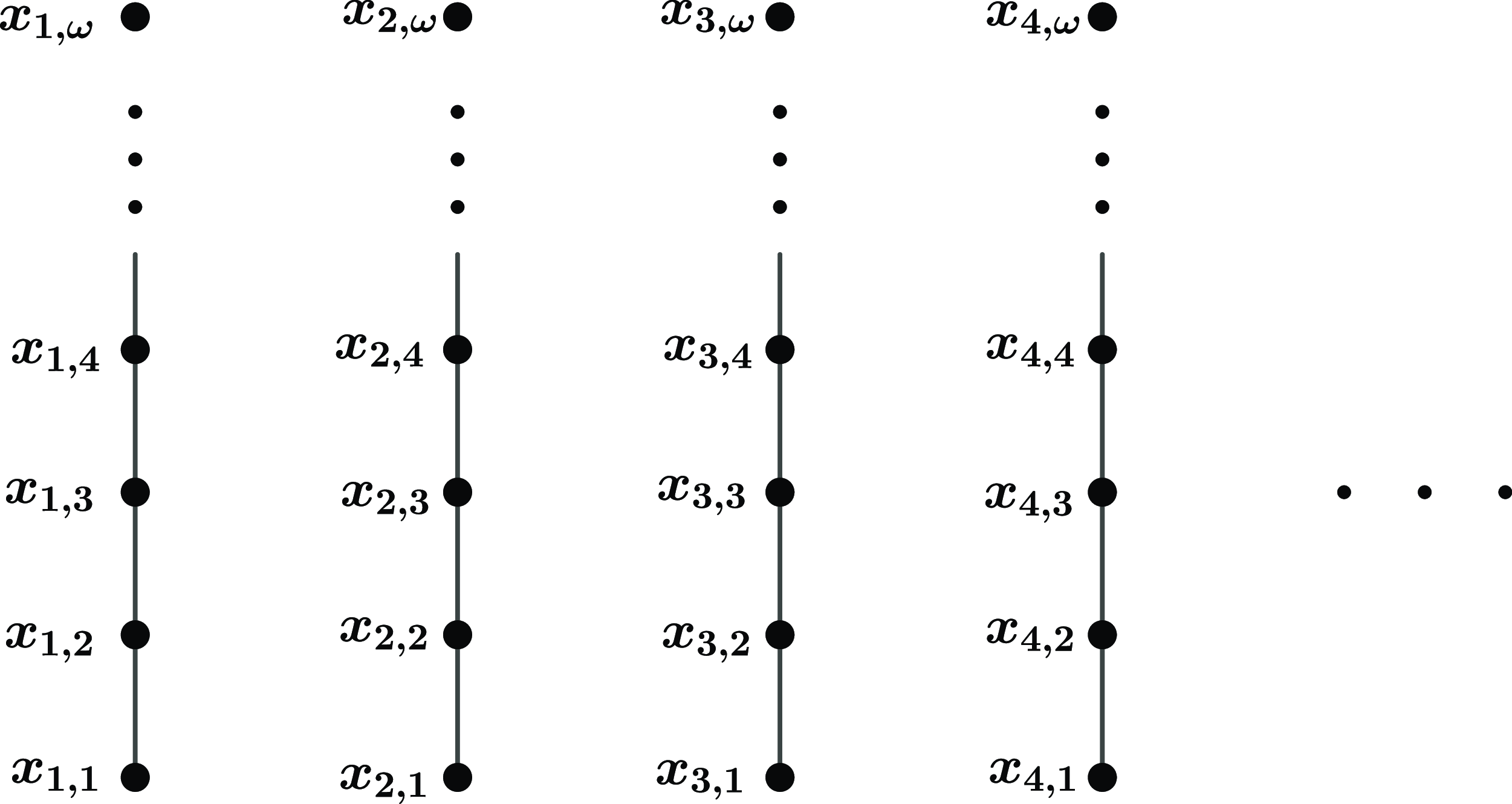
Example 2.3. Let
 $X:=\{{x}_{m,n}:m\in \mathbb{N},n\in \mathbb{N}\cup \{\omega \}\}$
with the partial order
 $\leq _X$
defined as follows:
 $\forall m_1,m_2\in \mathbb{N}$
and
 $n_1,n_2\in \mathbb{N}\cup \{\omega \}$
,
 \begin{equation*}x_{m_1,n_1}\leq _X x_{m_2,n_2} \Leftrightarrow m_1=m_2\text { and }n_1\leq n_2.\end{equation*}
Then,
 $X$
is an
 $\omega$
-algebraic domain, as shown in Figure 3. In fact, one easily sees that
 $\bigvee _{n\in \mathbb{N}}x_{k,n}=x_{k,\omega }$
for all
 $n\in \mathbb{N}$
. Moreover, we have that
 \begin{align*} \textrm{Max} X=\{{x}_{m,\omega }:m\in \mathbb{N}\} \text{ and } K(X)=X\setminus \textrm{Max} X=\{{x}_{m, n}:m, n\in \mathbb{N}\}. \end{align*}
It then follows that
 $|K(X)|=|\textrm{Max} X|=|X|=\omega$
.
Before presenting the counterexample, let us briefly discuss the order structure defined by combining two ordered structures, which will be helpful to understand the order relationship of our main counterexample.
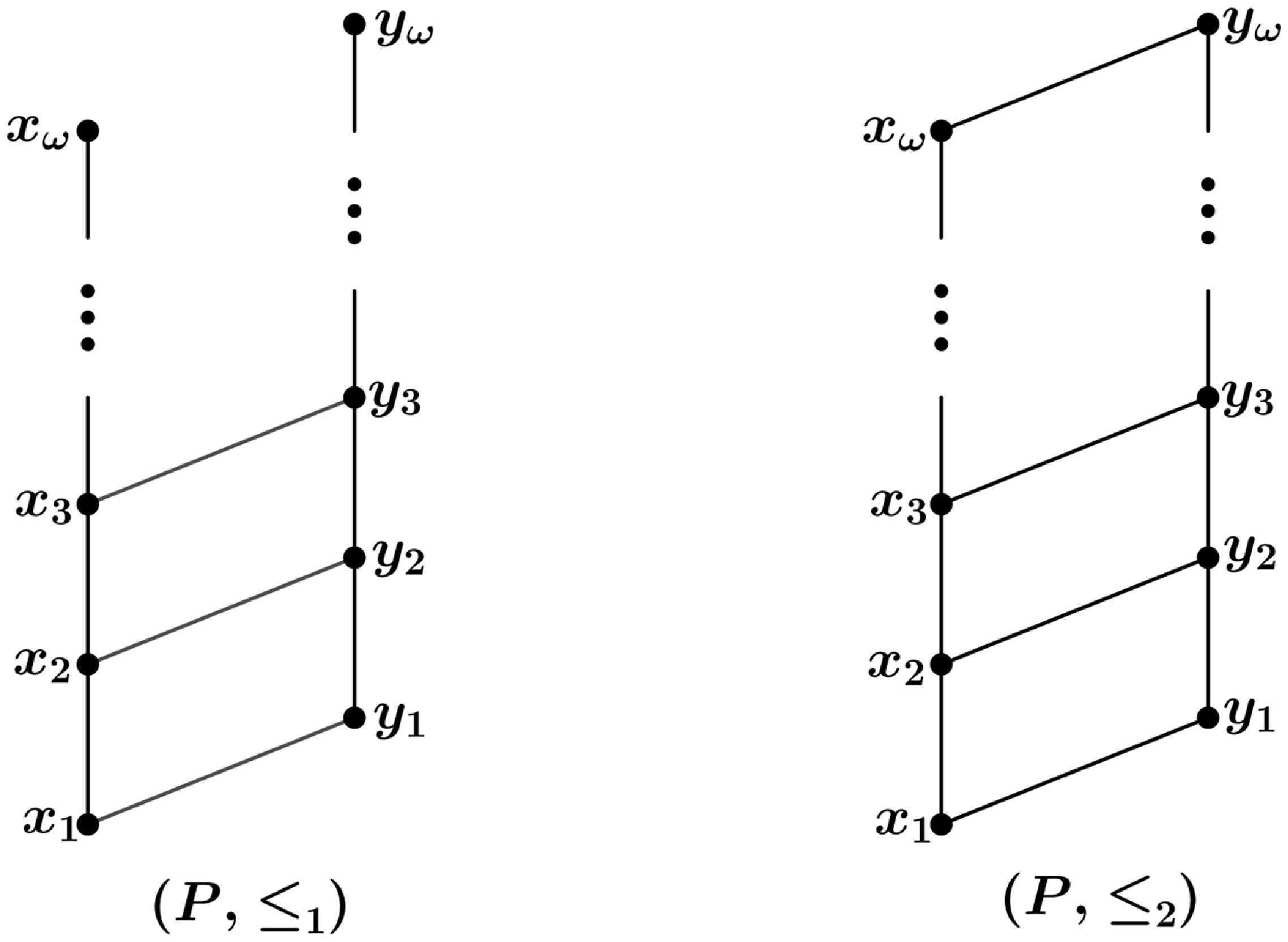
Remark 2.4. Let
 $P=\{x_n:n\in \mathbb{N}\cup \{\omega \}\}\cup \{y_n:n\in \mathbb{N}\cup \{\omega \}\}$
. We define two relations
 $\leq _1$
and
 $\leq _2$
on
 $P$
.
-
(1) The relation
$\leq _1$
is given as follows:-
(P1)
$x_1\leq _1 x_2\leq _1 x_3\leq _1 \cdots \leq _1 x_{n}\leq _1 x_{n+1}\leq _1\cdots \leq _1 x_{\omega }$
; -
(P2)
$y_1\leq _1 y_2\leq _1 y_3\leq _1 \cdots \leq _1 y_{n}\leq _1 y_{n+1}\leq _1\cdots \leq _1 y_{\omega }$
; -
(P3)
$\forall m,n\in \mathbb{N}$
,
$x_{m}\leq _1 y_{n}$
$\Leftrightarrow$
$m\leq n$
.Then, we define
$\leq _2:=\leq _1\cup \{(x_{\omega }, y_{\omega })\}$
. It is easy to verify that both
$\leq _1$
and
$\leq _2$
are partial orders on
$P$
, as shown in Figure 4.
-
-
(2) In the poset
$(P,\leq _1)$
, the chain
$C:=\{x_n:n\in \mathbb{N}\}$
has two incomparable upper bounds, namely
$x_{\omega }$
and
$y_\omega$
. Hence, the supremum of
$C$
in
$(P,\leq _1)$
does not exist, and consequently
$\bigvee _{(P,\leq _1)}C\neq x_{\omega }$
. However, since
$x_{\omega }\leq _2y_{\omega }$
, it is clear that the supremum of
$C$
in
$(P,\leq _2)$
exists and equals
$x_{\omega }$
, that is,
$\bigvee _{(P,\leq _2)} C=x_{\omega }$
.


The algebraic domain
 $(X,\leq _X)$
.

The posets
 $(P,\leq _1)$
and
 $(P,\leq _2)$
.

Example 2.5. Let
 $L:=X\cup \Sigma \cup \Sigma ^*,$
where
 $X$
is the poset defined in Example 2.3. For any
 $u,v\in L$
, define
 $u\leq v$
if any of the following conditions holds:
-
(i)
$u\sqsubseteq v$
in
$\Sigma$
; -
(ii)
$u\sqsubseteq ^* v$
in
$\Sigma ^*$
; -
(iii)
$u\leq _X v$
in
$X$
; -
(iv)
$u\in \Sigma$
,
$v=b^*\in \Sigma ^*$
and
$u \sqsubseteq b$
. The order is illustrated in Figure 5. -
(v)
$\exists k,m\in \mathbb{N}$
,
$u=x_{k,m}$
,
$\ell (v)\geq k$
and
$v_k\geq m$
(refer to Figure 6, where the black lines in the figure represent the relationship between the points in
$X$
and
$\Sigma$
, while the dotted red lines represent the relations between the points in
$\Sigma$
).


In fact, Condition (v) describes the relations between
 $X$
and
 $\Sigma \cup \Sigma ^*$
, which can be characterized as follows: for any
 $k, m\in \mathbb{N}$
,
 $v\in \Sigma \cup \Sigma ^*$
,
 \begin{align*} x_{k,m}\leq v\ \text{iff} \, \exists n_1,n_2,\cdots ,n_{k}\in \mathbb{N} \text{ such that } n_k\geq m \text{ and } \langle{n_1,n_2,\cdots ,n_k} \rangle \leq v. \end{align*}
For example, we have the following facts:
 \begin{equation*} \begin {array}{ll} &x_{4,11}\leq \langle 1,5,7,11 \rangle \leq \langle 1,5,7,11,11 \rangle ^*\leq \langle 1,5,7,11,11,22,22\rangle ^*;\\ &x_{4,11}\leq \langle {1,5,7,111}\rangle \leq \langle 1,5,7,111 \rangle \leq \langle 1,5,7,111,11 \rangle ^*\leq \langle 1,5,7,111,11,22,22\rangle ^*;\\ &x_{3,3}\leq \langle {}1,2,3\rangle \leq \langle {}1,2,3,\cdots ,n,n+1,\cdots \rangle \leq \langle {}1,2,3,\cdots ,n,n+1,\cdots \rangle ^*;\\ &x_{3,3}\leq \langle {}2,3,4\rangle \leq \langle {}2,3,4,\cdots ,n,n+1,\cdots \rangle \leq \langle {}2,3,4,\cdots ,n,n+1,\cdots \rangle ^*. \end {array}\end{equation*}
Next, we prove that
 $L$
is an
 $\omega$
-algebraic dcpo such that
 $\textrm{Max} L$
is not a
 $G_{\delta }$
-set in the Scott space of
 $L$
. We achieve this in a few steps.
(1) The relation
 $\leq$
is a partial order on
 $L$
.
The reflexivity and antisymmetry are almost trivial. For showing the transitivity, we need the following:
The relations between
 $\Sigma$
and
 $\Sigma ^*$
.

The subset
 $X\cup \Sigma$
of
 $L$
.

Claim 1:
 $\forall k, m\in \mathbb{N}$
,
 $\forall a\in \Sigma$
,
 $x_{k,m}\leq a$
 $\Leftrightarrow$
 $x_{k,m}\leq a^*$
.
By the definition of
 $a^*$
, it holds that
 $\ell (a^*)=\ell (a)$
and
 $(a^*)_k=a_k$
. Therefore, Claim 1 follows from the following facts:
 \begin{align*} x_{k, m}\leq a \text{ iff } \ell (a^*)=\ell (a)\geq k \text{ and } (a^*)_k=a_k\geq m \ \text{ iff } x_{k, m}\leq a^*. \end{align*}
Claim 2:
 $\forall a, b\in \Sigma$
,
 $a\leq b$
 $\Leftrightarrow$
 $a\leq b^*$
 $\Leftrightarrow$
 $a^*\leq b^*$
 $\Leftrightarrow$
 $a\sqsubseteq b$
.
Claim 2 follows from the following facts:
 \begin{equation*} a\leq b\ \stackrel {(i)}{\Leftrightarrow }\ a\sqsubseteq b \text { in }\Sigma \ \stackrel {(iv)}{\Leftrightarrow } \ a\leq b^*\ \stackrel {(iv)}{\Leftrightarrow }\ a\sqsubseteq b \text { in }\Sigma \ \Leftrightarrow \ a^*\sqsubseteq ^* b^* \text { in }\Sigma ^*\ \stackrel {(ii)}{\Leftrightarrow }\ a^*\leq b^*. \end{equation*}
We now verify the transitivity only by considering the following cases: for any
 $k,m,k',m'\in \mathbb{N}$
and
 $a,b,c\in \Sigma$
,
-
(c1)
$x_{k,m}\leq x_{k',m'}\leq a\leq b$
. Then, as
$x_{k,m}\leq x_{k',m'}$
, we have that
$k=k'$
and
$m\leq m'$
. Also, since
$x_{k',m'}\leq a\leq b$
, we have that
$\ell (b)\geq \ell (a)\geq k'=k$
and
$b_{k}=b_{k'}=a_{k}=a_{k'}\geq m'\geq m$
, and by (v), it follows that
$x_{k,m}\leq b$
; -
(c2)
$x_{k,m}\leq a\leq b$
. Then,
$\ell (b)\geq \ell (a)\geq k$
and
$b_k=a_k\geq m$
, which implies that
$x_{k,m}\leq b$
; -
(c3) By Claims 1 and 2, both cases
$x_{k,m}\leq a\leq b^*$
and
$x_{k,m}\leq a^*\leq b^*$
are equivalent to
$x_{k,m}\leq a\leq b$
. Then by (c2) , one can imply that
$x_{k,m}\leq b$
, and this is equivalent to
$x_{k,m}\leq b^*$
by Claim 1; -
(c4) By Claim 2, both cases
$a\leq b^*\leq c^*$
and
$a\leq b\leq c^*$
are equivalent to
$a\leq b\leq c$
, which means
$a\sqsubseteq b\sqsubseteq c$
in
$\Sigma$
. This implies
$a\sqsubseteq c$
, which is equivalent to
$a\leq c^*$
.


(2)
 $\textrm{Max} L=\textrm{Max} \Sigma ^*\cup \textrm{Max} X$
and
 $|\textrm{Max} L|=\omega _1$
.
First, one easily observes that

and

In addition, by the definition of the order
 $\leq$
on
 $L$
, we have that
 ${\mathord{\uparrow }} x_{m,\omega }\cap L=x_{m,\omega }$
, and therefore,
 $\textrm{Max} X\subseteq \textrm{Max} L$
. Then, we conclude that
 $\textrm{Max} L=\textrm{Max} \Sigma ^*\cup \textrm{Max} X$
, and
 $|\textrm{Max} L|=\omega _1$
.
In view of Remark 2.4, we need to check the following fact.
(3)
 $L$
is a dcpo.
Before proving this, we need the following remark about the characteristics of the relations of points
 $X\cup \Sigma$
.
Remark. For any
 $m\in \mathbb{N}$
, the set
 $A_m$
of all elements
 $a\in \Sigma$
that satisfy
 $x_{m,k}\leq a$
and
 $\ell (a)=m$
for some
 $k\in \mathbb{N}$
is an antichain. That is,
 $A_m=\mathbb{N}^m=\bigcup _{k\in \mathbb{N}}\min ({\mathord{\uparrow }} x_{m,k}\cap \Sigma )$
is an antichain. For example,
 $A_3$
is the antichain of all black points (on the right side) in Figure 7.
By Remark 2.2(4), we see that any two distinct elements of
 $A_m$
have no upper bound in
 $L$
. Thus, for any
 $a\in \Sigma$
and
 $k, l\in \mathbb{N}$
, we have that
 $a\geq x_{m,k}$
iff there exists a unique element
 $b\in A_m$
such that
 $a\geq b$
. This fact plays a crucial role in guaranteeing that the supremum of the chain
 $\{x_{m,k}:k\in \omega \}$
exists and is equal to
 $x_{m,\omega }$
(comparable to Remark 2.4). The convergence of all such chains in
 $X$
to their respective maximal points is the key to proving that
 $L$
is a dcpo, as shown below in Claim 1.
The set
 $\{x_{3,k}:k\in \mathbb{N}\cup \{\omega \}\}\cup A_3$
.

Now
 $L$
being a dcpo can be confirmed by the following four claims.
Claim 3: For any
 $m\in \mathbb{N}$
and any infinite subset
 $\{n_k:k\in \mathbb{N}\}$
of
 $\mathbb{N}$
,
 $\bigvee _{k\in \mathbb{N}}x_{m, n_k}=x_{m,\omega }$
.
Comparing to Remark 2.4, it is not obvious.
First, note that
 $x_{m,\omega }$
is an upper bound of
 $\{x_{m,n_k}:k\in \mathbb{N}\}$
in
 $L$
. It remains to verify that
 $x_{m,\omega }$
is the unique upper bound. We show this by considering the two cases below:
(i) Assume
 $\{x_{m,n_k}:k\in \mathbb{N}\}$
has an upper bound in
 $\Sigma$
. Then, as
 $\Sigma \subseteq{\mathord{\downarrow }} \textrm{Max} \Sigma$
, there must exist an element
 $a:=\langle{a_k}\rangle _{k\in \mathbb{N}}\in \textrm{Max} \Sigma$
such that
 $x_{m,n_{k}}\leq a$
for all
 $k\in \mathbb{N}$
. On the one hand, as
 $\{n_k:k\in \mathbb{N}\}$
is infinite, it follows that
 $\bigvee _{k\in \mathbb{N}}n_k=\omega \gt a_m\in \mathbb{N}$
, so there exists
 $k_0\in \mathbb{N}$
such that
 $n_{k_0}\gt a_m$
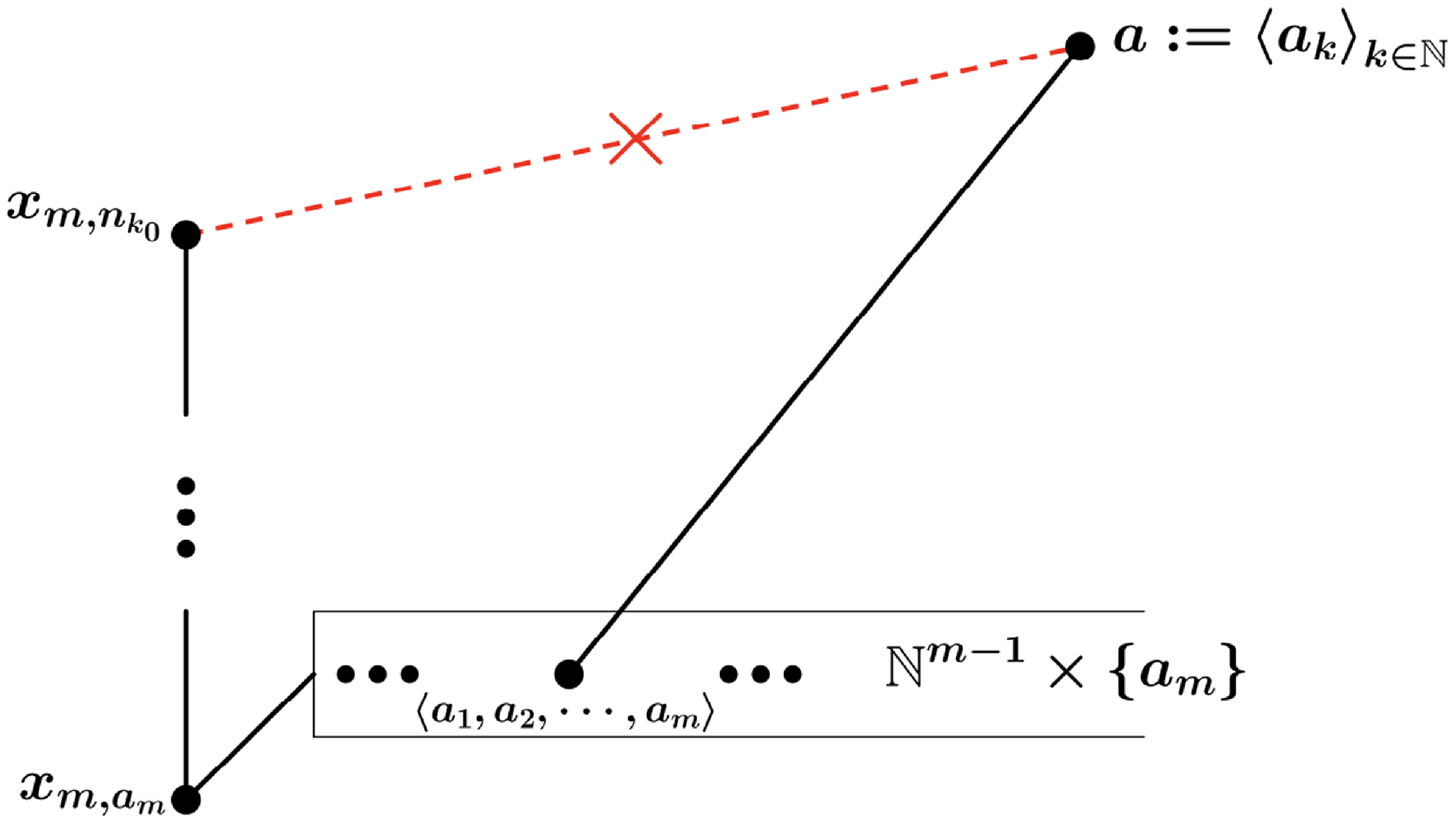
. On the other hand, as
 $x_{m,n_{k_0}}\leq a$
, we have that
 $a_m\geq n_{k_0}\gt a_m$
, a contradiction, as shown in Figure 8.
Therefore,
 $\{x_{m,n_k}:k\in \mathbb{N}\}$
has no upper bound in
 $\Sigma$
.
Order relations of
 $x_{m,a_m}$
,
 $x_{m,n_{k_0}}$
, and
 $a$
.

(ii) Assume that there exists
 $a^*\in \Sigma ^*$
that is an upper bound of
 $\{x_{m,n_k}:k\in \mathbb{N}\}$
. Then, by Claim 1 in (1),
 $a\in \Sigma$
is also an upper bound of
 $\{x_{m,n_k}:k\in \mathbb{N}\}$
, which contradicts (i).
Then (i) and (ii) together show that
 $\{x_{m,n_k}:k\in \mathbb{N}\}$
has no upper bound in
 $\Sigma \cup \Sigma ^*$
, and as it is clear that the only upper bound in
 $X$
is
 $x_{m,\omega }$
, we deduce that
 $x_{m,\omega }$
is the unique upper bound of
 $\{x_{m, n_k}:k\in \mathbb{N}\}$
in
 $L$
. Therefore,
 $\bigvee _{k\in \mathbb{N}}x_{m,n_k}=x_{m,\omega }$
.
Claim 4: All sets
 $X, \Sigma$
and
 $\Sigma ^*$
are subdcpos of
 $L$
.
Clearly both
 $\Sigma$
and
 $\Sigma ^*$
are subdcpos of
 $L$
. We now check that
 $X$
is a subdcpos of
 $L$
. Note that
 $X$
with the restriction order
 $\leq$
is exactly
 $\leq _X$
defined in Example 2.3. Note that all infinite directed subsets of
 $X$
are of the form
 $\{x_{m,n_k}:k\in \mathbb{N}\}$
, where
 $m\in \mathbb{N}$
and
 $\{n_k:k\in \mathbb{N}\}$
is an infinite subset of
 $\mathbb{N}$
; hence, we only need to prove that
 $\bigvee _{k\in \mathbb{N}}x_{m,n_k}=x_{m,\omega }$
.
Claim 5: For any directed subset
 $D$
of
 $L$
, if
 $\bigvee D\in{\Sigma ^*}$
, then
 $D\cap \Sigma ^*$
is a directed set such that
 $\bigvee D=\bigvee (D\cap \Sigma ^*)$
.
It suffices to prove
 $D\subseteq{\mathord{\downarrow }} (D\cap \Sigma ^*)$
. Note that
 $X\cup \Sigma$
is both a lower set and a subdcpo of
 $L$
, thus Scott closed. Then,
 $\Sigma ^*=L\setminus (X\cup \Sigma )$
is a Scott open subset of
 $L$
, so there exists
 $d_0\in D\cap \Sigma ^*$
, it follows that
 ${\mathord{\uparrow }} d_0\subseteq{\mathord{\uparrow }} \Sigma ^*=\Sigma ^*$
. Hence,
 $D\subseteq{\mathord{\downarrow }} (D\cap{\mathord{\uparrow }} d_0)\subseteq{\mathord{\downarrow }} (D\cap \Sigma ^*)$
. This shows that
 $D\cap \Sigma ^*$
is cofinal in
 $D$
, and so
 $D\cap \Sigma ^*$
is a directed set whose supremum equals
 $\bigvee D$
(see pp.61 in Goubault-Larrecq (Reference Goubault-Larrecq2013)).
Claim 6: For any directed subset
 $D$
of
 $L$
, if
 $\bigvee D\in \Sigma$
, then
 $D\cap \Sigma$
is a directed set such that
 $\bigvee D=\bigvee (D\cap \Sigma )$
.
For this, we only need to prove
 $D\subseteq{\mathord{\downarrow }} (D\cap \Sigma )$
. By the definition of
 $\leq$
on
 $L$
, we have that
 $D\subseteq{\mathord{\downarrow }} \bigvee D\subseteq{\mathord{\downarrow }} \Sigma =\Sigma \cup (X\setminus \textrm{Max} X)$
, and hence
 $D=(D\cap \Sigma )\cup (D\cap (X\setminus \textrm{Max} X))$
. Thus, to show
 $D\subseteq{\mathord{\downarrow }} (D\cap \Sigma )$
, it suffices to prove
 $D\cap (X\setminus \textrm{Max} X)\subseteq{\mathord{\downarrow }} (D\cap \Sigma )$
. Let
 ${x}_{m,n}\in D\cap (X\setminus \textrm{Max} X)$
. Note that
 $D\cap \Sigma \neq \emptyset$
(if
 $D\cap \Sigma =\emptyset$
, then
 $D\subseteq X$
, and since
 $X$
is a subdcpo of
 $L$
,
 $\bigvee D\in X$
, a contradiction), so we choose an arbitrary point
 $b\in D\cap \Sigma$
. Since
 $D$
is directed, there exists
 $e\in D$
such that
 $b\leq e$
and
 ${x}_{m,n}\leq e$
. Recall that
 $D\subseteq{\mathord{\downarrow }} \Sigma$
and
 ${\mathord{\uparrow }} b\cap{\mathord{\downarrow }} \Sigma \subseteq \Sigma$
(as
 $b\in \Sigma$
), so
 $e\in{\mathord{\uparrow }} b\cap D\subseteq ({\mathord{\uparrow }} b\cap{\mathord{\downarrow }} \Sigma )\cap D\subseteq \Sigma \cap D$
, which implies that
 ${x}_{m,n}\in{\mathord{\downarrow }} e\subseteq{\mathord{\downarrow }} (\Sigma \cap D)$
. Thus,
 $D\cap (X\setminus \textrm{Max} X)\subseteq{\mathord{\downarrow }} (D\cap \Sigma )$
. Therefore,
 $D\subseteq{\mathord{\downarrow }} (D\cap \Sigma )$
. This shows that
 $D\cap \Sigma$
is cofinal in
 $D$
, so
 $D\cap \Sigma$
is a directed set such that
 $\bigvee D=\bigvee (D\cap \Sigma )$
(see pp.61 in Goubault-Larrecq (Reference Goubault-Larrecq2013)).
(5)
 $L$
is an
 $\omega$
-algebraic domain and
 $K(L)=L\setminus (\textrm{Max}(\Sigma )\cup \textrm{Max}(\Sigma ^*)\cup \textrm{Max} X)$
.
Let
 $B:=L\setminus (\textrm{Max}(\Sigma )\cup \textrm{Max}(\Sigma ^*)\cup \textrm{Max} X)$
. Then,
 $B=\{x_{m,n}:m,n\in \mathbb{N}\}\cup \{a\in \Sigma : \ell (a)\in \mathbb{N}\}\cup \{a^*:a\in \Sigma , \ell (a)\in \mathbb{N}\}$
. Suppose
 $m\in \mathbb{N}$
and
 $a=\langle{a_1,a_2,\cdots ,a_m}\rangle \in \Sigma$
.
Step 1: We prove
 $a^*\in K(L)$
.
Suppose
 $D$
is a directed subset of
 $L$
such that
 ${a^*}\leq \bigvee D$
. Then,
 $\bigvee D\in{\mathord{\uparrow }}{a^*}\subseteq \Sigma ^*$
, so by Claim 3 of (3),
 $D\cap \Sigma ^*$
is a directed subset of
 $L$
and
 $a^*\leq \bigvee D=\bigvee (D\cap \Sigma ^*)$
. It follows that
 $D\cap \Sigma ^*$
is a directed subset of
 $\Sigma ^*$
and
 $a^*\sqsubseteq \bigvee D=\bigvee (D\cap \Sigma ^*)$
. Note that
 $a^*$
is a finite sequence of
 $\Sigma ^*$
, so it is compact in
 $(\Sigma ^*,\sqsubseteq ^*)$
, and then there exists
 $b^*\in D\cap \Sigma ^*$
such that
 $a^*\sqsubseteq ^*b^*$
. This implies that
 $a\leq b^*$
in
 $L$
. Therefore,
 $a^*\in K(L)$
.
Step 2: We prove
 $a\in K(L)$
.
Suppose
 $D$
is a directed subset of
 $L$
such that
 ${a}\leq \bigvee D$
. Then,
 $\bigvee D\in{\mathord{\uparrow }}{a}\subseteq \Sigma \cup \Sigma ^*$
. We consider the following two cases:
(e1)
 $\bigvee D\in \Sigma ^*$
.
Then, by Claim 2 of (1),
 $a^*\leq \bigvee D$
, and as we have proved in Step 1 that
 $a^*\in K(L)$
, there exists
 $e\in D$
such that
 $a\leq a^*\leq e$
, so
 $a\leq e$
.
(e2)
 $\bigvee D\in \Sigma$
.
Then, by Claim 2 of (3),
 $D\cap \Sigma$
is a directed subset of
 $L$
and
 $a\leq \bigvee D=\bigvee (D\cap \Sigma )$
. It follows that
 $D\cap \Sigma$
is a directed subset of
 $\Sigma$
and
 $a\sqsubseteq \bigvee D=\bigvee (D\cap \Sigma )$
. Note that
 $a$
is a finite sequence of
 $\Sigma$
, so it is compact in
 $(\Sigma ,\sqsubseteq )$
, and then there exists
 $e\in D\cap \Sigma$
such that
 $a\sqsubseteq e$
. This implies that
 $a\leq e$
in
 $L$
.
By (e1) and (e2), we conclude that
 $a\in K(L)$
.
Step 3:
 $\forall k, m\in \mathbb{N}$
,
 ${x}_{k,m}\in K(L)$
.
As a matter of fact, assume that
 $D$
is a directed subset of
 $L$
such that
 ${x}_{k,m}\leq \bigvee D$
.
(i) Let
 $\bigvee D\in X$
. Then,
 $D\subseteq{\mathord{\downarrow }} X=X$
. Note that
 $x_{k,m}\leq \bigvee D$
in
 $L$
implies
 $x_{k,m}\leq _X \bigvee D$
in
 $X$
, and it is clear that
 $x_{k,m}\in K(X)$
. Then, there exists
 $e\in D$
such that
 $x_{k,m}\leq _X e$
, and hence
 $x\leq e$
in
 $L$
.
(ii) Let
 $\bigvee D\in{\Sigma }\cup \Sigma ^*$
. Then, as
 ${x}_{k,m}\leq \bigvee D$
, there exist
 $n_1,n_2,\cdots ,n_{k}\in \mathbb{N}$
such that
 $n_k\geq m$
and
 ${x}_{k,m}\leq \langle{n_1,n_2,\cdots ,n_{k}}\rangle \leq \bigvee D$
. As we have proved in Step 2,
 $\langle{n_1,n_2,\cdots ,n_k}\rangle \in K(L)$
, there exists
 $e\in D$
such that
 $\langle{n_1,n_2,\cdots ,n_k}\rangle \leq e$
. Thus,
 $x_{k,m}\leq e$
.
Therefore, by above (i)–(ii),
 ${x}_{k,m}$
is compact.
From Steps 1–3, we deuce that
 $B\subseteq K(L)$
. Clearly, every element of
 $L$
can be represented as the supremum of some directed subset of
 $B$
, which means that
 $B$
is a base of
 $L$
. Note that
 $K(L)$
is included in any base of
 $L$
, so
 $K(L)\subseteq B$
. Therefore
 $B=K(L)$
. Also, one easily see that
 $|B|=|K(L)|=\omega$
. Hence,
 $L$
is an
 $\omega$
-algebraic domain.
(6)
 $\textrm{Max} L$
is not a
 $G_{\delta }$
-set in
 $\Sigma L$
.
Suppose, on the contrary, that
 $\textrm{Max} L$
is a
 $G_{\delta }$
-set. Then, there exists a countable family
 $\{U_k:k\in \mathbb{N}\}\subseteq \sigma (L)$
such that
 $\textrm{Max} L=\bigcap _{k\in \mathbb{N}}U_k$
. Recall that
 $\textrm{Max} L=\textrm{Max}(\Sigma ^*)\cup \textrm{Max} X$
.
Procedure 1: Since
 ${x}_{1,\omega }=\bigvee _{n\in \mathbb{N}}{x}_{1,n}\in \textrm{Max} X\subseteq \textrm{Max} L\subseteq U_1\in \sigma (L)$
, there exists
 $n_{1}\in \mathbb{N}$
such that
 ${x}_{1,n_{1}}\in U_1$
. Note that
 ${\langle }n_{1}{\rangle }\geq{x}_{1,n_{1}}\in U_1={\mathord{\uparrow }} U_{1}$
, so
 \begin{equation*}{\langle }n_{1}{\rangle }\in U_1.\end{equation*}
Procedure 2: Since
 ${x}_{2,\omega }=\bigvee _{n\in \mathbb{N}}{x}_{2,n}\in \textrm{Max} X\subseteq \textrm{Max} L\subseteq U_2\in \sigma (L)$
, there exists
 $n_{2}\in \mathbb{N}$
such that
 ${x}_{2,n_{2}}\in U_2$
. Note that
 ${{\langle }n_{1},n_{2}{\rangle }}\geq{x}_{2,n_{2}}\in U_2={\mathord{\uparrow }} U_{2}$
, so
 ${{\langle }n_{1},n_{2} \rangle }\in U_2$
. Since
 ${{\langle }n_{1},n_{2}{\rangle }}\geq{\langle }n_{1}\rangle \in U_1={\mathord{\uparrow }} U_1$
, we have that
 ${{\langle }n_{1},n_{2}{\rangle }}\in U_1$
, which follows that
 \begin{equation*}{{\langle }n_{1},n_{2}{\rangle }}\in U_1\cap U_2.\end{equation*}
Procedure 3: Since
 ${x}_{3,\omega }=\bigvee _{n\in \mathbb{N}}{x}_{3,n}\in \textrm{Max} X\subseteq \textrm{Max} L\subseteq U_3\in \sigma (L)$
, there exists
 $n_{3}\in \mathbb{N}$
such that
 ${x}_{3,n_{3}}\in U_3$
. Note that
 ${{\langle }n_{1},n_{2},n_{3}{\rangle }}\geq{x}_{3,n_{3}}\in U_3={\mathord{\uparrow }} U_{3}$
, so
 ${{\langle }n_{1},n_{2},n_{3}{\rangle }}\in U_3$
. Since
 ${{\langle }n_{1},n_{2},n_3{\rangle }}\geq{{\langle }n_{1},n_2{\rangle }}\in U_1\cap U_2={\mathord{\uparrow }} (U_1\cap U_2)$
, we have that
 ${{\langle }n_{1},n_{2},n_3{\rangle }}\in U_1\cap U_2$
, which follows that
 \begin{equation*}{{\langle }n_{1},n_{2},n_3{\rangle }}\in U_1\cap U_2\cap U_3.\end{equation*}
Repeating the above procedures, we obtain a countably infinite sequence
 $a: ={\langle }n_{k}{\rangle }_{k\in \mathbb{N}}\in \bigcap _{k\in \mathbb{N}}U_k$
. Note that
 $a\notin \textrm{Max} L$
(as
 $a\lt a^*$
), which contradicts our assumption
 $\textrm{Max} L=\bigcap _{k\in \mathbb{N}}U_k$
. Therefore,
 $\textrm{Max} L$
is not a
 $G_{\delta }$
-set in
 $\Sigma L$
.
From the preceding example, we obtain our main result as follows, which gives a negative answer to Martin’s problem.
Corollary 2.6.
There exists an
 $\omega$
-algebraic domain
 $P$
such that
 $\mbox{Max}(P)$
is not a
 $G_\delta$
-set of the Scott space
 $\Sigma P$
.
4.
$\mbox{Max}(L)$
Has an
$\omega$
-Ideal Model


A poset model of a topological space
 $X$
is a poset
 $P$
such that
 $\textrm{Max}(P)$
, the set of maximal elements of
 $P$
, with the relative Scott topology, is homeomorphic to
 $X$
. Clearly, every space having a poset model is
 $T_1$
.
Definition 3.1 (Martin (Reference Martin2003a)). A continuous dcpo is called ideal if every element is either compact or maximal. It is called
 $\omega$
-ideal if it is ideal and has a countable basis.
If
 $P$
is a poset model of
 $X$
such that
 $P$
is an
 $\omega$
-ideal domain, then we say that
 $X$
has an
 $\omega$
-ideal domain model, or equivalently, and
 $X$
can be modeled by an
 $\omega$
-ideal domain.
In this section, we construct an
 $\omega$
-ideal domain model of
 $\mbox{Max}(L)$
, which shows that
 $\mbox{Max}(L)$
can be modeled by an
 $\omega$
-ideal domain model. Therefore,
 $\textrm{Max}(L)$
is a
 $G_{\delta }$
-set in this model.
Let
 $\tilde{L}=X\cup \Sigma$
. We project
 $L$
onto
 $\tilde{L}$
and define a mapping
 $f:L\rightarrow L$
as follows:
 \begin{equation*} f(x)=\bigvee \{y\in K(\tilde {L}):y\leq x\},\forall x\in L.\end{equation*}
It is easy to observe the follows facts.
Fact 1: i)
 $\forall x\in X\cap K(L), f(x)=x$
; ii)
 $\forall x\in \Sigma \cap K(L), f(x)=x$
; iii)
 $\forall x^{*}\in \Sigma ^{*}\cap K(L), f(x^{*})=x$
.
Fact 2:
 $f$
preserves the supremum of directed subsets of
 $L$
and then is Scott-continuous.
Fact 3: The image of
 $f$
is
 $\tilde{L}$
, and
 $\textrm{Max}(L)$
are
 $\textrm{Max}(\tilde{L})$
are bijective.
By the definition of
 $f$
, we have that: i)
 $\forall x\in X\cap{\textrm{Max}(L)}, f(x)=x\in X\cap{\textrm{ Max}(\tilde{L})}$
; ii)
 $\forall x\in \Sigma \cap{\textrm{Max}(L)}, f(x)=x\in \Sigma \cap{\textrm{Max}(\tilde{L})}$
; and iii)
 $\forall x^{*}\in X\cap{\textrm{Max}(L^{*})}, f(x^{*})=x\in X\cap{\textrm{Max}(\tilde{L})}$
.
Fact 4: The restriction of
 $f$
to the maximal point space is an open mapping.
This can be seen from the results:
-
(i)
$\forall x\in K(L)\cap X, f({{\mathord{\uparrow }} x}\cap{\textrm{Max}(L)} )={{\mathord{\uparrow }} x}\cap{\textrm{Max}}(\tilde{L})$
; -
(ii)
$\forall x\in K(L)\cap \Sigma , f({{\mathord{\uparrow }} x}\cap{\textrm{Max}(L)} )={{\mathord{\uparrow }} x}\cap{\textrm{ Max}(\tilde{L})}$
; -
(iii)
$\forall x^{*}\in K(L)\cap \Sigma ^{*}, f({{\mathord{\uparrow }} x^{*}}\cap{\textrm{Max}(L)} )={{\mathord{\uparrow }} x}\cap{\textrm{ Max}(\tilde{L}})$
.


From these facts, we obtain the following results:
Theorem 3.2.
 $\mbox{Max}(L)$
can be modeled by an
 $\omega$
-ideal domain and therefore the maximal point space is a
 $G_\delta$
-set of the Scott space of the model.
The results here naturally lead to the following problems for further study on this topic:
Problem 1 Is there a
 $T_1$
space which has an algebraic domain model and does not have any ideal model?
Problem 2 Which spaces have an ideal domain model?
Acknowledgments
This work was supported by the National Natural Science Foundation of China (12331016, 12471438, 12071188, and 12101313).
Declaration of interests
The authors declare that they have no known competing financial interests or personal relationships that could have appeared to influence the work reported in this paper.