Il n’y a pas de philologie véritable sans philosophie et sans histoire. (T. Pavie, Notice sur les travaux de M. Eugène Burnouf (Paris, 1853), p. 5)
The Parsi Sanskrit Yasna, traditionally attributed to Nēryōsangh, is the product of a specific and highly elaborate translation project. This text—which at first glance might appear to be nothing more than a work of ungrammatical Sanskrit—encompasses a huge number of historical, religious, and cultural elements. The sophisticated philological system of the text entails not only a diachronic view of the Zoroastrian tradition and languages, but also the synchronic view of certain linguistic and religious features of the contemporary Indian society. Some centuries later, the same philological system so effectively used in producing the Sanskrit Yasna also proved optimal for the scholar Eugène Burnouf (1801–1852), who was able to unlock its potential to make significant strides in Indo-Iranian linguistics. I will argue that the multifaceted system underpinning the Sanskrit text, which was compiled in a multicultural, multireligious, and multilingual environment, can be better understood through a multidisciplinary approach, supported by a multicultural perspective and comparative study. Specific cultural and historical factors underlie the formal, grammatical, and content-related features of the text; they must be specially investigated to fully comprehend the text. This approach was probably the key to Burnouf’s successful interpretation and application of the text. I will first outline Nēryōsangh’s work and the context of the text’s compilation; then, I will retrace Burnouf’s means of reading and interpreting the Sanskrit Yasna; compare the two methodological approaches; and, finally, suggest and encourage future multidisciplinary studies of the Sanskrit text to disclose its historical implications.
Compilation: Nēryōsangh and the philological system of the Sanskrit Yasna
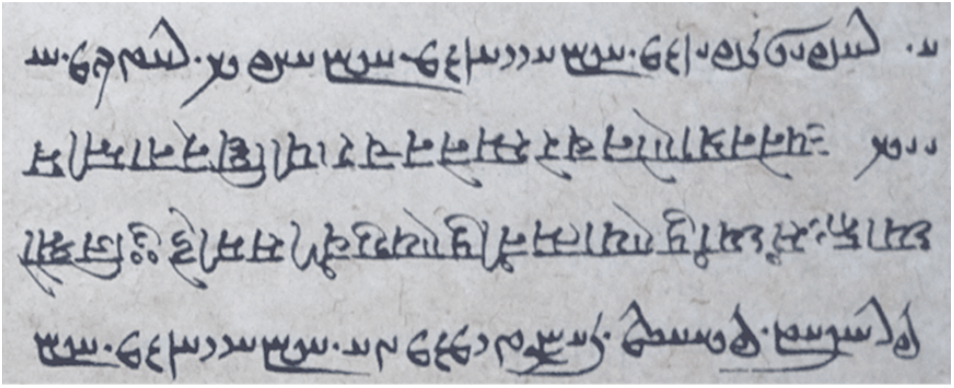
Part of the Sanskrit oeuvre of the Parsis consists of Sanskrit versions of Zoroastrian texts originally composed in Avestan.Footnote 1 Among them, the Yasna Footnote 2 is the most representative of the source tradition, as the Sanskrit includes 57 of the 72 chapters of the original Avestan text.Footnote 3 The manuscripts containing the Sanskrit version of the Yasna generally feature the Avestan text along with the corresponding Sanskrit written upside down to save space on the folio (Figure 1). Avestan is written from right to left, and Sanskrit from left to right; by turning the folio upside down, the scribe could save space and continue the text flow. However, the Sanskrit version does not come directly from the original Avestan one: throughout the first millennium CE, various Pahlavi versions of Zoroastrian texts, including the Yasna, were compiled in Iran.Footnote 4 When a group of Zoroastrians who were later known as the Parsis moved from Iran to Gujarāt—by land and by sea, in various waves that cannot be dated with certaintyFootnote 5—they brought along their Avestan–Pahlavi manuscripts.Footnote 6 Avestan was—and still is—the sacred language of Zoroastrianism, but, by that time, the priests were more familiar with the Pahlavi texts.Footnote 7 At the beginning of the second millennium CE, the Parsi community settled in India and was ready to start compiling its own literature. Unfortunately, we know very little about early Parsi history. Despite the lack of historical information on the Parsi community, we know that, during this period, Gujarāt became a flourishing state under the Cālukya Dynasty. The most influential figure at court was the Jaina savant Hemacandra (circa 1089–1173), who not only promoted the Jaina cult and traditions, but also wrote a Sanskrit–Prakrit–Apabhraṃśa grammar, the Siddhahemacandra, named after the ruling Cālukya king and himself. His work surely had a certain impact on the Gujarāti cultural environment, and the influence of Hemacandra’s grammatical codification could also be visible in the Sanskrit Yasna.
Sample of a manuscript containing the Sanskrit Yasna.

In the manuscripts containing the Sanskrit version of the Yasna, we read that the translation from Pahlavi into Sanskrit was carried out by the mythical figure Nēryōsangh:Footnote 8
idaṃ ijiśnijaṃda pustakaṃ māyā nirīosaṃghena dhavalasutena pahlavījaṃdāt saṃskratabhāṣāyām avatāritaṃ
The manuscript of the Yasna’s zand was translated from the Pahlavi zand into the Sanskrit language by me, Nirīosangha, son of Dhaval.Footnote 9
The declaration of authorship is symbolic: Nēryōsangh was considered one of the founders and leaders of the new Parsi community in Gujarāt. He is credited with various speeches, Sanskrit works, and legendary episodes that are clearly unrealistic even in terms of chronology. Quite interestingly, according to Parsi tradition, he was the first to give a speech about Parsi religious customs before the local Hindu ruler after the Parsi community arrived in India.Footnote 10 Scholars have debated abundantly over Nēryōsangh, his authorship, and the value of his work;Footnote 11 the most plausible theory is that several people worked on the Sanskrit versions of the Zoroastrian texts and that these works were credited to Nēryōsangh’s name to confer authority.
In any case, Nēryōsangh’s status as a historical figure is not particularly relevant to investigating the origin or aims of Parsi Sanskrit literature. Regardless of whether the author was one or many, his/their education and ability to execute such an accurate philological project are the more interesting concerns when attempting to draw a picture of the cultural milieu of the early Parsi community. In the Sanskrit text, we find a strong connection with both the Zoroastrian tradition and the Gujarāti cultural milieu at the beginning of the second millennium CE. The two elements are closely intertwined and created the ideal situation for the philological system to operate in. The authors of the Sanskrit version were learned Parsi priests, with a good knowledge of Pahlavi—though decreasing over the centuries after their settlement in India—and knowledge of the original Avestan text. Furthermore, they had recently moved to Gujarāt, and Sanskrit was not only a language with millennia of sacred literature, but had also just been revived by Hemacandra’s grammar.
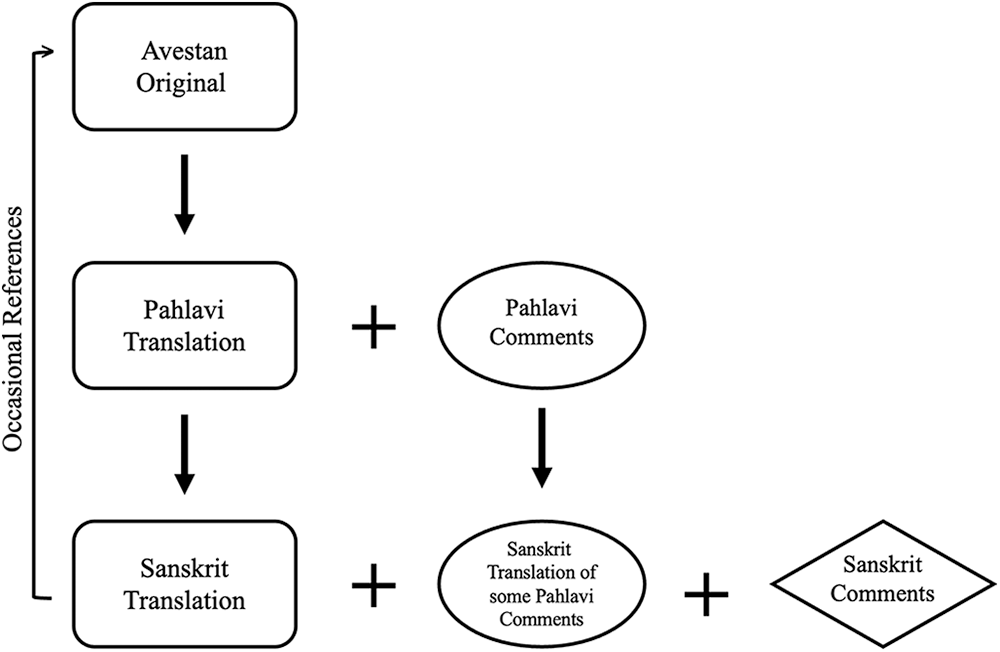
The translation process of the Yasna text took place in two phases (Figure 2): first, as already mentioned, during the first millennium CE, the original Avestan was translated into Pahlavi and an additional layer of comments in Pahlavi was added to the text. The comments are of various natures:Footnote 12 some are exegetical, others explicative, etc. Then, at the beginning of the second millennium CE, the Pahlavi main text was translated into Sanskrit, along with some of the Pahlavi comments,Footnote 13 and some original Sanskrit comments were added. The result is an unnatural Sanskrit syntax based on the Pahlavi with occasional reference to the Avestan original.
Translation process.

The lexical choices of the Sanskrit text deserve special mention. Specifically, Zoroastrian terminology has been rendered in Sanskrit with calques, loanwords, and proper names.Footnote 14 The most interesting of these are terms that have been adapted from the non-Zoroastrian environment.Footnote 15 We find both religious concepts and practices borrowed from other doctrines to render some of the Zoroastrian divinities, religious concepts, and ritual practices. For instance, the Avestan term cisti- ‘insight’,Footnote 16 Pahlavi frazānag, has been rendered as Sanskrit nirvāṇa-jñāna- ‘knowledge of the extinction’;Footnote 17 the well-known Buddhist, Jain, and Hindu term nirvāṇa- is part of a compound that corresponds here to an Avestan divinity. The Hindu concept of karman- is employed to render the (Zoroastrian) deed (Avestan š́iiaōθna-, Pahlavi kunišn), while the trans-religious term dharma- represents one of the Sanskrit renderings of the name of the divine entity, Aṣ̌a Vahišta.Footnote 18 The Hindu practices of namaskāraṇa-/namaskr̥ti-, and pūjākaraṇa- translate into ‘prayer’ (Avestan vahma-, Pahlavi niyāyišn) and gloss an act of gratification, respectively.Footnote 19 Although these terms do not carry their usual meaning in this context and are only mentioned in the Yasna—a ritual text that does not explain religious or philosophical concepts in detail—they clearly recall other religious traditions and sounded familiar in other Indian cultural contexts.
The translators who were gathered under the name of Nēryōsangh carried out a precise philological agenda, moved by the need to preserve the Zoroastrian tradition and, at the same time, to fit into the contemporary Indian cultural context. They used numerous neologisms and the syntax of the Sanskrit text is not always clear; however, the project of translating the text from Avestan into Sanskrit via Pahlavi has certainly been successful. This significant philological effort can easily be retraced by comparing the text in all three languages. It also features a sort of exegesisFootnote 20 by the Sanskrit translators showing the contemporary usage of Parsi Sanskrit in the rendition of the Iranian source languages. After all, the translators were learned Parsis and the text of the Sanskrit Yasna showcases all their linguistic and religious knowledge. Finally, yet importantly, the Parsi community wrote this particular specimen of Sanskrit in the so-called Parsi Nāgarī script,Footnote 21 mainly borrowed from Jaina Nāgarī, probably due to the dominant Jaina cultural environment in Gujarāt.
Revival: Eugène Burnouf and his philological approach
The effectiveness of this translation project from Avestan into Sanskrit is also attested by the fact that, seven to eight centuries later, Eugène Burnouf was able to retrace this philological path backwards. His Commentaire sur le Yaçna (1833) represents a milestone in Iranian studies as an early example of Indo-Iranian comparative philology: Burnouf engaged in the systematic study of the Yasna’s language and content, providing a precise analysis of the Avestan language—or the ‘Zend’ language, as he called it, following Anquetil-Duperron—relying on the comparison with the Sanskrit version. Burnouf had at his disposal the bilingual Avestan-Sanskrit manuscripts preserved at the Bibliothèque nationale de France (BnF)Footnote 22 as well as Anquetil-Duperron’s French translation of the Yasna,Footnote 23 based on the Pahlavi version and enriched by the contemporary Parsi exegesis.Footnote 24 Starting from the Sanskrit text and guided by Anquetil’s translation, Burnouf was able to provide an extended commentary on the Avestan original as well as an interpretation of the text.
Eugène Burnouf was a brilliant scholar and many of his intuitions were surely due to his individual skill and knowledge. Nevertheless, he certainly benefited from consulting his contemporaries and their own research on South Asian languages and religions. His father Jean-Louis Burnouf, a scholar of ancient languages himself, provided him with the right connections and materials. Moreover, the popularity of the so-called oriental languages in England, Germany, and France at the beginning of the nineteenth century created the ideal network for continuous exchange between scholars. He enjoyed relationships, for instance, with Christian Lassen (1800–1876) in Bonn and Franz Bopp (1791–1867) in Berlin. All these scholars, Burnouf included, spent some time in London studying the manuscripts preserved at the British Library.Footnote 25 Burnouf in particular took advantage of his stay in London by consulting the various Avestan manuscripts there for his study of the language and the Yasna.
Consulting the Avestan manuscripts was not the only crucial element in Burnouf’s analysis of the Avestan language: the study of Indian literature was also essential to his pursuit. He had already studied the Pāli language, in collaboration with the abovementioned scholar Lassen, and was familiar with Buddhist texts.Footnote 26 To understand Avestan and its connections with Sanskrit, Burnouf had to go back to Pāṇini and Vedic—the most archaic form of the Sanskrit language. In a letter to M. J. Mohl written in Paris on 3 January 1831, Burnouf writes: ‘dans l’intérêt de mon commentaire zend, je lis le plus que je puis de ce vieux sanscrit, qui a un rapport étonnant avec le zend; cela a considérablement modifié les idées que j’avais quand vous êtes parti.’Footnote 27 Burnouf understood that the language he was calling ‘Zend’ (Avestan) had more in common with Vedic than with classical Sanskrit. He was retracing its path backwards and trying to classify this ‘new’ language on the basis of comparison with other languages he had studied, including Latin and Greek. Clearly, the Sanskrit of the Sanskrit Yasna is a later form of the language, as the text was compiled at the beginning of the second millennium CE; this form of Sanskrit is also highly influenced by Middle Indic and includes many Prakritisms. Therefore, on the one hand, Burnouf’s knowledge of Pāli—and Prakrit languages in general—was extremely useful to his purpose. He was aware that his knowledge of different Indian languages could help him with his research. In 1830, three years before publishing his Commentaire, he wrote: ‘Le zend m’a également mis dans la nécessité de rassembler tout ce que je pouvais réunir de pâli et de prakrit; car ce vieux dialecte médique est tellement mélangé qu’on n’a pas trop de recherches polyglottes pour en comprendre quelques bribes.’Footnote 28 On the other hand, he did not recognise the importance of Pāli and Prakrit in understanding the Sanskrit text of the Yasna; he classified the features of this later stage of Sanskrit as fautes, ‘errors’, and deemed the style of the Sanskrit text as barbare, as it systematically violated the simplest rules of Sanskrit grammar.Footnote 29 This form of the language is indeed very far from the Sanskrit of the epics and poetry, and he recognised that the Avestan language is more archaic and has more points in common with Vedic. Despite describing the Sanskrit Yasna as the most incorrect and barbaric Sanskrit text that had ever reached Europe, he acknowledged its importance for interpreting the Avestan text and therefore sought to reproduce the manuscripts’ text accurately.Footnote 30 Unfortunately, Burnouf could not complete his promising work on the text due to his premature death in 1852.
Efficacy: comparing methodologies, features, and contexts
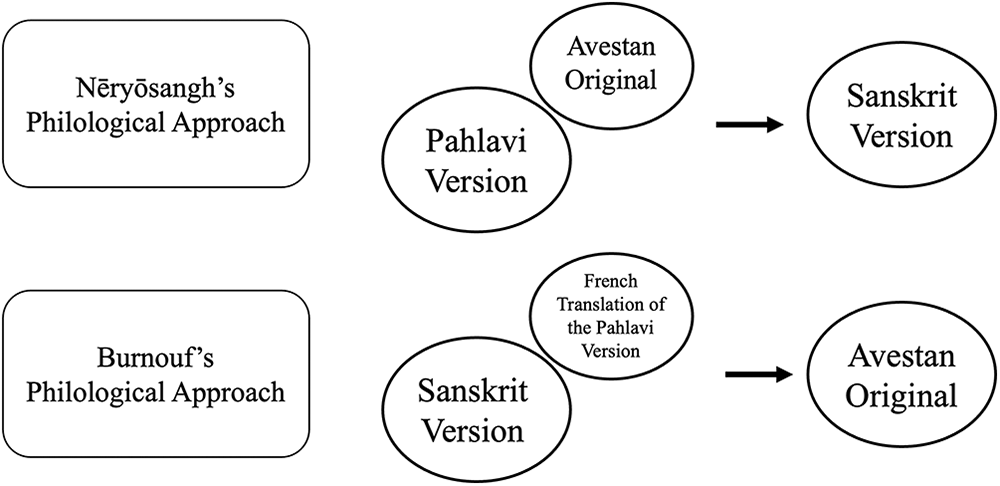
The philological processes of compiling the Sanskrit Yasna on the one hand and Burnouf’s study on the other probably shared some features or circumstances linking their respective methodologies. In other words, Burnouf was probably able to comprehend the text of the Sanskrit Yasna and retrace its philological system backwards precisely because he was familiar with cultural and linguistic elements that had been fundamental to the compilation of the Sanskrit Yasna (Figure 3).
Scheme of the philological systems.

How does the Sanskrit Yasna’s philological system work? First, it relies on the remarkable linguistic knowledge of its compilers. Taking advantage of the cultural and linguistic diversity of India, the Parsi priestly class adopted Sanskrit—an elite language that could surpass the borders of Gujarāt. Moreover, the religious syncretism of north-western India surely granted the Parsi priests the opportunity to be familiar with other Indian religious concepts and practices, such as Jaina, Buddhist, and Hindu ones.Footnote 31 In some way, Burnouf was also retracing the linguistic and cultural education of the Parsi priests: he studied Pāli (a Prakrit language), then classical Sanskrit, and finally Vedic. In this way, he could read a wide range of Buddhist and Hindu texts. Moreover, even if the text he was studying belonged to the Zoroastrian tradition, it had been copied in India, and therefore the phonology and morphology of its Avestan language included some Indian features.Footnote 32
Burnouf’s education in Indian languages and culture represented the starting point in his successful study of Iranian languages and religious customs. In the abovementioned quotation from his letter, he points to the connections between the Indian and Iranian branches and the necessity for mastering older stages of the Sanskrit language to comprehend Avestan. To understand the Avestan text, Burnouf mostly worked on a comparative basis with Indian languages, even if he also consulted the Pahlavi version of the Yasna and recognised that the Sanskrit version was based mainly on this one;Footnote 33 he was also interested in investigating other features of the Zoroastrian religion and had a special interest in other Iranian languages.Footnote 34 While the Parsis started from Iranian languages and added the Indian ones after settling in India, Burnouf started from Sanskrit, Vedic, and Prakrit to end up at Avestan. The impression is that, even in the past, learned people such as our Parsi priests were aware of the proximity of Indian and Iranian languages. For instance, the aforementioned direct references to the Avestan language in the Sanskrit text mainly concern inflection; the translators were probably aware that Sanskrit was structurally closer to ancient, inflected Avesta than to later, non-inflected Pahlavi. Moreover, leaving aside the numerous loanwords and Zoroastrian termini technici, the common lexicon employed in Sanskrit is, whenever possible, the closest to the Iranian form: for instance, the Sanskrit adjective jīva- Footnote 35 ‘living’, is very close to the Avestan jīuuiia- ‘living’, Pahlavi ǰān; there are also clearer cases, such as the use of the Sanskrit gira-/giri- Footnote 36 ‘mountain’ to render Avestan gairi-, Pahlavi gar, whereas the translator could have chosen other common Sanskrit forms such as parvata- ‘mountain’. Burnouf greatly contributed both to theorising the relationship between the two linguistic branches and to undertaking the systematic study of Avestan in the nineteenth century. In this way, he successfully laid the foundation for Indo-Iranian and modern Avestan studies.Footnote 37 Burnouf systematically established the relationship between (Vedic) Sanskrit and Avestan as well as other Indian and Iranian languages, contributing in all respects to the birth of comparative Indo-Iranian studies. Moreover, it has already been mentioned that Burnouf’s knowledge and interests were not limited to the linguistic sphere; he was also interested in the philosophical–religious content of texts, and thus his comparative philological method also benefited from these cultural factors. For instance, he tries to explain the Avestan term raêvaṭ (raēuuaṇt-), understood as ‘brilliant’, one of Ahura Mazdā’s epithets. Unable to directly refer to the Vedic root rev- ‘to go, move’,Footnote 38 he seeks an alternative explanation based on his knowledge of other traditions: Râivata or Rêvata is the name of one of the five Manus of the current era (kalpa),Footnote 39 who is son of the Sun. Therefore, he postulates that the root rev- could have anciently meant ‘to shine’ even in Sanskrit and thus explains the Avestan term. Another example could be the speculation on the Avestan term dôithra (dōiθra-), meaning ‘eye’, specifically Ahura Mazdā’s eye; it is rendered in the Sanskrit version as locana-, a term commonly used to designate the eye. To explain the etymology of the Avestan term, Burnouf suggests, among other interpretations, the fact that the term could be related to the Sanskrit noun dhī-, which he translates as ‘intelligence’ and presents as a synonym for the term buddhi-. To support this, he invokes an anonymous Vedic commentator, the Bhagavadgītā, and the Gāyatrī. In his discussion of the term buddhi- and its root budh-, he argues that it has the double meaning of ‘to think’ and also ‘to become awake’; in relation to this, he mentions the Buddha and extends his argument to Chinese Buddhism. Although his hypotheses may not always be plausible or well supported, his extensive knowledge of Indian texts and traditions provides an additional element for his linguistic comparison. In this way, he was able to pave the way to the understanding of the Avestan text and the development of comparative Indo-Iranian studies.
The general impression is that the philological apparatus Footnote 40 of the Sanskrit Yasna proved to be an excellent bridge between the different versions in each context, during both its compilation under the name of Nēryōsangh and its nineteenth-century revival by Burnouf. This later revival of the Yasna’s philological system was possible thanks to two reasons: first, Burnouf was convinced that philology also comprised philosophy and history, and therefore he deeply investigated these fields in his research. He already had a good knowledge of the Indian cultural milieu in which the philological apparatus of the Sanskrit Yasna arose, and skilfully used his expertise in Indian languages and cultures to investigate the language and the content of the original Avestan version. The second, fundamental reason was his awareness that Indian and Iranian languages are closely related and could be used to understand each other, thus allowing him to comprehend both versions of the Yasna—the Sanskrit as well as the Avestan one. He could understand the morphology and phonology of Avestan through (Vedic) Sanskrit and support his ideas with precise explanations in his commentary on the text.
Conclusion: future perspectives and the second revival of the Yasna’s philological system
Eugène Burnouf played an important role at the dawn of comparative Indo-Iranian studies in the first half of the nineteenth century. However, during his life, the study of Zoroastrianism was still too underdeveloped to support a proper comparative study of the Zoroastrian religion and languages.Footnote 41 Nowadays, we have a much deeper knowledge of the Avestan texts and Zoroastrian ritual; especially in recent decades, scholars have changed their approach to the texts and worked on ritual elements to reconstruct the Zoroastrian liturgies.Footnote 42 Studies on Pahlavi literature have also advanced enormously in recent years.Footnote 43 Therefore, it may now be the time to revisit Parsi Sanskrit literature (especially the Sanskrit Yasna) and analyse it properly. Given that the Sanskrit Yasna is the product of a multicultural environment, the approach to the study of this text must be multidisciplinary and appropriate to the context of its compilation: the text must be studied relative to its position both in the Zoroastrian tradition and in the Indian cultural environment. Moreover, it must be carried out on different levels, namely linguistic, religious, and historical.
The second revival of the Sanskrit Yasna’s philological system promises even more accurate results thanks to today’s technologies and in-depth knowledge of both Indian and Zoroastrian traditions. In particular, the content, the grammatical aspects, and even the script of the Sanskrit Yasna may reveal some historical elements of their settlement or cultural contact with other religious communities; as early Parsi history is still so lacunose, we may indeed draw important information from the text itself. Therefore, what I suggest at present is revisiting the Sanskrit text of the Yasna equipped with both the nineteenth-century comparative methodology and a renewed interest in Zoroastrian ritual and exegesis. In this way, we will also be able to integrate the text’s philosophy and history with linguistic analysis; as Burnouf suggested, they proved to be essential components of comparative philological analysis.
Acknowledgements
An earlier version of this article was presented at the European Conference of Iranian Studies (ECIS 10), hosted by Leiden University from 21 to 25 August 2023. I gratefully acknowledge Ghent University and the European Research Council (PhiSci: Philology as Science in 19th-Century Europe, grant no. 101042729) for their support. I am grateful to the PhiSci team for constructive feedback and helpful suggestions.
Conflicts of interest
The author is employed at Universiteit Gent (UGent) and funded by the ERC project ‘PhiSci: Philology as Science in 19th-Century Europe’, grant no. 101042729, led by Prof. Dr. P. M. Kurtz.