Introduction
Up to 88% of persons with Alzheimer's disease (AD) experience neuropsychiatric symptoms (NPS), including delusions, agitation, aggression, depression, anxiety, apathy, irritability, and sleep disturbances (Mega et al., Reference Mega, Cummings, Fiorello and Gornbein1996; Karttunen et al., Reference Karttunen2011; Lyketsos et al., Reference Lyketsos2011). NPS often occur in the early stages of AD and may be the first indicators of the disease (Lyketsos et al., Reference Lyketsos2011; Dillon et al., Reference Dillon, Serrano, Castro, Leguizamón, Heisecke and Taragano2013).
NPS are burdensome to people with AD and their caregivers. NPS are associated with a decline in daily activities (Lyketsos et al., Reference Lyketsos2011; Hallikainen et al., Reference Hallikainen2012), loss of quality of life (Karttunen et al., Reference Karttunen2011), and with early institutionalization (Dillon et al., Reference Dillon, Serrano, Castro, Leguizamón, Heisecke and Taragano2013; Kales et al., Reference Kales, Gitlin and Lyketsos2015). In addition, NPS are associated with greater caregiver depression and stress (Kales et al., Reference Kales, Gitlin and Lyketsos2015).
Psychotropic medications are widely prescribed to manage NPS (Dillon et al., Reference Dillon, Serrano, Castro, Leguizamón, Heisecke and Taragano2013; Taipale et al., Reference Taipale, Koponen, Tanskanen, Tolppanen, Tiihonen and Hartikainen2014; Kales et al., Reference Kales, Gitlin and Lyketsos2015; Koponen et al., Reference Koponen2015) albeit non-pharmacological approaches are considered first-line treatment (Kales et al., Reference Kales, Gitlin and Lyketsos2015). Some studies have reported psychotropic medications have only modest efficacy for treating NPS and may impair physical and cognitive function in people with memory disorders (Kales et al., Reference Kales, Gitlin and Lyketsos2015). Managing NPS accounts for approximately 30% of the total cost of AD management in the community setting (Beeri et al., Reference Beeri, Werner, Davidson and Noy2002). It has been estimated that the cost of providing care for AD increases by 8% for each point on the brief version of the neuropsychiatric inventory (NPI) (Jönsson et al., Reference Jönsson2006).
There has been considerable research into psychotropic drug use and the corresponding associations with cognitive and functional performance in persons with AD. Nevertheless, most previous studies have used a limited number of clinical measurements and have been of short duration. Many previous studies have analyzed Mini-Mental State Examination (MMSE) scores. MMSE has limited capacity to measure the progression of AD when used for period of less than three years (Clark et al., Reference Clark1999).
The objective of this study was to investigate the longitudinal associations between psychotropic medication use and NPS, cognition, and functional performance in persons with very mild or mild AD at baseline. Collectively, these three domains correspond to increased dependence on others in AD (McLaughlin et al., Reference McLaughlin2010).
Methods
Participants and data collection
Persons with recently diagnosed very mild (Clinical Dementia Rating, global CDR 0.5) or mild (global CDR 1) AD and their family caregivers were recruited from three memory polyclinics in Finland between 2002 and 2006 (Karttunen et al., Reference Karttunen2011; Hallikainen et al., Reference Hallikainen2012). Participants had recently diagnosed AD according to the National Institute of Neurological and Communicative Disorders and Stroke and the Alzheimer's Disease and Related Disorders Association (McKhann et al., Reference McKhann, Drachman, Folstein, Katzman, Price and Stadlan1984) and Diagnostic and Statistical Manual of Mental Disorders (DSM-IV; APA, American Psychiatric Association, 1994) guidelines. Participants underwent a neurological clinical examination, laboratory screening tests, brain imaging, electrocardiography, and neuropsychological examination.
All participants were Finnish-speaking, community-dwelling, and were free of comorbid conditions associated with cognition (e.g. blindness, deafness, or other major neurological conditions than AD) at baseline. In addition, participants were required to have a daily caregiver. In total, there were 236 eligible participants for this study.
Written informed consent was obtained from all persons with AD and their caregivers. Physicians were free to prescribe participants any medications they deemed clinically appropriate. Finnish guidelines recommend the initiation of anti-dementia medication for all persons with mild AD (Finnish Medical Society Duodecim, 2010). For this reason all participants initiated anti-dementia medications following AD diagnosis.
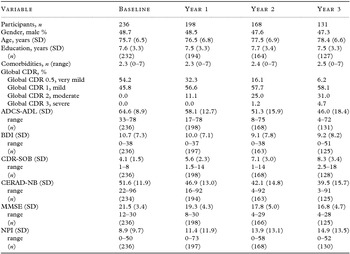
At baseline, 54% of participants had very mild AD (global CDR 0.5) and 46% had mild AD (global CDR 1) (Table 1) (Hallikainen et al., Reference Hallikainen2012; Hallikainen et al., Reference Hallikainen2013). The mean age of participants was 76 years (SD 6.5) and 49% were male. The change in all clinical measures with the exception of depressive symptoms reflected an increase in disease severity over the three-year follow-up. Altogether, 131 persons participated all the follow-up visits. Of those who did not participate in the third-year study visit, 32% were admitted to long-term institutional care, 19% died, 19% did not participate in the annual follow-ups for caregiver-related reasons, 14% due to deterioration in health, 8% refused to perform the follow-up tests, and 8% were not able to participate the follow-up visit for other reasons.
Demographics of persons with AD at baseline and during the study period

Data presented as means (SD), unless otherwise indicated. SD = Standard Deviation; Global CDR = Global Clinical Dementia Rating, scale 0–3; ADCS-ADL = Alzheimer's Disease Cooperative Study-Activities of Daily Living Inventory, scale 0–78; BDI = Beck Depression Inventory, scale 0–63; CDR-SOB = CDR Sum of Boxes, scale 0–18; CERAD-NB = The Consortium to Establish a Registry for Alzheimer's Disease Neuropsychological Battery total score, scale 0–100; MMSE = Mini-Mental State Examination, scale 0–30; NPI = Neuropsychiatric Inventory, scale 0–144. Global CDR, CDR-SOB, NPI and BDI scores increase as severity of symptoms increases; CERAD-NB, MMSE and ADCS-ADL scores decrease as severity of symptoms increases. All persons were not able to perform all parts of the test batteries (n).
Follow-up and measurements
All participants and their caregivers were interviewed annually by a study nurse and psychologist. The Clinical Dementia Rating Sum of Boxes (CDR-SOB, range 0–18, 0 indicating no dementia) was used to evaluate the AD severity and progression of AD (Hughes et al., Reference Hughes, Berg, Danziger, Coben and Martin1982; Morris, Reference Morris1993; Williams et al., Reference Williams, Storandt, Roe and Morris2013). Cognitive performance was evaluated using the Consortium to Establish a Registry for Alzheimer's Disease Neuropsychological Battery (CERAD-NB, range 0–100, 100 indicating no deterioration in cognition). The total CERAD-NB score was calculated for each participant using the sub-test addition method (Chandler et al., Reference Chandler2005). Cognition was also evaluated using the MMSE (range 0–30, 30 indicating no deterioration in cognition) (Folstein et al., Reference Folstein, Folstein and McHugh1975). The Alzheimer's Disease Cooperative Study-Activities of Daily Living Inventory (ADCS-ADL, range 0–78, 78 indicating independence in daily activities) was used to assess functioning (Galasko et al., Reference Galasko1997). The NPI (range 0–144, 0 indicating no psychological problems) was used to assess behavioral symptoms (Cummings et al., Reference Cummings, Mega, Gray, Rosenberg-Thompson, Carusi and Gornbein1994). Symptoms of depression were assessed by using the patient-rated Beck Depression Inventory (BDI, range 0–63, 0 indicating no depressive symptoms) (Beck et al., Reference Beck, Ward, Mendelson, Mock and Erbaugh1961). Data on demographics (age, gender), socioeconomic factors, years of education, and comorbid diagnoses were collected at baseline and at the annual interviews. All data were cleaned by screening, detecting, and then revising any inaccurate records e.g. typographical errors from the database prior to analyses. Self-reported and caregiver-reported data were also cross-checked with each participant's medical records.
Medication exposure assessment
Medication data were collected at baseline and at each annual visit. Family caregivers were asked to report all medications (including prescription, non-prescription, complementary, and alternative medications) used by persons with AD on a regular or on an as-needed basis over the past year. Data on the name and strength of each medication, dose, dose form, dosing frequency (regular, as-needed, stat), and indication were collected. Date when medications were initiated and ceased were also recorded. Medications were classified using the anatomical therapeutic chemical (ATC) classification system. For the purpose of this study, psychotropic medications were deemed to include antipsychotics (N05A), anxiolytics (N05B), sedative hypnotics (N05C), and antidepressants (N06A). Medications with ATC codes N05B and N05C were combined under the single category “benzodiazepines and related medications”.
Statistical analyses
Descriptive statistics were used to summarize characteristics of users and non-users of psychotropic medications. McNemar's test was used to compare participant's medication use at consecutive visits. Repeated measures generalized estimating equation (GEE) models were used to investigate the associations between psychotropic medication use and clinical measures (i.e. ADCS-ADL, BDI, global CDR at baseline, CDR-SOB, CERAD-NB, MMSE, and NPI). GEE models were used because it was possible to include all baseline participants in the analyses rather than only those participants who remained in the study at all follow-up visits. By utilizing a GEE model, we were able to include data for participants who dropped out of the study. In the multivariable analysis, use of different classes of psychotropic medications were dichotomized as use or non-use. The analyses were adjusted for demographic and socioeconomic variables (i.e. age, gender, years of education, number of comorbidities). All GEE models were specified using a binomial distribution, a logit link function, and an unstructured correlation matrix. First, adjusted analyses for individual clinical measures were computed, and the probability of using psychotropic medications as a function of clinical factor score was estimated using the logit function. Second, the multivariate models were fitted. Models were fitted by selecting clinical variables present in the patient dependence model (McLaughlin et al., Reference McLaughlin2010). ADCS-ADL, CERAD-NB, or MMSE and NPI were selected to specific domains of the dependence model (models A and B). CDR-SOB and NPI were selected in the global AD severity model (Model C). The choice of predictive clinical variables was made using the backward elimination method. Initially, the model included six (i.e. ADCS-ADL, BDI, CDR-SOB, CERAD-NB, MMSE, and NPI) candidate variables and four adjusting variables described above. The least significant clinical variable was eliminated and this process was repeated until the model consisted of significant clinical variables only (Model D). The results were also presented as the reciprocal (1/odds ratio) for ADCS-ADL, CERAD-NB, and MMSE for the reason of interpretation. The level of statistical significance was considered as p < 0.05 in all statistical analyses. All statistical analyses were conducted with IBM SPSS for Windows, version 21.0.
Ethical considerations
Approval to conduct the study was granted by the Kuopio University Hospital Ethics Committee (64/00, last updated 2015), Finnish Supervisory Authority for Welfare and Health and the Finnish Ministry of Social Affairs and Health. The study was undertaken in accordance with the Helsinki Declaration. Potential participants were provided with written and oral information about the study and written informed consent to participate was obtained. Participation was voluntary and confidentiality was assured. Written consent was obtained from the person with AD and their caregiver. Caregivers also provided proxy consent for the person with AD, regardless of whether or not the person AD was deemed to have capacity to consent themselves.
Results
Change in prevalence of psychotropic medication use
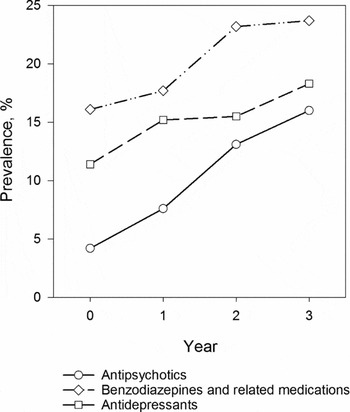
The prevalence of all psychotropic medication classes increased during the follow-up, however, the increase in antidepressant prevalence was not significant (Figure 1). Benzodiazepines and related medications (16% at baseline and 24% at 36 months; p = 0.031) were the most prevalent psychotropic medication class at baseline and during follow-up. Antidepressants (11% at baseline and 18% at 36 months; p = 0.057), and antipsychotics (4% at baseline and 16% at 36 months; p = 0.011) were the second and third prevalent psychotropic medication classes, respectively.
Psychotropic medications use classified by ATC-codes during follow-up (baseline and years 1–3). 95% confidence interval (CI) bars are omitted for the reason of clarity.

The prevalence, dose and indication for specific antipsychotics, benzodiazepines, and related medications, antidepressants, and anti-dementia medications are presented in Appendix Table S1. The most prevalent antipsychotics were risperidone and quetiapine, the most prevalent benzodiazepines and related medications were zopiclone and temazepam, and the most prevalent antidepressants were citalopram and mirtazapine. The annual prevalence of anti-dementia medications ranged from 45% to 46% for donepezil, from 26% to 29% for galantamine, from 7% to 40% for memantine, and from 14% to 20% for rivastigmine (data not shown). The annual prevalences of anticholinesterase and memantine combination therapy were 7%, 16%, 24%, and 40% for the study years 0, 1, 2, and 3, respectively (data not shown).
Association of clinical features with psychotropic medication use
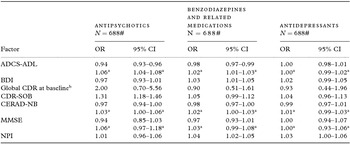
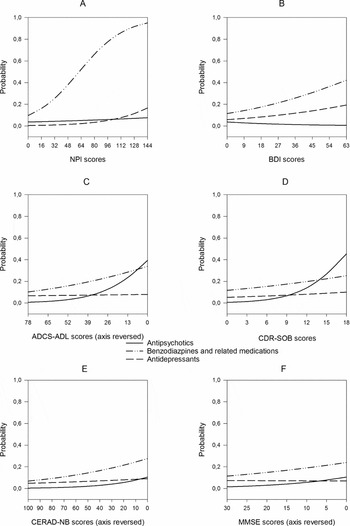
Association between psychotropic medication use and individual clinical measurement scores are presented in Table 2 and Figure 2. There was a strong association between NPI scores and the probability of using benzodiazepines and related medications, but not with classes of antipsychotics and antidepressants. BDI scores were also associated with a higher probability of using benzodiazepines and related medications. Decline of ADCS-ADL scores was associated with a higher probability of using antipsychotics and benzodiazepines and related medications. CDR-SOB scores were associated with a higher probability of using antipsychotics. Global CDR at baseline indicated that the probability of using antipsychotics is less in persons with very mild AD at baseline in comparison to persons with mild AD, but the association was not significant. Decline of CERAD-NB and MMSE scores were not associated with the probability of using any psychotropic medication class. None of the clinical measurement scores were associated with antidepressant use.
Adjusted analyses for studying the associations between individual clinical factors and psychotropics use, three-year follow-up

Data presented as OR = odds ratio and 95% CI = 95% confidence intervals. Odds ratios represent the results of multivariable generalized estimating equation (GEE) models with logit link and binomial distribution functions and unstructured correlation matrix (i.e. repeated measures logistic regression models). Adjusted for age, gender, education time, and number of co-morbidities. # indicates the number of available (clustered) observations in the GEE analysis. In the models, different variables related to dependency were analyzed. Separate analyses were performed for all clinical factors. Global CDR = Global Clinical Dementia Rating, scale 0–3; ADCS-ADL = Alzheimer's Disease Cooperative Study-Activities of Daily Living Inventory, scale 0–78; BDI = Beck Depression Inventory, scale 0–63; CDR-SOB = CDR Sum of Boxes, scale 0–18; CERAD-NB = The Consortium to Establish a Registry for Alzheimer's Disease Neuropsychological Battery total score, scale 0–100; MMSE = Mini-Mental State Examination, scale 0–30; NPI = Neuropsychiatric Inventory, scale 0–144. Global CDR, CDR-SOB, NPI and BDI scores increase as severity of symptoms increases; CERAD-NB, MMSE, and ADCS-ADL scores decrease as severity of symptoms increases.
a Data presented as 1/OR for ADCS-ADL, CERAD-NB, and MMSE for the reason of interpretation.
b CDR 0.5 as a reference category.
(a–f) Probability of using psychotropic medications in relation to clinical measures. (a) NPI = Neuropsychiatric Inventory, scale 0–144. (b) BDI = Beck Depression Inventory, scale 0–63. (c) ADCS-ADL = Alzheimer's Disease Cooperative Study-Activities of Daily Living Inventory, scale 0–78 reversed. (d) CDR-SOB = Clinical Dementia Rating Sum of Boxes, scale 0–18. (e) CERAD = The Consortium to Establish a Registry for Alzheimer's Disease Neuropsychological Battery total score, scale 0–100 reversed. (f) MMSE = Mini-Mental State Examination, scale 0–30 reversed Probabilities represent the results of multivariable generalized estimating equation (GEE) models with logit link and binomial distribution functions and an unstructured correlation matrix (i.e. repeated measures logistic regression models). Adjusted for age, gender, education time, and number of co-morbidities (set as mean values of whole follow-up data: age = 76.8; gender = 1.5; education_years = 7.6; comorbidity_number = 2.4). In the models, different variables related to dependency were analyzed. Separate analyses were performed for all clinical factors. Global CDR, CDR-SOB, NPI, and BDI scores increase as severity of symptoms increases; CERAD-NB, MMSE, and ADCS-ADL scores decrease as severity of symptoms increases.

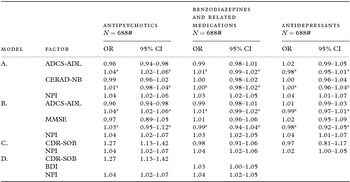
The association between psychotropic medication use and clinical measurements in combinations are presented in Table 3. The odds of using any psychotropic medication class increased from 3% to 4% according to each one-point increase in NPI scores. The association with antidepressants was significant in models that included ADCS-ADL and CERAD-NB or MMSE. A decline in ADCS-ADL was associated with an increased probability of using antipsychotics only in models that included NPI and CERAD-NB or MMSE. The odds of using antipsychotics was 4% lower for each one point increment of ADCS-ADL scores. CDR-SOB was associated with antipsychotic use only. The odds of using an antipsychotic was 27% higher for each one-point increase in CDR-SOB scores in model that included NPI. CERAD-NB and MMSE were not associated with using any psychotropic medication class in the models that included ADCS-ADL and NPI.
Adjusted multivariate analyses to study the associations between clinical factors in combinations and psychotropics use, three-year follow-up

Data presented as OR = odds ratio and 95% CI = 95% confidence intervals. Odds ratios represent the results of multivariable generalized estimating equation (GEE) models with logit link and binomial distribution functions and unstructured correlation matrix (i.e. repeated measures logistic regression models). Adjusted for age, gender, education time, and number of co-morbidities and clinical measures presented. # indicates the number of available (clustered) observations in the GEE analysis. In the models A, B, and C, different variables related to dependency were analyzed. Separate analyses were needed because of the significant correlation between CDR-SOB and ADCS-ADL, CERAD-NB and MMSE. NPI did not correlate with other clinical variables analyzed. In the model D, clinical variables with p < 0.05 in the backward elimination test were included. ADCS-ADL = Alzheimer's Disease Cooperative Study-Activities of Daily Living Inventory, scale 0–78; BDI = Beck Depression Inventory, scale 0–63; CDR-SOB = CDR Sum of Boxes, scale 0–18; CERAD-NB = The Consortium to Establish a Registry for Alzheimer's Disease Neuropsychological Battery total score, scale 0–100; MMSE = Mini-Mental State Examination, scale 0–30; NPI = Neuropsychiatric Inventory, scale 0–144. CDR-SOB, NPI and BDI scores increase as severity of symptoms increases; CERAD-NB, MMSE, and ADCS-ADL scores decrease as severity of symptoms increases.
a Data presented as 1/OR for ADCS-ADL, CERAD-NB, and MMSE for the reason of interpretation.
Discussion
The main finding was the significant increase in psychotropic medication use in relation to the clinical parameters associated with increasing dependency in AD. These increases are particularly strong in relation to the emergence of NPS, and with disease severity and impairment in ADLs. There was little evidence for an association between psychotropic medication use and cognitive performance over three-year follow-up time.
Prevalence of psychotropic medication use
The increase in prevalence of all classes of psychotropic medications following the diagnosis of AD was consistent with previous studies. A recent Finnish study reported the annual prevalence of any psychotropic in the 12-months following AD diagnosis was 53%, with sedative hypnotics dispensed to 29%, antidepressants dispensed to 28% and antipsychotics dispensed to 20% of those with AD (Taipale et al., Reference Taipale, Koponen, Tanskanen, Tolppanen, Tiihonen and Hartikainen2014). Another Finnish study with a seven-year follow-up reported 34% of persons with AD initiated antipsychotic medication treatment (Koponen et al., Reference Koponen2015). Martinez et al. (Reference Martinez, Jones and Rietbrock2013) reported that, 25% of those with AD in the United Kingdom used an antidepressant and 11% used an antipsychotic at the time of diagnosis, with 32% using antidepressants, and 19% using antipsychotics four years later.
One explanation for the difference in psychotropic medication prevalence compared to our findings is that the previous studies have analyzed annual prevalence using pharmacy claims data or prescription data whereas our study assessed the point prevalence using caregiver-reported medication data. Pharmacy claims data include records of reimbursed medications dispensed to people who live in nursing homes. These people are likely to have advanced stages of AD with a higher prevalence of NPS.
Neuropsychiatric symptoms, NPS
The increasing prevalence of psychotropic medications corresponded with an increasing prevalence of NPS. Each single point increase in NPI scores was associated with a 3% to 4% higher odds of using a psychotropic medication when adjusting for daily functioning, cognition, and disease severity. Similar results for antipsychotic use being associated with more NPS in moderately impaired patients, possibly reflecting the greater need for treatment when behavioral symptoms are present, have been reported by de Oliveira et al. (Reference de Oliveira, Bertolucci, Chen and Smith Mde2014).
Depressive symptoms were not associated with the use of psychotropics when adjusting for NPS. The BDI is a patient rated questionnaire and people with cognitive impairment may have difficultly responding to the items. Also, persons with AD are unaware of symptoms or deficits themselves (anosognosia). We hypothesized that the caregiver-reported NPI was a more valid measure of behavioral symptoms, including depressive symptoms, than the patient-rated BDI.
Daily functioning and disease severity
Antipsychotics have been associated with lower daily functioning (de Oliveira et al., Reference de Oliveira, Bertolucci, Chen and Smith Mde2014). We found impaired daily functioning and disease severity were associated with antipsychotic use. Each one-point decrease in ADCS-ADL scores increased the odds of antipsychotic use by 4%, when adjusting for NPI and CERAD-NB or MMSE. In addition, each one-point increment in CDR-SOB scores increased the odds of antipsychotic use by 27%, when adjusting for NPI. We hypothesized that the association between daily functioning and antipsychotics use may be because specific NPS may have been more pronounced in the advanced stages of AD (Hallikainen et al., Reference Hallikainen2013; de Oliveira et al., Reference de Oliveira, Bertolucci, Chen and Smith Mde2014; Brodaty et al., Reference Brodaty, Connors, Xu, Woodward and Ames2015).
Psychotropic medication use may reflect a failure to identify AD in the prodromal stages. This was the conclusion of Calvó-Perxas et al. (Reference Calvó-Perxas2012) who reported that the time from symptom onset to AD diagnosis was associated with the probability of antipsychotic use. In our study, the odds of using antipsychotics over the three-year follow-up was 100% higher in persons with mild AD at baseline compared to those with very mild AD, although this result was not statistically significant. The apparent association may be because behavioral symptoms were not identified as being NPS of AD in those with mild AD at baseline or because of the earlier intiation of AD medication in those with very mild AD at baseline.
Cognition
In contrast to previous studies, we found no significant association between cognitive performance and psychotropic medication use. Earlier studies have shown that psychotropic medications, particularly antipsychotics, impair cognition, and increase the risk of cognitive decline in persons with AD. Antipsychotic use in persons with AD or other dementias is associated with a 1.0 to 2.5 point impairment in MMSE scores over eight to 36 weeks compared to placebo (Schneider et al., Reference Schneider, Dagerman and Insel2006; Vigen et al., Reference Vigen2011). Psychotropic medications may increase the risk of cognitive decline (Ellul et al., Reference Ellul2007), and worsen dementia severity (CDR-SOB) and NPI scores (Rosenberg et al., Reference Rosenberg2012). Contrasting results have been reported by Rocca et al. (Reference Rocca, Marino, Montemagni, Perrone and Bogetto2007) who observed that treatment with psychotropic medications for six months maintained cognition and improved NPS. Although evidence is mixed, our results are plausible, since NPS are considered to be independent of cognitive decline (Hallikainen et al., Reference Hallikainen2012; Dillon et al., Reference Dillon, Serrano, Castro, Leguizamón, Heisecke and Taragano2013). A strength of our study was that we applied the CERAD-NB instrument in conjunction with MMSE. In previous studies, MMSE has been the principal instrument and MMSE has limited capacity to measure overall cognitive performance and the progression of AD when used for period of less than three years (Clark et al., Reference Clark1999).
Strengths and limitations
The strength of this study is that we were able to examine medication use in relation to clinical data in a longitudinal setting. Earlier studies have used a limited number of clinical measurements, have been of short duration, and have applied MMSE with only limited capacity to measure the progression of AD. The findings of this study are, however, restricted to home-dwelling persons with family caregivers and with very mild or mild AD at baseline. Thus, the findings cannot be generalized to institutionalized persons with more advanced AD. While we have reported the mean doses of each medication in our supplementary materials, we did not consider medication dose in our GEE models. It was not possible to conduct statistical analyses for use of specific antipsychotics, benzodiazepines, and related medications or antidepressants due to the small sample size of each active ingredient. All participants were prescribed anti-dementia medications in accordance with Finnish clinical practice guidelines (Finnish Medical Society Duodecim, 2010). This may limit the generalizability to countries with different prescribing practices. A study from the USA reported 20% of persons with probable AD at baseline were not using any anti-dementia medications during a six-year follow-up (Zhu et al., Reference Zhu2010). It has been shown that anti-dementia medication is associated with less NPS (de Oliveira et al., Reference de Oliveira, Bertolucci, Chen and Smith Mde2014), and that persons administered anti-dementia medication receive less antipsychotics and benzodiazepines than persons not administered anti-dementia medication (OR 0.55 [95% CI 0.38–0.79] and OR 0.62 [95% CI 0.46–0.84], respectively) (Fereshtehnejad et al., Reference Fereshtehnejad, Johnell and Eriksdotter2014). The authors concluded that anti-dementia medication may reduce prescribing of psychotropic medications in persons with AD. The pattern of anti-dementia medication use by the Alsova study sample are presented previously (Törmälehto et al., Reference Törmälehto2015).
Conflicts of interest
S. Törmälehto has been a paid employee of Medfiles Ltd, and is a founder of MediSoili Oy. These companies provide health economic and market access services to companies in the pharmaceutical, food, and medical device industry, and companies and other organizations active in public and private healthcare. J. Martikainen is a senior partner of ESiOR Ltd, which carries out health economic and outcome research studies for pharmaceutical companies, food industry companies and hospitals. All other authors declare that they have no conflicts of interest.
The ALSOVA study was supported by grants from the Yrjö-Jahnsson Foundation, Hospital Neuron; and the Social Insurance Institute of Finland (KELA). This part of the project was also supported by Kuopio University Hospital (EVO-grant 5220/5772728) and the University of Eastern Finland Co-Financed Research Project, supported by Novartis Pharma Ag. No author has received direct funding from any of the sponsors. ST has received a grant from the Outpatients Care Research Foundation (Avohoidon tutkimussäätiö rs). IH has received a grant from the Finnish Cultural Foundation. Sponsors had no role in the study design; in the collection, analysis, and interpretation of the data; in the writing of the report; and in the decision to submit the manuscript for publication.
Description of authors’ roles
All authors were involved in conception and designing the study. S. Törmälehto undertook the statistical analyses, and wrote the first draft of the manuscript. All authors contributed to manuscript drafting and have approved the final manuscript.
Acknowledgments
We wish to thank Tarja Välimäki PhD, RN and study nurse Helena Mäkelä RN for their effort to coordinate and to carry out participant follow-ups and in collecting the data; we also thank research assistant Markku Kalinen RN and project researcher Lotta Salo, MHS MSc (healthcare) for assisting in extracting the data from the original files to create analysis data and administrative assistant Mari Tikkanen for her invaluable help. Mrs Mäkelä, Mr Kalinen, and Mrs Salo were compensated from grant funds for their time. We thank statistician Marja-Leena Lamidi, biostatistician Tuomas Selander, and researcher Saku Väätäinen MSc (pharm) for their guidance in statistical analyses. We wish to thank researcher Katri Aaltonen MSc (pharm) for her guidance in handling medication data, pharmacy student Johanna Ryhänen for assisting in analyzing the medication data, and research assistant Paula Räsänen for her invaluable help. We thank Mark Phillips BA who kindly assisted with the language revision, and Choon Ean Ooi MClinPharm for proof reading the manuscript. Finally, we thank the Alzheimer Society of Finland for its support and the patients and their caregivers for their time and effort.
Supplementary Material
To view supplementary material for this article, please visit https://doi.org/10.1017/S1041610217001090