Introduction
Social service provision in China is hampered by the underdevelopment of the non-government sector. The Chinese government is following international trends and promoting the development of non-government organisations (NGOs) in a mixed social welfare system. A function of this facilitation is to improve the supply of social services to address unmet demand that government organisations do not have the capacity to fulfil. However, the limitations to increasing the supply of good quality support services by registered NGOs have not been examined in the Chinese context. We use Mattei's (Reference Mattei2009) managerial and democratic accountability framework to examine empirical data about the relationship between the maturation of the NGO disability services sector in Beijing and barriers to improving the type, quantity and quality of their social services.
The Chinese policy context is one of high unmet demand for disability support, and of changing relationships between government and non-government sectors (Li, Reference Li2009a; Li, Reference Li2009b; Fisher and Li, Reference Fisher and Li2008). Disability support is a relevant example for policy questions about NGOs that provide social support because the disability sector is relatively self-contained, which lends it well to examining accountability of NGOs in isolation from other social services. From this disability example, the article generalises the policy implications for NGOs in other social support sectors.
The article discusses the policy context and concepts about social organisations used in the study. It proposes that adapting Mattei's accountability framework to analyse NGOs that provide social support enables us to understand the internal and external barriers to service provision. The article describes the research methods and presents the findings about the development of NGOs and the barriers they have experienced to increasing the supply of disability support. The discussion draws conclusions for developments in policy and theorisation about the accountability of the non-government sector to facilitate the development of NGOs capable of supplying good quality social services in China.
Policy context of registered non-government organisations
As a background to the research, this section introduces multidimensional accountability theory and the policy context relevant to registered NGOs in China and contracted social services. It defines registered NGOs, describes their regulation and summarises the problems in the sector identified in other research.
Mattei's (Reference Mattei2009, Reference Mattei2007) multidimensional accountability framework, combines democratic and managerial concepts of accountability in relation to public policy. Extending the theory to NGOs providing social services that are otherwise provided by government, democratic accountability theory emphasises external NGO accountability to social service users, the public and the state; and managerial theory emphasises NGO accountability for the service outcomes and internal processes of the organisation. In relation to social service provision, these multidimensional accountabilities include the management of financial, professional and social outcomes. We propose that applying this framework to NGO activities can inform understanding about current limitations to democratic and managerial accountability for the provision of quality social services.
As part of the changing social welfare system in China, the quantity and proportion of social services provided by NGOs are increasing. The reasons for this change include social welfare system reform away from reliance on employer-provided support; increased total supply of social support by government and other sources; changing demands from the public for social support to meet their needs; and citizens forming new social organisations to provide these services. Some of these reasons overlap with similar historical trends internationally, where governments increasingly contract out social services (Schmid, Reference Schmid2004). Others coincide with broader democratic processes in China, with which the formation and government encouragement of NGOs are consistent. Currently these reforms include rationalising structural change to bureaucratic systems, consulting with elite groups and increasing opportunities for the public to influence and participate in local level decision making (He and Thogersen, Reference He and Thogersen2010).
Chinese and international researchers have categorised and described the breadth of social organisations in China (for example, Wang and Liu, Reference Wang and Liu2009; Howell, Reference Howell2007; Lu, Reference Lu2008; Tang and Zhan, Reference Tang and Zhan2008). The number of social organisations providing social support services in China grew very slowly until the 1990s. Up to that time, the government preferred that social support be provided through workplaces or the government, and the NGO sector remained underdeveloped (Howell, Reference Howell2007). During the economic reforms of the 1990s the role of government changed and organisations supporting and representing the interests of vulnerable groups began to develop (Ru and Ortolano, Reference Ru and Ortolano2009; Saich, Reference Saich2000; Wong and Tang, Reference Wong and Tang2006). Wang and Liu (Reference Wang and Liu2009) attribute the reasons for the change in the importance of NGOs since the 1980s as due to growth in the public sphere and economic reforms. They summarise the current functions of NGOs as mobilising resources, providing public services, contributing to social governance and participating in policy advocacy.
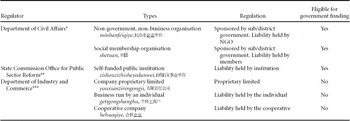
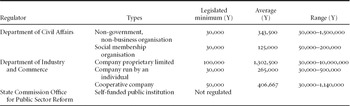
The NGO regulations date from 1989, amended in 1998 (Edele, Reference Edele2005). Currently, registered service provider NGOs are regulated by three government departments (Table 1).
Types of registered NGOs providing support services in China, 2007

Notes: Not including unregulated non-government groups such as informal self-help groups or government organisations.
* Also regulates foundations that do not provide support services relevant to this research.
** Also regulates fully and partly funded institutions, functioning as government agencies.
*** No non-profit company regulation option is available, e.g. company limited by guarantee.
The first two departments, the NGO Administrative Bureau of the Department of Civil AffairsFootnote 1 and the State Commission Office for Public Sector Reform,Footnote 2 regulate social organisations, which since 1989 require sponsorship by a government department before they can become registered (Howell, Reference Howell2007). Wang and Liu (Reference Wang and Liu2009) describe them as private non-enterprise organisations under a dual management system. Dual management refers to the compulsory government department sponsorship within the NGO governance structure.
NGOs registered by the Department Civil Affairs are required to have the sponsorship from a district or subdistrict government organisation, such as Disabled Persons Federation (DPF), Department of Education or Department of Health. The two relevant NGO types for this article are non-government and non-business organisations, and social membership organisations. These NGOs can receive government funding for their support services, including project funding, social assistance to provide services to people without capacity to pay the fee, operational funding to support NGO functions and personal allowances for rehabilitation to spend on approved NGO or government services, such as community medical support.
The third regulator is the Department of Industry and Commerce. Because some organisations are unable to find a local government organisation prepared to sponsor their registration, they have no other choice but to incorporate as a company if they wish to be a registered organisation. While they describe themselves as NGOs, they have no accountability mechanism that requires a non-profit status. These company types are a proprietary limited company, a company run by an individual and a cooperative company. These organisations cannot receive Chinese government funding, although this is beginning to change and so they are included in this study, as relevant to NGO accountability of social services.Footnote 3 Their company registration is merely an artefact of the restrictive dual management NGO regulations described above. No option for a non-profit company status, such as a company limited by guarantee, is available.
Registered NGOs probably number less than 500,000 and the total number of social organisations is more than ten times that (Wang and Liu, Reference Wang and Liu2009). In recent years, registered NGOs have increased by 10 per cent per year (Ministry of Civil Affairs and CDPF speeches 2008–09). The Ministry of Civil Affairs (2008) reports that, to the end of 2008, they had registered 182,000 non-government, non-business NGOs and 230,000 social membership NGOs (Table 1). Seven per cent of this first type of NGO were social welfare and social philanthropy organisations, including disability service NGOs, the subject of this article.
Social support provided by NGOs in China tends to be funded by client fees and donations. Unlike Hong Kong, where most social services are funded by government and provided by NGOs (Ip et al., Reference Ip, Li and Yau2003), China does not have a tradition of contracted social services whereby government funds and is responsible for the social support system and contracts out some of the service provision to other organisations. Huque (Reference Huque2009) summarises the goals of contracting out of government responsibilities for social support as including increased efficiency and size of the market for services, and promoting competition (through positive effects on cost, productivity, choice and quality). He cautions that the risks of contracting out include increased cost to government and problems arising from the government's inability to manage contracts. It is in this context of a low but growing base of contracted social support that we explore the accountability for social support supplied by registered NGOs in China.
Previous research has identified the problems faced by Chinese NGOs as limited funding; poor government relations and support, such as the dual management restrictions, which prevent registration if no government department is willing to sponsor the organisation; limited governance, management and professional capacity; and negative public perception (Wang and Liu, Reference Wang and Liu2009; Lau, Reference Lau2009; Hasmath and Hsu, Reference Hasmath and Hsu2008; Cooper, Reference Cooper2006; Edele, Reference Edele2005). This article builds on that literature by framing the problems in terms of multidimensional accountability to analyse the barriers experienced by the organisations that call themselves NGOs, provide social services to the public and are legally incorporated (referred to as registered NGOs).
The reason for restricting our analysis to registered NGOs is that it is with this group of NGOs that government agencies are beginning to formalise funding and contract service relationships. Many types of social organisations are not relevant to NGOs that provide social services. We do not include unincorporated, unregistered or unregulated non-government groups, such as informal self-help groups. We also do not include government organisations, such as the DPF and its disability specific associations, which are incorporated as part of government. Other exclusions include charitable organisations, which is not a registration status in China; and foreign and foreign religious NGOs, which have registration resolved on a case by case basis, generally incorporating as a company or not incorporating at all (Edele, Reference Edele2005).
Disability social services and NGOs
This article concerns specialist services that support to people with disabilities who live in the community. Most disability support is provided by government (Fisher and Li, Reference Fisher and Li2008). In Beijing, examples of such support include education, institutional care, rehabilitation, training, community centres and social welfare centres. The extent to which some of these service types are available in China is very limited in most locations.
In 2006, nearly one million people with disabilities lived in Beijing (999,000 or 6.49 per cent of Beijing population) (BDPF, 2008a).Footnote 4 Chinese DPF is the central semi-government agency responsible for disability policy, nominally an NGO. Provincial and local DPF agencies implement the policy. The Beijing DPF, district and local DPF are the relevant semi-government levels in this research. Kohrman (Reference Kohrman2005) discusses the origin and role of the DPF as a semi-government organisation and how this limits its capacity to represent the interests of people with disabilities.
The first Chinese disability NGOs were formed in the mid 1980s. They were grassroots, self-help social organisations that eventually contributed to the formation of the CDPF in 1988.Footnote 5 Guangzhou Zhiling School, established in 1985, was probably the first Chinese disability service organisation, and its related organisation, Huiling, is now the most widespread disability service NGO, providing educational services for people with intellectual disabilities (Pearson et al., Reference Pearson, Wong and Pierini2002; Pierini et al., Reference Pierini, Pearson and Wong2001). Most disability service organisations were established after 2000 (Li, Reference Li2007). The NGOs provided services to supplement and complement government and private services. However, most people with disabilities still do not receive the support they need (Wang, Reference Wang2008; Fisher et al., Reference Fisher, Shang, Xie, Carrillo and Duckett2011b; Shang et al., Reference Shang, Fisher and Xie2011).
Few studies about disability non-government service organisations are available. Early literature about specific services focused on the service outcomes for clients (Pearson et al., Reference Pearson, Wong and Pierini2002; Pierini et al., Reference Pierini, Pearson and Wong2001). Recent disability NGO survey research commissioned by national and local DPF concern services provided in Beijing, Guangdong and to deaf children and people with autism (Hu and Li, Reference Hu and Li2010; Tang and Li, Reference Tang and Li2010; Li, Reference Li2009b). Their research describes the extent of service provision. The recent research identified problems such as inconsistent government policy implementation, limited funding opportunities and low availability of qualified workers (BDPF investigation reports; BDPF 2003a, 2003b, 2005).Footnote 6 The research instruments for our research are based on these findings. Previous research has been imprecise about NGO registration status or has been based on single case studies. No previous research has been conducted about the accountability of registered disability service NGOs in Beijing. In its absence, little evidence is available to inform research, policy and practice, in a context where the government is increasing funding to supply disability support services from the NGO sector.
Research method
The study asks the research question whether multidimensional accountability theory explains the barriers to the supply of good quality disability support services from NGOs in Beijing. We applied mixed methods of policy document analysis, questionnaires and interviews to analyse accountability processes and barriers experienced by NGOs providing disability support services in Beijing in 2007.
Previous research about disability social services and NGOs described above identified preliminary evidence about difficulties experienced by disability NGOs. In this context, Beijing Disabled Persons Federation (BDPF) commissioned research from the Institute of Sociology, Chinese Academy of Social Sciences to inform policy development about supporting NGOs. Descriptive results of a profile of registered NGOs were published in Chinese (Li, Reference Li2007; Yang, Reference Yang2008). Two of the researchers from that project re-analysed some of the BDPF-commissioned research data for this article by applying the accountability framework to analyse the barriers NGOs face when providing disability support services.
The research instruments were a questionnaire and case study interviews. The questionnaire included: basic information about organisations (history of establishment, supervising governmental agency and registration deposit); staff information (founder, staff, qualifications, training, experience and expertise for rehabilitation and special education); financial conditions (annual income and expenditure, staff monthly income, service fees, capital and debt); internal governance (board, regulations and policies); service beneficiaries (history and current total services, clients and characteristics); and general questions (future, needs and challenges). The case study interviews explored the same content in greater detail, using semi-structured questions and observation.
Initially BDPF identified 100 disability NGOs. However, only sixty-eight NGOs were relevant to the research (including one that has now ceased operation due to bankruptcy). The other thirty-two are government organisations or unregistered groups. Seven NGOs refused to participate, leaving sixty-one NGOs, to which we distributed a questionnaire, with the assistance of BDPF. Forty NGOs returned a questionnaire but two were incomplete (62 per cent valid response rate). Where necessary, we contacted the thirty-eight NGOs by telephone to clarify and complete missing data.
From the valid returns, we selected thirteen representative NGOs for case studies. These were selected according to the disability category, age of the clients, nature of the organisation and location. Researchers conducted semi-structured interviews at the NGO with the people who established the NGO. This also provided an opportunity to observe the operation of the NGO and speak to people with disabilities or their families if they were at the NGO when the interview was conducted. Observation data from other disability support research by the authors in Beijing are also included where relevant to the research question.
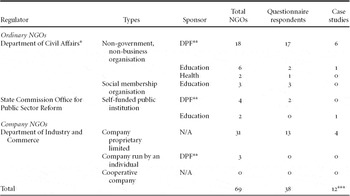
All results presented in the article relate to the thirty-eight respondents and case studies (Table 2). For the purpose of comparison, results are presented with respect to NGOs regulated by Civil Affairs and the State Commission (Ordinary NGOs) and NGOs regulated by Industry and Commerce (Company NGOs). We divide them this way because different financial accountability regulations apply to each of these categories of NGOs, which are likely to affect the multidimensional accountability analysis.Footnote 7
Beijing disability registered NGO respondents, 2007

Notes: *Department at Municipal government level or Bureau at District government level.
** Disabled Persons Federation.
*** Including one NGO insolvent at the start of the research.
The response rate was lowest for Company NGOs (42 per cent). They tend to be smaller than Ordinary NGOs. Non-respondents were probably less likely to trust the research process or to be operationally transparent. We also suspect that non-respondents are less structured. These differences would tend to accentuate the poor accountability identified in the research.
The findings are specific to the location because the policy context in Beijing is different to many other parts of China. Beijing is the capital, a large metropolitan area that includes rural suburbs, and has a high public funding base. Future research could include comparison with other parts of China, including similar large cities such as Shanghai, Guangzhou or Tianjin, which have a reputation for developing social services; Hong Kong; and also small metropolitan and rural communities. Such research would further inform the research question, particularly about directions of change and predictions for trends in NGO and government provision and funding.
A further qualification to the findings arises because most NGOs in the sample were established after 2000 (79 per cent). Indeed, 37 per cent were established in the year before the survey. The findings cannot be conclusive about the longer-term stability and quality of the NGOs.
Our research methods take a disability rights perspective when analysing the accountability of the supply and quality of disability support services by registered NGOs. China was one of the first countries to ratify the UN Convention on the Rights of Persons with Disabilities in 2008. The Convention commits the government to enabling the equal participation of people with disabilities in Chinese society. Specifically, this informs the concept of good quality support (Fisher et al., Reference Fisher, Shang and Blaxland2011a; Fisher et al., Reference Fisher, Parker and Purcal2009b).
Findings about Beijing disability NGO accountability
The next part of the article presents the findings about the profile of the disability NGOs, internal accountability limitations relating to their capacity and external accountability limitations concerning relations with government.
Financial management
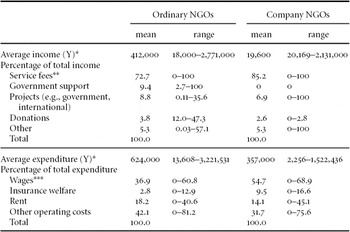
The findings include three aspects of financial accountability: annual income and expenditure, profit and loss and registration capital. The financial data relates to their position in 2006 (US$1 = 7Y). In 2006, the average income for Ordinary NGOs was twenty times that of Company NGOs (Table 3). The main reason for the income difference between the two NGO types was the size of the organisations. There were more small Company NGOs, although both NGO types included large NGOs with incomes over 2,000,000Y per year.
Income and expenditure of disability NGOs, 2006

Notes: * US$1 = 7Y.
** Includes income from selling products or services.
*** Does not include salary of the founder.
Most NGO income was from service fees and some organisations of each type relied only on this income source. Only Ordinary NGOs are eligible for government support and less than 10 per cent of their income was in this form, which is consistent with Wang and Liu's (Reference Wang and Liu2009) national research. One Ordinary NGO relied entirely on government support. Income from projects funded by government and international NGOs was also less than 10 per cent, but one Company NGO relied entirely on this income source. Donations were almost negligible (less than 5 per cent), although one Ordinary NGO relied on donations for almost half its income. This average for donations is less than the national average (10–15 per cent) (Wang and Liu, Reference Wang and Liu2009).
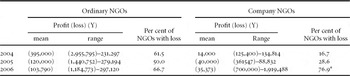
In 2006, the average expenditure was 624,000Y for Ordinary NGOs and 357,000Y for Company NGOs (Table 3). Expenditure varied enormously from less than 2,500Y to over three million per year. One-third to one-half of expenditure was wages. The other operating costs included the large salary for the person who founded the organisation.Footnote 8 The case studies showed that in-kind support such as rent-free premises from the government reduced the costs for some organisations (three of the thirteen case studies). In contrast, one organisation paid 850,000Y in annual rent, and at least one NGO of each type spent over 40 per cent of expenditure on rent. In the previous three years, at least half of Ordinary NGOs experienced a loss (Table 4).
Profit and loss of disability NGOs, 2004–06

Notes: * Higher percentage because many new organisations.
The case study NGO founders reported that they covered losses with their own money or money given by their friends, without borrowing from banks. NGO regulations do not include requirements about profits and losses of Ordinary NGOs. The regulations only stipulate that during operation an NGO should not make a profit and that, if the owner chooses to close, it should transfer its resources to another non-profit organisation. In contrast, corporation law requires that Company NGOs should cease trading after three years of losses, although no NGO in this study reported that they have considered closing down. In one case study, the Ordinary NGO ceased operating because of ongoing losses. It operated in a remote suburb of Beijing providing support for people with intellectual disability. It was too geographically isolated and did not have qualified staff to provide good quality services.
NGOs are required to maintain a minimum cash reserve of at least 30,000–100,000Y, depending on the incorporation type (referred to as registration capital; Table 5). Most NGOs reported that they have only the minimum required capital.
Registration capital by NGO type, 2006

Human resource management
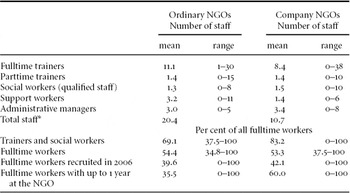
The second aspect of the NGO profile is their human resources (Table 6). The proportion of trainers and social workers compared to other staff is higher in Company NGOs (83.2 per cent) than in Ordinary NGOs (69.1 per cent). Over one-third of staff were recruited in the last year, which reflects the recent incorporation of one-third of the NGOs, staff leaving the organisation and growth within the organisations. Company NGOs had almost double the proportion of staff who had been with the organisation less than one year.
Human resources of disability NGOs, 2006

Note: * Does not equal total staff types above because total staff was asked as a separate question.
Service types
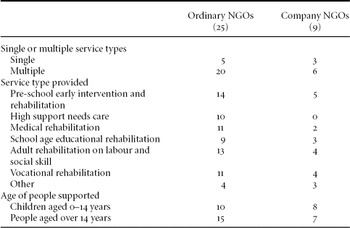
The third aspect of the NGO profile is the types of services they provide in terms of the type of support, the type of impairments and the age groups of the people supported (Table 7). No information about outcomes for service users was available.
Service types of disability NGOs, 2006

Notes: Impairment types include learning, intellectual, physical and sensory.
Company NGOs are more specialised – each NGO provides fewer service types to only one impairment group. It seems that Company NGOs have a more specific service definition. This could be one explanation why they are in a better financial position than Ordinary NGOs. Without the backing of a sponsoring agency and no access to rent-free premises, they may be more thorough in their strategic and financial decision making.
Few of the services provide individualised support. The NGOs provide similar services to all their clients. Few professional specialists are available in most of the NGOs, whether Company or Ordinary NGOs. The description of the service types shows that NGOs attempt to fill gaps in support provided by government. Examples include education and training for teenage young people, where government services tend to be for children under fourteen or adults. NGOs also provide education and training for children with autism; no government education was available for these children.
Discussion of NGO multidimensional accountability
The quantitative data presented above support information about a number of limitations to effective accountability of registered NGOs that are discussed below in relation to the interview data. The two sets of accountabilities are the internal managerial accountability and the external democratic accountability of the NGO.
NGO internal managerial accountability
The internal limitations to accountability concern the organisational capacity of the NGO for effective governance, financial management, staffing and knowledge about good practice.
The first internal managerial limitation relates to NGOs' organisational capacity for effective governance. Despite the regulations associated with NGO registration, almost none of the NGOs, whether Ordinary or Company, reported that they function within the required governance structure. Most Ordinary NGOs do not have an independent voluntary board that meets regularly to make strategic decisions as required by the regulation. Generally, this can be explained by the historical formation of the NGOs. Many NGOs were formed by a founder with a passion to solve a particular support service problem. Generally, the founder is employed in the organisation and also sits on the board. The only board with an independent governance structure is an old NGO founded by an academic who was employed in the Chinese Academy of Sciences. Even in that organisation, a paid staff member is also on the board. These governance arrangements compromise the independence of the board and the operation of the NGOs financially benefit the board members. This finding is consistent with the results in Hazmath and Hsu (Reference Hasmath and Hsu2008).
Most boards either never meet or only meet a couple of times a year. In most NGOs, the board members do not receive full financial reports, or make binding decisions about financial planning. These arrangements imply that the independent board does not engage in responsible financial management processes and the board members do not consider themselves accountable for the financial viability of the organisation. None of the boards had consumer representatives, which also limits their democratic accountability.
The impact of these governance arrangements is that the service users, funders and staff are potentially vulnerable to conflicts of interest and poor financial and strategic management. They are also less likely to be responsive to consumer needs and preferences. In most cases, the mechanisms to protect against these risks are absent and in the few cases with formal structures to ensure these accountabilities, they are not fully implemented.
The second internal managerial accountability limitation concerns the financial capacity of NGOs, in particular tight funding and loose financial management. Most income is from client fees, rather than government funding or donations (Table 3), which restricts the quantity and quality of support. For example, the NGOs managers reported that they cannot afford to provide sufficient support or employ qualified staff. We observed that the physical conditions at the NGOs are often very basic.
A direct impact of relying on client fees for the bulk of income is that it excludes clients whose families cannot afford to pay for the support. Some NGOs make arrangements to include a small number of clients who cannot afford to pay all or any of the fees, for example by subsiding through other client fee income or attracting funds specific to the person from the government or a donor.
Limited financial management capacity is another problem, reflected in undeveloped financial management systems, inexperienced and unqualified financial management staff and incomplete financial reporting. For example, some organisations had no record of income or expenditure, no independent accountant or auditor or did not require countersigning of cheques.
The third managerial accountability limitation is the low qualifications of the staff (Table 6). Social workers are usually the only qualified staff. As discussed above, the primary restriction on employing qualified staff is the lack of sufficient income. Trainers are not usually qualified in most of the NGOs surveyed, because the funds available for wages are too low to attract these staff. Few of the organisations have staff with university qualifications, such as qualified teachers and social workers. In addition, the support service sector is small and new. Few professional social workers are available. Although university social work training has been available for the last twenty years, few academics and graduates have work experience in a relevant field. Professional teachers, social workers and other university-qualified staff prefer to work in other professions because of the work conditions. For example a social work graduate would earn one-third to one-half the amount as an NGO social worker compared to working for a governmental agency or company. The impact of lack of qualified staff is to compromise quality of support. Few staff have any training, experience or receive supervision relevant to providing good quality disability support.
The final internal accountability limitation is poor knowledge about good practice in disability support. Knowledge about good practice is limited in at least two respects: practices relevant to good quality support and good quality management. While most NGOs attempt to provide the best quality support and management that they can, many of them are unaware of alternative ways of improving their practices. For example, some of them are unfamiliar with disability practices, such as individualised services, social participation, inclusive and integrated models of support, community-based support and family support to assist people to live within their community. A related external accountability limitation is that NGOs have few means to call on government support for information and training, because they do not have professional or industry associations; written information, training or advice from government agencies about quality standards, models of support and accountability requirements; and only ad hoc contact with researchers or international organisations to whom questions could be addressed.
The impact of this poor knowledge about good practice is that many NGOs do not have information to improve their services in ways that do not necessarily incur additional cost, for example by changing financial record keeping, including people with disabilities in management structures or supporting people in their home and community rather than in congregate care.
NGO external democratic accountability
The discussion above of limitations to internal managerial accountability included implications for democratic accountability. The governance structures do not include consumer participation and the professional development systems do not draw on good practice knowledge to improve responsive quality service provision. In addition, the external democratic accountability of registered NGOs is limited by the quality of their relationships with government, including how NGOs are regulated, funded, supported with information and training; and how the government addresses negative social attitudes towards people with disabilities and the NGOs that support them. These external limitations inhibit the effective functioning of the NGOs and are not independent of the internal limitations.
The first external accountability limitation is the NGO interface with government policy regulation and implementation. The NGOs were unclear about the regulatory requirements relevant to their registration and accountability. The first problem they face is finding a government agency to sponsor their incorporation if they seek Ordinary NGO status. As a last resort, some NGOs have registered as Company NGOs instead, when they have been unable to find a sponsor. While they claim they are NGOs, BDPF treats them as commercial companies.
Once registered, NGOs reported no expectation that they are required to adhere strictly to the legal requirements. For example, no sanctions have been applied, despite most Ordinary NGOs in the survey operating at a loss and board members not being independent or meeting regularly. BDPF has monitored some Ordinary NGOs by conducting annual monitoring since 2006. The monitoring does not include in-depth financial monitoring or the submission of written financial reports. If the monitoring activities identify poor quality support, BDPF may not allocate funding to the NGO in the following financial year. Most NGO disability support is not a government contracted service.
These restrictions on NGO relationships with government have a negative impact on democratic accountability. The first negative impact is inequitable access to disability support services. Only Ordinary NGOs can receive regular government funding for support (except project funding). Yet if an organisation wants to register but cannot find a government sponsor, the dual management NGO regulations force it to register as a Company NGO, which precludes them from receiving most government funding. Even the Ordinary NGOs receive only a small proportion of funding from government. The impact of low government funding is that clients without the capacity to pay are excluded from NGO support. Many types of NGO disability support are not available from government agencies, so the implication is that poor clients receive no formal support. Estimates of unmet demand and capacity to pay are unavailable.
The second negative impact of NGO and government relations on democratic accountability is accountability to the public for public expenditure. The findings show that government does not have adequate mechanisms to enforce financial accountability for government funding.
The final external limitation to democratic accountability is an indirect responsibility for changing the public's social attitudes. Negative public perceptions about disability and disability NGOs inhibit their greater involvement with community members. For example, a mental health facility reported that it struggles to gain any donations because companies and individuals are fearful and ignorant about mental illness. Another example is that an NGO founder started an inclusive kindergarten because government kindergartens are not required to accept children with disabilities and so they are excluded from education.
This limitation to democratic accountability concerns the accountability of NGOs and the accountability of the government agencies with which the NGOs interact. Equal access for people with disabilities to NGO or government services, such as education, training and employment support, remains unavailable. In addition, education of the general population about the experience of disability and disability rights is a government responsibility that cannot rely on the activities of unfunded NGOs. It is on these points that the contrast in expectations about the democratic accountability of NGOs and government agencies that might otherwise provide these social services is most stark, particularly if NGO social services continue to operate without government funding support.
The formation of the NGOs is helping to change negative attitudes towards individual people with disabilities by facilitating their access to integrated participation such as education and employment with the assistance of the NGO support services. However, the larger problem remains that general social attitudes are exclusionary. Changing public attitudes is arguably a government policy responsibility, but it also a responsibility that NGOs attempt to address, at least with the people for whom they provide support services.
Conclusion
These findings about the limitations to accountability of disability NGOs for their supply of good quality support services have implications for government policy about NGOs. The findings show that most NGOs have limited internal capacity to increase disability support because they do not have the management systems, resources or information to improve their operations. Equally, they are hampered by external limitations that affect their democratic accountability, including unclear and unenforced government regulations, limited government financial support, few opportunities or structures to share information from government or other NGOs and limited government investment in familiarising the public about disability. The impact of these barriers is to compromise the quality of disability support provided and accountability for the way the support is managed.
The findings suggest some possible solutions to these barriers to improve accountability for support services provided by NGOs. If the government intends to expand government funding to NGOs to increase the supply of support services, it will need to address each of the external accountability limitations identified in the research. An example includes supporting the formation of professional or industry groups so that NGO managers and staff have collective organisations in which to learn from each other, design common standards of support, management, training and accountability mechanisms.
Another direction for change to address the barriers to improved support is to consider the level and methods of allocating government funding and resources to NGOs. Allocation methods include capital and operational funding; operational subsidies, such as in-kind support and rent free premises, and access to subsidised utilities similar to that of government providers; individual funding depending on support needs or financial means; and project funding. Increased funding requires greater financial accountability from NGOs. The findings show that, in general, neither the current government monitoring mechanisms nor the NGOs' own financial management capacities are sufficiently developed to support that accountability. Investment in information, training, advice and monitoring are required to make that transformation.
In Beijing, the formation of social service NGOs is still developing. The number of NGOs is small and the relationship with government is evolving. However, already the Chinese government is beginning to rely on NGO service provision in some service areas, such as support for people with psychiatric disability and children with autism. Despite the barriers identified in the research, the number of registered disability NGOs is growing rapidly. This makes it urgent that government increases its support of NGOs, so that the quality of their support services and accountability can be ensured. If changes are not introduced soon, the government risks the closure of these first NGOs from financial and management instability and staff turnover. In the longer term, it also risks the establishment of a larger number of NGOs with poor quality support services and accountability systems – a situation which may be harder to remedy in the future.
Acknowledgements
Thank you to the Institute of Sociology, Chinese Academy of Social Sciences (CASS), YANG Tuan (project applicant), Research team members: LI Jing (project manager), JIN Jingping, FAN Lei, WANG Lei, WANG Huang, WU Jing from CASS and Peking University; NGO research participants; SHANG Xiaoyuan and Ryan Gleeson, University of New South Wales; colleagues and reviewers for comments on the article. Beijing Disabled Persons Federation funded the research.