Introduction
Host plant choice profoundly shapes the evolution of phytophagous insect taxa. Indeed, comparisons of plant and insect phylogenies suggest that the diversification of vascular plants played a key role in the unprecedented diversification that resulted in insects, most of which are phytophagous, being by far the most species-rich order of multicellular organisms nowadays (Mitter et al., Reference Mitter, Farrell and Wirgman1988; Ward et al., Reference Ward, Hackshaw and Clarke2003). Most phytophagous insects feed on only one or a small number of plant species; and many apparently polyphagous taxa have, upon closer examination, been found to be divided into host races or sibling species, i.e. into sympatric, partially interfertile but genetically differentiated taxa that use different host plants (Drès & Mallet, Reference Drès and Mallet2002). The fact that such taxa might represent different steps of ecological and sympatric speciation (Schluter, Reference Schluter2001; Via, Reference Via2001; Rundle & Nosil, Reference Rundle and Nosil2005) has fostered interest for the mechanisms that initiate, maintain or enhance their genetic differentiation (Funk et al., Reference Funk, Filchak and Feder2002).
Host preference plays a central role in such differentiation by being or becoming associated with traits involved in host performance and/or in assortative mating (Bush, Reference Bush1975, Reference Bush1994; Berlocher & Feder, Reference Berlocher and Feder2002; Drès & Mallet, Reference Drès and Mallet2002; Rundle & Nosil, Reference Rundle and Nosil2005). Association with host performance traits (i.e. traits involved in the ability to survive, grow and mature on a given plant species) favours divergent selection because it ensures that offspring of groups that have undergone different selection pressures are in turn exposed to different selection pressures similar to those experienced by their respective parents. This enables natural selection to steadily act over successive generations, on a consistent set of traits contributing to host adaptation. In addition, host preference can be, or become, associated with the second major ingredient of ecological speciation: reproductive isolation. Such isolation can be the ‘by-product’ of the two lineages adapting to their respective hosts' spatial distribution or phenology and, therefore, mating in different places or different times; or it can be determined by loci not involved in host adaptation, but happening to be genetically linked to host preference loci.
Strong host preferences have been reported in most of the extensively documented host races: Rhagoletis pomonella (Prokopy et al., Reference Prokopy, Diehl and Cooley1988; Feder et al., Reference Feder, Opp, Wlazlo, Reynolds, Go and Spisak1994), Eurosta solidaginis (Craig et al., Reference Craig, Itami, Abrahamson and Horner1993, Reference Craig, Horner and Itami2001), Zeiraphera diniana (Bovey & Maksymov, Reference Bovey and Maksymov1959; Emelianov et al., Reference Emelianov, Dres, Baltensweiler and Mallet2001, Reference Emelianov, Simpson, Narang and Mallet2003), or Acyrtosiphon pisum (Via & Hawthorne, Reference Via and Hawthorne2002), all of which have a small (2–4) number of host plants. Most attributes of taxa diverging mainly under ecological selective pressures have also been documented recently in the genus Ostrinia (Lepidoptera: Crambidae). This genus has the interesting property of being extremely polyphagous, e.g. more than 220 host plant species belonging to more than 40 different families for the European corn borer (ECB), Ostrinia nubilalis Hübner (review in Ponsard et al., Reference Ponsard, Bethenod, Bontemps, Pélozuelo, Souqual and Bourguet2004). Another interesting feature in this genus is the presence of several reproductively isolated taxa infesting maize on the one hand and various host plants on the other hand (Frolov et al., Reference Frolov, Bourguet and Ponsard2007). Among those taxa, two putative sibling species, O. scapulalis and O. nubilalis, are found, with various degrees of sympatry, from western to central Eurasia (Frolov et al., Reference Frolov, Bourguet and Ponsard2007). O. scapulalis feeds mainly on hop (Humulus sp.), hemp (Cannabis sativa) and mugwort (Artemisia sp.), while O. nubilalis feeds mainly on maize and a set of other plants (e.g. Sorghum sp., Panicum sp.). These two sibling species provide a suitable model to study the role of host preferences over the process of speciation.
Host preferences of Ostrinia populations had been studied first in eastern Europe, notably in the former Soviet Union. Vilkova and Frolov (Reference Vilkova and Frolov1978) and Frolov (Reference Frolov1991) showed that O. nubilalis are more attracted by maize than by hemp, whereas O. scapulalis display the opposite trend. Nagy (Reference Nagy1976) also reported that Ostrinia females collected at larval stage on hemp (presumably O. scapulalis) preferred laying their eggmasses on hemp rather than on sorghum, millet, mugwort or maize. Conversely, he found no significant oviposition preference for females collected on maize. Manojlovic (Reference Manojlovic1984) observed that, among 16 Ostrinia host plants growing together, maize was consistently preferred over the other 15 host plants, including hop and mugwort. In France, host preferences of the two sibling species have been studied by Bethenod et al. (Reference Bethenod, Thomas, Rousset, Frérot, Pélozuelo, Genestier and Bourguet2005). This study, however, used laboratory strains that were highly inbred and tested oviposition preferences toward only two host plant species, maize and mugwort.
At least three questions on host preferences in the genus Ostrinia still need to be addressed. First, do natural populations in France display the same oviposition choices for maize and mugwort as the inbred strains used by Bethenod et al. (Reference Bethenod, Thomas, Rousset, Frérot, Pélozuelo, Genestier and Bourguet2005) ? Second, what is the relative attraction of Ostrinia females towards hop, a major host of O. scapulalis in Europe (Martel et al., Reference Martel, Réjasse, Rousset, Bethenod and Bourguet2003; Bontemps et al., Reference Bontemps, Bourguet, Pélozuelo, Bethenod and Ponsard2004), which occasionally may be infested by O. nubilalis (Malausa et al., Reference Malausa, Leniaud, Martin, Audiot, Bourguet, Ponsard, Lee, Harrison and Dopman2007a,Reference Malausa, Dalecky, Ponsard, Audiot, Chaval, Streiff and Bourguetb)? Third, do O. nubilalis females display a strong attraction towards sorghum? Indeed, since the divergence between the two Ostrinia species is probably older than the introduction of maize into Europe (Malausa et al., Reference Malausa, Leniaud, Martin, Audiot, Bourguet, Ponsard, Lee, Harrison and Dopman2007a), this host plant could be the ancestral host plant on which Ostrinia populations fed before their shift to maize.
In this study, we further studied the oviposition behaviour of the two Ostrinia sibling species. We used two natural populations per species and tested their oviposition choices when exposed to two-by-two combinations of four common Ostrinia host plant species: maize, mugwort, hop and sorghum. Oviposition was recorded as the number of eggmasses and the number of eggs laid on each plant. Plant size was recorded to control for differences in total plant surface available for oviposition. Data were analyzed in order to determine whether the two sibling Ostrinia species displayed consistent differences in host preference and oviposition behaviour.
Material and methods
Sampling and plant preparation
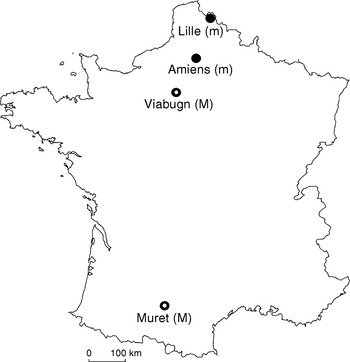
Four Ostrinia sp. populations were sampled during the winter 2004–2005, two (Muret and Viabugn) from maize and two (Amiens and Lille) from mugwort (fig. 1). These collection sites are located in France, in areas where O. nubilalis and O. scapulalis occur at different degrees of sympatry. Indeed, whereas populations of these two sibling species co-occur at substantial densities around Paris (e.g. Viabugn and Amiens), populations of O. nubilalis and O. scapulalis are very scarce in northern (around Lille) and southern (around Toulouse) France, respectively. Collecting individuals in the latter areas, in sites where no host plant of the other species was observed over several kilometres, insured that pure populations of each species were collected. Based on the results of Bourguet et al. (Reference Bourguet, Bethenod, Trouvé and Viard2000), Martel et al. (Reference Martel, Réjasse, Rousset, Bethenod and Bourguet2003), Thomas et al. (Reference Thomas, Bethenod, Pélozuelo, Frérot and Bourguet2003), Pélozuelo et al. (Reference Pélozuelo, Malosse, Genestier, Guenego and Frérot2004), Bontemps et al. (Reference Bontemps, Bourguet, Pélozuelo, Bethenod and Ponsard2004) and Malausa et al. (Reference Malausa, Bethenod, Bontemps, Bourguet, Cornuet and Ponsard2005), we hypothesized that populations collected on mugwort and maize in these areas consisted exclusively of O. nubilalis and O. scapulalis individuals, respectively. Indeed, these authors found that, all over France, Ostrinia females exclusively use the E (when originating from mugwort) or the Z (when originating from maize) sex pheromone blends, suggesting that these two host plants house pure populations of O. nubilalis (on maize) and O. scapulalis (on mugwort). For each population, ~1200 diapausing larvae were collected and maintained at 4°C during the winter. Adult moths were obtained by breaking diapause, i.e. by placing the larvae at ~25°C in June or July 2005.
Sampling sites of the two Ostrinia sibling species. M, populations of O. nubilalis collected on maize; m, populations of O. scapulalis collected on mugwort.

Four host plant species were used in our experiments: mugwort, maize, sorghum and hop. Mugwort roots were collected in northern France during the winter 2004–2005 and maintained at 5°C until they were placed at external temperature during spring and summer 2005 and plants were grown from them. From May to August, ~100 maize (var. Cecilia) and sorghum (var. Burgho) commercial seeds were sown each week in seven litre pots providing an adequate number of plants for testing. Finally, small hop plants were provided by A. Weissenberger (SRPV, Alsace, France) over May, June and July 2005 and grown locally until they were used.
Oviposition preference test protocol
Twenty five 1×1×1.4 m (L×W×H) wood cages, entirely covered by mosquito nets, were set up on a lawn of the Toulouse Rangueil University Campus. Each test consisted in releasing six virgin individuals (three males and three females) into a cage containing a combination of two host plant species. Each host plant combination was tested in pairwise tests replicated 6–8 times. For each test, four plants (two per species) were placed into the cage; the two plants of the same species standing diagonally from each other. Adult moths were released at dusk and removed in the morning of the fifth day. All plants were then taken outside the cages and eggmasses and eggs laid on each plant were carefully counted.
Each maize, sorghum or hop plant was used only once. As the number of mugwort plants was limited, each plant of this species was used twice. Before its second use, the plant was cleared of any eggmasses and left outdoor for at least two days before its second use. It received ‘blanket’ watering through a hose at least once a day, if not twice, as the weather was extremely hot. This might have reduced the possible influence of putative marking pheromones. As phenology can have a significant impact on host plants attraction (Patch, Reference Patch1942; Derridj et al., Reference Derridj, Gregoire, Boutin and Fiala1989; Lupoli et al., Reference Lupoli, Marion-Poll, Pham-Delègue and Masson1990; Spangler & Calvin, Reference Spangler and Calvin2000), experiments were performed using plants at similar development stages. Maize, sorghum and hop plants were 5, 5–6 and 5–7 weeks old, respectively. The exact age of mugwort plants could not be estimated, but all plants were 70–110 cm high. Finally, host plant combinations were tested in random order over the course of the experiment in order to avoid any relation between time period and host plant species involved in the tests.
For each plant, the total surface available for oviposition was estimated by the following protocol. For each host species, a set of 20–30 plants was randomly chosen. For each plant, all leaves were scanned and their overall surface was estimated by automatically counting the pixels of the resulting pictures using the ImageJ 1.33u software (Abramoff et al., Reference Abramoff, Magelhaes and Ram2004). In addition, the dry weight of the leaf set corresponding to each of a sub-sample of 20–30 plants was recorded for each host species. The XLSTAT 2006.3 program was used to test the fit of linear regression models with leaf dry weight and overall leaf surface as the explanatory and dependant variables, respectively. The regression coefficient of determination (r2) between dry weight and leaf surface were 0.80 (n=30), 0.47 (n=29) and 0.89 (n=28) for maize, hop and sorghum, respectively. Corresponding mean absolute percentage errors (MAPE) of leaf surface estimates were 13.5%, 15.6% and 10.9%, respectively. For these three host plants, we therefore used the regression equation to infer the overall leaf surface of each plant used in the experiment from its dry weight. For mugwort, r2 was lower, 0.33 (n=23), and the mean absolute percentage error was 34.7%, so that we decided to scan all plants used in the experiments rather than inferring their leaf surfaces from their dry weights. The total plant surface available for oviposition was the sum of the overall leaf surface and the stem surface (circumference at mid-height×plant height), except for hop, where the stems were very thin and therefore of negligible surface when compared to leaves (<5%). The number of eggmasses on a plant species X after correction with plant surface ratios (EcorrX) was calculated using equation (1).
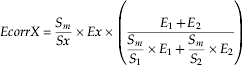
where S m is the mean surface of both species of plants, S 1 and S 2 are the surfaces of plants from species 1 and species 2, respectively, and E 1 and E 2 are the uncorrected number of eggmasses on plant species 1 and 2, respectively.
Data analysis
Proportions of eggmasses laid on each host plant
The proportion of eggmasses, rather than the proportion of eggs, was used as an indicator of host preference. Indeed, both Ostrinia species lay their eggs in clusters of ~20 eggs, so that individual eggs cannot be considered as the results of repeated, independent choices. For each host plant combination, we used the GENMOD procedure of SAS (1989) with a binomial distribution of the residuals and a type 3 analysis to test for the influence of the factors ‘Ostrinia species’ and ‘population (Ostrinia species)’ on the average proportions of eggmasses (corrected or not by the leaf surfaces of the plants) laid on the two host plants available in the cage. A Chi-square test was used to determine whether these proportions were significantly different from 0.5, the proportion expected if females randomly oviposited on the two available host plants.
Size of the eggmasses
Differences between populations and sibling species were further examined by comparing the size of their eggmasses, measured as the number of eggs per eggmass. This analysis was performed on a dataset in which the experimental unit was the host plant individual, i.e. one of the four plants introduced into the cages. We used the MIXED procedure of SAS with repeated measures to test for the influence of the factors ‘Ostrinia species’, ‘population (Ostrinia species)’ and ‘plant species’, as well as the interactions ‘Ostrinia species’בplant species’ and ‘population (Ostrinia species)’בplant species’, on the variable ‘number of eggs per eggmass’. ‘Experiment number’ (from 1 to 192) was considered as a random effect in the model. Each eggmass laid by females on a plant was treated as a repeated measure of the number of eggs per eggmass on the corresponding plant. The chosen covariance structure in the REPEATED statement was ‘compound symmetry’ (option ‘/type=CS’). Each plant introduced into a given cage was, thus, considered as subject in the REPEATED statement of the mixed procedure. Comparisons between sibling species and/or populations were performed with the LSMEANS statement and the PDIFF option.
Total number of eggs laid
We examined possible differences in the total number of eggs laid in each host plant combination, i.e. the total number of eggs of all eggmasses collected on the four plants of any given cage. The total number of eggs rather than number of eggmasses was used because we considered that it better estimated the energetic investment of females in oviposition on each plant. Since differences in early female mortality could bias the results by affecting the number of eggs laid over the duration of the experiments, this analysis was carried out on a dataset excluding replicates in which less than two out of three females were alive at the end of the experiment. The GENMOD procedure of SAS, with a normal distribution of the residuals, was used to test for the influence of factors ‘Ostrinia species’, ‘population (Ostrinia species)’, and ‘plant species combination’ on the total number of eggs laid by females. In order to determine whether the plant surface influenced the number of eggs laid, we added ‘plant surface’ as a covariable to the model. The LSMEANS option was used to compare the total number of eggs among all combinations of the three explanatory variables. Bonferroni corrections were applied to all pairwise tests.
Results
Proportions of eggmasses laid on each host plant
In all but one combination of host plants, the proportion of eggmasses laid on each plant was strongly influenced by the factor ‘Ostrinia species’, whether or not this proportion was corrected by the available plant surface (Chi2>15.64, df=1, P<10−3 for all tests except for the hop-sorghum combination where Chi2=4.22, df=1, P=0.040 when the proportion was not corrected by plant surface). The only plant combination for which the proportion of eggmasses laid on each host plant was not influenced by the ‘Ostrinia species’ factor was maize-sorghum (Chi2=0.31, df=1, P=0.577 and Chi2=1.17, df=1, P=0.279 with uncorrected and corrected proportions, respectively). A significant influence of the factor ‘population (Ostrinia species)’ was detected in two plant combinations: mugwort-hop (Chi2>20.83, df=2, P<10−3 with both corrected or uncorrected proportions); and mugwort-sorghum (Chi2=9.92, df=2, P=0.007 with corrected proportions but Chi2=1.01, df=2, P=0.604 with uncorrected proportions). LSMEANS pairwise comparisons revealed that the ‘population (Ostrinia species)’ factor only had an influence on the proportion of eggmasses laid on each plant in O. nubilalis.
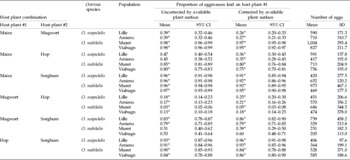
The proportions, whether or not corrected by the proportion of available plant surfaces, of eggmasses laid by each population on the two types of plants used in the different combinations are given in table 1. When cages contained both maize and mugwort, the two sibling species displayed antagonistic preferences; O. nubilalis females laid >95% of their eggmasses on maize, whereas O. scapulalis females laid 61% (or >70% after correction) of their eggmasses on mugwort. The preference of both Ostrinia species was high enough to significantly reject the null hypothesis that females displayed no oviposition preference, i.e. that they laid 50% of their eggmasses on each plant (P<10−3 for all populations). Although less marked, results for the maize-hop combination displayed the same trend; O. nubilalis females laid between 75 and 85% of their eggmasses on maize, these proportions being significantly (P<10−3) higher than 50% for both populations. Although O. scapulalis females were still less attracted by maize than by hop, the proportions of eggmasses laid on each plant did not significantly differ from 50% (P=0.359 and P=0.188 for Lille and Amiens, respectively), unless they were corrected by the relative plant surface available for oviposition (P<10−3 for both populations).
Proportions of eggmasses (corrected or not by the relative amount of available plant surface) and mean numbers of eggs laid during tests involving the various host plant combinations. The 95% confidence intervals (CI) were calculated using the modified Wald method (Agresti & Coull, Reference Agresti and Coull1998).

* indicates that the proportion was significantly different from 50%.
When given the choice between maize and sorghum, all populations strongly, if not exclusively, chose to oviposit on maize, resulting once again in the rejection of the 50% null hypothesis (P<10−3 for all populations for both corrected and uncorrected proportions). In cages containing hop and mugwort, females of both Ostrinia species showed a marked preference for hop; whether corrected or not, the proportion of eggmasses laid on this plant was always significantly higher than 50% (P<10−3) and varied from 75 to 97%. The mugwort-sorghum combination showed that O. scapulalis had a clear and substantial preference for mugwort, as the proportions (corrected or not) were always >75% and significantly different from 50% (P<10−3). Conversely, this combination was the only one not revealing any clear preference in O. nubilalis females. The proportions of eggmasses laid on these two plants were not significantly different from 50% (P>0.094), except for the Muret population and only after taking available plant surface into consideration (P=0.049). The last plant combination (hop-sorghum) again revealed very strong preferences. Both O. nubilalis and O. scapulalis preferred to oviposit on hop; the departure from 50% was highly significant for the four Ostrinia populations (P<10−3). This trend was slightly stronger in O. scapulalis (with a proportion on hop >90%) than in O. nubilalis (with a proportion on hop varying from 80 to 90%).
Size of the eggmasses
Both ‘plant species’ and the ‘plant species×Ostrinia species’ interaction had a significant effect on the number of eggs per eggmass (F=15.55, df=3, P<10−3 and F=6.68, df=3, P<10−3, respectively). Conversely, the size of the eggmasses was not influenced by ‘Ostrinia species’, ‘population (Ostrinia species)’, or by the ‘plant species×population (Ostrinia species)’ interaction (F=0.12, df=1, P=0.734; F=1.42, df=2, P=0.241; and F=0.77, df=6, P=0.594, respectively).
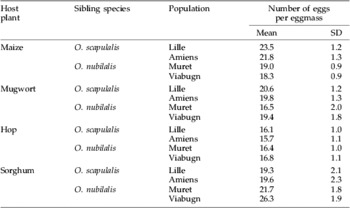
The mean sizes of eggmasses laid by each population on the various host plants are given in table 2. On average, the eggmasses laid by the females of the two Ostrinia species contained ~20 eggs. For O. nubilalis, these eggmasses were significantly smaller when laid on maize and significantly larger when laid on sorghum (P<10−4 and P=0.028, respectively).
Mean sizes (mean number of eggs) and standard deviations (SD) of the eggmasses laid by each population of each Ostrinia sibling species on the various host plants.

Total number of eggs laid
‘Ostrinia species’ (Chi2=6.02, df=1, P=0.014), ‘population (Ostrinia species)’ (Chi2=6.09, df=2, P=0.048), ‘plant species combination’ (Chi2=16.16, df=5, P=0.006) and the ‘Ostrinia species×plant species combination’ (Chi2=21.47, df=5, P<10−3) and ‘population (Ostrinia species)×plant species combination’ (Chi2=19.59, df=10, P=0.033) interactions all significantly influenced the total number of eggs laid by females. Conversely, no significant effect of the ‘plant surface’ factor was detected (Chi2=1.69, df=1, P=0.193).
Overall, O. nubilalis females produced more eggs than O. scapulalis females. The total number of eggs laid by each population per plant combination is given in table 1. It ranged from 205 (for the Viabugn population in the mugwort-sorghum combination) to 1004 (for the Muret population in the maize-mugwort combination). Bonferroni-corrected pairwise comparisons (results not shown) revealed that (pooling Amiens and Lille populations) O. scapulalis displayed no significant differences of the mean number of eggs laid on the various plant combinations. For O. nubilalis (pooling Muret and Viabugn populations), 5 out of 15 pairwise comparisons revealed differences between plant combinations, four of which included maize as one of the two plants.
Discussion
Both O. nubilalis populations showed a high preference for maize (75–98%), while populations of O. scapulalis showed a significant preference (61–83%) for hop and mugwort over maize and sorghum. These results are consistent with those reported by Nagy (Reference Nagy1976), Vilkova & Frolov (Reference Vilkova and Frolov1978), Manojlovic (Reference Manojlovic1984), Savinelli et al. (Reference Savinelli, Bacheler and Bradley1988), Frolov (Reference Frolov1991) and Bethenod et al. (Reference Bethenod, Thomas, Rousset, Frérot, Pélozuelo, Genestier and Bourguet2005) on other European populations or strains of Ostrinia. Hence, populations of O. nubilalis and O. scapulalis (sensuFrolov et al., Reference Frolov, Bourguet and Ponsard2007) display consistent host preferences in France and eastern Europe. Overall, results obtained on oviposition in the genus Ostrinia point to a high preference of O. nubilalis for maize and a more balanced range of preferences for O. scapulalis, the latter species being strongly attracted by mugwort, hemp and hop. It is noteworthy that these preferences are of the same order of magnitude (70–100% of eggmasses on native hosts) as those recorded between host races and sibling species of other phytophagous insects: Nilaparvata lugens (Sezer & Butlin, Reference Sezer and Butlin1998), E. solidaginis (Craig et al., Reference Craig, Horner and Itami2001), Galerucella nymphaeae (Pappers et al., Reference Pappers, Velde and Ouborg2002) and Z. diniana (Bovey & Maksymov, Reference Bovey and Maksymov1959). The magnitude of these preferences was also similar to those recorded by Prokopy et al. (Reference Prokopy, Diehl and Cooley1988) on R. pomonella in non-choice experiments.
Because sorghum and maize share a very similar morphology and a C4-type photosynthesis and because sorghum has been repeatedly recorded as an ECB host plant in several parts of the world (the former Soviet Union (Frolov et al., Reference Frolov, Dyatlova and Andriyash1995); North America (Painter & Weibel, Reference Painter and Weibel1951; Atkins et al., Reference Atkins, Guthrie, Ross and Kindler1983; Guthrie et al., Reference Guthrie, Dharmalingam, Jarvis, Kindler, Atkins, Tseng and Zhou1985); Hungary (Nagy, Reference Nagy1976); the former Yugoslavia (Manojlovic, Reference Manojlovic1984); and France (Leniaud et al., Reference Leniaud, Audiot, Bourguet, Frerot, Genestier, Lee, Malausa, Le Pallec, Souqual and Ponsard2006)), sorghum would logically appear as a good candidate for ancestral host of O. nubilalis. However, our results clearly show that females of both Ostrinia species were attracted slightly to sorghum. Hence, unless its attractivity changed over time, this crop would seem to be an accidental, rather than a regular and ancestral host plant of O. nubilalis.
Although, for both O. nubilalis and O. scapulalis, the oviposition preferences we found between maize and mugwort were similar to what we expected, results for hop were quite surprising for both species. The first intriguing result is the marked preference of O. scapulalis for hop over mugwort, which ranged from 75 to 83%. Indeed, in northern France, mugwort is usually more infested than hop, even when growing in sympatry at a scale <100 m (TM, DB and SP, personal observation). The second surprising result is that O. nubilalis does also oviposit readily on hop. This might explain why some diapausing larvae collected on hop in southern France are genetically assigned to O. nubilalis (Malausa et al., Reference Malausa, Dalecky, Ponsard, Audiot, Chaval, Streiff and Bourguet2007b). On the other hand, a substantial attraction of O. nubilalis females towards hop is hardly compatible with the low level of infestations found in northern France. In that area, most diapausing larvae collected on hop are genetically assigned to O. scapulalis (Malausa et al., Reference Malausa, Dalecky, Ponsard, Audiot, Chaval, Streiff and Bourguet2007b). One possibility is that larvae of O. nubilalis have a much lower survival rate on hop than larvae O. scapulalis do, i.e. although O. nubilalis females lay a substantial proportion of their eggmasses on hop only a low percentage of the larvae reach the diapausing stage. However, this would contradict the data presented in Manojlovic et al. (Reference Manojlovic1984), suggesting that the survival of ECB larvae tends to be higher, not lower, on hop than on maize and on mugwort. A second explanation is that the attraction of O. nubilalis females towards hop was higher in our experiment than what really happens in field conditions. Indeed, our experimental design enabled us to examine short-range, but not long-range, responses of Ostrinia females to host-plant features. Plant volatiles are known to play an active role in attracting ECB females (Schurr & Holdaway, Reference Schurr and Holdaway1970; Cantelo & Jacobson, Reference Cantelo and Jacobson1979; Lupoli et al., Reference Lupoli, Marion-Poll, Pham-Delègue and Masson1990; Binder et al., Reference Binder, Robbins and Wilson1995), and their effects may not have been fully visible at the scale of our experiment. This would suggest that the short-range attractivity of hop for Ostrinia is high (in our experiment, it ranked first for O. scapulalis and was second only to maize for O. nubilalis) and that the reason for its low infestation in the field is due rather to a relative lack of long-range attractivity.
Unlike in R. pomonella (Feder et al., Reference Feder, Opp, Wlazlo, Reynolds, Go and Spisak1994) or Z. diniana (Emelianov et al., Reference Emelianov, Dres, Baltensweiler and Mallet2001, Reference Emelianov, Simpson, Narang and Mallet2003), no mechanism of assortative mating directly induced by adult host-preference has been established clearly so far in the genus Ostrinia. Yet host preference might result in habitat isolation and micro-allopatry between the two Ostrinia sibling species since mugwort, hop and maize do not always grow in fine-scale sympatry and pre-mating dispersal can be limited, at least for O. nubilalis (Dalecky et al., Reference Dalecky, Ponsard, Bailey, Pelissier and Bourguet2006). However, when stands of hop are infested by both taxa, the emergence of adults in the same place prevents any assortative matings based on microallopatry. Moreover, ECBs are able to fly over several hundred meters (Hunt et al., Reference Hunt, Higley, Witkowski, Young and Hellmich2001; Showers et al., Reference Showers, Hellmich, Derrick-Robinson and Hendrix2001; Qureshi et al., Reference Qureshi, Buschman, Throne and Ramaswamy2005) and do not mate exclusively on their host plants but also in dense foxtail grass and other herbaceous, non-host-plant patches (Showers et al., Reference Showers, Reed, Robinson and Derozari1976). In addition, allochrony caused by developmental lags between the different plants seems limited (Thomas et al., Reference Thomas, Bethenod, Pélozuelo, Frérot and Bourguet2003) or absent (Malausa et al., Reference Malausa, Bethenod, Bontemps, Bourguet, Cornuet and Ponsard2005), at least in the surroundings of Paris. If further studies were to confirm that the host preference in the genus Ostrinia is linked to assortative mating by a mechanism that is not mediated by the host plant, comparative studies with host races or sibling species, where this appears to be the case, could provide interesting insights.
Acknowledgements
We thank the anonymous people who destroyed only two cages, leaving a sufficient number of them to complete this experiment; Alain Ferrier from ‘La Toulousaine des Céréales’ and Alain Weissenberger from ‘SRPV Alsace’; Laurent Crespin for helpful advice during data analysis; Claudine, Robert and Vincent Malausa for their help in the snowy plain of Viabugn. The financial support of this study was provided by the IFB, AO Biodiversité et Changement Global; the CNRS, AO Impact des Biotechnologies sur les Agrosystèmes; the ACI-FNS ‘Ecco’, Ecosphère Continentale: Processus et Modélisation; and the EU project ‘ProBenBt’.