Was Robert Schumann’s enthusiastic endorsement of William Sterndale Bennett in the pages of the Neue Zeitschrift für Musik an example of the triumph of hope over reality, or did he have sound reasons for believing that ‘Were there many artists like Sterndale Bennett, all fears for the future progress of our art would be silenced’?Footnote 2 Had Schumann’s been a lone voice, his judgement might have been questioned, but with Mendelssohn voicing a similar opinion to the organist and composer Thomas Attwood, the situation merits further investigation:
I know it is owing to your advice, that he [Bennett] went to visit the [Lower Rhine] festival, and therefore it is to you that I ought to address my thanks for all the pleasure he gave me by his compositions and his playing. I think him the most promising young musician I know, not only in your country but also here, and I am convinced if he does not become a very great musician, it is not God’s will, but his own.Footnote 3
Given Bennett’s failure to become a ‘very great musician’, one is left asking ‘Why?’ But before attempting to answer that question, some background information will help to place this unknown young composer’s career in its historical and geographical context and explain how he had become acquainted with these two leading figures in German musical life.
William Sterndale Bennett was born in Sheffield in 1816, the son of the organist of the Parish Church. Orphaned in early childhood, he was brought up by his maternal grandparents in Cambridge where, some two months before his eighth birthday, he became a chorister at King’s College. Just over two years later, in March 1826, he exchanged Cambridge for London on his admission to the Royal Academy of Music.Footnote 4 Here his progress on the piano, violin and the theory of music was initially steady rather than spectacular, but in 1831 he began to forge ahead, playing Hummel’s demanding Piano Concerto in A flat major and a year later completing his first major compositions, a symphony and piano concerto. While the symphony was a considerable achievement for a sixteen year old, it pales beside the remarkably finished concerto: the latter so impressed Mendelssohn when he heard it in June 1833 that he immediately invited the young composer to visit him in Germany:Footnote 5
‘If I come,’ said Bennett, ‘may I come to be your pupil?’ ‘No, no,’ was the reply, ‘you must come to be my friend.’Footnote 6
Three years elapsed before Bennett was able to take up the invitation, but in 1836 he made two visits to Germany – a short one to Düsseldorf for the Lower Rhine Music Festival (conducted by Mendelssohn)Footnote 7 in May and, after his student days had finished in July, an extended stay in Leipzig from October 1836 to June 1837.
The eight months Bennett spent in Germany would have a profound effect on his career. In Leipzig he found himself welcomed into an artistic circle that included Mendelssohn, Ferdinand David, the leader of the city’s Gewandhaus orchestra, and Robert Schumann, still better known as a critic than as a composer. Other members included two music publishers Friedrich Kistner and Hermann Härtel, both of whom would publish his compositions, and further musical and literary figures. Their companionship and encouragement were to be of immense value to him, and during his stay in the city he completed and had published three major works for solo piano – the three Romances Op. 14, the Piano Sonata in F minor Op. 13 (dedicated to Mendelssohn) and the Fantaisie in A for Piano Op. 16 (dedicated to Schumann). All were serious, technically demanding works of a kind that would have had little appeal in England, and it is significant that after their initial publication in Leipzig, the last two were not reissued in London: the contemporary English editions, published by Wessel & Stapleton in 1841, were both pirated.
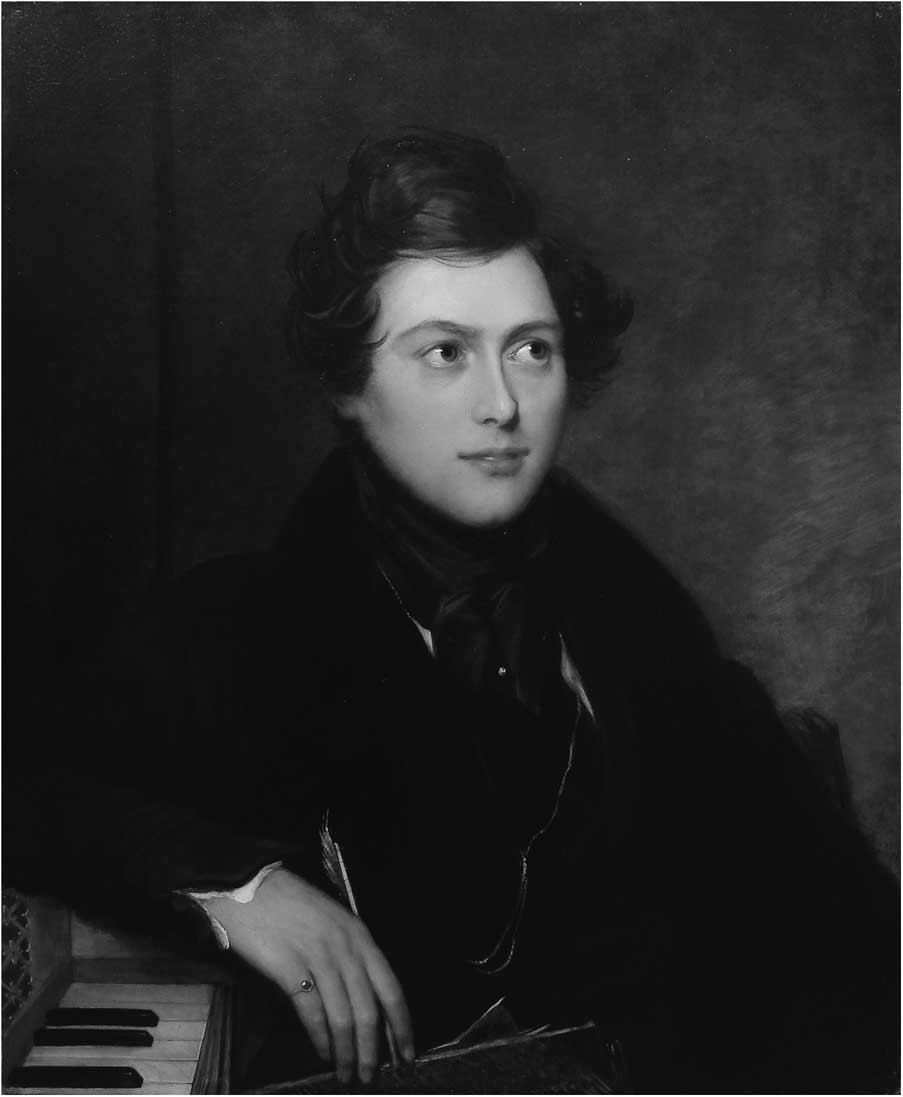
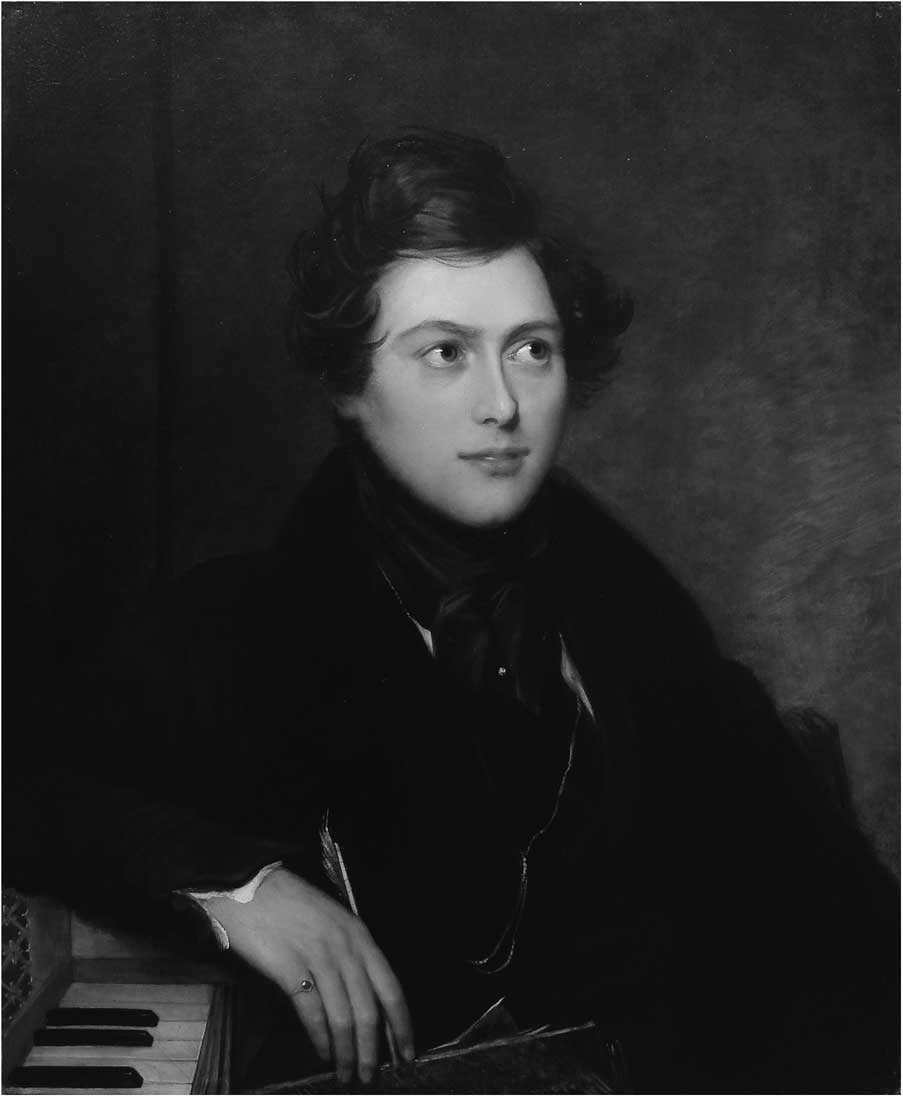
During his stay in Germany, Bennett kept a diary in which he recorded the details of his day-to-day life: social engagements, the music he heard, the people he met, his attempts to learn German, his appearances as a pianist and, occasionally, brief comments on the progress of new compositions. But what makes it such a fascinating document is the disarming candour of his comments. If he didn’t like a piece of music, or preferred London porter to German beer he would say so. And from the unselfconscious portrait he painted we gain an invaluable insight into his character. Reserved, happy to avoid the limelight, but a delightful companion, most at ease in a small group of friends with whom he could settle down to play music or enjoy a drink or cigar. Other sources reinforce this impression. Schumann, who did his young friend the honour of making him the subject of an editorial in the Neue Zeitschrift für Musik for 1837 recalled how ‘he plays all Mozart’s operas at the piano until we fancy we see the living master before us’,Footnote 8 and this impression of a serious but open-hearted young man is supported by a contemporary portrait by the little-known Thomas Henry Gregg (born 1801), painted when he was about 20, perhaps to mark his 21st birthday. Not only is it an engaging image, but its subject also exudes the same sense of self-confidence and joie de vivre, almost of excitement at having reached adulthood, found in the diaries. Confidence, as we shall see later, would become a crucial issue.
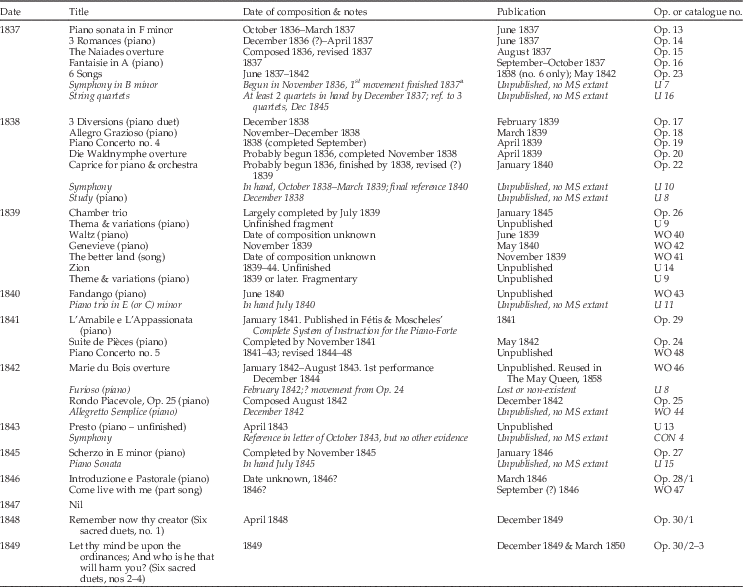
For several years previously Bennett had been leading a charmed life. Until he left the Royal Academy he had continued to enjoy free board and lodging, with the additional benefit during his final months of a private sitting room. His trip to Germany had likewise been made possible by a small legacy from his grandfather. Such teaching as he had done and the Sunday organist’s post he held in Wandsworth were effectively optional extras, providing a useful income but not essential for the keeping together of body and soul. This financial security had allowed him the freedom to compose what he wanted, when he wanted, at his own speed and with no commercial or other constraints imposed. For the years between 1832 and 1836 his output had followed a similar pattern, with the annual completion of a symphony, overture and concerto. The eight months he spent in Germany somewhat disrupted this routine, but it resumed its usual form in 1838 when he wrote his Piano Concerto No. 4 and overture Die Waldnymphe, and completed the Caprice for piano and orchestra. The last had probably been begun in 1836 and, in retrospect, its relatively long gestation could be seen as foreshadowing the difficulties that would begin to afflict Bennett. Certainly by 1839, if not before, the beginnings of a change can be identified. Gradually, but inexorably, the number of works he finished began to drop, while those that were took longer and longer to reach completion. A number were left unfinished or destroyed and a glance at the list of compositions on which he is known to have been working in the late 1830s and 1840s is very revealing (see Table 1).
Bennett’s compositions 1837-49, illustrating the change in his output and the works which have disappeared.Footnote 129 130

a See Henry Davison, From Mendelssohn to Wagner (London: W. Reeves, 1912), p. 31.
Titles in italics indicate works which have disappeared
Take, for example, the twelve songs to English and German words on which he began work in 1837.Footnote 9 The first reference to them is found in a letter to the publisher Friedrich Kistner, written on 27 June 1837 at Mainz on his return journey from Leipzig to London. He had, he wrote, ‘been amusing myself by reading some little German Poetry & selecting some for Songs, which I will send you very soon after I arrive in England’.Footnote 10 Some six months later he returned to the subject: ‘By the earliest opportunity you will recieve [sic] from me twelve Songs which I have composed, some to English, and some to German words, – the English songs you will be so kind as to get translated – but I wish the English words to be printed also underneath’.Footnote 11 Although he added as an afterthought ‘Perhaps six would be enough for one book’,Footnote 12 eighteen months would elapse before he wrote again, still promising to send the songs ‘very soon’.Footnote 13 Not, however, until January 1842, on the occasion of his third visit to Leipzig, would Kistner finally receive the first half dozen, issued in May 1842 as Bennett’s Op. 23. One of the remaining six was published in 1848, but the complete second set, numbered Op. 35, did not appear until 1855, eighteen years after Bennett had started work. What had caused the delay? One reason, as he explained to Kistner in 1840, was his desire to obtain good translations: ‘I wish first to arrange the words in English before I send them and some of the Songs which are already English I wish to get translated under my own Eye.’Footnote 14 Five months later he returned to the subject, complaining that ‘The Songs plague me very much to get English Words & German’, adding ‘These Compositions (upon my honor) you shall recieve … at the beginning of August.’Footnote 15 An entreaty from Kistner on New Year’s Eve – ‘Where are, what is become of my poor Lieder’Footnote 16 – produced no result and twelve months later we find him forced to write again to beg him to ‘bring along with You the Lieder – as You know I have got already one of them since several years’.Footnote 17 Finally, at the end of January 1842, Bennett could report to Mary Anne Wood (his future wife) that ‘My Songs are in the Engravers hands.’Footnote 18
Was Bennett’s concern about the translations the only reason for the delay? I suspect not, and my own view is that he found the transition from supremely gifted student to adult composer difficult. It was not necessarily the case that composition had suddenly become harder, merely that people’s expectations had changed. After returning from Leipzig in June 1837 he was faced with the reality that he had come of age, and that he and his music would now, as it were, have to stand on their own two feet. Among those who feared for his ability to succeed in London’s cut-throat commercial musical environment was Ferdinand David who, in April 1839, voiced his worries to Mendelssohn:
While travelling [to London] with him I came to realise the full charm of his personality. He is a man from whom I should like never to be parted, I cannot imagine the woman who would not wish to marry him. His compositions are, it appears, but little known here. They still see in him nothing beyond the Academy student. Heaven knows how he, with his unassuming manner, will make his way forward in this place. There are few Englishmen who would not deem a man insane, if he told them, that here was a musician of higher type than Mori, Lindley or their other authorities.Footnote 19
Back in London Bennett certainly found himself out of sympathy with the music that was on offer, much of it packed into a four-month period, from March to June, that reflected its short social season. Writing to Kistner in July 1839, he lamented that ‘Music is now dead in London & I think it is better for me now [to] hear no bad music [my italics]’.Footnote 20 It is the latter part of the sentence, suggestive of voluntary abstinence, which is of such interest. It was as though he felt it necessary to place himself in musical quarantine, lest he be infected by ‘bad’ music. Seven months later Kistner was the recipient of a further letter expressing his unhappiness with the capital’s musical shortcomings:
You know what a dreadful place England is for music; and in London, I have nobody who I can talk to about good things, all the people are mad with Thalberg & Strauss, and I have not heard a single Symphony or Overture in a Concert since last June. I sincerely hope that Prince Albert our Queens [sic] Husband will do something to improve our taste.Footnote 21
It was a theme which James Sterndale-Bennett would later touch upon in his biography of his father:
Out of harmony with prevailing musical tastes; entirely absenting himself … from the Italian Opera … Bennett was drawn much within himself, and found a solitary but safe refuge in his piano and his music-books … [but] the fact remains that, except in his own study, or while engaged with his few pupils, he was living in a musical atmosphere which if not positively depressing to him, certainly cannot have been exhilarating.Footnote 22
The contrast with Leipzig with its concert season from the autumn to early summer and close-knit musical community could not have been sharper.Footnote 23 And one can now see how Bennett was caught between two stools. Whilst in Germany he had benefited hugely not only from the support and encouragement of local musicians and music lovers, but also from the greater opportunities for hearing orchestral and chamber music in performance. However, the downside had been homesickness for his family, friends and familiar surroundings. Now, back in London, he not only yearned for the companionship and music-making he had experienced abroad, but also had to contend with an outspoken and sometimes critical press.
Although his music was generally received as warmly as in Germany, with the third piano concerto being hailed as ‘a work which the most experienced, the best established composer, might be proud to acknowledge’,Footnote 24 he would come to find himself caught up in the debate about the justification for programming all-English concerts. This had been brought to the fore by the establishment in 1834 of the Society of British Musicians, ‘For the Encouragement and Advancement of Native Talent in Composition and Performance’,Footnote 25 and while some critics, not least his long-standing friend J. W. Davison, and Henry Smart, were supportive, others, notably Henry Chorley and (later) C. L. Gruneisen, strongly objected to such discrimination. Chorley, moreover, although initially supportive of Bennett, gradually lost patience with the young composer.
More of a worry, however, was his belief ‘that a composer should never allow himself to write below his proper level; that, if he did so, his reputation would be more likely to rest on his bad work than on his good; that one single careless publication might rise up in judgement against him hereafter, and utterly condemn him’.Footnote 26 It was a fear which would haunt him for close on twenty years and quickly led to his development of an innate sense of caution, together with an increasing unwillingness to take any risks that might undermine his reputation and, as we have seen, a concern to isolate himself from all undesirable musical influences. We know from comments to his cousin John in 1840 that he was only too aware of the expectations of others:
My reputation is as great as I can well bear, after a man gets fame and reputation, he must support it, by continual movement and I very often fancy that my friends are more sanguine for me than they ought to be, for whatever they prophecy they expect me to fulfill [sic].Footnote 27
It was a message he would repeat to his future wife two years later: ‘I should be very ungrateful to complain for I am sure no one ever went through life as far as I have gone, meeting with more kindness and encouragement, but the difficulty is to answer the hopes of one’s friends, who are always too Sanguine’.Footnote 28
In such circumstances it is not so surprising that his output should have started to dry up. We can surely see this in the prolonged gestation of the two collections of songs, both of which had to be absolutely perfect before they could be presented to the world, and a similar situation seems to have affected a contemporary work, the Chamber Trio (as he called his piano trio in A). The earliest reference to this is found in a letter to Kistner from July 1839, in which he promised to send the songs ‘very soon and also a trio for the Pianoforte afterwards’.Footnote 29 It was not until February 1840 that he again referred to it,Footnote 30 and then the usual series of prevarications began. First, there was his concern that it might require revision after its premiere:
You are really very good not to be angry with me for not sending you any new Compositions, but you shall (auf Ehre) [i.e. on my honour] recieve them very shortly … The Trio I shall play on the 13th of March at some Chamber Concerts here in London & when I have altered some things which will perhaps occur to me on playing it in public I will send it to you.Footnote 31
The March performance never took place and the trio was not heard until 18 May, when Bennett, Henry Blagrove (violin) and Charles Lucas (cello) played it at one of Blagrove’s Quartet Concerts. Bennett, however, could still not bring himself to publish it and told Kistner in October that he had ‘some little cuts to make in my Trio which I have not time to do before he [Mendelssohn] goes to Leipsick. You shall hear from me next week.’Footnote 32 Kistner, needless to say, heard nothing and would have to wait until December 1844 to finally receive a copy;Footnote 33 publication took place in England on 9 January 1845 and in Germany the following April.
Earlier in 1840, Bennett had tried – but failed – to explain exactly what it was that was preventing him from sending manuscripts, among them a second trio, for publication:
Your letter gave me much pleasure, as I learn by it, that you still take an interest in me and my welfare – I can hardly tell you the reason why you have not recieved anything from me to publish, although I still say, that I have plenty in hand for you. The Season and noise of London is now fast disappearing and I have a little quiet to arrange and copy out my compositions which I have been doing at different times, and I can promise you two Trios for P. Forte Violin & Cello – one in A Major, and the other in C Minor – The former is rather small and only fit for Kammer-Musik … I played [it] at some Quartetts in London in April and one Movement I hope you will like better than anything I have done.Footnote 34
Given Bennett’s apparent satisfaction with the work, why was publication so long delayed? I suspect that it was not unconnected with the mixed review, not least the comment ‘we scarcely thought [it] worthy of … [his] genius’ which followed the first performance:
The first movement is the best portion of the work – it is beautiful in conception and skilfully wrought. The ‘Serenade,’ also, is pretty and effective; but the other movements [my italics] are strongly impressed with an appearance of having been hastily written.Footnote 35
For whatever reason – and the reviewer’s reservations seems the most likely one – the trio was not heard again for close on four years until, in January 1844, Bennett included it in the first of his Classical Chamber Concerts. By then, however, it had changed from being a four-movement to a three-movement work, with Bennett having cut the two movements, the second and fourth considered to have been ‘hastily written’ – a ‘Presto, agitato’ and ‘Rondo, semplice’ – and then only replaced the latter.Footnote 36 Not until it had been heard twice more in public and received generally favourable comment – although Davison still only gave the new Finale his qualified approval – did he send it for publication:
the whole movement, with the exception of one or two points, seems to us as unlike the composer’s general style as possible. We do not feel quite at liberty yet to pronounce a definite opinion of the merits of this finale – but are quite ready to bear witness to its energy and spirit.Footnote 37
Given that the Chamber Trio was written at a time when Bennett was neither inundated with pupils nor working on many substantial works, why did two movements give the impression of ‘having been hastily written’? Could it be that he was finding it more difficult to compose and needed the pressure of an approaching deadline to spur him into action? That he was beginning to suffer from some form of ‘composers’ block’? I am not the first to put forward this theory, as his son suggested something very similar. Noting his father’s inability to explain why he could not send any manuscripts to Kistner, he continued:
The question which he thus gave up trying to answer, thenceforward became a crux to others than himself; for notwithstanding the great facility for composition which the friends of his youth thought he had shown at the Academy, notwithstanding Schumann’s impression that he could ‘accomplish anything with sportive ease,’ Bennett was not to be a voluminous composer. Davison could point to movements of Symphonies which had been written in Tenterden Street currente calamo and without premeditation, but Bennett himself, if such facility were referred to in after years, would then shake his head in disapproval, and he once said that he could only compare the production of a composition to the acutest form of bodily pain.
Much was expected from him, more indeed than he seems to have felt he had the power to accomplish [my italics].Footnote 38
Knowing his fear of producing anything that might be considered sub-standard, one can begin to understand how starting, let alone finishing or publishing, a new work must have become an increasing strain for Bennett and, with this in mind, it is instructive to consider what is known about his compositional practice. As his son recorded, composition was very much a mental art for his father who ‘had a kind of unwillingness to commit his ideas to paper’. He explained this by saying,
once written down they became stereotyped in his mind, and … then revision proved to him a matter of great difficulty. Revision … had to be done before the pen was touched … He himself often spent a great deal of time in making up his mind before he wrote anything down, and the hours he gave to composition, or to attempts at composition, cannot be measured by the amount of music-paper he filled.Footnote 39
Only the threat of an imminent performance forced his hand. Such was clearly the case with the Sonata Duo, written for the cellist Alfredo Piatti in 1852 and completed so late that there was no time for a rehearsal! James Sterndale-Bennett described its last-minute completion:
On the eve of the concert for which it was promised, he told his wife that he could not possibly finish it. She begged him to make an effort to keep faith with the Public, and sat with him through the night while he worked. Next morning he went out to his pupils and, after six hours’ teaching, returned in the afternoon to complete his task.Footnote 40
Piatti himself provided further details:
I can’t forget the hearty laugh he gave me when on the evening of the Concert that it was to be performed, on my going to him to rehearse it, he informed me that it was not quite finished. That was about 2 hours before the Concert. His Piano was already gone to the Concert Room, at least I think so, because he invited me to go down stairs in the House keeper’s Room, where there was a little Cottage Pianoforte, and there he set at work to finish it and I to learn it – we could not rehearse it, being now the time to go to the Concert.Footnote 41
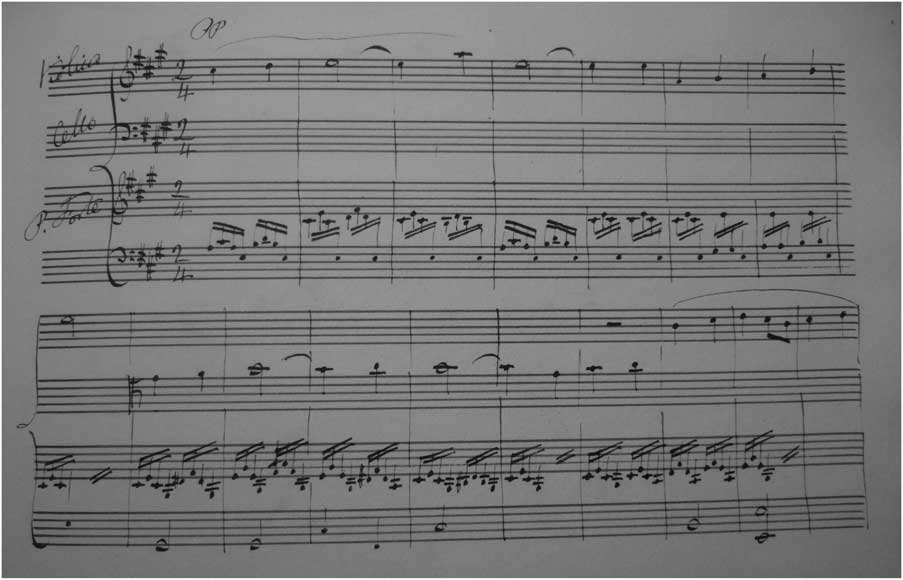
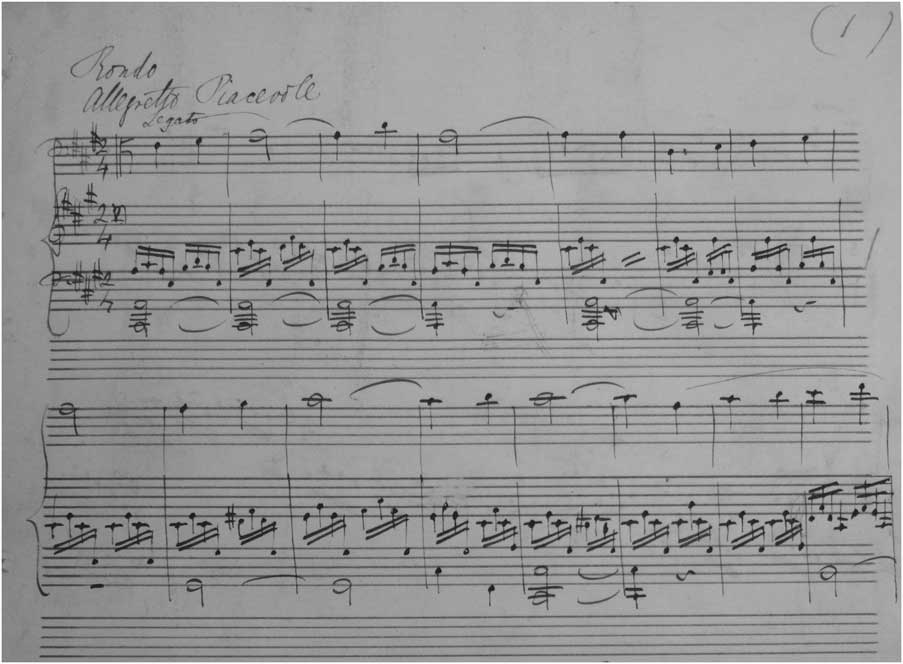
Bennett played from memory, Piatti from the manuscript and, despite the work’s eleventh hour completion, the performance went well: ‘If perfect execution could have insured the success of a new piece, the performance … would have placed it beyond a question.’Footnote 42 No less importantly, it was warmly welcomed, not least because (as Davison observed), Bennett ‘writes so little now, that a fresh work from his pen can hardly fail to attract a more than ordinary share of attention. The sonata is in all respects worthy of … [his] reputation.’Footnote 43 The knowledge that he ‘often spent a great deal of time in making up his mind before he wrote anything down’ alters our understanding of what would have been required to ‘finish’ the work, as does the discovery that the finale is a reworking of what appears to be the discarded, original rondo finale of the Chamber Trio: the opening of the Sonata Duo’s rondo finale is identical with a sketch for a movement for Piano Trio in A major (see Figure 1). While this must remain a hypothesis, it is interesting – and perhaps not so surprising – that Davison did not recognize the earlier ‘hastily written’ finale in the new work.Footnote 44 With this in mind, one wonders to what extent material from other unfinished or lost works listed in Table 1 was later recycled, or indeed whether it even existed in a physical, as distinct from a mental, form.
Opening of original Finale of the Chamber Trio Op. 26. ‘RAM’ notebook, British Library Neighbour deposit. Reproduced by kind permission of the British Library, London (© British Library Board (Neighbour Deposit).

Opening of Finale of the Sonata Duo Op. 32. Sterndale-Bennett Deposit, Bodleian Library, Oxford. Reproduced by kind permission of Barry Sterndale-Bennett.

Turning back to the list of missing works, one is struck by their number and scale. One, or perhaps two symphonies, two or three string quartets, one or possibly two piano trios, a piano sonata – all substantial works of the sort that Bennett had been writing in his late teenage years and early twenties, but which are noticeably absent from his work list in the 1840s and 1850s.Footnote 45 The Piano Trio in C minor is one of the few for which we have more than a name: it was described to Kistner in 1840 as being ‘rather more ambitious’ than the Chamber Trio.Footnote 46 Three larger-scale works from the 1840s do, however, survive – two finished (a sixth piano concerto and the overture Marie du Bois) and one unfinished (the oratorio Zion). As the first exemplifies several of the issues that effected his ability to complete a work to his satisfaction, it is worth looking at it in more detail.Footnote 47
Bennett had begun work on the concerto, or Concert-Stück as he frequently called it, in 1841 and had taken the incomplete manuscript with him on this third visit to Leipzig (January to March 1842) with the intention of performing it in one of the Gewandhaus concerts. In early February (as he wrote to his wife-to-be), this was still his aim: ‘I have … not yet played this Season … because I preferred to wait until I was just leaving Leipzig … therefore on the 3rd of March I will if possible play a New Concerto, which I have in hand.’Footnote 48 By the time of his next letter, twelve days later, the possibility of a German premiere had been ruled out: ‘I am rather busy now, with my new Concerto which I hope will be finished for me to play at the Philharmonic.’Footnote 49 In fact it was not until over a year later, on 5 June 1843, that the work received its premiere at the Philharmonic Society in London. Critical opinion was divided, but there was general agreement on two things: that the performance was marred by indifferent orchestral playing and that the new work (to quote The Times) ‘may be said to sustain, but without advancing, his [Bennett’s] reputation; well composed, with some beautiful snatches of melody, but as a whole ineffective, and leaving few traces on the memory’.Footnote 50 The Musical World and The Musical Examiner were of a similar opinion and neither felt able to offer more than a decidedly equivocal assessment: the former declared ‘we can almost positively [my italics] state that if it does not greatly enhance, it takes nothing away from the brilliant reputation of the composer’,Footnote 51 while the latter observed that it was ‘not prepared to venture a decided opinion on the merits of this … work ... [whose first movement] strikes us as something which ought to be, but is not’.Footnote 52
As the last review suggests, it was the first movement that confused the critics. Just as in his previous concerto, no. 4 in F minor, in which he had omitted the development section, Bennett had pared down the traditional first movement form, but more drastically this time. Not only was the opening orchestral tutti severely curtailed, but most of the recapitulation was also omitted, with the coda following closely on the development. The light, chamber-music-like scoring for the second subject was also criticized, with The Musical Examiner accusing him of a ‘decided mis-calculation’ over the ‘combination which he evidently intends. The sostenuto accompaniments of the violins … produce, in this instance, nothing but a feeling of tameness.’ Given that such adverse criticism can only have contributed to his increasing self-doubt, it is worth quoting more of the review:
The idea of the composer is good, but is not exemplified with sufficient force to be immediately comprehensible … The first solo … is the least satisfactory portion of the whole. It appears to us to want clearness, especially in the orchestral accompaniments, which do not well assort with the successions of brilliant passages assigned to the piano, and assuredly lack the melody usually displayed by Mr. Bennett, with such lavish prodigality. The second subject is a decided mis-calculation on the part of the composer … Moreover, the rhythm is anything but marked, and the whole gives a notion of confusion and mystery, anything but satisfactory.Footnote 53
To have parts of your most recent work condemned as being ‘anything but satisfactory’ cannot have been a happy experience, but, on the evidence of a letter to Kistner, Bennett quickly set to work and within four months could write that his ‘new Concerto which I performed last year [that is, last season] at the Philharmonic Society, and which I have since altered’ was ‘ready for the Engraver’.Footnote 54 Not unexpectedly, most of the revisions were concentrated in the first movement whose end was expanded and scoring thickened.Footnote 55 Something, however, still prevented him from sending the score to be engraved, and it was not until September 1844 that he informed Kistner that ‘As soon as this Trio [that is, the Chamber Trio] is published you shall have two more new works, one a little Overture for the Theatre [Marie du Bois] … [and] a Concert-Stück for the Pianoforte.’Footnote 56 . But despite his insistence that he would ‘make no more [false] promises, you shall have the music’, neither work was forthcoming: the overture, Marie du Bois, eventually surfaced in 1858 in the cantata The May Queen, but the Concerto – which Bennett would play twice more – remained unpublished.
Whilst it was the critics who voiced their doubts about the first movement, Bennett clearly had his own misgivings: why else would he have written a new middle movement, a Serenade (marked ‘Allegretto’), the day before the premiere? This was not the first time that he had made such a last-minute substitution, as a similar situation had arisen with the first of his two concertos in F minor (known as no. 5): the original slow movement, ‘A Stroll through the Meadows’, had been replaced overnight, between rehearsal and performance, by a Barcarole. On the present occasion the Serenade was apparently composed between the Saturday rehearsal, when, The Musical Examiner noted, it ‘was not tried’,Footnote 57 and the Monday evening premiere. The Times, meanwhile, had intriguingly reported that it was ‘understood that he [Bennett] wrote a slow movement [my italics], but it was not played’.Footnote 58 Does this mean that he had initially written a slow, as distinct from an Allegretto, movement and that it too had become a victim of his ‘Obsession with Perfection’? But, despite being hailed as ‘a current of charming melody, unceasing and untiring … [whose] effect is deliciously fresh, and … [whose] conception and development are altogether faultless’,Footnote 59 the ‘Serenade’ fared no better as it was itself only heard once. For the concerto’s second (and last) complete performance, in June 1848, Bennett curiously replaced it with the slow movement of his first concerto. Of the three movements, only the finale (Allegro quasi presto) initially enjoyed unqualified approval and consequently escaped more or less untouched by the revision process. Indeed, it so overwhelmed the critic of The Musical World – it can only have been Davison – that he could hardly contain his excitement: ‘The feeling of this movement is one of unbounded joy, of so excitable a character, that it is difficult to remain quiet during its performance.’ By the time he heard the revised score in 1848, his earlier opposition had evaporated:
The first movement… is glowing and passionate; the finale … joyous and exhilarating. We have no time to criticise it now, and must content ourselves with recording our impression that it is a fine but unequal work; the last movement is perfection, but the first is occasionally obscure. We must hear it again.Footnote 60
That last wish would remain unfulfilled, as a rift in 1848 with Michael Costa, conductor of the Philharmonic Society’s concerts, led Bennett to resign as one of the directors and consequently lose his principal venue for concerto performances. His disagreement with Costa grew out of an unfortunate misunderstanding: hearing that, in a rehearsal, Costa had taken his overture Parisina too slowly, Bennett sent a note to his friend Charles Lucas requesting him to ‘ask Costa to take my Overture a little faster. I have not been able to explain my idea of the time to him, but you have often done it, and I’m sure he would not take it amiss.’ Lucas, however, made the mistake of handing Costa the note rather than speaking to him, unaware that he was already irritated by the late arrival of Bennett’s score. Taking offence at what he regarded as criticism of his conducting, Costa refused to conduct the work. Attempts at mediation proved unsuccessful and Bennett, having received no apology from the Society, resigned as a director and for eight years declined the annual invitations to play at the concerts.Footnote 61 An immediate consequence was that he no longer had the same incentive to finalize and publish the Concerto, which, despite having been advertised by Coventry & Hollier in October 1844 as being ‘in the press’, was never issued.Footnote 62 Kistner, needless to say, did not receive the promised manuscript and the concerto has remained unheard and almost unseen since 1848.
The other major work on which Bennett was working in the early 1840s was an oratorio, Zion. The earliest reference to it is found in the diary he kept during his second visit to Germany, where, immediately after the last entry for January 1839, he sketched an outline of the text for its opening numbers.Footnote 63 Early in 1840 he told Mendelssohn that he was ‘writing an Oratorio and already have done a great deal which I should like to shew you, particularly a little Chorus which I have this morning written, I assure you I want some of your encouragement to make me prosper in such an undertaking’.Footnote 64 He was also concerned to keep Kistner informed, assuring him that ‘Although you have had no Compositions from me I have not been idle and have written a great deal of an Oratorio, which will be a real gratification & honor to me to hear some day in your town – God give me strength and health and ideas to finish it’.Footnote 65 By July 1840 the end was apparently coming into sight: ‘The Oratorio I shall finish I hope next Spring and if so, shall give it in London immediately afterwards.’Footnote 66 Thereafter Kistner’s periodic enquiries elicited no response and the last known reference to the work is in a letter to Mendelssohn in October 1842: ‘I am doing much to my Oratorio and have written just now a long Chorus, which I am rather satisfied with.’Footnote 67 The existence of a sketch dated 24 November 1844 demonstrates that he had continued to work on the score, but at some point in the mid- or late 1840s, that is, at a time when he was completing less and less, he must have given up completely, perhaps even after hearing Mendelssohn’s Elijah at the 1846 Birmingham Festival. Of the fifteen identifiable movements that survive only ten are complete, but even all fifteen would have formed no more than part of the work, leading one both to question whether Bennett had really written ‘a great deal’ of the score, and to ask why he abandoned a work on which he had embarked with such enthusiasm. Was his heart really in it?
Given the popularity of choral singing in England, not to mention the recent success of Mendelssohn’s St Paul (whose premiere he had attended in 1836), it was probably inevitable that Bennett’s thoughts should at some point have turned towards oratorio. While there is no reason to doubt his initial interest, there nonetheless remains a suspicion that his decision had been swayed by the promptings of others, who felt that he should not only compose more, but also work on a larger canvas. What his various friends and acquaintances did not appreciate, however, was that such well-meant comments ran the risk of being counter-productive – and so it proved. Among those who had been pressing him to enlarge his horizons was Schumann who, in his review of the Suite de Pièces for piano in 1842, observed:
He ought to write more, however. But it seems as though he feels himself moving in but a small domain, on which he should not always remain; for though we love fairy sports, we prefer manly deeds; and in order to accomplish these, the realm of the pianoforte is too confined; they need an orchestra or a stage.Footnote 68
Kistner was another who felt that Bennett should be more productive and work in larger forms and, with an eye on enlarging his catalogue, wrote something very similar. It was not, he pointed out, to Bennett’s advantage ‘to make such a long pause in publishing new works, because … the public could loose [sic] in a certain degree the warmth of interest which it took till here [that is, now] at the productions of Your Genious [sic]’.Footnote 69 He ended with a mock serious threat to send ‘innumerous letters, till I receive the promised manuscripts, depend upon [it]!’Footnote 70
Each of Your letters related me of Your diligence and You are counting all the works You had allready [sic] finished, however You are envious enough to keep them as secrets between You and Your London friends, though You know very well how desirous we are to follow the steps of Your Genious [sic]! – for instance the Oratorium which You are composing just now I assure You, I don’t know what I could spend only to hear some bars of it. If You continue as You did till then, it will most easily last yet a ten years till we may be edified by the charms of this composition.Footnote 71
Mendelssohn likewise felt that Bennett should have achieved more, and Davison recalled a conversation in 1847 while they returned by train from Birmingham to London:
‘Ah,’ said Mendelssohn, ‘he ought to come out with some large work, and say, “Here I am, I am Bennett”;’ then … He added, ‘for he is so gifted.’Footnote 72
It was an opinion which Davison had already endorsed, both personally and by reprinting a review from The Morning Post in The Musical Examiner. The occasion was Bennett’s annual benefit concert in 1844 and the other writer was probably Charles Gruneisen, with whom he rarely saw eye to eye. On this occasion, however, their thoughts largely concurred:
It is to be regretted that he brought forward nothing new – a MS. overture [Marie du Bois] had been spoken of, but it was not forthcoming. Since the Concert-stück … Bennett has been at a stand still. Something is decidedly required from him, as his reputation now cannot be expected to last on his youthful productions. He has, in fact, to realise the prophecies of those enthusiastic critics who predicted from his inspirations something more than the popularity arising from being a disciple and pupil of Mendelssohn [my italics]. It had been expected … that he would eventually be the founder of an English school, and at the head of which his name would have been European. The kindness of Mendelssohn has achieved much for Bennett in Germany, and if our countryman had possessed but a tithe of the industry and perseverance peculiar to the Germans, he might have been permanent conductor of our Philharmonic meetings. So much depends in this country on stability of character, that if the greatest musical genius were suddenly to spring up, he would secure no position unless the profession regarded him as safe. M. Bennett it is to be feared has been light, frivolous, and indolent, contented with the inflated praises of a small coterie, and neglectful of art, as well as his own interests.Footnote 73
Although anxious to defend Bennett from the charge of indolence, Davison was nonetheless in agreement with Gruneisen about the paucity of his output, but reminded his readers of the unrewarding conditions in which English composers had to work. His comment about Bennett’s youth, from one only three years older, was, however, slightly patronizing:
England is one thing – Germany another. In England, a professor must work night and day, desires he to make a competency, to provide against the mischances of the future. The instant a pianist or a composer becomes popular in this country, he is lost to art altogether. His whole time is consumed in giving lessons. How can a man, however devoted to art, after seven or eight hours of hard teaching, set himself down to the pianoforte to practise or compose? … Instead of wondering that Bennett has done so little, we are surprised that he has done so much … We certainly wish he had composed more – but what he has done, a very small portion of which is, doubtless, known to the writer in the Post, is quite enough to place him by the side of the first living European composers … Mr. Bennett is still very young, and has plenty of time before him … Still there is sufficient of the shadow of truth in what the Post says, to warn Bennett that he has, in some degree, to make up for lost time. He has that within him which must, eventually, raise him to the highest rank among musical composers. Let him use the gifts which God has lavished on him. To sacrifice or waste them, would be impious.Footnote 74
Such, then, were the circumstances in which Bennett, at the age of 28, found himself. Instead of basking in glory after his successful completion of a major choral work and other compositions listed in Table 1, he was being taken to task over his lack of productivity and accused of being ‘light, frivolous, and indolent, contented with the inflated prices of a small coterie, and neglectful of art, as well as his own interests’.Footnote 75 For a sensitive character this must have been particularly hurtful, and one can understand why he considered London to be such an unsatisfactory city for music. Not everything was black, however, as on 9 April 1843, after a two-year engagement, he and one of his former piano pupils from the Royal Academy of Music, Mary Anne Wood (1824–1862), were married.
In a letter to Mary Anne from Kassel in January 1842, Bennett told her that ‘I always will find time to write to you, for I have only two things to think of – viz – You and my Art – and in these two objects I am wholly engrossed’,Footnote 76 and marriage brought him great happiness. It also had a strange, albeit real, effect on his compositions and ability to compose. The evidence is inevitably subjective, but has three main elements. First, that four works written just before and whilst he was courting Mary, the Suite de Pièces Op. 24 (1841), the overture Marie du Bois (1842–1843), the Piano Concerto No. 6 (1841–1843), and ‘Lesson in G minor’ from the Preludes and Lessons Op. 33 (1842), have a particular link with her. Second, that the compositional ‘drought’ that afflicted him from the mid-1840s until the early 1860s broadly coincided with his married life. Third, that it was during his wife’s terminal illness in 1862 that he seemed finally to rediscover his musical voice and to speak again with the passion of his youth.
But now to the evidence. As letters to Mary reveal, the third movement of the Suite, and especially its slower second subject marked ‘Con passione’, possessed a special significance for Bennett: writing from Germany in January 1842 he told her ‘I played them … one of Mrs. Anderson’s pieces, or rather one of those new Compositions which I have told you belong to you’Footnote 77 and returned to the subject some two weeks later:
I do indeed wish I could play you the new Compositions which I have written for Mrs. Anderson, but I very often play one of them alone and think of the day that I wrote my first letter to you.Footnote 78
By itself this may tell us little, but when placed alongside the play on Mary’s name in the overture’s title, the inscribing and dedication of the Lesson in her manuscript album, and the publication of an anonymous biographical ‘programme’ for the concerto in The Musical Examiner (see below), a pattern begins to emerge – that during their engagement Bennett used his music as a means of conveying his love for Mary. After their marriage he was able express his feelings directly and it was not until he was losing her that his need to pour his emotions into his music returned. The ‘programme’ for the concerto is the most intriguing link. Although it bears no attribution, responsibility for it presumably lay with Davison, the journal’s editor. There seems little reason to doubt, however, that it was based on his knowledge of the composer’s feelings, perhaps even on comments he had made:
The idea of the composer in this concert stück was, as it seems to us – first, love – second, the expression of it – third, its happy completion. These are rendered by an earnest and passionate flow of feeling, such as the heart can only know when truly it loves – a pretty and grateful declaration, in the fanciful form of a serenade – and an impetuous outpouring of boundless delight at the knowledge that the love is reciprocated. This is a poet’s thought, and as a poet, Mr. Bennett has expressed it.Footnote 79
Regardless of whether these connections have any basis in fact, it is incontrovertible that during Bennett’s nineteen years of marriage his output not only shrank, but also changed in character: instead of the concertos, orchestral works and demanding piano pieces of the previous decade, it was dominated by short piano and vocal works of only moderate difficulty and suitable for amateurs. Works, incidentally, whose small scale and stature would protect them from comparison with those of ‘established’ composers. There were, of course, a few exceptions, notably two ventures into an unusual field for Bennett, choral music. Both were written for specific occasions – the extended anthem ‘Lord, who shall dwell in thy Tabernacle?’ for the Commencement Sunday service in the University of Cambridge (29 June 1856) following his appointment as professor of music, and the pastoral The May Queen, commissioned for the inaugural Leeds Music Festival in 1858.Footnote 80 As the latter, his largest choral work to date, signals the beginning of the end of the compositional drought and also poses questions relating to its genre and unexpectedly long gestation, it is worth looking at in more detail.
At first sight the history of The May Queen appears to be very simple – it was commissioned in May 1858 and completed between then and the performance on 8 September. Further investigation, however, proves this to be far from true: its genesis actually began ten or more years earlier, in the immediate post-Zion (and post-Elijah) era, and demonstrates that Bennett’s unsatisfactory experience with oratorio had not lessened his desire for success as a choral composer, merely prompted him to try something rather different. For a libretto he turned to Henry Chorley who, in 1858, recalled the composer approaching him ‘nine years ago’ for ‘a text for a Cantata, expressing a desire for something like “Acis and Galatea”’.Footnote 81 This leaves one question unanswered – why should Bennett have decided to model a work on Handel’s serenata? One can only speculate, but the evidence, although only circumstantial, suggests the following scenario: around the time he abandoned Zion he discovered Acis and Galatea, conducting a performance at the Greenwich Institute in November 1846Footnote 82 and, in 1847, completing an edition for the Handel Society.Footnote 83 Enthused, he asked Chorley for a libretto but there, for whatever reason, the matter rested. Bennett’s continuing failure to use the text annoyed Chorley, who, having written it at a time when he had felt ‘in no humour to attempt creation’,Footnote 84 became increasingly irritated by the lack of progress.
By 1856, if not earlier, he could no longer contain his annoyance and announced in The Athenaeum that ‘The Cantata by Prof. Bennett, on which he has been for some time engaged … is all but completed.’Footnote 85 This provocative (and almost certainly false) statement must have been intended to goad Bennett into action, but not until he was invited to compose a work to celebrate the opening of Leeds Town Hall on 8 September 1858 does he appear to have begun work in earnest. Renewing contact with Chorley proved to be a delicate matter as he felt obliged to account for his silence which, to judge from Chorley’s response, he attributed to ‘discouragement he had met with as a composer’.Footnote 86 Not to be outdone the critic replied:
It amuses me that you should use the word ‘disheartening’ to me – only, I suppose, that musicians imagine that those who furnish them with ideas for works come into the world to be disheartened. However, this ‘May Day’ business … is perhaps, as royal a case of neglect & want of consideration as could be cited.Footnote 87
We can only speculate as to other possible reasons for Bennett’s inactivity, among them lack of time, loss of interest, or the feelings of depression which, his son hinted, were the product of various setbacks in the late 1840s: his withdrawal from the Philharmonic Society, failure to complete Zion, difficulties with the sixth piano concerto and, as we shall see, the death of Mendelssohn:
In a fit of despondency, he tore the score of [his overture] ‘Parisina’ into fragments, thus destroying his final edition of the work. Now, too, it may have been that he registered a vow that he would compose no more; for later in life he hinted that he had come to such determination, adding the words: – ‘I gave them nothing for ten years.’Footnote 88
Lastly, as his words after accepting the Leeds commission suggest, there is the likelihood of continued difficulties with ‘composers’ block’: ‘at this time [he] expressed a doubt to his wife of his ability to write an extended composition. “It is so long,” he said, “since I did anything of the kind.”’Footnote 89
Regardless of the precise cause, Bennett was now faced with the challenge of completing a substantial score within four months. Teaching commitments prevented him from starting before the middle of July, but he nonetheless managed to finish the work by the end of August. And bearing in mind the limited timescale, it seems most likely that his incorporation of the unpublished Marie du Bois overture was, despite his son’s contrary view, a last-minute rather than a predetermined decision.Footnote 90 How else can one account for a work beginning and ending in C major being preceded by an overture in E major which, moreover, requires four horns whereas the remaining movements only call for two?
In comparison with Bennett’s earlier large-scale works, The May Queen may appear uncharacteristically lightweight. But it demonstrates that, despite his initial prevarication, he had been able – or have the confidence – to overcome ‘composers’ block’ and also score a reassuring critical and public success. As Davison hinted (see below), he had achieved this by adopting a simpler, less sophisticated musical idiom, very different from that of his concertos and overtures but not unlike that of Sullivan’s Savoy operas. It was, however, very appropriate for Chorley’s idealized view of a May Day celebration in ‘Olde England’:
Professor Bennett’s music to this agreeable little plot is most charming – simple, unaffected, and excellent … [and] the whole work breathes an aroma of the pure, fragrant forest-glade, green leaves, and blossoming May. It breathes, also, the true Mendelssohnian perfume … Not that … there is the slightest attempt at plagiarism … [but] the music, while being perfectly original, is the production of one who has evidently studied Mendelssohn, profoundly and reverentially, and learnt his language … The audience, however, were delighted, and overwhelmed the composer with sincere and rapturous applause.Footnote 91
Despite Davison’s observation that the music was ‘perfectly original’, one can sense his belief that, in breathing deeply of the ‘true Mendelssohnian perfume’, Bennett had sacrificed too much of his own individuality. His comment also raises the question of Bennett’s relationship with Mendelssohn, how it changed over time and how it affected his career. When they first met in 1833, Mendelssohn was already a world-renowned composer, whereas Bennett was only a seventeen-year-old student. As their friendship ripened, particularly during Bennett’s second visit to Leipzig, the balance began to shift and, although never able to consider himself Mendelssohn’s equal, he gradually came to see him as a friend and colleague rather than as a teacher. A less happy consequence was his continuing idolization of the older musician. Not only did this lead him to make his own music more Mendelssohn-like,Footnote 92 not always to its advantage, but it also resulted in a degree of psychological dependence, seen in his desire to gain Mendelssohn’s approval of his new works and in the decidedly melodramatic language of a letter to his Leipzig friend Carl Voigt:
since the departure of my dearest friend Mendelssohn – often when I would have written to you, my heart was sick, at the desolation of your town, and how sad you must all be at this calamity – and I could not write.Footnote 93
Coming as it did some six months before the incident with Costa, Mendelssohn’s death in November 1847 hit Bennett hard and must surely have contributed to his compositional difficulties.
In his review of the premiere of The May Queen, Chorley, never Bennett’s strongest supporter, likewise damned with faint praise, not least the comment that ‘Dr. Bennett has almost a style of his own.’ He also found it impossible to resist the opportunity to blow his own trumpet or add some sly remarks about the work’s long gestation and Bennett’s lack of productivity:
Wednesday evening’s concert included the greatest novelty of the Leeds Festival:– a composition the musical parentage of which must render it an object of great interest to every English amateur … The text was provided for Dr. Bennett by Mr. Henry F. Chorley … many years ago … The Pastoral is … the only vocal work of any pretension which has as yet been given to the public by one with whose indifference to a composer’s honours we shall not easily be reconciled. When the world … is famishing for something new to sing and to play, it becomes doubly vexatious when those who could, – will not. If ambition and appeal are left in the hands of the incompetent, if the public becomes reluctant, if the art dwindles, is the fault wholly with the incompetence or the reluctance? – does it not lie somewhat with the indifference? – It must have been felt by every one who heard the Pastoral, that – be it good or be it bad – Dr. Bennett has almost a style of his own, conciliating English simplicity and German science – certainly, a vein of melody which would yield rich treasure were it more diligently wrought out.Footnote 94
While Chorley had his own axe to grind and, as we saw earlier, was no supporter of calls for special treatment for ‘native talent’, two of his comments hit the nail on the head: his complaint about those who had the ability to compose but chose not to do so, and his reference to Bennett’s ‘conciliating English simplicity and German science’. The latter, however, was a two-edged sword: to some English ears his music sounded too German and to some Germans too English. More serious was Chorley’s other charge, as for some fifteen years Bennett, notwithstanding his great ability, had written very little. But the difficulties he encountered with composition in the late 1830s and which persisted for some twenty years were, I believe, only one symptom of a wider loss of confidence and change in character. To support this hypothesis I want now to turn to two other forms of evidence – iconographic and comments on his conducting. If you turn back to the portrait of Bennett by Gregg, you will see a young man on the threshold of his career, seemingly without a care in the world. While its expression of innocence is almost too good to be true, it nonetheless matches a contemporary description of Bennett in Leipzig in 1842:
Sterndale Bennett … was a frequent and welcome guest at our house, and I often met him and Mendelssohn together … They were both given to pleasantry and Bennett in particular was as a rule in the mood for all manner of fun. The German language … German life and customs all gave rise to laughable mistakes and witty remarks. Within the circle of his more intimate friends, Bennett’s childlike merriment was irrepressible. He was fond of performing divers conjuring tricks, and his anecdotes and comical stories were received with roars of laughter. In large assemblies he was reserved and retiring, but very popular, all considering themselves fortunate in counting him among their guests.Footnote 95
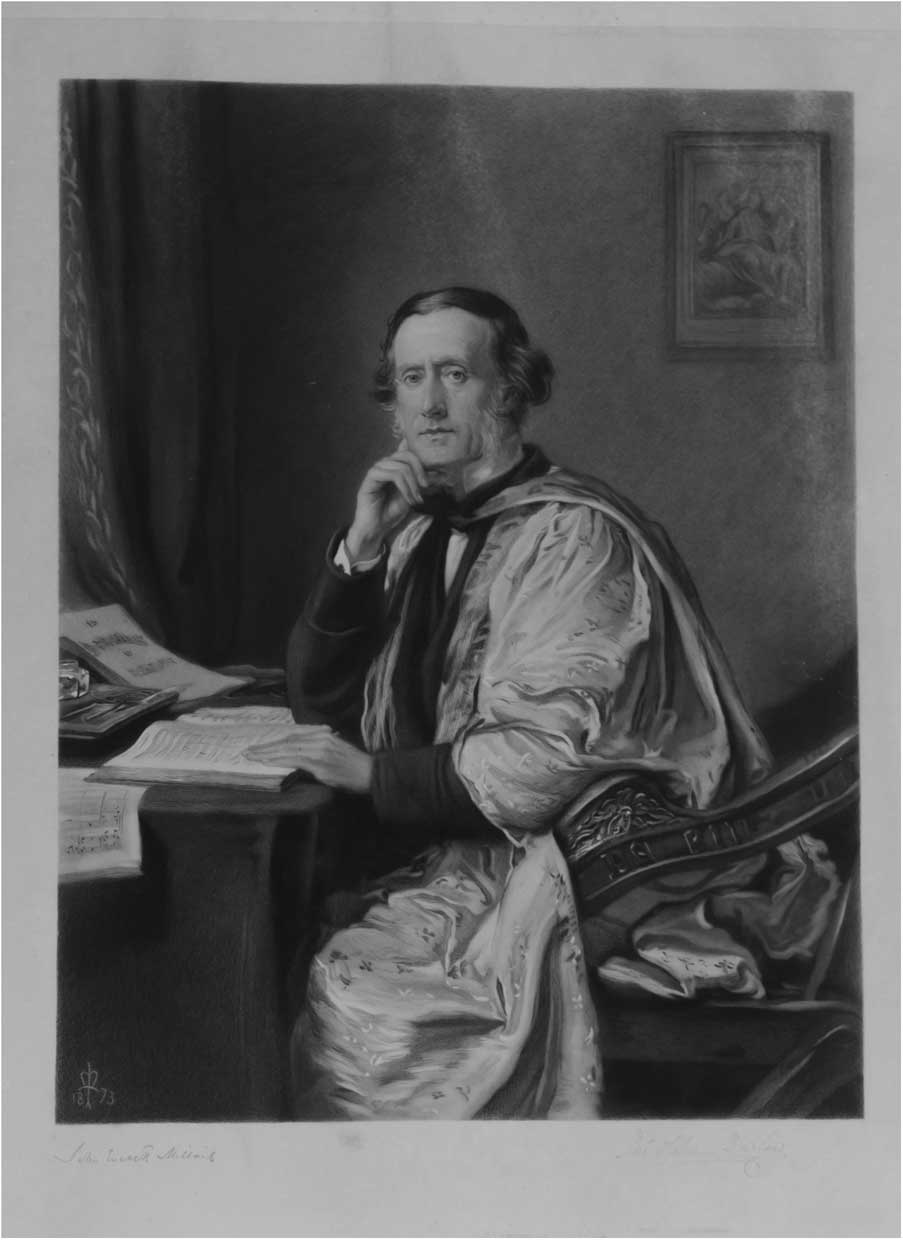
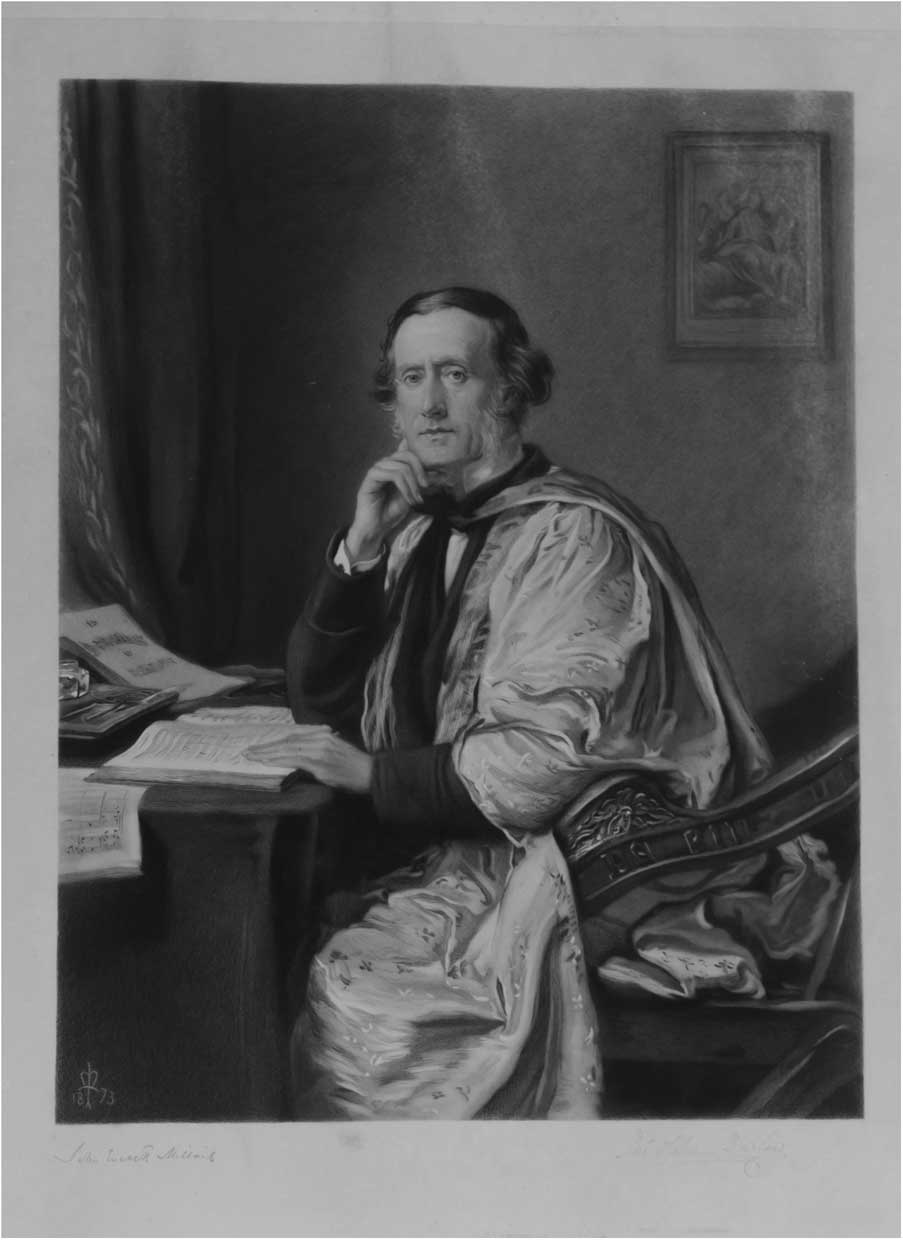
Compare this image with the engraving by Thomas Oldham Barlow after the well-known portrait by Millais, painted nearly forty years later in 1873. Here we see the face of a man apparently bearing the weight of the world on his shoulders. The sparkle in the young man’s eyes has been replaced by the weariness of middle age, youthful enthusiasm by an impression of slightly aloof detachment, the young man by the respected professor of music. Much of course had happened in the intervening period – marriage; the birth of three children; a successful career as teacher, pianist and conductor, culminating in his appointments at Cambridge and the Royal Academy of Music, whose principal he became in 1866. On the negative side, his career as a composer had faltered and he had suffered the loss of both his wife and his musical idol, and it would have been surprising if his face had not been tinged with sadness. But in my eyes there is worry as well, the worry of a man who lacks confidence in his own abilities and judgement.
William Sterndale Bennett. Portrait in oils, c1836, by Thomas Henry Gregg. Reproduced by kind permission of Philip Mould & Co.
Sir William Sterndale Bennett. Engraving by Thomas Oldham Barlow after the portrait by John Everett Millais (1873). Reproduced by kind permission of the Royal College of Music, London.
It would be foolish to attempt to construct an argument solely on the basis of an artist’s inevitably subjective depiction of his sitter, but there is additional documentary evidence to underpin the theory that Bennett suffered a significant loss of confidence in his early twenties. In support of this I propose to draw on the testimony of six further witnesses. Mendelssohn, Clara Schumann and William Spark all played under his baton, while the directors of the Gewandhaus concerts, Davison and Chorley observed his direction of an orchestra. Their opinions on his ability as a conductor differed sharply, depending upon whether they had seen him in the 1830s or 1850s.
During his first two visits to Leipzig (1836–1837, 1839), Bennett had conducted the Gewandhaus orchestra on several occasions and when, in 1843, he asked Mendelssohn for a testimonial, the latter specifically noted ‘That we consider your performance on the Piano as masterly as your Conducting of an Orchestra.’Footnote 96 Had the Gewandhaus concert directors not had equally positive memories, they would surely never have offered him the conductorship for the 1853–1854 season:
The undersigned Concert-direction still remembers with pleasure the time of your long residences in Leipzig and the active service you rendered as well as the kind feeling you showed to the Gewandhaus Concerts.
For these concerts … we are now anxious to obtain, for the next winter’s season, an able conductor. The considerable fame which you, Dear Sir, enjoy in the musical world, and the abiding favour always accorded to you by the public here, make us wish and herewith to express the hope, that it may be agreeable to you to undertake in the coming winter the direction of our twenty subscription concerts, and of two extra ones.Footnote 97
It was an unexpected but gratifying offer and the letter touched Bennett deeply. As his wife wrote, he had been ‘so completely overwhelmed with the feelings of joy and pride at the receipt of such a testimony of friendship and good feeling, that he could have accepted [the post] at once’.Footnote 98 But ever loyal and unwilling to break his previous commitments and, as he put it, ‘contrary to my sincerest desire, and, with the utmost regret’, he felt, nonetheless, compelled to ‘decline the very kind and generous invitation’.Footnote 99 Was this truly an invitation to someone of whom Clara Schumann would later write ‘He is a nice man, but no conductor, he has none of the necessary freshness and vigour’?Footnote 100 William Spark, organist of Leeds Town Hall when Bennett had conducted the inaugural Festival in 1858, was in agreement:
But, noble-minded and gifted as he was, it is only admitting the bare truth when I say that he failed as a conductor. He did not possess the necessary qualifications; he would not stamp his foot, tap the desk with his bâton, or shout to offending performers to keep good time, and play or sing correctly. Distrusting his own power and knowledge, he consulted both Blagrove (the leader of the band) and myself, as to the tempi of many numbers in some of the most important works performed at the Festival.Footnote 101
This same sense of diffident uncertainty had already been on display at the Philharmonic Society when, in June 1856, Bennett had conducted the English premiere of Schumann’s cantata Das Paradis und die Peri. Schumann’s music was still little known and under appreciated in London and, as Chorley reported, ‘Neither chorus and orchestra was at ease’. He continued:
Professor Bennett must have been more puzzled than complimented by one feature of this strange performance, – the presence in the orchestra of Madame Schumann, who guided the conductor, and gave the tempo Philharmonic to the solo singers.Footnote 102
Chorley interpreted this as an unwarranted imposition on Clara Schumann by the directors, whom he accused of ‘want of taste’ and ‘want of feeling for an artist, a stranger, and a woman’.Footnote 103 But, in the knowledge of Bennett’s lack of self-confidence, it could equally have been done at his request. It does, however, prompt the question of how and why he had been appointed in the first place. Following the resignation of Costa in November 1854, the directors had looked overseas for his successor. Their first choice, Spohr, declined, after which they approached both Berlioz and Wagner and the latter accepted.Footnote 104 His performances, however, had been so idiosyncratic (or downright wayward) and the subject of such adverse criticism that neither he nor the Society would have chosen to continue for a further season.Footnote 105 Bennett, in contrast, was considered a ‘safe’ figure and embarked on his task with a quantity of goodwill already banked. As The Musical World (that is, Davison) declared:
The difference between good and bad conducting … could scarcely have been exemplified more clearly than by a comparison of the performance on Monday night with any of the concerts of last year. The symphonies were played exactly as the composers intended, without those so-denominated new readings, the novelty of which consists chiefly in their badness.Footnote 106
It was not long, however, before doubts crept in. Reviewing the fourth concert, Chorley noted that ‘Prof. Bennett has failed in restoring its [the orchestra’s] precision, if, indeed, he has tried so to do’, observing (in connection with his conducting) that ‘His taste in pianoforte-playing … inclines towards what is easy in style and vacillating in measure; and it may be that he does not prize that undeviating accuracy of attack, which to us is the Alpha of orchestral mechanism, – delicacy being its Omega’.Footnote 107 Davison, whose judgements were relatively impartial, regarded him more favourably and his reviews suggest that Bennett grew into the job: if not the most inspirational conductor, he nonetheless presided over a revitalized orchestra before handing the baton to William Cusins in November 1866.Footnote 108 The third concert of that final season certainly excited him:
Rarely has the fifth Symphony of Beethoven … been more superbly played … than on this occasion, under the guidance of Professor Bennett, who, when he retires from the post he now holds with so much distinction, will at least enjoy the satisfaction of knowing that he leaves the society provided with a new and splendid orchestra which he may fairly take to himself the credit of having organised and disciplined.Footnote 109
Bennett’s respected position had made him the natural choice when the Philharmonic Society decided to commission a work to commemorate its fifieth anniversary in 1862, with the minutes recording that ‘Professor Sterndale Bennett be requested to compose a work, of the class that may be most agreeable to himself’.Footnote 110 His response was the fantasie-overture Paradise and the Peri, based on the poem by Thomas Moore that Schumann had used for his cantata. It was his first purely orchestral composition since the overture Die Waldnymphe (1838) and brings together several of the threads that run through this article, making it an appropriate work with which to take our leave of Bennett and the problems that beset him. But before considering whether or not he was ‘guilty’ of experiencing a crisis of confidence which resulted in a) an ‘obsession with perfection’, b) an attack of ‘composers’ block’ and c) insecurity as a conductor, we must review the evidence.
By the early 1860s much had changed since Schumann and Mendelssohn had predicted such a bright future for Bennett. He had not become a ‘very great musician’ and in the early 1850s had more or less acknowledged defeat as a composer and would shortly withdraw from public performance as a pianist. Those fateful words, ‘if he does not become a very great musician, it is not God’s will, but his own’ had turned out to be all too true.Footnote 111 The expectations of others and a growing loss of confidence in his own abilities had led him to question his achievements, as he continued to seek, but rarely found, musical perfection. The combination of London’s unforgivingly commercial musical environment, the hard-headed criticism of Chorley, Davison, Gruneisen and others, together with an absence of support and encouragement from fellow musicians such as he had received in Germany, proved to be almost more than he could cope with. As a result, for close on ten years he wrote very little of any scale or stature. The May Queen, however, proved to be a turning point. Its libretto had lain untouched for nine years, but the receipt of a commission, with its attendant deadline, had forced him to act. And, despite initial misgivings, his creativity began to re-assert itself, albeit in a slightly atypical form. A corner had been turned. During the next four years he received – and fulfilled – three further commissions: an ode for the opening of the 1862 International Exhibition, an ode for the installation of the Duke of Devonshire as Chancellor of the University of Cambridge (1862), and the new orchestral work for the Philharmonic Society. Together they demonstrate that he had not only conquered ‘composers’ block’, but had also fully recovered his compositional voice of old. Moreover, while the first two were both occasional pieces, Paradise and the Peri occupies a central place in his output.Footnote 112
Although not in any sense autobiographical, the overture has links with two people who held a particular place in his affections: ‘my own dear personal friend’,Footnote 113 Robert Schumann, and his beloved wife, Mary Anne; one of them had already died and the other was stricken with an incurable illness – ‘disease of the heart, in a very severe form’.Footnote 114 These circumstances, I believe, account – at least in part – for the work’s intensity of expression: it was as though Schumann had inspired Bennett’s music from beyond the grave. Their friendship, forged during Bennett’s first visit to Germany, had been close. Despite differences in temperament, they had a deep respect for each other as musicians and would regularly play and discuss their latest compositions. In the light of Bennett’s choice of verses from Moore’s Lalla Rookh it is unlikely to be coincidental that when they met for the last time, in Leipzig in early 1842, Schumann was working on the libretto of Das Paradis und die Peri. What would have been more natural than for them to have talked about this ‘work in progress’? When, early in 1851, Robert and Clara were contemplating a concert tour to London, Robert pressed it on Bennett as a work ‘which I believe might find favour in England’, suggesting Jenny Lind as the soprano soloist.Footnote 115 These plans, however, came to nothing and it was not until Bennett was appointed conductor of the Philharmonic Society that he was in a position to perform a work for which he had considerable affection:
I am very anxious to give the ‘Paradise and the Peri’ if Madame Jenny Lind will sing in it, and the Directors will invite her … I do not forget to think of my friend Robert. Do let me know if there is any improvement. What a beautiful work is ‘The Peri.’Footnote 116
Notwithstanding a virulent attack on the work by Davison – ‘three uninterrupted hours of Schumann, three uninterrupted hours of music “without form and void,” three hours of organised sound without a single tune!’Footnote 117 – Bennett chose to repeat it in his final season at the Philharmonic Society (5 March 1866) and these performances and his own use of verses from Moore’s poem can surely be interpreted as a tribute to his departed friend.
Schumann’s was not the only spirit to be embraced by the overture, as its composition coincided with Mary Anne’s fatal illness and much of her husband’s work was done in her sick room, on a ‘table placed by the side of her couch’.Footnote 118 It was clearly a time of great strain in which his feelings were never far from the surface, as when a visitor ‘watched a great tear slowly collecting in his eye until it suddenly dropped on his score whilst he continued to write’.Footnote 119 This emotional intensity is reflected in the work’s rich harmonic language and orchestration, which combine to make it the most Schumann-like of Bennett’s orchestral compositions. Faced with the prospect of his wife’s imminent death, he once again poured his emotions into his music in a manner unseen for twenty years. But some things did not change: notwithstanding the fourteen-month gap between commission and premiere, getting the notes onto the page proved to be a last-minute business. Composition was squeezed into the beginning of July 1862, with the score being finished with three days to spare, at 7a.m. on 11 July. While this surely reflects the fact that he had had another two commissions to complete first, it also suggests that he still needed the pressure of an imminent deadline to force him into action.
Knowing what we do about Bennett’s compositional method, it is more than likely that much of the overture had taken shape in his mind before he put pen to paper. While this would explain his ability to finish it so rapidly, it could also account for its only weakness – a lack of development – which probably reflects his way of working: able to conceive chunks of thematic material in his head, but less good at developing ideas mentally. If so, it would also explain his preference for episodic forms, in which the introduction of new, or the reiteration of earlier, material takes precedence over thematic development. Such was certainly the case with Paradise and the Peri in which, as Chorley noted, Bennett had introduced ‘a series of separate subjects – as many as five, – which are repeated and alternated without any extraordinary attempt at working them up’.Footnote 120 Whilst acknowledging individual beauties, his impression of the new work was lukewarm – ‘As the music slid past, some individual portions gave pleasure … [but] the impression left on us is a want of brilliancy and boldness’.Footnote 121 Davison, in contrast, was positively glowing: ‘the new and beautiful overture … which he had composed for the occasion – decidedly one of the most finished, as it is one of the most original and imaginative works from his pen’.Footnote 122 Paradise and the Peri was repeated annually by the Philharmonic Society while Bennett remained at the helm, but it was not until 1869 that he approached Carl Gurckhaus with a view to getting it published.Footnote 123 By then, however, it had yielded pride of place to his Symphony in G minor (1863–1864), which (he told Gurckhaus) ‘I care for more than my Overture.’Footnote 124
We have now heard all the evidence. Some, not least the role played by Paradise and the Peri in Bennett’s ‘recovery’, is speculative, but the main points, I believe, stand up to scrutiny. And the verdict? Guilty on three counts: of suffering from a) an ‘obsession with perfection’, b) an attack of ‘composers’ block’ and, reflecting these, c) insecurity as a conductor. There were, however, extenuating circumstances. Put simply, the musical climate in England was indifferent, or even actively hostile, towards the type of serious music which Bennett personified, making his transition from gifted student to ‘adult’ composer particularly difficult. Success required dogged determination and, to counter the seemingly endless lack of encouragement (and at times outright opposition) from certain critics, the possession of a thick skin: his obituary in The Athenaeum (see below) is a prime example of this, not without truth, but expressed in a blunt and unsympathetic manner.Footnote 125 Bennett struggled on both counts. Initially, deciding that discretion was the better part of valour, he gradually withdrew from the fray – an action his critics might have construed as cowardice – until, in the late 1850s and 1860s he found the inspiration to put at least some of his difficulties behind him. By then, however, his failure to advance stylistically at a time when Schumann, Liszt and Wagner had been constantly pushing musical boundaries forward meant that his works increasingly sounded dated and were no longer at the forefront of musical development. It is also all too likely that his reverence for Mendelssohn was responsible for his continued attachment to a Mendelssohnian idiom. If Bennett failed to become the ‘very great musician’ that Mendelssohn believed he could have been, it was not, at first, through want of trying. Nor was his predicament – a struggle to translate outstanding youthful achievement into mature greatness – unique. Mozart, Mendelssohn and Samuel Coleridge-Taylor, for example, all created masterpieces in their late teenage years, but only the first two managed to live up to their early promise – and not always without a struggle. Had Bennett remained in Germany he too might have achieved the greatness that was within his reach, but it was his misfortune to be ‘ein englischer Componist’ at a time when the term was rarely a compliment. Today we can laugh at an obituary – almost certainly the work of Gruneisen – whose sourness at times likens it to a caricature, but it serves as a timely reminder of the negative forces, against which Bennett, and others, had to battle. That Gruneisen’s criticisms contain more than a grain of truth complicates matters, but his sense of bewilderment at Bennett’s failure to advance musically during his career was, as we have seen, shared by others:Footnote 126
Deeply as the passing away of such a distinguished musician as Sir W. Sterndale Bennett must be regretted, there is no void left in the annals of Art. As a composer of genius … Bennett’s career ceased with his youth. He has left not a single work which is equal to his juvenile productions. Indeed, it is a most curious fact that there were no stages in his style, no transformations in his forms, no advance in his invention, nothing to fulfil the promise of his early performances. After a display of fancy and imagination, of learning and of melodious inspiration, which was more than enough to immortalize his name, he passed into a kind of lethargy, only producing periodically – almost, indeed, at distant intervals – pieces which, despite their perfect workmanship, their refinement and elegance, were singularly destitute of dramatic power; fire and force seemed to have abandoned him …
He had a circle here around him of devoted followers … but year after year passed, and the idol failed to realize the expectations that had been formed. Something great was always looked for, but it never came … It was strange, however, how, up to the time of his lamented decease, the musical world went on hoping for some masterpiece from him. He had all possible honours conferred on him … But all these … led to no new work showing progress. His programme compositions – [among them] the overture, ‘Paradise and the Peri,’ … are but a feeble reflex of his youthful inspirations … [and] impulsiveness and spontaneity are not to be found.Footnote 127
The Pall Mall Gazette – Davison? – in contrast, provided a more balanced assessment of Bennett’s achievement, and a few words from this make a fitting conclusion:
had he lived in Germany … he would have been appreciated, not more highly perhaps, but much more widely, than he is at this moment in England. There are more private players in Germany than in England equal to the difficulties of his pianoforte music … and more concerts … in which his sonatas, his concertos, and his symphonies would naturally find a place … But everyone who can be moved by sweet sounds must enjoy the music of Sterndale Bennett.Footnote 128