1. Introduction
The Xing’an–Mongolian Orogenic Belt is located between the Siberian and North China cratons (Fig. 1a), and belongs to the central-eastern segment of the Central Asian Orogenic Belt (CAOB), which is one of the largest Phanerozoic accretionary orogenic belts and the most important site of Phanerozoic crustal growth on Earth (Sengör & Natal’in, Reference Sengör and Natal’in1996; Jahn et al. Reference Jahn, Wu and Chen2000; Kovalenko et al. Reference Kovalenko, Yarmolyuk, Kovach, Kotov, Kozakov, Salnikova and Larin2004; Windley et al. Reference Windley, Alexeiev, Xiao, Kröner and Badarch2007; Li et al. Reference Li, Zhang, Feng, Li, Tang and Luo2014a). Since c. 1.0 Ga, the precursor to the Central Asian Orogenic Belt, the Paleo-Asian Ocean, underwent multiple subduction, accretion of island arcs and obduction of ophiolites before terminal collision between the North China and Siberian cratons at c. 250 Ma (Jahn et al. Reference Jahn, Natal’in, Windley and Dobretsov2004; Guo et al. Reference Guo, Fan, Li, Miao and Zhao2009; Li et al. Reference Li, Wilde, Wang, Xiao and Guo2014b). The evolution of the central part of the Paleo-Asian Ocean was closely related to the formation of the Xing’an–Mongolian Orogenic Belt (Tang, Reference Tang1990, Reference Tang1992; Xu & Chen, Reference Xu and Chen1997; Xiao et al. Reference Xiao, Windley, Hao and Zhai2003; Chen et al. Reference Chen, Zhang, Guo, Li, Feng and Tang2012; Xu et al. Reference Xu, Charvet, Chen, Zhao and Shi2013; Shi et al. Reference Shi, Faure, Xu, Zhao and Chen2013; Zhang et al. Reference Zhang, Wu, Feng, Zheng and He2013, Reference Zhang, Li, Li, Tang, Chen and Luo2015b; Li et al. Reference Li, Zhou, Brouwer, Wijbrans, Zhong and Liu2011, Reference Li, Zhou, Brouwer, Xiao, Wijbrans and Zhong2014c). Previous studies show that the Paleo-Asian Ocean underwent a bi-directional subduction process after late Proterozoic time, resulting in the formation of the Xing’an–Mongolian Orogenic Belt (Xiao et al. Reference Xiao, Windley, Hao and Zhai2003). Numerous studies have emphasized the role of multiple subduction in the final closure of the Paleo-Asian Ocean and it is widely accepted that this collision gave rise to the Solonker Suture Zone (Wang & Fan, Reference Wang and Fan1997; Li et al. Reference Li, Gao and Sun2007; Jian et al. Reference Jian, Liu, Kröner, Windley, Shi, Zhang, Shi, Miao, Zhang, Zhang, Zhang and Ren2008; Tong et al. Reference Tong, Hong, Wang, Shi, Zhang and Zeng2010; Wang et al. Reference Wang, Xu, Liu, Zhao and Jiang2013), but controversy remains about the timing and mechanisms involved. For instance, Tang & Shao (Reference Tang and Shao1996) suggested, based on a study of the Ondor Sum ophiolites, that subduction of the Paleo-Asian Ocean began during Cambrian–Ordovician time and terminated during Devonian – Early Carboniferous time. Xiao et al. (Reference Xiao, Windley, Hao and Zhai2003) considered that the Paleo-Asian Ocean underwent bi-directional subduction during the Cambrian–Silurian periods, but that subduction halted before Devonian – Early Carboniferous time, before recommencing after the Late Carboniferous Period. It has been suggested by many authors utilizing palaeogeographic, geochronological and geochemical data from central Inner Mongolia that subduction started during the Ordovician Period and ended during the late Permian Period (Jong et al. Reference Jong, Xiao, Windley, Masago and Lo2006; Li, Reference Li2006; Chen et al. Reference Chen, Jahn and Tian2009; Zhang et al. Reference Zhang, Zhao, Song, Hu, Liu, Yang, Chen, Liu and Liu2009; Wu et al. Reference Wu, Sun, Ge, Zhang, Grant, Wilde and Jahn2011; Wilde, Reference Wilde2015; Wilde & Zhou, Reference Wilde and Zhou2015; Ma et al. Reference Ma, Chen, Zhao, Qiao and Zhou2019; Xu et al. Reference Xu, Liu, Li, Xu and Xie2019). Moreover, most geologists considered that the early bi-directional subduction of the Paleo-Asian Ocean led to the formation of the Bainaimiao and Baiyinbaoli island arcs, with the final collision along the Solonker Suture Zone (Xiao et al. Reference Xiao, Windley, Hao and Zhai2003; Chen et al. Reference Chen, Jahn and Tian2009). Li et al. (Reference Li, Zhou, Brouwer, Xiao, Wijbrans and Zhong2014c) proposed that there was long-lasting bi-direction subduction of the Paleo-Asian Ocean crust from early Palaeozoic to middle Permian time, based on the north Baiyinbaoli island arcs and the south Ondor Sum subduction–accretion complex in the Solonker Suture Zone. Jian et al. (Reference Jian, Liu, Kröner, Windley, Shi, Zhang, Zhang, Miao, Zhang and Tomurhuu2010b) and Shi et al. (Reference Shi, Liu, Deng and Jian2014, Reference Shi, Jian, Kröner, Li, Liu and Zhang2016) considered that the Paleo-Asian Ocean mainly experienced the following events: Ordovician bi-directional subduction, Silurian accretion, Devonian extension, Permian subduction to the south with extension to the north, and continent–continent collision during the late Palaeozoic – early Mesozoic eras.
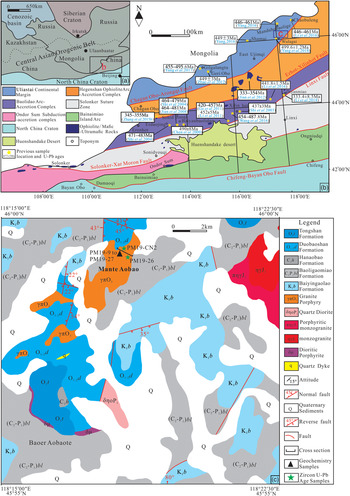
Geological sketch maps showing the location and tectonic setting of the study area: (a) Central Asian Orogenic Belt (modified from Jian et al. Reference Jian, Liu, Kröner, Windley, Shi, Zhang, Shi, Miao, Zhang, Zhang, Zhang and Ren2008 and Wu et al. Reference Wu, Liu, Zhu, Zhou, Jiang, Liu, Li, Wu and Ye2015a); (b) central and eastern Inner Mongolia, showing distribution of the lower Palaeozoic intrusive rocks (modified from Xiao et al. Reference Xiao, Windley, Hao and Zhai2003 and Li et al. Reference Li, Zhou, Li, Zhang, Liu, Zhao, Chen, Gu, Lin and Hu2016); and (c) the relationship of the Mante Aobao granite porphyry to rock units in the East Ujimqin Banner area, Inner Mongolia.

According to previous studies, the Xing’an–Mongolian Orogenic Belt in NE China formed as a result of subduction and accretion during early Palaeozoic time (Fig. 1a; Chen & Xu, Reference Chen and Xu1996; Chen et al. Reference Chen, Jahn, Wilde and Xu2000; Liu et al. Reference Liu, Jian, Zhang, Zhang, Shi, Shi, Zhang and Tao2003; Xiao et al. Reference Xiao, Windley, Hao and Zhai2003; Tao et al. Reference Tao, Xu, He and Su2005; Xu, Reference Xu2005; Zhao et al. Reference Zhao, Ran, Zhang, Li, Wang, Zhang, Xu and Hou2012; Xu et al. Reference Xu, Charvet, Chen, Zhao and Shi2013, Reference Xu, Zhao, Bao, Zhou, Wang and Luo2014; Li et al. Reference Li, Zhou, Li, Zhang, Liu, Zhao, Chen, Gu, Lin and Hu2016). Nevertheless, early Palaeozoic magmatic events are poorly documented in the Uliastai continental margin of the north-central Xing’an–Mongolian Orogenic Belt (Fig. 1b); it is unclear at present whether this reflects the true distribution or is a consequence of insufficient geochronological data hampering our understanding of the subduction history of the Paleo-Asian Ocean and the development of the Xing’an–Mongolian Orogenic Belt. Here we present new zircon U–Pb–Hf isotopes and whole-rock major and trace-element compositions of the Mante Aobao granite porphyry in the East Ujimqin Banner area of the central Xing’an–Mongolian Orogenic Belt (Fig. 1b, c), and evaluate its petrogenesis and tectonic setting.
2. Geological setting
2.a. Regional geology
The Xing’an–Mongolian Orogenic Belt in Inner Mongolia is located in the central-eastern segment of the Central Asian Orogenic Belt (Fig. 1a). It is an ENE-trending tectonic collage composed of the remnants of ophiolites, arcs, accretionary wedges and associated volcano-sedimentary rocks. From north to south, the Xing’an–Mongolian Orogenic Belt is divisible into six tectonic units (Fig. 1b): the Uliastai continental margin; the Hegenshan ophiolite arc-accretion complex; the Baolidao arc-accretion complex; the Solonker Suture Zone; the Ondor Sum subduction–accretion complex; and the Bainaimiao island arc (Xiao et al. Reference Xiao, Windley, Hao and Zhai2003).
The Uliastai continental margin extends along the China–Mongolia border and connects with the Nuhetdavaa terrane to the west (Badarch et al. Reference Badarch, Cunningham and Windley2002; Zhou et al. Reference Zhou, Zhao, Fu, Sun, Li, Huang and Ge2017; Fig. 1b). The strata exposed in the Uliastai continental margin are Ordovician, Silurian, Devonian, Carboniferous – lower Permian, Jurassic and Cretaceous volcano-sedimentary rocks and Tertiary and Quaternary sediments (Tang & Zhang, Reference Tang, Zhang, Xiao and Tang1991; Su, Reference Su1996; Xin et al. Reference Xin, Teng and Cheng2011). Palaeozoic magmatism is extensive and upper Carboniferous – lower Permian intrusive rocks are widespread, dominated by potassium calc-alkali and alkali granites (Zhang, Reference Zhang2008; Yang, Reference Yang2016, Reference Yang2017). Recently, several lower Palaeozoic arc-related magmatic complexes have been recognized (Fig. 1b), including the Wulagai gabbroic diorites (Yang et al. Reference Yang, Wang, Hu, Xin and Li2018), the gabbros in the western sector of the Shamai area (Yang, Reference Yang2016), the Chaobuleng gabbros (Li et al. Reference Li, Zhou, Li, Zhang, Liu, Zhao, Chen, Gu, Lin and Hu2016), the Gilgalangtu complex plutons (Yang, Reference Yang2016; Yang et al. Reference Yang2017), the granodiorite in the western sector of the Mandubaolige area (Yang, Reference Yang2016) and the Geri Obo granites (Zhao et al. Reference Zhao, Ran, Zhang, Li, Wang, Zhang, Xu and Hou2012). The Hegenshan ophiolite arc-accretion complex extends NE for c. 500 km to the north of the Erenhot–Hegenshan Fault (Xiao et al. Reference Xiao, Windley, Hao and Zhai2003; Zhang et al. Reference Zhang, Yuan, Xue, Yan and Mao2015a, b), and contains abundant ophiolitic blocks with various ages. The largest blocks are the lower Carboniferous arc-related supra-subduction zone (SSZ)-type ophiolite at Hegenshan (Robinson et al. Reference Robinson, Zhou, Hu, Reynolds, Bai and Yang1999; Jian et al. Reference Jian, Kröner, Windley, Shi, Zhang, Zhang and Yang2012) and several tectonic blocks at Erenhot (Zhang et al. Reference Zhang, Yuan, Xue, Yan and Mao2015a, b). The Baolidao arc-accretion complex contains abundant lower Carboniferous ophiolites (Miao et al. Reference Miao, Zhang, Fan, Liu, Zhai, Windley, Kusky and Meng2007), blueschists (Xu et al. Reference Xu, Charvet, Chen, Zhao and Shi2013) and upper Carboniferous magmatic arc rocks (Chen et al. Reference Chen, Jahn, Wilde and Xu2000, Reference Chen, Jahn and Tian2009), which were intruded by lower Permian alkaline and peralkaline granites (Shi et al. Reference Shi, Liu, Jian, Zhang, Zhang, Miao, Shi, Zhang and Tao2004).
The Solonker Suture Zone formed during the end of the Palaeozoic Era and represents the collision zone between the Siberian and North China cratons (Xiao et al. Reference Xiao, Windley, Hao and Zhai2003). It extends from Solonker, via Sonid Zuoqi and Xilinhot of Inner Mongolia, and further east to NE China (Fig. 1b). There are two regional faults representing Palaeo-suture zones: the Solonker-Xar Moron Fault and the Linxi Fault. The Solonker-Xar Moron Fault marks the southern boundary of the suture zone, and the Linxi Fault marks the northern boundary (Xiao et al. Reference Xiao, Windley, Hao and Zhai2003). The Ondor Sum subduction–accretion complex mainly comprises lower Palaeozoic blueschists (Tang & Yan, Reference Tang and Yan2007) and a series of ophiolite blocks of Palaeozoic age (Wang & Liu, Reference Wang and Liu1986; Xiao et al. Reference Xiao, Windley, Hao and Zhai2003; Li, Reference Li2006; Miao et al. Reference Miao, Zhang, Fan, Liu, Zhai, Windley, Kusky and Meng2007; Zhou et al. Reference Zhou, Zhao, Fu, Sun, Li, Huang and Ge2017). During late Palaeozoic subduction that was accompanied by the intrusion of several plutons, the Carboniferous and Permian volcano-sedimentary sequences were accreted onto the active margin of the North China Craton. The Bainaimiao island arc is located north of the Chifeng-Bayan Obo Fault. It comprises Middle Ordovician – lower Silurian volcano-sedimentary sequences and magmatic arcs (Jian et al. Reference Jian, Liu, Kröner, Windley, Shi, Zhang, Shi, Miao, Zhang, Zhang, Zhang and Ren2008; Zhang et al. Reference Zhang, Wu, Feng, Zheng and He2013).
2.b. The study area, samples and petrography
The study area is located about 60 km NE of the East Ujimqin Banner area and lies in the Uliastai continental margin zone (Fig. 1b). Lithostratigraphic units mapped in the study area are shown in Figure 1c. The Lower Ordovician Tongshan Formation (O1t) is composed of dark brown siltstone, whereas the Lower–Middle Ordovician Duobaoshan Formation (O1-2d) is composed of calc-alkali andesite, rhyolite, spilite-keratophyre, tuff and interbedded tuffaceous sandstone. The upper Carboniferous – lower Permian Baoligaomiao Formation ((C2–P1)bl) comprises volcanic breccia, rhyolite and dacite. The lower Cretaceous Baiyingaolao Formation (K1b) is composed of acidic volcanic rocks, whereas the Pliocene Baogedawula Formation (N2b) consists of brick-red clays.
Regional geological surveys have revealed the presence of four NE–SW-trending, lower Palaeozoic plutons that have a total area of c. 6.5 km2 (Fig. 1c), one of which is the Mante Aobao pluton. The Mante Aobao pluton was named after the Mante Aobao area, which lies c. 60 km NE of the East Ujimqin Banner area. In the field, the Mante Aobao pluton is granitic throughout and mainly consists of fine- to medium- grained granite porphyry devoid of any mafic-ultramafic intrusions or mafic enclaves (Fig. 1c). Chilled margins or flow structures have not been observed in the pluton, and it is undeformed. Field relationships show that the granite porphyry was emplaced into sandstone, limestone and volcanic rocks of the Duobaoshan Formation, and is unconformably overlain by volcanic rocks of the Baoligaomiao Formation (Figs 1c, 2a, b). We collected two samples for zircon U–Pb–Hf isotope analysis (PM19-26, 118° 17′ 47.626″ E, 45° 58′ 44.961″ N; PM19-CN2, 118° 17′ 37″ E, 45° 58′ 57″ N; Fig. 1c) and 11 samples for geochemical analyses (PM19-9 to PM19-27). The location of the samples is highlighted on Figure 1c. In order to avoid the influence of alteration, the freshest rocks were collected for geochemical analyses.
(a) Sketch and (b) field photograph of contact relationships between the granite porphyry and the Duobaoshan Formation ((C2–P1)bl) and Baoligaomiao Formation (O1–2d); and (c–e) cross-polarized photomicrographs of the granite porphyry. Bi – biotite; Pl – plagioclase; Q – quartz.

The granite porphyry has a porphyritic texture and a massive structure (Fig. 2c–e). Phenocryst minerals are plagioclase (15%), quartz (10%) and minor biotite (5%). The plagioclase is tabular and 0.3–2.5 mm across, and some of the plagioclase is altered to sericite and clay minerals. The quartz is anhedral and is 0.3–2.0 mm across, whereas the biotite forms dark laths that are 0.3–1.0 mm in length and unevenly distributed throughout the rock. The phenocrysts are set in a matrix of felsic minerals and biotite (c. 70%). The accessory minerals are magnetite, titanite, apatite and zircon.
3. Analytical methods
3.a. Zircon U–Pb analysis
As noted above, two granite porphyry samples were collected for zircon U–Pb and Lu–Hf isotopic analysis. Zircons were separated following standard procedures involving crushing and heavy liquid and magnetic techniques, and were handpicked under a binocular microscope. Zircons were then mounted in epoxy resin and the grain mount was abraded and polished in order to cut the crystals in half for analysis. In order to characterize the internal structures of the zircons, transmitted and reflected light photomicrographs and cathodoluminescence (CL) images were obtained and used to select the sites for U–Th–Pb analyses. CL images were obtained using a JXA-8800R electron microprobe at the Tianjin Institute of Geology and Mineral Resources (TIGMR), Tianjin. U–Pb analyses were conducted on a Thermo Scientific Neptune multicollector inductively coupled plasma mass spectrometer (MC-ICP-MS) coupled with a 193 nm laser ablation system at TIGMR. Data acquisition for each analysis took 20 s for the background and 40 s for the signal. Mass discrimination in the mass spectrometer and elemental fractionation were corrected by calibration against the homogeneous zircon standards 91500 and GJ-1; the detailed instrument operating conditions were described by Liu et al. (Reference Liu, Hu, Gao, Nther, Xu, Gao and Chen2008). All zircon data were acquired at a spot size of 32 μm. Off-line selection and integration of background and analytical signals, time-drift corrections and quantitative calibrations for trace-element analyses and U–Pb dating were performed using ICPMSDataCal version 9.0 software (Liu et al. Reference Liu, Gao, Hu, Gao, Zong and Wang2010). The common lead correction was calculated using the Excel software ComPbCorr#3_15G (Andersen, Reference Andersen2002). Concordia diagrams were prepared and weighted mean calculations were performed using Isoplot/Ex_ver3 (Ludwig, Reference Ludwig2003). All ages are quoted at the 2σ level of uncertainty.
3.b. Zircon Lu–Hf isotopic analysis
Zircon Hf isotope measurements were performed on the dated zircons using a Neptune Plus MC-ICP-MS (Thermo Fisher Scientific, Germany) in combination with a Geolas 2005 excimer argon fluoride (ArF) laser ablation system (Lambda Physik, Göttingen, Germany), hosted at the State Key Laboratory of Geological Processes and Mineral Resources, China University of Geosciences, Wuhan. The analyses were conducted on either the same sites previously analysed for U–Pb dating or on adjacent areas, guided by the CL images. All data were acquired with a spot size of 44 μm. Each measurement comprised 20 s of background acquisition followed by 50 s of ablation signal acquisition. The detailed operating conditions for the laser ablation system, the specific MC-ICP-MS instrument and the analytical methods involved were presented in Hu et al. (Reference Hu, Liu, Gao, Liu, Yang, Zhang, Tong, Lin, Zong, Li, Chen, Zhou and Yang2012). The 179Hf/177Hf and 173Yb/171Yb ratios were used to calculate the mass bias of Hf (βHf) and Yb (βYb), which were normalized to 179Hf/177Hf = 0.7325 and 173Yb/171Yb = 1.132685 (Fisher et al. Reference Fisher, Vervoort and Hanchar2014) using an exponential correction for mass bias. Interference of 176Yb on 176Hf was corrected by measuring the interference-free 173Yb isotope and using 176Yb/173Yb = 0.79639 (Fisher et al. Reference Fisher, Vervoort and Hanchar2014) to calculate 176Yb/177Hf. Similarly, the relatively minor interference of 176Lu on 176Hf was corrected by measuring the intensity of the interference-free 175Lu isotope and using the recommended 176Lu/175Lu = 0.02656 (Blichert-Toft & Albarede, Reference Blichert-Toft and Albarede1997) to calculate 176Lu/177Hf. We used the mass bias of Yb (βYb) to calculate the mass fractionation of Lu because of their similar physicochemical properties. The offline selection and integration of analytical signals, as well as the mass bias calibrations, were performed using ICPMSDataCal software (Liu et al. Reference Liu, Gao, Hu, Gao, Zong and Wang2010). The decay constant for 176Lu and the chondritic ratios of 176Hf/177Hf and 176Lu/177Hf used in the calculations were 1.865 × 10⁻¹¹ a–1 (Scherer et al. Reference Scherer, Munker and Mezger2001), and 0.282772 and 0.0332 (Blichert-Toft & Albarede, Reference Blichert-Toft and Albarede1997), respectively. The single-stage model age (T DM1) was calculated relative to the depleted mantle with a present-day 176Hf/177Hf ratio of 0.28325 and a 176Lu/177Hf ratio of 0.0384 (Griffin et al. Reference Griffin, Pearson, Belousova, Jackson, van Achterbergh, O’Reilly and Shee2000); two-stage model ages (T DM2) were calculated by assuming a mean 176Lu/177Hf value of 0.015 for the average continental crust (Griffin et al. Reference Griffin, Pearson, Belousova, Jackson, van Achterbergh, O’Reilly and Shee2000). Initial 176Hf/177Hf ratios and ε Hf(t) values were calculated using the mean zircon crystallization ages of the samples, as determined by the U–Pb dating.
3.c. Whole-rock major and trace-element analysis
Eleven homogeneous granite porphyry samples were selected from the least weathered and altered outcrops. Fresh, homogeneous samples were pulverized using an agate ring mill to <200 mesh. The major elements were analysed using X-ray fluorescence spectrometry (3080E1; Rigaku, Tokyo, Japan) and plasma spectrometry at the Hubei Geological Research Laboratory. FeO was obtained by titrating with potassium dichromate solution in the Hubei Geological Research Laboratory, with analytical uncertainty <5%. Trace-element aliquots were digested in HF + HNO3 in Teflon bombs and analysed with an Agilent 7500a ICP-MS at the Hubei Geological Research Laboratory following the protocols of Liu et al. (Reference Liu, Hu, Gao, Nther, Xu, Gao and Chen2008), with an analytical uncertainty of <1–3%.
4. Analytical results
4.a. Zircon U–Pb ages
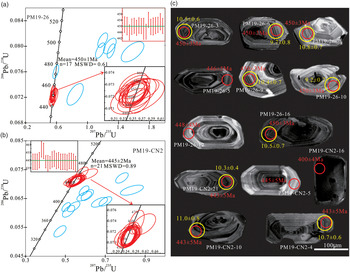
Zircon LA-ICP-MS U–Pb dating results are listed in Table 1. Zircon grains from the two granite porphyry samples were mostly colourless, columnar crystals (60–200 μm long) with length:width ratios of 1.2:1 to 3:1. In CL images (Fig. 3c), most of the zircons show strong oscillatory zoning, typical of magmatic crystallization (Corfu et al. Reference Corfu, Hanchar, Hoskin and Kinny2003; Wu & Zheng, Reference Wu and Zheng2004), but some zircons are dark in CL and lack zoning (Fig. 3c). The content of radiogenic Pb was 7–43 ppm, with little variation. The Th/U ratio ranged from 0.36 to 1.08, values characteristic of magmatic zircons. The zircon crystallization ages of the samples were <1000 Ma, so the 206Pb/238U age was adopted.
LA-ICP-MS zircon U–Pb dating results for the Mante Aobao granite porphyry in East Ujimqin Banner, Inner Mongolia. All U–Pb zircon ages are corrected for 204Pb using Excel software ComPbCorr#3_15G (Andersen, Reference Andersen2002)

LA-ICP-MS zircon U–Pb concordia diagrams for samples (a) PM19-26 and (b) PM19-CN2 from the Mante Aobao granite porphyry in the East Ujimqin Banner area. (c) Representative cathodoluminescence (CL) images, U–Pb ages and Hf isotopic compositions of zircons from samples PM19-26 and PM19-CN2. The red circles are 32 μm in diameter and show the location of the U–Pb analytical sites; the yellow circles are 44 μm in diameter and show the location of the Lu–Hf isotopes analytical sites.

A total of 24 spots were analysed on zircons from sample PM19-26; of these, 17 were concordant, recording a weighted mean 206Pb/238U age of 450 ± 1 Ma (mean square weighted deviation or MSDW = 0.61) (Fig. 3a). One analysis (26-2) recorded an older 206Pb/238U age of 472 ± 3 Ma, which was interpreted as a xenocryst. Six analyses were strongly discordant (Fig. 3a) and were not used in the age calculation. The reason for this is unclear, but perhaps represents an incorrect 204Pb correction.
A total of 32 sites were analysed on zircons from sample PM19-CN2, and 21 sites were concordant and recorded a weighted mean 206Pb/238U age of 445 ± 2 Ma (MSDW = 0.89) (Fig. 3b). The remaining 11 analyses gave younger and discordant ages. These zircons mostly have CL-dark features and some lack typical growth zoning (Fig. 3c), indicating that they may have undergone a degree of metamictization causing Pb loss (Wan et al. Reference Wan, Liu, Dong and Yin2011).
4.b. Zircon Lu–Hf isotope data
The sites used for U–Pb dating were also used for in situ zircon Hf isotope analysis (Table 2; Fig. 3c). Eight analyses of the c. 450 Ma zircons from granite porphyry sample PM19-26 yielded 176Hf/177Hf = 0.282767–0.282818, with ε Hf(t) values ranging from +9.2 to +10.8 and T DM2 = 719–821 Ma. Eight analyses of the c. 445 Ma zircons from granite porphyry sample PM19-CN2 yielded 176Hf/177Hf = 0.282776–0.282828, with ε Hf(t) values ranging from +9.3 to +11.2 and T DM2 = 691–810 Ma. In the ε Hf(t) versus age diagram (Fig. 4a, b), nearly all of the samples plot in the field of igneous rocks from the Eastern CAOB (Xiao et al. Reference Xiao, Zhang, Qin, Sun and Li2004; Chen et al. Reference Chen, Jahn and Tian2009), but are distinct from those of the Yanshan Fold and Thrust Belt (YFTB), as determined by Yang et al. (Reference Yang, Wu, Shao, Wilde, Xie and Liu2006).
Zircon Hf isotope compositions of the Mante Aobao granite porphyry in East Ujimqin Banner, Inner Mongolia

(176Hf/177Hf)i = (176Hf/177Hf)initial = (176Hf/177Hf)s–(176Lu/177Hf)s×(e λt–1); ε Hf(t)={[(176Hf/177Hf)s– (176Lu/177Hf)s×(e λt–1)]/[(176Hf/177Hf)CHUR,0 –(176Lu/177Hf)CHUR×(e λt–1)]}×10 000; f Lu/Hf=[(176Lu/177Hf)s/(176Lu/177Hf)Chondrite–1]×100%; T DM1=1/λ×ln{1+ [(176Hf/177Hf)s – (176Hf/177Hf)DM]/[(176Lu/177Hf)s – (176Lu/177Hf)DM]}; T DM2 = T DM1 – (T DM1 – t)[(f CC – f S)/(f CC – f DM)], where t is weighted age of zircon in the sample; λ is 176Lu β–decay constant; (176Hf/177Hf)i is initial 176Hf/177Hf ratio in samples; (176Hf/177Hf)s and (176Lu/177Hf)s are values measured in samples; ε Hf(t) and f Lu/Hf are deviation of Hf isotopic composition from chondrites; (176Hf/177Hf)CHUR, 0 and (176Lu/177Hf)CHUR are evolution of the (176Hf/177Hf) and (176Lu/177Hf) ratios in chondritic uniform reservoir, respectively; (176Hf/177Hf)DM and (176Lu/177Hf)DM are (176Hf/177Hf) and (176Lu/177Hf) ratios in depleted mantle (DM), respectively; T DM1 is single-stage evolutionary depleted mantle Hf model age of source rock; T DM2 is crust model age; f CC, f S and f DM are present f Lu/Hf values of continental crust, samples and depleted mantle, respectively. λ = 1.867×10⁻¹¹ a–1; (176Hf/177Hf)CHUR,0 = 0.282772; (176Lu/177Hf)CHUR = 0.03321 (Blichert-Toft & Albarede, Reference Blichert-Toft and Albarede1997); (176Hf/177Hf)DM = 0.28325, (176Lu/177Hf)DM = 0.03824 (Griffin et al. Reference Gorton and Schandl2000); f CC = –0.55 (average crust, Griffin et al. Reference Griffin, Pearson, Belousova, Jackson, van Achterbergh, O’Reilly and Shee2000); f DM = 0.1566 (Griffin et al. Reference Gorton and Schandl2000).
Diagrams of zircon ε Hf(t) versus crystallization age for the Mante Aobao granite porphyry: (a) 0–3000 Ma, with fields for the Eastern Central Asian Orogenic Belt (CAOB) (Xiao et al. Reference Xiao, Zhang, Qin, Sun and Li2004; Chen et al. Reference Chen, Jahn and Tian2009) and the Yanshan Fold and Thrust Belt (YFTB) (Yang et al. Reference Yang, Wu, Shao, Wilde, Xie and Liu2006); and (b) close-up of the Mante Aobao granite porphyry data for age 440–460 Ma.

4.c. Major and trace elements
A complete dataset of whole-rock major- and trace-element analyses of 11 representative samples from the Mante Aobao granite porphyry is presented in Table 3. All the samples display high SiO2 values, with a narrow range from 71.69 to 72.33 wt%, with high Na2O values (3.61–5.01 wt%) and moderate K2O values (3.06–3.92 wt%). Total alkalis (K2O+Na2O) range from 7.26 to 8.23 wt%, plotting in the granite field on the total alkali-silica (TAS) diagram (Middlemost, Reference Middlemost1994; Fig. 5a). Using the K2O versus SiO2 classification diagram, the samples belong to the medium- to high-K calc-alkaline series (Rickwood, Reference Rickwood1989; Fig. 5b). They have relatively high Al2O3 contents (13.48–14.59 wt%), and vary from metaluminous to weakly peraluminous (aluminous saturation index A/CNK, molar Al2O3/(CaO+K2O+Na2O), of 0.98–1.11) (Peccerillo & Taylor, Reference Peccerillo and Taylor1976; Fig. 5c), with uniform alumina saturation indices (ASI) of 0.73–0.84 (Table 3). The samples also exhibit low FeOT (2.13–2.58 wt%) and MgO (0.57–0.81 wt%) contents, which means they have magnesian granitic affinities according to the classification scheme of Frost et al. (Reference Frost, Barnes, Collins, Arculus, Ellis and Frost2001) (Fig. 5d).
Chemical compositions and main geochemical parameters of the Mante Aobao granite porphyry in East Ujimqin Banner, Inner Mongolia

a A/NK = molar Al2O3/(Na2O+K2O); b A/CNK = molar Al2O3/(CaO+Na2O+K2O); c Aluminium saturation index ASI = Al/(Ca – 1.67P + Na + K); d FeOT = FeO + 0.8998 × Fe2O3; e TZr (°C) = 12 900/[2.95+0.85M+ln(496 000/Zrmelt)] − 273.15, where M = (Na+K+2Ca)/(Al×Si), mole ratio and Zrmelt is the Zr content in the magma (Watson & Harrison, Reference Watson and Harrison1983); f (La/Yb)N is chondrite-normalized ratio; g Eu/Eu* = EuN/(SmN × GdN)/2, where N denotes chondrite normalization. The chondrite values are from Sun & McDonough (Reference Sun, McDonough, Saunders and Norry1989).
Geochemical diagrams for the Mante Aobao granite porphyry in East Ujimqin Banner. (a) TAS diagram for chemical classification (Middlemost, Reference Middlemost1994) and alkalinity index (after Irvine & Baragar, Reference Irvine and Baragar1971); (b) K2O versus SiO2 diagram (Rickwood, Reference Rickwood1989); (c) A/NK versus A/CNK diagram (Peccerillo & Taylor, Reference Peccerillo and Taylor1976); and (d) FeOT/(FeOT+MgO) versus SiO2 (Frost et al. Reference Frost, Barnes, Collins, Arculus, Ellis and Frost2001). A-type granite field after Frost et al. (Reference Frost, Barnes, Collins, Arculus, Ellis and Frost2001).

Total rare earth element (REE) concentrations for the Mante Aobao granite porphyry range over 132–149 ppm (mean, 141 ppm). Chondrite-normalized REE patterns (Sun & McDonough, Reference Sun, McDonough, Saunders and Norry1989; Fig. 6a) exhibit enrichment of light REEs (LREEs) with (La/Yb)N ratios of 4.68–5.77, and have moderate negative Eu anomalies with Eu/Eu* ratios of 0.52–0.63, as well as a greater differentiation of LREEs ((La/Sm)N = 3.1–3.6) compared with heavy REEs (HREEs) ((Gd/Yb)N = 1.0–1.1; Fig. 6a). On a primitive mantle-normalized spidergram (Sun & McDonough, Reference Sun, McDonough, Saunders and Norry1989; Fig. 6b), the Mante Aobao granite porphyry samples are enriched with large-ion lithophile elements (LILEs, e.g. U, Th, Rb and K), light REEs and Pb, and are depleted in high–field-strength elements (HFSEs, e.g. Nb, Ta, P and Ti); troughs for Sr and Ti may be related to plagioclase and Fe–Ti oxide remaining in the source or, for the latter, to the early extraction of Fe–Ti phases. The zircon saturation temperatures (TZr) for the Mante Aobao granite porphyry, calculated using the method proposed by Watson & Harrison (Reference Watson and Harrison1983), are 802–823°C (Table 3).
(a) Chondrite-normalized REE diagram and (b) primitive mantle-normalized trace-element spider diagram for the Mante Aobao granite porphyry in East Ujimqin Banner. Primitive mantle and chondrite values from Sun & McDonough (Reference Sun, McDonough, Saunders and Norry1989).

5. Discussion
5.a. Age of the Mante Aobao granite porphyry
These are the first isotopic crystallization ages obtained for the Mante Aobao granite porphyry. Relying only on geological features (Fig. 2a, b), previous researchers suggested that its formation age should be older than that of the volcanic rocks associated with the upper Carboniferous – lower Permian Baoligaomiao Formation. The zircon U–Pb ages indicate that the emplacement of the granite porphyry occurred at 445–450 Ma, which means it formed in the Late Ordovician Period, contemporaneous with other plutonic rocks in the Uliastai continental margin of the north-central Xing’an–Mongolian Orogenic Belt (Fig. 1b) including the granodiorite at Gilgalangtu (433–497 Ma) (Yang et al. Reference Yang2017), the complex massif at Geriaobao (449 Ma) (Zhao et al. Reference Zhao, Ran, Zhang, Li, Wang, Zhang, Xu and Hou2012), the gabbro in the western sector of the Shamai area (449 Ma) (Yang, Reference Yang2016), the granodiorite in the western Mandubaolige area (446–461 Ma) (Yang, Reference Yang2016), and the gabbro in the East Ujimiqin Banner area at Chaobuleng (450–461 Ma) (Li et al. Reference Li, Zhou, Li, Zhang, Liu, Zhao, Chen, Gu, Lin and Hu2016).
5.b. Classification of the Mante Aobao granite porphyry
Chappell & White (1974, Reference Chappell and White1992) first proposed the S-I classification for granites and, subsequently, the ‘alphabet classification’ of S-, I-, M- and A-type granites evolved (Bonin, Reference Bonin2007). The Mante Aobao granite porphyry is geochemically distinct from M-type granites, which are characterized by low K2O values (typically <1 wt%) (Bonin, Reference Bonin2007), relatively low alumina saturation indices (0.73–0.84), low 10 000 × Ga/Al values (2.04–2.38), low HFSE contents (Zr+Nb+Ce+Y = 297–322 ppm), low (Na2O+K2O)/CaO ratios (3.72–8.57) and low FeOT/MgO ratios (2.34–4.38), distinguishing them from A-type granites (Fig. 7a, b) (Whalen et al. Reference Whalen, Currie and Chappell1987). Moreover, most samples plot in the field of fractionated granites (FG) (Fig. 7a, b).
Plots of (a) 10 000×Ga/Al and (b) (K2O + Na2O)/CaO versus (Zr + Nb + Ce +Y) (Whalen et al. Reference Whalen, Currie and Chappell1987), (c) Th versus Rb and (d) Y versus Rb (Chappell & White, Reference Chappell and White1992) for the Mante Aobao granite porphyry in East Ujimqin Banner. Additional highly fractionated I-type granite data are from Fogang, South China (Li et al. Reference Li, Gao and Sun2007) and Chayu, Tibetan Plateau (Zhu et al. Reference Zhou, Zhang, Liu, Liu and Liu2009).

The samples of granite porphyry in this study are calc-alkaline to high-K calc-alkaline, and metaluminous to weakly peraluminous (A/CNK = 0.98–1.11), which are characteristics of I-type granites (Chappell & White, Reference Chappell and White1974). Generally, trace elements such as Rb, Y and Th are commonly used for distinguishing I- and S-type granites (Li et al. Reference Li, Gao and Sun2007). In Th and Y versus Rb diagrams (Chappell & White, Reference Chappell and White1992; Li et al. Reference Li, Gao and Sun2007; Zhu et al. Reference Zhu, Mo, Wang, Zhao, Niu, Zhou and Yang2009; Fig. 7c, d), our samples exhibit a distinct I-type trend. The amounts of differentiation index (DI) and corundum in the CIPW norm calculations are almost entirely within the range of 85–90% and 0.17–1.65%, respectively (with only one sample having >1% corundum), consistent with highly fractionated I-type granites (Chappell & White, Reference Chappell and White2001). In addition, the bulk zirconium saturation temperatures calculated for the Mante Aobao granite porphyry (Table 3, 802–823°C) are higher than those indicative of mean S-type granite temperatures (i.e. 764°C) (Pearce et al. Reference Pearce, Harris and Tindle1984). Accordingly, the Mante Aobao granite porphyry can be classified as a highly fractionated I-type granite.
5.c. Petrogenesis of the Mante Aobao granite porphyry
Parental magmas of highly fractionated I-type granites may be produced by: (1) fractional crystallization from mantle-derived mafic magma (Chappell, Reference Chappell1999; Wyborn et al. Reference Wyborn, Chappell and James2001); (2) mixing between crust-derived felsic and mantle-derived mafic magmas (Wu et al. Reference Wu, Yang, Wilde and Zhang2005a; Li et al. Reference Li, Gao and Sun2007; Zhu et al. Reference Zhu, Mo, Wang, Zhao, Niu, Zhou and Yang2009); and (3) partial melting of crustal material, followed by fractional crystallization (Chappell & White, Reference Chappell and White2001; Wu et al. Reference Wu, Yang, Wilde and Zhang2005a). The Mante Aobao I-type granite porphyry samples have relatively low MgO (0.57–0.81 wt%), Mg no. (29–40), Cr (4.09–17.06 ppm) and Ni (3.18–15.36 ppm) contents, inconsistent with the compositional characteristics of a mafic melt (Baker et al. Reference Baker, Hirschmann, Ghiorso and Stolper1995; Valley et al. Reference Valley, Lackey, Cavosie, Clechenko, Spicuzza, Basei, Bindeman, Ferreira, Sial, King, Peck, Sinha and Wei2005). On the basis of experimental petrology, hydrous, medium- to high-K mafic magmas can only fractionate to produce 12–25 wt% of a granitic differentiation product (Sisson et al. Reference Sisson, Ratajeski, Hankins and Glazner2005), meaning that large volumes of mafic rocks would be required to be coeval and cogenetic with the granites. We consider it unlikely that the primary magma of the Mante Aobao granite porphyry was generated directly from fractional crystallization of mafic magma because the SiO2 contents are extremely high (>71%); furthermore, there is a lack of contemporaneous large-scale mafic igneous rocks in the area. The magmatic mixing of mantle- and crust-derived melts would produce a wide range of isotopic and geochemical signatures. This is inconsistent with the narrow range of zircon ε Hf(t) values (+9.2 to +11.2) and the chemical composition (Table 3) of the Mante Aobao granite porphyry. Moreover, flow structures or mafic enclaves, which are two significant indicators of magma mixing (Perugini & Poli, Reference Perugini and Poli2012), have not been found in the Mante Aobao granite porphyry. Petrographic textures, such as quartz ocelli rimmed by hornblende and/or biotite and acicular apatite, which are typical of magma mixing (Hibbard, Reference Hibbard, Didier and Barbarin1991; Baxter & Feely, Reference Baxter and Feely2002), are also absent (Fig. 2b-d). Hence, the magma mixing model is inapplicable to the Mante Aobao granite porphyry. In general, the partial melting of mafic crustal materials accounts for the origin of I-type granites, as commonly documented by field observations, geochemical and experimental data (Chappell, Reference Chappell1999). The Mante Aobao granite porphyry samples display enrichment in LREEs relative to HREEs, with negative Eu anomalies and relatively flat HREE patterns. All these features, combined with the relatively high SiO2 contents, suggests that it is a crust-derived granite. Some trace element ratios (e.g. Nb/Ta, Zr/Hf and Th/U) are also useful to reveal the source rocks of granitic magmas. The similarity of the Nb/Ta (8.27–9.9; mean, 9.24), Zr/Hf (26.26–30.26; mean, 28.83) and Th/U (3.54–4.41; mean, 3.79) values between the Mante Aobao I-type granites and the bulk continental crust (Nb/Ta = 11, Zr/Hf = 33 and Th/U = 4) (Taylor & McLennan, Reference Taylor and McLennan1985, p.312) is also consistent with a crustal origin. Furthermore, the zircons exhibit positive ε Hf(t) values ranging from +9.2 to +11.2, and yield two-stage Hf model ages (T DM2) of 691–821 Ma, implying that the primitive magma was derived from juvenile crust, similar to the magma sources of the Palaeozoic – lower Mesozoic magmatic rocks in the south accretionary margin of the Siberian Craton which derived from depleted mantle or juvenile crust materials (Wu et al. Reference Wu, Sun and Lin1999, Reference Wu, Jahn, Wilde and Sun2000, Reference Wu, Jahn, Lo, Yui, Lin, Ge and Sun2003, Reference Wu, Li, Zheng and Gao2007; Chen et al. Reference Chen, Jahn, Wilde and Xu2000; Jahn et al. Reference Jahn, Wu and Chen2000, Reference Jahn, Natal’in, Windley and Dobretsov2004; Sui et al. Reference Sui, Ge, Wu, Zhang, Xu and Cheng2007; Miao et al. Reference Miao, Fan, Liu, Zhang, Shi and Guo2008; Liu et al. Reference Liu, Li, Chi, Zhao, Hu and Feng2012). Moreover, in the La/Sm versus La diagram (Fig. 8a) and in the Zr/Nb versus Zr diagram (Fig. 8b) the samples from the Mante Aobao granite porphyry define nearly horizontal trends, suggesting that fractional crystallization played a more important role during the magmatic evolution of the granites. The samples show significant depletion in Nb, Ta, Ti, Ba, Sr, P and Eu, which suggests that rutile, Fe–Ti oxides and apatite were rare in or absent from the magma sources. The pronounced depletion in these elements also implies fractional crystallization of plagioclase, K-feldspar and apatite during magmatic evolution. In summary, the granite porphyry was generated by partial melting of Neoproterozoic juvenile crust and subsequently underwent fractional crystallization during evolution and ascent of the magma. Combined with the relatively high zircon saturation temperatures (mostly 802–823°C; Table 3), it is suggested that the heat source for partial melting may have been provided by the underplating of mantle-derived magmas during the Late Ordovician Period.
(a) La/Sm versus La diagram and (b) Zr/Nb versus Zr diagram for the Mante Aobao granite porphyry in East Ujimqin Banner.

5.d. Tectonic setting
Although small, the Mante Aobao granite porphyry offers important insights into the tectonic evolution of the Xing’an–Mongolian Orogenic Belt. The U–Pb ages of 445–450 Ma demonstrate that a Late Ordovician magmatic event occurred in the East Ujimqin Banner area. To identify the tectonic setting of the Mante Aobao granite porphyry, we use plots of (La/Yb)N versus YbN, Sr/Y versus Y, the (Ta×3)–(Rb/30)–Hf triangular diagram, and Rb versus (Y+Nb) (Harris et al. Reference Harris, Pearce, Tindle, Coward and Ries1986; Defant & Drummond, Reference Defant and Drummond1990; Fig. 9a–d). Most samples plot in the arc and volcanic-arc fields on these tectonic discrimination diagrams. Furthermore, in the Th/Yb versus Ta/Yb and La/Yb versus Th/Yb diagrams (Pearce et al. Reference Pearce, Harris and Tindle1984; Condie, Reference Condie1989; Gorton & Schandl, Reference Gorton and Schandl2000; Fig. 9e, f), all samples plot within the active continental margin field. In Figure 1b, we have synthesized data from numerous lower Palaeozoic magmatic rocks with zircon U–Pb ages of 433–496 Ma, which extend in a NE direction along the East Ujimqin Banner, Geri Obao and Erenhot axis towards Mongolia (Cui et al. Reference Cui, Wang, Zhang and Cui2008; Wilhem et al. Reference Wilhem, Windley and Stampfli2012; Zhao et al. Reference Zhao, Ran, Zhang, Li, Wang, Zhang, Xu and Hou2012; Yang et al. Reference Yang, Luo, Wang and Xu2014; Zhu et al. Reference Zhu, Baatar, Miao, Anaad, Zhang, Yang and Li2014; Li et al. Reference Li, Zhou, Li, Zhang, Liu, Zhao, Chen, Gu, Lin and Hu2016). All these rocks have typical arc signatures, and the geochemical data for the Mante Aobao granite porphyry presented in this study share these same characteristics (Fig. 9a, b). Accordingly, the Mante Aobao granite porphyry, as well as the other almost coeval plutons, formed in an extensive subduction-related continental margin-arc setting that is consistent with generation during subduction of the Paleo-Asian Ocean.
Tectonic discrimination diagrams for the Mante Aobao granite porphyry in East Ujimqin Banner. (a) (La/Yb)N versus YbN (Defant & Drummond, Reference Defant and Drummond1990); (b) Sr/Y versus Y (Defant & Drummond, Reference Defant and Drummond1990); (c) (Ta×3)–(Rb/30)–Hf triangular diagram (Harris et al. Reference Harris, Pearce, Tindle, Coward and Ries1986); (d) Rb versus Y+Nb (Pearce et al. Reference Pearce, Harris and Tindle1984); (e) Th/Yb versus Ta/Yb (Gorton & Schandl, Reference Gorton and Schandl2000); and (f) La/Yb versus Th/Yb (Condie, Reference Condie1989). VAG – volcanic arc granites; ORG – ocean ridge granites; WPG – within-plate granites; SYN–COLG – syn-collisional granites; POST-COLG – post–collisional granites.

Previous studies have shown that the Xing’an–Mongolian Orogenic Belt underwent a series of tectonic events, including oceanic plate subduction, crustal accretion, multi-block collision and post-orogenic extension during the early Palaeozoic Era, resulting in several accreted tectono-magmatic belts (Xiao et al. Reference Xiao, Windley, Hao and Zhai2003; Xu et al. Reference Xu, Zhao, Wang, Liao, Luo, Bao and Zhou2015). In southern Mongolia, north of the study area, a series of large-scale subduction–accretion episodes took place between the Neoproterozoic and the early Palaeozoic eras. The Mongolian arc, now located in the border region between China and Mongolia, potentially extends from western Mongolia and connects with the Toudaoqiao–Gaxian–Xinlin ophiolite belt in the east. In terms of its tectonic position, the Mante Aobao granite porphyry may therefore occupy the extension of the southern margin of the Mongolian arc into China (Badarch et al. Reference Badarch, Cunningham and Windley2002; Eizenhöfer et al. Reference Eizenhöfer, Zhao, Zhang and Sun2014, Reference Eizenhöfer, Zhao, Sun, Zhang, Han and Hou2015; Xu et al. Reference Xu, Zhao, Wang, Liao, Luo, Bao and Zhou2015, Reference Xu, Zhao, Li, Liu, Wang, Han, Eizenhöfer, Zhang, Hou and Liu2017). However, according to existing data, ophiolites related to the Mongolian arc formed principally during Neoproterozoic–Cambrian time. For example, the formation age of the ophiolites in the western sector of the arc at Bayankhongor in central Mongolia is 636–655 Ma (Jian et al. Reference Jian, Kröner, Windley, Shi, Zhang, Miao, Tomurhuu, Zhang and Liu2010a), 568 Ma in the Khantaishir area of western Mongolia (Gibsher et al. Reference Gibsher, Khain, Kotov, Salnikova, Kozakov, Kovach, Yakovleva and Fedoseenko2001) and 571 Ma in the Bayannur area of Western Mongolia (Khain et al. Reference Khain, Bibikova, Salnikova, Kröner, Gibsher, Didenko, Degtyarev and Fedotova2003). The formation age of the Toudaoqiao blueschists ranges over 511–516 Ma in the eastern Mongolian arc (Zhou et al. Reference Zhou, Wang, Wilde, Zhao, Cao, Zheng and Zeng2015; Liu et al. Reference Liu, Li, Feng, Wen, Neubauer and Liang2017), over 510–539 Ma for the Xinlin ophiolites, and is c. 630 Ma for the Gaxian ophiolites (Feng, Reference Feng2015). Furthermore, Ge et al. (Reference Ge, Wu, Zhou and Rahman2005) and Wu et al. (Reference Wu, Sun, Zhao, Li, Zhao, Pang and Li2005b) dated post-collisional granites at 517–504 Ma and 494–480 Ma, respectively, marking the end of subduction beneath the Mongolian arc, in the north of Heilongjiang Province. The above data show that the Mongolian arc was activated before the Early Ordovician Period. As a result of this study, the Mante Aobao granite porphyry formed during the Late Ordovician Period (at c. 450–445 Ma), which is clearly later than the Mongolian arc, and hence are unrelated to that arc-building episode.
A lower Palaeozoic arc-related magmatic belt is also present along the Sonid Zuoqi to Xilinhot axis (with a magmatic age of 416–496 Ma) to the south of the Mante Aobao granite porphyry (Fig. 1b), most probably resulting from northwards subduction of the Paleo-Asian Ocean (Shi et al. Reference Shi, Liu, Jian, Zhang, Zhang, Miao, Shi, Zhang and Tao2004; Jian et al. Reference Jian, Liu, Kröner, Windley, Shi, Zhang, Shi, Miao, Zhang, Zhang, Zhang and Ren2008; Li et al. Reference Li, Zhou, Brouwer, Xiao, Wijbrans and Zhong2014c; Wang et al. Reference Wang, Xin, Hu, Zhang, Zhao, Geng, Yang, Teng and Li2016). Northwards subduction was recorded by the subduction-related diorite from the Hada pluton to the north of Siziwangqi with an age of 508 ± 10 Ma (Zhou et al. Reference Zhou, Zhang, Liu, Liu and Liu2009), coeval with eruption of the Duobaoshan volcano. Arc magmas on the southern margin of Sonid Zuoqi yielded a SHRIMP zircon U–Pb age of 490 ± 8 Ma, indicating that arc magmatism is also related to N-dipping subduction of the Paleo-Asian Ocean (Chen et al. Reference Chen, Zhao and Wilde2001). The age of Xilin Gol magmatism is in line with SHRIMP zircon U–Pb ages of 464 ± 8 Ma and 479 ± 8 Ma from the Baiyinbaolidao adakitic tonalities at Sonid Zuoqi (Shi et al. Reference Shi, Liu, Jian, Zhang, Zhang, Miao, Shi, Zhang and Tao2005).
The data presented in this paper therefore show that the Mante Aobao granite porphyry formed during the same magmatic period previously identified for the Sonid Zuoqi to Xilinhot axis (Shi et al. Reference Shi, Liu, Jian, Zhang, Zhang, Miao, Shi, Zhang and Tao2004, Reference Shi, Jian, Kröner, Li, Liu and Zhang2016; Zhao et al. Reference Zhao, Ran, Zhang, Li, Wang, Zhang, Xu and Hou2012; Li et al. Reference Li, Zhou, Li, Zhang, Liu, Zhao, Chen, Gu, Lin and Hu2016; Yang et al. Reference Yang2017, Reference Yang, Wang, Hu, Xin and Li2018). Furthermore, it has been suggested in previous studies (Cui et al. Reference Cui, Wang, Zhang and Cui2008; Wilhem et al. Reference Wilhem, Windley and Stampfli2012; Zhao et al. Reference Zhao, Ran, Zhang, Li, Wang, Zhang, Xu and Hou2012; Yang et al. Reference Yang, Luo, Wang and Xu2014; Zhu et al. Reference Zhu, Baatar, Miao, Anaad, Zhang, Yang and Li2014; Li et al. Reference Li, Zhou, Li, Zhang, Liu, Zhao, Chen, Gu, Lin and Hu2016) that the lower Palaeozoic zone adjacent to our study area was related to an active continental margin. These studies have also indicated that the magmatic rocks, along with volcanic rocks of the Duobaoshan Formation that indicate an island arc to the south, constitute an arc-basin system (Cui et al. Reference Cui, Wang, Zhang and Cui2008; Zhao et al. Reference Zhao, Ran, Zhang, Li, Wang, Zhang, Xu and Hou2012; Yang et al. Reference Yang, Luo, Wang and Xu2014; Li et al. Reference Li, Zhou, Li, Zhang, Liu, Zhao, Chen, Gu, Lin and Hu2016). The Mante Aobao granite porphyry most likely formed by the northwards subduction of the Paleo-Asian Ocean during the early Palaeozoic Era. However, the lower Palaeozoic magmatic rocks in the Uliastai continental margin, including the Mante Aobao granite porphyry, are located some considerable distance from the Sonid Zuoqi to Xilinhot axis (Fig. 1b), and are separated by the Hegenshan ophiolite belt. Moreover, previous studies (Chen et al. Reference Chen, Jahn, Wilde and Xu2000; Li et al. Reference Li, Zhou, Li, Zhang, Liu, Zhao, Chen, Gu, Lin and Hu2016; Shi et al. Reference Shi, Jian, Kröner, Li, Liu and Zhang2016; Wang et al. Reference Wang, Xin, Hu, Zhang, Zhao, Geng, Yang, Teng and Li2016) have not addressed the relation between the region’s rocks and the Sonid Zuoqi to Xilinhot subduction zone. With regard to the tectonic evolution of the study area, Miao et al. (Reference Miao, Fan, Liu, Zhang, Shi and Guo2008) considered that northwards subduction of the Paleo-Asian Ocean led to the formation of the Baolidao arc-related magmatic rocks in the Sonid Zuoqi area. Subsequently, the Hegenshan Ocean opened after generation of the Baolidao arc, and it was postulated this was due to the influence of slab rollback and back-arc extension. Furthermore, these authors suggested that the ocean basin closed during early–middle Permian time, thus forming the Hegenshan ophiolite belt. A similar scenario was proposed by Eizenhöfer et al. (Reference Eizenhöfer, Zhao, Zhang and Sun2014), who used detrital zircon ages and Hf isotopes of the Palaeozoic strata in the Xing’an–Mongolian Orogenic Belt to suggest that the Mongolian arc collided along the Sonid Zuoqi to Xilinhot collision zone during the early Carboniferous Period. They further suggested that the subducted Paleo-Asian Ocean plate retreated and that subsequently the Mongolian arc and subduction belt separated again, forming the Hegenshan Ocean, and that this ocean closed during middle–late Permian time. A study of Ordovician–Permian sediments in the Chagan’aobao area to the north of the Hegenshan ophiolite belt by Xu et al. (Reference Xu, Zhao, Li, Liu, Wang, Han, Eizenhöfer, Zhang, Hou and Liu2017) showed that such a shift in detrital zircon ages implies that the Sonid Zuoqi to Xilinhot collision zone was no longer a contributor of detritus during Carboniferous – early Permian time because of the opening of the ‘Hegenshan Ocean’, possibly induced by slab rollback of the subducting Paleo-Asian Ocean plate. The Dahate fore-arc basalt was identified by Li et al. (Reference Li, Wang, Wang, Li and Dong2018) in the western sector of the Diyanmiao Ophiolite (Fig. 1b), which suggests that the initial subduction of the oceanic plate and magmatism in the ocean–continent transition zone occurred when the Hegenshan Ocean existed during the early Carboniferous Period. Jian et al. (Reference Jian, Kröner, Windley, Shi, Zhang, Zhang and Yang2012) dated the gabbro and granite in the ‘Hegenshan ophiolites’ at 354 Ma and 333 Ma, respectively. Later, Zhang et al. (Reference Zhang, Li, Li, Tang, Chen and Luo2015b) similarly dated the ophiolites in the Erenhot area at 345–355 Ma. Although some controversy remains about the formation time and evolution of the Hegenshan Ocean, ocean basin opening can be dated to a time later than the formation of the Mante Aobao granite porphyry. To summarize, the Mante Aobao granite porphyry was most likely a part of the magmatic arc formed by northwards subduction of the early Palaeozoic Paleo-Asian Ocean along the Sonid Zuoqi to Xilinhot axis. It may therefore represent part of the magmatic island-arc or back-arc basin (Li et al. Reference Li, Zhou, Li, Zhang, Liu, Zhao, Chen, Gu, Lin and Hu2016); its distance from the subduction zone could be explained by its separation from the main body of the arc during a later period characterized by the opening of the Hegenshan Ocean. Afterwards, the gradual closure of the Hegenshan Ocean resulted in the current geographic location of the Mante Aobao granite porphyry and explains why it was separated from the Sonid Zuoqi to Xilinhot subduction–collision axis.
In conclusion, a Late Ordovician tectono-magmatic model based on data from the Mante Aobao granite porphyry can be summarized as follows (Fig. 10). During the Late Ordovician Period, the Paleo-Asian oceanic plate subducted northwards beneath the South Mongolian micro-continent along the Sonid Zuoqi to Xilinhot axis. Subsequently, the subducting oceanic slab broke off and sank (Jian et al. Reference Jian, Liu, Kröner, Windley, Shi, Zhang, Shi, Miao, Zhang, Zhang, Zhang and Ren2008; Li et al. Reference Li, Zhou, Li, Zhang, Liu, Zhao, Chen, Gu, Lin and Hu2016), which induced lithospheric thinning and asthenospheric mantle upwelling, forming a back-arc basin in the East Ujimiqin Banner area. This can be confirmed by the presence of an Upper Ordovician gabbro, which exhibits the geochemical characteristics of both mid-ocean-ridge basalt (MORB) and subduction-related island-arc basalt (IAB) (Li et al. Reference Li, Zhou, Li, Zhang, Liu, Zhao, Chen, Gu, Lin and Hu2016). The distribution and rock assemblages characteristic of the Lower–Middle Ordovician Duobaoshan and Wubinaobao formations that crop out near the research area are also consistent with the sedimentary features of a back-arc basin (Zhu, Reference Zhu1986; Yu et al. Reference Yu, Xu and Xu1996; Peng et al. Reference Peng, Pan and Luo1999; Xie, Reference Xie2013; Wu et al. Reference Wu, Chen, Sun, Liu, Wang and Xu2015b; Li et al. Reference Li, Zhou, Li, Zhang, Liu, Zhao, Chen, Gu, Lin and Hu2016). The upwelling of asthenospheric mantle provided sufficient heat for the partial melting of juvenile crust at the back of the active continental margin, generating highly fractionated I-type granites.
Tectono-magmatic model for the Mante Aobao granite porphyry in East Ujimqin Banner, see text for details.

6. Conclusions
(1) The Mante Aobao granite porphyry formed at 450–445 Ma during the Late Ordovician Period, and geochemical data indicate that it is a highly fractionated I-type granite.
(2) Combined with the geochemical characteristics of the pluton, the zircon Hf isotope signatures (positive ε Hf(t) values with young Hf model ages) indicate that it most likely originated from the partial melting of Neoproterozoic juvenile crust, with the uprise of mantle-derived magmas as a result of crustal thinning providing the heat for crustal melting. This melt subsequently underwent fractional crystallization during the uprise of the Mante Aobao pluton.
(3) Several lines of evidence indicate that the Mante Aobao granite porphyry was emplaced at an active continental margin that was related to the northwards subduction of the Paleo-Asian Plate beneath the South Mongolian Terrane along the Sonid Zuoqi to Xilinhot axis.
Acknowledgements
This work was supported by the China Geological Survey (12120113089000) and Integration and Processing of Geological Survey Data (DD20190429). We are grateful to Professor Brian Windley, Dr Songfeng Liu and Shengdong Wang for constructive discussions. We also extend our thanks to the editor Dr Kathryn Goodenough for her thoughtful comments and editorial handling of the manuscript and to two anonymous reviewers for their useful suggestions that have led to significant improvements in our manuscript.