Introduction
Vegetable oils as sources of biodiesel are continuously gaining worldwide interest as a result of the current high prices and the gradual depletion of fossil fuel stocks. The transesterification of a plant-derived oil with a monohydric alcohol, in most cases methanol, yields the corresponding monoalkyl esters, which are defined as biodiesel (Knothe, Reference Knothe2005). Biodiesel as an alternative diesel fuel is accepted in a growing number of countries around the world, because it is renewable and environmentally friendly (Harrington, Reference Harrington1986; Masjuki, Reference Masjuki1993). The use of non-edible vegetable oils for biodiesel production is of significant importance, not only because of the high prices of edible oils, but also to avoid competition with food production. The introduction of these alternative crops for biodiesel production in marginal lands has recently raised considerable interest (Jongschaap et al., Reference Jongschaap, Corré, Bindraban and Brandenburg2007). One of these crops is Jatropha curcas L. (Euphorbiaceae), a tropical shrub native of Central and South America, which produces oil-containing seeds. The potential of J. curcas for biodiesel production in marginal lands has recently created a hype of attention, resulting in the planning of large areas of plantations in tropical and subtropical zones of Asia, Africa and America (Kandpal and Madan, Reference Kandpal and Madan1995; Francis et al., Reference Francis, Edinger and Becker2005; King et al., Reference King, He, Cuevas, Freudenberger, Ramiaramanana and Graham2009). Seeds of J. curcas contain a viscous oil highly suitable for biodiesel production, with the total oil fraction in the kernel ranging from 45 to 60% of the total weight (Banerji et al., Reference Banerji, Chowdhurry, Misra, Sudarsanam, Verma and Srivastava1985; Pramanik, Reference Pramanik2003). In addition, J. curcas has been described as a suitable crop for marginal lands in arid and semi-arid regions (Jones and Miller, Reference Jones and Miller1992; Makkar et al., Reference Makkar, Becker, Sporer and Wink1997; Spaan et al., Reference Spaan, Bodnár, Idoe and de Graaf2004). However, the claims that have led to the popularity of J. curcas as an oil-producing crop for marginal lands, especially concerning low nutrient requirement, low water use and frost resistance, have not been proven convincingly in combination with its oil yield (Openshaw, Reference Openshaw2000; Jongschaap et al., Reference Jongschaap, Corré, Bindraban and Brandenburg2007). For instance, experimental fields of J. curcas in the Monte Desert of north-western Argentina failed to survive over the winter season, especially at altitudes over 800 m above sea level (asl) (Fracchia, unpublished data).
Pre-Andine regions of western Argentina have extremely arid conditions, with an annual precipitation of approximately 200 mm, which is confined to the wet season (summer), and with summer temperatures that can reach 45°C. Soils are sandy and poor in nutrients, and evaporation exceeds rainfall (Morello, Reference Morello1958). Five Euphorbiaceae species grow naturally in this environment, three of them belonging to the genus Jatropha. The five species are extremely drought resistant and were found to grow up to an altitude of 1800 m asl, thereby withstanding winter frosts. None of the seeds from these species is reported to be edible. They are presumably toxic. Native people use them as purgatives and emetics for medicinal purposes (Barboza et al., Reference Barboza, Cantero, Nuñez and Ariza Espinar2006).
In the work reported here we analysed seed weight, seed dimensions, oil content and fatty acid profiles of these five Euphorbiaceae species, in order to evaluate their potential use as biodiesel crops specially adapted for semi-arid and arid regions.
Materials and methods
Plant material and collection sites
Analyses were performed on the following Euphorbiaceae species: Jatropha macrocarpa Griseb., J. hieronymi Kuntze, J. excisa Griseb., Cnidoscolus tubulosus (Müll. Arg.) I.M. Johnst. and Manihot guaranitica Chodat & Hassl. All species are native to north-western Argentina, extending their distribution up to Bolivia and Paraguay (Lourteig and O'Donell, Reference Lourteig and O'Donell1943; Rogers and Appan, Reference Rogers and Appan1973; Font, Reference Font2003). Collection sites for each plant species were located in La Rioja province at the following geographic coordinates: J. macrocarpa and J. hieronymi (29°14′06″S–66°48′44″W; 721 m asl), J. excisa (28°54′40″S–66°39′09″W; 828 m asl), M. guaranitica (29°00′02″S–68°27′57″W; 1441 m asl) and C. tubulosus (29°21′16″S–66°54′02″W; 932 m asl).
Annual precipitation for the area is around 200 mm, while the average maximum/minimum temperatures are 33/18°C in summer and 18/3°C in winter. Vegetation in the collection sites consists mainly of perennial aphylle or subaphylle shrubs, with Larrea cuneifolia being the dominant species (Morello, Reference Morello1958).
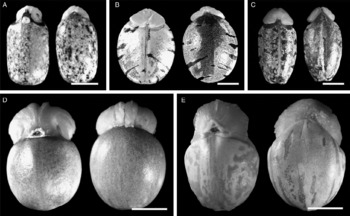
All five Euphorbiaceae species are perennial shrubs that shed their fruits at the end of the summer (February–April) (Aranda-Rickert, unpublished data). The fruits are tricarpellate capsules, with each carpel containing one seed. When fruits are ripe, seeds are discharged by the explosive dehiscence of the fruit, reaching considerable distances from the mother plant (Aranda-Rickert and Fracchia, Reference Aranda-Rickert and Fracchia2010). Seeds are hard and dry and vary in size, shape (Fig. 1) and colour. They all have a caruncle, a lipid-rich fleshy appendage, at the micropilar end. When seeds are dispersed explosively, the caruncle always remains attached to the seed body. In this family, the caruncle acts as an elaiosome, an ant-attractor for secondary seed dispersal (Brew et al., Reference Brew, O'Dowd and Rae1989; Aranda-Rickert & Fracchia, Reference Aranda-Rickert and Fracchia2010).
Seeds of the five Euphorbiaceae species: (A) Jatropha excisa. (B) Manihot guaranitica, (C) Cnidoscolus tubulosus, (D) J. hieronymi, (E) J. macrocarpa. Scale bars: A–C, 5 mm; D–E, 8 mm.

Seed weight and size
During the dispersal season of February–April 2008, ripe fruits of the five species were randomly picked from 20 individuals in each plant population. Because of their explosive dehiscence, once collected, the fruits were left to discharge inside plastic containers exposed to the sun. They were stored in paper bags at 4°C until used. Empty seeds (without embryo) could be recognized because they break down easily when pressed between the fingers, and were consequently discarded. Seeds were randomly collected from each sample and weighed on a balance. Seed size (length and width) was determined with a digital caliper (Tresna® EC16) with an accuracy of 0.01 mm. The caruncle was obtained by cutting it from the seed body with a blade, and weighed separately.
Lipid extraction and profiling
Seed and caruncle oil content was determined by Soxhlet extraction of 10 g seeds or 4 g caruncles, randomly collected from each sample. Both seeds and caruncles were dried and ground with a mortar. Samples were extracted at room temperature with 170 ml hexane for 6 h. The hexane was separated and collected under reduced pressure in a vacuum concentrator. The residue ( = lipophilic fraction) was dried at 80°C for 12 h and weighed.
The fatty acid composition of the oil was determined by gas–liquid chromatography of the fatty acid methyl esters (FAMEs) prepared from the lipid fraction. The FAMEs were obtained by transesterification with a cold methanolic solution of potassium hydroxide [ISO 5509:2000 (http://www.iso.org) and IUPAC 2.301 (http://old.iupac.org)]. Oil samples (0.1 g) were diluted in 2 ml hexane, to which 0.2 ml 2 N methanolic potassium hydroxide solution was added. After stratification, 1 μl from the upper layer, containing the fatty acid methyl esters, was injected into a Hewlett-Packard 5890 Series 2 gas chromatograph equipped with a flame ionization detector and CP-Wax 52 CB (Chrompack, Holland) capillary column (25 m length; 0.32 mm internal diameter; 0.22 μm film thickness) of fused silica. Hydrogen was used as the carrier gas, and the injector and detector temperatures were 250°C and 300°C, respectively. The oven temperature was programmed at 180°C for 5 min, then 180–240°C at 4°C min− 1, and finally 240°C for 3 min. The fatty acids were identified by comparison with retention times of a known standard mixture (AOACS RM-1, Sigma Aldrich, St. Louis, Missouri, USA).
Total seed and caruncle oil content is expressed as percentage on a seed dry weight basis. Fatty acids are expressed as the relative percentage of each individual fatty acid of the total fatty acids present in the sample. All determinations were performed in triplicate.
Statistical analysis
Data are expressed as means ± SD. Differences between species in all the analyses were tested using one-way ANOVA with plant species as the factor. A posteriori multiple comparisons were conducted using the Tukey HSD test. The level of significance was set at P < 0.05. Analyses were performed using the InfoStat package (InfoStat, 2008).
Results
Seed weight and size
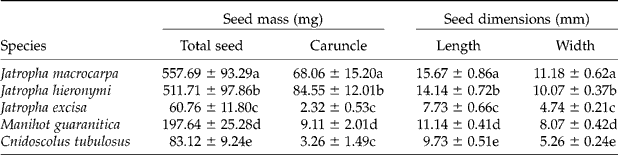
Seeds of the five species showed significant differences in weight, length and width (Table 1). J. macrocarpa seeds were heavier and bigger than the others, whereas J. excisa seeds were the lightest and smallest. The caruncles of both J. excisa and C. tubulosus were the smallest among the five species, with no significant differences in mass between the two of them. J. hieronymi had the highest caruncle weight (mean 84.55 mg), representing approximately one-sixth of the total seed weight.
Seed weight and dimensions of the five Euphorbiaceae speciesa
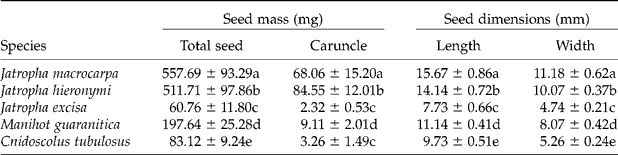
Different letters within a column indicate significant differences among species, P < 0.0001.
a Data are mean ± SD, n = 80 for all species.
Seed oil content and fatty acid profiles
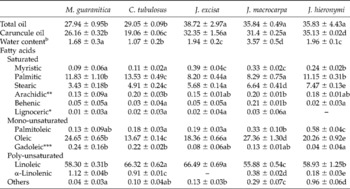
The seeds of J. macrocarpa, J. hieronymi and J. excisa exhibited the highest oil content, with no significant differences among them (Table 2). Caruncle oil content was significantly higher for J. hieronymi.
Oil content, water content and lipid profile of the five Euphorbiaceae speciesa

Myristic acid = 14:0, palmitic acid = 16:0, heptadecanoic acid = 17:0, stearic acid = 18:0, arachidic acid = 20:0, behenic acid = 22:0, lignoceric acid = 24:0, palmitoleic acid = 16:1, heptadecenoic acid = 17:1, oleic acid = 18:1, gadoleic acid = 20:1, linoleic acid = 18:2, α-linolenic acid = 18:3. *P = 0.84; **P = 0.0874; ***P = 0.0105.
a Seed and caruncule oil content expressed as a percentage on seed and caruncule dry weight basis, fatty acid profile expressed as percentages of total seed oil content. Data are means ± SD, n = 3 for all species. Different letters within a row indicate significant differences among species (P < 0.05).
b Water content expressed as percentage on total seed fresh weight basis.
The seed fatty acid profiles of the five species are shown in Table 2. A total of 13 different fatty acids were identified. The predominant fatty acid in all species was linoleic acid (18:2), followed by oleic acid (18:1), palmitic acid (16:0) and stearic acid (18:0). Considerable variation was observed in the contribution of each fatty acid to the total fatty acid composition among the five species. J. excisa and C. tubulosus showed a significantly higher percentage of linoleic acid and a lower percentage of oleic acid. J. macrocarpa had the highest values for oleic acid, followed by M. guaranitica and J. hieronymi. The percentage of linoleic acid was lowest in J. macrocarpa, followed by J. hieronymi and M. guaranitica. Palmitic acid was found in higher percentages in C. tubulosus, whereas J. excisa and J. macrocarpa had the lowest values. The other predominant saturated acid, stearic acid, had the highest percentage in J. hieronymi, followed by J. macrocarpa and J. excisa.
Fatty acids for all species were composed of saturated, mono-unsaturated and poly-unsaturated fatty acids (Table 3). The predominant fatty acids were found to be poly-unsaturated. Significant variation was found in mono-unsaturated and poly-unsaturated fatty acids among the species. J. hieronymi and J. excisa had the highest and lowest percentages of saturated fatty acids, respectively. J. excisa also had a high percentage of poly-unsaturated fatty acids, whereas J. macrocarpa, J. hieronymi and M. guaranitica had low percentages of poly-unsaturated fatty acids. Mono-unsaturated fatty acids were considerably higher in J. macrocarpa as compared to the other species. Total unsaturated/saturated ratio was the highest for J. excisa (5.84), followed by M. guaranitica (5.42) and J. macrocarpa (5.31). J. hieronymi and C. tubulosus had the lowest ratios, which were 4.06 and 4.30, respectively.
Average percentages of saturated, monounsaturated and polyunsaturated fatty acids of the five Euphorbiaceae species

Discussion
Successful introduction and commercialization of a new biodiesel source depends on its suitability to the biodiesel standards, such as the American Society for Testing and Materials (ASTM) D6751 and the European Committee for Standardization (EN) 14 214. The nature of the fuel components is what ultimately determines the fuel properties, many of which depend on the structure of the fatty esters obtained by the transesterification reaction. A biodiesel fuel is a mixture of fatty esters, each of which contributes to the properties of the fuel. As the methyl ester composition of biodiesel depends on the triglyceride composition of the initial oil, a first step to examine the suitability of a potential biodiesel source is to analyse the corresponding oil composition and properties.
Various problems associated with vegetable oil usage as fuel are caused by their high viscosity, which affects the atomization of fuel upon injection into the combustion chamber and thereby ultimately the formation of engine deposits (Pramanik, Reference Pramanik2003). Viscosity values of fatty esters increase with chain length and with increasing degree of saturation: cis double-bond configuration gives a lower viscosity than trans. Previous studies have shown that high viscosity of the J. curcas oil was decreased by blending with conventional diesel (Pramanik, Reference Pramanik2003). Generally, cetane number, heat of combustion, melting point and viscosity of neat fatty acid compounds increase with increasing chain length and decrease with increasing unsaturation. In conclusion, a biodiesel fuel enriched with certain fatty acids, possibly oleic acid, exhibits a combination of improved fuel properties.
Oil content of the seeds of the five Euphorbiaceae species in this study ranged from 27.94 to 38.72% by dry weight. The fatty acid composition consisted mainly of linolenic, myristic, palmitic, stearic, arachidic, oleic and linoleic acids, with linoleic and oleic acids being the most abundant. Although the identity of the predominant fatty acids was the same for all species, significant differences among the species were found in the contribution of both mono-unsaturated and poly-unsaturated fatty acids to the overall lipid composition.
Results from the analysis using the five species showed that J. macrocarpa has the best potential to be used as biodiesel source of the five species. The average total seed oil content of 35% and a high value of oleic acid content, together with the lowest values of linoleic acid in J. macrocarpa, compared with the other species, make it a promising oil source for biodiesel. Oil content and composition of this species are comparable to J. curcas, Cynara cardunculus and sunflower oil (Benjelloun-Mlayah et al., Reference Benjelloun-Mlayah, De López and Delmas1997; Jasso de Rodriguez et al., Reference Jasso de Rodriguez, Phillips, Rodriguez-García, Angulo-Sánchez, Janick and Whipkey2002; Jongschaap et al., Reference Jongschaap, Corré, Bindraban and Brandenburg2007). Further studies are necessary in order to assess the fuel properties of the biodiesel obtained from the J. macrocarpa seed oil.
An increasing number of alternative oils are currently tested for biodiesel production (Cardone et al., Reference Cardone, Mazzoncini, Menini, Rocco, Senatore, Seggiani and Vitolo2003; Vilas Ghadge and Raheman, Reference Vilas Ghadge and Raheman2005). The choice of a certain crop in a specific region mainly depends on the climatic conditions and soil characteristics. Here, we report the potential of J. macrocarpa as a biodiesel crop specifically adapted to arid regions. Its perennial nature, high drought and frost resistance, low soil nutrient requirements and its capability of growing at high altitudes, make it a suitable crop for marginal lands. Furthermore, the species produces non-edible oil, which enhances its suitability as an alternative biodiesel source. It is noteworthy that a number of Jatropha species other than J. curcas have already been noted as potential sources of industrial oil (Kleiman et al., Reference Kleiman, Smith, Yates and Jones1965; Mayworm et al., Reference Mayworm, Do Nascimento and Salatino1998).
The present study was carried out using seeds collected from wild plants. Production of these species in experimental fields will provide information about seed yield, crop requirements and the influence of environmental factors on oil content.
Acknowledgements
We thank the CONICET (Concejo Nacional de Investigaciones Científicas y Técnicas) for financial support and Peter Searles for his critical reading of the manuscript and helpful suggestions.