Introduction
According to the latest World Alzheimer Report, 44 million adults now suffer from dementia worldwide, and the projected number will double the current brunt of disease by 2,030, even trebling the existing number by 2,050 (Alzheimer's Association, 2014). Because there is no effective treatment to halt the disease process and treatment outcomes are unfavourable when the disease progresses to a later stage, it is crucial to identify the specific cognitive characteristics and markers that differentiate cognitive ageing from conditions associated with high risk of progressive neurodegeneration. The potential clinical implications of these markers may help to lay platforms for early intervention. Among all the cognitive domains, complex attention plays a fundamental role (Grady, Reference Grady2008) and serves as a main diagnostic item of mild neurocognitive disorders (MND) in Diagnostic and Statistical Manual of Mental Disorders, 5th edition (DSM-5) (American Psychiatric Association, 2013), which includes selective attention, sustained attention, and processing speed (Blazer, Reference Blazer2013). Hence, the composite role of complex attention as a sensitive marker for healthy ageing warrants exploration.
Based on attention network theory, attention is described as a set of integrated processes with differentiated functions, which includes alerting, orienting, and executive control (Petersen and Posner, Reference Petersen and Posner2012b; Posner and Petersen, Reference Posner and Petersen1990). Alerting provides the capacity to achieve and maintain vigilance to an impending stimulus, and has been associated with functioning in frontal lobe, parietal lobe and thalamus. Orienting is defined as the selection of relevant stimuli to attend to and the shifting of attention. The brain regions involved in orienting are the superior parietal lobe, temporal parietal junction, frontal eye fields, and superior colliculus (Posner, Reference Posner2014). Executive control refers to a variety of abilities ranging from planning, manipulating, and the inhibition of behavioral responses. It involves conflict resolution and control over decision-making, error detection, and response inhibition. The brain regions involved in this final and highest order of attentional process are the anterior cingulate cortex (ACC) and lateral ventral prefrontal cortex (VLPFC) along with the basal ganglia (Matsumoto and Tanaka, Reference Matsumoto and Tanaka2004).
The ANT is used to quantitatively and simultaneously evaluate alerting, orienting, and executive control (Fan et al., Reference Fan, McCandliss, Sommer, Raz and Posner2002a), and has been widely used across various participants (Rueda et al., Reference Rueda2004; Dennis et al., Reference Dennis, Chen and McCandliss2008; Mullane et al., Reference Mullane, Corkum, Klein, McLaughlin and Lawrence2011; Weaver et al., Reference Weaver, Bédard and McAuliffe2013). As to its application in the study of ageing, a handful of studies focusing on healthy adults with different age ranges have reported some consistent and inconsistent results. For instance, compared to young adults, a diminished alerting effect during conflict resolution has been found in healthy older adults (Fernandez-Duque and Black, Reference Fernandez-Duque and Black2006; Jennings et al., Reference Jennings, Dagenbach, Engle and Funke2007). Later, Gamboz also found that alerting was significantly reduced in old age, while orienting and executive control between young and older adults were equivalent (Gamboz et al., Reference Gamboz, Zamarian and Cavallero2010). When comes to a relatively large sample across the adulthood, a significant age-related decline has been found on executive control (Waszak et al., Reference Waszak, Li and Hommel2010; Zhou et al., Reference Zhou, Fan, Lee, Wang and Wang2011). Moreover, the negative correlation between age and executive control is still significant within older adults. In a relatively large sample of older adults, the age differences have been found in three attention network functions. Besides, the old-old adults (80+ years old) have demonstrated worse performance on executive control than the young-old adults (70–79 years old) (Mahoney et al., Reference Mahoney, Verghese, Goldin, Lipton and Holtzer2010).
Given the evidence summarized above, it seems that age has an effect on attention network functions, particularly on executive control function. However, two things should be noted may contribute to the inconsistent results between studies: The first is slowing processing speed: processing speed is the basic component of information processing, and is conceived as a general resource related to higher-level cognition (Salthouse, Reference Salthouse1996). Moreover, slowing processing speed is strongly tied to healthy ageing (Hedden and Gabrieli, Reference Hedden and Gabrieli2004). Except for Mahoney et al.'s study (Mahoney et al., Reference Mahoney, Verghese, Goldin, Lipton and Holtzer2010), the previous comparisons of ANT performance did not adjust for processing speed. Considering ANT scores are calculated by the subtractions of reaction time under specific experimental conditions, an immediate concern is whether the worse performance of ANT is due to the slowing RT? The second is increased IIV: IIV represents the facet of within-person variability, and is regarded as a measure of moment-to-moment fluctuations in an individual's performance (Martin and Hofer, Reference Martin and Hofer2004; Hilborn et al., Reference Hilborn, Strauss, Hultsch and Hunter2009; Shin et al., Reference Shin2013). Throughout the adulthood, IIV is a stable individual characteristic that appears to progressively increase with chronological age, especially with older age (Bielak et al., Reference Bielak, Cherbuin, Bunce and Anstey2014). Studies have confirmed that IIV measured by processing speed could differentiate young adults from older adults and has been served as a sensitive biomarker of ageing (MacDonald et al., Reference MacDonald, Li and Bäckman2009). As the spectrum of cognitive abilities has become diversified in old age, it should be noted that except for the slowing processing speed, the higher within-person variability might cause mixed results as well (Nelson and Dannefer, Reference Nelson and Dannefer1992; Christensen, Reference Christensen2001). Indeed, one recent study has reported that increased IIV is correlated with the decline of cognitive performance (Kennedy et al., Reference Kennedy, Taylor, Heraldez, Noda, Lazzeroni and Yesavage2013). Therefore, it may lead to the concern that whether the age difference of cognitive function was an artifact associated with increased IIV? Considering together, these findings provide the critical insight to investigate the possible influence of within-person variability on cognitive functions in older adults.
Thus, in this study we aimed to detect the disturbance of attention network functions in healthy Chinese older adults, with both processing speed and within-person variability considered. To achieve these objectives, we proposed a two-step strategy based on two analytical methods. In the first step, the older adults were considered as one group. The relationship of age and IIV would provide evidence to evaluate the necessity of subgrouping. In the second step, we would compare the ANT performance among different age groups, with processing speed considered. We hypothesized that: (1) The within-person variability would increase with advancing age; (2) The adults with older age would demonstrate poorer performance on ANT, especially under the conditions of high demand on executive control.
Methods
Study participants
A total of 145 right-handed Chinese older adults aged from 65 to 80 years (mean age 72.41 years) participated in this study. All participants were recruited from another cohort study that aims to establish a detailed characterization of cognitive and healthy profiles of Chinese older adults and to determine the diagnostic markers for preclinical dementia. Potential participants 65 and older, identified from the communities in Hong Kong, were first contacted and invited to participate by telephone. The eligible participants were scheduled for a 1.5-hour in-person interview at the research center.
During the on-site interview, the participants received comprehensive assessments, including cognitive, psychological, medical, everyday activity as well as attention network functions. The inclusion criteria were as follows: (1) aged 65 years and older; (2) no significant cognitive impairment (presented with Clinical dementia rating scale (CDR) score equal to 0 and Cantonese version of Mini-Mental State Examination (CMMSE) score of larger than 28; (3) absence of mood disorder, sleep disorder, and psychiatric disorders. Exclusion criteria were as follows: (1) cognitive impairment based on CMMSE score of less that 24; (2) mild or major neurocognitive disorders as defined by DSM-5 (American Psychiatric Association, 2013).
Ethics approval
Ethics approval was obtained from the Joint Chinese University of Hong Kong — New territories East Cluster Clinical Research Ethics Committee (The Joint CUHK-NTECCREC). Written informed consent from all participants was obtained before assessment.
Cognitive assessment and clinical evaluation
A standardized neuropsychological battery was used to evaluate the global cognition and major domains of cognition (Lam et al., Reference Lam2008). The battery was administered by trained research assistants and the scores were calculated by two independent raters. Cornell scale for depression in dementia (CSDD) is used to assess the depression symptom, with a cut-off of five (global score) (Schreiner et al., Reference Schreiner, Hayakawa, Morimoto and Kakuma2003). Chinese version of the Pittsburgh sleep quality index (PSQI) is used to evaluate the sleep problem, with a cut-off of eight (total score) (Beck et al., Reference Beck, Schwartz, Towsley, Dudley and Barsevick2004). Activity of daily living scale (ADL) is used to assess the everyday functioning (Lam et al., Reference Lam, Tam, Chiu and Lui2009). CDR, CMMSE, Alzheimer's Disease Assessment Scale (ADAS), Montreal Cognitive Assessment Hong Kong version (HK MoCA) (Chu et al., Reference Chu, Chiu, Hui, Yu, Tsui and Lee2000) are used as a global measure of cognitive function. Delayed recall of words: the number of recalled words is used as the performance of episodic memory. Trail making tests (TMT): the participants connect either numbers (A), or numbers and letters in an alternate fashion (B) as fast as possible; the time of completing in seconds is used as a measure of attention (TMT-A) and a measure of general executive function (TMT-B). Digit span tests: the participants repeat the numbers they heard, either forward or backward; the number of correct repeated numbers is used as a measure of attention (DSF) and a measure of working memory (DSB). All the measures were conducted with Chinese instructions.
Attention network test (ANT)
Paradigm and procedure
We used the standard ANT paradigm developed by Fan Jin and his team (Fan et al., Reference Fan, McCandliss, Sommer, Raz and Posner2002a) (Download from: https://www.sacklerinstitute.org/cornell/assays_and_tools/ant/jin.fan/), and ran the paradigm on E-Prime 2.0 (Psychology Software Tools, Pittsburgh, PA). Within ANT paradigm, there are four types of cue: no cue, center cue, double cue, and spatial cue; and three types of flanker: neutral, congruent, and incongruent. In a given trial, a central cross-fixation point presents for 400 to 1,600 ms (randomized), subsequently is replaced for 100 ms by one of four warning cues. The target, a central arrow could appear above or below the cross-fixation and was surrounded by two flankers on each side (Figure 1).
The schematic diagram of attention network test (ANT).

None of the participants had practiced the ANT previously. All participants were seated approximately 53 cm from the computer screen with corrected vision by their glasses if needed. Before the test, participants were instructed to play the practice trials of ANT and required to decide whether a central arrow pointed to left or right, and press a left button if the central arrow was pointing to left, or right button if it was pointing to right. Following the illustration, all participants were instructed to respond as rapidly and as accurately as possible to the direction of the flanker stimulus by clicking the left or right button. After completing 24 practice trials with accuracy feedback, all participants would take part in three test blocks without feedback, which contained 288 trials in total. There was a short break between each of the test block.
Evaluation of attention network functions
There are two indices used to evaluate the performance of ANT, which are accuracy and reaction time (RT). Accuracy is the degree of correctness of making a decision and is also used for the quality control of ANT data. An accuracy of experimental condition less than 70% is considered as unqualified data (Fan et al., Reference Fan, McCandliss, Sommer, Raz and Posner2002a). RT, measured in milliseconds (ms), refers to the processing speed for a defined stimulus, and is also used to assess the within-person variability (Dixon et al., Reference Dixon, Garrett, Lentz, MacDonald, Strauss and Hultsch2007; Wojtowicz et al., Reference Wojtowicz, Ishigami, Mazerolle and Fisk2014).
Measure of intra-individual variability
As described above, IIV represents the within-person fluctuation of performance in a repeated task. The ANT consists of 288 trials for collecting response speed and is suitable for measuring IIV. To adjust the effect of slowing processing speed, ICV-RT (Stuss et al., Reference Stuss, Murphy, Binns and Alexander2003; Phillips et al., Reference Phillips, Rogers, Haworth, Bayer and Tales2013) is used to evaluate the IIV enumerated with the formula: ICV-RT = (standard deviation of processing speed / mean of processing speed) × 100 (Tractenberg and Pietrzak, Reference Tractenberg and Pietrzak2011).
Measures of attention network functions
Two scoring methods were performed to evaluate the attention network functions:
-
(1) Conventional score: the score of each attention function is defined as a subtraction of the RT between one condition and the appropriate reference condition, resulting in scores for the attention network functions (Fan et al., Reference Fan, McCandliss, Sommer, Raz and Posner2002a; Galvao-carmona and Izquierdo, Reference Galvao-carmona and Izquierdo2014; Wang et al., Reference Wang2014). Alerting is calculated by subtracting the mean RT of the condition with center cue from the mean RT of the condition with no cue. Orienting is calculated by subtracting the mean RT of the conditions with spatial cue from the mean RT of the condition with center cue. Executive control is calculated by subtracting the mean RT of the condition with congruent flanker from the mean RT of the condition with incongruent flanker. The formulae of conventional scoring are as follows:
-
Alerting = RTno-cue – RTcenter-cue
-
Orienting = RTcenter-cue – RTspatial-cue
-
Executive control (conflict) = RTincongruent – RTcongruent
-
-
(2) Ratio score: to adjust the effect of slowing processing speed, the ratio score is equal to the conventional score divided by the RT of reference condition (Westlye et al., Reference Westlye, Grydeland, Walhovd and Fjell2011; Yin et al., Reference Yin2012; Galvao-carmona and Izquierdo, Reference Galvao-carmona and Izquierdo2014). The formulae of ratio scoring are as follows:
-
Alerting ratio = (RTno-cue – RTcenter-cue)/RTcenter-cue
-
Orienting ratio = (RTcenter-cue – RTspatial-cue)/RTspatial-cue
-
Executive control ratio = (RTincongruent – RTcongruent)/RTcongruent
-
Statistical analyses
In the first step: median values of RT averaged across blocks for each condition were used to avoid the influence of outliers. The scores of attention network components were calculated using the formulae described above. Person's correlation coefficients were performed to examine the relationships between age, ICV-RT, and ANT indices, controlled for the effects of gender, education, and processing speed. Linear regression was used to estimate the relationship between age, ICV-RT, and ANT indices. Significance levels were set at p values less than 0.05.
In the second step: The differences of demographics and cognitive performance and ANT among different age groups were tested either with χ 2 test for categorical variables or with one-way analysis of variance (ANOVA) for continuous variables. When appropriate, the Tukey method was used to do the post hoc multiple comparisons. The effect size was evaluated using the partial eta squared (η 2). Person's correlation coefficients were used to measure the associations of ANT indices and cognitive functions. Significance levels were set at p values less than 0.05. The quality checking, accuracy, RT, and standard deviation of RT were calculated by E-Data Aid embedded in E-Prime 2.0. The χ 2 test, one-way ANOVA, Pearson's correlation, and linear regression were performed by IBM SPSS Statistics 20.
Results
Quality control and ANT performance
According to the quality control standard suggested by Fan Jin (Fan et al., Reference Fan, McCandliss, Sommer, Raz and Posner2002a), an accuracy of ANT less than 70% indicates that the participate does not well understand how to perform the ANT. Thus, under this circumstances, the ANT indices, including processing speed, and attentional components calculated by subtractions of RTs, are considered unqualified as well. To evaluate the attention network functions with caution, eight participants were excluded from the dataset. Thus, a final sample of 137 healthy older adults was used for further analysis. The group-level performance of ANT was as follows: accuracy was higher than 99%; the processing speed was 687.49±105.97 ms; the ICV-RT was 19.99±4.57 ms; alerting score was 3.95±31.88; orienting score was −19.76±28.65; executive control score was 59.86±45.86.
Age-related change of attention network functions
Person's correlation analysis revealed that the alerting score (r = 0.011, p = 0.895) and orienting score (r = 0.019, p = 0.828) did not correlate with age. A significant positive correlation was found between the executive control score (r = 0.253, p = 0.003) and age, which indicates adults with older age spend more time to detect the conflict and make a decision. Linear regression demonstrated that age (controlled for gender, education) was the significant factor determining the executive control (β = 0.252, t = 3.01, p = 0.003).
As to the within-person variability, a significant relationship was found between age and the ICV-RT (r = 0.185, p = 0.032), which indicates that adults with older age demonstrate the greater within-person fluctuation of performance, even in the context of healthy ageing. This result indicates that the heterogeneity of attentional performance within older adults has become noticeable. Thus, in the second step, we divided 137 healthy older adults into subgroups.
Investigations among three age groups
Demographics and cognitive performance
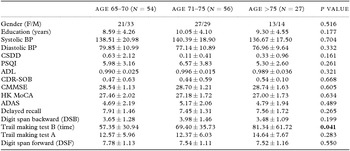
As suggested (Hester et al., Reference Hester, Kinsella and Ong2004; Verhaeghen, Reference Verhaeghen2013), we divided the healthy older adults into three groups: age of 65–70 years, age of 71–75 years, and age of >75 years, with an age range of 5 years. As Table 1 shows, the basic demographics in terms of gender and years of education among the groups were similar. The global cognition, episodic memory, and general attention were also comparable. However, a significant difference was found in executive function measure by TMT-B (F (2, 134) = 3.282, p = 0.041). Moreover, the group with age > 75 years showed poorer performance of TMT-B than the group with age of 65–70 years (p = 0.041).
Demographics and cognitive profiles among three age groups

Note. Data are raw scores and presented as mean±SD. CSDD = The Cornell Scale for Depression in Dementia; PSQI = Pittsburgh Sleep Quality Index; CDR-SOB = Clinical dementia rating-sum of box; ADL = Activity of daily living scale.
Ant performance
Accuracy:
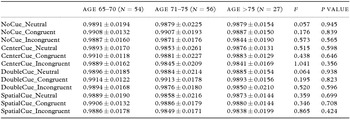
As Table 2 shows, the accuracy of ANT among the three age groups was similar.
Accuracy under different cue/flanker conditions among three age groups

Note. Data are raw scores and presented as means±SD. NoCue_Neutral represents the ANT trial with no cue as cue type and neutral as flanker type.
Reaction time and within-person variability
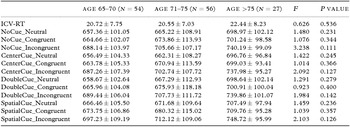
The RT and ICV-RT among the three age groups were similar (Table 3). Although the correlation between age and processing speed did not reach the significance (r = 0.067, p = 0.442), there was a trend that the processing speed was progressively slowed down with advancing age under various cue and flanker conditions.
ICV-RT and reaction time among three age groups

Note. Data are raw scores and presented as means±SD. NoCue_Neutral represents the ANT trial with no cue as cue type and neutral as flanker type.
ICV-RT = Intra-individual coefficient of variation (ICV) of Reaction Time.
Scores of attention network functions
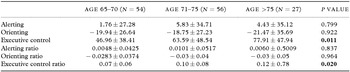
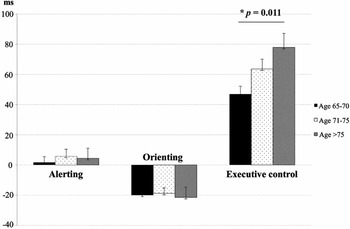
There was no age difference of alerting (F (2, 134) = 0.23, p = 0.78) and orienting (F (2, 134) = 0.08, p = 0.92) among the three age groups. An age-related decline was found in executive control (Conventional score: F (2, 134) = 4.648, p = 0.011, η 2 = 0.06; Ratio score: F (2, 134) = 3.884, p = 0.023, η 2 = 0.051) (Table 4). Moreover, the group with age > 75 years demonstrated poorer performance of executive control than the group age 65–70 years (Conventional score: p = 0.011; Ratio score: p = 0.020) (Figure 2).
Scores of attention network functions among three age groups

Note. Data are raw scores and presented as means±SD.
Associations of ANT indices and cognitive functions

Scores of attention network functions across three age groups.

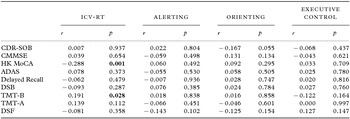
Correlations between ant indices and cognitive functions
There was no significant correlation between ANT scores and the scores of major cognitive functions (controlled for age, gender, education, and processing speed). As to the within-person variability, there was a negative correlation between ICV-RT and HK MoCA (r = −0.288, p = 0.001, 95% CI [−0.501, −0.125]), and a positive correlation between ICV-RT and TMT-B (r = 0.191, p = 0.028, 95% CI [0.021, 0.359]). Within ANT indices, no relationship was found between ICV-RT and ANT scores. The results indicated that attention network functions measured by ANT were relatively independent from other cognitive functions. However, the declined cognitive functions might have an effect on the within-person variability, or vice versa.
Discussion
To the best of our knowledge, this is the first work to detect both IIV and attention network functions in community-dwelling Chinese healthy older adults. With advancing age, increased within-person variability and declined executive control function have been found in current study. Meanwhile, the oldest group (age > 75 years) showed less efficient executive control function than the group with age 65–70 years. These findings suggest that executive control measured by ANT, rather than processing speed, alerting and orienting, is a sensitive marker of healthy ageing, even in the context of relatively normal cognition.
Age and intra-individual variability (IIV)
Until recently, variability has been considered as an important individual difference measure relevant to understanding age differences in brain function (Garrett et al., Reference Garrett, Samanez-Larkin, MacDonald, Lindenberger, McIntosh and Grady2013). Indeed, inspired by previous attempts (MacDonald et al., Reference MacDonald, Hultsch and Dixon2003; Bunce et al., Reference Bunce, MacDonald and Hultsch2004; Salthouse et al., Reference Salthouse, Nesselroade and Berish2006; Kennedy et al., Reference Kennedy, Taylor, Heraldez, Noda, Lazzeroni and Yesavage2013), our observations demonstrate that the within-person variability increased in old age, and appeared to highlight the necessity of subgrouping in a sample of older adults (Rabbitt et al., Reference Rabbitt, Osman, Moore and Stollery2001; Tractenberg and Pietrzak, Reference Tractenberg and Pietrzak2011; Phillips et al., Reference Phillips, Rogers, Haworth, Bayer and Tales2013). The increased within-person variability in old age suggests that older adults have more difficulty on keeping the consistency of performance across the experimental trials.
Given the declined brain functions in late adulthood, it is applaudable to assume that within-person variability maybe affected by the declined executive functions (Bellgrove et al., Reference Bellgrove, Hester and Garavan2004). As outlined nicely by MacDonald et al. (Reference MacDonald, Li and Bäckman2009), greater IIV is associated with the reduced functional MRI (fMRI) activities in the regions related to executive functions (MacDonald et al., Reference MacDonald, Li and Bäckman2009). A further question emerges from this work is whether poorer executive control and decision-making function in older adults are reflected by within-person variability of neuropsychological measure as well? Interestingly, the positive correlations between age, ICV-RT, and TMT-B supported that the age differences of executive function might be influenced by the increased IIV, or vice versa. The age differences in IIV seem to have profound effects on many cognitive functions, particularly on executive function. Alternatively, an absence of correlation between the ICV-RT and executive control measured by ANT implicated that the attention network functions measured by ANT seems to be less influenced by the IIV. Therefore, it may provide a more convincing evaluation of the age differences in attention network functions.
Age and attention network functions
Age, alerting, and orienting
Age difference on alerting is quite inconsistent. Some studies (Festa-Martino et al., Reference Festa-Martino, Ott and Heindel2004; Jennings et al., Reference Jennings, Dagenbach, Engle and Funke2007; Zhou et al., Reference Zhou, Fan, Lee, Wang and Wang2011) found a decreased alerting effect in older adults. In contrast, an increased alerting effect also was found in old age (Fernandez-Duque and Black, Reference Fernandez-Duque and Black2006). One thing should be noted is that among these studies, the researchers recruited the adults with a wide age range, such as young adults, middle-age adults, and older adults. However, when focusing on older adults, no significant relationship has been found between age and alerting, exactly in line with the results found by Mahoney et al. (Mahoney et al., Reference Mahoney, Verghese, Goldin, Lipton and Holtzer2010). As to orienting, no significant relationship has been found between age and orienting as well, which is consistent with previous attempts (Mahoney et al., Reference Mahoney, Verghese, Goldin, Lipton and Holtzer2010; Waszak et al., Reference Waszak, Li and Hommel2010).
Age and executive control
As expected, adults with old age demonstrate poorer performance on ANT, particularly on executive control. Additionally, the group with older age (age >75 years) has less efficient executive control function than the group with younger age (age: 65–70 years). And the results are consistent under both conventional and ratio scoring methods. Given the age-related decline in executive function, it is not surprising that our results are aligned with the studies focusing on late life (Fisk and Sharp, Reference Fisk and Sharp2004, Mahoney et al., Reference Mahoney, Verghese, Goldin, Lipton and Holtzer2010; Zhou et al., Reference Zhou, Fan, Lee, Wang and Wang2011). Interestingly, an unexpected result, that is insignificant relationship between age and processing speed encourages us to rethink the coexisting of slowing processing speed and declined executive control in older adults.
Based on attention network theory, executive control associated anatomical units are mostly located in prefrontal cortex (PFC) and embedded with dopaminergic networks (Posner, Reference Posner2012). The PFC is the hub of information processing and decision making, also participates in synthesizing a wide range of external and internal stimuli to exert control (van den Heuvel and Sporns, Reference Van den Heuvel and Sporns2013). As “frontal ageing hypothesis” proposed (Greenwood, Reference Greenwood2000; Salat, Reference Salat2011), the close relationship of the PFC and healthy ageing has been explored in a number of studies by means of structural MRI (Raz et al., Reference Raz, Briggs, Marks and Acker1999; Resnick et al., Reference Resnick, Pham, Kraut, Zonderman and Davatzikos2003; Yao et al., Reference Yao, Hu, Liang, Zhao and Jackson2012) and positron emission tomography (PET) (Hazlett et al., Reference Hazlett2010).
Supporting an association between neuroanatomy and neurotransmitter, the PFC regions are highly related to the executive functions, and with the dominant neuromodulator as dopamine (DA). Besides, this association also plays a key role in healthy ageing process. A body of work have exhibited that through the adulthood, the changes of cognitive functions occur gradually, and are accompanied with the decreasing dopamine D2 receptor (Volkow et al., Reference Volkow1998; Drag et al., Reference Drag and Bieliauskas2010). Additionally, a decrease of 5–13% per decade of D2/3R receptor has been found in the extrastriatal brain regions (Kaasinen et al., Reference Kaasinen2000), especially in the PFC regions (Li et al., Reference Li, Lindenberger and Sikström2001). Interestingly, DA is also the dominant neuromodulator of executive control described in attention network theory (Petersen and Posner, Reference Petersen and Posner2012b).
Taken together with the aforementioned evidence, it is reasonable to infer that the disturbance of executive control in older adults found in this study may enrich the neuropsychological evidence supporting the “frontal ageing hypothesis,” and highlight a sensitive and early sign of healthy ageing before the detectable changes of brain function occurred. It is also important to note that the findings need to be interpreted with its limitation. First, this is a cross-sectional study and the results could not imply ageing effect. Second, only older adults with a relatively restricted age range participate. Third, multiple correlations between ANT indices and the cognitive performance may inflate the rate of false positives. A predefined hypothesis and a confidence interval around a difference without overlap zero may help for declaring the significant results.
In the light of the preceding discussion, our findings are aligned with a growing body of evidence that healthy ageing is accompanied by several dynamic changes, such as increased within-person variability, slowing processing speed, and declined executive function (Hedden and Gabrieli, Reference Hedden and Gabrieli2004). At this point, we summarize two major thrusts of our results based on ANT: (1) With advancing age, the IIV measured by ICV-RT has become greater, which highlights the necessity of subgrouping in the older participants; and (2) The executive control function, rather than processing speed, alerting, and orienting, is a sensitive marker of healthy ageing, even in the context of relatively normal cognition. Therefore, it would be intriguing to evaluate if executive control component would be a sensitive marker to predict cognitive deterioration and the progression to dementia.
Conflict of interest
None
Description of authors’ roles
Hanna Lu, Sandra S.M. Chan and Linda C.W. Lam conceived and designed this study. Ada W.T. Fung coordinated the development of this study. Regarding to this paper, Hanna Lu drafted, Ada W.T. Fung, Sandra S.M. Chan and Linda C.W. Lam discussed and agreed the final version.
Acknowledgments
This research was supported by Lui Che Woo Institute of Innovation Medicine grant at The Chinese University of Hong Kong. The authors would like to thank all the participants and their relatives that kindly agreed to participate in the study. And we also want to thank the reviewers for their valuable comments and suggestions to improve the quality of the paper.