As of October 2021, Medical Reserve Corps (MRC) volunteers donated over 2 million h at a value of over $57 million while responding to the coronavirus disease 2019 (COVID-19) pandemic. 1 The MRC is a national network of volunteers, organized locally to improve the health and safety of their communities. Before the COVID-19 pandemic, in 2019 Greene County MRC received a 2020 MRC Operational Readiness Award (ORA) from the National Association of County and City Health Officials (NACCHO) for a plan to increase volunteers and develop a volunteer outbreak response team to conduct investigations. 2
After the 2001 anthrax attacks, public health system capacity issues in the state included inadequate disease and outbreak investigations. Reference Brannen and Stanley3 Similar capacity issues were noted for the COVID-19 pandemic indicating persistent disaster preparedness deficits. 4 Specific opportunities for improving volunteer disaster response were willingness to respond and triaging disaster survivors. Reference Ludtke, Narayan and Matariyeh5–Reference Fannin, Brannen and Howell7 Early steps to stop transmission and efficient medical allocations mitigate pandemic effects. Reference Brannen, Alhammad and Branum8,Reference Brannen, Branum and Pawani9 West Central Ohio MRC units had been very active in responding to May 2019 tornadoes that affected the region. 10 During that response, it was also apparent that some of the longtime key volunteers were aging out, adding emphasis to volunteer recruitment. Before the pandemic, the region’s Health Commissioners identified goals for the MRC. These included but were not limited to disease investigations and mass vaccinations. Consistent with the region’s goals, the United States Department of Health and Human Services Assistant Secretary for Preparedness and Response (ASPR) prioritized similar goals for the MRC as part of the ORA.
In 2018 during a region-wide pandemic exercise, fear had an impact on taking the protective health behavior. Reference Brannen, Caudill and Cottingim11 Furthermore, those who were aware of the impact of fear and had cognitive behavior strategies had increased compliance for protective health behavior. From May 26 to June 7, 2021, the Centers for Disease Control and Prevention (CDC) estimated vaccine hesitancy for COVID-19 for our region to be from 12.2 to 15.3%. 12 The Health Belief Model (HBM) is the value a person places on preventative behavior against the risk of disease. Reference Rosenstock, Strecher and Becker13 The HBM was developed in the 1950s by scientists at the US Public Health Service to understand barriers to adopting disease prevention behaviors. A person’s belief about the threat of COVID-19 and the effectiveness of the vaccine should predict the probability the person will get vaccinated. The West Central Ohio region consists of 8 counties with a population of over 1.1 million residents. 14 After our current study was conducted, mistrust of the public health authorities had been shown to be associated with differential uptake of protective health behaviors, including vaccination, across nations. Reference Sarwar, Imam and Jameel15 A cross-sectional survey was conducted of the MRC volunteers’ experience during the first half of 2021. The project’s prepandemic planning and subsequent MRC response provided public health surge capacity and an opportunity to analyze reasons why these highly trained and skilled persons volunteer, what barriers to vaccination they observed, and how these specialized medical volunteers overcame these barriers.
Methods
The first phase of the ORA project was to ascertain the levels of MRC volunteers, see Table 1a. 16 The second phase focused on improving operational readiness. Goals included developing an outbreak response and a medical team that could staff a vaccination site within 24 h. Early in 2020, planning sessions were started with Health Occupation Students of America (HOSA) and a Health Services Administration graduate student. Planning sessions shifted to operations to track and obtain testing of returning travelers potentially exposed to or sick from the pandemic virus. The sessions were adjusted to meet the social distance guidelines and to provide public health surge capacity in response to the pandemic.
2019 Medical Reserve Corps (MRC) volunteer recruitment goal per tier levels among volunteers who served in the pandemic in West Central Ohio during the first half of 2021 (responses N = 212)

a The initial goal for Level 1 included the FEMA IS-100, -200, -700 and -800, for the pandemic, the local requirement for FEMA courses was limited to IS-100.
Other areas of volunteer service included outbreak investigators who called cases, traced contacts, and when needed, referred persons to care. Several mass-testing sites were conducted with the National Guard and regular collaborations with local universities, Citizen Emergency Response Teams, HOSA, ARC, and local law enforcement to support regional efforts and MRC ASPR priorities. An area of over 1.1 million persons was followed from March to mid-June 2021 and the entire population’s reported COVID-19 cases, hospitalizations, and deaths were surveilled. Because the information was gathered for public health purposes in a deidentified manner from MRC volunteers, and publicly available counts of health outcome data was presented in the aggregate, no institutional review board oversight was required. During the first half of 2021, MRC volunteer activity was prospectively tracked at all the pandemic response sites. Volunteers were surveyed after the June 2021 lull in cases before the delta variant surge began in August of 2021. The survey asked about training, experience, what barriers were observed, strategies for helping others decide, how they addressed concerns, and how easy it was overcoming barriers to get persons vaccinated.
The survey of volunteers asked about training, past disaster experience, satisfaction with their volunteer service, how likely they were to serve again, what barriers they observed others had getting vaccinated, how volunteering changed their perceptions about vaccination, what strategies they used to help others decide about vaccination, and how easy was it to address vaccination concerns. Because much of the qualitative information revolved around the barriers to vaccination, another goal was to view the results in the context of the Health Belief Model. Reference Rosenstock, Strecher and Becker13
The 6 components of the HBM include:
-
1. Perceived Susceptibility: Belief of the probability of getting COVID-19.
-
2. Perceived Severity: Belief of how severe COVID-19 would be, including the social aspects of COVID-19.
-
3. Perceived Benefits: Belief in the ability to reduce or cure COVID-19.
-
4. Perceived Barriers: The cost-benefit of the obstacles to getting vaccinated (eg, actual cost and side effects versus effectiveness).
-
5. Cues to Action: Stimulus to trigger decision process to get vaccinated (eg, shortness of breath or advice from family members).
-
6. Self-efficacy: Level of confidence in the ability to successfully get vaccinated.
Specific trainings volunteers were required to take part in the mass vaccination clinics were excluded from the modeling to avoid endogeneity bias. These training courses were mandated for the dedicated volunteers so, the training would predict the dependent variable of total hours. Those variables included the CDC vaccination trainings, anaphylaxis training, and case-contact investigation training. Because CERT teams were also used, the more general Federal Emergency Management Administration (FEMA) independent-study training were included. The data points on the number of roles and type of volunteer service, the number of clinics served, the days volunteered totaled, and average total support or vaccinator hours were excluded from the modeling process as these variables would be co-linear with the total hours of volunteer service.
Odds ratios were calculated to see if there was a strong or weak relationship between the factor and volunteering, such as whether the factor increases volunteer service during the pandemic for all variables. The qualitative independent variables were recoded to binary values. The variables were recoded to values to allow prediction of total volunteer hours with 0 indicating the absence and 1 indicating the presence of the predictor. For odds ratio calculations for ordinal variables, the breakpoint was set to allow for at least 5 counts per cell, when possible, otherwise, the natural breakpoint was used. The total hours were recoded to binary values with less than or equal to the 50th percentile set to 0 to indicate low volunteer total hours (≤21.5) or 1 indicating high total volunteer hours >21.5 h).
Total hours per volunteer was skewed to the right, so this dependent variable was transformed to the log e. For modeling purposes, 4 subjects were extreme outliers as they were associated with substantial amounts of volunteer hours. These subjects’ total hours were muted to the amount of sequential increase from the prior subject’s total and a +1 amount was added for each muted value starting with the 3rd highest. This was done only for modeling purposes and before the log transformation, not for descriptive statistics. The transformed dependent variable’s undefined values that were originally zero were reset to zero. A backward regression model starting with a fully saturated model was used. The elimination process involved removing the 15% least significance predictor variables that also had the 15% lowest standardized beta coefficients were removed sequentially from the model, until the independent variable set was reduced to 10% of the total number of subjects. At that point in the variable removal process, the significance levels were set at less than 0.05 for inclusion. If the criteria were satiated, then the evaluation of collinearity was conducted to remove colinear variables. Area-level factors were not used for the regression analysis of total volunteer hours to avoid ecological bias. Collinearity was checked using the percent of the variation in each predictor explained by other variables. Tolerance values with a variance inflation factor (VIF) over 2 were explored. Collinearity diagnostics were confirmed with a calculation of Eigenvalues and condition indices. Indices over 15 were used to indicate collinearity. Tolerance values were over .80 for all the final variables except for 2 closely related variables asking how volunteering changed the perception of others’ views on vaccine safety and how well the vaccine protects from infection. These 2 variables had VIF values over 2, indicating collinearity. The vaccine safety question had better significance and a larger standardized beta, so it was prioritized over the vaccine efficacy question, and the model was rerun excluding the vaccine efficacy question.
No Eigenvalue condition indices were over 15. To determine the model’s fit, the significance of the analysis of variance F statistic was evaluated using an alpha level of <.05 and the adjusted R-square to determine the amount of variation explained by the model. A linear model was used to determine the effect of training, experience, what barriers were observed, strategies on helping others decide, how they addressed concerns, and how easy it was overcoming barriers to get vaccinated on the log e transformed dependent variable of total volunteer hours. The Mann-Whitney U-test was used to compare the total hours of volunteers with perceptions of attitude against vaccination on total volunteer service. The unvaccinated rate and barriers to vaccinations were aggregated across counties and adjusted to counts of persons per square mile and modeled using the barriers as predictors from the study data and the dependent variable as the real rate of unvaccinated persons per county as reported by the CDC as of October 20, 2021.
Internal Validation
A post hoc analysis was conducted to see what volunteer characteristics influenced the volunteer’s observations of the total barriers they perceived. The rationale for this post hoc test was to address a reviewer’s concern about the effect of bias to explain the observer’s variation in their reporting of the barriers to uptake of the protective health behavior, that is, the reasons persons did not get vaccinated. The post hoc null hypothesis was that volunteers would have no difference in their observations of barriers. If social media affected the volunteers’ observation, then the training effect on the observed barriers should be muted. If the training influenced the observations, the alternate hypothesis was that training affected observations. It can be assumed the more training volunteers had, the less affected by social media their observations were, and the more accurate their observations. Logistic regression was run to predict any barriers to vaccination (that is, the perception of the volunteer of having observed that barrier) using independent variables of the volunteer’s reported training and experience set to binary values with 0 representing not present and 1 present except as noted: Age Group (0 = 18 to 43; 1 = 44 plus), Baccalaureate Degree (0 < 4 Years of College, 1 ≥ 4 Year of College), Any Disaster Experience, Business, Healthcare Administration, Government, IT, Military, Education, FEMA Independent Study (IS-100, -200, or -700), licensed practical nurse (LPN), Mental Health, Counselor, Pharmacist, Dental Occupation, Veterinarian, Physician Assistant, and Advanced Nursing, Emergency Medicine (EMT, paramedic), Occupation MD DO, Medical Provider MD DO PA Advanced Nursing, Occupation Nursing Category, Occupation Emergency Preparedness Category, Occupation Other Healthcare Category, Occupation Public Health Category, Have you ever responded to a disaster situation before, and Other Emergency Preparedness Training. For variables that were wholly contained within another variable’s positive responses, the variable with a smaller positive response was used in the model first, and if not significant was dropped out of the model and replaced with the variable with larger response set. If the variable with the smaller response set was significant, the variable with the larger response set was not used. Linear regression was run to predict the total barriers observed per volunteer by their years of education (12 to 20), years of disaster experience, and total count of emergency preparedness training. Age was not used during linear regression as it was colinear to the years of education. For modeling, backward regression was used dropping out the least significant variable until the model only had significant predictors. Linear regression was run with bootstrapping taking 1000 samples to assure robust estimates due to non-parametric distribution. For the logistic regression model, the proportion of the total barriers’ variance explained by the predictor variables was reported using the Nagelkerke R square value.
External Validation
Rates of the observer’s traits and the barriers cross-tabulated to develop a rate ratio of the barrier observed for the observers with and without the characteristic. As claimed above, the effect of social media should be muted commensurate with increased training of laypersons and medical professionals that make up the MRC volunteers and, if significant, would partly address the internal validity of the observations. The external validity can be addressed by comparing the rate ratio of the observer characteristic-based observations of the barrier to vaccination. Under the alternative hypothesis, the rate ratio can be evaluated for an association with real-world rates of unvaccinated to determine if the observer’s perceptions are valid.
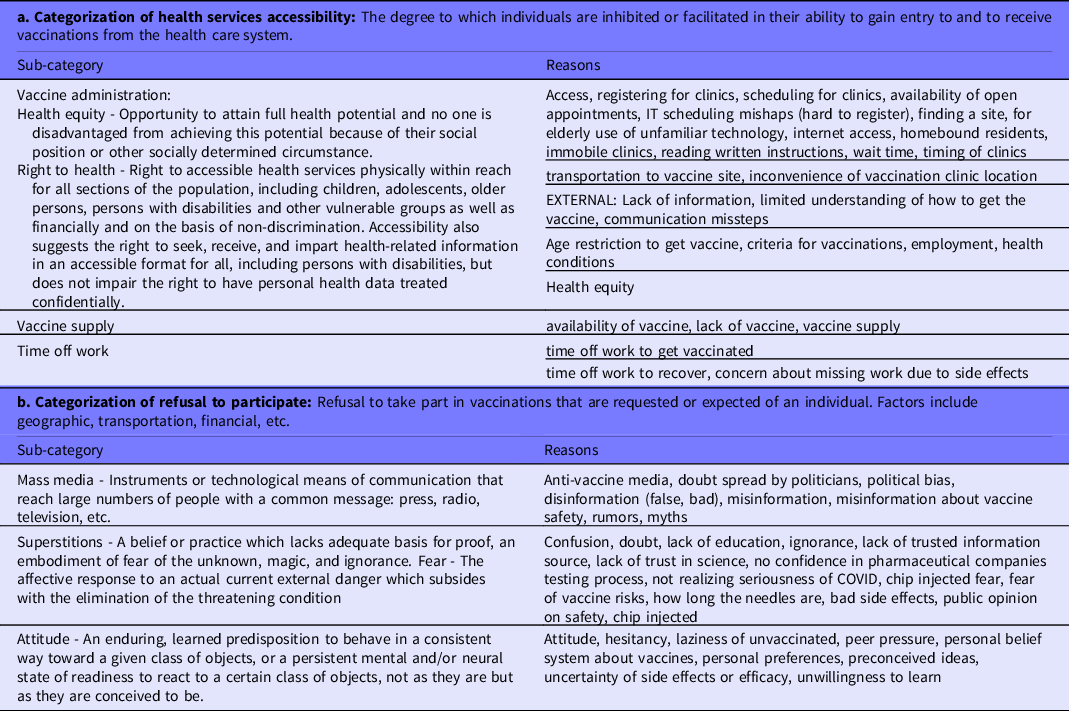
An a priori session was held with a multi-disciplinary team of public health staff including an epidemiologist, public health nurse, graduate intern, medical resident, and an environmental health specialist to discuss reasons why people were not getting vaccinated. The issues identified were categorized. The results of the free-form barrier question were categorized into bins and matched to likely medical subheadings and further collapsed into 2 broad categories.
Results
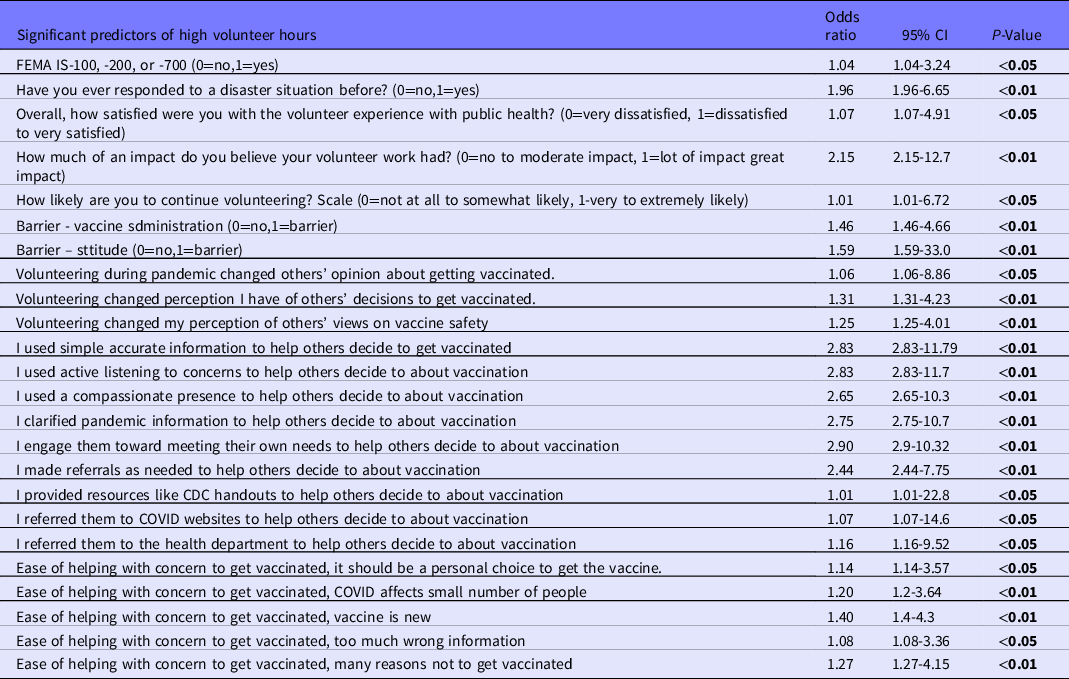
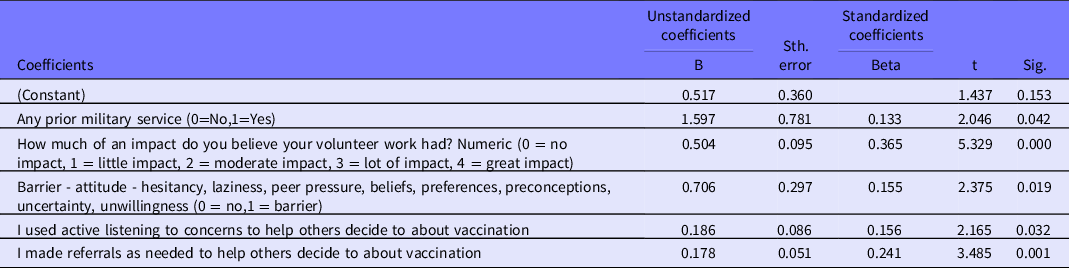
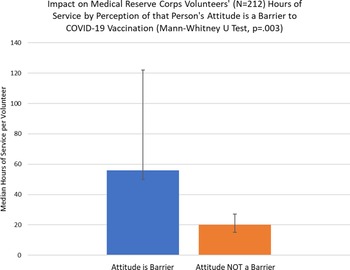
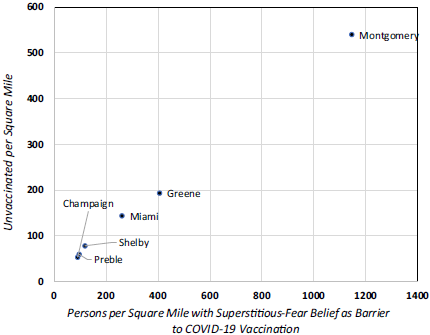
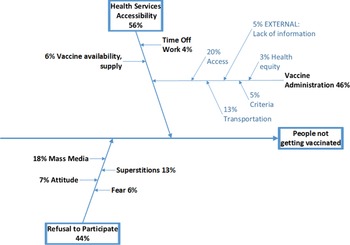
The total number of volunteers who completed the survey was 212. The recruitment goals for the Operational Readiness Award was exceeded except for Level 1 (Table 1a). Table 1b shows a maximum of 13 volunteers at Level 1, however, the number in this group waned with no more than 11 active volunteers at any time. The odds ratio of significant predictors of volunteer service during the pandemic is shown in Table 2. Regression of the variables to the total hours volunteered indicates the model accounted for over half the volunteers with an adjusted R-square of 0.593 (Table 3). The free text responses of the barriers to vaccination were matched to medical subheading topics as shown in Table 4. Service hours increased from 20 to 56 h among volunteers who saw attitude as a barrier to vaccination (Figure 1 ). MRC volunteers’ perceptions of the prevalence of community-based superstitions and fear as barriers to COVID-19 vaccination accounted for almost all the unvaccinated persons, adjusted R-square of 99.8% (P < 0.001) (Figure 2).
Odds of high volunteer time volunteer service hours >21.5

Coefficients of model of log transformed dependent variable “volunteer total hours”

Reasons why persons do not vaccinate from West Central Ohio Medical Reserve Corps volunteers (N=212, Jan June 2021)

The presence of attitude against vaccination increases medical reserve corps volunteers’ (N = 212) service time in hours (Mann-Whitney U-Test; P = 0.003).

Medical Reserve Corps (MRC) observations (N = 212) of superstition and fear predicts prevalence of unvaccinated in their communities (adjusted R-square 99.8%, ANOVA P = 0.001). Definition: Superstitions - A belief or practice which lacks adequate basis for proof, an embodiment of fear of the unknown, magic, or ignorance; Fear - The affective response to an actual current external danger which subsides with the elimination of the threatening condition. Unvaccinated counts from CDC as of October 21, 2021. Independent observations from MRC May through June 2021.

Internal Validity Results
Logistic regression of the volunteer’s perception of “any barriers to vaccine” as predicted by the volunteer’s characteristics was significant for volunteers with a baccalaureate degree (odds ratio [OR] 4.23; 95% CI 2.03-8.79), occupation public health (OR 0.18; CI 0.05-0.58), FEMA IS (-100, -200, or -700; OR 6.66; CI 2.89-15.36), and Other Emergency Preparedness Training (OR 6.9; CI 1.45-32.8). The logistic regression’s predictor variables explained 0.348 of the volunteer’s perception of “any barriers to vaccine” by means of Nagelkerke R-square. The linear regression of the total barriers observed per volunteer was significantly predicted by the Total Emergency Preparedness Training (P < 0.001) of the volunteer and the years of experience in their profession (P = 0.003). The Nagelkerke R-square value was 0.348.
External Validity Results
Linear regression of the unvaccinated rate per square mile was significantly predicted by the baccalaureate rate ratio of the rate a volunteer with a baccalaureate degree or higher that observed any barrier over the rate of a volunteer with an educational level lower than a baccalaureate degree that observed any barrier (P = 0.010) and by FEMA IS-100, -200, or -700 rate ratio of the rate a volunteer with a FEMA IS-100, -200, or -700 that observed any barrier over the rate of a volunteer without the FEMA IS-100, -200, or -700 that observed any barrier (P = 0.013). The predictor variables explained 0.862 of the unvaccinated rate per square mile variance by means of the Adjusted R Square. The perceptions of the MRC volunteers are shown in Figure 3.
Reasons persons not getting vaccinated as observed by 212 Medical Reserve Corps volunteer pandemic responders (rates are not adjusted for population).

Discussion
In an ideal response to the emergence of a novel communicable disease, international air and other travel would be restricted to and from the affected area, preventative behaviors mandated, and social policies initiated. Reference Brannen, Alhammad and Branum8 When WHO announced a “pneumonia of unknown cause” in Wuhan City, Hubei Province, on January 4, 2020, it took almost another month for global air travel to be restricted on February 1, 2020, by then the virus was spread globally. By October 19, 2020, global cases exceeded 40 million. It would be almost a year from nascent signs of the pandemic for a vaccine to receive emergency use authorization on December 11, 2020. The findings in this current study support the early mobilization of volunteers to support mass vaccinations and overcoming barriers to vaccines to increase the population’s vaccination rate. In the doldrum of the continuing pandemic and an abundant supply of vaccine in parts of the world, persons hesitant to get the vaccine were the leading source of cases during the delta surge. Reference Scobie, Johnson and Suthar17 Identifying strategies that these community-based frontline MRC volunteers used to both recognize and address concerns about vaccination is important to help alleviate the effects of future pandemics. In a pandemic that affects every community over a long period, it is ever more important to have MRC volunteers ready to help at the local level.
A critical component of the local response is its Level 1 volunteers (Table 1b). However, the persistence of volunteers staying at Level 1 is tenuous. Several had, over months, experienced life events that caused them to reduce their volunteer service and some to disengage entirely. Seeing that the Level 1 recruitment goal is hard to meet and sustain, it is important to identify reasons why qualified individuals choose to volunteer. Volunteers who believe they are having a positive impact are more likely to continue service. It will be important to empower and equip those who volunteer with the resources and skills to continue to make an impact. Consideration of having scripting ready to help address common questions and easy access to referral information are a few small steps that could help volunteers have greater community influence. It is an intense level of service and some volunteers’ service time was in the hundreds of hours. While local public health staff provided coordination, logistics, and leadership, it was not uncommon for a single vaccination site to have well over 60 staff with the majority being volunteers. This shows the importance of all levels of volunteer service.
At the national and state levels, which have had much experience in handling pandemic responses, the public health response was met with much resistance from a variety of public sources. The pandemic response plans that were created since the severe acute respiratory syndrome (SARS) pandemic and further refined with the H1N1 pandemic were largely not used. Politics and politicians rather than public health experts have conducted the pandemic response. This was likely due to the growing politicization of the global health crisis leading politicians into having to take sides on public health policy issues. This in turn led to increases in scientific studies of misinformation. This trend in articles on health-related misinformation and the role of social media in its propagation was visible in a study by Wang and colleagues who found in their co-citation analysis that there is a need for greater collaboration across fields. Reference Wang, McKee and Torbica18 This propagation of misinformation has likely added fuel to the fire of vaccine hesitancy. From an earlier analysis conducted on the 2009 H1N1 pandemic, public health leadership should have continued to strengthen oversight, control, and managerial capacity to create clear objectives using structured communication with the chain of command while continuing informatics modernization. Reference Brannen, McDonnell and Schmitt19 While in many ways, public health has been strengthened over the past 20 y, including the use of Internet-based disease reporting, some of the same issues are still reoccurring. Problems within the integration of investigations, development, and following response plans are critical issues that will need to be rectified to achieve success. Reference Brannen and Stanley3 While acknowledging the ongoing efforts at the state and CDC levels on addressing the following issues, real access by local public health to testing, automated data collection at the point of care, or bedside data collection would alleviate many of the problems during local disease investigations. There are over 4600 articles on vaccine hesitancy posted on the National Library of Medicine as of December 21, 2022. Twenty-two are observational studies that have occurred in the last 12 mo. Many of those are in countries across the globe with only 3 focused on the United States and only 1 focusing on the general population. That study found that a “… higher proportion of fully vaccinated individuals reported fewer new cases among the remaining unvaccinated population.” Reference Au20
In the sea of misinformation mentioned above, the public needs educated healthcare individuals, who they trust to help guide them in the choice of vaccination. Extending the front lines of vaccination to the primary care physician (PCP) could help alleviate many of the health equality concerns as well as the barriers to vaccination identified by the HBM. COVID vaccination became a highly politicized topic, however, according to a recent National Public Radio (NPR)/Ipsos survey, 84% of republicans, 89% of democrats, and 86% of independents state they trust their PCP. Reference Martin21 Showing across party lines the high influence PCPs have over the public. If COVID-19 vaccines were available in these offices, there would be increased opportunities to discuss and give the vaccine and further elimination of vaccine deserts. 22 The CDC also showed that equipping PCPs with the COVID-19 vaccine could also help in reaching the socially vulnerable and those communities disproportionately affected by COVID-19. 23 Using the issues identified by MRC volunteers, many of whom are experienced health-care practitioners in their communities, PCPs can be equipped with that knowledge to help them in addressing identified concerns. Using information about where vaccination rates are lowest and fear-superstition are rampant, local PCPs and community leaders can engage the public in addressing those concerns. Campaigning for PCPs to serve, even briefly during public health emergencies, as MRC volunteers, by showing them the power of their presence and the positive impact it has could help maximize the local response. When the concept of fear and its effect on the attitude toward protective health behavior is explored, the “upstream source” of the fear, that is, the root cause of the fear, is 1 of the next questions that could be asked. The public health authority extends beyond just 1 local public health department. Indeed, in Ohio, anyone including person, health-care provider, or government entity called upon to attend a person suffering from any “disease dangerous to the public health” is part of the overall public health response system. 24,25 The amount of observed fear and the number of unvaccinated grew with the volunteer’s extent of education and training. Stated another way, those who observed the phenomena were valid raters of said phenomena that found that fear prevented uptake of the protective health behavior. In a study by Sawar and colleagues of perceived barriers and adoption of preventative health behavior in Malaysia and Pakistan, the results revealed that mistrust of authority was a more important predictor than the perceived benefits of the protective health behavior. Reference Sarwar, Imam and Jameel15 The conclusion of this and the study by Sawar et al. is that mistrust led to fear and fear led to not getting vaccinated. Developing trust between the public health authority and the community before the next pandemic would be more efficient than trying to counter the false information and paranoia that fear propagates. Other research conducted in the United States during the same period, but among those with serious comorbidities, found vaccine hesitancy was associated with prior COVID-19 disease, conservative political leaning, younger age, and lower education level. Reference Tsai, Hervey and Hoffman26 While our current finding covers the entire population and had a greater strength of association, this other finding adds an external validation to the current results by consistency and strength of finding as well as suggesting a gradient in the level of trust by comorbidity severity. Those with serious comorbidities were in the first tier to get the vaccine, and it seems plausible that they would not have as high a vaccine hesitancy (as measured by the odds ratio) as the general public, as the risk-reward according to the Health Behavior Model would move them toward less hesitancy than the general public.
Using the log transformation of the outcome variable limited the usefulness of the beta coefficients, as taking the exponent of the unstandardized betas would have provided erroneous estimates of the linear effects. This limitation is balanced by the capacity to accurately identify the independent variables that influence the outcome variable and the ability to estimate the total hours of volunteer service from the exponent of the log e of the dependent variable. The standardized coefficients can be used to compare the variables with each other such that they represent 1 increase in standard deviation units of the independent variable by the standardized coefficient beta amount.
The HBM has limits on its utility in this disaster medicine and public health preparedness research. While the model does seem to fully account for the superstitions and fear directly corresponding to the number of unvaccinated, attitudes and beliefs dictate whether a person decides to get vaccinated. The HBM assumes everyone has access to equal amounts of information. Lay people do not go around thinking about COVID-19, whereas the HBM assumes the cues to action are widely prevalent. The other shortcoming of the HBM is that the 6 factors are not equal. Most would agree that personal susceptibility such as young or older age, immune issues, etc., predict vaccination. The severity of COVID-19 is less of an impetus at the population level to predict vaccination. Cognitive dissonance is apparent in this pandemic as many have lost loved ones who did not get vaccinated and still refuse to get vaccinated. The HBM does not consider the habitual use of social media and news outlets to induce “group processes/group think” and reinforce the social acceptability of the recommended health behavior among segments of the population. When media outlets highlight experts’ disagreements over vaccines and therapies, the public struggles to overcome the fear of real external danger from a deadly virus, quell thoughts and behavior arising from erroneous beliefs and do the recommended preventative behaviors. On the front lines of the day-to-day carnage of the pandemic, too many lives have been lost by vaccination refusal, vaccine hesitancy, inadequate isolation, and broken quarantine. On the aggregate, the local population only sees a few persons affected at any 1 time and many more inconvenienced by pandemic mitigation policies, such as masking, physical distancing, quarantine, isolation, lack of vaccine, limited supply, lack of testing, expensive testing, or the time to take to get tested.
The post hoc analysis found that educational level and emergency preparedness training increased the odds 4- to over 6-fold of observing any barrier to vaccination. The results were internally consistent across binary and scale variables that measured the same event differently. For example, the total emergency preparedness training a scale level variable, and the binary variables that asked for any FEMA incident command training or “other emergency preparedness trainings,” using different analytical methods were highly significant. The validated volunteers’ perception of the events they observed during the pandemic were causally associated with real-world outcomes of unvaccinated persons. The effect of bias appears minimal as the models had high rates of explaining the observer’s variation in their reporting of the barriers to uptake of protective health behavior. The unadjusted R-square for the external validation was over 95%. In 2013, we reported that organizational subtypes could affect health outcomes associated with the 2009 pandemic. Reference Brannen, McDonnell and Schmitt19 Fear among the population and the responder’s education and training are key factors in the uptake of the protective health behavior. The more training volunteers have, the less affected by social media their observations, and the more accurate their observations are. It should be no surprise that highly skilled MRC volunteers can make valid observations of the population they are helping. While medical licensed volunteers did not show up as significant, they are all represented, with 1 exception of an LPN, among raters with a baccalaureate degree.
Conclusions
This study shows the strengths of the HBM. The HBM can show us how to provide the information to help provide the cognitive trigger to help people decide to vaccinate. Our findings show that the volunteers who serve the most believe like they have an impact, and they have that impact by using simple accurate information, use active listening to concerns, maintain a compassionate presence, they clarify pandemic information, and engage those they serve in meeting their own needs, and when needed made referrals to help them decide on getting vaccinated. Before dismissing the HBM, the standardized coefficients of the linear regression are examined, a person’s attitude on preventing them from getting vaccination their volunteer service rises to approximately 15.5% when other variables are controlled for (P = 0.019). This is approximately twice as strong as an effect as the crude odds ratio, pointing out that the odds ratio direction was consistent with the model. MRC volunteers:
-
Helped others get vaccinated through referrals, compassionate presence, active listening, clarifying-using simple-accurate-information, and engaged others toward meeting their own needs.
-
Responded to past disasters and believed like they made an impact through their volunteer service.
-
Recognized barriers to vaccination such as access, equity, criteria, lack of information, transportation, travel, health services location.
-
Understood others’ hesitancy about getting vaccinated and helped them change their perception about getting vaccinated.
Recommendations
We would all be well-served to remember that infectious diseases are inherently frightening, are unseen, invisible, and deadly. It takes time for even experienced public health professionals to realize the dangers that an emergent infectious outbreak poses. Society must do better to build “a trusted consensus as an ongoing endeavor” as it is too late to start once the pandemic has begun. Factors that were shown to increase volunteer service time should be explored to determine their utility in volunteer recruitment and retention. The concepts that increased volunteer hours should be used to improve physician and nurse recruitment and be extended to operational deployments to enhance the volunteer experience. The perception of volunteer doctors and nurses was that attitude was a driving force of vaccine hesitancy and that perception drove them to volunteer to try to overcome refusals to vaccinate. The more the volunteers observed refusals to vaccinate, the greater their propensity to serve. Also, volunteers who believed they had an impact volunteered more. Recruitment and response should focus on educating volunteers about their impact on the community. In early 2021, fear and false beliefs directly corresponded to the community’s unvaccinated rates. When the HBM was applied, fear of the virus led to false beliefs that in turn led to preconceived notions and attitudes that prevented the uptake of the protective health behavior. The HBM thoroughly explains how the COVID-19 pandemic induced fear and superstition and weakened protective health behaviors of vaccination. This high statistical significance and consistency of results prove that superstition and fear were barriers to vaccination during the first half of the year 2021 of the COVID-19 pandemic. Fear was a barrier to the protective health behavior and that the public health system must do better to build a trusted consensus as an ongoing endeavor, as even the increased valuable service volunteers provided in response to the attitudes they observed was not enough to stem the exponential transmission once the pandemic had begun. Policy-makers and the public health authority should take all necessary steps early in the pandemic to ensure the effectiveness of the vaccination program.