The major goal of reading development is the establishment of a system that quickly converts orthography into meaning. For children who learn alphabetic systems, the process has been described as a transition from an orthography–phonology–semantics pathway to a more direct orthography–semantics pathway (Seidenberg, Reference Seidenberg2005; Seidenberg & McClelland, Reference Seidenberg and McClelland1989). Most reading models posit that children start out by decoding words through grapheme–phoneme correspondence rules, sounding them out letter by letter (Ehri, Reference Ehri2005; Frith, Reference Frith1985; Grainger & Ziegler, Reference Grainger and Ziegler2011; Seymour, Reference Seymour2005). Later, as they gain experience with written words and their decoding and spelling skills develop (Share, Reference Share1995, Reference Share2008), learners become aware of larger units that vary in size and complexity, such as syllables, idiosyncratic letter strings (e.g., OUGH), morphemes, and whole words. Reliance on these larger units enables faster access to meaning (Ehri, Reference Ehri2005; Harm & Seidenberg, Reference Harm and Seidenberg2004; Perfetti, Reference Perfetti1992; Seidenberg, Reference Seidenberg2011). Ziegler and Goswami’s (Reference Ziegler and Goswami2005) psycholinguistic grain size theory proposes that the size and the type of the linguistic units that children employ are determined by the specific characteristics of the language being learned and the orthography in which it is encoded. Namely, shallower or transparent orthographies (e.g., Serbo-Croatian) rely more on the orthography–phonology–semantics pathway (i.e., using small phonological units), whereas deeper orthographies (e.g., Chinese) rely more on the orthography–semantics pathway. Recent studies also show that orthographic depth is reflected not only in different reading processes but also in different patterns of brain activity (Bar-Kochva & Breznitz, Reference Bar-Kochva and Breznitz2012; Simon, Bernard, Lalonde, & Rebaï, Reference Simon, Bernard, Lalonde and Rebaï2006). However, a large body of evidence has shown that people make use of phonology in reading deep orthographies (Van Orden, Reference Van Orden1987; Zhang & Perfetti, Reference Zhang and Perfetti1993) and employ a visual pathway in reading transparent systems (Seidenberg, Reference Seidenberg2011). In terms of connectionist models, the computation of a word meaning from print is achieved through an efficient division of labor among orthographic, phonological, and semantic components. The balance between these three components changes over the course of reading development and depends on word features such as homophony, irregular spelling, pronunciation, and frequency (Harm & Seidenberg, Reference Harm and Seidenberg2004).
In addition to grapheme–phoneme connections and whole-word look-up methods, word identification involves processes of morphological decomposition, in which constituent morphemes of a word are “separated” (Verhoeven & Perfetti, Reference Verhoeven and Perfetti2011). These processes emerge as a graded, interlevel activation pattern, which is the result of a learned sensitivity to the systematic relationships among the surface forms of words and their meanings (Plaut & Gonnerman, Reference Plaut and Gonnerman2000; Seidenberg & Gonnerman, Reference Seidenberg and Gonnerman2000). In learning to read English, the contribution of this sensitivity to the morpheme level becomes important in third grade, when children are exposed to morphologically complex words (Anglin, Reference Anglin1993; Mann, Reference Mann2000). Repeated encounters with words that share the same stem (e.g., price in priceless and pricey) or the same affix (e.g., less in nameless and speechless) highlight the consistency between morphological forms and meanings and support the establishment of larger morpho-orthographic representation units (Schreuder & Baayen, Reference Schreuder and Baayen1995). Using these larger morpho-orthographic units contributes to faster and more accurate word identification (Carlisle & Fleming, Reference Carlisle and Fleming2003; Carlisle & Stone, Reference Carlisle and Stone2005; Deacon, Whalen, & Kirby, Reference Deacon, Whalen and Kirby2011). Anchored in this cross-linguistic framework, the current study examined the acquisition of morpho-orthographic representations and the “division of labor” among phonology and morphology components in learning to read Arabic.
Arabic is a Semitic language that serves as the native language of approximately 300 million people worldwide and as an official language in 27 states. Semitic languages such as Arabic and Hebrew constitute an instructive window on how morphology acts and interacts with phonology in the reading acquisition process (Bar-On & Ravid, Reference Bar-On and Ravid2011). This is predominantly in light of their dense morphological structures, as most content words (all verbs and most nouns and adjectives) are made up of two non-concatenated, interwoven morphemes: root and pattern (Holes, Reference Holes2004; Saiegh-Haddad & Henkin-Roitfarb, Reference Saiegh-Haddad and Henkin-Roitfarb2014). In addition, the dual nature of both the Arabic and the Hebrew orthographies dictates early reliance on morphological considerations: the two languages rely on two orthographic versions: a transparent version supplying readers with full phonological information about the word, and a deeper, more phonologically opaque version lacking much information about vowel representations (Abu-Rabia, Reference Abu-Rabia2001; Shimron, Reference Shimron1993). The morphological transparency of these orthographies (Frost, Reference Frost2012; Saiegh-Haddad, Reference Saiegh-Haddad2017; Share & Bar-On, Reference Share and Bar-On2017) compensates for the sparse phonological representation by facilitating the retrieval of full lexical information about most written words (Bar-On & Ravid, Reference Bar-On and Ravid2011). Consequently, learning to read Arabic involves morphological processes at earlier stages than in a language such as English, where the core lexicon is mostly monomorphemic (Mann, Reference Mann2000; Saiegh-Hadad & Geva, Reference Saiegh-Haddad and Geva2008). Moreover, nonlinear Semitic morphology plays a particular role in word decomposition (Frost, Deutsch, & Forster, Reference Frost, Deutsch and Forster2000; Shalhoub-Awaad & Leikin, Reference Shalhoub-Awwad and Leikin2016), which is essentially different from the concatenative structures that have occupied so much of the non-Semitic word processing literature (Share, Reference Share2008).
REPRESENTATION OF PHONOLOGY AND MORPHOLOGY IN THE ARABIC ORTHOGRAPHY
Modern Standard Arabic comprises 28 consonantal phonemes and 6 vowel phonemes, 3 short (a, i, u) and 3 long (a:, i:, u:). These phonemes are represented in the Arabic orthography by two graphemic sets: letters and diacritics. The 28 Arabic letters denote the consonants, while 2 of them (Y ي and W و) also represent the long vowels i: and u:, respectively. One more letter, called alef (A ا), represents the long vowel a:. The diacritic set, named tashki:l, can appear above or below the letters and is classified into two linguistic classes: phonemic and morphosyntactic (Saiegh-Haddad, Reference Saiegh-Haddad2017). The phonemic diacritics consist of five mainFootnote
1
diacritical marks, three of which consistently and completely map the three short vowels (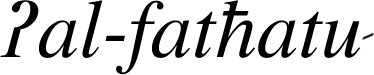 represents a,
 represents u, and
 represents i), one that denotes null vowelization (
 ), and one that denotes consonant germination/lengthening (
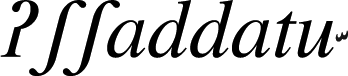 ) The morphosyntactic diacritics appear only at the end of the word and map abstract morphosyntactic properties, such as case and mood (Maamouri, Reference Maamouri1998). The modal endings of verbs and the case endings of definite nouns are represented using the same phonemic diacritics that encode the 3 short vowels. The case endings of indefinite nouns in nonpausal status are represented by the 3 vowel signs, doubled
 to indicate that the vowel sound is followed by the consonant n; see Saiegh-Haddad & Henkin-Roitfarb, Reference Saiegh-Haddad and Henkin-Roitfarb2014, for more information). While the morphosyntactic diacritics are not required for word identification, the phonemic diacritics are necessary for lexical access (Saiegh-Haddad, Reference Saiegh-Haddad2017). The current study focused on phonemic diacritics alone, as it investigated the processes involved in word identification.
The two orthographic versions of Arabic differ in the amount of phonological information they supply the reader via the two graphemic sets. The phonologically transparent version, called maʃku:l script, includes the two classes of diacritics, thus providing the reader with full phonological information. For example, the maʃku:l word MSTQBLFootnote
2
مُسْتَقْبَل corresponds to the phonological form mustaqbal, meaning “future.” The first short vowel u is represented by the diacritic  , the next two short vowels a are represented by the diacritic
 , and the absence of vowels is marked by the suku:n diacritic
 . The maʃku:l script is mainly used for early reading instruction at the onset of formal schooling, from first to fourth grades, and in children’s books. It is also used for the Quraa’n and most religious texts, and in poetry (Saiegh-Haddad, Reference Saiegh-Haddad2017). The second orthographic version, the default for Arabic speakers, is the ɣayr-maʃku:l script, which relies on letters alone with no diacritics. Thus, short vowels, consonant germination/lengthening, and the null vowelization are not represented at all (Abu-Rabia, Reference Abu-Rabia1997a, Reference Abu-Rabia1997b; Abu-Rabia & Siegel, Reference Abu-Rabia and Seigel2003; Taha, Reference Taha2013). As a result of the underrepresentation of the phonemic diacritics, almost every ɣayr-maʃku:l word can be potentially assigned many phonological forms, corresponding to both lexical and nonlexical readings. Consider, for example, the ɣayr-maʃku:l word MSTQBL مستقبل. With no information about the 3 short vowels and the null vowelization, there are, in principle, many possible phonological renderings, including the above example mustaqbal (“future”), as well as mastuqbal, mistuqbil, musataqbul, mustaqbil, and so on. While the first three examples are nonlexical, the last one (mustaqbil) is lexical, and means “host.” The ɣayr-maʃku:l MSTQBL مستقبل illustrates the two major challenges that children face in reading the opaque script: (a) identifying the word encoded in the written string, and (b) resolving the homographic word, a single letter string that has multiple phonological possibilities, each of which is associated with a different meaning (Bar-On, Dattner, & Ravid, Reference Bar-On, Dattner and Ravid2017; Perfetti & Hart, Reference Perfetti and Hart2001). Homography, which is omnipresent in both Arabic (Saiegh-Haddad & Hentkin-Roitfarb, Reference Saiegh-Haddad and Henkin-Roitfarb2014) and Hebrew (Shimron & Sivan, Reference Shimron and Sivan1994), is beyond the scope of the current study, which focuses on word identification.
Recovering phonemic diacritics while reading ɣayr-maʃku:l words, at least words that the reader is encountering for the first time, requires the use of morphological cues provided by the root-and-pattern morpho-orthographic structure of written Arabic words. The structure of Semitic written words reflects the non-concatenative interwoven bimorphemic nature of the Semitic spoken word (Ravid, Reference Ravid2012; Saiegh-Haddad, Reference Saiegh-Haddad2017). The Arabic spoken root usually consists of three to four consonants. It is an unpronounceable discontinuous morpheme, providing the core lexical meaning and basic consonantal skeleton common to a morphological family. Like the root, the morphological pattern is a discontinuous unpronounceable morpheme. It is a prosodic template specifying a vowel pattern into which root radicals are inserted at designated slots, and which may be preceded and/or followed by consonantal prefixes or suffixes. The insertion of root consonants within the pattern produces a distinctive lexical item, with a unique meaning and a well-defined grammatical category directly discernible by the specific pattern (Saiegh-Haddad & Henkin-Roitfarb, Reference Saiegh-Haddad and Henkin-Roitfarb2014). For example, the words sakan (“habitation”), sa:kin (“resident”), and musa:kanat (“housing”) are made up of the same root s-k-n and the word patterns CaCaC, Ca:CiC, and muCa:CaCat, respectively.
Roots and word-pattern morphemes exhibit morphemic constancy in the spelling of words. Roots are fully represented as a continuous internal core, separated only by the long-vowel letters. In contrast, patterns, being composed mostly of vowels, have lesser orthographic representation. Cues for pattern identification in reading ɣayr-maʃku:l words are a small subset of function letters that stand for pattern prefixes or suffixes, as well as the pattern-internal long-vowel letters. For example, the written forms of the three examples above are SKN سكن, SAKN ساكن, and MSAKNT مساكنة, respectively. The pattern is not represented at all in the first written word; it is represented only by the internal vowel-letter A (ا) in the second and by the peripheral consonantal letters M (م) and T (ت) and the vowel-letter A (ا) in the third. In reading these words, the reader must recover two short vowels in the first, one in the second, and three in the last. Despite spare representation, pattern cues constitute the main factor that facilitates the recovery of vowels in ɣayr-maʃku:l words. Thus, in learning to read Arabic, children must acquire the morpho-orthographic mapping strategy, which is critical to the reading process.
LEARNING TO READ ARABIC
Novice Arabic readers learn to read the phonologically transparent maʃku:l script and decipher it via phonological recoding of graphemic units composed of a letter and a diacritical mark. Although the maʃku:l script offers them a high degree of decipherability (Share, Reference Share2008), visual complexity and the problem of diglossia make the reading acquisition process slower, longer, and more exhausting than in other languages, delaying rapid, early mastery (Abu Ahmad, Ibrahim, & Share, Reference Abu Ahmad, Ibrahim and Share2014; Eviatar & Ibrahim, Reference Eviatar and Ibrahim2014; Hende, Reference Hende2012, Saiegh-Haddad, Reference Saiegh-Haddad2003). The visual characteristics of the Arabic orthography introduce a set of challenges for the novice reader, such as graphemes that are distinguishable only by the number and placement of the dots (consider, for example, the letters B ب, T ت, H ث; for more information, see Eviatar & Ibrahim, Reference Eviatar and Ibrahim2014). The second major source of disruption in phonological recoding consolidation involves the “distance” between written Standard Arabic and its spoken Arabic varieties, known as the diglossiaFootnote 3 phenomenon (Feitelson, Goldstein, Iraqi, & Share, Reference Feitelson, Goldstein, Iraqi and Share1993; Saiegh-Haddad, Reference Saiegh-Haddad2003, Reference Saiegh-Haddad2004, Reference Saiegh-Haddad2007, Reference Saiegh-Haddad2013). Children who learn to read Arabic encounter many written words that are not the same as the spoken words with which they are familiar. Saiegh-Haddad and Spolsky (Reference Saiegh-Haddad and Spolsky2014) reported that only one-fifth of spoken words used by preliterate Arabic-speaking children fully overlap with written Standard Arabic words. The other words can be divided into cognate words (40%), which are lexical items that are used in both spoken and written Arabic but have different surface phonological forms (e.g., tkassar “was broken” in the spoken variety versus takassar in the written variety), and meanings expressed using a different word in each of the two varieties (30%).
Differences between written and spoken language also appear at the phonological level, with phonemes existing in written but not in spoken Arabic. Letters representing sounds that do not exist in the spoken variety are more difficult to learn and identify (Asaad & Eviatar, Reference Asaad and Eviatar2013; Saiegh-Haddad, Reference Saiegh-Haddad2007). Furthermore, differences in syllable structure, phonotactic constraints, and stress patterns result in phonological alterations of many of the morphological word patterns when they are used in everyday speech. For instance, in Palestinian Arabic, the morphological pattern taCaCCaC (as in takassar “was broken”) is pronounced in the spoken variety as tCaCCaC (e.g., tkassar), as the omission of the first short vowel creating a consonantal cluster (tCa). Children who encounter the written maʃku:l form TKSR تَكَسَّر may tend to ignore the first short-vowel sign representing a and read the word as it is spoken. Diacritics are easy to ignore because they are less salient than letters (Shany, Bar-On, & Katzir, Reference Shany, Bar-On and Katzir2012). It is likely that the alterations and the instability of the short vowels in the transition from spoken to written language encourage readers to pay less attention to diacritics (Saiegh-Haddad, Reference Saiegh-Haddad2017). Learning to read in a diglossic context diminishes the advantages provided by transparent script. Though phonological recoding of maʃku:l words leads to accurate reading, it is not necessarily enough for lexical identification. The meaning of an unfamiliar written word can be retrieved by extracting semantic information conveyed in the root morpheme. Therefore, from a very early age, Arabic-speaking children intuitively look for larger grain size units (i.e., morphological units) for lexical access. Shalhoub-Awwad and Leikin (Reference Shalhoub-Awwad and Leikin2016) found a root priming effect among second graders, indicating the involvement of morpho-orthographic processes as early as the phase at which children read maʃku:l script and seemingly do not need to make use of higher processes.
Sensitivity to the morpho-orthographic structure of written Arabic words becomes crucial when children start to read ɣayr-maʃku:l words. The strategies needed for reading ɣayr-maʃku:l texts evolve during the first 3 or 4 years of school, while children still read maʃku:l texts. Bar-On and Ravid (Reference Bar-On and Ravid2011) investigated the development of morpho-orthographic identification (i.e., activation of morphological patterns via the discontinuous cues described above) in a Hebrew-speaking population. Children in the second, third, and fourth grades were asked to read aloud pseudowords constructed from a pseudoroot and a genuine pattern. Unpointed Hebrew words (words with no diacritics) were employed, such that recovery of missing vowel information relied on morpho-orthographic information. A dramatic increase in reading accuracy (from 30% to 57%) occurred between the beginning and the end of second grade, alongside gradual development from the end of second grade through the third and fourth grades. The authors attributed the development of morpho-orthographic identification to well-established phonological recoding skills, which allowed the participants to attend to larger orthographic units and to whole-word information (Share, Reference Share1995).
As children improve in reading ɣayr-maʃku:l text, phonological information provided by diacritics becomes redundant. However, it is unclear whether diacritics continue to contribute to more accurate and fluent reading. A series of studies that compared word reading accuracy for maʃku:l versus ɣayr-maʃku:l words, in isolation and in context, among poor and skilled readers, showed that reading accuracy was higher when words were presented with diacritics (Abu-Rabia, Reference Abu-Rabia1997a, Reference Abu-Rabia1997b, Reference Abu-Rabia1998; Abu-Rabia & Siegel, Reference Abu-Rabia and Seigel1995). However, these studies did not distinguish between the two diacritic systems: phonemic and morphosyntactic (Saiegh-Haddad, Reference Saiegh-Haddad2017). In a recent study, Saiegh-Haddad and Schiff (Reference Saiegh-Haddad and Schiff2016) examined accuracy and fluency in reading isolated Arabic words among native-speaking schoolchildren in the 2nd, 4th, 6th, 8th, and 10th grades. Unlike previous studies, Saiegh-Haddad and Schiff tested the contribution of only phonemic diacritics to reading, and found that they did not significantly affect accuracy, especially among children beyond 2nd grade. Moreover, ɣayr-maʃku:l words were read significantly more fluently than maʃku:l words across all grades, a finding that supports the suggestion that diacritics might create an excessive processing load among skilled readers (Abdelhadi, Ibrahim, & Eviatar, Reference Abdelhadi, Ibrahim and Eviatar2011; Eviatar & Ibrahim. Reference Eviatar and Ibrahim2014). Studies examining the development of reading diacritics in Hebrew have demonstrated a U-shaped path: 1st and 2nd graders relied on diacritics to extract vowel information; 4th graders, who were at the peak point in the transition to phonologically opaque script, used their superior morpho-orthographic skills to exploit pattern cues while ignoring, to some extent, the diacritics; and skilled readers were able to efficiently use both phonological and morphological information (Ravid, Reference Ravid1996; Shany et al., Reference Shany, Bar-On and Katzir2012).
With this background as a foundation, the current study aimed to: (a) trace the development of morpho-orthographic identification in learning to read Arabic, and (b) examine the use of phonological and morphological information at different points in reading acquisition in Arabic. To this end, we asked three groups of students, from the second, fourth, and sixth grades, and a control group of adults, to read three different word lists aloud. For the purpose of this study, we chose to use pseudowords and nonwords, making it possible to tease apart phonological and morphological components from lexical processes (Ravid & Schiff, Reference Ravid and Schiff2006). The first two lists contained identical pseudowords, each made up of a pseudoroot and a genuine pattern (Bar-On & Ravid, Reference Bar-On and Ravid2011) and thus defined as morphologically based. The pseudowords in one list were ɣayr-maʃku:l, such that reading them accurately would reflect intact morpho-orthographic identification. The second list included the same pseudowords, but with phonemic diacritics (i.e., maʃku:l pseudowords), such that reading them could rely on both phonological and morphological information. The final list was composed of maʃku:l letter strings that were phonologically and orthographically legal at the syllable level, but did not conform to an Arabic morphophonological pattern. These were thus defined as nonwords, and it was assumed that reading them would rely on phonological information alone. Our general predictions were that young readers would benefit mainly from phonological information, as expressed by faster and more accurate reading of maʃku:l pseudowords and nonwords than of morphologically based ɣayr-maʃku:l pseudowords, and that the contribution of morphological information to accuracy and speed would increase with age and schooling.
METHOD
Participants
Ninety native Arabic-speaking Israeli students (55 female), including 30 each from the second, fourth, and sixth grades, participated in the study alongside 20 young adults who constituted the control group. Mean ages and standard deviations of boys and girls in the four age groups are presented in Table 1.
Mean ages and standard deviations (in parentheses) of male and female participants in the four age groups

The study groups were chosen to reflect developmental milestones in reading acquisition as they appear in the language curriculum of the Arab sector in Israel: masku:l script is used in the first through the fourth grades; fifth graders start to read partially ɣayr-masku:l texts (using some of the phonemic diacritics to prevent homography); and sixth graders read fully ɣayr-masku:l texts. All participants were monolingual Arabic speakers who lived in the same northern region in Israel and thus spoke the same northern-dialect Arabic. All students attended the same school in a village defined as being of middle to high socioeconomic status, and were recruited on a voluntary basis with parental permission. Students reported by their teachers to have learning difficulties did not participate in the study. In addition, participants in the three student groups performed two subtests taken from the Arabic Standardized Reading and Writing Achievement Test (Assadi, Shany, Ben-Simon, & Ibrahim, Reference Assadi, Shany, Ben-Simon and Ibrahim2016), both of which required them to read aloud: a masku:l pseudoword reading task and a masku:l isolated word reading task. All students presented a reading level consistent with the norms expected at their respective grade levels.
Stimuli and design
Participants were asked to read aloud 36 letter strings divided into three lists. Two lists included the same 12 morphologically based pseudowords (MPW). Each word in these lists was constructed of a pseudoroot incorporated in a genuine pattern. For example, the pseudoword ʔNBXF انبخف is constructed of the pseudoroot B-X-F b-x-f ب-خ-ف incorporated in the real morphological verb pattern ʔinCaCaC. The difference between the two lists involved the presence or absence of phonemic diacritics (short-vowel signs and null vowelization sign): the first list, ɣayr-maʃku:l MPW, comprised pseudowords without phonemic diacritics, and the second list, maʃku:l MPW, comprised the same pseudowords but with phonemic diacritics (compare ʔNBXF with phonemic diacritics: اِنْبَخَفَ and without phonemic diacritics: انبخف). The third list included maʃku:l strings with no morpho-orthographic structure. For example, the maʃku:l string BTMNR بَتْمَنَر, read as the phonological form batmanar, does not correspond to any real Arabic morphological pattern. Because the strings in this list were not based on Arabic morphological patterns, they were defined as nonwords (NW). The criteria taken into account in designing each list are presented below.
Maʃku:l MPW and ɣayr-maʃku:l MPW lists
ROOT LETTERS
To maintain the orthographic and phonological transparency of the roots, all the pseudowords contained triconsonantal root letters. To avoid phonological distance between spoken and written standard Arabic, we chose root consonants that are pronounced the same in both modalities when produced in the northern Israeli–Arabic dialect. For instance, the standard consonant  is pronounced as t in the northern dialect, and thus did not appear as a root consonant in the study.
WORD PATTERNS
The 12 maʃku:l pseudowords were formed in accordance with 12 different morphological patterns, 7 of which correspond to nominal word patterns and 5 of which correspond to verbal word patterns. For example, the maʃku:l strings AXŠD أَخْشَد ʔaxʃad and MBAFL مُبافِل muba:fil are made up of the nominal patterns ʔaCCaC (e.g., أكْبَر ʔakbar “bigger”) and muCa:CiC (e.g., مُساعِد musa:ʕid “assistant”), respectively, and the maʃku:l strings ʔNBXF اِنْبَخَفَ ʔinbaxaf and ASTFLN اِسْتَفْلَن ʔistaflan are made up of the verbal patterns ʔinCaCaC (e.g., اِنْفَتَح ʔinfataħ “opened”) and ʔistaCCaC (e.g., اِسْتَعْمَل ʔistaʕmal “used”), respectively. Selected patterns were judged as age appropriate based on an existing list of verbal and nominal pattern frequencies in grade school textbooks (Shalhuob-Awwad, Reference Shalhoub-Awwad2013). Because the study focused on word identification processes, the pseudowords were presented with phonemic diacritics only.
The 12 ɣayr-maʃku:l pseudowords were constructed of the same letter strings (roots and patterns), representing the same morpho-orthographic structures. However, due to the homographic nature of Arabic, 9 of the ɣayr-maʃku:l pseudowords were homographic (i.e., the same morpho-orthographic structure represented between two and five morphological patterns). For example, the ɣayr-maʃku:l ASTFLN استفلن targets ʔistaflan and also ʔistaflin and ʔistuflin, corresponding to ʔistaCCaC (e.g., the active/past tense اِسْتَعْمَل ʔistaʕmal “used”), ʔistaCCiC (e.g., the imperative اِسْتَعْمِل ʔistaʕmil “use”), and ʔustuCCiC (the passive اِسْتُعْمِل ʔustuʕmil “has been used”), respectively. Six of the homographic MPWs conveyed two patterns, 2 conveyed three patterns, and 1 conveyed five patterns. It is important to note that in addition to the patterns that each of the homographic pseudowords targeted, there are many other phonological but nonmorphological reading possibilities. For example, the ɣayr-maʃku:l ASTFLN استفلن targets the 3 patterns presented above and also 69 potential nonpattern readings, such as ʔistuflan, ʔastaflin, ʔistiflan, ʔistufulan, and ʔastifalin, among others. The same is true of the ɣayr-maʃku:l ʔNBXF انبخف, which targets 2 morphological patterns and 22 additional phonological readings. Taking into consideration phonotactic restrictions, the number of phonological but nonmorphological reading possibilities ranges from 9 (MBAFL مبافل) to 69 (ASTFLN استفلن). Finally, to focus on the basic root-and-pattern structure identification, we avoided inflections and chose only surface words.
Maʃku:l NW list
The nonwords were created by replacing the prefixes of the morphologically based pseudowords with letters that are not used as function letters. Compare, for example, the maʃku:l morphologically based ʔNBXF اِنْبَخَفَ ʔinbaxaf with the maʃku:l nonword BTMNR بَتْمَنَر batmanar. Both strings are composed of five letters that correspond to a three-syllable word, two of which are closed (the first and the last) and one (the middle) of which is open. The two distinct morphemes, root and pattern, are easily recognized in the first example, owing to the two-function letter prefix ʔN اِن. In contrast, the second example presents a seemingly linear string of five root letters, which does not resemble any written or spoken Arabic word. Accurate reading of such words relies on phonemic diacritics alone. To allow comparison between the NW list and the two MPW lists, each one of the 12 nonwords was matched to one of the morphologically based pseudowords with respect to the number and type of syllables, as illustrated in the example above.
Pearson correlation coefficients for each list revealed a high level of reliability in the ɣayr-maʃku:l MPW list (r=.70) and the maʃku:l NW list (r=.76) and moderate reliability in the maʃku:l MPW list (r=.56).
Procedure and apparatus
The task was administered individually by the third author in a quiet room at school. As two of the three lists consisted of the same pseudowords, which differed only with respect to the presence or absence of phonemic diacritics, the task was conducted in two sessions, a month apart. During the first session, participants performed the reading task and read one of the two MPW lists. In the second session, they read the two other lists. To control for potential priming effects, half of the participants read the maʃku:l MPW list in the first session and the other two in the second, and the second half read the ɣayr-maʃku:l MPW list in the first session and the other two in the second session. Each session took approximately 10 min.
The 12 words in each list were presented in print, in traditional Arabic, font size 16, organized in two columns on one page. Each participant was instructed as follows: “The words on this sheet are words that you have never seen before; invented words. Please read each word aloud, going from top to bottom. Please note, I will measure your reading time, but try to read as accurately as possible and at your own pace.” The instructions before the maʃku:l lists also included the following sentence: “Note that the final diacritics are not marked in the words.” Oral reading was recorded and transcribed into broad phonemic transcription. Reading time was recorded for each list. To ensure accurate transcription, a sample of 20 words was taken from each study group, and 10 speech therapists were asked to transcribe the readings. A kappa test revealed high between-judge reliability.
Data treatment
Correct responses
ƔAYR-MAʃKU:L MPW LIST
Correct reading of ɣayr-maʃku:l MPWs involved correct pattern identification. For example, reading ʔNBXF انبخف as ʔinbaxaf. In the case of homographic pseudowords, each one of the potential patterns was considered a correct response. Recall that, as presented above, each ɣayr-maʃku:l MPW (homographic or not) can potentially be decoded in many other incorrect, phonological but not morphological, readings.
MAʃKU:L MPW AND NW LISTS
Correct reading of maʃku:l MPWs and NWs involved accurate reading according to phonemic diacritics.
Incorrect responses
For each list, the incorrect responses were classified into two or three types according to error type.
ƔAYR-MAʃKU:L MPW LIST
Incorrect responses for ɣayr-maʃku:l MPW reading were classified into two types: (a) nonpattern identification response, responses involving letter-string decoding rather than pattern identification, such as ʔanbaxaf, ʔunbixaf, or ʔinbuxaf instead of the correct ʔinbaxaf; and (b) letter-string error response, responses involving partial or erroneous letter-string decoding rather than word reading. For example, in the case of ʔNBXF, this could be ʔanbax, which does not represent the final f.
MAʃKU:L MPW LIST
Incorrect responses for maʃku:l MPW reading were classified into three types. The first two types were known as incorrect phonemic diacritic identification. Responses of this type involved correct letter–sound correspondence but incorrect decoding of the phonemic diacritics. Two different error types were defined in this case. The first was pattern identification response, a response that could only appear in the nine homographic pseudowords, when the reader ignored bottom-up phonological information from vowel signs in favor of top-down morphological information. For example, reading AXŠD أَخْشَد as ʔaxʃid, which corresponds to the real imperative-form pattern ʔaCCiC instead of the target ʔaxʃad. The second was nonpattern identification response, a response involving incorrect decoding of phonemic diacritics but with no pattern identification (e.g., ʔaxaʃad). Replacement of a short with a long vowel (e.g., ʔaxʃa:d) was also coded as this kind of incorrect response. The third error category was letter–string error response, which is described above (see the ɣayr-maʃku:l MPW List, error type [b]).
MAʃKU:L NW
Incorrect responses for maʃku:l NW reading were classified into two categories: (a) incorrect phonemic diacritic identification (see maʃku:l MPW List, error type [b]) and (2) letter-string error response (see ɣayr-maʃku:l MPW List, error type [b]).
RESULTS
Data analysis included two-way analyses of variance (ANOVA) examining the effects of Group (4: second, fourth, sixth, adults) and List (3: ɣayr-maʃku:l MPW, maʃku:l MPW, maʃku:l NW) on reading accuracy (in %) and on reading time (in seconds). Where necessary, we conducted post hoc pairwise comparisons at the .05 level for simple effects and for interactions. Means and standard deviations of accuracy rates (ARs) and of reading times (RTs) in each of the four age groups are presented in Table 2.
Means and standard deviations (in parentheses) of accuracy rates (AR) and reading times (RT) in each of the four age groups

Note: MPW, morphologically based pseudowords. NW, nonwords.
ARs
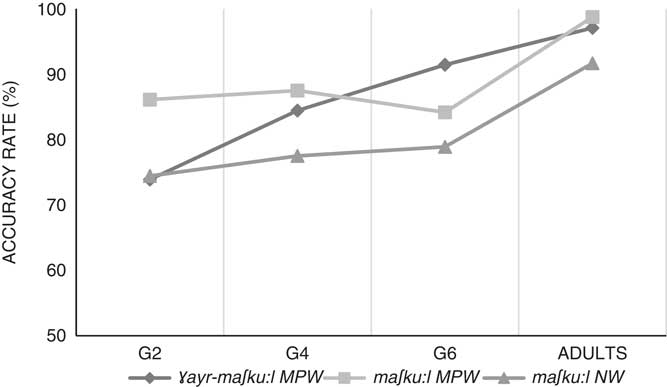
The two-way Group (4: 2nd, 4th, 7th, adults)×List (3: ɣayr-maʃku:l MPW, maʃku:l MPW, maʃku:l NW) ANOVA with AR as the dependent variable revealed a main effect of group, F (3, 106)=10.87, p<.0001. Ryan–Einot–Gabriel–Welsch multiple-range post hoc tests showed that adults (M=95.83, SD=7.39) were more accurate than second graders (M=78.15, SD=17.44) and fourth graders (M=83.15, SD=16.78). A main effect of list was also found, F (2, 212)=50.10, p<.0001. Pairwise comparisons showed lower accuracy for the maʃku:l NW list (M=80.63, SD=18.77) than for both the maʃku:l MPW list (M=89.13, SD=10.46) and the ɣayr-maʃku:l MPW list (M=86.71, SD=12.29). Finally, a significant interaction was found between group and list, F (6, 212)=2.99, p<.01. The interaction is presented in Figure 1.
Group × List interaction for accuracy rate.
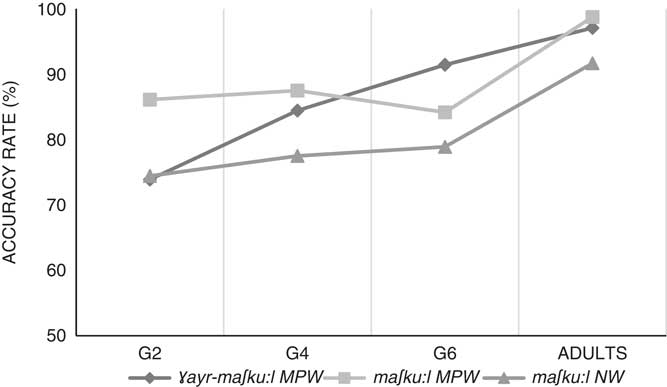
Looking at the graph shows same patterns in the two maʃku:l lists: the student groups did not differ and were less accurate than the adults. The interaction is derived from the ɣayr-maʃku:l MPW list, which shows a monotonic increase with age. Further analysis of between- and within-subject differences helped us to better understand the findings. Between-subject differences were tested using Ryan–Einot–Gabriel–Welsch multiple-range analysis at the .05 level, and revealed that when reading the ɣayr-maʃku:l MPW list, second graders were less accurate than all other groups and fourth graders were less accurate than adults. The three student groups did not differ from one another in reading both the maʃku:l MPW and the maʃku:l NW lists, and were less accurate than the adult group. Within-subject differences were tested using a repeated one-way ANOVA for each group. The analysis showed that second graders read the maʃku:l MPW more accurately than the ɣayr-maʃku:l MPW, F (1, 29)=11.04, p<.01, and the maʃku:l NW, F (1, 29)=10.20, p<.01. Fourth graders read the maʃku:l MPW more accurately than the maʃku:l NW, F (1, 29)=8.65, p<.01. Sixth graders were more accurate in reading ɣayr-maʃku:l MPW than both maʃku:l MPW, F (1, 29)=5.66, p<.05, and maʃku:l NW, F (1, 29)=9.92, p<.01, and adults were more accurate in reading maʃku:l MPW than maʃku:l NW, F (1, 29)=4.53, p<.05.
RTs
The two-way ANOVA revealed a main effect of group, F (3, 106)=26.64, p<.0001. Ryan–Einot–Gabriel–Welsch multiple-range post hoc tests showed the same difference pattern in the three lists, with adults and sixth graders reading faster than fourth and second graders. In addition, a main effect of list emerged, F (2, 212)=50.10, p<.0001. Pairwise comparisons indicated a hierarchy between the three lists, as follows: ɣayr-maʃku:l MPW (M=19.96, SD=6.58.2)<maʃku:l MPW (M=23.66, SD=8.2)<maʃku:l NW (M=28.01, SD=9.2). F values of the differences between ɣayr-maʃku:l MPW list and the maʃku:l MPW and maʃku:l NW lists were F (1, 106)=20.37, p<.0001 and F (1, 106)=103.93, p<.0001, respectively. The F value for the comparison between the latter two lists was F (1, 106)=29.16, p<.0001. No interaction was found between group and list, F (2, 212)=0.7, p=.65.
Correlation between AR and RT in reading the three lists
We also calculated the correlations between accuracy and speed for each list and for each student group. Among the nine Pearson correlation analyzes, only one significant weak correlation (r=.38, p=.04) was found among sixth graders when they read the maʃku:l MPW list. That is, the students who read more accurately this list demonstrated slower reading.
Incorrect response analysis
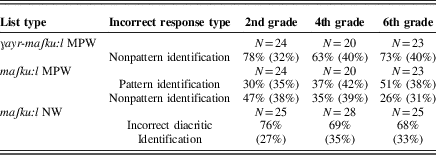
In addition to assessing reading accuracy, we were interested in examining the distribution of the incorrect responses. Adults made very few errors and therefore were not included in this analysis. For each list, we calculated the percentage of each incorrect response type of the total incorrect responses. As detailed above, three types of incorrect responses were defined for the maʃku:l MPW list, the third of which was letter–string error response, and two types were defined for the other two lists, the second of which was also letter–string error response. Table 3 presents the error percentage and standard deviations for two incorrect response types in the maʃku:l MPW list (the third type completes 100%) and for one type in the two other lists (the second type completes 100%). The analysis for each list included students who performed at least one error. Four one-way ANOVAs, each conducted on one of the aforementioned incorrect response types, revealed no effects, meaning that the three student groups displayed a similar distribution of the incorrect response types in all three lists.
Percentages and standard deviations of the incorrect response types for the three word lists in the three students groups (N=students who made at least one error)

Note: MPW, morphologically based pseudowords. NW, nonwords.
DISCUSSION
The main goal of the present developmental study was to investigate the contributions of phonological information, provided directly by phonemic diacritics, and morphological information, provided indirectly by morpho-orthographic root-and-pattern structures, in Arabic word identification. Participants were asked to read aloud three different types of pseudowords and nonwords, designed to enable separation between phonological and morphological information. The findings converge on the conclusion that the contribution of morphology exceeds that of phonology with respect to both accuracy and RT. This advantage is evident as early as second grade and increases over the years.
AR
High ARs were reached for all three types of the letter strings, with a significant advantage for the two MPW lists over the maʃku:l NW list. From a developmental perspective, the patterns demonstrated for the two maʃku:l lists were similar to one another, with adults performing more accurately than all three student groups, which did not differ from one another. In contrast, ɣayr-maʃku:l MPW-reading appeared to develop with age, with a significant improvement between second and fourth graders and between fourth graders and adults. Moreover, diacritics contributed to accuracy in second grade but not in the other three groups. Sixth graders even read the ɣayr-maʃku:l MPWs more accurately than the maʃku:l MPWs. These findings contrast sharply with previous studies that show higher reading accuracy when words are presented with diacritics than without them (e.g., Abu-Rabia, Reference Abu-Rabia1997a, Reference Abu-Rabia1997b, Reference Abu-Rabia1998; Abu-Rabia & Siegel, Reference Abu-Rabia and Seigel1995). One possible explanation for this contradiction involves differences in the nature of the diacritics used, as early studies did not distinguish between the two systems, phonemic and morphosyntactic, while the current study focused on phonemic diacritics alone. The current findings support Saiegh-Haddad’s claims regarding the importance of understanding the independent roles of the two diacritic systems in word processing, and particularly the role of phonemic diacritics in ensuring accuracy in lexical access and reading (Saiegh-Haddad, Reference Saiegh-Haddad2017).
Reading ɣayr-maʃku:l MPW
To fill in missing phonemic information when reading a ɣayr-maʃku:l MPW, readers must rely on pattern identification. This process proved to be a very effective strategy, leading to a high accuracy of 74% very early on in second grade, and gradually improving to almost full accuracy among adults. These rates are particularly impressive considering the dozens of phonological reading options for each one of the pseudowords (e.g., 72 for ASTFLN استفلن and 24 for ʔNBXF انبخف).
Our findings are in line with those of Bar-On and Ravid (Reference Bar-On and Ravid2011), who reported relatively high success in pattern identification of Hebrew unpointed (with no diacritics) morphologically based pseudowords at the end of second grade. However, comparison between the two studies reveals better performance of Arabic readers in all study groups (Arabic: 74%, 84%, 91%, 97% in the second, fourth, and sixth grades, and among adults, respectively; Hebrew: 55%, 65%, 73%, 85% in the second, fourth, and seventh grades, and among adults, respectively). Given that the current study employed the stimuli and design principles used by Bar-On and Ravid (Reference Bar-On and Ravid2011), and tested a similar population in terms of socioeconomic background, it is plausible that the more accurate performance displayed by Arabic readers stems from language differences rather than from differences in reading ability. Specifically, to minimize available correct responses, both studies attempted to avoid homography as much as possible. However, this was harder to do in Arabic (9 out of the 12 pseudowords were homographic), resulting in a higher potential for correct readings. In addition, while Hebrew readers have to cope with the completion of five vowels, Arabic readers are required to fill in three vowels alone. Thus, it appears that morphological pattern cues coupled with a relatively small inventory of short vowels requiring recovery, facilitated Arabic readers in identifying ɣayr-maʃku:l words.
Reading maʃku:l MPW and NW
The high ARs achieved in reading the two maʃku:l lists is not surprising, as all phonological information was provided in the written words. Yet, higher scores were achieved for the MPW than for the NW list. Reading maʃku:l NW relies on phonological information alone, whereas reading maʃku:l MPW can utilize both phonological and morphological information. The advantage of the MPW list over the NW list thus supports the existence of a unique contribution of morphological information, beyond that associated with phonological information. Alongside the steady advantage of reading maʃku:l MPW over NW, the three student groups revealed no between-grade development in accuracy with respect to either list. This finding was quite surprising and was particularly unexpected for the maʃku:l MPW list, in light of the development shown for its matched ɣayr-maʃku:l list. This result can be interpreted in the context of the explanation proposed by Shany et al. (Reference Shany, Bar-On and Katzir2012), who similarly found no difference between second and fourth graders (though they did find increased accuracy among sixth graders) in reading morphologically based Hebrew pseudowords with diacritics. The authors suggested that both age groups use phonological and morphological information, but differ in the extent to which each type of information is involved in reading. Namely, second graders were assumed to make more precise use of phonology than did fourth graders, and fourth graders to rely more on morphology. This explanation is in line with the current finding of significant between-grade development in reading ɣayr-maʃku:l MPWs (i.e., increased reliance on morphology) alongside similar accuracy levels between grades in reading maʃku:l MPWs (which can be achieved using both phonology and morphology).
The lack of development in reading maʃku:l (or pointed) Arabic and Hebrew pseudowords challenges the common view presented in the literature on English reading, which refers to pseudoword decoding as a crucial indicator of letter–sound knowledge. According to this view, the more proficient the reader is, the more accurately (s)he will decipher pseudowords. The unique features of both Semitic languages encourage the reader to gradually pay less attention to phonological information in favor of greater reliance on higher order, word-level lexical and morphological information (Share & Bar-On, Reference Share and Bar-On2017).
Analysis of the incorrect responses that appeared in both maʃku:l lists demonstrated that decreased reliance on bottom-up phonological information (diacritics) in favor of morphological top-down processes starts as early as second grade. Of all the errors in both maʃku:l lists, the vast majority involved incorrect decoding of phonemic diacritics (the average of the three student groups was 75% for the MPW list and 71% for the NW list). This demonstrates the well-known tendency of Arabic (Saiegh-Haddad, Reference Saiegh-Haddad2017) and Hebrew (Ravid, Reference Ravid1996; Shany et al., Reference Shany, Bar-On and Katzir2012) readers to ignore, to some extent, the small and less salient signs that appear below and above the letters. Moreover, about half (on average) of diacritic decoding errors in reading maʃku:l MPWs involved the retrieval of a morphological pattern that matched the letter string but not the diacritics (e.g., reading MBFYL مُبَافِل as mabfi:l instead of mubafi:l). It is important to note that, though some homographic pseudowords convey more than two potentially patterns, only one pattern in addition to the target appeared in all homographic words for both the maʃku:l and the ɣayr-maʃku:l MPW lists, apparently because the other potential patterns are much less frequent. Pattern identification errors in reading maʃku:l MPWs appeared in all age groups, with their percentage of the total number of incorrect responses showing an insignificant tendency to increase between the second (30%), fourth (37%), and sixth (51%) grades.
Developmental course of accurate reading of maʃku:l and Ɣayr-maʃku:l words
The three lists interacted differently between the grade levels, indicating different developmental trends. Specifically, second graders read morphological pseudowords more accurately than nonmorphological nonwords, but were more accurate in reading maʃku:l rather than ɣayr-maʃku:l pseudowords. These findings suggest that the Arabic-speaking second graders had already acquired morphological strategies, but at this point in reading acquisition, still benefited from phonological information. Fourth graders, who still read maʃku:l texts in school, displayed no difference between maʃku:l and ɣayr-maʃku:l pseudoword reading, showing that they no longer benefited from diacritics and were ready to move to ɣayr-maʃku:l text reading (as recommended by the curriculum). Sixth graders were, unexpectedly, more accurate in reading ɣayr-maʃku:l pseudowords. Following 2 years of experience in reading ɣayr-maʃku:l texts, the students acquired proficiency in pattern identification. However, accurate reading of maʃku:l MPW requires the extraction of information from two sources simultaneously, which may still be challenging for them. Adults, almost exhibiting a ceiling effect, presented higher accuracy in reading morphological pseudowords, showing once again the superiority of morphological information over phonological information. However, in contrast to sixth graders, adults have full possession of executive functions alongside skillful reading (Bar-On et al., Reference Bar-On, Dattner and Ravid2017), allowing them to avoid errors by relying on both phonological and morphological information.
RT
The RT results join the accuracy findings in providing strong support for the important role played by morphology in learning to read Arabic. All age groups displayed the same hierarchy: reading ɣayr-maʃku:l MPWs was faster than reading maʃku:l MPWs, which in turn was faster than reading maʃku:l NWs. This faster reading of morphologically complex words is in accordance with accumulating evidence from studies in Indo-European languages. Carlisle and Stone (Reference Carlisle and Stone2005), for example, showed that English-speaking readers in the second and third grades read suffixed words such as hilly faster than matched pseudosuffixed words such as silly. In a different paradigm, Colé, Bouton, Leuwers, Casalis, & Sprenger-Charolles (Reference Colé, Bouton, Leuwers, Casalis and Sprenger-Charolles2012) found that French students of the same ages read pseudowords composed of an illegally combined real stem and real derivational suffix faster than they read matched pseudowords composed of a pseudostem and a real derivational suffix, and that the latter were read faster than combinations of pseudostem and pseudosuffix. In Indo-European languages, readers parse the written word into its concatenated continuous stem and affix morphemic units. As a result, reading larger units (morphemes rather than letters) enhances reading speed (Carlisle & Fleming, Reference Carlisle and Fleming2003; Carlisle & Katz, Reference Carlisle and Katz2006; Carlisle & Stone, Reference Carlisle and Stone2005; Laxon, Rickard, & Coltheart, Reference Laxon, Rickard and Coltheart1992; Marcolini, Traficante, Zoccolotti, & Burani, Reference Marcolini, Trificante, Zoccolotti and Burani2011; Quémart, Casalis, & Colé, Reference Quémart, Casalis and Colé2011).
As in Indo-European languages, many studies in Arabic and Hebrew have shown that the identification of Semitic written words involves morphological decomposition. However, the explanation above cannot be directly applied to Semitic languages for two reasons. First, surface-derived Semitic words are basically decomposed into two non-concatenated root and pattern morphemes, which cannot simply be treated as two larger units that are linearly concatenated to each other. Second, while a root morpheme is a continuous unit, a word pattern is discontinuous, making it more challenging to understand the way in which it enhances word identification speed.
An ample body of robust and consistent evidence, mostly from priming studies, has indicated that skilled readers and typically developing readers in both Arabic and Hebrew make use of the root morpheme during word recognition (Boudelaa & Marslen-Wilson, Reference Boudelaa and Marslen-Wilson2000, Reference Boudelaa and Marslen-Wilson2001, Reference Boudelaa and Marslen-Wilson2005, Reference Boudelaa and Marslen-Wilson2011; Deutsch, Frost, Peleg, Pollatsek, & Rayner, Reference Deutsch, Frost, Peleg, Pollatsek and Rayner2003; Frost, Forster, & Deutsch, Reference Frost, Forster and Deutsch1997; Schiff, Raveh, & Kahta, Reference Schiff, Raveh and Kahta2008; Shalhoub-Awwad & Leikin, Reference Shalhoub-Awwad and Leikin2016; Velan & Frost, Reference Velan and Frost2011; Velan, Frost, Deutsch, & Plaut, Reference Velan, Frost, Deutsch and Plaut2005; Yamin & Raveh, Reference Yamin and Raveh2005). In contrast, findings on word-pattern priming are less consistent, and reveal less coherence between Arabic and Hebrew. In Arabic, priming effects were found for both nominal (Boudella & Marslen Wilson, Reference Boudelaa and Marslen-Wilson2005, Reference Boudelaa and Marslen-Wilson2011) and verbal (Boudella & Marslen Wilson, Reference Boudelaa and Marslen-Wilson2005) patterns among skilled readers. Among developing readers (second and fifth grades), word-pattern priming was not found to affect RT, but a nominal pattern facilitated accuracy in second grade and a verbal-pattern in fifth grade (Shalhoub-Awwad, Reference Shalhoub-Awwad2013). In Hebrew, a verbal pattern improved reaction time in making lexical decisions but a nominal pattern did not (e.g., Deutsch, Frost, & Forster, Reference Deutsch, Frost and Forster1998; Frost et al., Reference Frost, Deutsch and Forster2000). Deutsch and Malinovitch (Reference Deutsch and Malinovitch2016) used a picture–word interference paradigm and found a nominal pattern effect in skilled Hebrew readers. The authors suggested that identification of a root-letter morpheme is enough for word perception but not for word production, a task requiring construction of the word’s phonological word-form. Word patterns provide all phonological information, including the segmental, vocalic, metrical structure, and suprasegmental levels. The current study findings strongly support the crucial role of word patterns in reading and suggest that they not only function as cues for completing missing vowel information but also constitute a critical factor in the process of word unitization. That is, word patterns are used in creating whole-word representations, a sine qua non for automatism and fluency (Share, in press).
While word patterns facilitate RT, diacritics apparently slow down reading, a finding also reported by Saiegh-Hadad and Schiff (Reference Saiegh-Haddad and Schiff2016). Maʃku:l NWs are decoded via linear grapheme–phoneme correspondence, such that it is not surprising that these words are read at the slowest pace. In reading maʃku:l MPW, diacritics contributed to better accuracy in second grade, while they appeared to be redundant for the other age groups. However, all four groups read these words more slowly than they read ɣayr-maʃku:l MPWs. This indicates that diacritics can compete for the reader’s attention and thus interfere with the reading process. In addition, as most of the MPWs were homographic, it is likely that while two (or more) correct responses were available for the reader in reading homographic ɣayr-maʃku:l MPWs, only one was available when reading same word with diacritics. In the latter case, the reader was forced to obey the signs, which may have been a time-consuming process. Finally, the between-grade development in RT attests to a similar identification process in all four groups, whereby the presence of pattern cues, with or without diacritics, encouraged the reader to employ whole-word access. In the absence of pattern cues (which are less common in Arabic), the reader is forced to rely on alphabetic mechanisms.
Phonology and morphology in the development of Arabic word identification
Our findings show that both phonological and morphological information are involved in reading Arabic from very early stages, but have different weights at different points in the reading acquisition process. The weight of morphology appears to increase with age and schooling, at the expense of phonology. Integration of the reading accuracy and RT results marks the period between the fourth and sixth grades as the watershed in the development of skilled morpho-orthographic strategies. Thus, fourth graders are better than second graders in using morphological information for the recovery of vowel information, but are not faster than the younger group. Meanwhile, sixth graders show faster reading, indicating more efficient word identification (Perfetti, Reference Perfetti1992), and demonstrate a high tendency to ignore diacritics, indicating that they are at the height of the transition from maʃku:l to ɣayr-maʃku:l scripts (Shany et al., Reference Shany, Bar-On and Katzir2012). A trade-off between accuracy and speed was only found in this group and in reading maʃku:l MPW’s: students who read these words faster tend to make more errors, that is, to ignore diacritics. Accurate reading of these words requires overcoming the whole-word pattern-identification strategy, and paying attention to diacritics. This demanding interferes with the fluency of the reading.
Morpho-orthographic identification is essential for reading the opaque ɣayr-maʃku:l script and, in accordance with the current study findings, Arabic-speaking students make the transition to ɣayr-maʃku:l textbooks in sixth grade. The same transition from transparent to opaque scripts occurs in learning to read Hebrew, but somewhat earlier, in fourth grade. The process of reading acquisition in Arabic poses unique challenges for learners (Eviatar & Ibrahim, Reference Eviatar and Ibrahim2014; Saiegh-Haddad, Reference Saiegh-Haddad2017). Specifically, they learn in the context of extreme diglossia, such that phonological differences between the written and spoken language varieties can impede links between orthography and morphophonology and hinder the acquisition of morpho-orthographic representations. In addition, though morphosyntactic diacritics are not relevant for word identification, the demand associated with learning another representation system places an additional, significant load on the reader in the reading acquisition process. It is important to note that morpho-orthographic identification skills are not sufficient for reading ɣayr-maʃku:l texts. The high prevalence of homographic words in every Arabic text requires efficient reliance on context, as well as monitoring abilities (Bar-On et al., Reference Bar-On, Dattner and Ravid2017).
Conclusion
This study on reading in Arabic demonstrates the division of labor between phonology and morphology in word identification and the changes that occur in the trade-off between these two processes over the course of reading development. The findings contribute knowledge about the way morphology functions in reading a Semitic language. As in English and other Indo-European languages, morphology appears to facilitate the identification of larger units, thus promoting whole-word identification. Unlike these languages, morpheme units are nonlinear rather than concatenative structures. In this sense, Arabic shares features with Hebrew, another Semitic language. While studies in both languages focus mostly on the role played by the root-morpheme in morphological decomposition, the current study joins studies emphasizing the crucial role played by word patterns in word identification (Bar-On & Ravid, Reference Bar-On and Ravid2011; Deutsch & Malinovitch, Reference Deutsch and Malinovitch2016). In the context of reading in a phonologically opaque but morphologically transparent orthography, identification of the written word via its morpho-orthographic pattern is the primary tool in constructing the word’s phonological word-form. Alongside the similarities between the two Semitic languages, Arabic possesses unique challenges that slow down, to some extent, the pace of progress in reading acquisition. Increased understanding of the role of morphology and the way it interacts with the unique characteristics of the Arabic language and orthography can be useful for reading instruction and in designing diagnostic and intervention programs for students with reading disabilities.
 “connecting hamza,” and
 الخَنْجَرِيّةُ ʔal- ʔalifu l’xanjariyyatu “dagger aleph,” a short vertical stroke on top of a consonant indicating a: as in
 ʔallah (“god”; Saiegh-Haddad & Henkin-Roitfarb,