Why do some individuals become lifelong voters, while others do not? A typical answer focuses on resources and the degree to which young adults have access to the time, money and civic skills for participation.Footnote 1 Recent research on voting behavior points to a fourth resource: health. If participation requires that individuals possess some physical capacity and mental well-being, then population health inequities may lead to a health–participation gap. Indeed, the voting gap across health status is consistently estimated to be upwards of 10 percentage points,Footnote 2 rivaling other noteworthy disparities in electoral participation. This association is important not just because it pinpoints a source of political inequality, but because health inequalities in turnout may also have significant political and electoral consequencesFootnote 3 due to health-based disparities in partisanshipFootnote 4 and public opinion.Footnote 5
While research on the health–participation gap is in its infancy, research on the adult consequences of childhood and adolescent health has accumulated in the fields of sociology psychology, public health and economics. It is now well established that poor health early in life is deleterious to success on an array of adult outcomes such as educational attainment, socioeconomic status and health.Footnote 6 One recent article aptly described this effect as the ‘long shadow cast by childhood physical and mental problems on adult life’.Footnote 7 We expand this work into the political realm by asking whether the ‘long shadow’ extends to adult political life.
Using the National Longitudinal Survey of Youth 1997 (NLSY), we find that poor adolescent health generally retards the upward trajectory of voting, but that certain childhood resources can reverse this effect in complex and unexpected ways. Specifically, we show that self-rated health status (SRHS) is associated with an individual’s initial probability of voting but not the voting trajectory, depression has little influence on the initial probability of voting but is associated with changes in voting over time, and physical limitations are unrelated to voting in young adulthood. We further show that the parents’ educational level mitigates the effect of self-rated health on voting for some young adults and exacerbates it for others, while the parents’ economic standing does not change the nature of the health–turnout linkage. Importantly, we demonstrate the robustness of some claims and the precariousness of others by replicating our findings using the Panel Study of Income Dynamics (PSID).
This study contributes to our understanding of political behavior in several ways. First, it affirms and extends the idea developed in recent scholarship that health is important to political participation. Participation in politics requires a functioning and healthy (or at least not unhealthy) body. While previous research on the participatory consequences of health has generally focused on only one aspect of health,Footnote 8 we show that health influences turnout differently depending on the ailment. Health is multidimensional, and our understanding about how health is related to political behavior must take this into account.
Secondly, our findings – that certain health conditions may interrupt the traditional voting trajectory of young adults – challenges the dominant assumption in the turnout literature that the likelihood of voting increases in the first few elections but flattens soon after.Footnote 9 We show that chronic health conditions not only affect the initial likelihood of voting, but may also rob individuals of the typical increase in voting during their early 20s. It remains to be seen whether these same individuals ‘catch up’ to their healthy counterparts later in life. This finding, along with more recent research showing that the development of a voting habit is bumpier than previously suggested,Footnote 10 requires scholars to question commonly held views about how young adults transition to being active participants.
Thirdly, we show that the resources for participation – health, education and income – must be considered in tandem. Studies of voting behavior typically model turnout as a function of an individual’s resources on the basis that more resources unequivocally lead to a higher propensity to participate. We find, however, that some sets of resources can activate participation while other sets can debilitate it. For example, the prior experience of poor health can increase participation among now-healthy individuals who come from educated families. This effect – in which prior poor health is associated with higher turnout – suggests that poor–rich combinations of resources may sometimes motivate participation by placing past grievances (that is, prior poor health) in a resource-rich environment (that is, now-excellent health, educated family). In contrast, we show that coming from a well-educated family can reduce participation in the face of declining health. Although we are not able to replicate these findings, we believe that they call for new theorizing on how sets of resources, rather than the individual resources themselves, may motivate or depress participation.
Finally, our research is notable in that it employs underutilized longitudinal datasets including the NLSY and the PSID to understand political participation. The majority of work on the health–participation gap uses cross-sectional surveys with adult samples. While cross-sectional data are useful for certain analytic purposes, they do little to distinguish between factors that influence an individual’s long-term propensity to vote from those that have temporary, short-term effects that are associated with recent personal or political conditions.Footnote 11 The inability to ‘sort out’ causal ordering and the potential endogeneity issues associated with cross-sectional analyses is particularly problematic for understanding the relationship between health and turnout, because health may have both developmental and contemporaneous components.Footnote 12 By employing longitudinal data and a developmental design we can better pinpoint both the short- and long-term effects of poor health across childhood, adolescence and young adulthood.
A DEVELOPMENTAL APPROACH TO VOTER TURNOUT
Political scientists have long viewed voting as a habit that develops over the life course,Footnote 13 with the bulk of this development occurring in young adulthood. The developmental trajectory has three components including a starting level, which is the probability that citizens vote in their first eligible election, growth, which is the period in which individuals gain resources and experiences that are relevant to participation, and inertia, which is ‘the propensity for citizens to settle into habits of voting or nonvoting’.Footnote 14 As Plutzer explains, young citizens must decide whether to vote in their first eligible election; this decision is determined in large part from parental, demographic and personal factors in adolescence.Footnote 15 First-time voters are likely to become habitual voters quickly after the first election, while non-voters are likely to remain non-voters in subsequent elections. Of the non-voters who become habitual voters, the factors that determined their initial probability of voting become less important.
Plutzer finds that the resources attained from parents have a strong influence on whether an individual voters in her or her first election, but are largely unrelated to growth thereafter.Footnote 16 This makes sense considering how costly it is to vote for the first time. Young citizens have the most barriers to voting: they are unfamiliar with the registration process, they may not know the location of their polling place or have a good understanding of key issues, they have few friends who vote and they are least likely to be targeted by political groups.Footnote 17 Surprisingly, research shows that the adoption of adult roles, such as leaving home, attending college or buying a house, has little bearing on turnout in ‘the first seven years of the political life cycle’.Footnote 18 Turnout in young adulthood thus seems to be influenced more by the resources and socialization experiences of childhood and adolescence than by the adult experiences that would be expected to draw individuals into politics.
Inertial states are different than starting values or growth. Because the costs of voting are constant and resources generally increase with age, many nonvoters eventually become habitual voters. The difference across individuals is the speed at which they do so. For instance, Plutzer shows that college-educated individuals make the transition to habitual voters quicker than those without a college degree.Footnote 19 And, while major life events – such as job loss or divorce – are likely to cause temporary disruptions in turnout, these effects are more detrimental for habitual voters than for non-voters.
Using a developmental approach allows scholars to assess the determinants of turnout more precisely by (1) looking at how factors originating in adolescence or young adulthood impact starting levels compared to growth, (2) modeling variations in how quickly individuals make the transition from non-voters to habitual voters, and (3) allowing major life events to temporarily disrupt the inertia of habitual voters. The developmental model, combined with a theoretical understanding of how health imposes additional costs to voting, is also well suited to generate hypotheses for how different facets of health are related to voter turnout.
THE ROLE OF HEALTH IN THE DEVELOPMENTAL MODEL OF VOTER TURNOUT
We discuss the effect of three dimensions of health – physical health, mental health and overall well-being – over an individual’s life and in terms of the resources and motivation required to participate, thereby placing the role of health firmly in the theoretical frames offered by the developmental and resource models of participation. There are two reasons for focusing on these three dimensions of health. First, research on the health–participation gap has consistently shown the importance of these dimensions of health, but has often done so in an isolated fashion. Because one of our goals is to reconcile past research and provide a more comprehensive understanding of the health–participation link, it makes the most sense to build on previous research. Secondly, these dimensions of health are the most commonly available in survey data.
Physical Health and Turnout
We define physical health as ‘the general working of one’s body’Footnote 20 and measure it as the presence (or absence) of a chronic condition that limits daily activities. Conditions that limit physical mobility are particularly detrimental to political participation,Footnote 21 since they impose additional physical costs to voting. Absentee ballotsFootnote 22 and improved street conditionsFootnote 23 help overcome some of these physical limitations for senior citizen participation, but individuals are generally less likely to vote if they find it more physically difficult to do so.Footnote 24 Prior research on limitations focuses on disabilities such as blindness, hearing impairment and immobility, but overlooks those that emerge from other physical health conditions earlier in life such as cancer, diabetes, asthma and high blood pressure. Disability and chronic conditions differ in several important respects; most notably, disability does not imply poor physical health.Footnote 25 An individual with a hearing impairment or who is in a wheelchair may consider themselves to be in perfect health otherwise, or may be diagnosed as healthy along a range of health dimensions. However, the logic of physical limitations should apply equally to disabilities and chronic conditions when looking at their effects on political participation.
Living with chronic conditions in a physical world that privileges able-bodied individuals is part of a managed process: individuals establish routines, redesign their environment and living conditions to be more accommodating, and establish networks of social support to manage the condition and its subsequent limitations. In this sense, we expect that physical limitations primarily affect the inertia underpinning voting as opposed to the starting levels or growth. The onset of a chronic condition will be disruptive until the condition and its limitations are sufficiently managed and accommodated in everyday life. That is, among individuals who have already developed the habit of voting, a negative change in physical health will likely cause a temporary disruption in their voting trajectory, much like a job loss or divorce causes temporary disruptions.
Like other disruptive factors, such as widowhoodFootnote 26 or withdrawal from the labor market,Footnote 27 we expect that the negative effect of physical limitations on turnout will be considerably less evident among young citizens than their older counterparts. We expect this for three reasons. First, younger citizens are much less likely to have formed voting habits that can be disrupted by the onset of a limiting chronic condition. Secondly, the onset of the chronic conditions considered here, such as diabetes, high blood pressure and cancer, often occur later in life, making them less prevalent among younger citizens. In our dataset, for instance, nearly 60 per cent of young adults cited asthma as their chronic condition. While asthma is certainly an affliction that limits physical activity, it may not be as significant as those caused by the types of conditions that are more typical in late adulthood. Thirdly, research has identified generational differences in how individuals understand their disability; young citizens, unlike their older counterparts, are much more likely to identify with and rally around their disability, which in turn leads to smaller differences in political participation between those with and without a disability.Footnote 28 This type of generational change also seems possible with chronic conditions like cancer and diabetes, which have recently been subject to organizational efforts to raise awareness, reduce stigma around the disease and empower those affected.Footnote 29 Because we are looking at samples of young adults who came of age in the late 1990s and early 2000s, it seems less likely that a large dampening effect would be observed.Footnote 30
Mental Health and Turnout
For mental health, we focus on depression because it is associated with political participation, it is one of the leading burdens of disease, and relevant to the larger population due to its high prevalence. Depression is a mood disorder characterized by a loss of energy, low self-esteem, concentration problems, changes in eating and sleeping patterns, and thoughts of suicide.Footnote 31 We measure depression in terms of symptomology. Using a gradient of symptoms is better because it captures individuals along a depressed mood spectrum, including respondents with clinically significant but non-major symptoms.Footnote 32 As Ojeda explains, people with a depressed mood are less likely to vote because of a loss in motivation, decreased cognitive abilities and reduced somatic capacity, all of which are required for participation.Footnote 33
Depression is much more likely than physical limitations to disrupt all aspects of voting, because it imposes larger costs. Whereas voters who are physically limited may still have the motivation and cognitive resources to turn out, depression attacks not only the physical capacity to vote, but also the psychological factors that impact the decision to vote. Depression impairs the cognitive abilities and executive functioning that underpin the civic skills required for participation. If voting requires ‘mind, body and heart’, voters with physical limitations lack the body while voters experiencing a bout of depression are affected in all three domains.
There are also more opportunities for citizens with physical limitations to be integrated into society compared to those with mental health issues. The disability rights movement is nearly a half-century old, and efforts like the Voting Accessibility for the Elderly and Handicapped Act of 1984 and the Americans with Disabilities Act of 1990 have helped make the political process more open to those with physical disabilities.Footnote 34 However, disability was only redefined to include depression in 2008.Footnote 35 While research on the economic and social consequences of depression has flourished,Footnote 36 there is little electoral policy to make voting easier for people with mental disorders; in some cases, policy excludes such individuals.Footnote 37
Overall Well-Being and Turnout
We capture overall well-being using a SRHS question asking respondents ‘In general, how is your health?’ with five allowable responses of excellent, very good, good, fair and poor. Because SRHS is empirically related to objective measures of health,Footnote 38 scholars argue that it is ideally suited to test theories of political behavior.Footnote 39 Some even claim that ‘an individual’s health status cannot be assessed without’ SRHS and that this single item captures ‘an irreplaceable dimension of health status’.Footnote 40
While poor health is associated with lower levels of turnout, we expect SRHS to have a substantial effect on starting levels and a lesser effect on growth and inertia. As stated above, factors that originate in adolescence and enable citizens to overcome the high costs of first-time voting are the most likely to differentiate individuals in their starting levels of turnout. Unlike other ailments that develop as people age or fluctuate quite substantially over the life course, SRHS originates in early childhood,Footnote 41 is transmitted across generationsFootnote 42 and is highly correlated with socioeconomic status,Footnote 43 much like political voice and power.Footnote 44 Consequently, we expect that SRHS will largely differentiate individuals in their initial starting levels of turnout but have little effect on voting rates over time, much like parental education.Footnote 45
FAMILY RESOURCES AND THE HEALTH TURNOUT LINKAGE
The transition to adulthood, including the development of a voting habit and an interest in politics more broadly, is smoothed by the presence of resources; adolescents from well-to-do families are better equipped to confront the challenges that come with independent living and thinking, while their less well-off counterparts face a bumpier path.Footnote 46 The role of health on political participation must be considered in this context. Thus while poor health negatively affects turnout, it is also worth considering how family resources can mitigate or exacerbate the health–participation gap. We consider two resources in particular – parental education and family income. Parental education is an important predictor of political participation,Footnote 47 and income is an important predictor of health status.Footnote 48
Parental education is a well-known and well-studied predictor of turnout. Children from families with educated parents are, on average, according to the results of a recent meta-analysis of voter turnout, more likely to participate later in life than those from less well-educated families.Footnote 49 Educated parents are likely to have established interest in politics that they can transmit to their children through direct teaching, inculcation and role modeling. In this sense, we expect parental education to mitigate the effects of health in much the same way that we expect income to. However, we also believe that there is a second pathway through which parental education can have mitigating effects: by helping adolescents and young adults learn how to manage their health. Education has consistently been shown to improve health behaviors.Footnote 50 In this vein, we expect that educated parents will better understand insurance plans and know how to navigate the healthcare system. These resources and knowledge can be provided to offspring, helping to reduce the burden of poor health. We therefore expect that the effect of health on turnout will be lower among children who grow up in better-educated families both because parental education prepares children for the political process and assists them in dealing with health problems.
Perhaps one of the best-established findings in the study of political behavior is that the rich are more likely to participate than the poor.Footnote 51 Income also affects health outcomes, as sociologists have long noted.Footnote 52 These findings together would point to a spurious health–turnout linkage were it not for evidence showing a persistent health effect even after controlling for economic status.Footnote 53 Still, the nature of the relationship raises interesting questions about how income might condition the effect of health. The rich are more likely to participate than the poor because they are more likely to be better educated (thereby acquiring the requisite civic skills for participation), are more likely to develop friendship networks largely composed of voters (raising the possibility that they will be recruited into politics) and are more likely to be contacted by an election campaign seeking donations and votes (thereby raising the probability that they will be mobilized to participate).Footnote 54 It therefore seems likely that the skills, recruitment and mobilization that come with rising income levels will offset the negative effects of health. That is, income will have a compensatory effect where good health is lacking, thus shrinking the degree to which poor health limits participation.
These two hypotheses – both of which posit that the health–participation gap will be biggest where family resources are lowest – are part of a larger narrative about cumulative disadvantage and political participation. Research elsewhere shows that resources beget more resources, and can therefore widen the participation gap between the haves and the have-nots.Footnote 55 While we expect health to contribute to cumulative disadvantage, we do not believe that this effect will manifest the same across all dimensions of health. We expect that the effect of physical limitations will be more disruptive and prevalent later in life. Thus, physical health will be untainted by the presence or absence of other resources in adolescence. Depression and SRHS, however, should exhibit a cumulative disadvantaging effect. We expect to see the greatest cumulative disadvantage in initial levels of participation when family resources are most proximate to turnout.
To summarize, we anticipate that poor health will generally dampen levels of turnout; however, how poor health impacts turnout depends on the indicator under consideration and on what other family resources are present. We hypothesize that starting levels of turnout are affected by SRHS and depression but less so by physical limitations, and that these effects on initial turnout are exacerbated by low levels of parental education and family income. We also expect depression to affect the growth period, hindering individuals’ movement from non-voter to voter status; during this period, we expect to see a small level of cumulative disadvantage that carries over from the low levels of family resources available during adolescence. Finally, we hypothesize that physical limitations will a temporarily disrupt voting among habitual voters.
DATA AND METHODS
We use the 1997 National Longitudinal Study of Youth (NLSY97) to study the effect of physical limitations, depression and SRHS on an individual’s developmental trajectory of voter turnout. Collected by the Bureau of Labor Statistics, the NLSY97 is a longitudinal dataset that surveyed a nationally representative sample of approximately 9,000 youths annually (1997 to present) when they were 12 to 16 years old. The NLSY97 contains detailed information on a wide range of topics including relationships with parents, marital and fertility histories, employment activity, education, expectations, deviant behavior and health. In addition, parents were surveyed about the youths’ family background and history in 1997; in some instances, we use parental questions to control for adolescent factors. The NLSY97, in coordination with the American National Election Studies, asks about voter turnout in the 2004 and 2008 presidential elections and the 2006 and 2010 midterm elections.
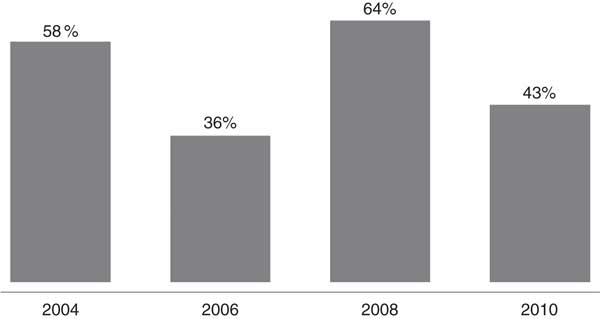
Figure 1 shows the percentage of citizens who reported voting during each election year. As expected, respondents report higher levels of turnout in presidential years compared to midterm years. There is also descriptive evidence that levels of voter turnout increased over time; 57 per cent reported voting in the 2004 election compared to 63 per cent in 2008. Similarly, only 35 per cent reported voting in the 2006 midterm election compared to 43 per cent in 2010. This indicates that even though turnout drops significantly in midterm years, there is still a general pattern of growth over the four election cycles.
Reported turnout in each election, NLSY97

Fundamentally, we are interested in looking at how the propensity to turn out changes over time, and exploring whether health is related to individual differences in these changes. Empirically, we use multi-level modeling as it allows us to partition the variance in voter turnout into two parts: within-individual change and inter-individual change. The first stage of the multilevel model, known as level-1, looks specifically at within-individual change and aims to describe each person’s pattern of change. The second stage of the multilevel model, known as level-2, looks at inter-individual differences in change and seeks to determine the relationship between predictors and the shape of each person’s individual trajectory. Although we model both types of variation, we are primarily interested in the latter.Footnote 56 About 40 per cent of the variance in voter turnout is at level-1, while 60 per cent is at level-2.
An important methodological feature of panel analyses is a sensible metric for time. We opt to use election year as the metric of time, with the 2004 election marking the first recorded experience in presidential electoral politics; thus we code the 2004 election as election 0, with 2006, 2008 and 2010 coded as 1, 2 and 3, respectively. Notably, because about 38 per cent of the sample was old enough to vote in the 2000 election and almost all respondents were eligible to vote in the 2002 midterm election, this temporal choice will necessarily add noise the analysis and make it more difficult to distinguish health effects on the initial probability of voting from changes in the trajectory of voting. Unfortunately, NLSY97 does not ask about voter turnout in the 2000 and 2002 elections. We therefore also estimate the basic models with only those respondents for whom 2004 was the first presidential election and find that the inferences are nearly identical to what is reported below.
More specifically, the probability of an individual, i, voting in election t, is estimated as:
 $$\matrix{ {{\bf{Level}} \,{\bf{1}} } \hfill & {Pr\left( {{\rm Y}_{{{\rm ti}}} \,{\equals}\,1} \right){\equals}\,{\rm B}_{{0{\rm i}}} {\plus}{\rm B}_{{1{\rm i}}} \left( {{\rm Election}_{{{\rm ti}}} } \right){\plus}{\rm B}_{{2{\rm i}}} \left( {{\rm Midterm}_{{{\rm ti}}} } \right){\plus}{\rm B}_{{3{\rm i}}} \left( {{\rm Time}{\minus}{\rm Varying \,\,X}_{{{\rm ti}}} } \right){\plus}{\rm e}_{{{\rm ti}}} } \hfill \cr {{\bf{Level}} \,{\bf{2}} } \hfill & {{\rm B}_{{0{\rm i}}} \,{\equals}\,{\rm \gamma }_{{00}} {\plus}{\rm \gamma }_{{01}} \left( {{\rm Z}_{{\rm i}} } \right){\plus}{\rm U}_{{0{\rm i}}} } \hfill \cr {} \hfill & {{\rm B}_{{1{\rm i}}} \,{\equals}\,{\rm \gamma }_{{10}} {\plus}{\rm U}_{{1{\rm i}}} } \hfill \cr {} \hfill & {{\rm B}_{{2{\rm i}}} \,{\equals}\,{\rm \gamma }_{{20}} } \hfill \cr {} \hfill & {{\rm B}_{{3{\rm i}}} \,{\equals}\,{\rm \gamma }_{{30}} } \hfill \cr } $$
Variation among individuals is modeled in two ways. First, the intercept (B0i) captures differences in starting levels of turnout when citizens are, on average, 22 years old. The intercept, or the probability of voting in the 2004 election, is predicted by variable Z (the effect of variable Z is captured by γ01) and U0i, which is the unexplained variance in person i’s starting point. Variation is also captured by the slope (B1i), which estimates the developmental trajectory of turnout that occurs over time, in this case over four consecutive elections, and U1i, which is the unexplained variance in person i’s trajectory. Since turnout is typically lower in midterm elections, we also include a dummy variable to differentiate between the two types of elections, although we assume that this negative effect does not vary across respondents (for example, the midterm elections variable does not have a random effect).
Developmental theory suggests that variables determined in adolescence will have a greater impact on the initial starting point than on subsequent changes in turnout over time. Empirically, Plutzer finds that this is largely the case.Footnote 57 As a result, all of the control variables measured prior to 2004 are entered into the random intercept part of the model (for example, as variable Z in the above equation) and, therefore, can only influence the probability of initially turning out in the 2004 election. That is, these variables only contribute to understanding differences in the intercept across individuals and tell us little about changes over time.Footnote 58
In cases where the independent variable is time varying (for example, marital status), we include both the 2004 value (for example, as variable Z in the above equation) as well as the change in that variable, shown as B3i in the equation above. Including both the initial starting value and the time-varying variable allows us to model systemic variation in both the initial probability of turnout and changes in turnout.Footnote 59 For example, we are able to determine whether married citizens had higher levels of turnout in 2004 compared to unmarried citizens (for example, if marital status differentiates starting levels or the intercept) as well as whether getting married increased turnout across the same time period (for example, affected the voting trajectory or slope over time). Model specification in this manner allows us to explore not only how aspects of health impact turnout in the 2004 election, but also subsequent growth by accessing how changing levels of health impact changes in the probability of turning out.Footnote 60
Measuring Physical Health, Mental Health and Overall Well-Being
In 2002 and 2008, respondents listed up to six chronic conditions and were subsequently asked whether any of these conditions limited their daily activities. This variable is recoded into a binary indicator where a 1 indicates that the respondent is limited to any extent by at least one of these conditions (mean=0.20). This variable measures physical limitations. Respondents are also asked a series of questions in all four election years about their mental health, and more specifically, their level of depression. We combine these questions into a standardized scale (mean=−0.01, SD=0.59), with a high degree of reliability, as indicated by Cronbach’s alpha (r=0.79).Footnote 61 Finally, we measure overall health using a self-rated health question that ranges from poor (3) to excellent/very good (0) with higher values indicating poorer health (mean=0.47, SD=0.68). Thus for all measures of health, higher values correspond to poorer health levels.Footnote 62 Question wording for the health measures is reported in Appendix Table A.1, and the corresponding descriptive statistics are reported in Appendix Table A.2.
Control Variables
It is important to control for other variables that influence the propensity to vote over time. Demographic characteristics include race (measured as two indicator variables for black and other, with white as the reference category), gender (female=1), and age (centered at 22).Footnote 63 One important parental influence on young adult turnout is education.Footnote 64 Consequently, we include a composite index of parental education by combining the highest degree earned by the respondent’s mother and father; this index has a high degree of reliability, as indicated by Cronbach’s alpha (r=0.93). We also include a measure of parent-reported family income in 1996, the year in which parents were asked about the family’s economic status.
Plutzer finds that high school achievement matters mostly indirectly through knowledge and political engagement; that is, students who are high achievers in high school have a higher propensity to vote in their first election primarily because they are more engaged in politics.Footnote 65 We control for adolescent political engagement indirectly by including a measure of high school GPA in 1999, which captures high school achievement. Adult education, and particularly college education, also contributes to a head start and a more rapid increase in voter turnout. We include a time-varying measure of the highest degree earned by the respondent (centered at twelve years) to account for the additional resources respondents gather through higher education.
Other variables tap into important life events that may temporarily disrupt political activity, including marital status (measured by two dummy variables indicating whether the respondent was married or divorced/separated; never married/widowed is the omitted category), parenthood (measured as the number of children living in the household) and residential migration (measured by a dummy variable indicating whether the respondent has moved since the prior interview). Finally, we capture political engagement directly by including a time-varying measure of the extent to which respondents follow what is going on in government, which ranges from 0 (hardly at all) to 3 (most of the time).
Unless otherwise noted, all predictors that are numeric scales (for example, depression or parental education) are mean centered, while variables with arbitrary scales (for example, SRHS) and dummy variables remain in their natural metric (see Appendix Table A.2 for descriptive information on all of the variables). This allows an intuitive interpretation of the intercept, which is the propensity to turn out in the 2004 election. Linear mixed models are estimated using the lmer function in R in order to examine the overall pattern of individual differences in voter turnout across election years. Restricted maximum likelihood is used to report model parameters and to assess the significance of random effects.
RESULTS: THE EFFECT OF PHYSICAL HEALTH, DEPRESSION AND SRHS ON TURNOUT
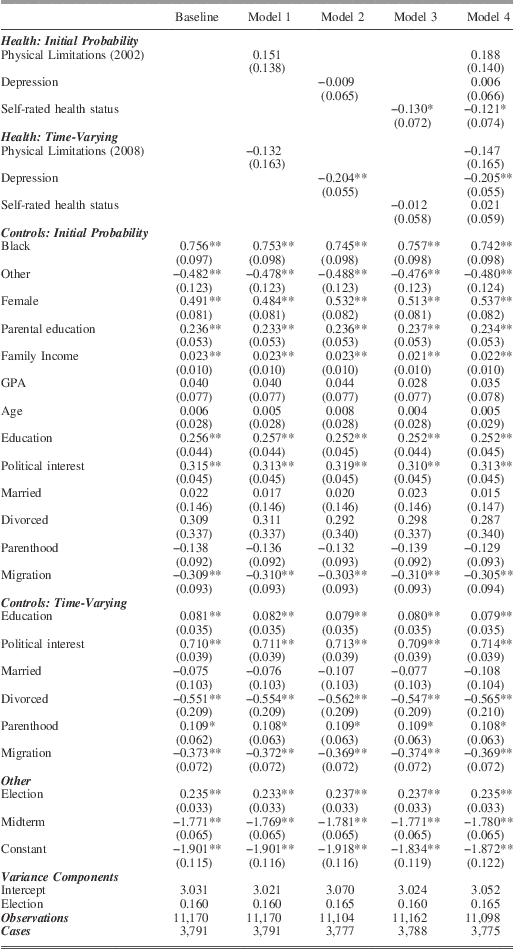
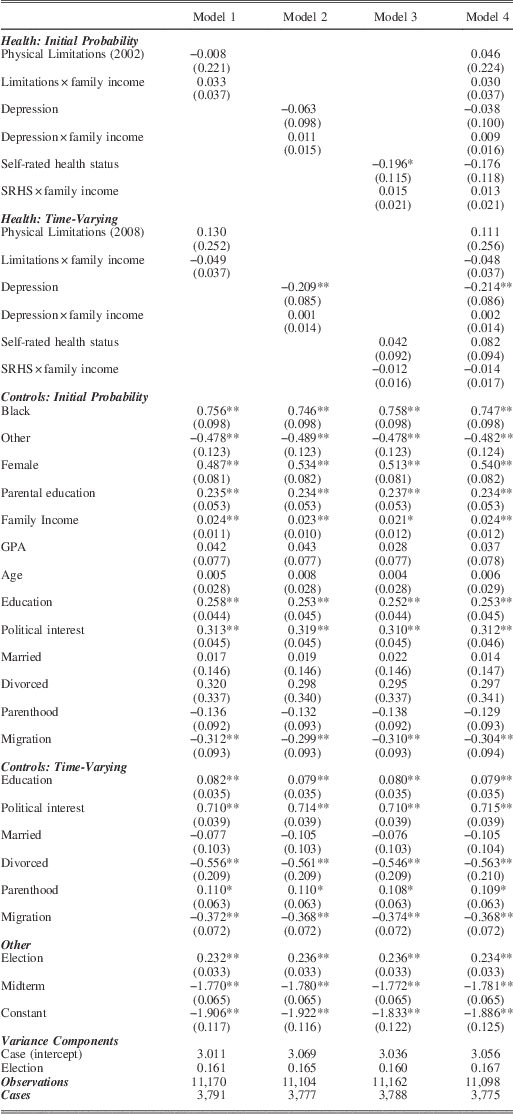
The baseline model reported in Table 1 largely corroborates previous research.Footnote 66 Parental education is strongly related to turnout among offspring in the 2004 election. Respondent education is also important to the initial starting level of turnout in the 2004 election as well as to change. Young adults who are politically interested are more likely to turn out in the 2004 election, and as political interest increases, so does the probability of voting. The election variable is statistically significant, indicating that turnout generally increases over time, although the probability of turning out decreases substantially in midterm elections. Finally, we find that residential mobility is associated with turnout. As a reference, we note that the constant is the probability of turning out in the 2004 election (estimated to be about 15 per cent) when all other variables are 0, which corresponds to never married, white, male, aged 22 years old with twelve years of education whose parents have an average level of education and who does not follow what is going on in politics.
Self-rated Health Status and Depression Affect Different Parts of the Voting Habit

Note: data come from the National Longitudinal Study of Youth 1997. Cell entries are coefficients from a multi-level logistic regression; standard errors are listed in parentheses. **p<0.05, *p<0.10
We now turn to the effects of health, which are presented in Models 1–4 in Table 1. Past research shows that individuals with physical limitations are less likely to turn out,Footnote 67 as are those with depressive symptomsFootnote 68 and poor SRHS.Footnote 69 Our results suggest that inferences about the effect of health on political participation need to be qualified, particularly when applied to young adults. As shown in Model 1 of Table 1, we find that physical health during adolescence is not related to voter turnout in the 2004 election or change thereafter, even when other health indicators are absent from the model.Footnote 70 The developmental model suggests that the effect of physical health will be greatest for habitual voters, and therefore negligible for young voters. The estimates presented in Models 1 and 4 in Table 1 are consistent with that argument.
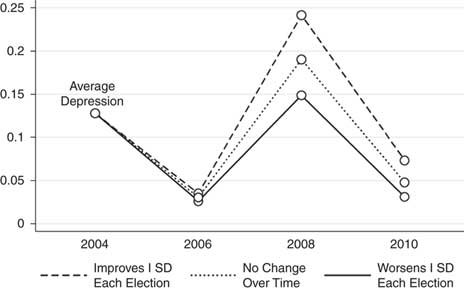
Unlike physical health, depression is associated with lower rates of turnout over time, as is shown in Model 2 of Table 1. Figure 2 illustrates these effects by plotting the trajectory in the predicted probabilities of voting for individuals who had average levels of depression in 2004, but who differed in terms of how their depressive symptoms changed over time.Footnote 71 As seen in Figure 2, both types of individuals had a low probability of voting in the 2004 election (13 per cent). Yet individuals who experienced a decline in depression nearly doubled their probability of turning out in the next presidential election (24 per cent), while those whose symptoms worsened over time saw no growth in their propensity to turn out in the 2008 election (15 per cent). By the 2010 election, these two types of individuals differ in their probability of voting by a four-point gap even though starting levels in 2004 are the same – a not insubstantial change given the overall low level of turnout among young adults. An otherwise larger improvement or worsening of depressive symptoms would further widen this gap. Fluctuations in depression over the life course are not uncommon. While almost half of respondents had changes in their symptoms between 2004 and 2010 within a standard deviation, about one-third of respondents saw their depressive symptoms decline by over a standard deviation, while another one-fifth saw their symptoms rise by more than one standard deviation.
Predicted probabilities of voting across levels of depression and change in depression

Finally, the results in Model 3 show that SRHS affects starting turnout levels in 2004, but has little effect thereafter, much like the effect of parental education. The predicted probability of turning out in the 2004 election for young adults who report being in excellent health is 15 per cent, which is larger than the 9 per cent of young adults who report being in poor health. While this effect is small, it is comparable in size to the difference in turnout between an individual who follows what is going on in the government ‘some of the time’ (24 per cent predicted probability of voting in 2004) compared to ‘hardly at all’ (15 per cent predicted probability of voting in 2004).
We replicate the findings from Table 1 using the PSID and report these results in Appendix Table B.1. The results of the PSID analysis reveal that SRHS is negatively associated with the initial probability of voting, while depression negatively affects growth in voting over time. The similarity between the NLSY and PSID results affirms our conclusion that health affects turnout, but it depends on what aspect of health and turnout are considered. Nevertheless, two differences in the substantive effects are worth noting. First, the NLSY model tends to underestimate participation levels compared to the PSID model. This difference means that the effect sizes of depression and SRHS observed in the NLSY model are probably smaller than their actual effect on turnout in the population. Secondly, while the NLSY model shows that increases in depression over the course of young adulthood can stunt the development of a voting habit, this effect was not as strongly observed in the PSID. The voting trajectory of those with depression is flattened in the PSID relative to those with consistently average or improved levels of depression, but it is not flat as in the NLSY.
Interactions with Parental Education
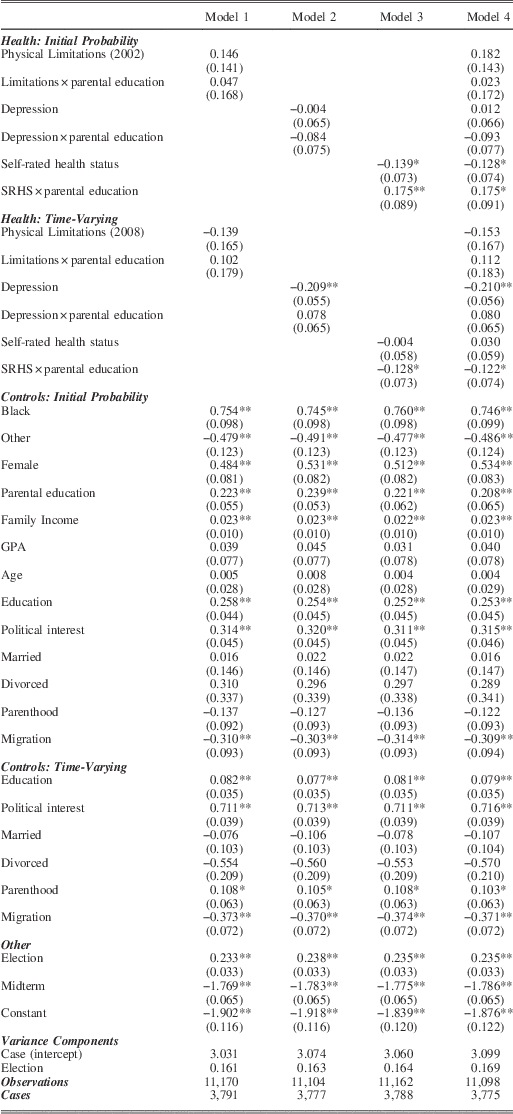
While the findings from Table 1 show that different aspects of health affect the development of a voting habit at different points in the process, they tell us nothing about how this process interacts with other childhood and adolescent resources that are important to political participation. In this section we examine how parental education conditions the effects of health on voting by including interaction terms between parental education and each measure of health. We report these results in Table 2. Model 1 shows that physical limitations do not affect political participation at any value of parental education. This comports with our hypothesis that physical limitations matter later in life, and therefore should not reveal an effect regardless of parental education.
The Effect of Self-rated Health Status on Voting is Conditional on Parental Education

Note: data come from the National Longitudinal Study of Youth 1997. Cell entries are coefficients from a multi-level logistic regression; standard errors are listed in parentheses. **p<0.05, *p<0.10
Next we turn to depression. The results of Model 2 in Table 2 reveal that the effects of depression documented earlier hold regardless of parental education levels. As we noted before, depression does not affect the starting level of turnout but does shape the voting trajectory. This finding does not follow our hypothesis of cumulative disadvantage, in which those from disadvantaged backgrounds would be hit hardest by depression because they would not have other resources to compensate for the lack of motivation and physical fatigue induced by depression.
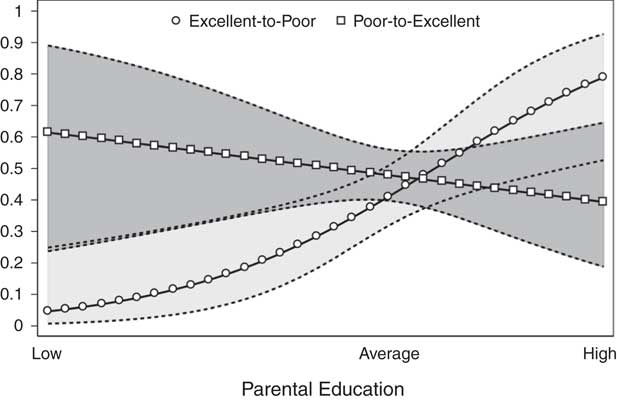
Perhaps the most interesting and surprising results are those related to how parental education conditions the effect of SRHS. Model 3 of Table 2 reveals that the interaction term for each measure of SRHS is statistically significant and in the opposite direction from the other, suggesting that changes in health over time can have opposing effects on turnout depending on parental education. This finding holds in Model 4 after controlling for physical limitations and depression. For ease of interpretation, Figure 3 plots the probability of voting in 2008 for four illustrative cases in which health either changed or stayed the same between 2004 and 2008 – poor to poor, poor to excellent, excellent to poor, and excellent to excellent – across all the potential values of parental education.
Predicted probabilities of voting across levels of SRHS and parental education

Two noticeable patterns emerge from this graph. First, the probability of voting increases with parental education when health is consistent over time: those who are always in excellent health are more likely to participate than those who are always in poor health. Secondly, the effect of changes in SRHS over time is conditional upon parental education. Those who transitioned from poor health to excellent health are the least likely to vote when parental education is low, but the most likely when parental education is high. The exact opposite is true for those who transition from excellent health to poor health. These results do not comport with a story about cumulative disadvantage as we originally imagined, but instead suggest that a lack of resources can mobilize turnout under the auspices of a grievance. We elaborate on this possibility in the discussion, but do so cautiously given that the results do not replicate in our analysis of the PSID (reported in Appendix Table B.2).
Interactions with Family Income
Next we turn to the conditional effect of family income. As shown in Table 3, none of the interaction terms are statistically significant. These findings thus mirror those reported in Table 1 and do not change our understanding of health, except to the extent that the lack of statistically significant interaction terms indicates that the effects of health on participation are present regardless of economic background. The replication of these results using the PSID is reported in Appendix Table B.3.
Family Income Does Not Condition the Health-turnout Linkage

Note: data come from the National Longitudinal Study of Youth 1997. Cell entries are coefficients from a multi-level logistic regression; standard errors are listed in parentheses. **p<0.05, *p<0.10
CONCLUSIONS
Our findings advance research on voter turnout more broadly and the health–participation gap more specifically. Regarding turnout, the results of this article challenge the commonly held view that the probability of voting uniformly increases throughout young adulthood. We show that certain conditions – in this case, depression – dampen the probability of voting in spite of all the changes in young adulthood, such as education, mobilization and familiarization with the political process – that would typically lead to a positive voting trajectory during this period. Because of the age limitations of our data, it remains to be seen whether the negative voting trajectory that results from depression is temporary or permanent, but even the possibility that it is permanent should be of concern, given the habitual nature of voting.
This study also contributes to the larger research agenda on health and politics. Recent research, much of it conducted in isolation, finds that various facets of adult health are associated with political participation. We tie together and strengthen the inferences of these disparate findings using a developmental framework that incorporates multiple dimensions of adolescent and young adult health. Doing so allows us to distinguish the effect of health on starting levels of turnout from the voting trajectory. We find that: (1) self-rated health reduces the initial probability of voting but not the voting trajectory, (2) depression slows (and sometimes even reverses) an individual’s voting trajectory and (3) physical limitations do not have a statistically significant effect on either the initial probability of voting or a citizen’s trajectory in young adulthood; however, this does not rule out the possibility of an effect later in life.
That these findings were replicable across datasets bolsters the strength of our results and more generally solidifies the idea that health affects participation. Importantly, the findings have larger implications for social and political processes beyond voter turnout. In particular, they contribute to emerging scholarship on the ‘new inequality paradigm’, which emphasizes the role of interdisciplinary research in highlighting and documenting the breadth and depth of social, economic and political inequalities around the world.Footnote 72 With respect to health and politics, research elsewhere suggests that the diminution of political voice due to health inequalities has political consequencesFootnote 73 that may reinforce initial inequalities in health.Footnote 74 If this is the case, then knowing when and how health inequalities lead to inequality in political voice is important for breaking this cycle. Our findings suggest that breaking the health–participation linkage cannot be done by treating health as a monolith – in which individuals are simply characterized as healthy or unhealthy – but requires recognizing the multidimensionality of health. Indeed, severing the health–participation linkage will require diverse efforts: encouraging participation among young adults with poor-rated health, mobilizing individuals with depression and potentially findings ways to facilitate participation among older citizens with physical limitations.
As research on health and politics continues to grow, we see three important lines of research. First, scholars should continue exploring the effect of health on political behavior by considering other forms of participation and political attitudes. The majority of the literature focuses on voter turnout. Voting is arguably one of the easiest forms of political participation, and may therefore be less affected by health disparities than other forms of participation, such as working in campaigns or in the community, contacting government officials and contributing money.Footnote 75 In addition to alternative forms of participation, scholars should also consider other types of health indicators. For example, research on the mental health–participation linkage has thus far focused primarily on depression. Other forms of mental health should also be considered – potentially including anxiety, externalizing and substance-related behaviors, and personality disorders. Examining several measures of mental health will illuminate which aspects matter most for participation. This is also the case with specific chronic conditions. Gollust and Rahn show that both cancer and heart disease affect voting in different ways.Footnote 76 Sund and colleagues show that mental health disorders, alcoholism and neurodegenerative brain diseases reduce the probability of voting, while cancer, chronic obstructive pulmonary disease and asthma do the opposite.Footnote 77 Future research should continue to theoretically and empirically distinguish between when specific chronic conditions are expected to depress turnout and when they become motivating factors for participation (for example, participation and advocacy among women who have, or have had, breast cancer).
A second line of research would focus on the policy consequences of health-based inequalities in participation. Are individuals in poor health under-represented compared to their healthy counterparts? Research shows a direct link between inequalities in turnout and policy responsiveness, yet the majority of this research concentrates on class-based politics.Footnote 78 Since voters are better represented than non-voters, itFootnote 79 stands to reason that healthy individuals may also enjoy better responsiveness. Preliminary evidence is suggestive. For instance, Pacheco finds that healthy individuals are better represented by their congressional representatives compared to unhealthy citizens; this positive relationship is particularly true for individuals who are affluent as well as when citizens are represented by Republicans.Footnote 80 Determining the extent of under-representation and its policy consequences are important for identifying the magnitude of the problem.
Finally, having firmly established a health–participation link, scholars should turn their attention to examining how the under-representation of individuals in poor health reinforces both poor health and health-based inequalities in participation. Institutions and policies shape how individuals experience health and navigate the health system, which raises the possibility that the health–participation link is self-reinforcing. Evaluating how access to (and the quality of) healthcare is shaped by healthcare policy and then experienced differently across racial, gender and class identities could be important in understanding how institutions and policies can close the health–participation gap. For example, recent changes in the state of healthcare due to the Affordable Care Act (ACA), as well as challenges and changes to the ACA, means that the healthcare landscape is constantly changing. Evaluating the policy consequences of the ACA, as well as state-level variation in its implementation, will reveal the extent to which access to and the quality of healthcare can magnify the political voice of individuals in poor health. These suggestions are forward looking, but should in no way obscure the noteworthy contributions of the current study. To reiterate, we add to a growing body of research on health and participation through a more detailed analysis of longitudinal data. We show that health politics research must consider the multidimensionality of health as well as the habit of voting to fully understand what the health–participation gap represents.