Introduction
The sterile insect technique (SIT), an environmentally friendly strategy that is used in various parts of the world to control insect pests (Dyck et al., Reference Dyck, Hendrichs and Robinson2005), and is also widely used for the control of fruit flies. Application of this technique requires the rearing and sterilization of a large number of insects to be released in the field, with the expectation that the sterile males will compete successfully with wild males for mating with wild females (Knipling, Reference Knipling1955). As the presence of sterile females released simultaneously with males reduces the efficiency of pest population suppression due to matings between sterile pairs (McInnis et al., Reference McInnis, Lance and Jackson1996; Orozco et al., Reference Orozco, Hernández, Meza and Quintero2013b ), genetic sexing strains (GSSs) have been developed to allow the elimination of females and the release of only males (Franz, Reference Franz, Dyck, Hendrichs and Robinson2005). GSSs are already available for Ceratitis capitata (Wied.) (Robinson & Van Heemert, Reference Robinson and Van Heemert1982), Bactrocera cucurbitae (Coquillett) (McInnis et al., Reference McInnis, Tam, Lim, Komatsu, Kurashima and Albrecht2004), Bactrocera dorsalis (Hendel) (McCombs & Saul, Reference McCombs and Saul1995) and Anastrepha ludens (Loew) (Zepeda-Cisneros et al., Reference Zepeda-Cisneros, Meza-Hernández, García-Martínez, Ibañez-Palacios, Zacharopoulou and Franz2014). The last strain, developed at the Moscafrut facility in Metapa de Domínguez, Chiapas, Mexico (Orozco et al., Reference Orozco, Meza, Zepeda, Solís and Quintero2013a ; Zepeda-Cisneros et al., Reference Zepeda-Cisneros, Meza-Hernández, García-Martínez, Ibañez-Palacios, Zacharopoulou and Franz2014), is characterized by the distinct coloration of the puparium, enabling the separation of males (brown puparia) from females (mutant black puparia). This strain, named Tapachula-7, originated from a genetic translocation linking the wild-type allele (brown pupae) located on an autosome to the male Y chromosome of A. ludens (Orozco et al., Reference Orozco, Meza, Zepeda, Solís and Quintero2013a ; Zepeda-Cisneros et al., Reference Zepeda-Cisneros, Meza-Hernández, García-Martínez, Ibañez-Palacios, Zacharopoulou and Franz2014).
One of the fundamental requirements for SIT to be effective is that the sterile males should be sexually competitive. However, the mass-rearing process results in significant alterations that negatively impact sexual behaviour (Lux et al., Reference Lux, Munyiri, Vilardi, Liedo, Economopoulos, Hasson, Quilici, Gaggl, Cayol and Rendon2002; Robinson et al., Reference Robinson, Cayol and Hendrichs2002; Rull et al., Reference Rull, Brunel and Mendez2005). In the rearing of standard strains, this negative effect has been overcome by replacing or hybridizing strains (Shelly, Reference Shelly2001; Rull & Barreda-Landa, Reference Rull and Barreda-Landa2007), with some degree of success. In case of GSSs, implementation of this approach is complicated by the need of inbreeding for several generations, with the risk of outbreeding depression (Aspi, Reference Aspi2000). Additionally, in the laboratory, the crossing process can result in the loss of the mating competitiveness that one intends to introduce by incorporating wild genetic material. Thus, alternative methods of colonization and mass rearing that can reduce the risk of losing desirable traits are required. Directional selection, which has been used by breeders to improve plants and animals, is defined as selection for a higher or lower value of a character than is the current mean value (Lande & Arnold, Reference Lande and Arnold1983; Futuyma, Reference Futuyma2009). Studies on Drosophila melanogaster (Hudak & Gromko, Reference Hudak and Gromko1989; Hillesheim & Stearns, Reference Hillesheim and Stearns1991, Reference Hillesheim and Stearns1992; Partridge & Fowler, Reference Partridge and Fowler1992, Reference Partridge and Fowler1993; Zwaan et al., Reference Zwaan, Bijlsma and Hoekstra1995; Bubli et al., Reference Bubli, Imasheva and Loeschcke1998), B. cucurbitae (Miyatake, Reference Miyatake1995, Reference Miyatake1996, Reference Miyatake1997; Takahashi et al., Reference Takahashi, Teramura, Muraoka, Okada and Miyatake2012), and C. capitata (McInnis et al., Reference McInnis, Shelly and Komatsu2002) have shown that it is possible to design processes of selection to favour desired characteristics. In this case, males could be selected on the basis of desirable biological attributes, such as survival ability or mating competitiveness, and then used as parents of future generations (McInnis et al., Reference McInnis, Shelly and Komatsu2002).
Our objective here was to analyse the impact of selection based on the mating performance of A. ludens males of the Tapachula-7 GSS. We discuss the implications of this colony management method on SIT applications.
Materials and methods
Study area
Laboratory rearing and experiments were carried out at the Moscafrut facility in Metapa de Domínguez, Chiapas. Mating tests were conducted in a mango orchard (Mangifera indica cv. Ataulfo) close to the Moscafrut facility (14°49′33.8″N, 92°11′46.1″W, 100 m above sea level). Flies were reared under laboratory conditions at 25 ± 1°C, 60 ± 5% relative humidity, a 12:12 L:D cycle, and 350 ± 50 lux light intensity. Field observations were conducted between 15:00 and 19:00 h, as males of this strain are sexually active during this time interval (Orozco et al., Reference Orozco, Meza, Zepeda, Solís and Quintero2013a ). The environmental conditions in the field were 25–30°C, 70–90% relative humidity and 3500–0 lux light intensity.
Insects
Wild flies were obtained as larvae from infested bitter orange (Citrus x aurantium L.), mango (M. indica L.) and matasano or white sapote (Casimiroa edulis Llave & Lex) collected in the Soconusco region and on the Comiteca Tojolabal Plateau, Chiapas, Mexico. Once the larvae reached maturity, they were placed in containers with wet vermiculite to promote pupation and remained in those containers until they emerged as adults (Orozco et al., Reference Orozco, Meza, Zepeda, Solís and Quintero2013a ).
Parental flies from the GSS Tapachula-7 were obtained as pupae from the Moscafrut mass-rearing facility 2 days prior to adult emergence. At this time, approximately 70 generations had occurred since the development of the strain in 2008. The pupae were placed in 30 × 30 × 30 cm3 wooden frame cages covered with mesh tulle (mesh 2 mm). The emerged flies were sorted by sex and fed ad libitum using a mixture of enzymatically hydrolysed yeast (MP Biomedicals, LLC, Santa Ana, CA, USA) and sugar at a 1:3 ratio and water until they reached sexual maturity, which was 10–12 days old for the mass-reared flies and 18–20 days old for the wild flies (Orozco et al., Reference Orozco, Meza, Zepeda, Solís and Quintero2013a ).
Mating competition and selection
Experiments were conducted in screened field cages (3 m diameter × 2 m height) supported by a metallic structure (Calkins & Webb, Reference Calkins and Webb1983). The field cage covered a mango tree (M. indica L.) of approximately 1.8 m in height.
Males were identified by marking the individuals 48 h before the tests with a numbered tag adhered to the thorax (Meza-Hernández & Díaz-Fleischer, Reference Meza-Hernández and Díaz-Fleischer2006). In each field cage, 30 Tapachula-7 virgin males (Parental), 30 wild virgin males and 30 wild virgin females, all sexually mature, were released (1:1:1 ratio). The males were released 30 min before the females to allow them to establish territories. Every time a mating occurred, the pair was collected in a vial (a plastic container of 2 cm diameter × 4 cm height). Data were recorded for the number of males calling (determined by vigorous wing fanning, an everted prostiger, and puffed pleural glands), the number and type of mating pairs (Tapachula-7 male-wild female or wild male-wild female), the mating latency (elapsed time between the release of the females and mating initiation) and copula duration. Each cage was considered one experimental unit. Three production batches were used, and ten cages were used as replicates for a given batch, for a total of 30 replicates per generation. This process continued over four consecutive generations.
To exercise a higher selection pressure (Fuller et al., Reference Fuller, Baer and Travis2005), the males that mated with wild females were again exposed to different wild virgin flies the next day while maintaining the 1:1:1 ratio (♂Tapachula-7: ♂wild: ♀wild). The males that successfully mated with wild females for a second time were recovered for the next generation, and the remaining males were discarded. The males selected were placed in 30 × 30 × 30 cm3 wooden frame cages with virgin Tapachula-7 females for mating and reproduction. To obtain greater egg production for the next generation (F1), a male:female ratio of 1:4 was utilized. Egg collection began after 5 days, with mating occurring during the interval. An ‘egg-laying device’ (container of 6.5 cm diameter × 5 cm in height, with a base covered with terylene fabric and coated with silicon on the inside) was placed at the top of the cage and moistened with water. Eggs were collected daily for ten consecutive days. The collected eggs were placed over black satin fabric over a moistened sponge in plastic Petri dishes (100 × 15 mm2) for incubation at 25°C until hatching. The new-born larvae were placed on an artificial diet (two larvae per gram of diet) formulated according to the Moscafrut facility mass-rearing process (Domínguez et al., Reference Domínguez, Trinidad, Solís, Hernández, Montoya, Toledo and Hernández2010). When the larvae reached the third instar (without apparent food in the digestive tract), they were separated from the food by washing with water and filtering through a sieve (mesh 2).
The recovered larvae were placed in containers 12.5 cm in diameter × 5.5 cm in height with vermiculite (ratio 1:1) to promote pupation. When the pupae were 13 days old, they were separated from the vermiculite using a sieve (mesh 18) and were then separated by colour to eliminate aberrant flies (males emerged from black pupae and females emerged from brown pupae).
The F1 males obtained in each batch were evaluated and selected again in the field following the same process. This was repeated for the F1, F2, F3 and F4 generations. In each field cage, 30 selected virgin males, 30 virgin males of the Tapachula-7 strain that did not undergo the selection process, 30 wild virgin males, and 30 wild virgin females, all sexually mature, were released (the 1:1:1:1 ratio was maintained, and the male:female ratio was 3:1).
The males that did not undergo the selection process were reared in the same manner as the selected flies (two larvae per gram of diet). The cage size (30 × 30 × 30 cm3 wooden frame) was similar for both strains, though the adult density and sex ratio per cage was not the same because of the small number of selected males.
Development time and survival
To determine the effects of selection in each generation (P, F1, F2, F3 and F4), development time and survival were determined according to the rearing process developed by the Moscafrut facility (Domínguez et al., Reference Domínguez, Trinidad, Solís, Hernández, Montoya, Toledo and Hernández2010). The selected line was compared against the mass-reared Tapachula-7 unselected (P) strain and wild flies collected from C. edulis.
Twenty sexually mature pairs of each strain were placed in a 30 × 30 × 30 cm3 wooden frame cage, and the flies were provided with food and water ad libitum, as described above. Egg collection started 3 days later and continued for a period of 10 days. A device for egg laying was placed at the top of the cage. Eggs were collected and incubated using methods similar to those described above for the mating selection experiments.
Four days after egg laying, when the eggs were ready to hatch, 100 eggs were placed in Petri dishes (100 × 15 mm2) with 50 g of larval diet. The Petri dishes were checked every 24 h, and the number of individuals at each stage was recorded. The egg development time was determined as the time between oviposition and larval eclosion, the larval development time was determined as the time between larval eclosion and the recovery of third-instar larvae (as described above), and the pupal development time was determined as the time between larval recovery and the emergence of adults. With these data, mean development times and survival rates were estimated for each immature stage. The rearing process was similar to the methods described above.
Each Petri dish was considered as an experimental unit. Three different production batches were observed, with ten replicates for each batch. In total, 30 replicates were performed for each one of the five generations and for the wild flies.
Mass-rearing quality parameters
The weight of the larvae and pupae, adult emergence and flight ability were determined for each generation following the methods described in the FAO/IAEA/USDA (2014) quality control manual. The experimental units, treatments, and replicates were similar to those used in the evaluation of development time and survival.
Pheromone production
Pheromone collection and analysis were performed at the Chemical-Ecology Laboratory at El Colegio de la Frontera Sur (ECOSUR) in Tapachula, Chiapas, Mexico. The composition of volatiles emitted during male mating calling were determined for the Tapachula-7 strain without selection (Parental), for those selected for mating at the fourth generation (F4), and for wild males collected from C. edulis fruits. Volatile collection was accomplished via solid-phase microextraction (SPME) according to the collection procedure and analytical methods reported by Bosa et al. (Reference Bosa, Cruz-López, Zepeda-Cisneros, Valle-Mora, Guillén-Navarro and Liedo2016). Ten sexually mature virgin males (12 days of age for Tapachula-7 and 18–20 days for wild males) were placed in a 250-ml Erlenmeyer flask (chamber) 15 min before extraction; the chamber entrance was covered with aluminium foil. An SPME device equipped with 50-micron fibre coatings of divinylbenzyne/carboxen/polydimethylsiloxane (DVB/CAR/PDMS) (Supelco, Bellefonte, PA, USA) was introduced into the upper part of each chamber for 60 min. Six SPME fibres of the same type were used to collect volatiles, and the same fibre was always used for a given strain. Before the experiments, the quality of the fibres was analysed for residues from other compounds. The environmental conditions were 25 ± 1°C, 50–60% relative humidity and a light intensity of 100–0 lux. All volatile collections were carried out at 1 h before sunset, which is the most sexually active period for this species (Aluja et al., Reference Aluja, Piñero, Jácome, Diaz-Fleischer, Sivinski, Aluja and Norrbom2000; Bosa et al., Reference Bosa, Cruz-López, Zepeda-Cisneros, Valle-Mora, Guillén-Navarro and Liedo2016).
Volatile analysis was performed using a Varian CP-800 gas chromatograph attached to a Varian 2200400 mass spectrophotometer (GC-MS Varian, Palo Alto, CA, USA), with helium as the gas carrier and an initial temperature of 50°C that was maintained during the first 2 min and then increased at 15°C min−1 until 280°C, which was maintained for 10 min. Quantification of the mixture of compounds was performed by measuring the area under the peaks of the chromatograph and comparing the findings among the strains. The compounds were identified by considering retention time, the Kovat index (KI), and the mass spectrum, and the values were compared with those of synthetic standards (Bosa et al., Reference Bosa, Cruz-López, Zepeda-Cisneros, Valle-Mora, Guillén-Navarro and Liedo2016). Three different production batches were evaluated. In total, 11 volatile collections were performed for each of the three strains of flies. Each volatile collection was considered an experimental unit.
Data analysis
Data normality and the homogeneity of variance were determined using the Shapiro test and the Bartlett test, respectively. The proportion of calls, survival of immature stages, flight ability and pheromone production were normalized by means of arcsine √χ transformation. The data for mating competitiveness (number of matings, copula duration, mating latency and percentage of calls) were analysed by a paired Student t test in the parental generation and by two-way analysis of variance (ANOVA) in the F1, F2, F3 and F4 generations to determine interactions between batch and generation. The data for development time were analysed using the Cox proportional hazard model and multiple comparisons using logrank and Montecarlo tests. The survival of immature stages was analysed by means of a binomial logistic regression and random effects (Fox & Weisberg, Reference Fox and Weisberg2011). Generation was considered the fixed effect, and batches were considered the random effect. Multiple comparisons were achieved via orthogonal contrasts with Bonferroni correction. Mass-rearing quality parameters and pheromone production were analysed by two-way analysis of variance. Means were compared by Tukey's test (Zar, Reference Zar1999). All statistical tests used α = 0.05. All analyses were performed using R software (R Core Team, 2015) and the packages lme4 (Bates et al., Reference Bates, Maechler, Bolker and Walker2015) and CAR (Fox & Weisberg, Reference Fox and Weisberg2011).
Results
Mating competition
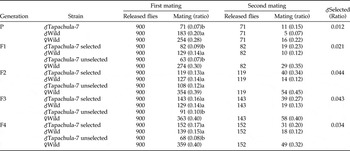
Wild males were more competitive than mass-reared males in both the parental (t 29 = −9.82, P < 0.001) and F1 (F 2,87 = 8.84, P < 0.001) generations. The number of matings achieved by wild males in these generations was twofold that of Tapachula-7 strain males, regardless of whether they were selected. In the F3 (F 2,87 = 6.43, P = 0.002) and F4 (F 2,87 = 15.53, P = 0.001) generations, the selected males were as competitive as the wild males and significantly more competitive than the males of the same strain without selection. In the F4 generation, the proportion of matings by the selected males was twofold that of the unselected males (table 1).
Number of matings with wild females and mating ratio for males from unselected, selected Tapachula-7 and wild Anastrepha ludens strains under field cage conditions.

Different lowercase letters between rows for each generation indicate significant differences (P < 0.05; Student's t test for parental generation, two-way ANOVA for F1, F2, F3 and F4 generations).
Fewer than 5% of the Tapachula-7 males were able to mate on the second day, though the sexual competitiveness of these males was greater than that of the wild virgin males. Although no significant differences were observed among batches (F 2,348 = 0.75, P = 0.47), large differences among generations were found (F 3,348 = 4.53, P = 0.004). In addition, the generation-batch interaction was significant (F 6,348 = 05.04, P < 0.001).
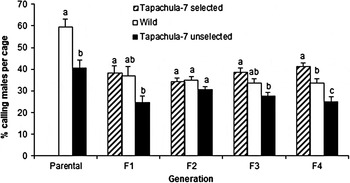
Calling behaviour also presented significant differences. In the parental generation, the Tapachula-7 males presented the lowest propensity to call (t 29 = −2.53, P = 0.017). However, differences were not significant in the F1, F2, and F3 generations. In contrast, the selected males of the F4 generation called significantly more than both the wild and unselected males (F 2,87 = 17.37, P < 0.001). Overall, the unselected mass-reared males showed the lowest propensity for calling. Significant differences were not observed among batches (F 2,348 = 0.02, P = 0.98), though differences among generations were significant (F 3,348 = 7.22, P = 0.020). The interaction between generations and batches was not significant (F 3,348 = 0.05, P = 0.99) (fig. 1).
Percentage (SE) of Tapachula-7 (selected and unselected) and wild Anastrepha ludens males calling. Different lowercase letters between the bars in each generation indicate significant differences (P < 0.05; Student's t test for parental generation, two-way ANOVA for F1, F2, F3 and F4 generations).

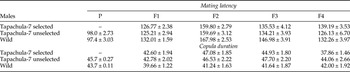
No significant differences among strains and generations were observed with regard to mating latency (P > 0.05) and copula duration (P > 0.05), yet significant differences were found among generations (F 3,348 = 40.81, P < 0.001) and batches (F 2,348 = 9.81, P < 0.001). The generation-batch interaction was significant (F 6,348 = 26.70, P < 0.001) (table 2).
Mating latency and copula duration (min ± SE) for Tapachula-7 (selected and unselected) and wild Anastrepha ludens males.

The differences were not significant (P < 0.05; Student's t test for the parental generation and two-way ANOVA for F1, F2, F3 and F4 generations).
Development time and survival
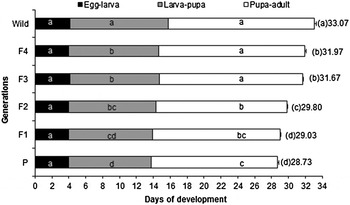
There were no significant differences in egg development time (χ 2 = 3.83, P = 0.57), but the development time from larva to pupa (χ 2 = 66.85, P < 0.001) and from pupa to adult (χ 2 = 174.24, P < 0.001) increased gradually with each generation. For the F3 generation, the development time from pupa to adult was similar to that of the wild flies. The full development time from egg to adult increased 3 days from the parental generation to the F4 generation, and this difference was significant (χ 2 = 216.28, P < 0.001). Wild, F3 and F4 flies displayed the longest development time from egg to adult (P < 0.001). Although no significant differences were observed between batches (χ 2 = 0.135, P = 0.934 from egg to larva; χ2 = 4.05, P = 0.132 from larva to pupa; and χ2 = 0.55, P = 0.757 from pupa to adult), the generation–batch interaction was significant (χ2 = 5.18, P = 0.878 from egg to larva; χ2 = 28.51, P = 0.001 from larva to pupa; and χ2 = 31.37, P < 0.001 from pupa to adult) (fig. 2).
Development times of immature stages of the offspring of selected Tapachula-7 males for five generations (P, F1, F2, F3 and F4) and wild Anastrepha ludens. The final line of each bar represents the SE for the development time from egg to adult. Different lowercase letters among bars for each state indicate significant differences (P < 0.05; Cox proportional hazard model) between each generation and wild flies. The number at the end of each bar indicates the average development time from egg to adult. Different lowercase letters at the end of each bar indicate significant differences.

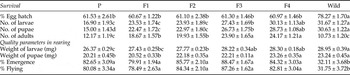
No significant difference was observed for egg to larva survival (expressed as the percentage of eggs hatched) for the selected and unselected Tapachula-7 flies. However, the egg hatch per cent of the Tapachula-7 females was significantly lower than that of the wild flies (χ2 = 308.42, P < 0.001). Survival in the other immature stages of the selected strain increased gradually in each generation, and differences in relation to the wild flies were significant for the larval (χ2 = 221.81, P < 0.001), pupal (χ2 = 249.22, P < 0.001) and adult (χ2 = 318.09, P < 0.001) stages. Larval and pupal survival of the selected strain in the F4 generation was similar to that of the wild strain, with egg to adult survival increasing significantly after the first cycle of selection and maintained until the F4 generation, and survival to adult stage of the selected strain was significantly greater than that of the wild strain (table 3).
Survival and mass-rearing quality parameters (±SE) for the offspring of selected Tapachula-7 males in four generations (P, F1, F2, F3 and F4) and wild Anastrepha ludens flies.

Different lowercase letters between rows indicate significant differences (P < 0.05; survival, binomial logistic regression and quality parameters, two-way ANOVA).
Mass rearing quality parameters
The quality parameters of the Tapachula-7 and wild flies were significantly different among generations (P < 0.001) (table 3). Larval and pupal weights increased gradually with each generation, but no significant differences were observed after the F3 generation for larvae (F 5,174 = 9.30, P < 0.001) and F2 for pupae (F 5,174 = 13.38, P < 0.001) when compared with the wild strain (P > 0.05). Adult emergence (F 5,174 = 64.03, P > 0.05) and flight ability (F 5,174 = 54.85, P > 0.05) of the selected strain showed no significant differences among generations; however, the differences from the wild flies were significant, with the wild flies having the lowest values (P < 0.001). Significant differences were observed among both batches (F 2,162 = 3.90, P = 0.022 weight of larvae; F 2,162 = 3.38, P = 0.037 weight of pupae; F 2,162 = 4.46, P = 0.013 adult emergence; and F 2,162 = 5.22, P = 0.006 flight ability) and generations (F 5,162 = 10.87, P < 0.001 weight of larvae; F 5,162 = 17.54, P < 0.001 weight of pupae; F 5,162 = 74.50, P < 0.001 adult emergence; and F 5,162 = 65.30, P < 0.001 flight ability). The generation–batch interaction was significant (F 10,162 = 3.37, P < 0.0001 weight of larvae; F 10,162 = 5.94, P < 0.001 weight of pupae; F 10,162 = 3.15, P = 0.001 adult emergence; and F 10,162 = 3.47, P < 0.001 flight ability).
Pheromone production
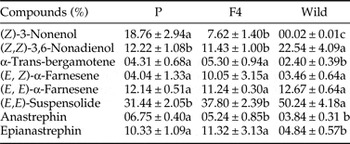
According to gas chromatography–mass spectrometry (GC–MS) analysis, the males of the Tapachula-7 parental and F4 generations released the same mixture of compounds as the wild males, including (1) (Z)-3-nonenol, (2) (Z,Z)-3,6-nonadienol, (3) α-trans-bergamotene, (4) (E,Z)-α-farnesene, (5) (E,E)-α-farnesene, (6) (E,E)-suspensolide, (7) anastrephin and (8) epianastrephin (table 4). However, differences in the relative quantities of certain compounds were observed. Indeed, the quantity of (Z)-3-nonenol emitted was significantly different between the three types of males (F 2,30 = 57.35, P < 0.001). Although the quantities of (Z,Z)-3,6-nonadienol were not significantly different among the Tapachula-7 generations (F 2,30 = 5.29, P = 0.011), significant differences were observed with wild males. Overall, the wild males emitted a significantly lower quantity (trace) of (Z)-3-nonenol and a greater quantity of (Z,Z)-3,6-nonadienol than the Tapachula-7 males. The amounts of α-trans-bergamotene, (E, Z)-α-farnesene, (E, E)-α-farnesene, (E,E)-suspensolide and epianastrephin were not significantly different among the Tapachula-7 males (P > 0.05), but the quantities of α-trans-bergamotene, (E,E)-suspensolide and epianastrephin were significantly different from those emitted by the wild males (P < 0.05). The amount of anastrephin emitted by the F4 males was similar to that emitted by the wild males but significantly different from that emitted by the parental males (F 2,30 = 6.06, P = 0.006) (table 4).
Relative quantities (average %±SE) of the compounds emitted by Anastrepha ludens males during the most sexually active period.

Different lowercase letters between rows for each generation indicate significant differences (P < 0.05, two-way ANOVA).
Discussion
Our objective in this study was to compare the sexual performance of A. ludens males of the Tapachula-7 strain reared through a selection process based on their ability to mate with wild females compared with that of males produced without selection. The results support the hypothesis that directional selection would increase the sexual competitiveness of the selected strain. In three generations, the sexual competitiveness of the selected Tapachula-7 males was similar to that of wild males. Similar results were reported for C. capitata, whereby researchers combined selection and hybridization with wild flies and obtained better sexual performance (McInnis et al., Reference McInnis, Shelly and Komatsu2002). In our case, the selection process was exerted consecutively over four cycles, and the offspring produced were crosses of the selected males with females of the Tapachula-7 strain. This method permitted an evaluation of the effects of selection alone, without the effects of hybridization, and also allowed the production of large numbers of individuals in the next generation because the females were already adapted to the mass-rearing conditions. There is evidence that hybridization or outcrossing improves the sexual performance of fruit fly males (Boller, Reference Boller1972; Shelly, Reference Shelly2001; Rull & Barreda-Landa, Reference Rull and Barreda-Landa2007). However, in the case of GSSs, hybridization would jeopardize maintenance of the characteristics used for separation of the sexes or would further complicate the process. Selection alone is a more simple method. Bosa et al. (Reference Bosa, Cruz-López, Zepeda-Cisneros, Valle-Mora, Guillén-Navarro and Liedo2016) documented improvement of the sexual performance of males of the standard strain of A. ludens by selecting males for survival and mating them with wild females. The authors found that the mating performance of the selected strain was improved after one selection event (F1). Our results were similar, though we did not detect significant differences in the F1 generation. Better male sexual performance was observed with significant differences after the third generation (F3). This difference in the first generation suggests that selection by survival could accelerate the establishment of mating characters and could play an important role in the sexual performance of males.
With respect to the proportion of males that mated a second time, a significant increase in successful males was observed in each generation, despite obtaining fewer than 5% of the males at the first evaluation and the fact that male competitiveness was twofold greater than that of the wild males. Both age and mating experience have been shown to increase male mating success in A. ludens (Teal et al., Reference Teal, Gomez-Simuta and Proveaux2000; Pérez-Staples et al., Reference Pérez-Staples, Martínez-Hernández and Aluja2010), and this better performance in the second mating could be attributed to the mating experience of the selected males.
Orozco et al. (Reference Orozco, Meza, Zepeda, Solís and Quintero2013a ) found that the mating behaviour of Tapachula-7 males was similar to that of wild males. In our study, the Tapachula-7 parental males showed reduced sexual performance when they competed with wild flies. This possibly indicates that the flies became more adapted to the mass-rearing conditions after 70 generations, which affected their sexual performance under conditions more similar to the natural ones and when courting wild females. Such loss in mating competitiveness in mass-reared insects has been documented for other fruit fly species (McInnis et al., Reference McInnis, Lance and Jackson1996; Miyatake, Reference Miyatake1998; Shelly, Reference Shelly2001) and confirms the need for colony management for more efficient SIT application.
Calling behaviour was also significantly affected by selection. Starting with the F1 generation, the selected males exhibited behaviour similar to the wild flies, showing a greater proportion of calling males than among the unselected males. These results are similar to those reported by Bosa et al. (Reference Bosa, Cruz-López, Zepeda-Cisneros, Valle-Mora, Guillén-Navarro and Liedo2016), who found that the males of the Tapachula-7 strain showed lower calling propensity than selected males under field cage conditions.
The lack of significant differences in mating latency and copula duration between the Tapachula-7 and wild flies could be because these traits are under female control (Pérez-Staples et al., Reference Pérez-Staples, Martínez-Hernández and Aluja2010). These results are similar to those observed in the standard strain of A. ludens, for which no differences in mating latency and copula duration between mass-reared and wild males were reported (Meza et al., Reference Meza, Arredondo, Orozco and Pérez-Staples2014).
Selection based on sexual competition also affected the expression of other characteristics, which suggests genetic correlations (Falconer, Reference Falconer1989). Both negative and positive relationships were observed for development time, survival, mass-rearing quality parameters and pheromone production. Positive relationships were found for survival to larval, pupal and adult stages as well as for larval and pupal weights, which increased gradually in each cycle of selection. These results suggest that selection by mating indirectly selected for longer development times and greater size. In fact, large-sized males have been documented to be more competitive (Burk & Webb, Reference Burk and Webb1983; Churchill-Stanland et al., Reference Churchill-Stanland, Stanland, Wong, Tanaka, McInnis and Dowell1986; Partridge, Reference Partridge1987; Orozco & López, Reference Orozco, Lopez, Aluja and Liedo1993; Kaspi et al., Reference Kaspi, Taylor and Yuval2000; de Aquino & Joachim-Bravo, Reference De Aquino and Joachim-Bravo2014).
The development times of eggs, larvae, and pupae were also affected by selection: a 3-day increase was observed in the egg-adult development time from the parental to the F4 generation. Development time contributes to reproductive efficiency and is related to changes in courtship behaviour at the genetic level (Shimizu et al., Reference Shimizu, Miyatake, Watari and Arai1997). In D. melanogaster, selection experiments have revealed a correlated evolution between development time and reproduction age (Partridge & Fowler, Reference Partridge and Fowler1992; Zwaan et al., Reference Zwaan, Bijlsma and Hoekstra1995), body weight (Hillesheim & Stearns, Reference Hillesheim and Stearns1991, Reference Hillesheim and Stearns1992), thorax size (Partridge & Fowler, Reference Partridge and Fowler1993), larval development time (Zwaan et al., Reference Zwaan, Bijlsma and Hoekstra1995), sexual maturity (Hudak & Gromko, Reference Hudak and Gromko1989) and resistance to heat (Bubli et al., Reference Bubli, Imasheva and Loeschcke1998). In B. cucurbitae, relationships among a short larval development period, circadian rhythm, and age of sexual maturity have been found (Miyatake, Reference Miyatake1997), as have relationships between body size and survival rate (Miyatake, Reference Miyatake1995). These results indicate that development time has significant effects on male sexual competitiveness and mate choice by wild females. In A. obliqua, males with a longer pupal development time were demonstrated as having greater sexual competitiveness (Telles-Romero et al., Reference Telles-Romero, Toledo, Hernández, Quintero-Fong and Cruz-López2011).
With respect to pheromone components, there was no difference with respect to the compounds previously reported by Nation (Reference Nation1975, Reference Nation, Miyamoto and Kearney1983), Battiste et al. (Reference Battiste, Strekowski, Vanderbilt, Visnick, King and Nation1983), Rocca et al. (Reference Rocca, Nation, Strekowski and Battiste1992) and Wydra et al. (Reference Wydra, Harden, Strekowski, Battiste and Coxon1992). However, the observed differences in the emitted quantities of some compounds, such as (Z)-3-nonenol and anastrephin, between the parental and F4 males suggest the possible effects of selection and trade-off. According to Robacker & Hart (Reference Robacker and Hart1985), the two alcohols with nine carbons ((Z,Z)-3,6-nonadienol, (Z)-3-nonenol) identified in A. ludens are not separated, though (Z)-3-nonenol is found in greater quantities in mass-reared males. Although the parental males in our study presented the same pattern, the F4 males exhibited a different pattern, emitting a significantly lower quantity of (Z)-3-nonenol, suggesting that it would be possible for the F4 flies to be similar to wild flies after various cycles of selection. The compound anastrephin was emitted in similar proportions between F4 males and wild males. According to Robacker & Hart (Reference Robacker and Hart1985), anastrephin has a synergetic effect on the two alcohols and also has an individual positive impact on the response of A. ludens females. These effects have been suggested to play some role in the pheromone system of this species.
Our results show that directional selection for the improvement of sexual performance of Tapachula-7 strain males is possible, and such improvement requires the development of a rearing process that allows directional selection. The use of the filter system for rearing GSSs (Fisher & Cáceres, Reference Fisher, Cáceres and Tan2000) suggests that it is possible to manage insect colonies while incorporating selection (Calkins & Parker, Reference Calkins, Parker, Dyck, Hendrichs and Robinson2005). The process will help in maintaining the genetic stability of the strain and could also be applied for improving the sexual performance of sterile males. Other research aspects involve the evaluation of male sexual behaviour after various cycles without selection to determine the time or number of generations that will maintain mating competitiveness on a par with that of wild males. The evaluation of other traits directly related to successful mating, such as the selection of males with the most participation in leks, defence of territory, and/or largest size, would offer other alternatives. In addition, selection by pupa size would facilitate its inclusion in the rearing process because selection by size could be easily conducted at the colony level in the laboratory.
Acknowledgements
We thank Juan H. Luis, Marco P. Pérez, José L. Zamora, Jesús A. Escobar, Margarita C. Najera and Facundo D. Gallardo (Moscafrut) for their technical support and José Manuel Gutiérrez Ruelas, Director of the National Fruit Fly Programme, for the facilities granted during the development of the project. Special thanks are extended to Javier Valle-Mora (ECOSUR) for statistical advice. This research was funded by the Programa Moscafrut, Dirección General de Sanidad Vegetal-Servicio Nacional de Sanidad Inocuidad y Calidad Agroalimentaria (DGSV-SENASICA) and the Consejo Nacional de Ciencia y Tecnología (CONACYT) through the Sectorial Fund SEP-CONACYT to Project 134651. L.Q.F. thanks CONACYT for scholarship support. This study is part of L.Q.F.'s doctoral thesis.