Introduction
Fetal development requires highly controlled sequences of cell proliferation, differentiation, migration and cell death. These processes are regulated by both genetic and environmental factors that direct and influence the maternal–placental–fetal microenvironment. The suggestion that developmental outcome may be positively affected by relatively minor manipulations of maternal condition is not new. For instance, supplementation with vitamins,Reference Brough, Rees, Crawford, Morton and Dorman 1 caffeine or xanthines,Reference Brough, Rees, Crawford, Morton and Dorman 1 – Reference Kurishita 3 retinoic acidReference Brough, Rees, Crawford, Morton and Dorman 1 or nicotinamideReference Torchinsky, Gongadze and Orenstein 4 can reduce spontaneous or induced malformations in experimental animals. More recently, studies in humans and rodents have established the importance of folic acid and antioxidants in prevention of fetal malformations.Reference Toriello 5
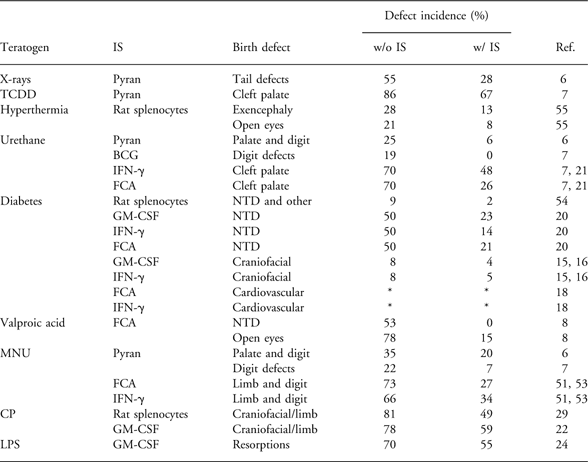
Nomura et al.Reference Nomura, Hata and Kusafuka 6 first reported that activation of peritoneal macrophages in pregnant, inbred ICR (Institute for Cancer Research) mice reduced fetal malformations. These authors used intraperitoneal (IP) injection with a synthetic copolymer (pyran) or the biological agent Bacillus Calmette–Guerin (BCG) to activate the maternal macrophages. Both procedures resulted in reduced palate, digit and tail anomalies in fetuses exposed to ethyl carbamate (urethane), methylnitrosourea (MNU) or X-ray irradiation, as compared with fetuses exposed to the teratogens alone. This early report has been confirmed and extended by many investigators, demonstrating the efficacy of maternal immune stimulation to reduce morphologic lesions in developing mouse fetuses (Table 1). A variety of teratogenic agents have been used including diverse chemical and therapeutic agents, hyperthermia, X-rays and diabetes mellitus. The maternal immune stimulation sometimes resulted in a remarkable degree of protection against teratogens, for instance, completely blocking urethane-induced digit defects and valproic acid (VA)-induced exencephaly.Reference Holladay, Sharova and Smith 7 , Reference Holladay, Sharova and Punareewattana 8
Published reports showing efficacy of maternal immune stimulation in preventing birth defects

IS, immune stimulant; TCDD, 2,3,7,8-tetrachlorodibenzo-p-dioxin; BCG, bacillus Calmette–Guerin; IFN-γ, interferon-gamma; FCA, Freund's complete adjuvant; NTD, neural tube defects; GM-CSF, granulocyte-macrophage colony stimulating factor; MNU, methylnitrosourea; CP, cyclophosphamide; LPS, lipopolysaccharide.
*Data in this report were presented as reduced myocardial, ventricular chamber and thoracic aorta transverse sectional area rather than as percentage decrease per litter.
In addition to showing positive results with diverse teratogens, the techniques used to stimulate the maternal immune system and the timing of stimulation relative to pregnancy have been quite variable. These immunostimulatory treatments have included pre-breeding or mid-gestation injection with immune modulating cytokines, IP injection with inert polymer particles, intrauterine injection with allogeneic or xenogeneic splenocytes and pre-breeding injection with BCG or Freund's Complete Adjuvant (FCA; Table 1). All methods were effective in reducing morphologic birth defects caused by teratogens.
Because the exact time of conception is typically unknown, there are different conventions for counting gestational days. To facilitate comparison of studies in this review, we have designated gestation day 0 (gd 0) as the day female mice were found with a vaginal plug. It should be noted that this occasionally shifts the timing by one day from the designation used in the original report.
Possible mechanisms of immune protection against maldevelopment
Nomura et al.Reference Nomura, Hata and Kusafuka 6 first hypothesized that immune protection against chemical-induced teratogenesis may be the result of a maternal immunosurveillance system, in which activated peritoneal macrophages cross the placenta, recognize and eliminate pre-teratogenic cells. However, later studies using flow cytometry and cell-tracking probes failed to demonstrate activated maternal peritoneal macrophages in the circulation of teratogen-exposed fetal mice.Reference Holladay, Sharova and Punareewattana 8 These authors also noted that surveillance of the fetus by maternal immune cells may be unexpected as a mechanism to explain reduced teratogenesis, due to the semi-allogeneic nature of the fetus relative to the dam. Reduction of 2,3,7,8-tetrachlorodibenzo-p-dioxin (TCDD)-induced cleft palate by maternal immune stimulation may also argue against direct activity of maternal macrophages against pre-teratogenic fetal cells.Reference Holladay, Sharova and Smith 7 This particular defect has been associated with failure of apoptosis of the epithelial cells lining the palatal shelves, an event required prior to proliferation and fusion of underlying mesodermal cells.Reference Abbott, Probst, Perdew and Buckalew 9 , Reference Abbott and Birnbaum 10 Thus, the cells associated with this morphologic lesion are phenotypically normal fetal cells that failed to undergo apoptosis. This observation raised questions regarding mechanisms by which these epithelial cells might be immunologically distinguished from other fetal cells by maternal leukocytes that enter the fetal circulation. The possibility was later suggested that maternal immune stimulation might reduce fetal morphologic lesions through the transplacental activity of cytokines secreted by activated maternal immune cells.Reference Sharova, Sura and Smith 11
Maternal cytokines as mediators of reduced birth defects
Limited information is presently available about placental transport of cytokines; however, some cytokines are known to cross the placenta. In addition to roles in hematopoiesis and macrophage function, colony stimulating factor 1 (CSF-1) plays an important role in embryo development and readily crosses the placenta.Reference Roth, Dominguez and Stanley 12 Other cytokines show activity in fetal development and have also been found to cross the placenta, including granulocyte colony stimulating factor, granulocyte-macrophage colony stimulating factor (GM-CSF), transforming growth factor-beta (TGF-β) and interferon-alpha (IFN-α).Reference Calhoun, Posa and Christensen 13 , Reference Zdravkovic, Knudson and Liu 14 These reports lend support to the hypothesis that maternal immune stimulation may overcome or partially overcome teratogen-induced lesions by increasing the maternal production and transplacental availability of molecules that are important regulators of fetal development.
Using streptozotocin (STZ), a diabetogenic agent, to induce craniofacial defects in mice, Hrubec et al.Reference Hrubec, Prater, Toops and Holladay 15 , Reference Hrubec, Toops and Holladay 16 reported significantly reduced maxillary and mandibular shortening in fetuses from hyperglycemic dams that also received GM-CSF or interferon-gamma (IFN-γ) by IP injection. Maternal diabetes also increases cardiovascular defects in humans and rodents.Reference Lale, Yu and Ahmed 17 Gutierrez et al.Reference Gutierrez, Prater and Hrubec 18 therefore used STZ to induce diabetes in pregnant mice in order to determine whether maternal immune stimulation may modulate expression of cardiovascular defects. The maternal hyperglycemia negatively affected cardiovascular morphology of the late-gestation fetus by causing ventricular chamber dilation and myocardial reduction, and increased ascending aortic area. Maternal IFN-γ injection prevented both the myocardial reduction and the increased aortic area caused by diabetes. These authors later associated diabetes-related fetal mouse myocardial reduction with increased myocardial apoptosis, and suggested that maternal immune stimulation may restore normal myocardial apoptosis rates during development.Reference Gutierrez, Prater and Smith 19
Punareewattana et al. used STZ-induced diabetes in pregnant mice to induce craniofacial and neural tube defects (NTDs). These authors identified 36 out of 151 maternal splenic cytokine/growth factor genes studied as significantly different (either upregulated or downregulated) between immune-stimulated diabetic dams and non-stimulated diabetic dams.Reference Punareewattana, Sharova, Li, Ward and Holladay 20 Three different methods of immune stimulation were used: footpad injection with FCA, IP injection with GM-CSF or IP injection with IFN-γ, and largely produced the same pattern of altered gene expression, but with differences in magnitude. Gene expression changes that contributed most to variability between immune-stimulated and non-stimulated diabetic dams were identified by principal component analysis (PCA), and included genes for GM-CSF, epidermal growth factor (EGF) and TGF-β3. These authors therefore suggested that reduced birth defects caused by maternal immune stimulation might be mediated by growth factors such as EGF and TGF-β or the cytokine GM-CSF. These results agreed closely with a previous report from the same laboratory, where increased maternal splenic leukocyte GM-CSF and TGF-β3 gene expression levels correlated strongly with protection against urethane-induced cleft palate.Reference Sharova, Gogal, Sharova, Crisman and Holladay 21
In mice, cyclophosphamide (CP) exposure during development causes limb malformations ranging from oligodactyly to amelia. Similar to diabetes- and urethane-induced fetal defects, Savion et al.Reference Savion, Brengauz-Breitmann, Torchinsky and Toder 22 reported a significant decrease in limb malformations if the CP-treated dams were dosed with GM-CSF prior to breeding. The GM-CSF treatment resulted in enhanced maternal splenocyte proliferation and increased interleukin (IL)-2 and IL-3 cytokine production, leading the authors to suggest a role for these or other regulatory cytokines in protection against CP-induced limb malformations.
CP treatment in pregnant rodents has been associated with inappropriate apoptotic cell death in developing fetal limb buds, leading to teratogenesis.Reference Toder, Carp, Fein and Torchinsky 23 Intrauterine immunization of pregnant CP-treated mice with either semi-allogeneic (paternal) or xenogeneic (rat) splenic lymphocytes reduced such apoptotic nuclei in developing fetal limbs and increased fetal survival.Reference Savion, Zeldich and Orenstein 24 Increased levels of maternal cytokines including GM-CSF, as compared with controls, were again implicated in the protective effect. The authors hypothesized that such regulatory activity might occur through effects on fetal gene expression in target tissues that were reached by maternal cytokines.
Maternal immune stimulation alters fetal gene expression
The precise relationship between shifts in maternal cytokine levels, normalized fetal gene expression and protection against morphologic defects remains speculative. Sharova et al.Reference Sharova, Sura and Smith 11 reported that maternal IP injection with the macrophage stimulatory Th1 cytokine IFN-γ decreased cleft palate caused in mice by urethane. Fetal heads from the urethane-exposed pregnant dams showed reduced expression of cell cycle/apoptotic genes bcl2α, bcl2β and pkCα at gd 14. The maternal injection with IFN-γ normalized fetal expression of those genes and also normalized the bcl2α/p53, bcl2β/p53 and pkCα/p53 gene expression ratios to control levels. These data suggested that protection against urethane-induced cleft palate might be mediated through a maternal immune regulatory effect on fetal gene expression. The authors hypothesized that cytokines of maternal origin, in this case IFN-γ or IFN-γ-induced maternal cytokines, may cross the placenta and act as the molecular mediators of improved development in teratogen-exposed mice.
The genes bcl2 and p53 are important in fetal development and are affected by maternal immune stimulation. Protein products of bcl2 and p53 operate at the G1 cell cycle phase and are involved in assessment and regulation of deoxyribonucleic acid (DNA) replication and repair.Reference Gjerset, Lebedeva, Haghighi, Turla and Mercola 25 The bcl2 gene is normally highly expressed in fetal tissues, including central nervous and rapidly proliferating epithelial cells.Reference Ninomiya, Numakawa and Adachi 26 The protein product of this gene plays a role in mediating the growth-inhibiting and apoptotic effects of the p53 gene.Reference Zhang, Tang, Hadden and Rishi 27 A membrane-bound isoform of protein kinase C (pkCα) is also involved in the phosphorylation of proteins regulating both bcl2 and p53 gene products; thus, the pkCα gene may be important in control of interactions between bcl2 and p53.Reference Coutinho, Pereira and Pereira 28 , Reference Savion, Lepsky and Orenstein 29 The pkCα gene was also upregulated by maternal immune stimulation in teratogen-exposed fetal mouse heads.Reference Sharova, Sura and Smith 11
The p53 gene is also highly expressed in fetal tissues, including rapidly proliferating epithelia, where its expression is induced by TGF-β. Tightly regulated proliferation/apoptosis ratios that are critical for normal fetal development are believed to depend more on bcl2/p53 gene expression ratios than on the expression of the individual genes. For instance, apoptosis induced by p53 protein can be prevented by an elevation in the level of the bcl2 gene product.Reference Elledge and Lee 30 Conversely, the apoptotic function of p53 is activated when the equilibrium between p53 and bcl2 favors p53.Reference Korsmeyer 31 Thus, it is noteworthy that maternal urethane treatment decreased bcl2α/p53 and bcl2β/p53 expression ratios (i.e. a relative shift toward p53) in fetal mouse heads, and these decreases were reversed by maternal injection with IFN-γ or FCA.Reference Sharova, Sura and Smith 11
Immune stimulation models other than cleft palate induced by urethaneReference Holladay, Sharova and Smith 7 have also shown effects on fetal bcl2 and p53 gene expression. Savion et al.Reference Savion, Kamshitsky-Feldman and Ivnitsky 32 exposed pregnant mice to CP with or without three different methods of immune stimulation: intrauterine rat splenocytes, intrauterine GM-CSF or intravenous GM-CSF. In the absence of maternal immune stimulation, apoptotic cells and expression of p53 increased in fetal heads 24 h after CP treatment, whereas bcl2 expression decreased. The maternal immune stimulation procedures all normalized or partially normalized p53 and bcl2 expression in the fetal heads, and prevented the CP-induced rise in apoptotic cells at 48 h. To determine the mechanisms by which maternal immune stimulation may affect fetal limb tissue apoptosis after CP exposure, these authors later evaluated caspases 3, 8 and 9 activation, as well as nuclear factor (NF)-kappaB (NFκB) DNA-binding activity in the fetal mice.Reference Torchinsky, Gongadze and Zaslavsky 33 , Reference Savion, Aroch and Mammon 34 Immune stimulation using intrauterine rat splenocytes normalized the CP-induced activation of the tested caspases, as well as the CP-induced suppression of NFκB DNA-binding activity. These results add further support to the hypothesis that maternal immune protection against teratogenesis may in part relate to restored gene expression and correction of dysregulated fetal apoptosis. On the basis of these observations, the authors speculated that regulation of apoptosis during development might depend partially on fetal–maternal immune interactions, and that maternal immune stimulation might reduce embryonic sensitivity to embryopathic stresses via NFκB- and caspase-associated pathways.
Some developmental defects including NTDs can be induced by altered cell proliferation, in addition to or rather than altered apoptosis.Reference Bennett, Wlodarczyk, Calvin, Craig and Finnell 35 , Reference Craig, Bennett, Miranda, Mackler and Finnell 36 For instance, VA, an antiepileptic drug that causes NTDs in mice, caused a 50% reduction in the proliferation of c6 glioma cells impeding the cell cycle during the G1 phase.Reference Martin and Regan 37 Wlodarczyk et al.Reference Wlodarczyk, Craig, Bennett, Calvin and Finnell 38 found that VA exposure also changed the normal temporal pattern of gene expression in embryos such that (messenger ribonucleic acid) mRNA levels were comparable with what would normally be observed 12 h later under control conditions. This change in expression was marked by elevated mRNA levels for transcription factors Emx-1, Emx-2, c-fos, c-jun and creb and genes p53 and bcl-2, consistent with a pattern of drug-altered cell proliferation rather than increased cell death.
Exencephaly caused by VA in mice, a form of NTD, was reduced from 53% in fetuses of non-stimulated mothers to 0% in fetuses of mothers receiving footpad injections with FCA shortly before mating.Reference Holladay, Sharova and Punareewattana 8 Protection against this VA-induced defect may suggest the possibility that maternal immune stimulation can act to normalize proliferation events in addition to apoptotic events. With this idea in mind, the above-described urethane-induced cleft palate was associated with decreased bcl2/p53 gene expression ratio in fetal mouse heads, consistent with increased apoptosis. However, this relative shift toward p53 shown by these authors is also a shift toward decreased proliferation.Reference Sharova, Sura and Smith 11 Maternal immune stimulation restored the expression ratio of these genes to the control level and reduced cleft palates from 70% in fetuses from urethane-treated mothers without immunostimulation to 26% in fetuses from urethane-treated mothers with immunostimulation.
TCDD alters expression of TGF-β and EGF in the fetal mouse palate, both of which are required for the timed expression of cell cycle genes necessary for closure of the palate.Reference Abbott, Probst, Perdew and Buckalew 9 , Reference Abbott and Birnbaum 10 IFN-γ increases production of TGF-β by macrophages, and as indicated above this cytokine crosses the mouse placenta where it potentially could help restore a TCDD-induced TGF-β deficit in the fetal palate. IFN-γ also increases production of IL-17 and IL-22 by Th17 T cells, which in turn increases the production of EGF and EGF-like molecules from keratinocytes and other cell types.Reference Tohyama, Hanakawa and Shirakata 39 EGF does not appear to cross the mouse placenta;Reference Diaugustine, Rosch, Lannon, Walker and Pratt 40 however, it is not known whether other IFN-γ-induced maternal cytokines such as IL-17 or IL-22 may cross the placenta and act locally to increase EGF production in the fetal palate. Since maternal IFN-γ injection upregulates numerous cytokines, which in turn affect other regulatory molecules and pathways, verifying transplacental activity of specific role-playing maternal cytokines to reduce fetal palate defects caused by TCDD or other teratogens is likely to prove challenging.
Uteroplacental improvement as a mediator of reduced birth defects
Another possible mechanism for improved developmental outcome with maternal immune stimulation may be protection of uterine or placental function and integrity. Gorivodsky et al.Reference Gorivodsky, Torchinsky and Shepshelovich 41 observed decreased fetal resorptions in CP-treated pregnant mice that were immune stimulated by intrauterine injection with allogeneic mouse lymphocytes. Uteroplacental tissue from the CP-treated mice displayed decreased CSF-1 mRNA, as well as reduced expression of the CSF-1 receptor (c-fms), effects that were largely reversed in the immune-stimulated mothers. These authors extended this observation by reporting significantly decreased uteroplacental TGF-β2 in mice with CP-induced pregnancy loss, compared with control mice.Reference Gorivodsky, Torchinsky and Zemliak 42 The immune stimulation with allogeneic lymphocytes increased uteroplacental TGF-β2 mRNA expression 2.0- to 3.2-fold in the CP-treated mice, leading the authors to conclude that reduced resorptions may in part be due to increased uterine or placental synthesis of TGF-β2. These results suggest a beneficial effect of immune stimulation on the uterus and placenta in reduced resorptions.
Fein et al.Reference Fein, Kostina and Savion 43 demonstrated increased uterine levels of tumor necrosis factor-alpha (TNF-α) and TNF-α mRNA in diabetic mice on days 0, 4 and 8 of gestation, both of which were associated with a high rate of deformed fetuses and reduced pregnancy rates. The TNF-α was localized in the glandular and luminal epithelium of the uterus, and the stroma and myometrium on gd 0 and 4, as well as in the decidua on gd 8. Maternal immune stimulation with intrauterine rat splenocytes decreased uterine TNF-α at all time points and reduced resorptions. Using a similar diabetic mouse model, these authors reported decreased TGF-β mRNA in uterine epithelium on gd 0 and 4, and in the decidua and trophoblast on gd 8, in the hyperglycemic mice.Reference Fein, Magid and Savion 44 The maternal immune stimulation increased TGF-β mRNA in the uterus and decidua on gd 8 and increased TGF-β protein at all three time points to control levels. These results may suggest a beneficial effect of TGF-β on the uterine environment, leading to reduced resorptions. The immune-stimulated dams also produced fewer malformed fetuses. It could not be determined whether the beneficial developmental effects were the result of improved uterine function caused by locally increased TGF-β or by possible transplacental activity of TGF-β in the fetus.
In a different model, lipopolysaccharide (LPS) was used in mice to induce pregnancy loss, and intrauterine plus intravenous GM-CSF were used to immune stimulate the pregnant dams.Reference Savion, Zeldich and Orenstein 24 The LPS treatment increased TNF-α expression in both primary and secondary decidua at 3 and 6 h post treatment, with expression declining by 24 h when the resorption process was almost complete. LPS treatment also decreased TGF-β2 in the primary and secondary decidua and in the glandular epithelium of the uterus at 3, 6 and 24 h post treatment. The maternal GM-CSF administration decreased the rise in TNF-α at 3 and 6 h and normalized the decrease of TNF-α at 24 h to levels seen in control mice. Maternal GM-CSF also increased TGF-β expression to be almost equal to untreated controls in the primary and secondary decidua and the glandular epithelium of the uterus.
GM-CSF has been found to be critically important in placental development by mediating the recruitment and behavior of uterine leukocytes and stimulating trophoblast cell differentiation.Reference Garcia-Lloret, Morrish and Wegmann 45 , Reference Robertson, O'Connell, Hudson and Seamark 46 GM-CSF and TGF-β2 are also regulators of selective immunosuppressive activity in the uterus, protecting the embryo from maternal natural killer and cytotoxic T cells,Reference Garcia-Lloret, Morrish and Wegmann 45 , Reference Robertson, Seamark, Guilbert and Wegmann 47 and which may in part explain the beneficial placental results observed in LPS-treated mice. The results with GM-CSF immune stimulation in LPS-treated mice were similar to the above-described results with diabetic mice that had been immune stimulated with xenogeneic lymphocytes,Reference Fein, Kostina and Savion 43 , Reference Fein, Magid and Savion 44 and suggest that GM-CSF administration in teratogen-exposed mice may help restore uterine TNF-α and TGF-β to levels that better support fetal maintenance and development.
Sharova et al. demonstrated a marked improvement in placental damage caused by urethane, when the mice also received maternal immune stimulation with FCA or IFN-γ.Reference Sharova, Sharova and Sura 48 It was not known whether these placental changes were downstream to the effects on maternal spleen that included increased TGF-β3 and GM-CSF production, or to the effects of immune stimulation on the placenta. Other authors have shown that the spleens of pregnant but not virgin mice produce a variety of cytokines that stimulate placental cell proliferation, including CSF-1, IL-3, IL-10 and GM-CSF.Reference Athanassakis, Aifantis, Ranella and Vassiliadis 49 – Reference Thaxton and Sharma 51 In addition to improving placental morphology, Sharova et al.Reference Sharova, Sharova and Sura 48 found that maternal immune stimulation restored to control or above-control levels the urethane-induced downregulation of placental genes for several cytokines previously found to reduce birth defects, including IFN-γ and GM-CSF. Placental apoptosis and cell cycling genes were also normalized in urethane-treated mice by the maternal immune stimulation. The authors concluded that urethane shifted placental cytokines toward a Th1 pro-inflammatory profile, whereas maternal immune stimulation upregulated Th2 cytokines and shifted the placental profile back toward Th2 cytokines that favor pregnancy.
Placental morphology was again improved by immune stimulation in pregnant mice that had been dosed with the alkylating agent MNU.Reference Prater, Strahl, Zimmerman, Ward and Holladay 52 Maternal exposure of these mice to MNU on day 9 of gestation caused multiple limb and digital defects in the fetuses. Fetal limbs were significantly shortened, and limb and digital defects including syndactyly, polydactyly, oligodactyly, clubbing and webbing were observed. In the placenta, the spongiotrophoblast layer was disrupted by MNU and there was increased cell death of placental trophoblasts and fetal labyrinthine endothelial cells. Maternal immune stimulation with IFN-γ on day 7 of pregnancy, or with FCA administered 3 and 5 days prior to breeding, prevented the limb shortening caused by MNU and reduced digit defects at both days 12 and 14 of gestation. Both procedures of maternal immune stimulation diminished cell death within all layers of the placenta, particularly in the labyrinthine layer. The authors later associated two primary cellular signaling pathways with placental damage caused by MNU – Jak-STAT and NFκB.Reference Prater, Laudermilch and Holladay 53 Activation of these pathways by maternal immunostimulation restored or partially restored placental GM-CSF, IL-2, IL-4, macrophage chemotactic protein-1 (MCP-1), TNF-α and vasculoendothelial growth factor levels relative to controls. These results again support the hypothesis that improved placental function or structure by immune stimulation may contribute to the reduction of birth defects caused by some teratogens.
Conclusions
Numerous reports from independent laboratories verify the efficacy of maternal immune stimulation in reducing teratogen-induced morphologic defects in mice. Determining the operating mechanisms for such broad-spectrum immune protection against birth defects is now needed to move this new field of research forward. The immune protection may involve beneficial actions of maternal cytokines on the placenta or the fetus. The placenta consists of rapidly proliferating cells, is a vital support structure for development, and was adversely affected by several of the studied teratogens. Placental ultrastructure and placental function were improved in teratogen-exposed mice following local (uterine) or systemic maternal immune stimulation, and correlated with reduced resorptions and reduced fetal defects. Cytokines, including GM-CSF and TGF-β, are critical in normal placental development and function, and were upregulated by maternal immune stimulation, and thus may be mediators of improved placental structure and function.
Gene expression in fetal target tissues of teratogens was also restored to control levels by maternal immune stimulation in a number of different teratogen-exposure models. It remains unknown whether this improved fetal gene expression was due to improved placental function and support of development, or to transplacental activity of maternal cytokines and growth factors induced by the maternal immune stimulation or due to a combination of these events. Several reports from independent laboratories have implicated increased maternal splenic levels of specific cytokines in protection against teratogen-induced birth defects, including GM-CSF, IFN-γ and TGF-β. The ability of some of these cytokines to cross the placenta supports a hypothesis for possible transplacental activity of these cytokines in target tissues of the teratogens.
The demonstration that maternal immune stimulation dramatically improves fetal development in teratogen-exposed mice raises novel questions about the possible unrecognized regulatory activity of maternal cytokines in normal fetal development. Interestingly, all of the chemical teratogens studied in the reviewed reports are immunotoxicants, as are many other teratogens. Taken together, these observations also raise new questions about the importance of a healthy maternal immune system in normal development. This includes the possibility that maternal immune suppression, of itself, may increase risk of abnormal fetal development by reducing production of beneficial factors to placental function or fetal development.
It is not known whether maternal immune stimulation in pregnant women may have beneficial effects on birth outcome, similar to mice. Naturally-occurring human cohorts exist that received immune stimulation during pregnancy, for instance due to infections or vaccination. Such pregnancies might be studied retrospectively to determine whether they produced the same number of cleft palates, NTDs or other birth defects as occurred in carefully matched controls that did not receive immune stimulation during pregnancy. It of course must also be recognized that non-specific maternal immune stimulation during human pregnancy may carry risks to the postnatal health of the fetus, including increased immune-mediated diseases such as asthma.Reference Baizhuang, Pekkanen, Jarvelin, Olsen and Hartikainen 54 Also, while mice exposed to VA during pregnancy showed dramatically reduced exencephaly after maternal immune stimulation, the same mice displayed increased incidence of anury (absence of a tail), a defect not typically seen in mice exposed to VA.Reference Holladay, Sharova and Smith 7 This report of anury appears to be the only observation of a birth defect apparently caused in mice by maternal immune stimulation. Should there be any apparent benefits of such procedures in humans, determining specific role-playing molecules and pathways involved would be required to minimize adverse effects while maximizing any beneficial effects of designed immune-based therapies.