Introduction
Delirium is a serious and often undiagnosed neuropsychiatric syndrome commonly affecting elderly hospitalized patients (Siddiqi et al., Reference Siddiqi, House and Holmes2006; Collins et al., Reference Collins, Blanchard, Tookman and Sampson2010). It is characterized by an acute onset and fluctuating course with deficits in attention, arousal state, and perception. The cause frequently originates outside the brain, for example, arising secondary to infection, trauma, or metabolic disturbance (Elie et al., Reference Elie, Cole, Primeau and Bellavance1998; van Gool et al., Reference van Gool, van de Beek and Eikelenboom2010).
The genesis of delirium is multi-factorial but C-reactive protein (C-RP) is known to be elevated, non-specifically in multiple conditions that can precipitate delirium (Clyne and Olshaker, Reference Clyne and Olshaker1999; Hopstaken et al., Reference Hopstaken, Muris, Knottnerus, Kester, Rinkens and Dinant2003; Wright and Frier, Reference Wright and Frier2008; Yeh et al., Reference Yeh2012). This implies that C-RP sits as a downstream factor in the genesis of delirium, but upstream from the theorized cholinergic and dopaminergic synaptic dysregulation that generates clinical symptoms (Hshieh et al., Reference Hshieh, Fong, Marcantonio and Inouye2008; Sanders, Reference Sanders2011; Cerejeira et al., Reference Cerejeira, Nogueira, Luis, Vaz-Serra and Mukaetova-Ladinska2012).
C-reactive protein is an acute phase protein with widespread clinical utility as a marker for infection, inflammation, and tissue injury (Pepys and Hirschfield, Reference Pepys and Hirschfield2003; Black et al., Reference Black, Kushner and Samols2004; Macdonald et al., Reference Macdonald, Adamis, Treloar and Martin2007). There is also evidence to support inflammation in the pathogenesis of delirium in both peripheral and central tissues (Cerejeira et al., Reference Cerejeira, Firmino, Vaz-Serra and Mukaetova-Ladinska2010). Several actions of C-RP can lead to neuroinflammation such as disruption of the blood brain barrier and increase in both central cytokine and microglial activity (Perry, Reference Perry2004; Uchikado et al., Reference Uchikado2004; Quan and Banks, Reference Quan and Banks2007; Alexander et al., Reference Alexander, Anderson, Barnum, Stevens and Tenner2008; Kuhlmann et al., Reference Kuhlmann2009; Juma et al., Reference Juma, Lira, Marzuk, Marzuk, Hakim and Thompson2011). However, evidence for an association between C-RP and delirium is inconsistent and from small clinical populations (Aldemir et al., Reference Aldemir, Ozen, Kara, Sir and Bac2001; Pisani et al., Reference Pisani, Murphy, Van Ness, Araujo and Inouye2007). Moreover, C-RP may be an intermediary factor only in certain pathways, from different origins culminating in delirium.
The aim of this study was to describe the association between C-RP and the incidence and severity of delirium in a large sample of elderly patients admitted to an acute hospital, and to determine if there was any interaction between C-RP and delirium by diagnosis as a proxy for upstream etiologies.
Methods
To investigate the hypotheses, an existing database was used. Data were gathered for the study on the prevalence and mortality of dementia in the acute hospital setting (Sampson et al., Reference Sampson, Blanchard, Jones, Tookman and King2009). Recruitment of participants took place at a North London teaching hospital, which serves a diverse population of almost 1.5 million people. During a six-month period all patients aged over 70 years with unplanned acute admission to the Medical Acute Admissions Unit (MAAU) were considered eligible for inclusion. Patients who were admitted to the ward for less than 48 hours or who did not speak adequate English for evaluation by the Confusion Assessment Method (CAM) were excluded. All patients included in the sample were assessed within 72 hours of admission by trained specialists in old age psychiatry, and this assessment (including the CAM; Thomas et al., Reference Thomas, Kreisel, Oster, Driessen, Arolt and Inouye2012) was conducted prior to consulting the medical notes (Sampson et al., Reference Sampson, Blanchard, Jones, Tookman and King2009).
The CAM has good discriminating ability to avoid misclassification of dementia as delirium. It can also be used to assess the severity of delirium with a good inter-observer reliability in general wards and outpatients (Inouye et al., Reference Inouye, van Dyck, Alessi, Balkin, Siegal and Horwitz1990; Wei et al., Reference Wei, Fearing, Sternberg and Inouye2008). This was calculated by summing four symptom scores in the CAM: inattention, disorganized thinking, and altered level of consciousness as absent (0), mild (1), or marked (2), while acute onset and fluctuation was measured as absent (0) or present (1), giving a total out of 7 (Wei et al., Reference Wei, Fearing, Sternberg and Inouye2008).
Participants’ age, gender, and place of residence were collected from hospital notes, and results from all routine blood tests were recorded. Primary cause of admission was obtained from the Hospital Episode Statistics using ICD-10 diagnosis; this was recorded independently by the hospital coding department and categorized according to the Ambulatory Care Sensitive Condition system (Sanderson and Dixon, Reference Sanderson and Dixon2000). The Atropine Risk Score (Rudolph et al., Reference Rudolph, Salow, Angelini and McGlinchey2008) was calculated from all medications at the time of admission. We then categorized each patient into one of the following five diagnostic clusters based on primary diagnosis and medical admission causes: (1) cardiovascular, (2) musculoskeletal, (3) infection, (4) metabolic, or (5) other.
The severity of acute illness was measured using the Acute Physiological and Chronic Health Evaluation (APACHE) II score (Knaus et al., Reference Knaus, Draper, Wagner and Zimmerman1985). Chronic comorbidity was measured using the Charlson Comorbidity Index (CCI; Charlson, Reference Charlson1987; de Groot et al., Reference de Groot, Beckerman, Lankhorst and Bouter2003).
Data Analysis
An independent t-test was used to investigate the relationship between C-RP and delirium. This was followed by logistic regression to adjust for predisposing or causal factors of delirium possibly related to C-RP: age, gender, CCI score, APACHE score, diagnosis at admission, and atropine equivalence of medication prescribed upon admission.
Investigation of a possible difference in the association between C-RP levels and delirium between diagnosis categories was undertaken using a logistic regression between C-RP and delirium stratified by diagnostic category. Test for a significant modifying effect (interaction) was performed. The relationship between C-RP and delirium severity was also investigated using an analysis of variance (ANOVA) and the non-parametric Spearman's rank correlation coefficient. All analysis took place in SPSS 20.0 or STATA version 12 as appropriate.
The study was authorized by the hospital's ethics committee (Sampson et al., Reference Sampson, Blanchard, Jones, Tookman and King2009).
Results
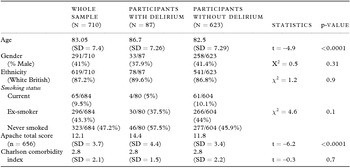
A total of 710 participants were included, of whom 87 (12.3%) were observed to have delirium within 72 hours of admission. The mean age was 83.05 years (SD = 7.4; minimum age = 70 years, maximum age = 101 years), 419 (59%) were females, 619 (87.2%) were described as of White British ethnicity, and 57% were smokers (Table 1).
Sample characteristics

C-RP levels and delirium
C-reactive protein levels were highly skewed, so these were log-transformed. There was a very strong association between the presence of delirium and raised C-RP on admission (t = 5.09; p < 0.001; Table 2).
C-RP level and delirium

The crude association between C-RP level and delirium caseness as defined by the CAM was adjusted for using the APACHE score, the CCI, gender, age, and the Atropine Risk Score of prescribed medication. This analysis demonstrated that raised C-RP retained a strong and independent association with delirium (odds ratio (OR) of delirium for each one unit increase of logC-RP = 1.32; 95% CI: 1.10–1.58, p = 0.003).
C-RP, diagnosis, and delirium
Of the 710 participants it was possible to determine the primary diagnosis in 696 (98.0%). Of these, 205 (29.5%) were included in the cardiovascular group, 197 (28.3%) into the infection group, 56 (8.0%) into the musculoskeletal group, and 30 (4.3%) into the metabolic group. The remaining 208 (29.9%) were grouped as “other diagnosis.” Infection was often documented as a secondary diagnosis responsible for admission. In 270 (38.8%) participants, infection was either the primary diagnosis or as a cause of admission and there was a significant association between infection as a diagnosis and delirium (χ 2 = 21.3, df = 1; p < 0.0001), but there was no association between C-RP levels and delirium in those with a primary diagnosis of infection (delirium group mean logC-RP = 4.1; SD = 1.4 versus no delirium group mean logC-RP = 3.7; SD = 1.5; t = −1.4; p = 0.14).
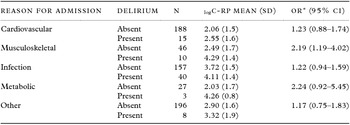
As shown in Tables 2 and 3, the relation between C-RP and delirium differs between the different admission categories. An increase in C-RP level was more strongly related to delirium in patients admitted for musculoskeletal (OR = 2.19) or metabolic reasons (OR = 2.24). However, statistical test for interaction did not show that this association differed significantly between the five diagnostic categories (χ 2 = 4.75, df = 4, p = 0.31).
C-RP level and delirium by admission diagnosis

Note: *Odds ratio for risk of delirium for each one unit increase in logC-RP.
C-RP levels and severity of delirium
There was no evidence of a linear association between C-RP levels and the severity of delirium (ANOVA, F = 0.288; p = 0.59; df = 1,69). This was confirmed by the Spearman's rank correlation coefficient (ρ = 0.11, p = 0.36).
Discussion
We have reported that C-RP levels are significantly elevated in a large sample of patients with delirium in an in-patient medical setting. The association was most noticeable in patients with “musculoskeletal” reasons for admission. However, C-RP levels did not appear significantly related to the severity of delirium.
Previously, a large cohort study showed that raised C-RP is associated with a cognitive decline in the elderly patients (Tilvis et al., Reference Tilvis, Kahonen-Vare, Jolkkonen, Valvanne, Pitkala and Strandberg2004). C-RP while suggested to be predictive for delirium and raised in prevalent delirium patients by some groups, others have disagreed (de Rooij et al., Reference de Rooij, van Munster, Korevaar and Levi2007; Lee et al., Reference Lee2007; Macdonald et al., Reference Macdonald, Adamis, Treloar and Martin2007; Speciale et al., Reference Speciale, Bellelli, Guerini and Trabucchi2008; White et al., Reference White, Eeles, O'Mahony and Bayer2008; Adamis et al., Reference Adamis2009). Inconsistencies in the extant evidence base may be driven by clinical populations in studies suffering from different medical conditions, and there is therefore an argument to apply the same methodology across diagnostic groups in a single study (de Rooij et al., Reference de Rooij, van Munster, Korevaar and Levi2007; Lee et al., Reference Lee2007; Macdonald et al., Reference Macdonald, Adamis, Treloar and Martin2007; Speciale et al., Reference Speciale, Bellelli, Guerini and Trabucchi2008; White et al., Reference White, Eeles, O'Mahony and Bayer2008; Adamis et al., Reference Adamis2009).
Strengths and limitations
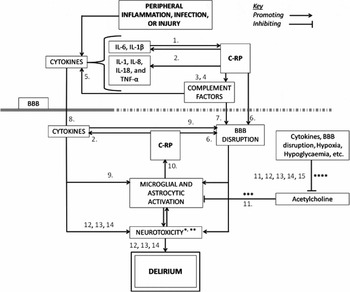
In using an existing dataset, we were unable to explore the role of other inflammatory markers (particularly various interleukins that interact with C-RP in various inflammation pathways (Figure 1). This limited the conclusions we can make at this stage regarding the role C-RP has in the genesis of delirium, although our data certainly suggest that further more purposeful exploration of role of C-RP within a cascade of inflammatory processes is merited. Future studies would also benefit from exploring changes in these markers prospectively to identify their role in incident delirium as opposed to cross-sectional studies (like this) that look for associations in prevalent cases.
Putative C-RP pathway from peripheral inflammation to delirium. IL = interleukin, TNF-α = tumour necrosis factor-α, C-RP = C-reactive protein, BBB = blood brain barrier. Peripheral inflammation may induce delirium through actions mediated by C-RP. *It is likely that there is also synaptoxicity and neurodegeneration (Perry, Reference Perry2004). **C-RP itself may directly contribute to neurotoxicity/neurodegeneration. The mechanism would probably be similar to the peripheral acute-phase response involving C-RP-aided clearance of damaged cells (Seo et al., Reference Seo2012). ***Attenuates some pro-inflammatory actions of microglia. ****Cholinergic neurons are easily damaged or killed. 1. Kushner et al. (Reference Kushner, Jiang, Zhang, Lozanski and Samols1995), 2. Ballou and Lozanski (Reference Ballou and Lozanski1992), 3. Mold et al. (Reference Mold, Gewurz and Du Clos1999), 4. Volanakis (Reference Volanakis1982), 5. Salmon and Pricop (Reference Salmon and Pricop2001), 6. Kuhlmann et al. (Reference Kuhlmann2009), 7. Alexander et al. (Reference Alexander, Anderson, Barnum, Stevens and Tenner2008), 8. Quan and Banks (Reference Quan and Banks2007), 9. Perry (Reference Perry2004), 10. Juma et al. (Reference Juma, Lira, Marzuk, Marzuk, Hakim and Thompson2011), 11. van Gool et al. (Reference van Gool, van de Beek and Eikelenboom2010), 12. Hshieh et al. (Reference Hshieh, Fong, Marcantonio and Inouye2008), 13. Sanders (Reference Sanders2011). 14. Cerejeira et al. (Reference Cerejeira, Nogueira, Luis, Vaz-Serra and Mukaetova-Ladinska2012), 15. Willard et al. (Reference Willard, Hauss-Wegrzyniak and Wenk1999).

The lack of interaction between C-RP and clinical diagnosis may reflect the non-specific nature of C-RP elevation relative to etiology. Although this may also reflect the diagnostic categories that we created; a multiplicity of clinical diagnoses may have been included in broad and heterogeneous diagnostic clusters. In addition, it is important to consider the pathogenesis of delirium when comparing different diagnoses. Figure 1 shows that while C-RP may be an early step in the pathway to neuroinflammation, myriad inflammatory mediators may precipitate a similar disturbance. One could argue that the multifactorial nature of delirium suggests that this pathway can be initiated at different or multiple points and that in some conditions C-RP plays a greater role than in others; C-RP may be important in delirium secondary to musculoskeletal trauma, for example. Unfortunately, there was insufficient power to analyze our data by individual diagnoses, but we consider that the major clusters of infection, musculoskeletal, and cardiovascular diseases have reasonable clinical and face validity, and probably represent acceptable consistency of underlying disease processes between the clinical conditions and central emergence of delirium. Our sample was large enough to investigate the association between C-RP and delirium by most diagnostic clusters, although the metabolic cluster had fewest patients within it, but the statistical formal interaction remained low.
Our study has particular strengths. It is the first large study that has identified a central role for C-RP in delirium, most marked when the medical problems are exclusively extra-cerebral. It has a clinically well-characterized population that benefits from the consistency of evaluation for the primary outcome (delirium) and the rich data collected on well-being, drugs, and medical comorbidities.
We have demonstrated that C-RP is elevated in delirium, even after adjustment for important potential confounders such as age, medical comorbidities, and severity of medical illness. However, from our data, which are cross-sectional in nature, we are unable to determine when in the sequence of events this elevation occurs and also whether it is a consequence of delirium as opposed to being a preceding step in its genesis. Time lines of changes in biomarkers for delirium would need multiple sampling and clinical assessments which may be possible, for instance, in patients undergoing elective surgery where the incidence of delirium is reasonably high and there is an opportunity to do multiple pre- and post-operative assessments (Bruce et al., Reference Bruce, Ritchie, Blizard, Lai and Raven2007). The observation that the association between C-RP elevation and delirium was particularly noted in patients with musculoskeletal diagnosis and less strong in the infection group is worthy of further discussion.
Delirium has multiple causes which may invoke different cascades of pathological events or processes before the development of symptoms. The clinical symptoms though are quite homogenous, perhaps reflecting the final genesis of symptoms is one mediated by synaptic dysfunction irrespective of the upstream pathological cascades. This similarity in clinical expression should not though be assumed to reflect upstream homogeneity of processes. Our data suggest that C-RP appears to play a critical role in cases where the medical illness leading to delirium sits exclusively outside the brain and is not related to infection. This hypothesis needs more specific testing in future studies.
Clinical and research implications
Our observations have important implications for further translational and clinical research. Most importantly, in future studies, either detailed medical histories are needed to allow exploration for different pathways to delirium from a variety of etiologically distinct clinical conditions or they need to be limited to specific disease clusters. We would suggest that such clustering should be informed by the possible impact of diseases on the brain directly and whether or not infection is present, as these two factors would be, from our data, important influences on pathological pathways leading to delirium.
Moreover, future studies would benefit from being longitudinal so as to be able to describe the sequence of inflammatory and neuroinflammatory events in patients with incident delirium. This could be achieved most practically in elective surgical patients who can be seen prior to a suspected initiating event for delirium. Such work could then describe the critical steps and their sequence associated with incident delirium post-operatively. Elaboration of these pathological sequences could form the basis of intervention studies with specific anti-inflammatory agents that could be given pre-operatively to reduce the risk of developing delirium.
In conclusion, we have demonstrated in a large sample an association between elevation in C-RP and delirium. This finding supports a cascade of inflammatory events peripherally that signals centrally to disrupt synaptic function and the generation of cardinal clinical features of delirium. We consider that mapping this pathway in longitudinal studies and articulating variations in pathways between clinical conditions leading to delirium are necessary steps to trial both pharmacological and risk reduction intervention studies to reduce the incidence of this common and disabling condition.
Conflict of interest
None.
Description of authors’ roles
C.W. Ritchie developed the original research idea and hypothesis, oversaw the data analysis, and made significant contributions to the interpretation of results and drafting of the paper. T.H. Newman undertook the preparation of the dataset used in this study from the parent dataset, the main drafting of the paper, and inference from the results of the analysis. B. Leurent was the study statistician who undertook the data analysis and made significant contributions to the interpretation of results and drafting of the paper. E.L. Sampson led the original parent study, made significant contributions to the analysis, interpretation of results, and drafting of the paper.
Acknowledgments
The original study from which this analysis was performed was funded by a UK Medical Research Council training Fellowship in Health Services research awarded to Elizabeth Sampson