INTRODUCTION
There is considerable debate on the origins and antiquity of deep-sea species (Kussakin, Reference Kussakin1973; Hessler et al., Reference Hessler, Wilson and Thistle1979; Jacobs & Lindberg, Reference Jacobs and Lindberg1998; Horne, Reference Horne1999; Wilson, Reference Wilson1999; Gage, Reference Gage2004). It is clear, however, that shallow-water benthic organisms have colonized the deep sea during several geological periods (Wilson, Reference Wilson1980; Gebruk, Reference Gebruk and David1994; Jacobs & Lindberg, Reference Jacobs and Lindberg1998; Wilson, Reference Wilson1998; Gage, Reference Gage2004; Raupach et al., Reference Raupach, Held and Wägele2004; Smith, Reference Smith2004; Smith & Stockey, Reference Smith and Stockley2005). Migrations to the deep-sea are still occurring as suggested by the shallow-water species that have extended their depth distributions to the deep sea including the seastar Stichastrella spp. (Howell et al., Reference Howell, Billett and Tyler2002) and the sea urchin Echinus acutus (Tyler et al., Reference Tyler1995). However, it is not clear how widespread is the potential for colonization of deeper water among shallow-water invertebrates.
For a species to invade the deep sea its dispersal stages must have the physiological ability to withstand the physical properties of this environment. Most species found in coastal habitats have a restricted depth distribution; this may be because of the inability of their dispersal stages to survive under the physical conditions that prevail in the deep sea. But it might also be a consequence of many other factors such as biological interactions or the requirement of recruits or adults for a specific type of habitat or food. It has been shown in the echinoderms Ophiura ljungmani (Gage & Tyler, Reference Gage and Tyler1981a, Reference Gage and Tylerb), Ophiocten gracilis (Sumida et al., Reference Sumida, Tyler, Lampitt and Gage2000) and Luidia sarsi (Howell et al., Reference Howell, Billett and Tyler2002) that the juvenile depth distribution may extend beyond the maximum depth of the adult; but this is not enough to establish generalizations about the tolerance of shallow-water species dispersal stages to deep-sea physical conditions. Unfortunately, dispersal and juvenile stages are rarely sampled from the deep-sea and are not always easily identifiable (but see Gage & Tyler, Reference Gage and Tyler1981a, Reference Gage and Tylerb). Nevertheless, it is possible to assess embryonic and larval tolerances to deep-sea conditions by simulation of these conditions in the laboratory.
From shallow coastal waters to abyssal depths, various physical and chemical changes in the environment occur such as oxygen availability, light availability, sediment type, temperature and hydrostatic pressure (Menzies, Reference Menzies1965; Tyler, Reference Tyler1995). A relationship has been suggested between depth zonation of invertebrate species and the limits of the permanent thermocline, which appear to establish important faunal boundaries (Menzies et al., Reference Menzies, George and Rowe1973; Gage et al., Reference Gage, Billett, Jensen and Tyler1985; Billett, Reference Billett1991; Howell et al., Reference Howell, Billett and Tyler2002; Carney, Reference Carney2005). Unlike temperature, pressure varies constantly along the depth gradient (increasing 1 atm for every 10 m depth increase in the water column) and its role in determining species depth distribution is not clear. Both temperature and hydrostatic pressure are known to affect biological systems at all organizational levels (Vernberg & Vernberg, Reference Vernberg and Vernberg1972; Somero et al., Reference Somero, Siebenaller, Hochachka and Rowe1983; Somero, Reference Somero, Pörtner and Playe1998; Pörtner, Reference Pörtner2002). Therefore, in order to assess the physiological ability of species to disperse into the deep sea, it is important to test the ability of its dispersal stages to survive changes in these two environmental factors.
Along the depth gradient, temperature decreases while pressure increases. Therefore laboratory experiments to assess deep-sea invasion potential are more realistic when they reflect this by employing temperature and pressure combinations, instead of addressing these factors separately. Embryos or larvae of six strictly shallow-living sea urchin species have been submitted to temperature and pressure tests so far. These are Arbacia punctuata (Marsland, Reference Marsland1950), the Mediterranean Sea urchins Paracentrotus lividus, Arbacia lixula and Sphaerechinus granularis (Young et al., Reference Young, Tyler and Fenaux1997), the North Atlantic species Echinus esculentus (Tyler & Young, Reference Tyler and Young1998), and Sterechinus neumayeri from Antarctica (Tyler et al., Reference Tyler, Young and Clarke2000). Other studies have focused on hydrostatic pressure alone (Marsland, Reference Marsland1938; Young et al., Reference Young, Tyler, Emson and Emson1995). Additionally, Benitez-Villalobos et al. (Reference Benitez-Villalobos, Tyler and Young2006) have performed studies on the embryos and larvae of the seastars Asterias rubens and Marthasterias glacialis, providing evidence from a new echinoderm class.
Taken altogether, these studies have suggested that: (1) high hydrostatic pressure can inhibit cleavage or lead to abnormal development, especially under low temperature; and (2) that dispersal stages, particularly later larval stages, can survive in pressures higher than those encountered within the depth range for the adult. This may lead to the general assumption that the physiological ability for larval dispersal into deep-sea habitats is widespread among invertebrates living in shallow water. However, unpublished data on the limpet Patella alyssiponensis (Aquino-Souza, personal observation) showed that under low temperatures, trochophores cannot tolerate hydrostatic pressure equivalent to 500 m depth; this contradicts the results from previously studied species and shows that more pressure/temperature tests are needed.
Our study investigated the effects of various combinations of pressure and temperature, similar to those found along the depth gradient, on embryos and larvae of Psammechinus miliaris. This species occurs in the eastern Atlantic, from Morocco to Norway. In this region, embryos and larvae have the potential to be transported through the thermohaline circulation and be carried to the deep sea during deep water formation. We test whether pressure and temperature represent an important physiological barrier to bathymetric larval dispersal in this species.
MATERIALS AND METHODS
General methods
Individuals of Psammechinus miliaris were collected in April from Batten Bay, Plymouth, on the south-west coast of England, and kept in the aquarium of the National Oceanography Centre, UK. The animals were induced to spawn by intracoelomic injection of approximately 2 ml of 0.5 M KCl. The following experiments have been performed according to general procedures described in previous works (Young & Tyler, Reference Young and Tyler1993; Young et al., Reference Young, Tyler, Emson and Emson1995, Reference Tyler, Young and Clarke2000; Tyler & Young, Reference Tyler and Young1998; Benitez-Villalobos et al., Reference Benitez-Villalobos, Tyler and Young2006).
Experiments on early stages of development
Approximately 3 ml of active sperm from 1 male were added to a 2 l beaker containing the eggs obtained from 2 females. After 5 minutes, a drop of the egg suspension was analysed under the microscope to check the presence of fertilization membranes. When all the eggs were fertilized, the egg suspension was used in the experiments. The zygotes were distributed among 8 ml-volume plastic scintillation vials and subjected to different combinations of hydrostatic pressures (1 atm, 50 atm, 100 atm, 150 atm and 200 atm) and each vial contained approximately 200 zygotes. At each hydrostatic pressure, 4 temperatures were tested (5°C, 10°C, 15°C and 20°C). Three vials were assigned for each pressure/temperature combination. Pressurization was achieved using steel pressure vessels (described by Young et al., Reference Young, Tyler, Emson and Emson1995) and a manual ENERPAC pump (model 111000). Temperature was controlled using incubators and water baths. At the end of the incubation period, vessels were depressurized and embryo development was stopped by adding drops of formaldehyde to scintillation vials. A hundred embryos from each replicate were then analysed under a compound microscope to measure the percentage of embryos at different developmental stages, as well as abnormal embryos.
The above experiment was performed three times using a different incubation period each time (3 h, 6 h and 12 h). For each experiment newly spawned sperm and eggs were used.
Experiments on larval stages
Gastrulae experiment: for these experiments, zygotes were left to develop at ambient temperature (approximately 12°C) in a 2 l beaker filled with seawater, at density of approximately 20 embryos ml−1. The culture was kept aerated. Twenty-four hours later, the swimming stage had been reached, as in previous cultures carried out at 17°C in the same species (Kelly et al., Reference Kelly, Hunter, Scholfield and McKenzie2000). At the beginning of gastrulation, larvae were subjected to different hydrostatic pressures (1 atm, 50 atm, 100 atm, 150 atm and 200 atm) and at each pressure four temperatures (5°C, 10°C, 15°C, 20°C) were tested. Three replicate 8 ml-volume plastic vials were used for each pressure/temperature combination. After 24 h, vessels were depressurized and larvae from each replicate were analysed under a stereomicroscope to measure the survival rate (% of swimming larvae).
Prism experiment: a stock of swimming larvae at the gastrula stage, obtained as above, was kept in a 2 l beaker filled with seawater at ambient temperature (approximately 12°C) and density of approximately 20 larvae ml−1. The culture was kept aerated. Forty-eight hours after fertilization, larvae had reached the prism stage but, unlike larvae from experiments carried out previously at 17°C (Kelly et al., Reference Kelly, Hunter, Scholfield and McKenzie2000), had not completed gut formation. At this stage, a second experiment was performed following the same method described for the gastrulae experiment.
Statistical analysis
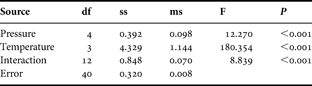
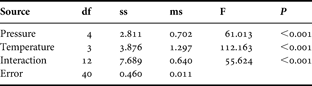
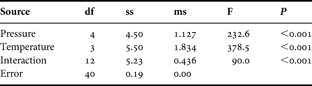
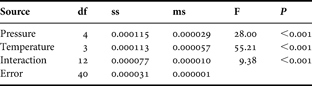
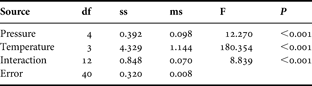
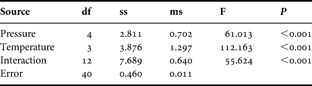
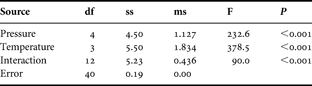
Analyses of variance (ANOVAs) were performed to analyse the effects of pressure and temperature on abnormality rates during the development of embryos and on the survival of larval stages (Tables 1–5). Post-hoc Sheffé tests were performed to test significant differences between selected pairs of samples. Percentage data were arcsin-transformed where necessary to meet the assumptions of ANOVA.
Two-way analysis of variance on percentages* of abnormal embryos of Psammechinus miliaris after 3 h of incubation at five pressures and four temperatures (Figure 1).
*Transformed to arcsin (√%)
Two-way analysis of variance on percentages* of abnormal embryos of Psammechinus miliaris after 6 h of incubation at five pressures and four temperatures (Figure 2).
*Transformed to arcsin (√%)
Two-way analysis of variance on percentages* of abnormal embryos of Psammechinus miliaris after 12 h of incubation at five pressures and four temperatures (Figure 3).
*Transformed to arcsin (√%)
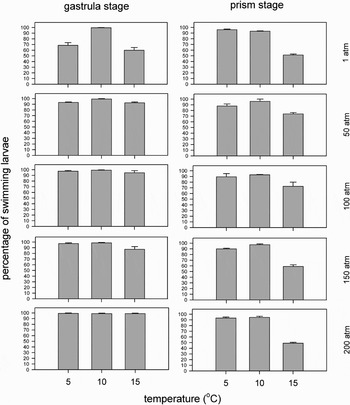
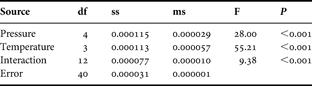
Two-way analysis of variance on percentages of swimming gastrulae of Psammechinus miliaris after 24 h of incubation at five pressures and three temperatures (Figure 4).
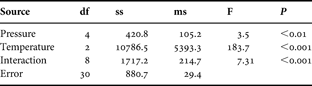
Two-way analysis of variance on percentages of swimming prisms of Psammechinus miliaris after 24 h of incubation at five pressures and three temperatures (Figure 4).
RESULTS
General results
The analyses revealed pressure and temperature effects, as well as interaction between these factors, in determining larval survival (Tables 4 & 5; Figure 4) and embryonic abnormality rates (Tables 1–3; Figures 1–3). On all occasions, F-values were higher for temperature effects than for pressure effects on the variables analysed (embryo abnormality and larval survival). This suggests that variations in temperature have more severe consequences for embryonic development and larval survival than variations in hydrostatic pressure.
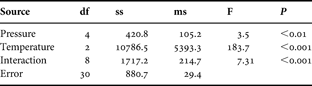
Percentage of Psammechinus miliaris embryos at different stages after being subjected to different combinations of temperature and pressure during 3 h of incubation. Stages: U, uncleaved; 2, 2-cells; 4, 4-cells; 8, 8-cells; 16, 16-cells; 32, 32-cells; 64, 64-cells; B, blastulae; G, gastrulae; abn, abnormal embryos.

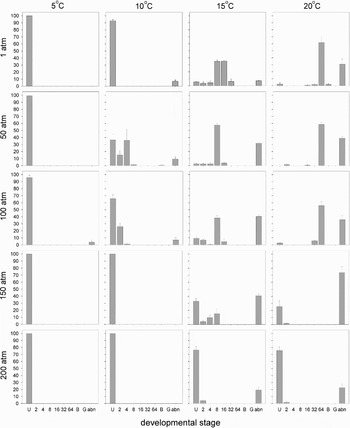
Percentage of Psammechinus miliaris embryos at different stages after being subjected to different combinations of temperature and pressure during 6 hours of incubation. Stages: U, uncleaved; 2, 2-cells; 4, 4-cells; 8, 8-cells; 16, 16-cells; 32, 32-cells; 64, 64-cells; B, blastulae; G, gastrulae; abn, abnormal embryos.

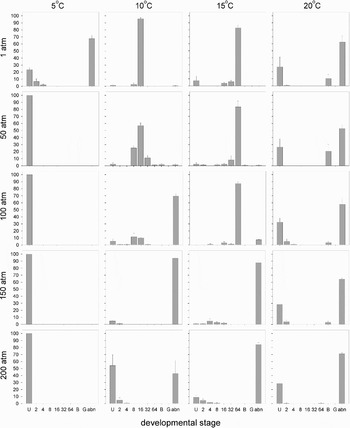
Percentage of Psammechinus miliaris embryos at different stages after being subjected to different combinations of temperature and pressure during 12 hours of incubation. Stages: U, uncleaved; 2, 2-cells; 4, 4-cells; 8, 8-cells; 16, 16-cells; 32, 32-cells; 64, 64-cells; B, blastulae; G, gatrulae; abn, abnormal embryos.

Combined pressure/temperature effects on zygotes after 3 h of incubation
At 5°C embryos had not cleaved in any of the pressures analysed. At 10°C embryos had started to cleave at 50 and 100 atm, but no cleavage was observed at higher or lower pressures, at this temperature. At 15°C and 20°C development had begun in pressures up to 150 atm; the highest developmental rates observed were at pressures up to 100 atm (Figure 1). ANOVA showed pressure and temperature effects on abnormality rates (P < 0.01), as well as an interaction (P < 0.01) (Table 1).
Combined pressure/temperature effects on zygotes after 6 h of incubation
Analysis of variance revealed strong effects of both pressure and temperature on abnormal developmental rates (P < 0.01) as well as a strong interaction (P < 0.01) (Table 2). This interaction was observed because at low temperature (5°C) no development occured under high pressures (>50 atm) whereas at 1 atm abnormal development was observed, at 10°C embryos were abnormal from 100 atm onwards and developed normally up to 50 atm, and at 15°C approximately 90% of the embryos developed abnormally at pressures from 150 atm while a similar proportion was found to be normal 64-cells stages in lower pressures. At 20°C, in all pressure treatments tested, more than 50% of the embryos showed abnormal cleavages (Figure 2).
Combined pressure/temperature effects on zygotes after 12 h of incubation
Analysis of variance results for the 12-h experiment showed results similar to the 3-h and 6-h experiments; a strong effect of both pressure and temperature (P < 0.01) on abnormal developmental rates, as well as a strong interaction (P < 0.01) (Table 3). Again there were high rates of arrested zygote development under 5°C at some pressures treatments. At all pressures at 5°C zygotes either did not cleave or cleaved abnormally. At 10°C more than 90% of embryos had developed to at least the blastula stage at pressures lower than 100 atm, whereas at higher pressures development did not occur or resulted in unviable embryos. At 15°C approximately 40% of embryos developed normally up to 100 atm and developed abnormally at higher pressures. At 20°C more than 80% of embryos showed abnormal development regardless of pressure (Figure 3).
Combined pressure and temperature effects on gastrulae after 24 h of incubation
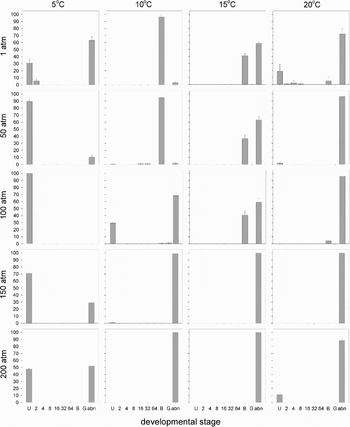
Analysis of variance (see Table 4) showed significant (P < 0.01) pressure and temperature effects on survival (swimming) rates of gastrulae, as well as interaction (P < 0.01). High pressures either did not affect survivorship of gastrula or had positive effects, depending on temperature. The only treatments where survivorship rates were lower than 80% were at 5°C and 15°C. This lower survivorship was not observed at 10°C/1 atm, whereas 100% survivorship was observed in all three replicates (Figure 4).
Psammechinus miliaris. Effects of pressure and temperature on the survival (swimming) rate of gastrulae and prisms, after 24 hours of incubation.

Combined pressure and temperature effects on prisms after 24 h of incubation
Analysis of variance (see Table 5) showed significant temperature (P < 0.01) and pressure (P < 0.05) effects on survival (swimming) rates, as well as interaction (P < 0.01). At all pressures, survivorship of prism-stage larvae was significantly lower (P < 0.05, Sheffé test) at 15°C than at 10°C. At 5°C, survivorship rates were not different from survivorship at 10°C (P > 0.05, Scheffé test), at any pressure. At 15°C, survivorship under hydrostatic pressure was at least similar to that observed under 1 atm (around 50%) (Figure 4).
DISCUSSION
Approximately 40% of embryos of Psammechinus miliaris can develop normally at least up to the blastula stage at pressures up to 100 atm, at 15°C. This pressure is not tolerated, however, at lower temperatures, with 100% of embryos showing arrested or abnormal development after 12 h. This reveals an interaction between temperature and pressure. A temperature of 5°C does not allow normal embryo development at any pressure. Overall these results indicate that the potential for embryo dispersal into the deep-sea in this species is limited. Nevertheless, at 10°C, embryos could survive and develop normally up to 50 atm. Taking into account the distribution limit of adults of around 100 m (10 atm), these results suggest that pressure and temperature tolerances in the embryonic stages should not be regarded as limiting factors for this species to invade regions deeper than the habitats the adult occupies today, although it would not survive in regions as deep as 1000 m. However, an egg fertilized within shallow water, being carried into the deep ocean, will not reach 1000 m at the developmental stage (zygote) tested in this experiment, as it rapidly progresses to later larval stages.
Once developed to a swimming stage, the larvae were able to survive in all conditions tested. The gastrulae revealed even higher survival rates in ‘deep-sea’ conditions. This demonstrates that high pressures and low temperatures may prevent zygotes from developing normally at depths greater than 500 m, but do not prevent larvae from migrating to these depths and surviving. While embryonic stages last only a few hours, larval stages can last for weeks depending on temperature. Thus larval stages are more important for dispersal than early embryonic stages, particularly for deep-sea invasion. The larval stages are the most likely to migrate vertically and survive in the deep sea, since the embryo may be retained in shallow-water during the whole embryonic period, until it is brought to an area of deep-sea water formation and is dispersed into deep-sea.
The present results suggest that: (1) depth distribution of P. miliaris cannot be explained by physiological restrictions of its dispersal stages in relation to pressure and temperature; (2) in terms of pressure and temperature tolerances, P. miliaris has the physiological potential for dispersal into the deep sea during planktonic stages; and (3) this potential varies ontogenetically, being greater during larval stages than during embryonic development. These findings corroborate past data for other species of the order Echinoida (Young et al., Reference Young, Tyler and Fenaux1997; Tyler & Young, Reference Tyler and Young1998; Tyler et al., Reference Tyler, Young and Clarke2000).
Past work includes data from the genus Echinus (Tyler & Young, Reference Tyler and Young1998), which has shallow-water and deep-sea species (Tyler et al., Reference Tyler, Young, Serafy and Emson1995). This genus is believed to have originated in shallow water, in the north-eastern Atlantic, where deep-sea water formation takes place (Tyler et al., Reference Tyler, Young, Serafy and Emson1995). Shallow-water species of Echinus have a high larval tolerance to pressure and low temperature (Tyler & Young, Reference Tyler and Young1998). Sterechinus neumayeri (Tyler et al., Reference Tyler, Young and Clarke2000) has also shown high larval tolerance to pressure and low temperature. This genus is restricted to Antarctica, where the deepest water in the world ocean is formed, and includes both deep-sea and shallow-water species (Brey & Gutt, Reference Brey and Gutt1991; Tyler et al., Reference Tyler, Young and Clarke2000). Echinus and Sterechinus may have undergone bathymetric migration and speciation from a shallow-water ancestor helped by favourable hydrographic conditions (with the formation of deep-water masses both in the north-eastern Atlantic and in Antarctica). Additionally, the extraordinary larval tolerance to high pressure and low temperature may have been fundamental to the success of these genera in colonizing deep water.
Our work shows that a high larval tolerance to pressure and temperature occurs also in larvae from P. miliaris, as found in Paracentrotus lividus (Young et al., Reference Young, Tyler and Fenaux1997). Both Psammechinus miliaris and Paracentrotus lividus inhabit areas near deep-water formation, and are very closely related to species of Sterechinus and Echinus, all belonging to the same family (Echinidae) which is believed to have speciated less than ~30 million years ago. This suggests that their larval tolerance to high pressure/low temperature may have been inherited from their common ancestor. Despite this high larval tolerance to deep-sea pressure and temperature conditions, Psammechinus and Paracentrotus do not have deep-sea representatives. Further research on later larval stages and phylogenetic investigations are necessary to understand why Psammechinus and Paracentrotus did not invade the deep-sea.
There seems to be a critical point for the development of echinid embryos between 50 atm and 100 atm. It acts as a depth limit for embryos of shallow-water species and at the same time an upper limit for deep-sea species. Paracentrotus lividus (Young et al., Reference Young, Tyler and Fenaux1997), Echinus esculentus (Tyler & Young, Reference Tyler and Young1998), and now Psammechinus miliaris, showed abnormal embryonic development at pressures higher than 100 atm. This value is fifty times greater than the maximum hydrostatic pressure found in their habitat, since their depth distribution rarely extends deeper than 200 m. At the same time, 100 atm coincides with the minimum required pressure for successful embryonic development of the sea urchin E. affinis (Young & Tyler, Reference Young and Tyler1993), but this is only slightly lower than the pressure corresponding to its minimum recorded depth (120 atm). Similar results were found in the deep-sea starfish Plutonaster bifrons, where vertical distribution corresponds to embryonic pressure tolerances (Young et al., Reference Young, Tyler and Gage1996).
Many physical and chemical factors undergo sharp vertical changes within the top 1000 m in the ocean and remain fairly constant beyond this depth. This is the case of important physiological factors such as temperature, oxygen concentration, salinity, and light availability, but is not the case of hydrostatic pressure (Menzies, Reference Menzies1965; Carney & Rowe, Reference Carney, Haedrich, Rowe and Rowe1983; Tyler, Reference Tyler1995). Hydrostatic pressure increases at the same rate at all depths. Therefore deep-sea species moving upwards will encounter few changes in the water column along the way, and will go as far as their tolerance to lower pressures will permit. On the other hand, shallow-water species migrating downwards may be limited by temperature or lack of oxygen before they can even reach the maximum pressure they are able to tolerate. This could explain the relationship between embryonic tolerance to pressure and the upper distribution limit in deep-sea species while normal embryonic development of shallow-water species can occur under pressures far beyond their lowest distribution limit.
The tolerance of larval stages to changes in pressure is still much greater than for the embryonic stages. The pressure threshold found for embryos in this paper coincides with the threshold found for dehydrogenases from shallow-water organisms across various taxa (Somero, Reference Somero, Pörtner and Playe1998). This threshold is situated between 50 atm and 100 atm. The mortality of embryos at 100 atm, observed in this study and others (e.g. Young et al., Reference Young, Tyler and Fenaux1997) may be a consequence of the denaturation of proteins under similar pressures. Our work demonstrates that whatever the mechanism preventing embryos of Psammechinus miliaris from surviving higher pressure, it does not take place during the larval stages. Ontogenetic changes were also observed in temperature tolerance. The optimum temperature for both embryos and gastrulae at 1 atm was 10°C. But as the larvae develop into the prism stage, there is no effect of low temperature (5°C). These ontogenetic changes in physiological tolerances are fundamental because they enable the larvae of P. miliaris to survive a wide range of environments, including habitats at low temperature and high hydrostatic pressure, providing the species with a high potential for invasion of deeper waters.
ACKNOWLEDGEMENTS
This work was part of a PhD funded by the Brazilian Research Council, CNPq. S.J.H. was supported by a NERC grant-in-aid funded fellowship at the MBA.