Introduction
Although cryopreservation is gaining routine application, there is no tradition in studies reporting the effect of exposure to cryoprotectants or simply hypoxia and hypothermia on gene expression in the ovarian tissue. Except for one study on the expression of GAPDH in vitrified ovarian tissue (Isachenko et al., Reference Isachenko, Lapidus, Isachenko, Krivokharchenko, Kreienberg, Woriedh, Bader and Weiss2009), there is no background regarding reference or target genes quantification, and comparisons of normoxic with hypoxic, hypothermic and toxic conditions.
Gene expression levels in tissues and cells can be measured accurately by quantitative reverse transcription PCR (qRT-PCR). Reference genes were used as internal controls, and as means to calculate the relative expression of target genes, because they are assumed to be expressed stably and are not regulated by experimental or pathological conditions. However, reference genes may vary in expression, and the use of genes that are not sufficiently stable may result in erroneous data (Hugget et al., Reference Hugget, Dheda, Bustin and Zumla2005).
Glyceraldehyde-3-phosphate dehydrogenase (GAPDH) is used traditionally as a reference gene. However, GAPDH transcription in adipose stem cells is unstable under hypoxia (Fink et al., Reference Fink, Lund, Pilgaard, Rasmussen, Duroux and Zachar2008) and in ovarian tissue submitted to vitrification (Isachenko et al., Reference Isachenko, Lapidus, Isachenko, Krivokharchenko, Kreienberg, Woriedh, Bader and Weiss2009). In contrast, hypoxanthine phosphoribosyl transferase (HPRT1) is a suitable reference gene for ischemia studies in astrocytes (Gubern et al., Reference Gubern, Hurtado, Rodriguez, Morales, Romera, Moro, Lizasoain, Serena and Mallolas2009). Finally, TATA-box binding protein (TBP) has been indicated as an appropriate reference gene for studies related to ovarian cancer (Li et al., Reference Li, Ye, Hu, Lu and Xie2009) and gonadal development (Svingen et al., Reference Svingen, Spilller, Kashimada, Harley and Koopman2009).
We aimed to determine reference genes for qRT-PCR in ovarian tissue from capuchin monkeys submitted to hypoxic, hypothermic and toxic conditions. GeNorm, BestKeeper and NormFinder software were used to determine the most stable genes.
Material and methods
Animals
Our study was approved by the local Ethical Committee in Animal Research (no. 029/2009/CEPAN/IEC/SVS/MS) and by the Brazilian Institute for Wildlife and Environment (IBAMA). Eight ovaries from healthy and sexually mature capuchin monkey females (8–12 years old, weight range: 1.9–2.8 kg) were selected for our study. The daily diet of the females consisted of fresh fruit and commercial pellet chow (FOXY Junior Supreme, 28% crude protein; Provimi, São José dos Pinhais, Paraná, Brazil). Milk, vitamins, minerals, and eggs were supplied once a week. Tap water was available ad libitum. The females were kept indoors under a natural photoperiod and housed individually in cages (80 × 90 × 80 cm) at the National Primate Center, Ananindeua, Pará, Brazil.
Ovarian tissue collection
All procedures were performed under general anaesthesia. Each animal was anesthetized with ketamine hydrochloride (10 mg/kg; intramuscularly); Vetanarcol, Köning S.A., Avellaneda, Argentina) and xylazine hydrochloride (1 mg/kg; intramuscularly; Kensol, Köning S.A.). The females were placed in dorsal recumbence and ovarian biopsies were collected by exploratory laparoscopy. For this procedure, a ventral midline skin incision was made to reach the ovaries, as described by Domingues et al. (Reference Domingues, Caldas-Bussiere, Martins and Carvalho2007). From each ovary, one fragment (control) was immediately snap frozen in liquid nitrogen and stored at –80°C until RNA extraction. Other two fragments (treated) were submitted to hypoxia and hypothermia (HH), 20 min at 20°C, in tissue culture medium alone (HH) or added by 4 M ethylene glycol (HHT).
RNA extraction and cDNA synthesis
Total RNA was extracted using Trizol reagent (Invitrogen, Carlsbad, CA, USA). RNA concentration was estimated by reading the absorbance at 260 nm and was checked for purity at 280 nm in a spectrophotometer (NanoDrop® ND-1000 and ND-8000 8-Sample, NanoDrop, Wilmington, DE, USA). For each sample, the RNA concentrations were adjusted to 45 ng/ml and used to synthesize cDNA. The reverse transcription was performed in a total volume of 20 μl composed of 10 μl of sample RNA, 2 μl RT (reverse transcriptase) buffer, 0.8 μl dNTP mix (100 mM), 2 μl RT random primers, 1 μl MultiScribe™ reverse transcriptase, 1 μl RNase inhibitor and 3.2 μl of ultrapure water (High Capacity Reverse Transcription kit, Applied Biosystems, Foster City, CA, USA). The mixture was incubated at 42°C for 1 h, subsequently at 80°C for 5 min, and finally stored at –20°C. The negative control was prepared under the same conditions, but without addition of the nucleic acid.
PCR amplification and determination of gene stability
To identify the most stable reference genes in the ovarian tissues from capuchin monkeys, quantification of mRNA for glyceraldehyde-2-phosphate dehydrogenase (GAPDH), hypoxanthine phosphoribosyltransferase 1 (HPRT1) and TATA-box binding protein (TBP) was performed with the use of SYBR Green. Each reaction was performed in a thermocycler (ABI PRISM 7500 Real-Time PCR system, Applied Biosystems). cDNA reactions for PCR amplification consist of initial denaturation and polymerase activation for 10 min at 95°C, followed by 45 cycles of 2 min at 50°C, 15 s at 95 °C, 15 s at 58°C, 45 s at 60°C (extension), 15 s at 95°C and 1 min at 60°C. The primers chosen to carry out amplification of different reference genes candidates are shown in Table 1.
Pairs of primers used in real-time PCR for quantification of reference genes in the ovarian tissue from capuchin monkeys

Data analysis and statistics
Data analysis was performed using GeNorm (Vandersompele et al., Reference Vandersompele, De Preter, Pattyn, Poppe, Van Roy, De Paepe and Speleman2002), BestKeeper (Pfaffl et al., Reference Pfaffl, Tichopad, Prgomet and Neuvians2004) and NormFinder (Andersen et al., Reference Andersen, Jensen and Orntoft2004) software packages. The GeNorm algorithm relies on the principle that the expression ratio of two ideal reference genes is identical in all samples regardless of the experimental condition. The program applies a statistical algorithm to calculate the average stability measure (M) of each candidate gene as the average pair-wise variation (V) for that gene to the control genes. The reference genes are then ranked by stepwise exclusion of the gene with the highest M. The genes with the lowest M are considered most stable. BestKeeper uses Ct values instead of relative quantities as input and employs different measure of expression stability. BestKeeper calculates a Pearson correlation coefficient for each candidate reference gene pair. All highly correlated reference genes are then combined into a normalization factor, by calculating the geometric mean. NormFinder generates a similar measure of stability – a lower value implies a higher stability in gene expression as described by Andersen et al. (Reference Andersen, Jensen and Orntoft2004). P-values less than 0.05 were considered to be significant.
Results and Discussion
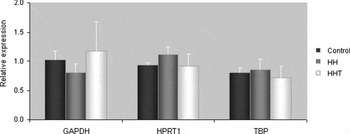
Analysis of cDNA determined gene expression stability in fresh (normoxic) and treated (hypoxic, hypothermic and toxic conditions) ovarian tissue from capuchin monkeys. Hypoxic, hypothermic and toxic conditions did not affect the expression of GAPDH, HPRT1 and TBP. However, there was a great variability in the relative expression of GAPDH (Fig. 1).
Relative expression levels were compared between control and treated (HH: hypoxia and hypothermia; HHT: hypoxia, hypothermia and toxicity of cryoprotectant) groups for each reference gene.

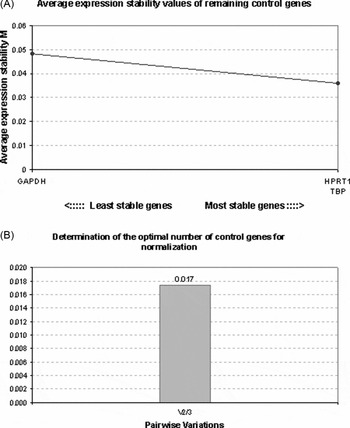
Using GeNorm, a stepwise exclusion of unstable genes and subsequent recalculation of the average M-values resulted in a ranking of the genes based on their M-values with the two most stable genes (HPRT and TBP; M < 0.04) leading the ranking (Fig. 2A). After stepwise elimination of the least stable gene (GAPDH) we recommend the use of HPRT1 and TBP. GeNorm analysis revealed that a pair-wise variation (V) value for V2/3 was of 0.017, which is far below the cut-off value of 0.15 (Fig. 2B). Therefore, inclusion of an additional reference gene is not required (Vandersompele et al., Reference Vandersompele, De Preter, Pattyn, Poppe, Van Roy, De Paepe and Speleman2002) and the use of two genes was sufficient for a stable and valid reference in qRT-PCR.
Average expression stability measure (M) of reference genes candidates (A), and pair-wise variation (V) between sequential normalization factors (B).

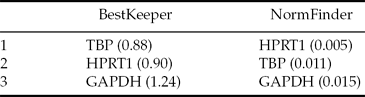
BestKeeper software calculates the standard deviation (SD) reference genes based on raw Ct values regardless of the sample's efficiency. The gene with the lowest SD is considered to be the most stable gene. Once again, we observed that HPRT1 and TBP were the most stably expressed genes, while GAPDH presented a SD higher than 1 (Table 2), which characterizes an unstable gene (Seoul et al., Reference Seoul, Choe, Zheng, Jang, Ramakrishnan, Lim and Martin2011).
Ranking order of candidate reference genes in the ovarian tissue from capuchin monkeys
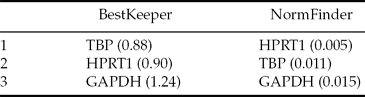
Values in parentheses represent standard deviation in BestKeeper and stability in NormFinder.
NormFinder is a model-based approach to estimate expression variation (Andersen et al., Reference Andersen, Jensen and Orntoft2004). The most obvious finding from the NormFinder analysis was the unstable expression of GAPDH across all experimental conditions, which underlines its ineffectiveness as a reference gene. The stability values are shown in Table 2. Based on NormFinder, the stability value for the best combination of HPRT1 and TBP was 0.008. Even although ranking data differed between BestKeeper and NormFinder, in both tests HPRT1 and TBP were selected as the most stable genes. Variation in ranking when using different programs has been showed before (Seoul et al., Reference Seoul, Choe, Zheng, Jang, Ramakrishnan, Lim and Martin2011). As our intention was to define the two most stable genes, a ranking using the mean of the three outcome measures was unnecessary.
Although often used as a reference gene, GAPDH's lack of stability has been described previously in ovarian preantral follicles (Frota et al., Reference Frota, Leitão, Costa, Brito, Van den Hurk and Silva2011). Under low oxygen tension, GAPDH transcription may be induced by hypoxia inducible factor-1 (HIF-1), leading to its unstable expression (Foldager et al., Reference Foldager, Munir, Ulrik-Vinther, Soballe, Bunger and Lind2009). Li et al. (Reference Li, Ye, Hu, Lu and Xie2009) also reported the inadequacy of GAPDH as a reference gene in the study of human serous ovarian cancer. In the present study, not only did the hypoxic treatment did affect the expression of GAPDH, but also did the exposure of the ovarian tissue to a vitrification solution. In fact, Isachenko et al. (Reference Isachenko, Lapidus, Isachenko, Krivokharchenko, Kreienberg, Woriedh, Bader and Weiss2009) have reported that vitrification affects the expression of GAPDH in the ovarian tissue.
We have observed that HPRT1 was expressed stably independently of the hypoxic, hypothermic and toxic conditions. Li et al. (Reference Li, Ye, Hu, Lu and Xie2009) have shown that HPRT1 is more stably expressed than GAPDH in the human ovary. In addition, Meldgaard et al. (Reference Meldgaard, Fenger, Lambertsen, Pedersen, Ladeby and Finsen2006) have found that HPRT1 is a suitable reference gene for ischemia studies, which explains its appropriateness in our study. TBP has also been described as a suitable reference gene for human ovary studies (Li et al., Reference Li, Ye, Hu, Lu and Xie2009), and for murine placenta (Lucas et al., Reference Lucas, Watkins, Cox, Marfy-Smith, Smyth and Fleming2011) and chondrocytes exposed to hypoxia (Foldager et al., Reference Foldager, Munir, Ulrik-Vinther, Soballe, Bunger and Lind2009). TBP is a basal transcription initiation factor that is conserved universally in eukaryotic species (Kopitz et al., Reference Kopitz, Soppa, Kreitschi and Hauser2009). Furthermore, both TBP and HPRT1 have a diverse array of cellular functions, which makes the occurrence of a directional alteration in expression unexpected (Lucas et al., Reference Lucas, Watkins, Cox, Marfy-Smith, Smyth and Fleming2011).
In conclusion, we recommend HPRT1 and TBP as reference genes for qRT-PCR analyses of ovarian tissue from capuchin monkeys. GAPDH should be avoided as a reference gene for ovarian tissue under hypoxic, hypothermic and toxic conditions. In the forthcoming qRT-PCR analyses of cryopreserved ovarian tissue, use of HPRT1 and TBP as reference genes constitutes the most reliable normalization strategy.
Acknowledgments
This study was supported by the project No. 483439/2009–6 from CNPq, Brazil. The authors thank CENP for the logistical support.