Doctoral students in political science are understandably concerned with job
placement. Most students enter graduate school with an eye to academia and
want to know what they must do to secure their ideal academic position.
Faculty members readily offer guidance on how to increase students'
likelihood of obtaining an academic job. And PS has published many
articles that focus on this topic, ranging from empirical descriptions of
the job market to personal accounts of job-hunting experiences.
Unfortunately, graduate students often receive anecdotal or contradictory
advice. To help rectify this, we undertook a more systematic examination of
the qualities department hiring committees seek when granting interviews to
job applicants.
Here is what we knew prior to conducting our study: the job market is
competitive. Job placement for political science Ph.D.s has hovered near 70%
in recent years, with only half of candidates finding permanent employment
(Davis 2002). Temporary positions constitute
an increasingly large proportion of all openings, with ever more newly
minted Ph.D.s accepting part-time and adjunct positions. Such a competitive
environment creates a buyers' market. Job candidates must do all they can to
meet the needs of hiring departments. Even with that information, however,
all that we know about the hiring process is that candidates with a
Ph.D. in hand do better in finding employment than ABD candidates (Davis 2002; Yin 1998;
Mann 1997). Besides this empirical evidence
the data on the hiring process are largely anecdotal.
What exactly do hiring departments look for when granting applicant
interviews? Many speculate that publications are more important than
teaching qualifications (e.g., Furlong and Furlong
1994). Some contend that publications are not a prerequisite if
recommendation letters indicate potential, and may go so far as to say that
publications are a handicap when applying to certain types of schools (e.g.,
Drezner 1998). Still others assert that the
ranking of a student's department can overcome deficiencies in all parts of
the application. Then there is the debate about whether liberal arts
colleges seek different qualities than do research universities. Such
accounts may give graduate students a general feel for what employers look
for, but they do not offer the specificity needed to help students better
allocate their limited time and attain their career goals.
In this article we shed more light on the academic hiring process that
political science Ph.D.s face. Using a brief survey instrument administered
to department chairs, we identify the relative importance that hiring
committees place on various factors when deciding to grant applicant
interviews. Although self-reports imperfectly measure which factors matter
most—especially in a process as capricious as academic hiring (Drezner 1998)—we take a first step in systematically
addressing the debates referenced above. In doing so we provide graduate
students with more hard-and-fast information regarding the hiring process so
that they may better plan their graduate pursuits.
Methods
We conducted the survey in the fall of 2003 after selecting departments
through a stratified random sampling procedure. The master list of
colleges and universities and the sub-category breakdowns came from the
US News & World Report 2003 edition of
America's Best Colleges. We randomly sampled 58% of each of
the following four types of schools (as categorized by the Carnegie
Foundation for the Advancement of Teaching): National
Universities-Doctoral, Liberal Arts Colleges-Bachelor's,
Universities-Master's, and Comprehensive Colleges-Bachelor's.1
US News lists 249 National
Universities-Doctoral. These schools offer bachelor's, master's
and doctoral degrees. There are 217 Liberal Arts
College-Bachelor's. They emphasize undergraduate education, with
the majority of their degrees awarded in liberal arts majors.
572 Universities-Master's offer a master's as the highest degree
and tend to draw students regionally. Finally, there are 324
Comprehensive Colleges-Bachelor's. They focus on undergraduate
education, but do not award a majority of their degrees in the
liberal arts. For a more complete description of the Carnegie
Foundation categories, see any edition of US News' America's
Best Colleges.
Finally, we used the APSA's
internal directory to locate the addresses of department chairpersons at
the selected schools and asked that either they complete the survey, or
designate another professor with experience on a hiring committee to do
so. Response rates are given in
Table 1.
The sampling procedure screened out many potential biases, leaving
response patterns and our use of department chairs as the major causes
for concern. Some might object that department chairs do not accurately
represent department hiring committees, but targeting these individuals
has a built-in advantage. Department chairs almost certainly have
recently served on a hiring committee, and we have no reason to think
that their responses would differ from those of other faculty.
Non-response bias is also of little concern, as we have no theoretical
reason to expect that respondents have qualities that make their answers
significantly different from non-respondents.
Although these potential sources of bias do not appear problematic, one
should bear in mind that the survey results are reported at an aggregate
level. Each member of a search committee has his or her own preferences
and biases. Readers should view the averaged responses as just that, the
relative importance that an average committee member at a particular
type of institution would place on each hiring factor. We encourage the
reader to also examine the variability of each factor as a measure of
how confident we are of that factor's position relative to others.
Finally, in the results section we aim to compare results within and
between school types. Each comparison entails certain hazards. Different
school types may have different applicant pools, which can cause
problems when comparing across school types. For example, if national
universities rank an applicant's academic record lower than
comprehensive colleges, this could mean that academic records are less
important to them. But it could also mean that everyone who applies to
national universities has an exemplary academic record, forcing hiring
committees to base their hiring decisions on other criteria. This has
implications in rankings within school types as well, as
respondents may rank a factor as less important simply because it does
not vary among the applicants they come across. One, therefore, must be
cautious in drawing inferences regarding the differences between and
within school types. That being said, the results of the survey still
afford plenty of insight.
Results
In the top portion of the survey we asked respondents to rank 10 factors
that figure into the decision to grant applicant interviews, with “1”
signifying the most important factor and “10” the least important
factor. These include departmental reputation, dissertation, fit,
teaching experience, academic record, letters of recommendation, quality
of application, publications, conference presentations, and
honors/awards. Most of these categories are self-explanatory. Fit is
perhaps the most vague. While conducting a pilot survey we asked our
respondents how they interpreted the “fit” factor. Respondents took this
to mean the fit between an applicant's area of research and the
department's specific sub-field needs.
We graphically display the results of the top portion of the survey
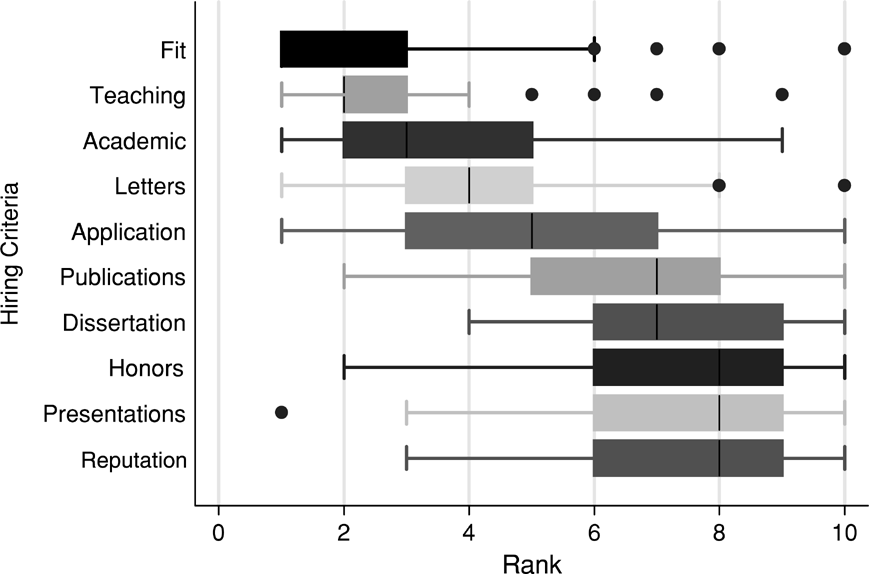
through box plots of the 10 items. Figure 1
shows results for all respondents, regardless of school type. The more
importance respondents place on a factor, the closer to zero the
resulting box. Thus we see that leaving aside the school types of our
respondents, department chairs, on average, value the fit between an
applicant and a hiring department, an applicant's teaching experience,
and faculty letters of recommendation much more than an applicant's
dissertation, conference presentations, or honors and awards won.
Next, we disaggregate the responses by school type. To do this we use
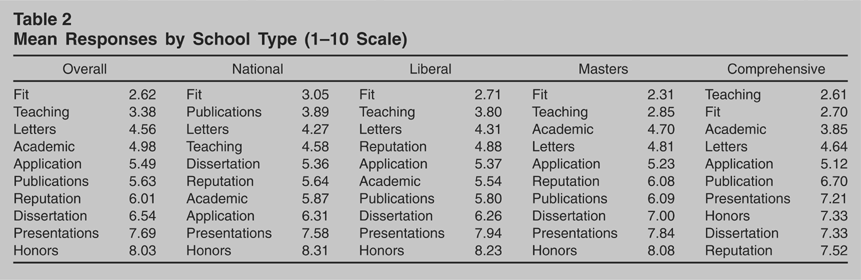
three different statistical illustrations. Table
2 lists the means of each factor by school type (again, a
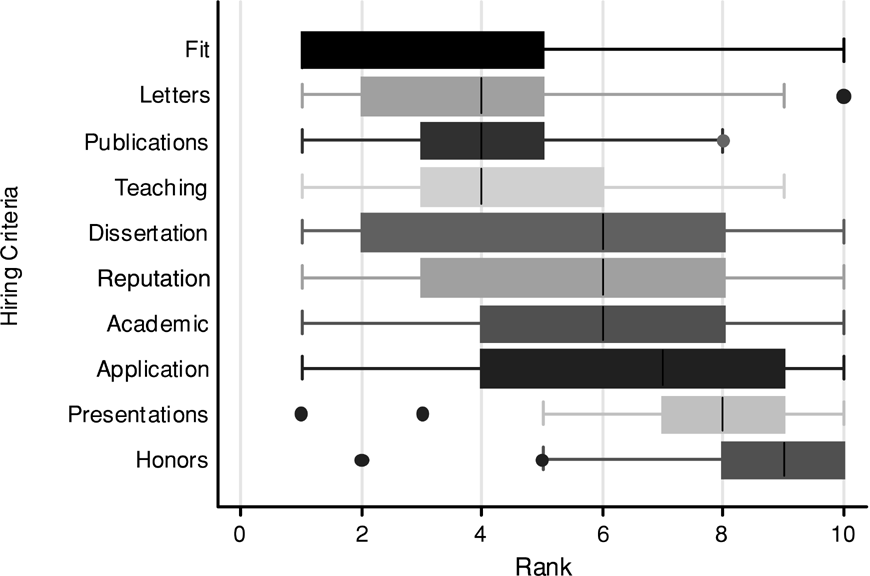
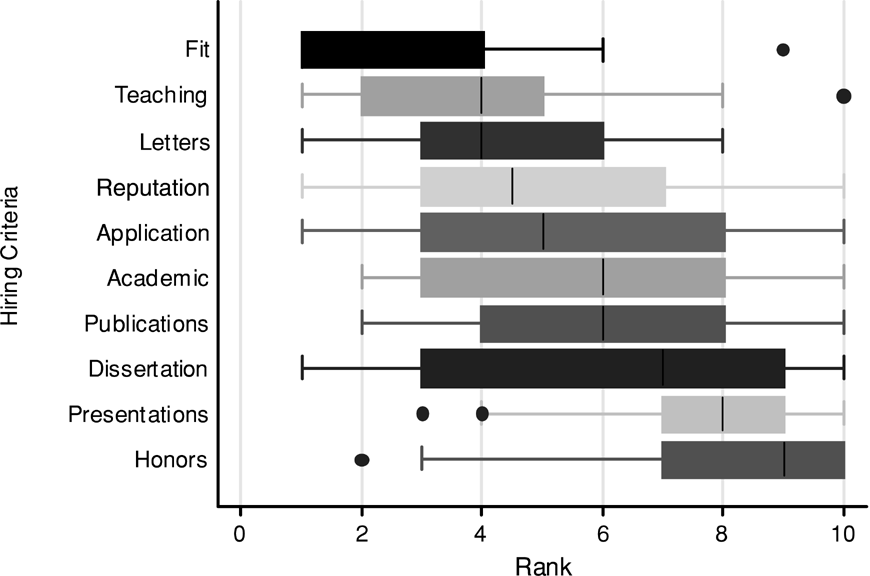
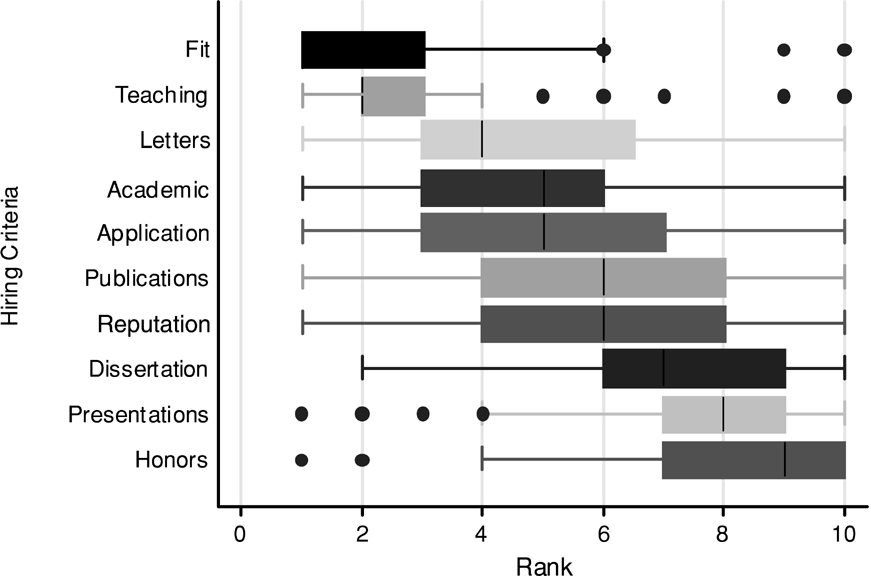
lower mean implies greater importance). In Figures 2, 3, 4,
and 5 we present a series of box plots by
school type. Unlike Table 2, these figures
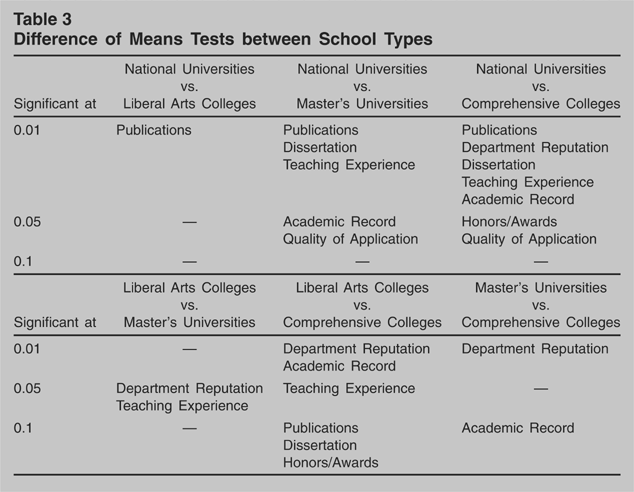
order criteria by their medians. Finally, Table
3 lists those school-type pairings and factors that yielded
statistically significant t-tests for differences of means, along with
the relevant p-value.
Mean Responses by School Type (1–10 Scale)
National Universities—Criteria Ranking
Liberal Arts—Criteria Ranking
Comprehensive Colleges—Criteria Ranking
Difference of Means Tests between School Types
In the interest of space we will highlight some particularly noteworthy
findings from the top portion of the survey and leave it to the reader
to examine the figures and tables. The results show that national
universities indeed put more emphasis on publications and the
dissertation than any other school type. Conversely, all other school
types put more emphasis on teaching experience than do national
universities.2
Although this is
marginally insignificant (p < .15) when compared to liberal
arts colleges.
Respondents from liberal arts colleges
distinguish themselves in that they place more importance on the
reputation of an applicant's department. They also rank teaching
experience substantially higher than publications.
3 Their inter-quartile ranges barely overlap in Figure 3.
Finally, the box
plots reveal that the inter-quartile ranges of factors rarely overlap
for master's universities and comprehensive colleges. This implies a
clearer ordering of hiring priorities for these institutional types.
In the latter portion of our survey we asked respondents to rate 30
smaller factors on a one to five scale (more to less important). These
30 factors are subsets of the more inclusive factors from the first part
of the survey. For example, we disaggregated the “letters of
recommendation” according to whether or not the letter came from an
applicant's advisor or another faculty member. We can use this section
to look at several, more specific relationships. But with 30 factors and
four school types, there are too many possible relationships to test or
report. Instead we focus on a few interesting results.
One section asks respondents to rate the importance of the reputation of
the applicant's department overall, as well as that department's
reputation in the applicant's sub-field. No matter the school type, the
two categories do not significantly differ in importance. However,
respondents from national universities appear to value sub-field
reputation more highly, just not significantly so, while respondents
from the other three school types appear to value overall department
reputation more highly.
Another section inquires about the quality of the dissertation and the
importance of a candidate having finished it. Again, no matter the
school type, respondents rank a finished dissertation ahead of a good
one (p < .00001). This confirms earlier findings that a finished
dissertation helps in securing an interview and, subsequently, a
job.
We also asked respondents about the importance of letters of
recommendation from an applicant's advisor, and those from other
recommenders. At all school types except for comprehensive colleges, the
dissertation advisor's letter holds more weight. At comprehensive
colleges the two letter types do not significantly differ in
importance.
The bottom portion of the survey contained four items related to
publications: the number of published/accepted articles, the number of
articles under review, the reputation of the publishing journal, and the
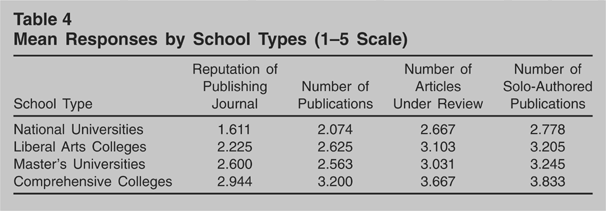
number of publications the applicant solo-authored. Results are given in
Table 4. Recall that the scale goes from 1
(more important) to 5 (less important).
Mean Responses by School Types (1–5 Scale)
We once again see that publications on the whole are more important to
national universities, less so to liberal arts colleges and master's
universities, and still less so to comprehensive colleges. But we also
find that a somewhat clear general ordering of the four factors exists
within school types. The reputation of the journals that publish an
applicant's work holds more weight than even the number of articles an
applicant has had published. And both of these factors play a larger
role than the number of articles under review or the number of articles
an applicant has solo-authored.
Finally, the results from the bottom portion of the survey enable us to
re-examine the debate between research and teaching. We look at this in
two ways. First we compare the responses on our leading publications
indicator, reputation of publishing journals, and our leading teaching
indicator, amount of teaching experience. Here we find significant
differences for all school types, with national universities weighting
research more heavily, and the other three school types weighting
teaching more heavily. A similar pattern obtains when we do a difference
of means test for an applicant's statement of teaching interests versus
his or her statement of research interests. National universities
privilege the research statement, while the other school types privilege
the teaching statement.
Summary and Conclusions
First and foremost, the survey results establish “fit” as the most
important factor across school types. Whether a job candidate works in
the sub-field of the available position is of greater importance than
anything else. Since hiring departments often establish their area of
need and then look to fill it—instead of identifying the “best”
candidate and filling a generic position—even the strongest candidates
may have difficulty securing employment if the market is tight on
positions matching their credentials. This is intuitive but important. A
graduate student mulling over potential courses of study should at least
consider the future need for certain specialties. Although this is an
admittedly speculative undertaking, and many agree that a doctoral
student ought to study what he or she is interested in, all else
being equal, students should pursue research in areas in which they
anticipate departments will hire.
The results of this survey also inform the debate regarding the relative
importance of research and teaching. Overall, it appears that schools
that hire political scientists on average weight teaching experience
ahead of publications—and far ahead of conference presentations and
quality of dissertation. Again, we cannot deduce from these rankings the
amount of research or teaching experience that respondents have in mind;
but we can say that teaching experience is important no matter where one
wishes to work. However, national universities provide one wrinkle in
the research/teaching debate: on average national universities place
publications ahead of teaching experience and rank them significantly
higher than do other school types. And the totality of the survey
results clearly shows that publications matter much more in securing
employment at a national university than at other schools. The moral of
the story is that doctoral students need teaching experience no
matter what academic job they desire. On the other hand,
publications appear necessary in securing a job at a national
university, but their value decreases significantly when dealing
with the remainder of schools (which represent the majority of
existing schools).
Like “fit” and teaching experience, letters of recommendation prove quite
important across school types. Letters place as a top-three factor for
liberal arts and national universities and as a top-four factor for the
other two institutional types. No matter where students wish to
obtain employment, it is important for them to secure strong
recommendation letters—especially from their dissertation
advisor. Again, this may seem intuitive, but the importance of
letters of recommendation really stands out in this study. Letters
outrank everything but fit and publications at national universities,
and outrank everything but fit and teaching experience at liberal arts
colleges.
The significance of the results regarding the quality of a candidate's
dissertation, academic record, and department reputation is less clear.
The data indicate that the dissertation becomes less important as
research overall becomes less important. Moreover, it appears that
national universities prioritize publications ahead of a candidate's
dissertation (although it is worth noting that a quality dissertation
may lead to future publications). What we do know is that on average
the candidate with a completed dissertation has an advantage
over a candidate who has not yet completed one—apparently regardless
of the quality of the research.
As for the reputation of the department from which the candidate comes,
the results for the most part are not statistically significant.
Department reputation appears to matter most for liberal arts schools
and very little for master's and comprehensive colleges. Moreover, it
appears that national universities value department reputation in an
applicant's sub-field more than the overall reputation of an applicant's
department. Conversely, the other three school types seem to favor a
department's overall reputation. Although these results are merely
suggestive, it makes intuitive sense that schools predisposed toward
research would use sub-field reputation as a signal of candidate
quality, whereas schools predisposed toward teaching would worry about
the overall quality of students a department tends to attract,
regardless of their specific research training. These results, coupled
with the fact that liberal arts schools seem to weight department
reputation more heavily, seem to imply that students aiming for top
liberal arts schools get the most mileage from overall department
reputation.
Academic record is of moderate importance, although at master's
universities and comprehensive colleges it becomes more important. As
mentioned before, however, this may have a lot to do with what varies
among the applicant pool for each type of school. If comprehensive
colleges do not have an applicant pool that varies according to
publications, quality of dissertation, and department reputation,
perhaps they only have academic record as a means of distinguishing
between candidates.
Finally, conference presentations and honors and awards place at or near
the bottom for each school type. This indicates that students
considering a tradeoff between teaching experience and conference
presentations should go with more teaching experience. In that same
vein, if a student seeks a job at a top national university and has to
decide between having frequently presented at conferences or having one
or two publications, he or she should focus on publications. In this
study honors, awards, and conference presentations come off as an
expendable part of the CV. This may be misleading, however, since
conference presentations can lead to publications and intangibles such
as networking. And, for example, good teaching may yield honors and
awards. All we are saying is that conference presentations and
honors should not be sought for their own sake, but as a byproduct
along the path to obtaining teaching experience, recommendation
letters, and publications.
Seeing as the difference between research universities and liberal arts
colleges has been a topic of debate, it is worth reiterating some of our
findings on the subject. The survey results indicate that in terms of
our original 10 hiring criteria, “publications” yields the only
statistically significant difference between the two school types.
Consistent with that, other research-related criteria, such as
dissertation and publication quality (including relative number of
publications and reputability of publishing journal) are of greatest
value to national universities, and decline in import as one moves from
liberal arts, to master's, and finally to comprehensive colleges.
Moreover, national universities privilege the statement of research
interests over the statement of teaching interests, while the other
school types privilege the teaching statement. Unfortunately, the survey
instrument precludes our distinguishing between different schools within
the Carnegie classification scheme. It is conceivable, and probable,
that some liberal arts schools hold greater research demands than some
national universities. In fact, the “top 20” may have vastly different
preferences than the remainder of national universities. All we can say
is that on average, it appears that research matters more to national
universities, and that teaching is not notably more important at liberal
arts colleges.
This study sheds more light on the hiring process by providing
information on the relative importance of some different factors in
obtaining an interview. The importance of fit affirms that market demand
is the greatest force working against certain job candidates,
irrespective of their quality. The value of publications varies
depending on the type of school, while the importance of teaching
experience and letters of recommendation is constant and strong across
school types. Finally, it appears that some factors are not worth
focusing on, although they may be a means or byproduct of meeting some
of the more important hiring criteria. This study for the most part does
not allow us to look into the absolute differences between certain
factors within and between school types, such as the number of
publications and years of teaching experience the respondents had in
mind—but it should provide graduate students in political science with a
clearer idea of the tradeoffs they should make, depending on their
career aspirations.
Author Bios
Daniel Fuerstman is a graduate student at the University of Wisconsin,
Madison.
Stephan Lavertu is a graduate student at the University of Wisconsin,
Madison.