


1 Introduction
McCarthy (Reference McCarthy, Borowsky, Kawahara, Shinya and Sugahara2012) proposes a combination of Harmonic Serialism (henceforth HS; Prince & Smolensky Reference Prince and Smolensky1993, McCarthy Reference McCarthy2000 and other work) and the theory of Optimal Interleaving of Wolf (Reference Wolf2008) (henceforth OI) to account for different phonological and morphological phenomena found before a pause in Arabic. He calls this combined theory HS/OI. HS is a derivational model of Optimality Theory in which Gen can perform only one change at a time. The output of each pass through Gen and Eval becomes the input to a next pass through Gen and Eval, and so on until no further harmonic improvement is possible, in which case convergence has been reached. At each pass the ranking of the constraints is the same. OI is a theory of the phonology–morphology interface based on Optimality Theory with Candidate Chains (McCarthy Reference McCarthy2007), adapted to HS in McCarthy (Reference McCarthy, Borowsky, Kawahara, Shinya and Sugahara2012). The key aspect of this theory is the idea that the input to the phonology contains only abstract morphemes (abstract roots, bundles of morphosyntactic features, etc.), represented in this paper in small capitals, e.g. dog, pl. The selection of morphs or spell-out (‘Vocabulary Insertion’ in Distributed Morphology terms; Halle & Marantz Reference Halle, Marantz, Hale and Keyser1993) is a Gen operation, on a par with phonological operations like deletion, epenthesis and phonological feature changes; in the previous examples the morphs /dɔg/ dog and /z/ pL will be inserted. The new phonological information does not replace the morphosyntactic information, but is added to it. Spell-out is controlled by the constraint hierarchy, which contains faithfulness constraints like Max-M[F] in (1) (Wolf Reference Wolf2008: 26). Max-M[F] penalises morphemes that lack a corresponding morph. F can refer to roots (Max-M[rt]) or affixes (for instance, Max-M[pl]).
-
(1)


Spell-out constraints are interleaved with phonological constraints; this interleaving allows phonological and morphological operations to interact. Once a morph is introduced, forced by Max-M[F], it can undergo phonological changes at later steps, due to the pressure of phonological constraints.
The HS/OI model can be illustrated with an example from McCarthy (Reference McCarthy, Borowsky, Kawahara, Shinya and Sugahara2012) that is relevant for the cases to be discussed in this paper. The requirement that in Classical Arabic there must be a heavy syllable at the end of an utterance (before a pause) is satisfied in different ways, including epenthesis, metathesis, choice of a specific allomorph, etc. Indefinite nouns often surface with a suffix -n, a phenomenon called ‘nunation’, which is illustrated in (2a). However, in the nominative and the genitive, before a pause (marked with subscript ‘Pau’) only the stem is found, as shown in (2b). Contextual, non-final forms are marked with subscript ‘Cont’.
-
(2)

The realisation of the stem alone in these cases is a puzzle, because the form with nunation in (2a) ends in a heavy syllable, and one would not expect a change to be necessary in order to satisfy the weight requirement. However, these apparently puzzling facts follow naturally from the HS/OI perspective. The input to the phonology is book-nom-indef]Utt. The two tableaux in (3) show the two steps needed to reach the output [kita:b]Pau ((3b) corresponds to McCarthy Reference McCarthy, Borowsky, Kawahara, Shinya and Sugahara2012: 359 (24)). The constraint HeavyInPause penalises monomoraic syllables in utterance-final position. The other relevant constraints, Max-M[rt] and a more general Max-M, are ranked in such a way to ensure spell-out of the most embedded constituent, the root, before less embedded ones. Since HS allows only one change at a time, and spelling out a morpheme constitutes one change, the winner of step 1 contains a realised root and two abstract morphemes, as shown in (3a). At step 2, in (3b), the candidate with realised case, [kitaːb-u-indef]Utt, violates the phonological constraint HeavyInPause, and is ruled out in favour of the candidate with only a realised root, identical to the input. For this reason convergence is reached at step 2, and it is therefore impossible to generate the candidate [kitaːb-u-n]Utt. Throughout this paper, as in McCarthy (Reference McCarthy, Borowsky, Kawahara, Shinya and Sugahara2012), it is assumed that when morphs are inserted the morphosyntactic features remain, but, in order to simplify the representations, they are not shown. A candidate like (3b.ii), for instance, should be interpreted as [kitaːbroot -unom-indef]Utt.
-
(3)
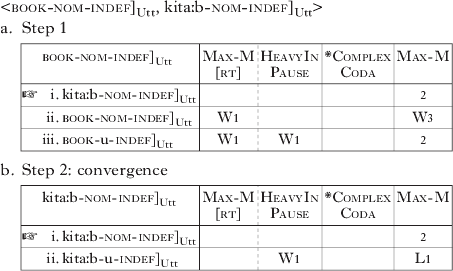
Following Wolf (Reference Wolf2008), McCarthy assumes that spell-out proceeds strictly inside out. For this reason, step 2 excludes the candidate [kitaːb-nom-n]Utt, with the outermost suffix spelled out instead of the inner suffix.Footnote 1 However, it could also be assumed that Gen has no such restriction and that candidates like [kitaːb-nom-n]Utt can in fact be generated. This candidate would not be the winner at step 2, because it would violate *ComplexCoda, a constraint that McCarthy (Reference McCarthy, Borowsky, Kawahara, Shinya and Sugahara2012) includes in the ranking for other cases. In §2 it will be shown that this second option must be adopted, at least for the data from Catalan presented in this paper; Gen cannot control which morpheme should be spelled out at each step.
In this paper I examine two phenomena from Catalan that involve the plural morph s in nominals, in one case within the word and in the other case within the DP. The first one, analysed in §2, is the selection of a marked masculine allomorph to avoid contact between sibilants when the stem ends in a sibilant and the plural morph, also a sibilant, is inserted. After summarising Bonet et al.'s (Reference Bonet, Lloret and Mascaró2007) parallel OT analysis of this phenomenon, I show that an account within HS/OI implies forcing the plural morpheme to be spelled out before the gender morpheme, through the relevant ranking of specific Max-M constraints; the outermost suffix must be realised before the inner suffix. The second phenomenon, discussed in §3, is found in one dialect of Catalan and involves the non-realisation of the plural morpheme in prenominal position under specific syntactic and phonological conditions. The parallel OT analysis of the phenomenon in Bonet et al. (to appear) can be adapted, with a few changes, to HS/OI. §4 is devoted to the implications for the parallel and the HS/OI analyses of the two phenomena co-occurring within the same phrase. It is shown that HS/OI cannot account for the data, even if different constraint rankings are assumed for word-internal and phrasal phonology. The parallel analysis does not face such problems. In §5, I argue against alternative analyses of the phenomena presented in §2 and §3. Finally, §6 contains some conclusions and further remarks.
2 Masculine allomorph selection and plurals in Catalan
Catalan masculine nominals have a gender-related morpheme, with the allomorphs Ø and -o (pronounced [u] in most dialects).Footnote 2 Most nominals choose the zero allomorph Ø; many fewer select -o. Some examples of each type appear in (4). The same allomorph appears when the nominal is plural. As mentioned above, the plural morph is -s.
-
(4)
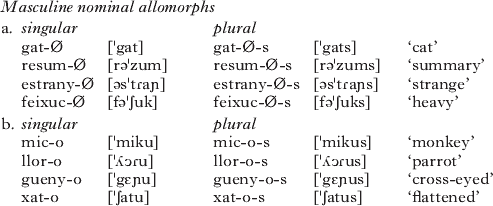
However, when a nominal with allomorph Ø has a stem ending in a sibilant (/s z ʃ ʒ ʧ ʤ/), the masculine allomorph -o is chosen in the plural. This change of allomorph prevents adjacency between two sibilants, one from the stem and one from the plural suffix s. Some examples of this phonologically conditioned allomorphy appear in (5). The Ø that appears in the singular forms corresponds to the masculine allomorph. The singular morph is also Ø, but is omitted for clarity. Voiceless [s] is spelled as ss between vowels; ix corresponds to [ʃ], and tx to [ʧ].
-
(5)
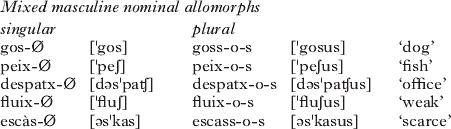
The argument against HS/OI to be developed in §4 depends crucially on the interpretation of the mixed masculine nominals assumed here. §5 includes a discussion of the bases for this interpretation and the inadequacy of alternative interpretations.
Bonet et al. (Reference Bonet, Lloret and Mascaró2007) propose an analysis of mixed masculine nominals within a parallel model of OT, in which the input contains underlying phonological representations. Following Mascaró (Reference Mascaró2007), they propose that the input of all masculine nominals contains both allomorphs, in an ordering relation. The lexical entry of the masculine morpheme is given in (6); ‘>’ is to be interpreted as ‘is preferred to’ or ‘is less marked than’.
-
(6)
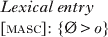
A universal constraint, Priority, in (7) (Mascaró Reference Mascaró2007: 726), penalises the choice of the less preferred allomorph -o. The selection of Ø does not violate this constraint, because Ø is the dominant allomorph; the -o morph incurs one violation, because it is the less preferred allomorph.
-
(7)

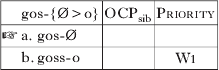
The tableaux in (8) and (9) show how different allomorphs of the masculine are chosen in the singular and plural respectively, when the stem, here gos ‘dog’, ends in a sibilant (see Bonet et al. Reference Bonet, Lloret and Mascaró2007 for a detailed analysis). The input contains the root plus the allomorphs of the masculine, with their ordering relation. The constraint OCPsib penalises sequences of sibilants. In (8), the singular form, Priority determines the choice of the unmarked, dominant allomorph Ø, because there is no phonological conflict.
-
(8)
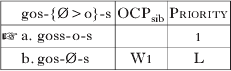
In (9), the addition of the plural suffix -s causes a violation of OCPsib if the unmarked masculine allomorph Ø is chosen; the ranking OCPsib≫Priority forces the selection of the marked allomorph -o.Footnote 3
-
(9)
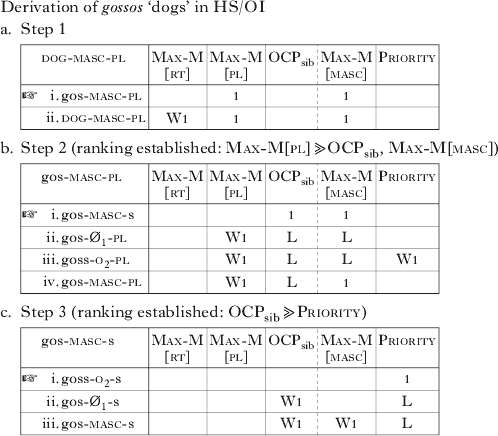
Let us now see how these facts can be handled in HS/OI. In OI the input contains only morphosyntactic features, and in HS Gen can perform only one operation at a time. An output like goss-o-s cannot be obtained if we assume, with McCarthy (Reference McCarthy, Borowsky, Kawahara, Shinya and Sugahara2012), that spell-out necessarily takes place inside out (see the discussion around (3)).Footnote 4 The input at step 2 would be gos -masc-pl and we would expect [masc] to be spelled out before [pl]. But at that stage nothing would prevent the insertion of the dominant allomorph Ø: the allomorph -o would violate Priority, and OCPsib would be vacuously satisfied in both cases; the output goss-o -pl would be harmonically bounded by goss -Ø-pl, and we would expect the same allomorph Ø that we find in the singular gos. What triggers the insertion of the masculine allomorph -o is the morph -s corresponding to [pl]; it is a case of outward-looking allomorphy. This means that the assumption that spell-out proceeds strictly inside outward must be abandoned in favour of a weaker model, in which it is the ranking of specific Faith-M constraints that determines the order of spell-out, not a restriction on Gen (see Wolf Reference Wolf2008: ch. 3 for discussion along the same lines). We need a constraint Max-M[pl], ranked above Max-M[masc]. The derivation of goss-o-s must be <dog-masc-pl, gos-masc-pl, gos-masc-s, goss-o-s>.Footnote 5
The tableaux in (10) show the HS/OI derivation of goss-o-s, with the crucial ranking Max-M[pl]≫Max-M[masc). At step 1, gos -masc-pl is the winner, due to the high ranking of Max-M[rt]. The relevant steps are step 2 (10b), and step 3 (10c). At step 2, Gen creates candidates with either [masc] or [pl] spelled out, but not both. Since [masc] has two allomorphs, either of them can be inserted. Subscripts have been added to each allomorph to indicate their lexical preference relation: Ø1 is the dominant, preferred allomorph, and -o 2 the less preferred one; the latter, but not the former, violates Priority. The sequence gos -masc- s, which is the only candidate that violates OCPsib, is selected as the optimal output, because of the high ranking of Max-M[pl]. At step 3, a violation of OCPsib is avoided only by the candidate with the marked morph -o, the winner. At step 4, not shown in (10), convergence is reached, since no further harmonic improvement is possible.
-
(10)
In this section it has been shown that masculine allomorphy before plurals in Catalan is a case of outward-looking allomorphy, at least under common views of the syntactic relation between gender and number (see Footnote note 4). This requires a weakening of the claim that spell-out operates strictly inside out. The phenomenon can be accounted for within HS/OI if constraints of the Max-M[F] family can be ranked freely. In this case, the necessary ranking is Max-M[pl]≫Max-M[masc], with the phonological constraint OCPsib being ranked below Max-M[pl]. An analysis in terms of parallel OT also does not present any problems.
3 Plural non-realisation in NEC Catalan
3.1 The phenomenon
Catalan, like most Romance languages, has gender and number concord within the DP triggered by the noun, as illustrated in (11), where the noun is feminine plural and all the modifiers (determiners, adjectives) are feminine plural, whether prenominal or postnominal.Footnote 6
-
(11)

In North-Eastern Central (NEC) Catalan, however, the plural morph -s fails to surface in prenominal position when it would appear between two consonants. The two necessary conditions for the non-realisation of the plural morph -s appear in (12).
-
(12)

Some examples of this phenomenon appear in (13), where the absence of the expected plural morph (which is present in other dialects of Catalan) is indicated with an underscore. The examples are taken from Bonet et al. (to appear) (see also Wolf Reference Wolf2008 and Nevins Reference Nevins2011 for examples and discussion of this phenomenon).
-
(13)
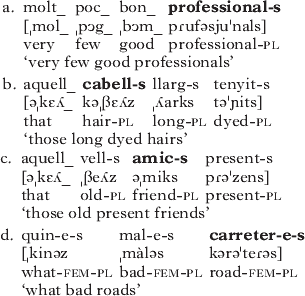
In (13a) the three modifiers appear in prenominal position (condition (12a)), and all of them start and end in a consonant (condition (12b)); for these reasons they do not surface as molts, pocs and bons. In (13b), as expected, the prenominal demonstrative aquells surfaces without the plural morph (the two conditions in (12) are met), but the noun and the two postnominal adjectives do surface with the plural morph, in spite of the fact that the -s appears between two consonants in each case; condition (12a) is not met. In (13c), the demonstrative aquells surfaces without a plural morph because of the presence of two surrounding consonants, but the prenominal adjective vells does surface with the plural morph -s, because the following noun, amics, starts with a vowel; hence condition (12b) is not met. Finally, in (13d), the plural morph surfaces in all prenominal modifiers and the noun, because it is always preceded by a vowel (the feminine morph -e, pronounced [ə]); again, condition (12b) is not met.
3.2 The failure of concord in NEC Catalan
In §3.1 it was assumed that the missing -s in NEC Catalan is a case of the non-realisation of a morpheme, rather than the result of phonological deletion. This section is devoted to showing that this is indeed the correct interpretation (see McCarthy Reference McCarthy, Borowsky, Kawahara, Shinya and Sugahara2012 for some similar arguments for Classical Arabic). A deletion analysis faces problems related both to the target of the deletion and to the domain of the deletion.
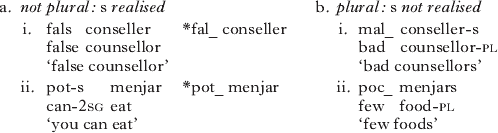
This phenomenon does not have the properties of conventional phonological deletion, because it does not affect other coronal sibilants of the language in the same phonological context (C̲C), as the examples in (14a) show. In (14a.i), the DP-internal modifier ends in s, but it is not deleted, in spite of the fact that it is prenominal and appears between two consonants, because the s is not the plural morph, but rather belongs to the stem of the adjective fals. This example constitutes an almost minimal pair with (14b.i), where the plural -s of the prenominal adjective is not realised; this adjective is realised as mals before a vowel in NEC Catalan (e.g. mal-s amic-s ‘bad friends’). In (14a.ii), an s that is the exponent of a morpheme is realised between two consonants, yet this morpheme is not the plural found in nominals, but instead the 2nd person singular morpheme found in verbs, in this case pots; this example also shows that the phenomenon is restricted to DPs. Again, the example in (14b.ii) constitutes an almost minimal pair with (14a.ii); in (b.ii) the absent s is the exponent of the plural morpheme of a prenominal modifier, and it is not realised because it appears between two consonants; before a vowel or in any context in other dialects of Catalan, this modifier would be realised as pocs (cf. poc-s amic-s ‘few friends’).
-
(14)
The domain in which the absence of the plural morph is found cannot be characterised in prosodic terms either. In order to capture the prenominal–postnominal asymmetry, a single prosodic phrase would have to be postulated containing all prenominal elements plus the noun; each postnominal modifier would have to constitute an independent prosodic phrase: deletion would affect plural s between two consonants within a prosodic constituent. The required prosodic constituency is shown schematically in (15). ‘Mod’ stands for any type of determiner or adjective; prosodic boundaries are indicated by { }.
-
(15)

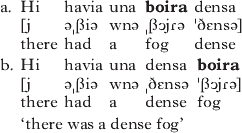
The prosodic structure in (15) cannot be justified on prosodic grounds. According to Prieto (Reference Prieto2002a, Reference Prietob), intermediate prosodic phrases in Catalan are characterised by an abrupt intonational rise on the last syllable, optionally preceded by lowering on the same syllable and optionally followed by a pause; length is not distinctive. Two or more prosodic phrases are found in sentences with long subjects, adjuncts, coordinated structures, most subordinated structures or peripheral elements. No description of Catalan intonation can be found that makes a distinction between the intonation of noun–adjective sequences and that of adjective–noun sequences (Pilar Prieto, personal communication), although, given the facts from NEC Catalan, one would expect a noun to belong to a different phrase than a following adjective, while an adjective should belong to the same prosodic phrase as a following noun. But there are no differences in the intonational contour of sentences like those in (16). In (16a) the adjective follows the noun, while in (16b) the adjective precedes it. In both examples, syllables with secondary stress have high pitch, while syllables with primary stress have low pitch.Footnote 7
-
(16)
Bonet et al. (to appear) also show that there is non-realisation whenever the two conditions in (12) are met, regardless of the weight of the prenominal sequence.
An additional reason in favour of the non-realisation interpretation is that other languages have agreement asymmetries within the DP, most often without any obvious phonological context participating in them. In Moroccan Arabic demonstratives agree in gender and number with the noun when postnominal, but are bare stems when prenominal (Shlonsky Reference Shlonsky2004); Central Ladin feminine plural nouns trigger gender and number agreement postnominally, but only gender agreement prenominally (Rasom Reference Rasom2008); Asturian has mass agreement postnominally but gender agreement prenominally (Fernández-Ordóñez Reference Fernández-Ordóñez, Cobos and Ocal2007, Bonet & Mascaró Reference Bonet, Mascaró, Fábregas, Felíu, Martín and Pazó2012). Other examples can be found in Abkhaz (Hewitt Reference Hewitt1979) and Spanish (Eddington & Hualde Reference Eddington and Hualde2008), for instance.
Finally, and more generally, claiming that we are dealing with a case of phonological deletion would imply modifying some standard, well-established assumptions about how phonology works. Since deletion would occur at the phrasal level, we would be dealing with a postlexical phenomenon. But, crucially, the process would have to mention the morphosyntactic status of the target, namely the fact that it is the plural morph.
Thus there are enough reasons to conclude that the absence of the plural -s is the result of lack of agreement (lack of concord), rather than phonological deletion.
3.3 Analysis in parallel OT and HS/OI
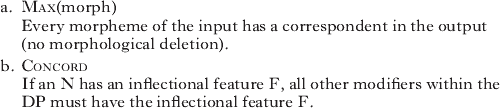
The parallel OT analysis of plural non-realisation in NEC Catalan to be presented here is the same as that proposed in Bonet et al. (to appear), albeit somewhat simplified. In this proposal, the syntax is responsible for postnominal agreement only (possibly through a Spec-Head configuration). Postsyntactically, morphosyntactic faithfulness and markedness constraints that are interspersed with phonological constraints determine the final agreement patterns.Footnote 8 The faithfulness constraint Max(morph) in (17a) prevents the deletion of agreement features assigned by the syntax, present on the noun and postnominal modifiers; the markedness constraint Concord in (17b) penalises lack of concord with the noun for any modifier (determiner, quantifier, adjective) present in the DP, either prenominal or postnominal. Max(morph) and Concord can be relativised to different agreement features (gender, number), the relevant features in NEC Catalan being those corresponding to number.
-
(17)
The tableau in (18) illustrates how final concord is obtained for an example like (13c) above. The input contains the plural feature of the noun amic and that of the postnominal adjective present already realised; postnominal agreement has taken place syntactically, and the corresponding morphs have been inserted. *CsC is the phonological constraint that penalises an interconsonantal s.Footnote 9
-
(18)

Candidate (18c) is the only candidate that satisfies the phonological constraint *CsC fully, but it is ruled out by the higher-ranked constraint Max(num), because the noun has not preserved the feature [pl] that was present syntactically. Candidate (18b) satisfies Concord(num), which requires full concord, but it does not win, because it violates *CsC more than the winner. For candidate (18a), the winner, the ranking Max(num)≫*CsC ensures that the plural morph is realised on the noun and in postnominal position, regardless of the phonological context; the ranking *CsC≫Concord(num) triggers prenominal concord as long as a vowel appears before or after the plural morph, as is the case in the partial sequence vell-s amic-s. In sequences like fals conseller in (14a.i), the root-final s of the adjective already appears in the input, and Max(segment), ranked above *CsC, prevents its deletion.
Let us now see how this phenomenon can be accounted for within HS/OI. We can assume, as in the previous analysis, that syntactically we find only postnominal agreement. On this assumption, the input of (13c) will be as shown in (19), with abstract roots and the features [pl] and [masc] only on the noun and the postnominal adjective.
-
(19)

We assume with McCarthy (Reference McCarthy, Borowsky, Kawahara, Shinya and Sugahara2012: §7) that in the first steps of the derivation the spell-out of morphemes and word-internal changes take place in parallel for each word; the domain for serial and gradual derivation is the X0. At the phrasal level the domain has expanded, and it is natural to assume that any change that takes place at any locus within the DP will then count as one change. In what follows, the relevant domains, the word or the DP, appear between square brackets. On these assumptions, at step 1 of the derivation the root of each word is inserted in parallel, due to the high ranking of Max-M[pl]. The input to step 2 is therefore as shown in (20).
-
(20)

Given the ranking of the spell-out constraints Max-M[pl]≫Max-M[masc], argued for in §2, the input to step 3 (output of step 2) is presumably as in (21a), with plural morphs on the noun and the postnominal adjective derived in parallel. The input to step 4 (output of step 3) is as in (21b), with the phonologically realised masculine morph (the dominant allomorph Ø, which satisfies Priority). Prenominal modifiers remain unmodified, because at the word level there is no relevant operation that could apply to them, given that agreement is a phrasal operation, and the derivation has to proceed bottom up.
-
(21)

The output of step 4 is identical to its input for the purposes of this paper (irrelevant phonological modifications are ignored here). In the phrasal domain, the Concord constraints have to force gender and number features to spread to prenominal elements, and these features must be phonologically realised, enforced by the effect of Max-M constraints. Ignoring here whether Concord targets one modifier at a time and whether number and gender spread independently of each other, the input to the relevant step for the issues at hand, step 5, will be as in (22). The features [masc] and [pl] are now present on the prenominal modifiers. The intermediate square brackets of (21) do not appear in (22), in order to make clear that the relevant domain at this stage is the whole DP, the phrasal domain.
-
(22)

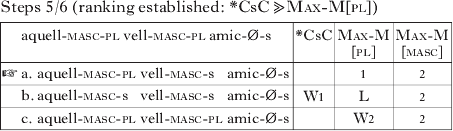
At this point the relevant constraints are those that realise the gender and number features (Max-M[pl] and Max-M[masc]) and the phonological constraint *CsC. The ranking of *CsC above Max-M[pl] ensures that the plural morph is realised only when there is no phonological conflict, as the tableau in (23) illustrates. The last modifier, presents, has been suppressed to concentrate on the relevant, prenominal, modifiers. Although the realisation (or non-realisation) of the plural morphs should proceed gradually from modifier to modifier, tableau (23) shows all the relevant steps at the same time for convenience, and the steps are numbered as 5/6. In (23), the candidate with all the plural morphs realised, (b), is ruled out because the first one (aquell-masc- s) violates the phonological constraint, the faithful candidate, (c), violates the constraint Max-M[pl] twice, while the winner, (a), violates it only once.
-
(23)
At steps 7/8, the feature [masc] will be realised, with Ø being selected in preference to -o by Priority. The output at convergence will be aquell-Ø-pl vell-Ø-s amic-Ø-s.
It seems, then, that HS/OI can account nicely for the asymmetric non-realisation of the plural morpheme in NEC Catalan. However, problems with this model arise when the two phenomena co-occur, that is, when a prenominal modifier in NEC Catalan has a stem ending in a sibilant and the noun is masculine plural. This is considered in the next section.
4 Co-occurrence of allomorph selection and plural non-realisation
4.1 Problems for HS/OI
Not surprisingly, those adjectives that end in a sibilant, like escàs ‘scarce’ in (5), and occur in prenominal position before a masculine plural noun, surface with the less preferred masculine allomorph -o and the plural -s, i.e. escass-o-s; the vocalic gender allomorph favours the realisation of the plural morph, because the C̲C context is not met. One such example is given in (24).
-
(24)
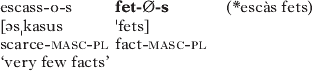
Following the analysis that was given for (13c), aquell_ vells amics presents, the steps for (24) up to the problematic ones will be as shown in (25). The input to step n in (25) contains the adjective with the gender and number features, which have satisfied the constraint Concord in one or two steps.
-
(25)
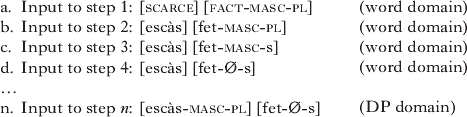
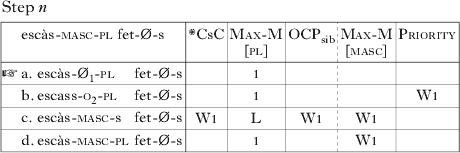
The tableau in (26) shows the derivation of step n, which has escàs-masc-pl fet-Ø-s as the input. Only one of the abstract morphemes can be spelled out. The candidate with the plural morpheme realised, (c), cannot be the winner, because it violates *CsC (as well as OCPsib), which is crucially ranked above Max-M[pl]. The ranking *CsC≫Max-M[pl] was established in tableau (23), for aquell_ vells amics (presents). There is a crucial competition between candidates (26a) and (b) ((d) is included only for completeness). In order to achieve the desired final output escass-o-s fet-s we would need the marked gender allomorph -o 2 to be selected, but because the plural morph has not yet been inserted, there is no pressure for its selection (there is no violation of the phonological constraints *CsC or OCPsib), and the candidate with the less marked allomorph Ø1 is the winner instead.
-
(26)
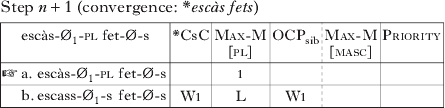
As shown in (27), the consequences of step n are fatal at convergence, because the final output is escàs-Ø-pl fet-Ø-s, i.e. the ungrammatical *escàs fets of (24). Resorting to a different constraint ranking for phrasal phonology, as in Stratal OT (Kiparsky Reference Kiparsky2000, Bermúdez-Otero to appear), will not solve the problem. As mentioned above, the only candidate that would ultimately lead to the correct grammatical output, escass-o-s fet-s, would be candidate (26b), with the -o allomorph, but this candidate is harmonically bounded by the winning candidate with the dominant Ø allomorph (26a), so there is no constraint ranking that could make (26b) the winner.
-
(27)
The problem that sequences like escassos fets in NEC Catalan pose for HS/OI is directly related to the need for the plural morph to be present in order for the marked masculine allomorph -o to be inserted, but at the same time we need the -o to be present for the plural morph to have a chance to surface. These two operations cannot be done sequentially, which is precisely the basic feature of HS; they must be done in parallel.
4.2 A parallel OT analysis
A parallel account of the two phenomena does not face the problems that arise with HS/OI. The ranking OCPsib≫Priority was shown to be necessary to derive the selection of the less preferred masculine allomorph -o, in §2 (see tableau (9) for goss-o-s). The constraint ranking needed to account for the asymmetric absence of the plural morph within the DP was shown to be Max(num)≫*CsC≫Concord(num) (see tableau (18) for aquell_ vells amics presents). These rankings also account for the cases where the two phenomena co-occur, like escass-o-s fet-s in (24). The tableau in (28) shows the one-step derivation of this sequence. As has been assumed all along, the prenominal adjective does not have any gender or number features in the input; these are assigned at PF by Gen, together with the corresponding morphs, and are controlled by the relevant constraints. The noun contains all the allomorphs of [masc] and the plural morph -s. In order to focus on the fate of the adjective, there are no candidates in (28) that violate Max(num).
-
(28)
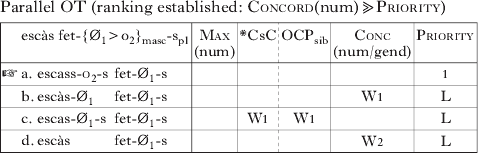
Because candidates in parallel OT can have any number of changes with respect to the input, (28a) is a valid candidate, an option not available in HS/OI. Contrary to candidates (b) and (d), the winner agrees in gender and number with the noun, and therefore satisfies Concord(num) and also Concord(gend) (added here for completeness). The candidate with the dominant masculine allomorph Ø, (c), violates the two phonological constraints, which makes (a) the winner, because it violates only low-ranked Priority. The simultaneous presence of -o and -s in (a) has as a consequence the satisfaction of *CsC and OCPsib, a possibility that is unavailable in a model in which morphs must be introduced one at a time.
5 Alternative HS/OI analyses
As pointed out by two reviewers, the problems raised for HS/OI in §4 by examples like escass-o-s ‘scarce-masc-pl’ would disappear if a different morphological segmentation were attributed to mixed masculine nominals. The segmentation could be escasso-s or escass-os, with the vowel o belonging either to the stem or to the plural morpheme. If the plural had two allomorphs, -s and -os, at the step in which the plural is spelled out in sequences like escassos fets (see (26), with an input escàs-masc-pl fet-Ø-s), the allomorph -os for the adjective would win over -s or the lack of spell-out, because it would avoid the phonological problems, while satisfying the constraint Max-M[pl]. However, these alternative segmentations would be clearly undesirable for other reasons. Considering the vowel o as part of a plural allomorph -os would miss two generalisations: (a) the vowel of this allomorph coincides with the masculine morph of many masculine nouns and adjectives, as illustrated in (4b) with nouns like mic-o ‘monkey-masc’ and adjectives like gueny-o ‘cross-eyed-masc’; (b) the -os ending appears only with masculine nouns and adjectives, never with feminine ones; the feminine of the adjective that means ‘cross-eyed’ is gueny-a [ˈgεɲə] (gueny-e-s [ˈgεɲəs] in the plural), for instance. With invariable adjectives like feliç [fəˈlis] ‘happy’, the masculine plural is realised with o, but the feminine plural is realised with a schwa, which can be interpreted either as the typical feminine morph or as an epenthetic vowel, depending on the analysis (see, for instance, Bonet et al. Reference Bonet, Lloret and Mascaró2007). The inflectional paradigm of the adjective feliç is given in (29).
-
(29)

With two plural allomorphs, -s and -os, and an invariable adjective, we would expect to find invariable feliços for masculine and feminine in the plural.
If the vowel o were attributed to the stem, we would have to posit two allomorphs for all masculine nouns and adjectives ending in a sibilant. Taking the examples in (5), we would have gos [ˈgos] and gosso [ˈgosu] ‘dog’, peix [ˈpeʃ] and peixo [ˈpeʃu] ‘fish’, despatx [dəsˈpaʧ] and despatxo [dəsˈpaʧu] ‘office’, and so on (together with some constraint, with or without lexical ordering, that favoured the consonant-final allomorph in the singular). It would be an accident that all the nouns and adjectives ending in a sibilant happen to have an allomorph that has the same added vowel o; in addition, this allomorphy would be found only with masculine nouns and adjectives (with adjectives like feliç requiring three allomorphs: feliç [fəˈlis] for the singular, masculine and feminine, feliço [fəˈlisu] only for the masculine singular and felice [fəˈlisə] only for the feminine plural).
Under the interpretation assumed in this paper, the vowel o is the same marked masculine morph that appears in mico, guenyo and other masculine words, and surfaces in the plural of masculine plural nominals to avoid an unwanted sibilant cluster. Mixed masculine nominals have been extensively discussed in the literature on Catalan, and attributing o to the stem or to the plural has never been considered a possibility (see, among others, Wheeler Reference Wheeler1979, Reference Wheeler2005, Mascaró Reference Mascaró1985, Lloret & Viaplana Reference Lloret, Viaplana, Ferrando and Hauf1992 and Clua Reference Clua2002). As mentioned by one of the reviewers, the o could also be considered a case of morphological epenthesis, a term used in Lloret & Viaplana (Reference Lloret, Viaplana, Ferrando and Hauf1992) for this phenomenon. This is a good descriptive term, because the vowel is inserted to avoid a phonological problem, but the inserted vowel is not the usual epenthetic vowel of Catalan, schwa, but rather a vowel that is taken from the morphology of the language. The analysis in Bonet et al. (Reference Bonet, Lloret and Mascaró2007) assumed in §2 formalises this intuition within Optimality Theory. Along the lines of Mascaró (Reference Mascaró1985) and Clua (Reference Clua2002), for instance, this morphological vowel is identified with the masculine morph used in nouns like mico and adjectives like guenyo. This is the reason why this vowel appears in (29) in the masculine plural, but not in the feminine plural, which would have the same phonological problem.
A very different HS/OI alternative account, which avoids the problems mentioned in §4, is suggested by an anonymous reviewer. This alternative assumes the strong lexicalist hypothesis, according to which all words, including inflection, are derived in the lexicon. Under this view, the final form of all categories (nouns, adjectives, etc.) would be derived step by step, as assumed in §2; a plural like gossos would be derived as in (10) (<dog-masc-pl, gos-masc-pl, gos-masc-s, goss-o-s>). The crucial difference would be that only fully formed words would be inserted at syntactic terminals, as atomic units, because spell-out internal to words, as well as their phonology, would occur within the lexicon. Incomplete words like gos-masc-s would never enter the postsyntactic evaluation; only the singular gos and the plural gossos, and similar fully spelled-out forms, would be possible candidates for insertion at a syntactic terminal. The reviewer provides the two tableaux reproduced in (30), with a noun starting in a consonant, fets, to illustrate the difference between a prenominal adjective like escassos, with plural agreement, and a prenominal adjective like vells, without plural agreement, vell. The constraint Max[pl]ph applies only at the phrasal level, while Max[pl]wd (equivalent to Max-M[pl] in (10)) would apply within the lexicon. In (30) the input contains an abstract prenominal element to which [pl] has been assigned through Concord constraints, as was assumed in §3. It is also assumed that the noun has already been spelled out. The candidates are the two options that the lexicon provides, the singular adjective escàs and the plural adjective escassos, both derived step by step within the lexicon. The plural candidate is chosen when no conflict arises with the higher-ranked *CsC.
-
(30)
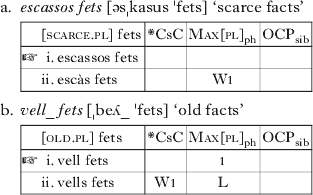
A sequence like escassos fets was shown to be problematic in §4, but it can successfully be derived under this strong lexicalist variant of HS/OI.
However, this account runs into problems in the case of adjectives that have a final n alternating with Ø. Especially in nouns and adjectives, n is not realised in word-final position when preceded by a stressed vowel. Some examples appear in (31).
-
(31)
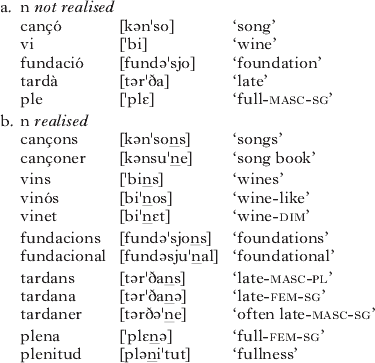
The n∼Ø alternation is considered a phonological process in Mascaró (Reference Mascaró1976), Wheeler (Reference Wheeler1979) and Bonet & Lloret (Reference Bonet and Lloret1998), for instance, but as a case of allomorphy in Wheeler (Reference Wheeler2005) and Bonet et al. (to appear). Under either interpretation, adjectives with this alternation constitute a problem for the strong lexicalist version of HS/OI, given that what enters postsyntactic evaluation is a fully formed word that has undergone whatever phonological changes or allomorph selection the lexical constraint ranking has imposed. The problem is illustrated with the adjective ple ‘full’, whose inflectional paradigm appears in (32).
-
(32)

The strong lexicalist version of HS/OI predicts that the masculine singular form ple will be used in NEC Catalan in prenominal position, to avoid a violation of *CsC. But what surfaces is in fact the non-paradigmatic form [ˈplεn], as the example in (33), taken from Bonet et al. (to appear), illustrates.
-
(33)

The tableau in (34) shows how the masculine singular is chosen; crucially, the form [ˈplεn] cannot be a candidate.
-
(34)
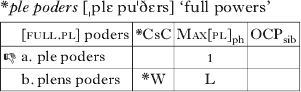
In the parallel non-lexicalist approach in Bonet et al. (to appear), the grammatical output plen is interpreted as a root without inflection, a possibility not available in this analysis.Footnote 10
In conclusion, although at first sight this alternative strong lexicalist proposal would deal with the problems posed by mixed masculine nominals, it would fail to account for additional facts related to the n∼Ø alternation.
6 Conclusions
The HS/OI model, with a crucial modification, has been shown to be well suited to account separately for two related phenomena from Catalan. One of the phenomena, the selection of a marked masculine allomorph -o that prevents sequences of sibilants, is general in Catalan and, as has been shown, is a case of outward-looking allomorphy. A first result of this paper is that this fact requires giving up the restriction on Gen that spell-out works strictly inside out; the burden must be passed to constraints and constraint ranking. The crucial ranking Max-M[pl]≫Max-M[masc] enforces the insertion of the plural morph first, which, in a later step, enforces the selection of the marked allomorph -o to avoid an OCPsib violation. The second phenomenon, restricted to NEC Catalan, is found in the phrasal domain, the DP, and consists of the non-insertion of the plural morph -s only in prenominal position when it would surface between two consonants. For these type of cases it was assumed that the syntax triggers only postnominal agreement and that at PF constraints on agreement, interspersed with phonological constraints, determine final agreement within the DP. For NEC Catalan, the crucial ranking *CsC≫Max-M[pl] prevents the spell-out of the plural morph at any step in the phrasal domain. A second, more important, result of this paper is that it has shown that HS/OI is incapable of deriving the right output when the two phenomena co-occur within the same DP, i.e. when a prenominal modifier with a stem ending in a sibilant appears next to a masculine plural noun starting with a consonant, in which case the prenominal adjective surfaces with the marked -o allomorph plus the plural morph. For the -o allomorph to be selected, the plural morph -s would have to be inserted first, but for the plural morph to be realised, the presence of a previously selected -o allomorph would be necessary, yet these two desired situations cannot be achieved simultaneously in a model like HS, where changes can only be introduced one at a time. A parallel analysis of each case and the combination of the two does not run into the problems faced by the HS/OI approach, because in parallel OT Gen can introduce several changes at once. Here, crucially, it can insert any gender allomorph together with the number allomorph. It has also been shown that assuming different morph segmentations for mixed masculine nominals or assuming the strong lexicalist hypothesis is inadequate to account for the complete set of facts; the former alternative must be rejected on conceptual grounds, while the latter fails to account for additional facts.
Although the parallel approach has been shown to be more adequate for the phenomena analysed in this paper, it cannot account for the phenomenon from Classical Arabic, exemplified in (2), which was used to illustrate HS/OI. McCarthy (Reference McCarthy, Borowsky, Kawahara, Shinya and Sugahara2012) shows the clear advantages of deriving the absence of nunation before a pause in HS, with the gradual insertion of morphs. In principle, parallel OT wrongly predicts that the output before pause should be identical to the output in the contextual form, because a form like [kitaːb-u-n]Cont satisfies the weight requirement (HeavyInPause); the output [kitaːb]Pau (more precisely [kitaːb-nom-indef]Pau) is not expected.
If we put together the three phenomena that have been discussed in this paper, two from Catalan and one from Classical Arabic, one possible conclusion to draw from this puzzle is that it is only for word-internal evaluation that Gen is restricted to taking one step at a time; for phrasal phenomena Gen would not have such restriction. This might not be a desirable move, because it would imply that different properties are attributed to Gen depending on the level of derivation, but more research is needed on HS and phrasal phenomena to find out whether this is the direction to take. Obviously, another option is to find an alternative analysis for the Classical Arabic facts in a parallel approach. However, it is difficult to see at this point what a plausible HS/OI alternative analysis for the Catalan phenomena might be.


