1. Introduction
1.1 Divided opinion on whether Kim Jong-un's regime will survive
The prospects of the political survival of the North Korean regime has long been a major international concern, especially as severe economic hardships have continued over the last two decades and the production and supply of basic goods have been stagnant since the early 2000s. International opinion, however, remains divided. For instance, a regime collapse was predicted during the Arduous March in the mid-1990s, when there was an enduring widespread famine that killed over 1 million North Koreans. It was similarly predicted in 1994 when the USA nearly went to war with North Korea to halt its nuclear weapons program. The prospects were once again mooted following the deaths of Supreme Leader Kim Il-sung in 1994 and Dear Leader Kim Jong-il in 2012. Nevertheless, the Kim-family regime has managed to survive despite a series of political and economic crises, and it has now been over 5 years since Kim Jong-un's rise to power in 2011. However, while critical issues, such as chronic economic hardship, frequent purging and defections of North Korean elites, and international sanctions through the United Nations Security Council (UNSC) Resolutions continue, the question of whether Kim Jong-un's regime will survive remains. Previous studies undertaken by western academia shortly after the inception of his regime have usually predicted instability. For example, Saxonberg (Reference Saxonberg2013) predicted that once Kim Jong-il stepped down and if the economy under the new leader continued to perform poorly, a revolutionary situation or regime collapse could emerge. Hayes and Cavazos (Reference Hayes and Cavazos2015) concluded that even if Kim Jong-un consolidates his immediate powers, the sustainability of his regime is questionable given the stresses induced by his domestic rule and the external pressure of sanctions. Snyder and Draudt (Reference Snyder and Draudt2015) predicted the potential instability of Kim Jong-un's regime due to brutal leadership consolidation and continued discord with even its most supportive neighbors, such as China. On the contrary, recent studies undertaken by Korean academics have predicted the stability of his regime. For instance, Kim (Reference Kim2015) concluded that Kim Jong-un's regime is stable and the durability of his regime will depend on social control through its coercive capacities, expansive reproduction of shared beliefs, and meeting the people's needs. Most recently, Koo et al. (Reference Koo, Choi and Kim2016) have diagnosed Kim Jong-un's regime as stable based on the analysis of his regime's maintenance of the attributes of a hybrid authoritarian regime that seeks its sustainability through party apparatuses. Taken together, previous studies have predominantly analyzed the regime's limitations and weaknesses and the threats posed to it due to certain political, economic, or intuitive factors. Studies based on baseline theoretical models to diagnose leadership stability have rarely been undertaken.
1.2 Selectorate theory
Building upon previous research, this paper seeks to determine the stability of the North Korean regime using selectorate theory, developed by Bueno de Mesquita et al. (Reference Bueno De Mesquita, Smith, Siverson and Morrow2003). Several studies have endeavored to develop baseline models of leadership stability: Gasiorowski (Reference Gasiorowski1995) on the stability of political regimes, Warwick (Reference Warwick1994) on the stability of the executives in parliamentary democracies, Barro (Reference Barro1997) on the effect of economic growth on leadership tenure, Lake and Baum (Reference Lake and Baum2001) on the effect of public goods provision, and Colaresi (Reference Colaresi2004) on leadership vulnerability to international conflict behavior. Selectorate theory explains political survival from an institutional viewpoint using institutional factors, measured as vectors, to explain a variety of observations and consequences pertinent to political survival and provide a logical basis for studying the politics of various regimes.
According to selectorate theory, two critical groups act as institutional factors to affect leaders: (1) the selectorate (nominal and real selectorate) nested within the residents of all polities and (2) the winning coalition (essentials) within the selectorate. The selectorate is composed of those who nominally or substantially choose the leaders, and the winning coalition is drawn from the selectorate whose support is essential for the leaders to stay in power. For example, in an American presidential election, the nominal selectorate is all registered voters, the real selectorate is composed of those who cast a vote, and the winning coalition is all voters who cast a vote for the candidate who obtains 270 electoral college votes. In the Soviet Union, the nominal selectorate was all adult citizens whose decision was chosen by the communist party, the real selectorate were all voting members of the party, and the winning coalition consisted of a small group of people inside the party who substantially chose the candidates and controlled policy. The primary assumption of selectorate theory is that the sole purpose of leaders is to remain in power by enacting policies and providing private goods, such as cash or legal impunity, to the winning coalition. The key to remaining in power lies in managing the winning coalition, not the masses. The concepts of selectorate theory have already been adopted in the comparative politics literature (see Clark et al., Reference Clark, Golder and Golder2009: 331–349). This paper aims to expand its application within political science, specifically focusing on its applications to leadership stability and the future of the North Korean regime.
Within this framework, this paper first investigates the political, ideological, and institutional limits of Kim Jong-un during his initial years in office. Second, the paper illustrates the selectorate and the winning coalition of Kim Jong-un's regime and his rationale for peculiar personnel management, such as frequent changes, promotion and demotion of his top aides, and the reign of terror. Third, it analyzes how traditional economic ideologies, policies, and theories of North Korea have been utilized for the regime's political survival during economic difficulty. Fourth, it explores how physical coercion in the forms of the reign of terror and military brinkmanship affects North Korean international and domestic affairs in enhancing his political survival, and why the regime has intensified party-dependent bureaucracy and granted economic autonomy to the people. Finally, it explains how the analytical results influence regime stability. To reexamine the analytical framework and results, this study has undertaken in-depth interviews with high-level North Korean defectors who have served in key power apparatuses of Kim Jong-il and/or Kim Jong-un's regimeFootnote 1 and extensively reviewed official publications of North Korea.
2. Political, ideological, and institutional limits of Kim Jong-un during his initial period in officeFootnote 2
2.1 Background: the power transfer from Kim Il-sung to Kim Jong-il
Supreme Leader (Suryong) Kim Il-sung established the Democratic People's Republic of Korea in 1948 in collaboration with the Soviet Union, ruled the country for 46 years, and handed leadership to his son, Kim Jong-il, in 1994. The process of transferring power to Kim Jong-il was elaborately and carefully planned with relevant ideological, political, legal, and institutional arrangements being gradually developed to secure his legitimacy from his proclamation as the Suryong’s successor in 1974. Among a variety of theoretical tools to politically and ideologically legitimize the transfer of hereditary power, the primary is the Juche idea (or ideology). Developed by Hwang Jang-yop, the Juche idea is a humanist system that defines individuals as socially driven, yet endowed with autonomy, creativeness, and consciousness, and are the masters of the universe. The Juche idea, consequently, defines humans as the primary agents of historical development, with human history representing a struggle for individual autonomy. This struggle is, however, both decided and realized by an autonomous ideological consciousness which, in turn, requires the supreme instruction (or supreme leadership, Ryongdo (領導)) of the Suryong (citation removed for peer review), who is the sole, absolute, infallible, and most sacrosanct being (Kim, Reference Kim1996c: 145–156). Kim Il-sung was personified as ‘the great Suryong that we have greeted and admired for the first time in human history’ (Social Science Publisher, 1992: 19). Consequently, any errors in policy implementation were attributed to officials and not to the Suryong or his successor, Kim Jong-il. Further, Kim Il-sung repeatedly endorsed Kim Jong-il as his legitimate successor through the issuance of Kyo-Shi (敎示, royal teaching and instructions by the Suryong and Suryong’s successor).
In 1971, a Continuous Revolution doctrine was adopted. It was argued that ‘the most critical issue in inheriting and developing the revolutionary tradition lies in following the monolithic leadership of Suryong’s successor’ (Hahm, Reference Hahm1992: 88). In 1986, Kim Il-sung elevated the status of his successor to that of a Suryong by stating, ‘the successor issue is to decide who will inherit the status and role of Suryong’ (Kim, Reference Kim1994: 100). In 1991, he emphasized that ‘Kim Jong-il has laid the organizational and ideological foundations of the Party and is wisely leading the revolution and construction generation after generation’ (Kim, Reference Kim1996a: 212–213). In 1993, he stated, ‘if the leadership for the revolution and construction is not rightly succeeded, the socialist exploit will eventually fail’ (Kim, Reference Kim1996b: 109–110). He added, ‘Kim Jong-il exercises amazing leadership with an extraordinary ability of exploration and energy’ (Kim, Reference Kim1996a: 111–113). In tandem with a series of Kyo-Shi, the North Korean authorities also institutionalized the qualifications of the successor by stating that only a leader with extraordinary dignity and the appropriate qualifications could be anointed as successor. In addition, a monolithic leadership system was established (Workers’ Party of Korea Publisher, 2000: 50–71). From the 1980s, the Kim Jong-il myth was developed with the same structure as the myth of Kim Il-sung, including noble lineage, extraordinary childhood, sense of duty through suffering, forward-looking mentality, and extraordinary ability. The myth was disseminated and reinforced in textbooks, literature, and artistic works (Hyun, Reference Hyun2015).
Institutionally, the transfer of power from Kim Il-sung to Kim Jong-il proceeded gradually and systematically over a span of 20 years. In 1973, Kim Jong-il officially entered the political scene through his appointment as the secretary for Organization and Ideology in the Central Committee of the Workers’ Party of (North) Korea (WPK, or simply the Party). He became the political commissar of the WPK in 1974, a member of the Standing Committee of the Politburo of the WPK in 1980, the first Deputy Chairman of the National Defense Commission (NDC) in 1990, and the Chairman in 1994. Having effectively ruled North Korea since 1994, Kim Jong-il finally ascended to the post of General Secretary of the WPK in 1997.
2.2. Abrupt and haphazard power transfer to Kim Jong-un
However, the transfer of power from Kim Jong-il to Kim Jong-un was abrupt and haphazard. Kim Jong-il reportedly issued a Kyo-Shi outlining his decision to transfer power to Kim Jong-un, which was passed by the Division of Organization and Instruction of the WPK in early January 2009. In 2010, Kim Jong-un was suddenly appointed as the General of the Korean People's Army (KPA), a member of the Central Committee of the WPK, and Vice-Chairman of the Military Committee of the WPK. Kim Jong-un was officially enthroned as the supreme leader of North Korea on 28 December 2011, following the sudden demise of his father.
When Kim Il-sung established the principle of the successor to the Suryong in the 1970s (Kim, Reference Kim1984: 48), it was determined that the successor of the Suryong should be designated by the Suryong during his lifetime, and the status and role of the Suryong automatically transferred to the successor of the Suryong upon the death of the Suryong. To prevent overlaps of the statuses and roles of the Suryong and his successor during the Suryong’s lifetime, the principle classifies the roles of the successor according to periods: the period when the successor assists the ideology and the supreme leadership of the Suryong for a considerable (unspecified) period, and the period when the successor succeeds the status of the Suryong after the Suryong’s death and completes his revolutionary achievements (Lee, Reference Lee2003: 36). However, Kim Jong-un, spending only 3 years assisting his father, nearly skipped the former role and directly assumed the latter.
Indeed, the ruling of the Kim family is considered an undoubted constant by North Korean people. The only question is which of the Kim-family members will rule. Hereditary ruling by the Kim family was established during the transfer of power from Kim Il-sung to Kim Jong-il. Eventually, in 1974, Kim Jong-il proclaimed the ‘Ten Principles for Establishment of Monolithic Ideology System of the Party’ as the essential code of conduct for North Korean daily life: this specified hereditary ruling and the monolithic leadership of the center of the Party. Since then, the dynastic ruling of the Kim family through heredity has been institutionalized.
Kim Jong-un's regime has taken several important institutional measures to consolidate the transfer of power during his initial period in office. First, the ‘Ten Principles for Establishment of Monolithic Ideology System of the Party’ was retitled and amended to the ‘Ten Principles for Establishment of Monolithic Supreme Leadership (領導) System of the Party’ in June 2013. The amended ‘Principles’ intend to further legitimize the Kim-family's rule by emphasizing the lineage of the original Kim family. It amended the original ‘revolutionary ideology of the great Suryong Kim Il-sung’ and ‘the Kyo-Shi of dear Suryong’, to ‘the Kyo-Shi of Suryong (Kim Il-sung), Words of the General (Kim Jong-il), and the Party (implying Kim Jong-un)’, thus juxtaposing the weight of the words of all three leaders. It articulates, ‘All tasks should proceed under the monolithic leadership of the Party and policies should be handled only by the conclusions of the center of Party’. It also replaced ‘socialist and communist exploits’ with ‘Juche revolution exploits’, thus prioritizing the hereditary rule by Kim Jong-un (Democratic Peoples’ Republic of Korea, 1974, 2013).
Kim Jong-un's regime established Kimilsungism-Kimjongilism as the official ideology of the Party at the Convention of Representatives of the Party in 2012. Kimilsungism refers to the Juche revolutionary idea of Kim Il-sung and his work to realize it. Kimjongilism includes the ‘Military First Politics’ doctrine (Sungun Politics (先軍政治)) of Kim Jong-il. By institutionalizing Kimilsungism-Kimjongilism, Kim Jong-un intended to enhance his ideological legitimacy as part of the original lineage. Kim Jong-un's regime has clearly demonstrated that North Korea is a dynasty of the Kim family, and no longer a socialist state.
Practically, Kim Jong-un's regime has enhanced the party-dependent bureaucracy. The regime has normalized some party organs, such as the Representative Meeting of the Party and the Plenary Session of the Central Committee of the Party, and given them key decision-making authority. Specifically, the authority to declare war has been changed from the independent decision of the Supreme Commander to a collective decision of the Party Central Committee, the Central Military Committee of the Party, the NDC, and the Supreme Headquarters.
However, despite institutional measures to consolidate the transfer of power and his noble lineage, it seems certain that Kim Jong-un was enthroned without first proving why he should be the national leader. In comparison, the feats of Kim Il-sung in wars against Japanese colonial rule from mid-1920 until the 1930s – though fabricated – and against the USA from 1950 to 1953, in addition to numerous cults and deifications, placed him in the rank of Supreme Leader. Kim Jong-il had gone through a long period of training and succession procedures to become Dear Leader. Given the situation, Kim Jong-un needed a strong strategy to assure his political survival during his initial period in office.
3. The selectorate of Kim Jong-un's regime, his rationale of peculiar personnel management, and the reign of terror
3.1 The selectorate and the winning coalition of Kim Jong-un's regime
Selectorate theory characterizes polities by the size of a leader's winning coalition and the selectorate. Bueno De Mesquita and Smith (Reference Bueno De Mesquita and Smith2011: 8) explain, ‘Dictatorship means a government based on a particularly small number of essentials drawn from a very large group of interchangeables…and a relatively small batch of influentials’. A dictatorship that retains a small winning coalition increases the dictator's chances of political survival, as it is always possible to replace those in the winning coalition with other members of the selectorate and the potential defection of the members results in the loss of all the privileges, especially private goods.
Since Kim Il-sung's rule, the North Korean dictatorship has maintained vertical networks, which are comprised of strong interpersonal ties with the dictator at the top and define the power of those in the network. For instance, the nominal supreme decision-making apparatus of North Korea is the Party Convention of the WPK. Of the over 2 million members of the WPK, only 3,000 are selected according to the will of the dictators to participate in the Party Convention to determine important party lines, policies, and the election of members. For instance, the Party Convention has been electing the members of the Central Committee of the WPK or the members of the standing committee of the Politburo under that Committee. However, the results of elections have also always been decided unanimously and corresponded exactly to the will of the dictators. The nominal supreme sovereign authority of North Korea is the Supreme People's Assembly (SPA) that exercises the legislative power. Elections are conducted by secret ballot. However, only one candidate for the seat of the SPA appears on the ballot in each constituency. Voter turnout has always been almost 100% since the introduction of the electoral system. The electoral acts are nothing more than a rubber-stamping.
As per selectorate theory (Bueno De Mesquita et al., Reference Bueno De Mesquita, Smith, Siverson and Morrow2003: 43), people in all societies are sorted into and out of the selectorate based on at least four defining personal characteristics: (1) personal origin: birthplace and lineage; (2) special proficiency: skills, beliefs, and/or knowledge; (3) wealth; and (4) gender and/or age. The North Korean dictatorship has sorted people into its selectorate on the grounds of special personal origin and proficiency, and wealth as a privileged benefit has been given to the members of the selectorate and the winning coalition. The members of the selectorate and the winning coalition have been filtered out and replaced over three generations of dictatorship. There are three key socio-political power elite groups in North Korea. The first and most powerful group is the Kim family and the descendants of communist partisans who fought the Japanese imperialist forces while supporting Kim Il-sung. The Kim family encompasses Kim Il-sung and his siblings and relatives. As the husband of Kim Jong-il's sister, Kim Kyong-hui, Jang Song Taek, and his family were included in the Kim family before Jang's death. In addition to kinship via marriage, Jang was deeply involved in earning foreign currency for the power elite (Park and Choi, Reference Park and Choi2013: 99–100). Broadly, the Kim family has occupied the most essential social positions and economic interests in North Korea since Kim Il-sung's rule. The second group is the anti-Japan fighters and their families. The anti-Japan fighters, known as the ‘Anti-Japan Partisans’, are the guerrillas who fought Japanese colonial rule in northeastern China and Soviet Russia and constitute the first generation of the Juche revolution. According to Park (Reference Park2014: 10), the rule of Kim Il-sung and Kim Jong-il was the period of a de-facto joint government of the Kim family and this group. One of the most representative figures of the second generation of this group is Choi Ryong-hae who, born in 1950 to Choi Hyon, the former defense minister of the first generation of the socialist revolution, currently serves as a member of the Politburo Presidium and Secretariat of the WPK. The third and largest group consists of the relatives of the fighters of the Korean Civil War from 1950 to 1953 and the distinguished contributors to the socialist revolution. Many in this group are members of the military. Together, these three groups comprise the selectorate, including the winning coalition or power elite of North Korea.
The party-state system was developed during Kim Jong-il's rule, and the WPK has become the absolute power center in North Korea. Currently, the Party's leadership assumes overall responsibility and coordinates every aspect of state rule. Therefore, the winning coalition should hold positions inside the Party. Among the various organizations of the WPK, the Secretariat and the Organization and Guidance Department (OGD) are the most powerful. The members of these organizations cannot be clearly identified and the Secretariat is an even more secret organization. Of the staff of the Secretariat, Cho Yon-jun is known to be the most influential person. Since the sole, absolute, infallible, and most sacrosanct being of the Suryong or their successor is not open for discussion, the Secretariat merely delivers information and analyses gathered by the OGD and other Party organizations to Kim Jong-un and transmits his Ryongdo back to them. Decisions are made monolithically by Kim Jong-un. Moreover, now that the Suryong or their successor should be sole, absolute, infallible, and most sacrosanct, the assistance of these organizations is imperative. Accordingly, these organizations are necessarily powerful. The analysis described above is the view commonly shared by the North Korean defectors interviewed for this study and Thae Yong-ho, the former deputy ambassador of the DPRK to the UK, who defected to South Korea in 2016 (see Song, Reference Song2017). In sum, Kim Jong-un and the members of the winning coalition have a symbiotic relationship.
This paper compares the members of key power apparatuses of the WPK between Kim Jong-il's regime in 2011 (just before Kim Jong-il's demise) and Kim Jong-un's regime in 2016. It was found that only one out of four standing members (Kim Yong Nam), three out of 12 members (Kim Ki Nam, Choe Thae Bok, and Yang Hyong Sop), and none of 14 alternate members of the standing committee of the Politburo are still active. In the Party Central Military Commission, only four out of 16 are active (Kim Won Hong, Kim Kyong Ok, Choe Pu Il, and Kim Yong Chol). In addition, the Executive Policy Bureau has been newly established, constituted by Kim Jong-un and nine members. Moreover, the size of the key power apparatuses has been markedly reduced. These findings imply that a considerable number of the members of the winning coalition have been replaced (or purged). In addition, Kim Jong-un has minimized the winning coalition by reducing the total members of the coalition under Kim Jong-il during the first 5 years of his rule. Personnel management is one of the most effective means of governance and Kim Jong-un has exercised this through frequent promotion, demotion, replacement, and purging. These frequent changes to top aides and officials have fanned speculation concerning the stability of the regime. However, his peculiar personnel management style is considered to be highly strategic, the reasons for which follow.
3.2 Kim Jong-un's strategy embedded in the reign of terror
Like his predecessor, Kim Jong-il utilized purging as a ruling strategy. For example, on 30 November 2009, the North Korean authorities announced a nationwide currency revaluationFootnote 3 to root out the capitalist influence that had grown in the midst of marketization of the North Korean economy since early 2000, strengthen its centralized planned economy, and embrace the markets under state control. However, this caused severe disorder throughout society as market transactions stopped and prices rose dramatically. Then, Kim Jong-il removed blame from himself with the public execution of the director of the Planning and Finance Department of the WPK, Pak Nam-Gi, the designer of the currency revaluation. Though purging is a strategy that both Kim Jong-il and Kim Jong-un have utilized, their methods have stark differences. Kim Jong-un's purge has been far more extensive, irrespective of rank and personal origin, unusually high in frequency, extremely cruel, and overt. According to the Institute for National Security Strategy (INSS) under the National Intelligence Service (Seoul Daily, 2015) and North Korean defectors interviewed for this study, his purging includes not only imprisonment and exile, but also public torture and execution by flamethrowers and anti-aircraft guns.
Generally, there are three forms of purges (Bueno De Mesquita et al., Reference Bueno De Mesquita, Smith, Siverson and Morrow2003: 383–385). The first is to directly purge coalition members, reducing the size of the coalition while maintaining the size of the selectorate. In this circumstance, the members of the winning coalition whose affinities for the leader are questionable are purged, thus increasing loyalty to the incumbent leader. The second is to maintain the coalition size as members of the selectorate are removed. As this makes the winning coalition a larger proportion of the selectorate, loyalty becomes weakened. Consequently, the leader has greater expenditures to prevent defection of the coalition members. The third is to reduce the sizes of the coalition and selectorate. In this circumstance, each member risks being newly excluded. Kim Jong-un's purge corresponds to the first case.
Through purging, Kim Jong-un has demonstrated that anyone can be immediately removed if loyalty is not assured. By creating a society-wide atmosphere of terror, he has effectively eliminated anti-leadership sentiment and kept all organizations under his control. While maintaining a large selectorate relative to the coalition, he has been able to easily replace troublemakers in the coalition. For instance, Choi Ryong-hae has been one of the most influential men of Kim Jong-un's regime. In April 2012, he was appointed as Vice Marshal, member of the Politburo Presidium of the WPK, vice-chairman of the Central Military Commission, and member of the NDC. However, Choi was demoted from Vice Marshal to General in December 2012 and restored in February 2013. In March 2014, he was reportedly jailed and interrogated. However, he was appointed as the vice-chairman of the NDC in the next month and reelected as a member of the Presidium of the SPA in May 2016. Similarly, in late 2013, Kim Jong-un shocked the world by executing his uncle, Jang Song Taek, who had been North Korea's de-facto second-in-command for the last 20 years. The exorbitant purge, demotion, and promotion as a strategy to retain power has been used to compensate for his weak authority and insufficient ideological, political, and institutional background. Then, does this mean that a new era of Kimjongunism has arrived? It does not seem so for reasons detailed in the following section.
4. Inevitable but clever plutocracy of Kim Jong-un's regime
4.1 Political risk of Kim Jong-un during his initial period in office and the purge of Jang Song Taek: a strategic joint effort of Kim Jong-un and the selectorate
Kim Jong-un's governing strategy can be summarized based on the primary assumption of selectorate theory: to attain power, to maintain power until death, and to control as much national revenue as possible. As per Bueno De Mesquita and Smith (Reference Bueno De Mesquita and Smith2011: 73–74), although dictators survive longer, their survival during the initial period in office is particularly difficult because they have yet to identify resource locations and essential supporters. Kim Jong-un came to power following the sudden demise of his father. Despite his father's endorsement through the Kyo-Shi, there may have been (covert) doubt surrounding his ascent to the throne since he was too young and inexperienced. It would have put his rule in the initial period at risk, as his status in the beginning was similar to ‘a challenger’ seizing power. Generally, a challenger must meet three conditions to attain power: first, remove the incumbent; second, seize the governmental apparatus; and third, form a coalition of supporters sufficient to sustain power (Bueno De Mesquita and Smith, Reference Bueno De Mesquita and Smith2011: 23). In Kim Jong-un's case, the first condition was easily met as his father had died, leaving him to meet the second and third conditions as quickly as possible to prevent challenges to his political survival. He effectively purged the winning coalition until it was small enough to minimize expenses and ensure strong loyalty. Nevertheless, as the history of dictatorships reveals without exception, no leader is monolithic or can govern alone (Svolik, Reference Svolik2012). In this respect, the purge of Jang Song Taek was a strategic joint effort of Kim Jong-un and the selectorate for their political survival.
Again, Kim Jong-un's survival during his initial period in office was likely to be difficult, with his ruling likely to be at least subject to doubt. The key to securing the governmental apparatus and coalition lay in finding the necessary resources. However, this paper notes the long-standing fight among the aforementioned three groups of the North Korean power elites for political and economic hegemony. The political setting since the 1990s is characterized by the first group checking the second and third groups (see Park, Reference Park2014). Kim Jong-il officially introduced the ‘Military First Politics’ doctrine in 1998, following the death of Kim Il-sung, and promoted many military figures to governmental positions. He intended to, thereby, check the second group. Conversely, from the mid-2000s, Kim Jong-il began to check the politically bloated military and Jang Song Taek played a significant role in this task. However, as Kim Jong-il's health deteriorated, the conflict reemerged.
Under these conditions, the power and economic interests of Kim Kyong-hui and Jang Song Taek rapidly expanded. Specifically, Kim Kyong-hui's guardianship of Kim Jong-un was remarkable until the purge of Jang Song Taek. Kim Jong-un, who had yet to completely seize control of resources and identify whose support was essential, desperately needed to seize the governmental apparatus and form a coalition of supporters sufficient to sustain him. Conversely, the winning coalition wanted to survive and receive a share of private benefits from the incumbent in exchange for their support. In such a situation, Jang Song Taek was a highly experienced professional; he knew where the resources were and how to manage them, and controlled the Cabinet and various economic organs. Moreover, Jang often dared to behave audaciously in front of Kim Jong-un, as if he looked down upon the successor of the Suryong. Eventually, Jang became the biggest stumbling block to Kim Jong-un's political survival, and Kim Jong-un’s best option, which he elected to pursue, was to ally with the power elites opposed to Jang. Jang's final sentencing (Rhodong Daily, 2013) stated that ‘while he had taken hold of all Cabinet business, the Cabinet had lost its normal function (and thus was acting contrary to the unilateral management of the national economy by a monolithic leadership)’. It further emphasized that ‘anyone who dares to challenge the monolithic leadership of our Chief Commander and counterpose an individual to the Paektu lineage one to one will be ruthlessly punished’.
The information presented by the National Intelligence Service (Park, Reference Park2014: 2) attributed the purge of Jang Song Taek to conflict over economic interests. Since Kim Jong-un came to power, most of the economic rights, such as foreign capital earnings and the management of collective farms owned by the military during the previous era, have been transferred to the WPK and the Cabinet. Bueno De Mesquita and Smith (Reference Bueno De Mesquita and Smith2011: 25) argue that ‘paying supporters, not good governance or representing the general will, is the essence of ruling’. In sum, Kim Jong-un seems to have intended to tighten his control of resources by purging Jang, along with his allies, and enhancing his capacity to finance the party-dependent bureaucracy.
However, the members of North Korea's winning coalition are neither one group nor several groups with strong solidarity. According to the North Korean defectors interviewed for this study, for security reasons, no individuals of state organs are allowed to gather, and the whole society is in the grip of widespread distrust. In effect, the winning coalition of North Korea is the aggregate sum of those who seek personal survival and share a common – albeit temporary or coincidental – political orientation.
The SPA met on 29 June 2016 with the agenda to amend the Socialist constitution and enthrone Kim Jong-un as the Supreme Leader of the State (Ministry of Unification, 2016). According to the amended constitution, the Commission on State Affairs (CSA) has replaced the NDC, and Kim Jong-un is proclaimed the Chairman of the CSA. The CSA, as the Supreme Leading Policy Authority of the National Sovereignty, is responsible for creating national policies and supervising the implementation of policies approved by the Chairman of the CSA, who is the Supreme Leader of the State and the Chief Commander of the Military. Consequently, Kim Jong-un is considered to have successfully taken over the entire North Korean regime, maintaining control of resources in an institutionally Party-dependent bureaucracy based on a practically symbiotic relationship within the inner circle.
4.2 The disparity between North Korean economic ideology and its application
It is estimated that, since around 1990, North Korea's economy has been stagnating. Attempts to secure external aid and foreign investment have been unsuccessful due to international sanctions over its nuclear brinkmanship and the country's inferior investment environment. According to selectorate theory, a state's economic crisis usually develops into a political crisis, as it causes the incumbent to lack the resources to purchase political loyalty. In this respect, the economic difficulties of North Korea could be a significant threat to Kim Jong-un's political survival. However, even these economic difficulties have been deliberately maneuvered and utilized for the political survival of the Kim-family regime.
Kim Il-sung often argued that a ‘socialist society that is newly built by overthrowing a capitalist society is the society that does not know the exploitation of the people by the people; hence, social and individual interests in the socialist society are mutually identical’ (Kim, Reference Kim1981a: 593). However, he also acknowledged that differences in the economic interests of individuals and social groups exist because of a transitional phenomenon in socialist societies that had yet to reach the highest level of social development: the communist society. On this account, Kim Il-sung acknowledged that when economic activities were motivated by economic interests, the people would become enthusiastic about such activities and therefore, the achievement of socialist economic ideals would be possible (Hahn, Reference Hahn1986: 57). With respect to economic accumulation (capital and production) and consumption, Kim Il-sung argued:
Deciding the relationship between accumulation and consumption is to harmonize socialist economic development and increasing the quality of life of the people…(therefore) accumulation [through production] should grow rapidly, with accumulation and consumption being kept balanced so that consumption can constantly be increased (Kim, Reference Kim1983: 126, 357).
These ideas provided the theoretical foundations for North Korea's pursuit of a ‘low-consumption high-accumulation’ strategy, the Heavy Industry First Strategy, and the extensive growth strategy. Using these strategies, North Korea has pursued economic growth through massive commitment of production inputs since the end of the Korean War in 1953 primarily to meet the prospective and social interests of the country, and, second, to meet the present and individual interests of light industry and agriculture. Kim Il-sung further stressed the importance of material incentives:
It is impossible to fully motivate workers’ desire for production using only political and moral incentives in a socialist society where old ideological vestiges (such as individual interests) still remain…(therefore) to prioritize the political and moral incentives for work and to properly combine them with material incentives has been the consistent policy of our Party (Kim, Reference Kim1984: 124–125).
With respect to distribution, Kim Il-sung asserted that ‘distribution based on quality and quantity of work is the objective principle of socialist society…and it is a strong means to materialistically motivate workers’ passion for production’ (Kim, Reference Kim1981b: 199). Under the same rationale, he added, ‘a key point in implementing a socialist wage system is that workers should be paid living expenses, prizes, and incentives based on the quality and quantity of their work’ (Kim, Reference Kim1980: 314). However, in applying these ideologies, the three Kims took different stances from their rhetoric and became preoccupied with enhancing their monolithic leadership. They intended to prioritize accumulation and curb consumption. Kim Jong-il emphasized, ‘Socialism cannot coexist with pluralism, liberalization of ideology, and a multiparty system of politics, and thus diversification of ownership should never be allowed’ (Kim, Reference Kim1997: 13). Regarding socialist economic management, Kim Jong-il argued, ‘to deliberately develop the national economy and rightly manage the national livelihood…the national capital should be unilaterally managed by a monolithic leadership’ (Social Science Publisher, 1996: 153–156). Little has changed since Kim Jong-un's accession. The security and well-being of the regime is prioritized.
From the perspective of selectorate theory, however, North Korean dictators have had clear reasons to maintain this economic system despite the continuing economic hardships. Their priority has been to retain power, and they have employed the most effective methods of political survival. According to selectorate theory, national economic crisis does not affect dictators as long as they can provide enough to those that keep them in power. Kim Il-sung and Kim Jong-il's Kyo-Shi on accumulation, consumption, and the unilateral management of the national economy by a monolithic leadership connote the political stratagem to facilitate the political survival of the Kim family. The Kim family has effectively maintained a plutocracy, primarily though controlling the foreign currency acquired by the activities of the ‘Royal Court economy’ (Mikheev, Reference Mikheev1993: 89–90).
The North Korean economy is divided into three major categories: an elite economy consisting of the ‘Royal Court economy’, a military economy, and a people's economy that falls under the control of the Cabinet. The Royal Court economy and the military economy constitute almost half of North Korea's economy. Consisting of the syndicate of finance–industry–trade, the Royal Court economy controls the core businesses and activities that earn foreign currency. While independently running various affiliated agencies, banks, and enterprises, it is responsible for securing governing funds for the selectorate and the Kim family through a variety of domestic and overseas (licit and illicit) economic activities.
Kim Jong-il and Kim Jong-un have introduced similar economic measures. In 2002, Kim Jong-il proclaimed the ‘July 1st (or 7.1) Economic Management Improvement Measure’ that abolished the national rationing system and rewarded farms and factories the right to independent management of the yield and surplus profit after the deduction of the state's compulsory share at a flat rate (600–6,000 North Korean Won per month). In 2012, Kim Jong-un introduced the ‘June 28th (or 6.28) New Economic Improvement Measure’ that allowed work teams on collective farms to share the yield according to their input after the deduction of the state's compulsory share. The yield must be divided in a ratio of 7 to the state and 3 to the farm. Factories and enterprises have been given autonomous operating rights for production, sales, and profit management. Furthermore, the marketization of the North Korean economy, which had accelerated since the ‘July 1st Measure’, has further expanded under Kim Jong-un's rule. However, the above measures are a strategic expedient to practically ignore the people's economy and collect the state's share. Given the chronic shortage of resources symptomatic of current economic difficulties, these measures have been intended to concentrate resources on strategic sectors, such as the Royal Court Economy and the military. Whereas Kim Jong-il directly provided his winning coalition with cash, Kim Jong-un is providing his winning coalition with the right to engage in rent seeking in the market. Kim Jong-un is acquiescing in their rent seeking provided they deliver governing funds to him, which has been further accelerating marketization. Consequently, the policy measures exercised by the Kim family are the results of rational decision making by self-interested leaders.
5. The effects of physical coercion on the political survival of Kim Jong-un's regime
5.1 The internal effects on domestic affairs with respect to political efficacy, deliberate indifference, and independent communication networks
Facing the weak politico-ideological authority of Kim Jong-un and impending economic difficulties, Kim Jong-un's regime has relied on physical coercion. In a sultanistic regime, the whole of society is subject to the despotic interventions of the leader or sultan (Linz and Stepan, Reference Linz and Stepan1996). In a totalitarian regime, power is based on the belief that the rulers are on a messianic mission for which they develop totalizing ideologies (Linz, Reference Linz2000; Saxonberg, Reference Saxonberg2013). The despotic leader usually creates a ruling ideology and often relies on physical coercion to exercise power. Political alternatives and critics are eliminated through physical coercion and control of communication. Accordingly, the Kim-family regime demonstrates the qualities of a sultanistic totalitarian regime.
The internal effects of physical coercion on the political survival of Kim Jong-un's regime are understood in conjunction with political efficacy, deliberate indifference, and the presence of independent communication networks. Political efficacy is the ‘feeling (of an individual citizen) that political and social change is possible and that the individual citizen can play a part in bringing about this change’ (Campbell et al., Reference Campbell, Gurin and Miller1954: 187). However, if the public, confronted by effectively functioning physical coercion, merely act with deliberate indifference on the ground of a self-centered concern to preserve themselves, then political and social change cannot occur. Moreover, if communication networks are monopolized by the state, then mass gathering through mutual communication is restricted. Though mobile phone use has recently become widespread in North Korea, mobile communications are always wiretapped. Accordingly, the prospect of bottom-up change or mass demonstration is unlikely. The fall of the Berlin Wall is a good example of these mechanisms: protest demonstrations spread throughout East Germany in late 1989, and the wave of refugees leaving East Germany for the West kept increasing as the physical coercion on the citizens in East Germany was weakening. Consequently, scores of people praying at St. Nicholas Church in the East German city of Leipzig on 9 October 1989 catalyzed the protest march of over 70,000, who gathered using independent communication networks against the communist regime, resulting in the fall of the Berlin Wall. In comparison, North Korea differs significantly. According to the North Korean defectors interviewed for this study, physical coercion through surveillance, censorship, control, torture, and execution of citizens and government officials practiced by the Ministry of People's Security and the Ministry of State Security is still in effect under Kim Jong-un. The forms of torture exercised by state agencies include thrashing, electric shock, water torture, compulsory abortion, and hanging people by the heels. Faced with a prisoner's dilemma, the only possible choices for rational, ordinary citizens, and officials are to mutually act with deliberate indifference and to continue watching and reporting to state authority, or to escape. This trend is known to have intensified as citizens experienced the Arduous March in the mid-1990s. For the elites, the inability of a potential challenger(s) to guarantee that the prospective defectors will always be members of his (or their) winning coalition is a substantial advantage for Kim Jong-un as per selectorate theory (see Bueno de Mesquita et al., Reference Bueno De Mesquita, Smith, Siverson and Morrow2003: 60). Accordingly, they do not have the political efficacy. Hence, a coup d’état is presently unlikely. Recently, an increasing number of North Koreans, including high-ranking government officials, such as the deputy ambassador to the UK, Thae Yong-ho, and a colonel of the Reconnaissance General Bureau, have defected to South Korea. However, this does not mean the state is in a crisis similar to those seen in Syria, Crimea, or East Germany (citation removed for peer review). They have merely been attempting to leave a troubled environment in the pursuit of safety and resource-rich opportunities.
5.2. External effects on international affairs related to nuclear capacity
The external effect of physical coercion on the political survival of Kim Jong-un's regime is directly related to North Korea's nuclear capacity. On 9 September 2016, North Korea conducted its fifth nuclear test, the third since Kim Jong-un's rule. Considering the two successful nuclear tests in 2016, the estimate of a military specialist (Dr Jeon Kyung-mann who has been interviewed for this study),Footnote 4 and the report by the KCNA on 9 September 2016 (Korea Times, 2016), it seems that North Korea has designed and successfully demonstrated nuclear warheads that can be mounted on ballistic missiles. Then, when North Korea deploys strategic nuclear missiles and carries out military provocations with conventional weapons in South Korea, it is questionable how South Korea and the USA should respond. Even if South Korea counterattacks, Kim Jong-un's regime, along with a small coalition, could survive a military defeat involving a significant number of casualties as long as he could control physical coercive forces and preserve the resources to sustain the coalition. Besides, North Korea now has effectively achieved the balance of terror as a de-facto nuclear state to prevent a potential attack by its enemies for fear of mutually assured destruction (MAD). On the contrary, the USA, with its large coalition, is not likely to wage a war on North Korea without having strong confidence in its own victory. Moreover, the USA would fear a domestic political backlash due to the potentially large number of casualties among US soldiers and the involvement of China and Russia. Finally, the USA has spent considerable military resources on the War on Terror since early 2000. China, with a small coalition and large selectorate, maintains a stance similar to North Korea for the political survival of the regime. China outlined the strategic direction of its twenty-first century foreign policy during the 16th Communist Party of China Representatives Convention in 2002. According to the strategic direction, China has decided to catch up with world powers in terms of their international influence, to make neighboring countries stable, prevent potential instability from curbing China's rise, and embrace developing countries to secure natural resources. China can survive a military defeat with huge casualties and does not fear a defensive war. As a whole, South Korean conventional weapons are likely to be useless against North Korea's nuclear weapons. If the USA brings back tactical nuclear weapons to South Korea, then it will increase the likelihood of military tension with China. Moreover, there is no reason to expect that the USA will not make a separate deal with North Korea for the political survival of the incumbent US administration if North Korea attacks South Korea with nuclear weapons. Military provocations will complement the insufficient politico-ideological authority of Kim Jong-un as Supreme Commander by producing militarily successful achievements. Consequently, Kim Jong-un has no reason to stop developing the nuclear weapons that increase the chances of his political survival.
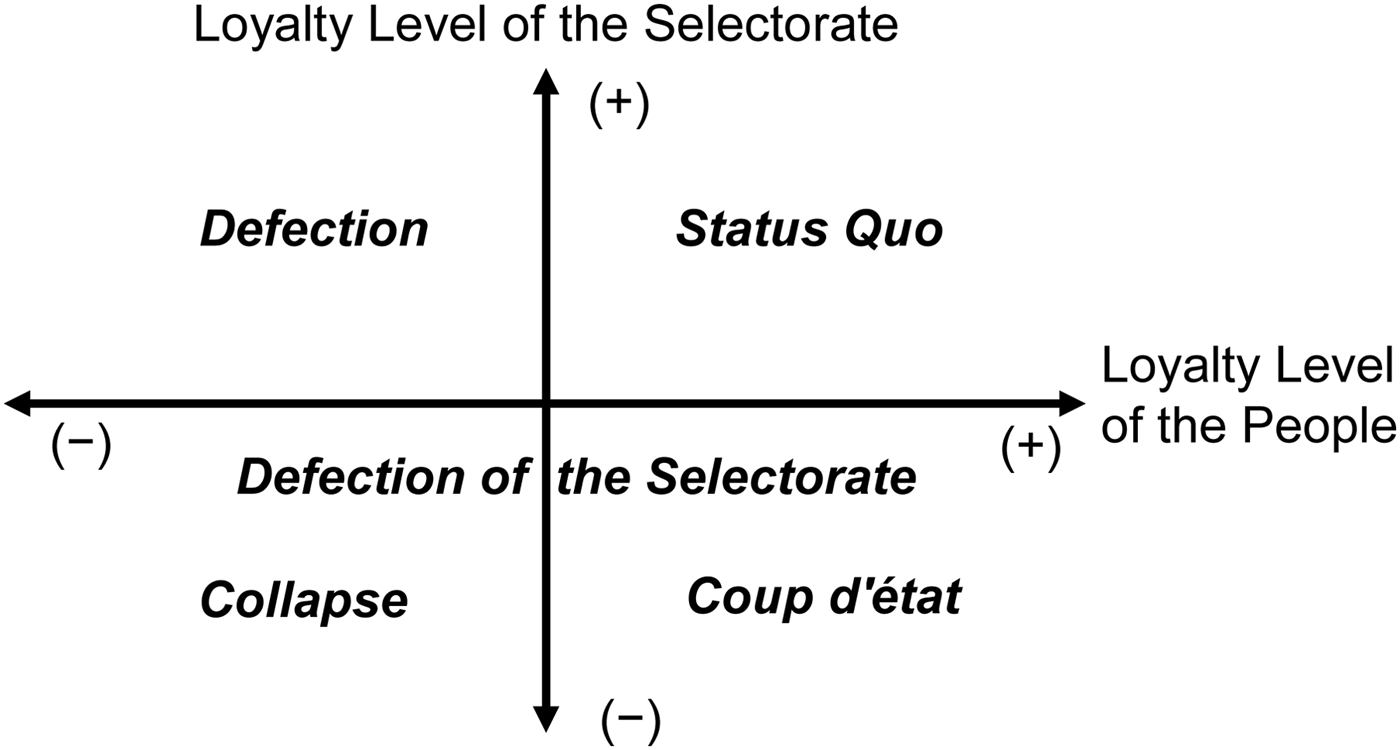
The destiny of the political survival of Kim Jong-un's regime will depend on the level of loyalty shown to the regime by both the selectorate and the people. The four structural scenarios that analyze the political destiny of Kim Jong-un's regime based on the selectorate theory are described in Figure 1.Footnote 5
Four structural scenarios analyzing the political destiny of Kim Jong-un's regime in North Korea. Status quo: The loyalty of both the selectorate and the people remains stable. Consequently, the status quo is maintained. Defection: The loyalty of the selectorate is kept high, whereas that of the people decreases. Hence, the possibility of defection, including mass exodus, increases. Defection of the selectorate: The loyalty of the selectorate is decreasing while that of the people is concomitantly decreasing. The possibility of defection of the selectorate increases and that of coup d’état is not ruled out either. However, the possibility of absolute collapse is yet to come. Coup d’état: The loyalty of the people is kept high, whereas that of the selectorate decreases. Accordingly, the possibility of an internal conflict, such as a coup d’état, increases. Collapse: The loyalty of both the selectorate and the people decreases. The possibility of absolute collapse becomes feasible.

As seen in the structural model, the current North Korean political situation lies in the defection of the selectorate, in which the loyalty of the selectorate is decreasing while that of the people is concomitantly decreasing. Kim Jong-un's greatest concern is the sliding of the current situation into the far more serious possibility of a coup d’état or collapse. Accordingly, the regime has made substantial efforts to prevent the current situation from worsening. In addition to the strategic symbiotic relationship with the inner circle, downsizing the winning coalition, peculiar personnel management, plutocracy, and the ever-intensifying reign of terror, Kim Jong-un has been buying the loyalty of the Party and Cabinet by authorizing them to reward themselves directly in the market. Furthermore, he is purchasing the loyalty of the military by increasing the military budget and executing military-friendly policies, such as land mine provocation in the Demilitarized Zone in between the two Koreas in 2015, firing missiles 16 consecutive times and performing nuclear tests twice in 2016 alone; the most recent missile tests in 2017 are considered the country's most successful to date. He uses much of North Korea's limited resources on asymmetric warfare capabilities, such as nuclear weapons, and uses the rest for rewarding the essentials where he sees fit, rather than on meeting the basic needs of the population. In summary, Kim Jong-un's regime relies on physical coercion to effectively reinforce his position as leader and emphasize his strength as chief commander internally, while raising the level of prestige and substantial military strength of the country, and thus increasing the possibility of his political survival.
6. Conclusion
In late August 2016, northeastern North Korea was severely affected by the heaviest floods since 1945, with tens of thousands of buildings destroyed and people left suffering great hardship. However, Kim Jong-un's regime has made an open and public call for assistance rather than using its own resources for the rescue. International society has responded by providing emergency food and rescue missions through the Red Cross and the World Food Program (Hong, Reference Hong2016). This event came a few days after the fifth nuclear missile test. Indeed, this event is a clear example of Kim Jong-un's strategy for political survival in times of economic hardship. Given the chronic shortage of resources, dictator Kim Jong-un may be able to extract more relief assistance by letting people die and exploiting the goodwill of the international community, which enhances his political survival as per selectorate theory (see Bueno De Mesquita and Smith, Reference Bueno De Mesquita and Smith2011: 208–209). Kim Jong-un's regime relies on the same tools used by his forefathers to stay in power: restrictive social policies, manipulation of ideas and information, and manipulation of foreign governments (Byman and Lind, Reference Byman and Lind2010: 45). The methods have proven relatively successful in that the regime has managed to survive up until now. When all the analytical results are combined, therefore, the prospects of the political survival of Kim Jong-un's dictatorship are good.
Then, what will be the longer term prognosis for North Korea if Kim Jong-un's regime does politically survive? Those interviewed for this study commonly assert, ‘North Korea is the strongest dictatorship, unprecedented in history’. They further explain that even if intensifying international sanctions over military provocations could worsen the economic situation, the internal durability of North Korea that overcame the Arduous March in the late 1990s is far stronger. Moreover, a dictatorship with a small coalition can survive an economic crisis that involves mass casualties as long as it can preserve the resources to sustain the coalition. Indeed, concerning North Korea's economic situation, no specific difference is found between the official statements by the North Korean authorities under Kim Jong-il's rule and those under Kim Jong-un's rule. Korea Central News Agency (2011: 288–305) and the Korea Central News Agency (2016: 419–433) both describe surplus of government revenue, successful agricultural production, and construction of power stations, factories, and social infrastructure. However, according to the interviewed North Korean defectors, the actual economic sentiment of North Korea's people under Kim Jong-un's rule has actually been ameliorating, due to marketization and China's limited cooperation with international sanctions for military brinkmanship restricting these measures’ potentially negative influence on North Korea's economy. Taxation, especially in dictatorship, redistributes resources from those outside the coalition (the poor) to those inside the coalition (the elites) (Bueno De Mesquita and Smith, Reference Bueno De Mesquita and Smith2011: 79). Accordingly, Kim Jong-un's regime is likely to extract as much as possible from the people by allowing them pseudo economic autonomy, such as is seen in the 6.28 Measure and economic activities in the market.
Finally, it is not easy to predict whether Kim Jong-un will eventually be able to establish the same politico-ideological authority as supreme leader that was enjoyed by his forefathers. However, it is certainly debatable whether he will be able to continue ruling the regime relying solely on peculiar personnel management and the reign of terror, or whether he will be able to continue exerting forms of soft power and hard power over the elite group that, in turn, exert coercive forms of hard power over the people and each other (citation removed for peer review). This situation will thus always leave the possibility that while his regime is further intensifying the reign of terror on the selectorate and the coalition, they may find an alternative that can assure their political survival and equivalent (or better) benefits. Consequently, if he continues his current ruling method, no one will completely rule out the descent of the current situation into the far more serious possibility of a coup d’état.
Financial support
Not applicable.
Conflict of interests
None.
Hanhee Lee is a Professor of the School of Global Service at Sookmyung Women's University of the Republic of Korea. He is affiliated with the Ash Center for Democratic Governance and Innovation, the Weatherhead Center for International Affairs at Harvard University, the World Bank, and the Committee on Foreign Affairs of the US House of Representatives. He graduated from Harvard and Korea University.