


Introduction
Carotenoids are typically colourful, mostly C-40-based pigments that are generally obtained via plant food items. Over 1100 different carotenoids have been identified(Reference Yabuzaki1), and additional new carotenoids are being discovered, including shorter (C-30), and longer (C-50) analogues of bacterial origin(Reference Rodriguez-Concepcion, Avalos and Bonet2). Likewise, apo-carotenoids, carotenoid breakdown products formed in plants(Reference Felemban, Braguy, Zurbriggen and Al-Babili3) or after human ingestion(Reference Harrison and Quadro4), can be considered to belong to this group.
The interest in these secondary plant compounds has increased considerably in the past two to three decades, due to the relation of their intake and circulating plasma concentrations with chronic disease risk. A high carotenoid intake within a plant-food-rich diet and carotenoid concentrations in plasma have been related, among others, to a reduced risk of type-2 diabetes(Reference Sluijs, Cadier, Beulens, van der, Spijkerman and van der Schouw5), age-related macular degeneration(Reference Zhou, Zhao and Johnson6), some types of cancer such as those of the prostate(Reference Dulińska-Litewka, Hałubiec, Łazarczyk, Szafrański, Sharoni, McCubrey, Gąsiorkiewicz and Bohn7), and even total mortality(Reference Zhao, Zhang, Zheng, Li, Zhang, Tang and Xiang8). The underlying mechanisms for such associated health benefits are not quite clear and are the topic of controversial discussions, but potential mechanisms include direct antioxidant effects such as quenching of singlet oxygen and lipid peroxides(Reference Krinsky and Johnson9), interactions with transcription factors related to inflammatory pathways (e.g. NF-kB) and oxidative stress (e.g., Nrf-2)(Reference Bohn10), and also their interaction with the nuclear factors retinoid-X receptors (RXRs) and retinoic acid receptors (RARs) together with peroxisome proliferator-activated receptors (PPARs)(Reference Bonet, Canas, Ribot and Palou11–Reference Mounien, Tourniaire and Landrier13).
It has also been postulated that the potential health benefits are conveyed not necessarily by the native carotenoids, following their absorption in the small intestine, but by their metabolites / cleavage products. Carotenoids as lipophilic constituents are absorbed following their micellisation into enterocytes, where they may partly undergo cleavage by carotenoid oxygenases, namely BCO1 and BCO2, resulting in the formation of symmetrical or non-symmetrical cleavage products(Reference Amengual, Widjaja-Adhi, Rodriguez-Santiago, Hessel, Golczak, Palczewski and von Lintig14).
While some of the symmetrical cleavage products have vitamin A activity (following e.g. cleavage of β-carotene or β-cryptoxanthin) by BCO1, the biological role of the other cleavage products remains uncertain. These cleavage products or apo-carotenoids have been proposed to be bioactive. For instance, in in vitro studies, lycopene derivatives were shown to have higher affinity to Nrf-2 and NF-kB, due to their higher electrophilicity, and perhaps better aqueous solubility(Reference Linnewiel, Ernst, Caris-Veyrat, Ben-Dor, Kampf, Salman, Danilenko, Levy and Sharoni15–Reference Bruzzone, Ameri and Briatore19). Lycopene has been shown to act in part similarly to vitamin A metabolites in normalising a vitamin-A-deficient diet in rats / mice(Reference Aydemir, Kasiri, Bartok, Birta, Frohlich, Bohm, Mihaly and Rühl20). It cannot also be excluded that bacteria in the colon produce more hydrophilic metabolites of carotenoids that are bioavailable and bioactive(Reference Dingeo, Brito, Samouda, La Frano and Bohn21).
Therefore, there has been increased interest in carotenoid metabolites and their potential connection to health benefits. A limitation of their detection in human specimens is the lack of commercial standards, in addition to their lower concentration and the lower sensitivity of UV- detection, the most common technique employed in their quantification, due to the shortened delocalised electron system in the molecule.
In this review, we strive to present the current state of knowledge of metabolites and breakdown product of carotenoids in humans, their known concentration ranges, and potential health benefits involved, as well as pointing out gaps and potential ways forward in this research domain. In this review, we focused exclusively on the human situation, owing to the proven presence of the described carotenoids and carotenoid metabolites in humans.
Carotenoid metabolites in plasma and tissues
Rationale for interest in metabolites and overview of metabolites
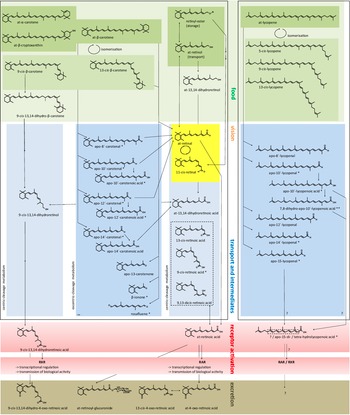
Carotenoids, with major human food relevance (Fig. 1 and Table 1), were investigated mainly for their metabolism in the human body, and it is uncertain whether the native compounds alone or rather their metabolites are responsible for the attributed health effects. Mainly nuclear hormone receptor-mediated effects were the focus of these studies(Reference Evans and Mangelsdorf22,Reference Mangelsdorf, Thummel and Beato23) . These ligand-activated receptors include RARs and RXRs, which may become activated, resulting in altered gene expression of a large set of genes involved in inflammation, differentiation, proliferation and lipid metabolism / homoeostasis(Reference Balmer and Blomhoff24–Reference Karkeni, Bonnet, Astier, Couturier, Dalifard, Tourniaire and Landrier27).
Metabolic pathway starting from all-trans-β-carotene and all-trans-lycopene via (a) geometric isomerisation, (b) eccentric cleavage metabolism and (c) centric-cleavage mechanisms. Starting from food, towards transport and intermediate derivatives, nuclear hormone receptor activating ligands including further regulation of transcription and thereby major mediation of biological signalling of carotenoids and further deactivation / excretion metabolites. Arrows in the figure indicate potential and simplified metabolic pathways. Derivatives that were not conclusively identified to be present endogenously in humans were marked with a star (*) and represent derivatives which that were suggested as metabolites and identified in in vitro or in vivo experimental approaches. Additional derivatives, which were predicted based on analytical studies, were indicated by two starts (**). Abbreviations: AT: all-trans-, RAR: retinoic acid receptor, RXR: retinoid-X receptor.

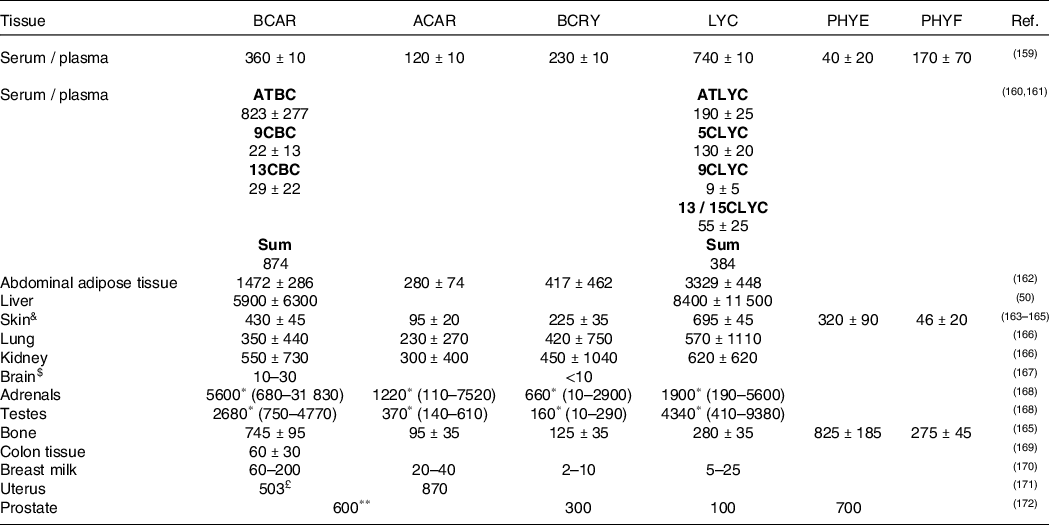
Concentrations of carotenoids in various tissues, all data in nM (nmol/kg or L), adapted from ref.(Reference Böhm, Borel and Corte-Real97)

All values represent mean ± SD; ‘blank’ represents non-determined carotenoids or no data available.
$ , infants, prefrontal cortex, frontal cortex, hippocampus, auditory cortex and occipital cortex.
£ , values given in literature as ‘carotenes’.
& , dermis and epidermis of back, forehead, inner forearm and hand.
* , including upper and lower level of this range.
** , indicates a value as a potential sum of BCAR and ACAR.
ACAR, α-carotene; BCAR, β-carotene; BCRY, β-cryptoxanthin; LYC, lycopene; PHYE, phytoene; PHYF, phytofluene; CBC: cis-β-carotene; CLC: cis-lycopene; ATLYC: all-trans-lycopene; ATBC: all-trans β-carotene.
The activation of RARs and / or RXRs was shown to be related to physiologically and nutritionally relevant levels of endogenous carotenoid metabolites(Reference Mangelsdorf, Ong, Dyck and Evans28–Reference Petkovich, Brand, Krust and Chambon31). Thus, native carotenoids may not interact on their own with gene-regulatory pathways, but rather via their metabolites, the apo-carotenoids, here conclusively the apo-15-carotenoids / retinoids and potentially others, such as apo-13/14-carotenoids that might interact with the binding grooves of RARs and RXRs(Reference Eroglu, Hruszkewycz and dela Sena32–Reference Schierle and Merk34). Here, a focus for activating compounds is put on apo-carotenoids with an acid functionality, while apo-carotenoids with aldehyde or alcohol functionalities might result in low affinity activators / antagonistic compounds(Reference Schierle and Merk34). Consequently, knowing more on their identity, concentration, metabolic pathways and homeostatic control and further RAR-RXR-mediated signalling appears critical for estimating potential health benefits of carotenoids(Reference Schmidt, Brouwer and Nau35–Reference Allenby, Janocha, Kazmer, Speck, Grippo and Levin39) (Tables 1 and 2).
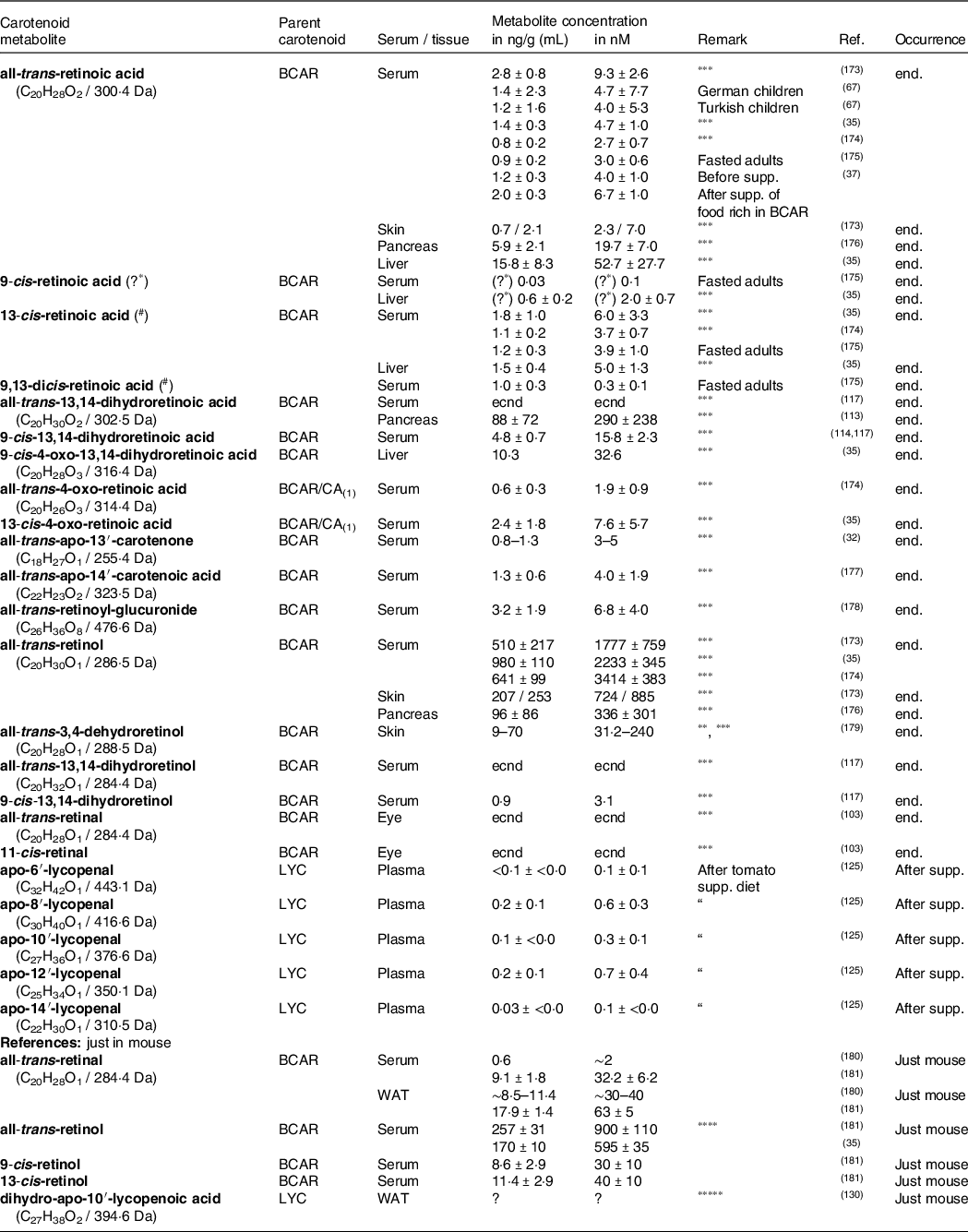
Levels of major carotenoid metabolites / retinoids in blood plasma / serum and tissues including molecular weight in Dalton (Da) and molecular formula of each retinoid

* , likely just an isomerisation product of ATRA during sample preparation.
** , present in different concentrations in different zones of the human skin.
*** , healthy adults.
**** , all-trans-retinol levels in mouse are just used as reference for comparison with 9-cis- and 13-cis-retinol levels, which were just determined in mouse serum and not in humans.
***** , derivatives which were predicted by analytical studies.
# , 9,13-dicis- and 13-cis-retinoic acid usually co-elute during HPLC separation and are not identified separately in many described studies.
(1): 4-oxo-retinoic acid was described as an in vitro metabolite of canthaxanthin(Reference Stahl, Hanusch and Sies182).
BCAR, β-carotene; LYC, lycopene; CA, canthaxanthin; WAT, white adipose tissue; end., endogenous; supp., supplementation; ecnd, exact concentration was not determined.
Individual carotenoids, listed in Table 1 along with their endogenous levels in serum / plasma as well as selected organs, may be cleaved by either BCO1 (centric cleavage) or BCO2 (excentric cleavage) to produce a variety of apo-carotenoids / retinoids (Fig. 1 and Tables 1 and 2)(Reference dela Sena, Narayanasamy, Riedl, Curley, Schwartz and Harrison40,Reference dela Sena, Sun, Narayanasamy, Riedl, Yuan, Curley, Schwartz and Harrison41) .
In general, there are three different types of carotenoid metabolites that occur in human plasma / serum and tissues and have been detected especially after carotenoid supplementation: (a) non-cleaved carotenoids with modifications at the cyclohexenyl ring or the polyene chain, such as epoxycarotenoids, geometric isomers and metabolites resulting from further rearrangement pathways; (b) excentrically cleaved metabolites with also alcohol, aldehyde or carboxylic acid functionalities; and (c) centrically cleaved metabolites with additional alcohol, aldehyde or carboxylic acid functionalities (Fig. 1 and Tables 1 and 2). Of note, glucuronidated products are also formed, following phase II conjugation, prior to their excretion via the kidney, as reported, for example, for retinoic acids(Reference Barua and Olson42–Reference Radominska, Little, Lehman, Samokyszyn, Rios, King, Green and Tephly44).
The origin of selected apo-15-carotenoids / retinoid derivatives, such as retinyl esters, retinol, retinal and retinoic acids, might occur from various metabolic pathways including (a) central cleavage of individual carotenoids such as β-carotenes or β-cryptoxanthins (Fig. 1) by BCO1 cleavage(Reference Amengual, Lobo, Golczak, Li, Klimova, Hoppel, Wyss, Palczewski and von Lintig45–Reference Kiefer, Hessel, Lampert, Vogt, Lederer, Breithaupt and von Lintig47); (b) by interaction of these previously mentioned carotenoids with environmental or endogenous oxidants and following cleavage(Reference Bohn10,Reference Caris-Veyrat, Schmid, Carail and Böhm48,Reference Bohn, Desmarchelier, El, Keijer, van Schothorst, Rühl and Borel49) ; or (c) by BCO1 cleavage of individual apo-carotenoids, which might originate from food directly or from mitochondrially based BCO2 cleavage in the human organism(Reference Amengual, Widjaja-Adhi, Rodriguez-Santiago, Hessel, Golczak, Palczewski and von Lintig14,Reference Amengual, Lobo, Golczak, Li, Klimova, Hoppel, Wyss, Palczewski and von Lintig45,Reference Kiefer, Hessel, Lampert, Vogt, Lederer, Breithaupt and von Lintig47) .
Alternatively, these apo-15-carotenoids / retinoids might originate from food-derived apo-15-carotenoids present at high concentration in animal-derived food matrices, such as retinol and retinyl esters, or from bioactive retinoids, such as retinoic acids and retinal, which are present in low amounts in the food matrix. Unfortunately, it is not possible to quantitatively describe which derivative originated from which individual pathway, or even at which percentile amount, due to the large variety of individually consumed food sources and individual enzymatic pathways present in humans(Reference Bohn, Desmarchelier, El, Keijer, van Schothorst, Rühl and Borel49–Reference Bohn, Bonet and Borel51).
Interestingly, some studies have reported that blood and tissue concentrations of active vitamin A retinoids differ significantly between disease and health state (reviewed in ref.(52)). These results raise the question as to whether the differences in such levels are caused by the disease or whether low intake of carotenoids has led to the development of these conditions. It appears that, at least in inflammation-related diseases, vitamin A active compounds are often less abundant in plasma, likely as a consequence and not as a cause of the disease(Reference Rubin, Ross, Stephensen, Bohn and Tanumihardjo52), as a potential feedback to counteract inflammation mediated by bioactive vitamin A derivatives induced by pro-inflammatory RAR- and RXR-mediated signalling(Reference Al Senaidy53,Reference Nogueira, Borges, Lameu, Franca, Rosa and Ramalho54) .
In many countries, shortage of food and especially vitamin A deficiencies are still common(Reference Akhtar, Ahmed, Randhawa, Atukorala, Arlappa, Ismail and Ali55), and supplementation with provitamin A carotenoids / vitamin A appears to be a prudent strategy. However, in our Western society, vitamin A intakes are very often quite high, while carotenoid intake is generally lower(56,Reference Biehler, Alkerwi, Hoffmann, Krause, Guillaume, Lair and Bohn57) . This has partly been associated with pathophysiological situations(Reference Aage, Kiraly, Da Costa, Byberg, Bjerregaard-Andersen, Fisker, Aaby and Benn58–Reference Crandall63). Whether increased all-trans-retinoic acid (ATRA) concentrations in plasma or tissue following carotenoid supplementation are purely beneficial has thus been the subject of controversial discussion(Reference Mihaly, Gericke, Lucas, de Lera, Alvarez, Torocsik and Rühl64–Reference Gruber, Taner, Mihaly, Matricardi, Wahn and Rühl67). The lipid hormone ATRA has been described to be associated with cell differentiation, proliferation and apoptosis with beneficial relevance mainly for cancer prevention(Reference Wei, Kozono and Kats68,Reference Connolly, Nguyen and Sukumar69) , and various diseases related to reduced inflammatory competence(Reference Tan, Sande, Pufnock, Blattman and Greenberg70,Reference Saiag, Pavlovic, Clerici, Feauveau, Nicolas, Emile and Chastang71) . Unfortunately, ATRA has also been associated with toxic effects, especially embryonic toxicity(Reference Tzimas and Nau72,Reference David, Hodak and Lowe73) .
Recently, ATRA has been discussed more controversially in the context of diabetes, obesity, allergies and osteoporosis(Reference Govind Babu, Lokesh, Suresh Babu and Bhat74–Reference Trasino and Gudas76). Especially the adverse effects of retinoids regarding inflammatory processes, related to many diseases in Western societies, and alteration of local and systemic lipid metabolism and homoeostasis are regarded as critical(Reference David, Hodak and Lowe73,Reference Rühl, Garcia, Schweigert and Worm77,Reference Wansley, Yin and Prussin78) . Therefore, it must be carefully evaluated whether retinoid / carotenoid supplementation in such countries is generally beneficial.
General properties of metabolites originating from β-carotene and β-cryptoxanthin
When focusing on β-carotene, we may obtain a large variety of known and yet unknown, although partly postulated, metabolites (Fig. 1). In this chapter, β-carotene isomers such as α- or γ-isoforms of carotene, geometric isomers of these carotenes, were included, as well as the provitamin A carotenoid β-cryptoxanthin as a relevant precursor for the carotenoid metabolites addressed later in this subchapter (Fig. 1 and Table 1).
Firstly, several chain-modified carotenoid metabolites have been identified, including in mammals and human serum, with epoxy-, oxo- and hydroxyl-containing functional groups located at the cyclohexenyl ring or at the polyene chain, as well as additional isomers(Reference Khachik, Spangler, Smith, Canfield, Steck and Pfander79,Reference Britton, Liaaen-Jensen and Pfander80) . Whether these metabolites originate from plant-based metabolism or from mammalian endogenous metabolism is not always obvious. Concentrations of these potential metabolites, which are usually lower than those of their parent direct / indirect nutritional precursor all-trans-β-carotene, are rarely reported. Precise quantification presents a challenge, owing to the lack of commercially available standards and also lower UV–Vis sensitivity.
Several similar compounds may also be generated during digestion or food processing(Reference Britton, Liaaen-Jensen and Pfander80). For example, upon gastrointestinal exposure to oxidising agents, such as iron, a large variety of degradation products in the intestine have been reported, including several β-apo-carotenals(Reference Kopec, Caris-Veyrat, Nowicki, Gleize, Desmarchelier and Borel81), epoxides and diketones(Reference Sy, Dangles, Borel and Caris-Veyrat82). On the other hand, many reports have stated that carotenoids from plant matrices remain relatively stable upon in vitro digestion, as demonstrated for β-carotene(Reference Ferruzzi, Lumpkin, Schwartz and Failla83), lutein(Reference Granado-Lorencio, Olmedilla-Alonso, Herrero-Barbudo, Perez-Sacristan, Blanco-Navarro and Blazquez-Garcia84) and lycopene(Reference Richelle, Sanchez, Tavazzi, Lambelet, Bortlik and Williamson85). Whether such degradation products can be absorbed, and whether they are then further metabolised in vivo, remains unknown(Reference Kopec, Caris-Veyrat, Nowicki, Gleize, Desmarchelier and Borel81).
Various apo-carotenoids originating from excentric cleavage of carotenoids were identified in mammals and partly in the human organism after carotenoid supplementation(Reference Eroglu and Harrison86,Reference Harrison, dela Sena, Eroglu and Fleshman87) . Both BCO1 and BCO2 appear able to cleave β-carotene. While BCO1 appears to favour full-length provitamin A carotenoids resulting in centric cleavage, BCO2 appears to cleave both provitamin A carotenoids and xanthophylls excentrically(Reference dela Sena, Narayanasamy, Riedl, Curley, Schwartz and Harrison40,Reference dela Sena, Sun, Narayanasamy, Riedl, Yuan, Curley, Schwartz and Harrison41,Reference Bandara, Thomas, Ramkumar, Khadka, Kiser, Golczak and von Lintig88) and is induced in BCO1−/− mice adipose tissue, leading to β-apo-10’-carotenol accumulation(Reference Amengual, Gouranton and van Helden89). It is possible that some of these metabolites are themselves substrates for BCO1/2, as indicated for β-apo-8′-carotenal, β-apo-10′-carotenal, β-apo-12′-carotenal and β-apo-14′-carotenal in chicken and rats(Reference Eroglu and Harrison86,Reference Kim and Oh90,Reference Harrison91) . Unfortunately, as already outlined, a clear ordination as to which individual carotenoid metabolite is created by which specific individual metabolic pathway with specific substrate / product derivatives is not possible due to the large diversity of food sources and individual human enzymatic pathways(Reference Bohn, Desmarchelier, El, Keijer, van Schothorst, Rühl and Borel49,Reference Böhm, Lietz and Olmedilla-Alonso92) . This large variety of food sources with individual carotenoid-metabolite precursors and endogenous enzymatic pathways is an important feature of the mammalian organism(Reference Bohn, Desmarchelier, El, Keijer, van Schothorst, Rühl and Borel49,Reference Böhm, Lietz and Olmedilla-Alonso92) . It entails the use of various regionally and timely restricted available food sources to create and degrade ligands for nuclear hormone receptors to enable normal healthy biological functions. This also includes auto-regulative metabolic and uptake pathways to regulate ligand creation and degradation, as exemplified and described in detail in a review relevant for β-carotene(Reference Bohn, Desmarchelier, El, Keijer, van Schothorst, Rühl and Borel49), outlined in Fig. 1.
Different apo-carotenals and apo-carotenoic acids of various chain lengths were found after β-carotene supplementation(Reference Eroglu and Harrison86,Reference Harrison, dela Sena, Eroglu and Fleshman87) . These were then synthesised ex vivo and further studied in molecular biological experiments, and partly identified after direct supplementation of β-carotene and food items rich in β-carotene. These described apo-carotenoids are of different chain lengths, ranging from apo-8′-, apo-10′-, apo-12′- and apo-14′-carotenals, and can further be oxidised to apo-carotenoic acids (Fig. 1). Contrarily, endogenously produced levels have rarely been described, only for selected derivatives(Reference Ho, de Moura, Kim and Clifford93). Following the ingestion of tomato juice high in β-carotene (360 ml, 30 mg β-carotene, 35 μg apo-carotenoids per day), only apo-10′- and 12′-carotenal were reported to be detected in plasma of some individuals under the set quantification limit, though unfortunately without any added visualised analytical confirmation(Reference Cooperstone, Riedl, Cichon, Francis, Curley, Schwartz, Novotny and Harrison94). It could not be distinguished whether these were absorbed or formed de novo in vivo (Reference Kopec, Caris-Veyrat, Nowicki, Gleize, Desmarchelier and Borel81,Reference Cooperstone, Riedl, Cichon, Francis, Curley, Schwartz, Novotny and Harrison94) . In a study by Kopec et al. (Reference Kopec, Caris-Veyrat, Nowicki, Gleize, Desmarchelier and Borel81), (13C-10)-β-carotene was administered to healthy subjects. Though non-symmetrical β-apo-carotenals were found in the gut, none was observed in the plasma TRL fraction, suggesting a low bioavailability.
Following excentric cleavage, shorter products such as β-ionone, β-cyclocitral and related derivatives have been described in vitro as well as in animals(Reference dela Sena, Sun, Narayanasamy, Riedl, Yuan, Curley, Schwartz and Harrison41,Reference Sommerburg, Langhans and Arnhold95) . Carotenoid metabolites, originating from two-side carotenoid cleavage, were also described as carotenedials in vitro, including rosafluene and crocetindial(Reference Amengual, Lobo, Golczak, Li, Klimova, Hoppel, Wyss, Palczewski and von Lintig45), but these have not yet been identified in vivo and thereby were also not further investigated regarding physiologically relevant nuclear hormone-mediated signalling.
Finally, and possibly most important for the biological activity of carotenoids, centric-cleavage metabolites have been described. These metabolites of β-carotene, α-carotene and β-cryptoxanthin are the apo-15-carotenoic acids, termed retinoic acids(Reference von Lintig and Wyss96). Retinoic acids are well-known endogenous derivatives, functioning as lipid hormone receptor ligands, responsible for activating two major families of nuclear hormone receptors, that is, the RARs and RXRs. These receptors can, following ligand activation, modify transcription of receptor-specific genes(Reference Evans and Mangelsdorf22,Reference Mangelsdorf, Thummel and Beato23) . The major products are retinoic acids, mainly in the form of ATRA, the endogenous ligand of the RARs (RARα, β, γ), as reviewed previously(Reference Petkovich, Brand, Krust and Chambon31). Endogenous levels of ATRA in serum / plasma were in the range of 0·8–2·8 ng/ml (2·7–9·3 nM) and up to 6 ng/g (20 nM) in the pancreas and 16 ng/g (53 nM) in the liver (Table 2). Thus, these concentrations are at least one to two magnitudes lower than those of β-carotene in the bloodstream, with concentrations of approximately 0·1–2 µM (Table 1 (Reference Böhm, Borel and Corte-Real97)). While these centric cleavage products are the main activators of RARs and RXRs(Reference Allenby, Bocquel and Saunders38,Reference Allenby, Janocha, Kazmer, Speck, Grippo and Levin39) , the excentric apo-carotenoid apo-13-carotenone is present at lower endogenous levels of 0·8–1·3 ng/ml (3–5 nM) and has been demonstrated to act as ‘antagonist’ or low-affinity partial agonist or competitive antagonist, but the physiological and nutritional relevance is not yet known(Reference Eroglu, Hruszkewycz and dela Sena32,Reference Harrison, dela Sena, Eroglu and Fleshman87) . The physiological and nutritional relevance of the ‘antagonism’ / partial agonist activity was never convincingly determined for humans, though in in vitro experiments, with weak and questionable prediction potential for humans, but is deemed plausible when considering endogenous concentrations in human serum (3–5 nM, Table 2 and Fig. 1).
In addition to ATRA, other geometric isomers were identified endogenously, such as 13-cis-, 9,13-dicis- and 9-cis-retinoic acid(Reference Horst, Reinhardt, Goff, Nonnecke, Gambhir, Fiorella and Napoli98–Reference Sass and Nau100), with low concentrations (Table 2). A large focus was placed on 9-cis-retinoic acid (9CRA), which was postulated as ‘an’ or even ‘the’ endogenous ligand of RXRs (RXRα, β, γ)(Reference Levin, Sturzenbecker and Kazmer29,Reference Heyman, Mangelsdorf, Dyck, Stein, Eichele, Evans and Thaller30) . However, this is seen as controversial by the authors / additional experts in the field of retinoid lipidomics(Reference de Lera, Krezel and Rühl36,Reference Wolf101,Reference Rühl, Krzyzosiak and Niewiadomska-Cimicka102) focusing on ultrasensitive retinoid-lipidomics analysis, as its endogenous presence and function as a physiologically relevant lipid hormone could not be confirmed. Alternative endogenous geometric isomers of retinoic acid, including 13-cis-, 9,13-dicis- and 11-cis-retinoic acid were not described to be of relevant major biological activity mediated via the activation of RARs–RXRs(Reference Levin, Sturzenbecker and Kazmer29). For retinal, the endogenous cycle between all-trans-retinal and 11-cis-retinal in the visual cycle in the eye is well established(Reference Palczewski103,Reference von Lintig, Moon and Babino104) , but it is of no systemic relevance for the whole human organism.
For ATRA, increased serum levels of 1·2 to 2·0 ng/ml (4·0 to >6·7 nM) were found following supplementation of β-carotene-rich foods(Reference Rühl, Bub and Watzl37). Whether these increased serum levels reflect also tissue levels and increased RAR-mediated signalling was and could not be identified. The physiological and nutritional relevance in humans could also not be evaluated. This intervention with food items rich in β-carotene resulted in low and non-significant alterations of interleukin (IL) secretion and immune response as indicators of RAR-mediated signalling(Reference Watzl, Bub, Brandstetter and Rechkemmer105,Reference Watzl, Bub, Briviba and Rechkemmer106) . Whether such β-carotene interventions are beneficial for humans is questionable. Interestingly, the strongest effects were identified in the carotenoid wash-out phase prior to intervention, resulting in reduced IL-2, natural killer (NK) cell cytotoxicity and lymphocyte proliferation, a potential consequence of β-carotene (or general carotenoid) or even vitamin A deficiency and possibly reduced RAR–RXR-mediated signalling(Reference Watzl, Bub, Briviba and Rechkemmer106). These reductions were rapidly recovered after β-carotene or lycopene supplementations, likely as a consequence of recovered RAR–RXR-mediated signalling(Reference Watzl, Bub, Briviba and Rechkemmer106). In animal studies, β-carotene supplementation resulted in the recovery of vitamin A deficiency indicated by visualised RARE-mediated signalling. In addition, serum, but not liver, ATRA concentrations were improved, while retinol levels recovered and even increased(Reference Aydemir, Kasiri, Bartok, Birta, Frohlich, Bohm, Mihaly and Rühl20). It can be assumed that β-carotene supplementation can reinstate basal retinol and ATRA concentrations and RAR-mediated signalling. However, no further increase in ATRA concentrations in organs and enhanced RAR-mediated signalling could be observed as a result of increased storage and transport of retinol due to a highly regulated homoeostasis of retinoid / vitamin A / RAR-mediated signalling pathways.
Nutritionally relevant β-carotene intake mainly contributes to the anti-infective properties of vitamin A, which is commonly identified as its major activity besides ocular functions(Reference Rühl12,Reference Underwood107) . It is suggested that provitamin A carotenoids are relevant for maintaining vitamin A activity, while being of no further physiologically or nutritionally proven relevance.
In contrast, long-term high-dose supplementation of pure synthetic all-trans-β-carotene, studied in tobacco-smoke-exposed ferrets, may alter RAR–RXR-mediated signalling by a negative feedback regulation(Reference Lee, Leung and Tang108), thereby strongly reducing RARβ- and ATRA levels in the lung, as the target organ(Reference Wang, Liu, Bronson, Smith, Krinsky and Russell109,Reference Lotan110) .
In addition, it is questionable whether higher-than-basal RAR-mediated signalling is more beneficial or whether it can be considered as detrimental, while increased RXR-mediated signalling may be considered mainly beneficial(Reference Desvergne25). On the basis of these limited studies, we conclude that β-carotene can prevent general vitamin A deficiency(Reference Rühl, Bub and Watzl37,Reference Watzl, Bub, Briviba and Rechkemmer106) , reaching a plateau, while higher and pure β-carotene supplementation seems unrelated to improved health status(Reference Bohn, Desmarchelier, El, Keijer, van Schothorst, Rühl and Borel49). It seems unlikely that moderate or even high dietary consumption of natural food items rich in β-carotene and additional bioactive derivatives including other carotenoids has non-beneficial effects.
Recently, dihydro-metabolites of apo-15-carotenoids were described in mice, likely originating from 13,14-dihydroretinol(Reference Moise, Kuksa, Imanishi and Palczewski111) (Fig. 1 and Table 2). In a larger cohort study, 13,14-dihydroretinol and the novel identified endogenous all-trans-13,14-dihydroretinoic acid(Reference Moise, Alvarez and Dominguez112,Reference Bazhin, Bleul, de Lera, Werner and Rühl113) and 9-cis-13,14-dihydroretinoic acid(Reference Krezel, Rühl and de Lera33,Reference de Lera, Krezel and Rühl36,Reference Rühl, Krzyzosiak and Niewiadomska-Cimicka102) were analysed in human serum(Reference Lucas, Szklenar, Mihály, Szegedi, Töröcsik and Rühl114) as well as adipose tissue (Rühl et al. unpublished). All-trans-13,14-dihydroretinoic acid was described as a medium-affinity endogenous RAR ligand(Reference Allenby, Bocquel and Saunders38,Reference Sani, Venepally and Levin115) , and recently, 9-cis-13,14-dihydroretinoic acid (9CDHRA) became a focus of attention, as it appears to be ‘an’ or even ‘the’ physiologically and nutritionally relevant RXR ligand in mammals, serving as a novel endogenous lipid hormone(Reference Krezel, Rühl and de Lera33,Reference de Lera, Krezel and Rühl36,Reference Rühl, Krzyzosiak and Niewiadomska-Cimicka102) . Further nutritionally relevant precursors of 9CDHRA, such as 9-cis-13,14-dihydroretinol, 9-cis-dihydrocarotenoids and even the well-known 9-cis-β-carotene were recently postulated(Reference Rühl, Krezel and de Lera116) and confirmed(Reference Krężel, Rivas, Szklenar, Ciancia, Alvarez, de Lera and Rühl117) as even being a new independent vitamin A signalling pathway, termed vitamin A5 (Fig. 1)(Reference Bohn, Hellmann-Regen, de Lera, Böhm and Rühl118).
Metabolites of lycopene
In addition to β-carotene, lycopene is one of the major carotenoids present in the diet, resulting in high tissue and blood concentrations (Fig. 1 and Tables 1 and 2). However, the metabolism of lycopene has been studied to a much lesser extent compared with that of β-carotene and especially when focusing on the human situation.
Oxidative metabolism of lycopene and of additional acyclic carotenoids such as phytoene and phytofluene (Table 1) has been described(Reference Khachik, Carvalho, Bernstein, Muir, Zhao and Katz119), while such metabolism was neither conclusively observed nor the focus in studies employing lutein and other carotenoids with hydroxyl- / oxo-functional groups, such as zeaxanthin, canthaxanthin, β-cryptoxanthin and astaxanthin, which would have broader relevance for the human situation. Selected xanthophylls were described to interact and block apo-carotenoid-mediated signalling(Reference van den Berg120,Reference van den Berg and van Vliet121) , while no mechanism involving xanthophyll-metabolites was mentioned and outlined. Both excentric and centric metabolism was described for lycopene(Reference dela Sena, Narayanasamy, Riedl, Curley, Schwartz and Harrison40,Reference dela Sena, Sun, Narayanasamy, Riedl, Yuan, Curley, Schwartz and Harrison41) . With the exception of lycopenoids, there was no further focus on the identification of potential endogenous derivatives or molecular biological examination to investigate their biological activities(Reference Caris-Veyrat, Garcia, Reynaud, Lucas, Aydemir and Rühl122–Reference Aydemir, Kasiri, Birta, Beke, Garcia, Bartok and Rühl124). Various lycopenals were identified and predicted in the food matrix and in the human organism after a tomato product intervention. Human serum levels were reported to be low (Fig. 1 and Table 2 (Reference Kopec, Riedl, Harrison, Curley, Hruszkewycz, Clinton and Schwartz125)).
While many studies display a complex pattern of lycopene metabolism via various pathways(Reference dela Sena, Narayanasamy, Riedl, Curley, Schwartz and Harrison40,Reference Kopec, Riedl, Harrison, Curley, Hruszkewycz, Clinton and Schwartz125–Reference Wang129) , and potential lycopene metabolites were found after supplementing high amounts of lycopene in experimental animal models(Reference Aydemir, Kasiri, Birta, Beke, Garcia, Bartok and Rühl124,Reference Gouranton, Aydemir and Reynaud130–Reference Gajic, Zaripheh, Sun and Erdman132) , a direct association of human relevance was only recently indirectly concluded(Reference Moran, Thomas-Ahner and Fleming133). Indirect evidence of lycopene activity and a further lycopene metabolite for RAR activation was revealed, using a RARE-luciferase-expressing mouse model(Reference Aydemir, Kasiri, Bartok, Birta, Frohlich, Bohm, Mihaly and Rühl20,Reference Aydemir, Carlsen, Blomhoff and Rühl134) . Based on RARE-mediated signalling, a partial vitamin A activity following lycopene intervention was found(Reference Aydemir, Kasiri, Bartok, Birta, Frohlich, Bohm, Mihaly and Rühl20). An identification of the involved functional metabolites was only partly achieved, and apo-15-lycopenoic acids were claimed to be present endogenously, especially after lycopene supplementation(Reference Aydemir, Kasiri, Birta, Beke, Garcia, Bartok and Rühl124,Reference Ben-Dor, Nahum and Danilenko135) .
Other lycopenoic acids might also be bioactive, as it was shown previously in a mouse study that the potential lycopene metabolite apo-10′-lycopenoic acid(Reference Hu, Liu, Ernst, Krinsky, Russell and Wang131) reduced hepatic fat accumulation(Reference Ip, Liu, Lichtenstein, von Lintig and Wang136). The physiological and nutritional relevance of apo-10′-lycopenoic acid was only shown in ferrets(Reference Hu, Liu, Ernst, Krinsky, Russell and Wang131), but could not be confirmed in vivo in mice and ex vivo for humans(Reference Gouranton, Aydemir and Reynaud130). Alternatively, due to extensive metabolism, a dihydro-apo-10′-lycopenoic acid analogue was identified and on the basis of UV and mass spectrometry characteristics predicted to be 7,8-dihydro-apo-10′-lycopenoic acid. How lycopene is metabolised to dihydro-apo-10′-lycopenoic acid and whether apo-10′-lycopenoic acid is a potential intermediate are yet unanswered questions. These dihydro-apo-10-lycopenoids are likely to be direct precursors of dihydro-apo-15-lycopenoids, which might be highly potent RAR and / or RXR ligands(Reference Aydemir, Kasiri, Birta, Beke, Garcia, Bartok and Rühl124).
Summary for carotenoid metabolites
Thus, for many metabolites it remains inconclusive whether they derive from human metabolism or are ingested via animal origin as pre-formed carotenoid metabolites in the forms of retinol and mainly retinyl esters(Reference Rühl12,Reference Rühl137) . In addition, the biological function and the concentration-dependent activity of various carotenoid metabolites besides ATRA has generally not been studied, mostly due to the lack of available standard compounds and established sensitive and selective analytical methods. Furthermore, the direct link between carotenoid intake and RAR–RXR-mediated transcriptional signalling as a multi-step procedure has not yet been proven. However, each step of this cascade has been clearly demonstrated with experimental data: (a) higher carotenoid supplementation resulting in higher carotenoid levels in supplemented individuals(Reference Watzl, Bub, Brandstetter and Rechkemmer105,Reference Muller, Bub, Watzl and Rechkemmer138) , (b) higher β-carotene levels correlating and resulting in increased ATRA concentrations(Reference Rühl, Bub and Watzl37,Reference Bohn, Desmarchelier, El, Keijer, van Schothorst, Rühl and Borel49) , (c) higher ATRA levels causing increased RAR-mediated signalling(Reference Aydemir, Carlsen, Blomhoff and Rühl134); and (d) higher RAR-mediated signalling resulting in increased individual-specific immune responses(Reference Rubin, Ross, Stephensen, Bohn and Tanumihardjo52,Reference Rühl, Garcia, Schweigert and Worm77,Reference Rühl, Hanel, Garcia, Dahten, Herz, Schweigert and Worm139,Reference Zunino, Storms and Stephensen140) and altered lipid metabolism(Reference Landrier, Kasiri and Karkeni141,Reference Rühl and Landrier142) , with partially beneficial or detrimental effects.
Recently, a novel class of bioactive carotenoid metabolites, namely strigolactones, was described to be enzymatically synthesised in certain plants, such as carlactones(Reference Al-Babili and Bouwmeester143–Reference Alder, Jamil and Marzorati145) and identified as plant-relevant hormones during germination(Reference Al-Babili and Bouwmeester143) and branching inhibition(Reference Gomez-Roldan, Fermas and Brewer146). Whether these derivatives are of direct or indirect relevance for the human organism remains speculative.
In summary, human supplementation studies with food items rich in β-carotene / lycopene or supplemented β-carotene / lycopene, focusing on multi-targeted analyses, and identifying β-carotene / lycopene and retinoid concentrations and further RARE-mediated signalling, have not yet been performed and should be addressed. Due to the access of multi-omic techniques, serum markers or novel transcriptional markers of diseases(Reference Casamassimi, Federico, Rienzo, Esposito and Ciccodicola147,Reference Pedrotty, Morley and Cappola148) , possibly also co-associated with vitamin A / carotenoid deficiency or reduced RAR–RXR-mediated dysfunction(Reference Desvergne25,Reference Altucci, Leibowitz, Ogilvie, de Lera and Gronemeyer149) , should be compared with carotenoid intake and serum / plasma carotenoid / retinoid concentrations to obtain valuable correlations.
Discussion and perspectives
Several carotenoids are implicated in health-related outcomes, from AMD (lutein and zeaxanthin) to possible effects regarding cardio-metabolic diseases (predominantly, β-carotene) and diabesity / cancer (predominantly, lycopene). The dietary intake of carotenoids has also changed over time. While lycopene intake was uncommon in the pre-industrialised human diet, especially considering the primarily European-focused world view, it strongly increased in Western society, due to a high consumption of tomatoes and tomato products(Reference Jenab, Ferrari and Mazuir150).
Additionally, it became obvious that light irradiation(Reference Xu and Harvey151) and more practically relevant thermal food processing(Reference Schieber and Carle152), as also reviewed by Khoo et al.(Reference Khoo, Prasad, Kong, Jiang and Ismail153), including cooking >100°C, appears to constitute important mechanisms for carotenoid isomerisation, yielding different precursor carotenoids for different functional apo-carotenoids, as well as non-endogenous human-generated apo-carotenoids, serving as easy accessible substrates for functional apo-carotenoids(Reference Cooperstone, Novotny, Riedl, Cichon, Francis, Curley, Schwartz and Harrison154). This highlights cooking and food processing as important cultural achievement for generating bioactive derivatives for enabling a healthy and well-functioning human organism(Reference Rosati155).
However, carotenoids are generally considered as lipid precursors (mainly for bioactive vitamin A / retinoids) in the diet, while their complex and multi-step metabolic pathways and the relationship with health beneficial effects are still poorly understood. In this review, we summarised all available relevant information focusing on the human organism with implication of mechanistic results from further in vitro to in vivo experiments. Unfortunately, these experimental results are difficult to generalise to humans owing to the non-similar nutri-kinetics pattern of carotenoids(Reference Lee, Boileau, Boileau, Williams, Swanson, Heintz and Erdman156) and different eating behaviour in humans compared with the pure vegetarian dietary pattern of rodents, which are frequently used as experimental animal models.
Conclusions
As a cornerstone, we suggest that, besides benchmark concentrations for carotenoids, retinoids should also be considered, including both ‘normal’ and deficiency threshold ranges. These ranges should correlate with well-defined and established nuclear hormone receptor signalling cascade markers, disease markers, prognostic early markers of diseases and markers of impairments of physiologically important functions based on novel ‘omics’ markers such as transcriptomics, lipidomics and proteomics, which are now frequently published for various target diseases(Reference Olivier, Asmis, Hawkins, Howard and Cox157). In the case of diseases and dysfunctions related to carotenoid and vitamin A deficiency, underlying molecular mechanisms such as RAR–RXR- / RXR-plus additional nuclear hormone receptor (NHR)-dysfunctional signalling(Reference Evans and Mangelsdorf22,Reference Desvergne25,Reference Szanto, Narkar, Shen, Uray, Davies and Nagy158) (i.e. signalling not associated with a healthy condition as present in various diseases of Western society) should also be considered.
On the basis of these two ranges, targeted supplementation strategies may be recommended to overcome deficiencies and reach and maintain ‘normal’ concentration ranges. A correlation between dietary intake, serum levels and bioactive carotenoid metabolites and further examination of RXR–RAR / RXR–NHR in an easily accessible compartment such as peripheral blood mononuclear cells (PBMCs), plus target genes of relevant diseases, are missing in carotenoid / retinoid nutritional research.
The basal benchmark concentration indicating a higher risk for chronic diseases appears to constitute a total carotenoid plasma / serum concentration <1·000 nM and should further focus on endogenous retinoids. The second benchmark concentration reflecting ‘normal’ carotenoid intake is average plasma / serum concentration of individual and total carotenoids indicating, and here defined as, a healthy varied diet. Such levels can then be translated into the intake of relevant food items rich in carotenoids, based on correlations between reported average intakes for β-carotene and lycopene with serum concentrations and considering intervention with carotenoid-rich foods(Reference Böhm, Borel and Corte-Real97).
In this review article, we summarised the current mechanisms of carotenoid metabolism including reference levels of bioactive carotenoid metabolites with relevance to the human organism. To summarise, elucidation of carotenoid-to-bioactive-metabolite metabolism is important to justify which biological-response pathway of carotenoids is enabled to elicit valuable beneficial effects. This is paramount in order to evaluate if there might be a problem in individual dietary intake of food enriched in specific carotenoids is present or if a genetic hereditary problem in metabolism of carotenoids to bioactive carotenoids based on genetic polymorphisms is the cause of disturbed occurrence of bioactive carotenoid metabolites.
Acknowledgements
This article is partly based upon work from the COST Action 13156, EUROCAROTEN (European network to advance carotenoid research and applications in agro-food and health, www.eurocaroten.eu), supported by COST (European Cooperation in Science and Technology). Opinions contained herein are those of the authors and do not necessarily represent the views of any institutions.
This article is not sponsored or funded by any agency or association, and has received support only from the EU-COST Action 13 156.
There are no conflicts of interest.