Introduction
Acute coronary syndrome (ACS) including acute myocardial infarction (MI) or unstable angina is the leading cause of disease burden worldwide (Murray et al. Reference Murray, Vos, Lazano, Naghavi, Flaxman, Michaud, Ezzati, Shibuya, Salomon, Abdalla, Aboyans, Abraham, Ackerman, Aggarwal, Ahn, Ali, Alvarado, Anderson, Anderson, Andrews, Atkinson, Baddour, Bahalim, Barker-Collo, Barrero, Bartels, Basáñez, Baxter, Bell, Benjamin, Bennett, Bernabé, Bhalla, Bhandari, Bikbov, Bin, Birbeck, Black, Blencowe, Blore, Blyth, Bolliger, Bonaventure, Boufous, Bourne, Boussinesq, Braithwaite, Brayne, Bridgett, Brooker, Brooks, Brugha, Bryan-Hancock, Bucello, Buchbinder, Buckle, Budke, Burch, Burney, Burstein, Calabria, Campbell, Canter, Carabin, Carapetis, Carmona, Cella, Charlson, Chen, Cheng, Chou, Chugh, Coffeng, Colan, Colquhoun, Colson, Condon, Connor, Cooper, Corriere, Cortinovis, de Vaccaro, Couser, Cowie, Criqui, Cross, Dabhadkar, Dahiya, Dahodwala, Damsere-Derry, Danaei, Davis, De Leo, Degenhardt, Dellavalle, Delossantos, Denenberg, Derrett, Des Jarlais, Dharmaratne, Dherani, Diaz-Torne, Dolk, Dorsey, Driscoll, Duber, Ebel, Edmond, Elbaz, Ali, Erskine, Erwin, Espindola, Ewoigbokhan, Farzadfar, Feigin, Felson, Ferrari, Ferri, Fèvre, Finucane, Flaxman, Flood, Foreman, Forouzanfar, Fowkes, Fransen, Freeman, Gabbe, Gabriel, Gakidou, Ganatra, Garcia, Gaspari, Gillum, Gmel, Gonzalez-Medina, Gosselin, Grainger, Grant, Groeger, Guillemin, Gunnell, Gupta, Haagsma, Hagan, Halasa, Hall, Haring, Haro, Harrison, Havmoeller, Hay, Higashi, Hill, Hoen, Hoffman, Hotez, Hoy, Huang, Ibeanusi, Jacobsen, James, Jarvis, Jasrasaria, Jayaraman, Johns, Jonas, Karthikeyan, Kassebaum, Kawakami, Keren, Khoo, King, Knowlton, Kobusingye, Koranteng, Krishnamurthi, Laden, Lalloo, Laslett, Lathlean, Leasher, Lee, Leigh, Levinson, Lim, Limb, Lin, Lipnick, Lipshultz, Liu, Loane, Ohno, Lyons, Mabweijano, MacIntyre, Malekzadeh, Mallinger, Manivannan, Marcenes, March, Margolis, Marks, Marks, Matsumori, Matzopoulos, Mayosi, McAnulty, McDermott, McGill, McGrath, Medina-Mora, Meltzer, Mensah, Merriman, Meyer, Miglioli, Miller, Miller, Mitchell, Mock, Mocumbi, Moffitt, Mokdad, Monasta, Montico, Moradi-Lakeh, Moran, Morawska, Mori, Murdoch, Mwaniki, Naidoo, Nair, Naldi, Narayan, Nelson, Nelson, Nevitt, Newton, Nolte, Norman, Norman, O'Donnell, O'Hanlon, Olives, Omer, Ortblad, Osborne, Ozgediz, Page, Pahari, Pandian, Rivero, Patten, Pearce, Padilla, Perez-Ruiz, Perico, Pesudovs, Phillips, Phillips, Pierce, Pion, Polanczyk, Polinder, Pope, Popova, Porrini, Pourmalek, Prince, Pullan, Ramaiah, Ranganathan, Razavi, Regan, Rehm, Rein, Remuzzi, Richardson, Rivara, Roberts, Robinson, De Leòn, Ronfani, Room, Rosenfeld, Rushton, Sacco, Saha, Sampson, Sanchez-Riera, Sanman, Schwebel, Scott, Segui-Gomez, Shahraz, Shepard, Shin, Shivakoti, Singh, Singh, Singh, Singleton, Sleet, Sliwa, Smith, Smith, Stapelberg, Steer, Steiner, Stolk, Stovner, Sudfeld, Syed, Tamburlini, Tavakkoli, Taylor, Taylor, Taylor, Thomas, Thomson, Thurston, Tleyjeh, Tonelli, Towbin, Truelsen, Tsilimbaris, Ubeda, Undurraga, van der Werf, van Os, Vavilala, Venketasubramanian, Wang, Wang, Watt, Weatherall, Weinstock, Weintraub, Weisskopf, Weissman, White, Whiteford, Wiebe, Wiersma, Wilkinson, Williams, Williams, Witt, Wolfe, Woolf, Wulf, Yeh, Zaidi, Zheng, Zonies, Lopez, AlMazroa and Memish2012). After the acute stage of ACS, treatment becomes focused on improving general health and functional status (Ruo et al. Reference Ruo, Rumsfeld, Hlatky, Liu, Browner and Whooley2003). Accordingly, quality of life (QoL) is increasingly being used as a relevant outcome measure (Stafford et al. Reference Stafford, Berk, Reddy and Jackson2007). Considerable efforts have been made to investigate the determinants of QoL in ACS, and depression was identified as one of the most significant factors that has adverse impacts on QoL in ACS (Dickens et al. Reference Dickens, McGowan, Percival, Tomenson, Cotter, Heagerty and Creed2006). Unfortunately, depression is common in ACS, in that the prevalence of major depression is estimated to range from 15% to 27%, with an even higher proportion of patients with minor depression (Rudisch & Nemeroff, Reference Rudisch and Nemeroff2003).
Most previous research into depression and QoL in ACS has been observational, confirming both cross-sectional and prospective associations (Beck et al. Reference Beck, Joseph, Belisle and Pilote2001; Sullivan et al. Reference Sullivan, LaCroix, Russo and Walker2001; Ruo et al. Reference Ruo, Rumsfeld, Hlatky, Liu, Browner and Whooley2003; de Jonge et al. Reference De Jonge, Spijkerman, van den Brink and Ormel2006; Dickens et al. Reference Dickens, McGowan, Percival, Tomenson, Cotter, Heagerty and Creed2006; Parashar et al. Reference Parashar, Rumsfeld, Spertus, Reid, Wenger, Krumholz, Amin, Weintraub, Lichtman, Dawood and Vaccarino2006). Based on these observations, it is conceivable that treatment of depression may have beneficial effects on improving QoL. Only a few studies have investigated this issue in ACS and have reported inconsistent findings. One is the Sertraline Antidepressant Heart Attack Randomized Trial (SADHART), in which sertraline was effective in improving QoL in the recurrent depression subgroup of hospitalized patients with ACS with major depressive disorder in a 24-week double-blind placebo-controlled trial (Swenson et al. Reference Swenson, O'Connor, Barton, Van Zyl, Swedberg, Forman, Gaffney and Glassman2003). The Enhancing Recovery in Coronary Heart Disease Patients (ENRICHD) study found that psychosocial interventions conferred modest QoL benefits in post-MI patients (Mendes de Leon et al. Reference Mendes de Leon, Czajkowski, Freedland, Bang, Powell, Wu, Burg, DiLillo, Ironson, Krumholz, Mitchell and Blumenthal2006). However, another study found no significant change in QoL associated with psychotherapeutic intervention (Bambauer et al. Reference Bambauer, Aupont, Stone, Locke, Mullan, Colagiovanni and McLaughlin2005). Longitudinal depression treatment effect on QoL has rarely been conducted and results are also controversial. In the Myocardial INfarction and Depression–Intervention Trial (MIND-IT) antidepressant trial, no beneficial effect on QOL at 18 months follow-up was found (van Melle et al. Reference van Melle, de Jonge, Honig, Schene, Kuyper, Crijns, Schins, Tulner, van den Berg and Ormel2007). However, a recent study reported superior effects of collaborative v. usual care for QoL in patients with chronic physical diseases with higher depression score, although the participants were composed of other than ACS patients (Von Korff et al. Reference Von Korff, Katon, Lin, Ciechanowski, Peterson, Ludman, Young and Rutter2011).
Overall, previous research on depression treatment effect on QoL has been scarce despite the clinical importance of this issue in ACS. Furthermore, most previous studies were performed with Caucasian populations, but have not been explored in Asians. It is necessary to investigate these issues outside Caucasian populations, because there is ethnic heterogeneity in cardiovascular profiles between Caucasians and Asians, including total cholesterol levels (Zhang et al. Reference Zhang, Patel, Horibe, Wu, Barzi, Rodgers, MacMahon and Woodward2003) and differences in antidepressant responses have been described (Kim et al. Reference Kim, Lim, Kim, Kim, Chang, Carroll and Kim2006). To address these limitations and unanswered questions, we analysed data from a naturalistic and interventional study in patients with ACS to investigate the escitalopram treatment effect of depression on QoL using a placebo-controlled design, and to assess the longitudinal effects of co-morbid depression and its treatment on QoL in ACS.
Method
Study overview and participants
This analysis was conducted using data from a large naturalistic study of patients with ACS, the Korean DEPression in ACS (K-DEPACS) study, which also included a nested randomized controlled trial for depressive patients with ACS, the Escitalopram for DEPression in ACS (EsDEPACS) study. The overall design and rationale have been published (Kim et al. Reference Kim, Bae, Kang, Kim, Shin, Hong, Kim, Shin, Ahn, Kim, Jeong and Yoon2014a ). The outline of the present study is presented in Fig. 1. Details on the eligibility criteria for the K-DEPACS and EsDEPACS participants are described in the online Supplementary material. Written informed consent was collected for the K-DEPACS and EsDEPACS studies, both of which were approved by the Chonnam National University Hospital Institutional Review Board.
Study outline and participant recruitment process. ACS, Acute coronary syndrome; BDI, Beck Depression Inventory; MINI, Mini-International Neuropsychiatric Interview; K-DEPACS, Korean Depression in Acute Coronary Syndrome study; EsDEPACS, Escitalopram for DEPression in Acute Coronary Syndrome study.

The naturalistic K-DEPACS study
To investigate the epidemiology of depressive disorders in patients with ACS using a naturalistic prospective design, the K-DEPACS study was conducted from 2006. Participants were consecutively recruited from patients recently hospitalized with ACS (N = 4809) at the Department of Cardiology of Chonnam National University Hospital, Gwangju, South Korea. In 2005, this Department was nominated by the Korean Circulation Society to serve as the central coordinating centre for the Korea Acute Myocardial Infarction Registry because of its large number of ACS patients (Hong et al. Reference Hong, Jeong, Ahn and Kang2013). Patients were treated based on international guidelines for the management of ACS (Anderson et al. Reference Anderson, Adams, Antman, Bridges, Califf, Casey, Chavey, Fesmire, Hochman, Levin, Lincoff, Peterson, Theroux, Wenger, Wright, Jneid, Ettinger, Ganiats, Philippides, Jacobs, Halperin, Albert, Creager, DeMets, Guyton, Kushner, Ohman, Stevenson and Yancy2013) by the study cardiologists. The K-DEPACS participants (N = 1152), those who met eligibility criteria and agreed to participate, were screened for depressive symptoms with the Beck Depression Inventory (BDI; Beck et al. Reference Beck, Ward, Mendelson, Mock and Erbaugh1961) at baseline as inpatients within 2 weeks (mean 6.3 ± 2.4 days) post-ACS and thereafter as outpatients every 4 weeks up to 12 weeks. Those with depressive symptoms (BDI > 10) on any of these occasions received a clinical evaluation by the study psychiatrists using the Mini-International Neuropsychiatric Interview (MINI; Sheehan et al. Reference Sheehan, Lecrubier, Sheehan, Amorim, Janavs, Weiller, Hergueta, Baker and Dunbar1998), and a structured diagnostic psychiatric interview for DSM-IV (APA, 1994). All baseline participants were approached for follow-up investigation at 1 year (mean 12.6 ± 2.7 months) after the baseline evaluation to assess the consequences of ACS at the chronic stage.
The nested randomized controlled trial: the EsDEPACS study
Of 446 participants with a baseline diagnosis of major or minor depressive disorder, the 300 who agreed to participate were randomized to a 24-week, double-blind, placebo-controlled trial of escitalopram efficacy and safety (ClinicalTrial.gov registry number: NCT00419471), in which it was found that escitalopram was superior to placebo in both primary depressive and secondary outcomes (Kim et al. Reference Kim, Bae, Jung, Kang, Kim, Kim, Shin, Hong, Kim, Shin, Ahn, Kim, Jeong and Yoon2014b ). The first patient was enrolled in May 2007 and the last patient completed the follow-up evaluation in March 2013. The 146 who declined participation in the trial received conventional medical treatment for ACS only (MTO).
The efficacy and safety of flexible doses of escitalopram (5, 10, 15 or 20 mg) were investigated using a randomized double-blind, placebo-controlled design. The escitalopram and placebo were provided by H. Lundbeck A/S (Denmark). Patients were randomized on a 1:1 ratio following computer-generated randomization codes provided by a statistician independent of the recruiting clinicians. Examinations were scheduled at baseline, and weeks 4, 8, 12, 16, 20, and 24 thereafter, with a 7-day allowable window. The initial escitalopram dose at baseline was 10 mg/day generally, but 5 mg/day for those aged ⩾65 years with hepatic dysfunction. After the second evaluation (week 4), the medication doses could be changed (from 5 to 20 mg/day) as determined by the investigators’ clinical decision considering response and tolerability of treatment without specific guidelines. Medications were taken once daily orally within 30 min after the supper meal. Adherence was checked by pill counts at every visit, and was defined as acceptable if at least 75%, in accordance with a previous escitalopram trial in MI patients (Jiang et al. Reference Jiang, Velazquez, Kuchibhatla, Samad, Boyle, Kuhn, Becker, Ortel, Williams, Rogers and O'Connor2013). At the end of 24-week double-blind treatment, the study was completed and study medication was tapered down. Concomitant medications such as any other antidepressant, psychostimulant, antipsychotic, or anticholinergic agents were not permitted. However, transient use was allowed of analgesics, antipyretics, and cold medicines, hypnotics such as zolpidem or triazolam, and benzodiazepines. Subjects evaluated at least once after baseline comprised the sample for the drug trial analysis here.
QoL measurements
QoL was measured by the World Health Organization Quality of Life – Abbreviated form (WHOQOL-BREF), a 26-item self-administered questionnaire in which items are rated on a 5-point scale (WHOQOL Group, 1998). WHOQOL-BREF evaluates four domains related to physical factors, psychological factors, social relationships, and environmental context. The Physical domain is composed of seven items including pain and discomfort; the Psychological domain is composed of six items including positive affect; the Social domain is composed of three items including personal relationships; and the Environmental domain is composed of eight items including financial resources and transportation. Since the ‘Psychological domain’ includes aspects of depressive symptoms, this subscale was excluded and the remaining three subscales were included in the analyses. Raw subscale scores were converted to a scale from 0 to 100 to facilitate comparisons with other instruments, with final scores representing the percentage of the total possible score achieved, i.e. higher scores indicate better QoL. The WHOQOL-BREF has been standardized in Korean, and the validity and reliability have been reported as satisfactory (Min et al. Reference Min, Lee, Kim, Suh and Kim2000). The K-DEPACS participants were evaluated at baseline (as inpatients mean 6.3 ± 2.4 days post-ACS and thereafter as outpatients every 4 weeks up to 12 weeks) and at 1-year follow-up (mean 12.6 ± 2.7 months); and the EsDEPACS participants were additionally assessed at the baseline point for the drug trial and follow-up weeks 4, 12, and 24 thereafter. Other than the WHOQOL-BREF, the assessment scales evaluated both the EsDEPACS and K-DEPACS but were not used in the present analysis and are described in the Supplementary material.
Demographic and clinical characteristics at baseline
Demographic data were obtained. For evaluating depressive symptoms, the self-completed BDI and psychiatrist-administered MINI diagnoses were ascertained as described. The following cardiovascular risk factors were ascertained: diagnosed hypertension and diabetes mellitus, hypercholesterolaemia by fasting serum total cholesterol level (>200 mg/dl), obesity by measured body mass index (BMI), and reported current smoking status. Severity of ACS was estimated by the Killip classification (Killip & Kimball, Reference Killip and Kimball1967), left ventricular ejection fraction (LVEF) was estimated using echocardiography, and serum cardiac biomarkers troponin I and creatine kinase-MB (CK-MB) were measured.
Statistical analysis
According to the depression co-morbidity and treatment status, participants were divided into four groups: no depression, depression on MTO, depression on escitalopram, and depression on placebo. Demographic and clinical characteristics at baseline were compared between the four groups by analysis of variance or χ2 tests with post-hoc Scheffé's tests or with individual pairwise post-hoc comparisons among four groups as appropriate. Characteristics significantly associated with depressive status (p < 0.05) were used as covariates in further analyses. For investigating the effects of co-morbid depression and its treatment on QoL in ACS patients, three analyses were conducted from three samples as shown in Fig. 1. First, to evaluate the association between depressive status and QoL at the acute stage of ACS, scores on three domains of WHOQOL-BREF at baseline were compared between the four groups using analysis of covariance with post-hoc Scheffé's tests after adjustment for characteristics significantly associated with depressive status at baseline. Second, to compare the 24-week treatment effect of escitalopram and placebo on QoL changes, subjects evaluated at least once after baseline comprised the dataset and were included in this analysis. Multiple imputation by chained equations was used for missing data due to discontinuation after post-baseline second (week 4) visits by treatment group, demographics (age and gender), and baseline measures on BDI and Killip scores. Repeated-measures analyses of covariance in a mixed model were used to calculate group × time interactions on the three domain scores of WHOQOL with corresponding baseline scores and characteristics significantly associated with depressive status at baseline as covariates. Finally, to compare the longitudinal effects of depression co-morbidity and treatment on QoL changes after 1 year, repeated-measures analyses of covariance in a mixed model were used to calculate group × time interactions on the three domain scores of WHOQOL with corresponding baseline scores and characteristics significantly associated with depressive status at baseline as covariates with individual pairwise post-hoc comparisons among the four groups. For this analysis, the 13 (eight escitalopram, five placebo) patients that exited post-randomization in the EsDEPACS trial were included as well. Bonferroni corrections were used to maintain an overall type I error rate of 0.05 against the multiple comparisons for three WHOQOL-BREF outcomes: a two-sided p value of 0.017 (0.05/3) was used to define statistical significance. Statistical analyses were performed using SPSS v. 18.0 (SPSS Inc., USA) and Stata v. 12.0 (StataCorp., USA) software.
Results
Recruitment
The recruitment process is described in Fig. 1. The K-DEPACS baseline sample (n = 1152) was divided into four groups: no depression (N = 706), depression on MTO (N = 146), depression on escitalopram (N = 149), and depression on placebo (N = 151). Of 300 participants randomized to the EsDEPACS trial, 83 (28%) exited from the study after baseline, and the remaining 217 (108 on escitalopram, 109 on placebo) formed the sample for the 24-week trial analysis. There were no significant differences in any baseline characteristic between the remaining subjects in two treatment groups (all p values >0.2). The serum CK-MB level was significantly higher in patients exiting after baseline evaluation compared to those followed-up (p = 0.043), but there were no significant differences in any other characteristic at baseline including scores on WHOQOL-BREF (all p values >0.05), as summarized in Supplementary Table S1. Of the 1152 K-DEPACS population, 828 (72%) (504 no depression, 111 depression on MTO, 107 depression on escitalopram, 106 depression on placebo) comprised the sample for 1-year follow-up analysis. Of the remaining 324 individuals, 200 (62%) were lost to follow-up, 50 (15%) died, 59 (18%) refused to participate, and 15 (5%) were too unwell to participate. Attrition was significantly associated with older age (p = 0.005) and higher Killip class (p = 0.039), but was not associated with any other baseline characteristic.
Baseline demographic and clinical characteristics
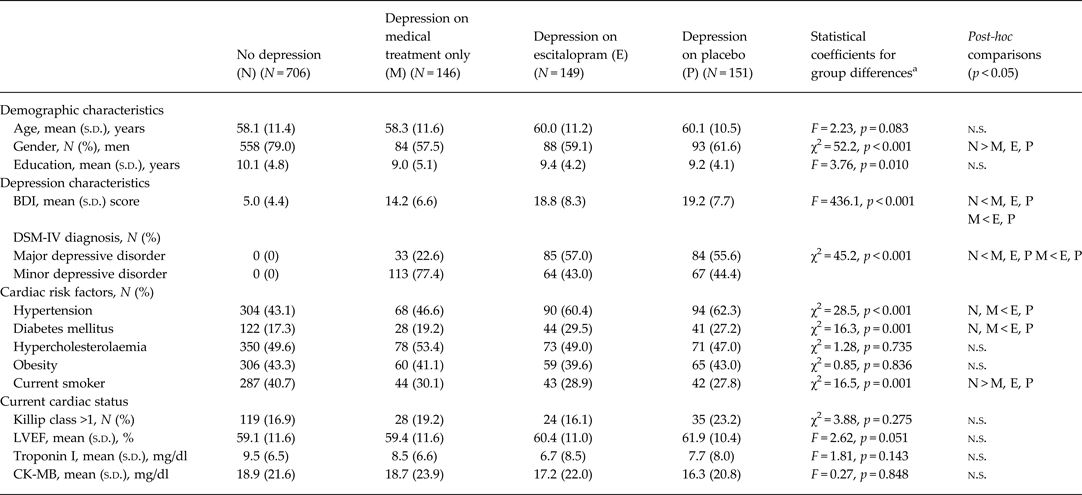
Baseline characteristics were compared between the four groups divided by depression co-morbidity and treatment status in Table 1. Significant group differences were found in gender, BDI scores, DSM-IV diagnosis of depressive disorder, hypertension, diabetes, and smoking status. These characteristics were included as covariates in subsequent analyses, apart from DSM-IV diagnosis because of collinearity with BDI. In post-hoc comparisons, the without depression group had a significantly higher number of men and current smokers compared to the three depression groups. The escitalopram and placebo trial groups had significantly higher BDI scores and higher prevalence of major depressive disorder compared to depression on MTO, and they had significantly higher prevalences of hypertension and diabetes compared to the remainder.
Baseline characteristics by depression and treatment status (N = 1152)

BDI, Beck Depression Inventory; LVEF, left ventricular ejection fraction; CK-MB, creatine kinase-MB.
a Analysis of variance or χ2 tests as appropriate.
Associations between depressive status and QoL at baseline
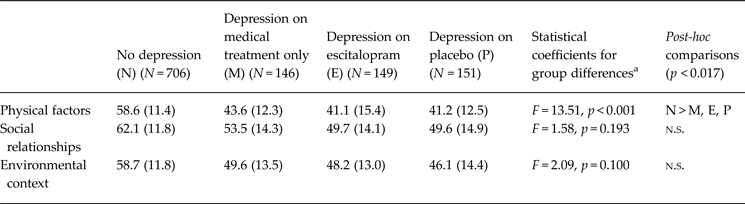
Scores on three domains of WHOQOL-BREF at baseline were compared between the four groups in Table 2. Significant group differences were found in the Physical domain, but were not found in the Social and Environmental domains context after adjustment for covariates. In post-hoc comparisons, those with no depression had significantly higher Physical domain scores compared to the combined three depression groups (p value <0.017, applying a Bonferroni correction for three outcomes).
Scores on three domains of World Health Organization Quality of Life – Abbreviated form by depression and treatment status at baseline (N = 1152). Data are mean (s.d.) scores

a Analysis of covariance after adjustment for gender, Beck Depression Inventory scores, hypertension, diabetes, and smoking status.
Comparison of escitalopram and placebo on QoL changes
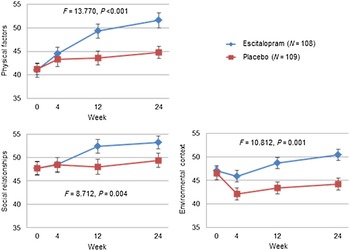
Score changes on the three WHOQOL-BREF domains during the 24-week double-blind treatment of escitalopram and placebo are displayed and compared in Fig. 2. With respect to treatment, the mean [standard deviation (s.d.)] doses at the last visit were 7.6 (3.7) mg and 8.5 (3.9) mg for the escitalopram and placebo groups, respectively, and the mean (s.d.) treatment durations were 138.3 (22.4) and 138.0 (22.9) days, respectively. In addition, there were no significant differences in any aspects related to study drug treatments, concomitant medications, and discontinuation between the escitalopram and placebo groups (Supplementary Table S2). However, there were significant differences in group × time interactions on all three domain scores of WHOQOL after adjustment for corresponding baseline scores and covariates (p value <0.017, applying a Bonferroni correction for three outcomes). All interactions indicated significantly more improvement in QoL domains in the escitalopram compared to placebo group over the 24-week treatment period. The effect sizes were 0.45, 0.34, and 033 for the Physical, Social, and Environmental domains, respectively.
Scores on the three domains of World Health Organization Quality of Life – Abbreviated form (WHOQOL-BREF) in the 24-week double-blind treatment of escitalopram and placebo (N = 217). Statistical coefficients were driven from repeated-measures analysis of covariance in a mixed model to calculate group × time interactions on the three domain scores of WHOQOL with corresponding baseline scores, gender, Beck Depression Inventory scores, hypertension, diabetes, and smoking status as covariates.

Longitudinal effects of depression co-morbidity and treatment on QoL changes
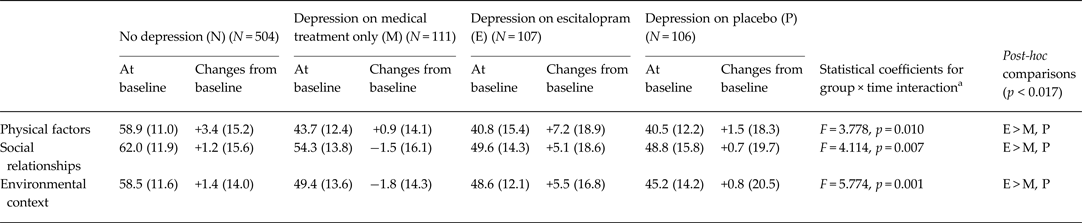
Score changes on the three domains of WHOQOL-BREF over 1 year are summarized and compared in Table 3, and displayed visually in Supplementary Fig. S1. There were significant differences in group × time interactions on all three scores of WHOQOL after adjustment for corresponding baseline scores and characteristics significantly associated with depressive status at baseline. In post-hoc comparisons, the escitalopram treatment group showed significantly more improvement in all domains compared to each of placebo and MTO groups (p value <0.017, applying a Bonferroni correction for three outcomes), but showed no significant improvement compared to those with no depression. Antidepressants were being taken by 19 participants (nine no depression, two depression on care as usual, five depression on escitalopram, three on depression on placebo) at the 1-year follow-up point. When the same analyses were repeated after excluding these participants, the results were not changed substantially (data not shown).
Scores on the three domains of World Health Organization Quality of Life – Abbreviated form (WHOQOL-BREF) at baseline and at one year follow-up by depression and treatment status (N = 828). Data are mean (s.d.) scores

a Repeated measures analysis of covariance in a mixed model with corresponding baseline three domain scores of WHOQOL, gender, Beck Depression Inventory scores, hypertension, diabetes, and smoking status as covariates.
Discussion
Principal findings of this study in patients with recent ACS were that QoL was lower in patients with co-morbid depressive disorder than those without, and that escitalopram treatment over 24 weeks was associated with QoL improvement on all domains in this patient group, an effect which remained evident at 1-year follow-up.
The association between depression and QoL in ACS
There have been numerous studies investigating associations between depression and QoL in ACS in Western settings (Beck et al. Reference Beck, Joseph, Belisle and Pilote2001; Sullivan et al. Reference Sullivan, LaCroix, Russo and Walker2001; Ruo et al. Reference Ruo, Rumsfeld, Hlatky, Liu, Browner and Whooley2003; de Jonge et al. Reference De Jonge, Spijkerman, van den Brink and Ormel2006; Dickens et al. Reference Dickens, McGowan, Percival, Tomenson, Cotter, Heagerty and Creed2006; Parashar et al. Reference Parashar, Rumsfeld, Spertus, Reid, Wenger, Krumholz, Amin, Weintraub, Lichtman, Dawood and Vaccarino2006), and two recent reviews concluded that depressive symptoms significantly undermine QoL in patients with ACS despite successful medical and surgical management (Stafford et al. Reference Stafford, Berk, Reddy and Jackson2007; Dickens et al. Reference Dickens, Cherrington and McGowan2012). Our findings in a Korean clinical sample were in keeping with this research in that depression was associated with poorer QoL even in the acute phase of ACS. A particular feature of the present study was that three aspects of QoL were evaluated and significant associations between depression and QoL were found in the Physical domain but not in Social or Environmental domains. Since baseline evaluations were made in hospitalized patients soon after ACS development, QoL domains of social and environmental aspects may not have been adequately quantified.
Depression treatment effects on QoL in ACS
Several randomized controlled trials have reported successful depression treatment results with medication or cognitive behavioural therapy in ACS (Roose et al. Reference Roose, Laghrissi-Thode, Kennedy, Nelson, Bigger, Pollock, Gaffney, Narayan, Finkel, McCafferty and Gergel1998; Strik et al. Reference Strik, Honig, Lousberg, Lousberg, Cheriex, Tuynman-Qua, Kuijpers, Wellens and Van Praag2000; Glassman et al. Reference Glassman, O'Connor, Califf, Swedberg, Schwartz, Bigger, Krishnan, van Zyl, Swenson, Finkel, Landau, Shapiro, Pepine, Mardekian, Harrison, Barton and Mclvor2002; Lespérance et al. Reference Lespérance, Frasure-Smith, Koszycki, Laliberté, van Zyl, Baker, Swenson, Ghatavi, Abramson, Dorian and Guertin2007). As far as we are aware, only one study has investigated the effects of depression treatment on QOL in ACS: the SADHART study, in which 369 hospitalized patients with ACS with major depressive disorder were randomized to 24 weeks’ double-blind treatment with sertraline or placebo (Swenson et al. Reference Swenson, O'Connor, Barton, Van Zyl, Swedberg, Forman, Gaffney and Glassman2003). Sertraline was superior to placebo in improving QoL in the recurrent depression subgroup; but there was no significant difference between sertraline and placebo in the total randomized group. The study design of our EsDEPACS trial was similar to that of SADHART in terms of the enrolment point (acute stage of ACS) and treatment period (24 weeks). However, in the EsDEPACS trial, escitalopram was superior to placebo in all randomized patients. The difference in favour of escitalopram over placebo was clinically relevant, with effect sizes of 0.33–0.45 for mean changes from baseline to endpoint. Furthermore, the changes in the escitalopram group are approximately half of the baseline s.d. which is considered to be the threshold of discrimination for changes in health-related QoL for chronic diseases (Norman et al. Reference Norman, Sloan and Wyrwich2003). The difference may be due to the study sample characteristics in that 44% of the EsDPEACS trial patients were diagnosed as having minor depressive disorder, and therefore levels of depression in EsDEPACS participants were less severe than in the SADHART study [mean baseline scores on the Hamilton Depression Rating Scale for Depression (Hamilton, Reference Hamilton1960) were 16 and 20, respectively] (Glassman et al. Reference Glassman, O'Connor, Califf, Swedberg, Schwartz, Bigger, Krishnan, van Zyl, Swenson, Finkel, Landau, Shapiro, Pepine, Mardekian, Harrison, Barton and Mclvor2002). We included these patients a priori, based on previous research reporting that minor depression is frequent (Stafford et al. Reference Stafford, Berk, Reddy and Jackson2007) and has significant negative effects on cardiac prognosis (Bush et al. Reference Bush, Ziegelstein, Tayback, Richter, Stevens, Zahalsky and Fauerbach2001). Furthermore, several meta-analyses have suggested that antidepressant effects are substantial only in severely depressed patients (Fournier et al. Reference Fournier, DeRubeis, Hollon, Dimidjian, Amsterdam, Shelton and Fawcett2010), although other studies have demonstrated antidepressant efficacy as sufficiently robust to recommend treatment for patients with non-severe depressive symptoms (Stewart et al. Reference Stewart, Deliyannides, Hellerstein, McGrath and Stewart2012).
Longitudinal effects of depression co-morbidity and treatment on QoL in ACS
A recently published study reported 1-year QOL outcomes in patients with chronic physical diseases including diabetes and ACS (Von Korff et al. Reference Von Korff, Katon, Lin, Ciechanowski, Peterson, Ludman, Young and Rutter2011), randomizing 218 patients with higher depression scores to 12-month multi-condition collaborative or usual care. Integrated care was found to enhance global QoL at 6- and 12-month evaluation points. Another study demonstrated beneficial effects of telephone-delivered collaborative care on health-related QoL in patients with coronary artery bypass graft at 8 months follow-up (Rollman et al. Reference Rollman, Belnap, LeMenager, Mazumdar, Houck, Counihan, Kapoor, Schulberg and Reynolds2009). Furthermore, a low-intensity collaborative care model to concurrently manage cardiac patients with depression and/or anxiety disorders was effective for improving mental health-related QoL (Huffman et al. Reference Huffman, Mastromauro, Beach, Celano, DuBois, Healy, Suarez, Rollman and Januzzi2014). In keeping with the previous findings, the present 24-week escitalopram treatment effect on QoL persisted to the 1-year follow-up point, which is a novel finding and suggests that escitalopram was superior not only to placebo but also to no treatment in depressive disorders. However these positive findings were not consistent with those of MIND-IT trial, which found no effects of antidepressive intervention on QoL at 18 months follow-up (van Melle et al. Reference van Melle, de Jonge, Honig, Schene, Kuyper, Crijns, Schins, Tulner, van den Berg and Ormel2007). More studies with longer follow-up period are needed. Participants on escitalopram treatment did not experience significantly greater improvements in QoL compared to non-depressed participants. Since QoL in ACS is closely associated with depressive symptoms, the QoL of the non-depressed ACS patients might have improved with the natural course of the disease independent of depressive disorder.
Strengths and limitations
Our study comprehensively evaluated effects of depression co-morbidity and its treatment on QoL in a large number of ACS patients with both a prospective observational and interventional study design. The observed prevalence of depressive disorder including both major and minor was 38.7% (446/1152), comparable to previous reports (31–56%) conducted over a similar time-frame and with the same diagnostic criteria (Lesperance et al. Reference Lesperance, Frasure-Smith and Talajic1996; Catipović-Veselica et al. Reference Catipović-Veselica, Galić, Jelić, Baraban-Glavas, Sarić, Prlić and Catipović2007). The intervention was a randomized placebo-controlled trial. Participants were recruited at baseline consecutively from all eligible patients with a recent ACS and were followed at 1 year thereafter, which reduced the risk of error arising from heterogeneous examination times and therefore increased the sample homogeneity. Depressive disorder was ascertained using a structured diagnostic interview, and all measurement methods for psychiatric and cardiovascular characteristics were well validated.
A range of covariates were considered in the analyses. Recruitment was conducted at a single site, unlike previous studies using multi-centre recruitment (Beck et al. Reference Beck, Joseph, Belisle and Pilote2001; Swenson et al. Reference Swenson, O'Connor, Barton, Van Zyl, Swedberg, Forman, Gaffney and Glassman2003; de Jonge et al. Reference De Jonge, Spijkerman, van den Brink and Ormel2006; Von Korff et al. Reference Von Korff, Katon, Lin, Ciechanowski, Peterson, Ludman, Young and Rutter2011). This may limit the generalizability of the present findings, but a single-centre study has strengths in terms of consistency in the evaluation and treatment of patients. The 1-year follow-up rate was reasonable (72%) for the cohort as a whole, and although attrition was associated with older age and poorer cardiac status at baseline, it was not associated with depressive status. In addition, the statistical models for 1-year follow-up analysis were designed for comparing groups that were formed by random assignment, while the MTO group was not randomly assigned but was formed by those depressed patients who refused to take part in the clinical trial. Furthermore, the baseline characteristics of the MTO group indicate less severe depression symptoms, lower prevalence of major depressive disorder, and higher QoL ratings (Tables 1 and 2). It can be argued that the changes of WHOQOL-BREF scores between the escitalopram and MTO group might be related to ceiling effects, since the MTO group had better QoL at baseline. However, all data on the 1-year longitudinal effects were drawn after adjustment for the corresponding baseline WHOQOL-BREF scores. In the EsDEPACS trial, 28% of the randomized subjects exited the study after baseline evaluation. We predicted this potential level of attrition from a previous Korean naturalistic study of antidepressant treatment outcomes, which also reported that a considerable proportion (30%) exited the study after baseline evaluation (Kim et al. Reference Kim, Kim, Stewart, Kim, Yoon, Jung, Lee, Yim and Jun2011), and thus increased the sample size for randomization when designing this trial (Kim et al. Reference Kim, Bae, Jung, Kang, Kim, Kim, Shin, Hong, Kim, Shin, Ahn, Kim, Jeong and Yoon2014b ). Since serum CK-MB levels of those exited were significantly higher compared to those followed up, more severe ACS pathology might be associated with attrition. However, there were no significant differences in any other baseline variables including QoL measures between those followed or not. Furthermore, no significantly different variable was found between the remaining subjects in two treatment groups. Nonetheless, those who exited may still have other different unmeasured confounders from those who continued, and their elimination from the analyses can nullify the benefits of randomization in the 24-week treatment analyses. Finally, no attempt was made to investigate the effect of non-pharmacological treatment for depression or other mental health conditions during the trial or the 1-year follow-up period, although within the Korean healthcare system this would be relatively uncommon.
Conclusions and implications
We found significant positive effects of escitalopram on QoL in patients with ACS and depressive disorder. As stated earlier, there has been very little previous evidence in this field, despite the fact that QoL is increasingly highlighted as an outcome measure in ACS and is recognized to be adversely affected by depression. Based on the evidence to date, antidepressants (escitalopram in our study, sertraline in the SADHART trial) and/or integrated collaborative care can be recommended for improving QoL in these patients. For future research, replication of our findings in larger multi-centre settings may be needed to increase generalizability as well as further evaluation of differences between interventions and their cost-effectiveness.
Supplementary material
For supplementary material accompanying this paper visit http://dx.doi.org/10.1017/S003329171400275X.
Acknowledgements
The study was funded by a grant of the Korean Health Technology R&D Project, Ministry of Health & Welfare, Republic of Korea (HI12C0003), and was supported by Basic Science Research Program through the National Research Foundation of Korea (NRF) funded by the Ministry of Science, ICT and future Planning (NRF-2013R1A2A2A01067367) to Professor J.-M. Kim. Professor Robert Stewart is part-funded by the National Institute for Health Research (NIHR) Biomedical Research Centre and Dementia Biomedical Research Unit at South London and Maudsley NHS Foundation Trust and King's College London. (Trial Registration: ClinicalTrial.gov identifier for the 24-week drug trial, NCT00419471.)
Declaration of Interest
Professor J.-M. Kim reports receiving grants from Ministry of Health and Welfare, Republic of Korea, Lundbeck, Lilly, and Otsuka. Professor R. Stewart reports research funding from Pfizer, Lundbeck, J&J and Roche. The other authors report no competing interests.