Introduction
Protobranch bivalves are common elements in fossil assemblages throughout the whole Phanerozoic, but despite their local abundance, they are usually difficult to identify on shell characters alone due to a combination of conservativeness of the shell form and homeomorphy between members of different families (Allen, Reference Allen1978). There is consensus that the Nuculida are the most primitive living Bivalvia. On the other hand, the Nuculanida have specialized feeding mechanisms with a posterior inhalant current (Yonge, Reference Yonge1939), and highly modified ctenidia for pumping water, and “there is nothing remotely primitive about them” (Yonge, Reference Yonge1959, p. 211). Early Paleozoic radiation produced all protobranch superfamilies (Waller, Reference Waller1990), but diversification within extant clades occurred after the end-Permian mass extinction during the early Mesozoic (Sharma et al., Reference Sharma, Zardus, Boyle, González, Jennings, McIntyre, Wheeler, Etter and Giribet2013). In this context, new knowledge about this critical period becomes of great interest to understand the phylogeny of the group.
This paper includes all Early Jurassic protobranch bivalve specimens available from Chubut. Although the Early Jurassic bivalve faunas from Chubut are very similar to those from the Neuquén Basin (only somewhat less diverse), protobranchs are more diverse than in Neuquén (Damborenea et al., Reference Damborenea, Echevarría and Ros-Franch2013; Damborenea and Echevarría, Reference Damborenea and Echevarría2015, see Table 1 here). Nevertheless, there were only few previous mentions to protobranch bivalves from Chubut (Levy, Reference Levy1966; Franchi and Page, Reference Franchi and Page1980, p. 217; Damborenea, Reference Damborenea1987a, p. 54), the last one based on specimens collected by Piatnitzky and housed at the La Plata Museum. On the other hand, the specimens referred to by Franchi and Page (Reference Franchi and Page1980) and examined by Levy de Caminos (Reference Levy de Caminos1978) could not be located in the collections of the National Geological Survey in Buenos Aires.
Regional distribution of protobranch species recorded from Early Jurassic deposits in South America.

Extensive personal collections with accurate stratigraphic and geographical location were made with the purpose of updating the knowledge of Early Jurassic bivalve faunas from Chubut, which is of great potential interest from a paleobiological point of view because that was a time of phylogenetic diversification for most bivalve clades. This study is the first of a series of systematic analyses that attempt to review old identifications and describe newly collected material, with the purpose to obtain an updated picture of marine bivalve diversity in the Chubut Early Jurassic basin. Ammonites from the same or nearby levels provided the key to the stratigraphy according to the biostratigraphic zonation in use (Riccardi et al., Reference Riccardi, Damborenea, Manceñido, Ballent and Caminos2000; Riccardi, Reference Riccardi2008a, Reference Riccardib).
Previous research
Early Jurassic marine deposits from Chubut Province have been known since the accounts made by Roth (Reference Roth1908) of a trip to the Tecka River region and by Keidel (Reference Keidel1917) to Nueva Lubecka. This last region provided a particularly diverse invertebrate fauna, and its most conspicuous elements were described by Feruglio (Reference Feruglio1934) and later by Wahnish (Reference Wahnish1942). Furthermore, early geological surveys of central and western Chubut provided lists of fossils that clearly indicate a varied benthic fauna with bivalves, gastropods, corals, and brachiopods (Piatnitzky, Reference Piatnitzky1936; Perrot, Reference Perrot1961; Levy, Reference Levy1966; Franchi and Page, Reference Franchi and Page1980; Turner, Reference Turner1982; Nullo, Reference Nullo1983). Gastropods have been recently revised (Ferrari, Reference Ferrari2013 and references therein), and a new decapod crustacean was described (Pagani et al., Reference Pagani, Damborenea, Manceñido. and Ferrari2011), but bivalves were not systematically updated. Ammonites were also recorded (Musacchio and Riccardi, Reference Musacchio and Riccardi1971; Blasco et al., Reference Blasco, Levy and Nullo1979; Vizán, Reference Vizán1989; Massaferro, Reference Massaferro2001; Pagani et al., Reference Pagani, Manceñido, Damborenea and Ferrari2012), and, although they need revision, they indicate an age range from late Pliensbachian to early Toarcian for most deposits.
Early Jurassic bivalve faunas from the Neuquén Basin in Argentina and Chile are relatively well known as a result of several systematic revisions (Damborenea, Reference Damborenea1987a, Reference Damborenea1987b, Reference Damborenea2002; Aberhan, Reference Aberhan1994, Reference Aberhan2004; Pérez et al., Reference Pérez, Aberhan, Reyes and Hillebrandt2008). Their systematic study allowed the development of a biostratigraphic zonation for the region based on bivalves, which complements those based on ammonites and brachiopods (Damborenea in Riccardi et al., Reference Riccardi, Damborenea and Manceñido1990; Damborenea, Reference Damborenea1993, Reference Damborenea1994, Reference Damborenea2002). Nevertheless, only a few bivalves from Chubut Province were included in those systematic revisions, and their systematic knowledge has become largely outdated since the pioneer studies from the first half of the 20th century (Feruglio, Reference Feruglio1934; Wahnish, Reference Wahnish1942; Levy, Reference Levy1966). Only few additions were made later, some in comprehensive papers dealing with Early Jurassic bivalves (Damborenea, Reference Damborenea1987a, Reference Damborenea1987b, Reference Damborenea1993, Reference Damborenea2002), and most in lists related to geological mapping (Franchi and Page, Reference Franchi and Page1980; Turner, Reference Turner1982; Nullo, Reference Nullo1983) or isolated figures in geological studies of localized areas (Vizán, Reference Vizán1989; Massaferro, Reference Massaferro2001; Pagani et al., Reference Pagani, Manceñido, Damborenea and Ferrari2012; Ferrari and Bessone, Reference Ferrari and Bessone2015).
Geological setting and localities
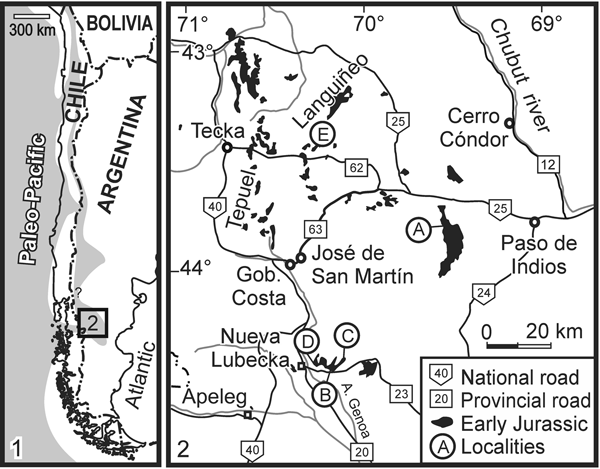
In central and western Chubut Province there are extensive outcrops of Jurassic beds, mostly deposited in terrestrial environments. Marine beds are occasionally intercalated and laterally interdigitated with Early Jurassic volcanoclastic and coarse-grained clastic sediments, and although outcrops are scattered over a wide geographical area (Fig. 1), they show frequent lateral facial changes. In the Pampa de Agnia-Cañadón Puelman region of central Chubut, the marine sediments are referred to the Osta Arena Formation (Musacchio in Herbst, Reference Herbst1966) or Lomas Chatas Formation (Robbiano, Reference Robbiano1971), previously known as “Sedimentos Liásicos Marinos” in Feruglio (Reference Feruglio1949). Farther southwest, in the Nueva Lubecka-Ferrarotti area, Early Jurassic marine beds are known as Mulanguiñeu Formation (Fernández Garrasino, Reference Fernández Garrasino1977; see Cortiñas, Reference Cortiñas1984 and references therein). The southwesternmost outcrops with marine fossils were reported from the Lake Fontana region (Blasco et al., Reference Blasco, Levy and Ploszkiewicz1980). Contrary to Wahnish´s (Reference Wahnish1942, p. 22, 67) assumption of a complete Early Jurassic marine sequence in Chubut, most marine beds seem to have been deposited during the short interval of the late Pliensbachian to early Toarcian. Ammonites were reported by Musacchio and Riccardi (Reference Musacchio and Riccardi1971), Blasco et al. (Reference Blasco, Levy and Nullo1979, Reference Blasco, Levy and Ploszkiewicz1980), and Massaferro (Reference Massaferro2001).
Location map. (1) General paleogeographical regional context for the early Toarcian, modified from Vicente, Reference Vicente2005; area marked by 2 in rectangle indicates area enlarged in Figure 1.2; (2) Early Jurassic localities in central Chubut Province. Localities mentioned in text: A Puesto Currumil-Quebrada El Córdoba, Pampa de Agnia region; B Aguada Loca; C Betancourt; D Loma de Plate; E Quichaura.

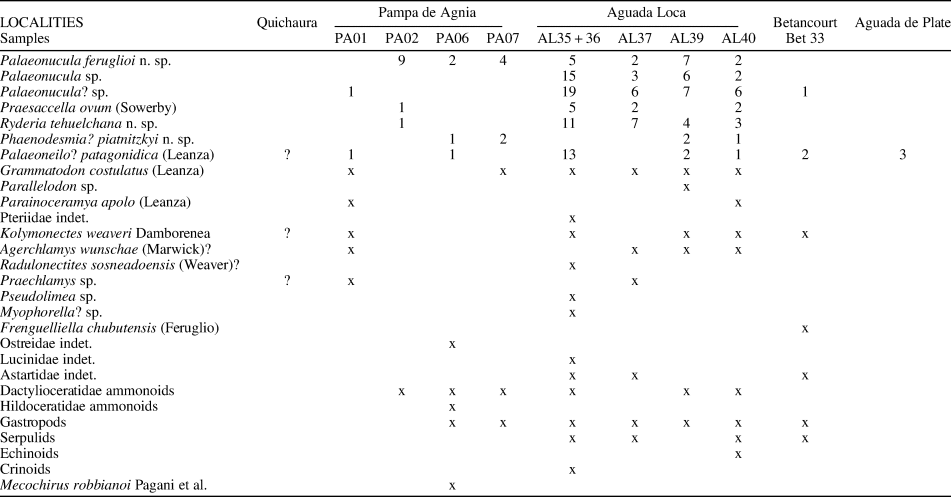
Material from four localities, which can be grouped in eastern and southwestern areas of the Chubut Basin, was examined (see A to D, Figure 1.2 and synthesis of faunal contents in Table 2). Protobranchs were also reported by Franchi and Page (Reference Franchi and Page1980, p. 217) from Quichaura (locality E on Fig. 1), but their material was not available for examination.
Distribution and abundance of the species described here in the sampled localities, and associated fauna. Numbers correspond to number of specimens in each sample. Also listed the associated fauna at the same levels and localities.

Pampa de Agnia area
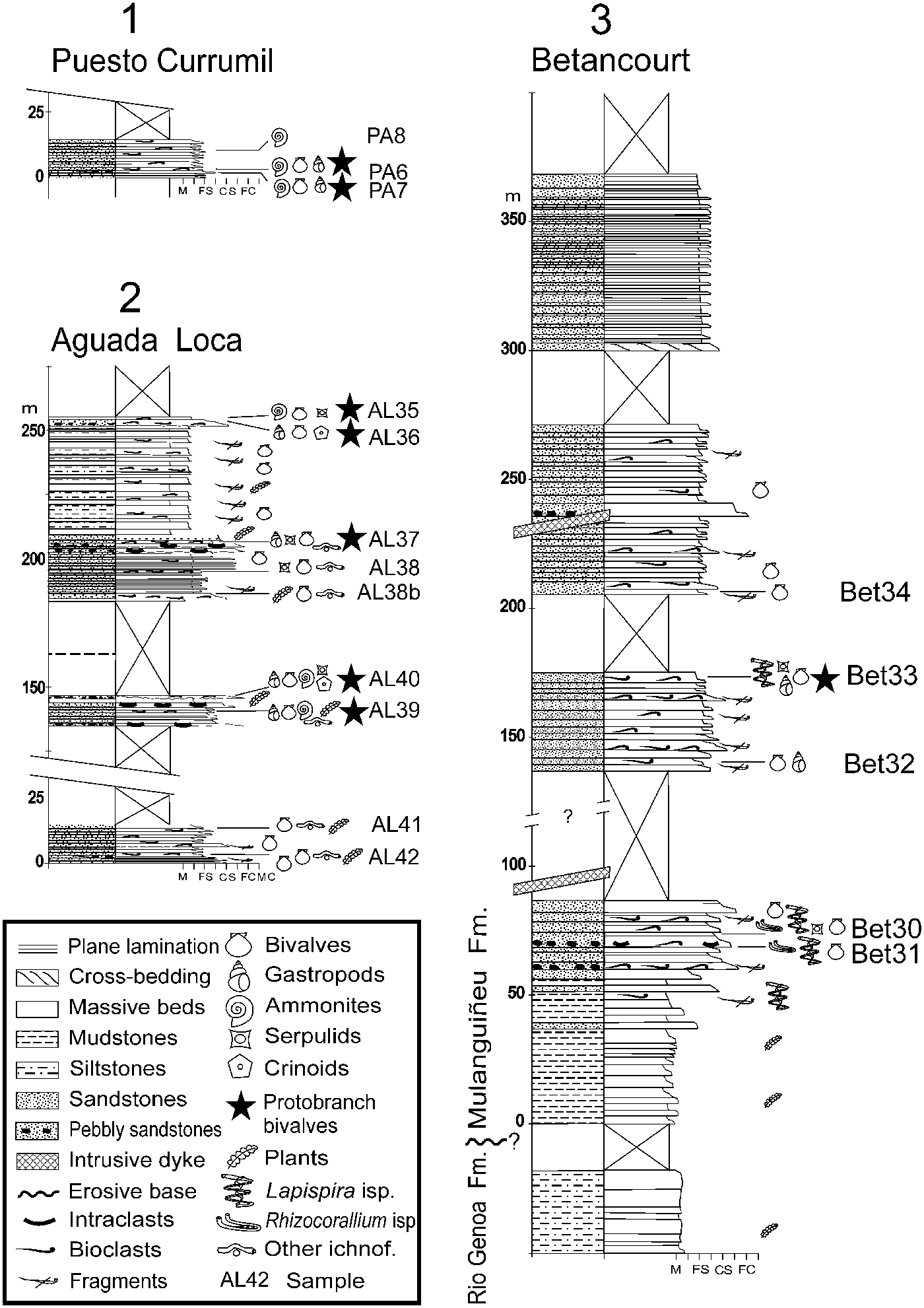
At Sierra de Pampa de Agnia region (Fig. 1.2.2), better known as Sierra del Cerro Negro, according to Robbiano (Reference Robbiano1971), there are extensive outcrops of an Early Jurassic volcanoclastic complex referred to the El Córdoba Formation (Robbiano, Reference Robbiano1971). These beds show a complex facial arrangement (Musacchio and Riccardi, Reference Musacchio and Riccardi1971; Musacchio, Reference Musacchio1975, Reference Musacchio1981) and are intercalated with and laterally transitional to sedimentary (mostly marine) beds of the Osta Arena Formation. This unit includes tuffs, fine-grained sandstones, thin conglomerates, and shales. At some levels, late Pliensbachian to early Toarcian ammonites are locally abundant and include dactylioceratids (described by Blasco et al., Reference Blasco, Levy and Nullo1979). Bivalves are also common, but only a few have been formally described (Levy, Reference Levy1966; Damborenea, Reference Damborenea1987a, Reference Damborenea1987b, Reference Damborenea, Johnston and Haggart1998, Reference Damborenea2002). The material described here was collected at Puesto Currumil-Quebrada El Córdoba (Fig. 2; see logged section in Pagani et al., Reference Pagani, Damborenea, Manceñido. and Ferrari2011, fig. 1).
Logged sections (by S. Damborenea and A. Pagani) at (1) Puesto Currumil, Pampa de Agnia region, (2) Aguada Loca, and (3) Betancourt, the main three localities with abundant and diverse Protobranchia in central Chubut.

The material mentioned by Franchi and Page (Reference Franchi and Page1980, p. 217) was probably collected near Pocitos de Quichaura (NW of Pampa de Agnia, locality E on Fig. 1.2), in deposits also referable to the Osta Arena Formation, characterized by their high volcanoclastic content, scarcity of invertebrate fossils, and lack of ammonites.
Betancourt area
To the southwest of the previous region, Early Jurassic marine deposits show less volcanic content, and were deposited in a diversity of near-shore environments. They are referred by most authors to the Mulanguiñeu Formation, and, as can be seen at Betancourt (Fig. 1.2.C), Nueva Lubecka, and Cerro La Trampa, they rest unconformably on top of late Palaeozoic, mostly marine, deposits.
No protobranch bivalves were recovered from the shallow-water deposits at Lomas Occidentales, just west of Nueva Lubecka, River Genoa region, which bear a diverse bivalve, gastropod, coral, and brachiopod fauna, typical of a high-energy sublittoral environment. Depth increased and energy decreased to the east, and at Aguada Loca (see logged section in Fig. 2.2) and Betancourt localities (Fig. 2.3; logged section in Pagani et al., Reference Pagani, Manceñido, Damborenea and Ferrari2012, fig. 1), protobranchs were particularly abundant and diverse. At these last two localities, fine- and medium-grained sandstones prevail, and bear a far less diverse bivalve and gastropod fauna, with frequent ammonoids, locally dominated by pectinoideans, astartids, or protobranchs. At Aguada Loca, all the species described here are present, and both diversity and abundance of protobranch bivalves are particularly high in two extremely bioturbated levels towards the top of the logged section.
Lomas de Plate is located to the west of Aguada Loca. This locality was mentioned for the first time by Ugarte (Reference Ugarte1966). There, the Early Jurassic deposits rest unconformably on top of late Paleozoic sediments. The beds include slates and calcareous breccias with corals. This locality was not sampled by the authors. The material described here belongs to Piatnitzky collection.
Material, terminology and measurements
The species synonymy lists contain only the original reference and those strictly referring to material from Chubut. Other records are discussed in the text. The systematic arrangement follows Bouchet and Rocroi (Reference Bouchet and Rocroi2010) and Carter et al. (Reference Carter, Altaba, Anderson, Araujo, Biakov, Bogan, Campbell, Campbell, Chen, Cope, Delvene, Dijkstra, Fang, Gardner, Gavrilova, Goncharova, Harries, Hartman, Hautmann, Hoeh, Hylleberg, Jiang, Johnston, Kirkendale, Kleemann, Koppka, Kříž, Machado, Malchus, Márquez-Aliaga, Masse, McRoberts, Middelfart, Mitchell, Nevesskaja, Özer, Pojeta, Polubotko, Pons, Popov, Sánchez, Sartori, Scott, Sey, Signorelli, Silantiev, Skelton, Steuber, Waterhouse, Wingard and Yancey2011), with the emendations proposed by Carter et al. (Reference Carter, Altaba, Anderson, Campbell, Fang, Harries and Skelton2015). The interpretation of hinge details and muscle scars was based on Driscoll (Reference Driscoll1964), Bradshaw and Bradshaw (Reference Bradshaw and Bradshaw1971), and Bradshaw (Reference Bradshaw1999). Terminology of dentition follows Carter et al. (Reference Carter, Harries, Malchus, Sartori, Anderson, Bieler, Bogan, Coan, Cope, Cragg, García-March, Hylleberg, Kelley, Kleemann, Kříž, McRoberts, Mikkelsen, Pojeta, Temkin, Yancey and Zieritz2012).
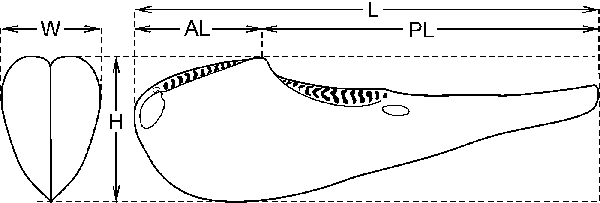
Linear measurements were made with Vernier calipers to an accuracy of 0.1 mm. For orientation of specimens for measurements, see Figure 3. Abbreviations: AL = anterior length, H = height, L = length, PL = posterior length, W = inflation, nAT = number of anterior teeth, nPT = number of posterior teeth.
Measurements taken, shown on a sketch of Ryderia tehuelchana new species internal mold. AL: anterior length, H: height, L: length, PL: posterior length, W: inflation.

Repositories and institutional abbreviations
All newly collected material is deposited in the Invertebrate Paleontology collections of the Museo Paleontológico Egidio Feruglio, Trelew, Chubut (MPEF-PI). Old collections were seen at the Museo de Ciencias Naturales, La Plata (MLP), and Servicio Nacional Geológico y Minero, Buenos Aires (SNGM).
Systematic paleontology
Subclass Protobranchia Pelseneer, Reference Pelseneer1889 (= Palaeotaxodonta Korobkov, Reference Korobkov1954)
Order Nuculida Dall, Reference Dall1889
Superfamily Nuculoidea Gray, Reference Gray1824
Family Nuculidae Gray, Reference Gray1824
Remarks
Nuculidae shells are characterized by their small to medium size, nacreous shell portions, opisthogyrate beaks, and an internal lamellar ligament in a resilifer. This family has a long record (since the Ordovician), and Jurassic species are mostly referred to Palaeonucula Quenstedt and Nuculoma Cossmann. The shell characters of both are very similar to the extant Nucula Lamarck. All living species are shallow burrowers and deposit feeders, and the same is inferred for extinct species of this family.
On the basis of shell microstructure, Carter (Reference Carter2001) defined the subfamily Palaeonuculinae for nuculids with a largely non-nacreous adult shell, including the genera Palaeonucula Quenstedt, Reference Quenstedt1930 (late Carboniferous to Jurassic) and Condylonucula Moore, Reference Moore1977 (Recent). Carter restricted Nuculinae to mostly nacreous shells with marginal denticulations, extended in time from Cretaceous (or Carboniferous?) to Recent (Carter, Reference Carter2001). This microstructure criterion is very difficult to apply in most fossil material due to imperfect preservation of the shell.
The abundant material from Chubut referable to this family has a wide range of shell sizes and shapes, and at least three taxa can be recognized, which are all left in open nomenclature.
Genus Palaeonucula Quenstedt, Reference Quenstedt1930
Type species
Nucula hammeri Defrance, Reference Defrance1825, p. 217, from the Early Jurassic of France, original designation.
Remarks
This taxon was regarded as a subgenus of the late Paleozoic genus Nuculopsis Girty by Schenck (Reference Schenck1934, Reference Schenck1939). A clear and lucid discussion on the systematic relationships of Palaeonucula was provided by Cox, who first considered it as a subgenus of Nucula Lamarck (Cox, Reference Cox1940) and later of Nuculoma Cossmann (Cox, Reference Cox1965). McAlester in Cox et al. (Reference Cox, Newell, Branson, Casey, Chavan, Coogan, Dechaseaux, Fleming, Haas, Hertlein, Keen, LaRocque, McAlester, Perkins, Puri, Smith, Soot-Ryen, Stenzel, Turner, Weir and Moore1969) regarded it as a separate genus, and later Duff (Reference Duff1978, pp. 22–23) extensively discussed previous references and argued in support of this. An up-dated diagnosis was provided by Hodges (Reference Hodges2000) and its paleogeographic distribution was summarized by Ros et al. (Reference Ros, Márquez-Aliaga and Damborenea2014, fig. 1). Although no Early Jurassic species from Argentina had been formally assigned to this genus, material described as Nucula leufuensis Weaver (Reference Weaver1931, p. 183), from Middle Jurassic deposits of the Neuquén Basin, is referable to Palaeonucula. Here we describe two Early Jurassic species referred to this genus.
The general shell morphology of Palaeonucula is similar to Nucula Lamarck, but shell is non-nacreous and has a smooth margin. Species of Palaeonucula were probably also deposit feeders, living as shallow burrowers in soft substrate.
Palaeonucula feruglioi new species
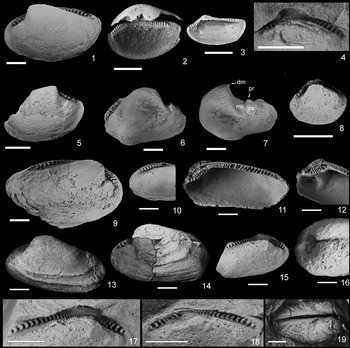
Figures 4.1–4.4, 7.1
(1–4) Palaeonucula feruglioi new species; (1) MPEF-PI 3149, paratype, right valve internal mold; (2) MPEF-PI 3897, paratype, latex cast of specimen with valves half open, showing interior of left valve and fragment of right valve shell and detail of external ornamentation; (3) MPEF-PI 6495, holotype, latex cast of left valve internal mold; (4) MPEF-PI 3898, paratype, internal mold of right valve, oblique view showing hinge. (5–8) Palaeonucula sp.; (5) MPEF-PI 2843, left valve internal mold; (6, 7) MPEF-PI 2932, left valve internal mold of deformed specimen in lateral and dorsally oblique views to show muscle scars; (8) MPEF-PI 5763, juvenile specimen, right valve internal mold. Abbreviations: dm = dorsomedian muscle scar; mb = myophoric buttress; pa = posterior adductor muscle scar; pr = posterior retractor muscle scar. (9–19) Palaeonucula? sp.; (9) MPEF-PI 3369, left valve internal mold; (10) MPEF-PI 2920, detail of anterior part of left valve; (11, 12) MPEF-PI 3144, latex cast of left valve internal mold, inner view and tilted view to show posterior adductor muscle scar; (13) MPEF-PI 3371, latex cast of external mold; (14) MPEF-PI 3372, right valve internal mold and latex cast of external mold; (15) MPEF-PI 2978, left valve internal mold, tilted view showing hinge; (16) MPEF-PI 5767, dorsal view of posterior part of complete specimen with closed valves, showing escutcheon, latex cast; (17) MPEF-PI 2978, left valve internal mold, tilted view showing hinge; (18) MPEF-PI 5765, right valve internal mold and latex cast; (19) MPEF-PI 3364, dorsal view of closed valves, latex cast. Scale bars = 5 mm.

Holotype
MPEF-PI 6495, an internal mold of a left valve.
Diagnosis
Small- to medium-sized Palaeonucula, with inflated subtrapezoidal shells. Hinge gradidentate with convexodont teeth, hinge plate with a small, anteriorly directed, triangular resilifer, anterior part of hinge longer than posterior, both slightly dorsally convex. Posterior adductor in a shallow depression. Exterior of shell with regular commarginal threads, inner margin smooth.
Occurrence
Aguada Loca, Tehuelches Department, Chubut Province (sample levels AL37, AL39, AL40), Pampa de Agnia, Paso de Indios Department, Chubut Province (sample levels PA02, PA06, PA07); see Figure 2.
Description
Nuculiform, small- to medium-sized subtrapezoidal shell, inequilateral, valves inflated, longer than high (L/H ~1.6). Umbos wide, opisthogyrate, placed posteriorly to mid-length, at about 1/3 of total length from posterior end. Antero-dorsal margin slightly dorsally convex, postero-dorsal margin nearly straight. Anterior, ventral, and posterior margins rounded, with a marked antero-dorsal angle (Fig. 4.1, 4.2). No distinct lunule or escutcheon. Maximum shell height posteriorly placed.
Hinge gradidentate with convexodont teeth, anterior part of hinge longer than posterior, with ~25 narrow, chevron-shaped teeth and sockets decreasing in size towards umbo. Posterior teeth ~10, also decreasing in size towards umbo. All teeth are narrow and tall, triangular, slightly inclined towards umbo, and larger ones are clearly diconvexodont, with a wide M-shaped section. Each tooth shows a shallow but distinct central fold flanked by a shallow sulcus at each side on their external face, and the opposite (central sulcus and two lateral folds) on their umbonal face. Posterior teeth are taller at the middle of the series. There is a small, anteriorly directed, triangular resilifer (Fig. 4.4), placed below the very narrow five or six central anterior teeth.
Posterior adductor muscle scar oval in shape and placed in a very shallow depression, situated below the three posteriormost teeth, and anteriorly limited by a very low ridge (Fig. 4.1, 4.2); anterior adductor muscle scar only slightly impressed, oval in shape. No other muscle scars could be recognized.
External surface with regular, thread-like faint growth lines, ~6 per mm on the central part of the shell. Inner margin smooth.
Etymology
Dedicated to Dr. Egidio Feruglio, Italian geologist who made substantial contributions to the geology and paleontology of Patagonia.
Materials
Two specimens with valves open (one of them in butterfly position), plus 27 isolated right and left valves, most of them preserved as internal molds: MPEF-PI 2964, 2981, 3149 (paratype), 3897 (paratype), 3898 (paratype), 5768, 5771, 6454, 6456, 6457, 6461, 6462, 6463, 6465, 6466, 6467, 6469, 6470, 6471, 6476, 6477, 6487, 6495 (holotype), 6499, 6554, 6555, 6560.
Measurements
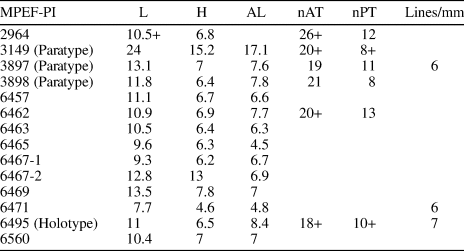
See Table 3.
Measurements (in mm) of Palaeonucula feruglioi new species. Lines/mm = number of commarginal lines per mm in central part of shell.

Remarks
The type material of P. cuevitana Aberhan (Reference Aberhan1994, pl. 1, figs. 1–4), from the Hettangian of Chile, has a similar shell outline, umbo position, and lack of lunule and escutcheon, but differences include a smaller and shorter shell, more concave postero-dorsal margin, fewer anterior teeth, and lack of regular external ornamentation in the Chilean material.
The type species of the genus, Palaeonucula hammeri (Defrance, Reference Defrance1825) (Quenstedt, Reference Quenstedt1851, p. 527, pl. 44, figs. 4, 5; Reference Quenstedt1856, p. 313, pl. 43, figs. 7–12; Schenck, Reference Schenck1934, p. 35, pl. 2, fig. 20, pl. 4, fig. 1), from the Toarcian-Bajocian of Europe, has a subrectangular, inflated shell, with wider umbones that are more posteriorly placed. The same applies to the possible synonym (see Schenck, Reference Schenck1934, p. 37; Aberhan, Reference Aberhan1998, p. 64), Palaeonucula hausmanni (Roemer, Reference Roemer1836, p. 98, pl. 6, figs. 12a–12d; Kuhn, Reference Kuhn1935, p. 120, pl. 8, figs. 33a–33b, 41a–4d).
Palaeonucula saigonensis Hayami (Reference Hayami, Kobayashi and Toriyama1972, pl. 33, figs. 1–3, pl. 38, figs. 1, 2), from the Early Jurassic of Saigon, has a similar shell shape to the species here described, but the Asian species has fewer teeth and muscle scars are more strongly impressed. The species here described is also similar in general shape to P. sp. B from the Toarcian of Canada (Aberhan, Reference Aberhan1998, pl. 1, figs. 1–4), but the specimens from Chubut lack lunule and escutcheon (mentioned for the Canadian material, although all specimens are internal molds), have less-prominent umbos, and have a less-impressed anterior adductor muscle scar.
The shell shape of Palaeonucula feruglioi n. sp. is reminiscent of material referred to Palaeoneilo galatea (d´Orbigny, Reference d´ Orbigny1850), as do the specimens figured by Aberhan et al. (Reference Aberhan, Scholz and Schubert2011, pl. 1, figs. 3, 4) from Europe and those from southern Neuquén (Damborenea, Reference Damborenea1987a, pl. 1, fig. 4).
Palaeonucula menkei (Roemer, Reference Roemer1836) in Fürsich and Werner (Reference Fürsich and Werner1988, pl. 1, fig. 2) and Sha et al. (Reference Sha, Fürsich, Smith and Wang1998, pl. 1, fig. 1), Middle and Late Jurassic from Europe and Asia, is smaller and has fewer teeth.
This species clearly differs from Palaeonucula sp. described below, from the same locality, by its longer shell with less-prominent umbos, marked antero-dorsal angle, adductor scars not impressed, and more numerous anterior teeth. The shell of Palaeonucula? sp., also described here, has a different shape, without dorso-anterior angulation, more-prominent umbones, and a coarser ornamentation of commarginal rugae.
Palaeonucula sp.
Figures 4.5–4.8, 7.2
Occurrence
Aguada Loca, Tehuelches Department, Chubut Province (sample levels AL35/36, AL37, AL39, AL40; Fig. 2.2).
Description
Small subtrigonal shell, slightly to moderately inequilateral, valves inflated, young shells nearly as high as long (L/H = 1.1), shell longer than high in adults (L/H ~1.5). Umbos very prominent and wide, opisthogyrate, strongly incurved, placed centrally or somewhat posteriorly. Antero-dorsal margin straight or dorsally convex, postero-dorsal margin dorsally concave. Anterior, ventral, and posterior margins rounded. Without lunule or escutcheon.
Hinge gradidentate with convexodont teeth. Anterior part of hinge longer than posterior, with up to ~20 chevron-shaped teeth and sockets, decreasing in size towards umbo. Posterior teeth ~10, larger than anterior ones, also decreasing in size towards umbo.
Posterior adductor muscle scar oval in shape and placed in a very deep depression situated below the posteriormost teeth, and anteriorly limited by a strong ridge or myophoric buttress; anterior adductor muscle scar only slightly impressed. A small punctiform depressed muscle scar (dm in Fig. 4.7) (dorsomedian scar?) occurs in the umbonal region. Between the umbo and the posterior adductor muscle scar, parallel to the dorsal margin, there is a slightly impressed oval muscle scar (pr in Fig. 4.7), probably corresponding to the posterior retractor muscle. Pallial line continuous, parallel to the margin. Internal shell margin appears smooth, although some specimens show very faint crenulations (Fig. 4.5).
External surface with irregularly spaced faint growth lines.
Materials
The 26 available specimens are preserved as molds, mostly internal, and include a wide size range: (MPEF-PI 2841, 2843, 2863, 2865, 2932, 2934, 2970, 2971, 3157, 3366, 3376, 3889, 5763, 5776 , 6474, 6480, 6482, 6493, 6496, 6498, 6557, 6562, 6563, 6574, 6585, 6592).

Remarks
According to its shape, dentition, and details of aductor muscle scars, this species can be referred to Palaeonucula. It differs from Palaeonucula feruglioi n. sp. described above by a shorter shell, with wider umbones, fewer anterior teeth, presence of conspicuous posterior myophoric buttress, and external shell surface with growth lines only.
Palaeonucula navis (Piette, Reference Piette1856), from the Hettangian to Pliensbachian of Europe and China, has a similar subtrigonal shell, but its umbones are more posteriorly placed and there is a deep escutcheon (see Terquem and Piette, Reference Terquem and Piette.1865, pl. 10, figs. 8–10; extensive description and discussion in Hodges, Reference Hodges2000, pl. 1, figs 1–29). The species described here is very similar to a single specimen from the late Pliensbachian of Canada described by Aberhan (2008, pl. 1, fig. 9) as Palaeonucula sp. A, and to material from the Chinese Early Jurassic described by Chen (Reference Chen1982, pl. 1, fig. 5–7) as Palaeonucula cf. navis (Piette).
Palaeonucula triangularis Duff, Reference Duff1978 (pl. 1, figs. 6–13, 17, 23, text-fig. 6), from the Callovian of England, has a similar trigonal shape, but is more inflated with well-developed escutcheon. Shell shape and strong myophoric buttress are similar to those of P. acuta (Borissjak, Reference Borissjak1904, pl. 1, fig. 3) from the Middle Jurassic of Russia. The Late Jurassic species P. putiensis (Marwick, Reference Marwick1953, p. 87, pl. 10, fig. 4) from New Zealand has a more oval shell outline.
The described specimens cannot be readily referred to any known species. The available material allows characterization the species in detail, but unfortunately poor knowledge of most Early Jurassic Palaeonucula species, and the large number of available specific names, prompted the use of open nomenclature for this taxon.
Palaeonucula? sp.
Figure 4.9–4.19, 7.3
Occurrence
This species is widely distributed in Chubut, at Aguada Loca, Tehuelches Department (AL35-36, AL37, AL39), Betancourt, Tehuelches Department (Bet-33), and Pampa de Agnia, Paso de Indios Department (PA-01), Chubut Province.
Description
Medium- to large-sized, inflated shell; oval in outline, with very wide opisthogyrate umbos. Anterior and posterior dorsal margin continuous and dorsally convex. Shell much longer than high, L/H ratio 1.5–2. Anterior and posterior margins convex, anterior one wider; the maximum shell height is anterior to the umbones in most specimens. Deeply impressed short escutcheon (Fig. 4.16), no lunule (Fig. 4.19).
Hinge very slightly gradidentate, with convexodont teeth. Both anterior and posterior series of teeth placed in a continuous convex line. Posterior teeth are differentiated in four to five strong, distal chevron-like concavoconvexodont teeth and five narrow, blade-like teeth near the umbo (Fig. 4.17, 4.18). Teeth of anterior series (25–30 in number) are chevron-like concavoconvexodont and decrease gradually in size towards the umbo (Fig. 4.10, 4.11). Small and narrow triangular resilifer placed under umbo below the smallest anterior teeth and directed anteriorly (Fig. 4.11, 4.17, 4.18).
Posterior adductor muscle scar subcircular, placed in a shallow depression, anteriorly limited by a wide and low swelling (Fig. 4.12). Anterior adductor oval in outline, but not so well marked as posterior, placed just below the first teeth (Fig. 4.11). Pallial line very faintly impressed, seemingly truncated.
Shell exterior with irregular commarginal lines, some of them thickened, forming well-developed folds and becoming lamellar-like towards the margin in large shells (Fig. 4.13, 4.14). Inner shell margin smooth.
Materials
Forty specimens, preserved as internal or external molds, five of them with both valves, one of them open in butterfly position: MPEF-PI 2892, 2920, 2935, 2978, 3144, 3359, 3364, 3369, 3371, 3372, 5765, 5766, 5767, 5770, 5773, 5774, 5775, 5777, 5778, 6479, 6485, 6486, 6489, 6492, 6497, 6500, 6550, 6556, 6564, 6565, 6566, 6567, 6569, 6570, 6575, 6580, 6581, 6583, 6584, 6591.

Remarks
This species differs from Palaeonucula feruglioi n. sp. and P. sp. described above by the presence of a conspicuous escutcheon, rounder and higher anterior shell margin, hinge with more numerous anterior teeth, and smaller resilifer, and by the prominent external commarginal folds in adults. From Palaeoneilo? patagonidica (Leanza, Reference Leanza1942) this species is distinguished by its ornamentation, and by its shorter and more inflated shell, which is higher anteriorly, stronger teeth, and by the presence of resilifer and escutcheon.
The type species of Prosoleptus, P. lineatus (Goldfuss, Reference Goldfuss1837, p. 153, pl. 124, fig. 17; Carter, Reference Carter and Carter1990, fig. 13), from Carnian beds of the Alps, has a similar shell shape with escutcheon and the same number of anterior and posterior teeth, but the shell is shorter, more protruded anteroventrally, and apparently lacks a resilifer.
The oval, rather compressed shell shape and type of commarginal ornamentation precludes reference of this species to Palaeonucula, but the anteriorly elongated shell, presence of resilifer, hinge features, and thick shell indicate nuculidae affinities. It cannot be referred with certainty to any Mesozoic nuculid genus, and thus it is here left in open nomenclature until better preserved material allows a proper identification of its generic affinities.
On the other hand, shell shape and hinge of the material from Chubut are closely comparable to shells of some older genera, especially to the Triassic genus Prosoleptus Beushausen (Reference Beushausen1895, p. 95), which, however, has a characteristic antero-ventral protrusion. Also similar is the Carboniferous genus Spathelopsis of Hoare et al. (Reference Hoare, Heaney and Mapes1989), although it has a subrostrate posterior margin and posteriorly gaping valves. Due to the imperfect knowledge of internal details, the systematic affinities of these genera are still uncertain and open to discussion (see Peck et al., Reference Peck, Bailey, Heck and Scaiff2009, p. 957), but it is worth trying to elucidate their possible relationships with the species here described and other Jurassic species.
The material here described has some of the diagnostic characters of the genus Rollieria Cossmann (Reference Cossmann1920, p. 82), such as an ovate shell without lunule, with resilifer and hinge rows continuous or forming a very obtuse angle. Nevertheless, the specimens from Chubut are anteriorly elongated, have an escutcheon, and the shell appears to be thicker and more inflated that in other species referred to Rollieria. Rollieria was regarded as a subgenus of Nuculana in Cox et al. (Reference Cox, Newell, Branson, Casey, Chavan, Coogan, Dechaseaux, Fleming, Haas, Hertlein, Keen, LaRocque, McAlester, Perkins, Puri, Smith, Soot-Ryen, Stenzel, Turner, Weir and Moore1969, p. N237), and later referred to the Yoldiidae by Hodges (Reference Hodges2000, p. 35) on account of its posteriorly elongated shell, with a shallow pallial sinus, and low prosogyrous umbones.
Order Nuculanida Carter, Campbell, and Campbell, Reference Carter, Campbell, Campbell, Harper, Taylor and Crame2000
Superfamily Nuculanoidea Adams and Adams, Reference Adams and Adams1858 (1854)
Remarks
This superfamily includes protobranchs with posterior rudimentary mantle fusion and siphons. Nuculanoid bivalves are diverse and relatively abundant in Chubut, but in the Neuquén Basin they are rare and only diverse in its southern region (Piedra Pintada; see Damborenea, Reference Damborenea1987a). In some localities from Chubut, several species can be found together in the same beds (see Table 2). The material from Chubut is generally preserved as high quality molds in very fine-grained siltstones, allowing a precise description of internal characters, such as hinge and muscular impressions.
Family Nuculanidae Adams and Adams, Reference Adams and Adams1858 (1854)
Genus Praesaccella Cox, Reference Cox1940
Type species
Nuculana (Praesaccella) juriana Cox, Reference Cox1940, from the Oxfordian of Kutch, India.
Praesaccella ovum (J. de C. Sowerby, Reference Sowerby1824)
Figures 6.1–6.6, 7.5
- Reference Sowerby1824
Nucula ovum Sowerby, p. 118, pl. 476, fig. 1.
- Reference Volkheimer, Manceñido and Damborenea1978
Nuculana sp.; Damborenea in Volkheimer et al., tab. 2.
- Reference Damborenea1987a
Nuculana cf. ovum (J. de C. Sowerby); Damborenea, p. 59, pl. 1, figs. 7–9, text-fig. 9.
- Reference Damborenea and Westermann1992
Nuculana cf. ovum (J. de C. Sowerby); Damborenea, pl. 115, fig. 15.
- Reference Aberhan1994
Nuculana (Praesaccella) ovum (J. de C. Sowerby); Aberhan, p. 10, pl. 1, figs. 5–12, text-fig. 3.
Occurrence
Aguada Loca, Tehuelches Department (sample levels AL35, AL37, AL40), Pampa de Agnia, Paso de Indios Department (sample levels PA02), Chubut Province (Fig. 2). This species is also known from several localities in the Neuquén Basin (Damborenea, Reference Damborenea1987a, p. 59), and the Pliensbachian to Toarcian of northern Chile (Aberhan, Reference Aberhan1994); the material described here extends its geographical range to central Chubut.
Description
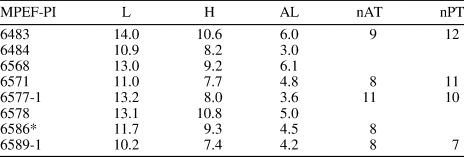
Small nuculaniform shell, inflated, slightly longer than high, with a short posterior rostrum. Outline subtriangular, inequilateral. Umbones strongly opistogyrate, located anteriorly to mid-length. Anterior and ventral margins of shell evenly convex, posterior dorsal margin concave. Posterior end of rostrum convex, located at about mid-height. A low, wide, indistinct ridge extends from the umbones to the end of rostrum, delimiting a postero-dorsal concave shell surface. Inner shell margin smooth. Anterior adductor muscle scar oval in shape and strongly impressed on inner shell surface, below the first hinge teeth (Fig. 6.6). Posterior adductor muscle scar of equal size, rounder and deeply impressed (Fig. 6.2, 6.3), pallian line continuous and clearly marked (Fig. 6.2). Hinge plate strong, anterior portion slightly dorsally convex and posterior part dorsally concave, separated by small, narrow but deep, triangular resilifer (Fig. 6.3). Teeth V-shaped and strong, 10–12 on the anterior series, about the same number on the posterior one. Exterior of shell ornamented by faint but regular commarginal lines over the whole surface (Fig. 6.5).
Materials
Five right valves and five left valves, preserved as internal or external molds: MPEF-PI 6481, 6483, 6484, 6561, 6568, 6571, 6577, 6578, 6586, 6589.

Remarks
As already pointed out by Aberhan (Reference Aberhan1994), this species can be referred to Praesaccella Cox (Reference Cox1940, p, 32), originally described as a subgenus of Nuculana Link. For comparisons see Damborenea (Reference Damborenea1987a, p. 60).
Family Polidevciidae Kumpera, Prantl, and Růžička, Reference Kumpera, Prantl and Růžička1960
Remarks
The Ordovician to Late Jurassic family Polidevciidae was recently characterized by Carter et al. (Reference Carter, Altaba, Anderson, Campbell, Fang, Harries and Skelton2015, p. 3) by having a “strongly mineralized, prominent external ligament; a small to moderately well-developed resilium, shallow to deep submarginal; paleotaxodont hinge; nacreous shells, not porcelaneous; and shells posteriorly extended without permanent dorsoposterior shell gape.”
Genus Ryderia Wilton, Reference Wilton1830
Type species
Leda renevieri Oppel, Reference Oppel1856, p. 215, from the Early Jurassic of Great Britain, designated by Cox, Reference Cox1936, p. 467.
Remarks
See updated diagnosis of the genus and synonyms in Hodges (Reference Hodges2000, p. 40).
There is a group of Late Triassic and Early Jurassic nuculanoid species characterized by a very long, narrow rostrum and externally ornamented with radial, oblique (in the sense of Checa, Reference Checa2002), or divaricate patterns. They were early included in the genus Ryderia, but this was incorrectly diagnosed in Cox et al. (Reference Cox, Newell, Branson, Casey, Chavan, Coogan, Dechaseaux, Fleming, Haas, Hertlein, Keen, LaRocque, McAlester, Perkins, Puri, Smith, Soot-Ryen, Stenzel, Turner, Weir and Moore1969) as having a pallial sinus, which is absent in all shells examined (also by Hodges, Reference Hodges2000).
A complex pattern of ornamentation is common in many rostrate nuculanoid genera and species from the late Paleozoic to the present, and is most probably a variable character that is highly influenced by function in these active shallow burrowers, and thus of limited phylogenetic value. Furthermore, the intraspecific variability of ornamentation is thought to be high in the few species in which it was analyzed (Jaitly et al., Reference Jaitly, Fürsich and Heinze1995; Hodges, Reference Hodges2000; Yin and McRoberts, Reference Yin and McRoberts2006; Ayoub-Hannaa et al., Reference Ayoub-Hannaa, Abdelhady and Fürsich2017). Nevertheless, Chen et al. (Reference Chen, Liu and Lan1983) regarded ornamentation of nuculanoids as an important feature, and erected the subfamily Veteranellinae to include nuculanids with strong ornamentation. Chen et al. (Reference Chen, Liu and Lan1983) did not mention Ryderia in their analysis, and they referred Late Triassic–Early Jurassic material to Teinonuculana Zhang (in Zhang et al., Reference Zhang, Wang and Zhou1977), now regarded as a junior synonym of Ryderia (see Yin and McRoberts, Reference Yin and McRoberts2006, p. 106). The type species of Teinonuculana Zhang (in Zhang et al., Reference Zhang, Wang and Zhou1977) has similar features, including ornamentation pattern, to those of the type species of Ryderia and to the material from Chubut. Recent revision of the genus Ryderia (Hodges, Reference Hodges2000) has shown that it also includes species that may be externally ornamented by commarginal or radial striae, and that the presence of these characters seems to depend largely on preservation. With these arguments in mind, Yin and McRoberts (Reference Yin and McRoberts2006) referred the type species of Teinonuculana to Ryderia, but Hautmann et al. (Reference Hautmann, Stiller, Cai and Sha2008) doubtfully assigned it to Phestia.
According to Hodges (Reference Hodges2000), Ryderia stratigraphic range extends from the Carboniferous to the late Pliensbachian, but the oldest well-documented records are from Rhaetian beds (Ivimey-Cook et al., Reference Ivimey-Cook, Hodges, Swift, Radley, Swift and Martill1999; Yin and McRoberts, Reference Yin and McRoberts2006; Mander et al., Reference Mander, Twitchett and Benton2008; Ros et al., Reference Ros, Márquez-Aliaga and Damborenea2014), and it extends into the early Toarcian (Cox, Reference Cox1965; Liu, Reference Liu1995; Fürsich et al., Reference Fürsich, Berndt, Scheuer and Gahr2001). Records of Ryderia from the Middle Jurassic are also doubtful; for instance, at least Bathonian specimens from Sinai referred to Ryderia decorata (Douvillé, Reference Douvillé1916) by Abdelhady and Fürsich (Reference Abdelhady and Fürsich2014, fig. 3.E, 3.F; see also Ayoub-Hanna et al., Reference Ayoub-Hannaa, Abdelhady and Fürsich2017, fig. 7) could belong to Nuculana. On the other hand, the genus Costinuculana, recently described from those Bathonian Sinai beds (Ayoub-Hannaa et al., Reference Ayoub-Hannaa, Abdelhady and Fürsich2017), is certainly closely related to Ryderia. According to these authours, Ryderia differs from Costinuculana “in having a narrower and much more elongated rostrum, a narrow and smooth escutcheon, fine and closely spaced commarginal ribs, in lacking posterior oblique ribs, and in being much more compressed” (Ayoub-Hannaa et al., Reference Ayoub-Hannaa, Abdelhady and Fürsich2017, p. 436). Nevertheless, some Ryderia species, among them the new species described here, do have oblique ribs on the rostrum, although less developed than in Costinuculana.
The Permian–Triassic genus Veteranella Patte, Reference Patte1926 is also very closely related, it has similar shell shape and internal characters, and a very variable ornamentation pattern, which may include divaricate, commarginal, and/or radial ribs (see Fang et al., Reference Fang, Chen, Chen, Sha, Lan and Wen2009). Glyptoleda Fletcher (Reference Fletcher1945), from the Permian of Australia, has comparable ornamentation, but its rostrum is much shorter than in Ryderia.
This is the first description of a Ryderia species from the Early Jurassic of Argentina and South America. The late Triassic species described by Jaworski (Reference Jaworski1922) from Peru as Leda oxyrhyncha could belong to Ryderia, and the genus was also recorded from Norian beds in southern Chile (Pérez-Barría, Reference Pérez-Barría2004, Reference Pérez-Barría2005).
Ryderia tehuelchana new species
Figures 5.1–5.18, 7.4
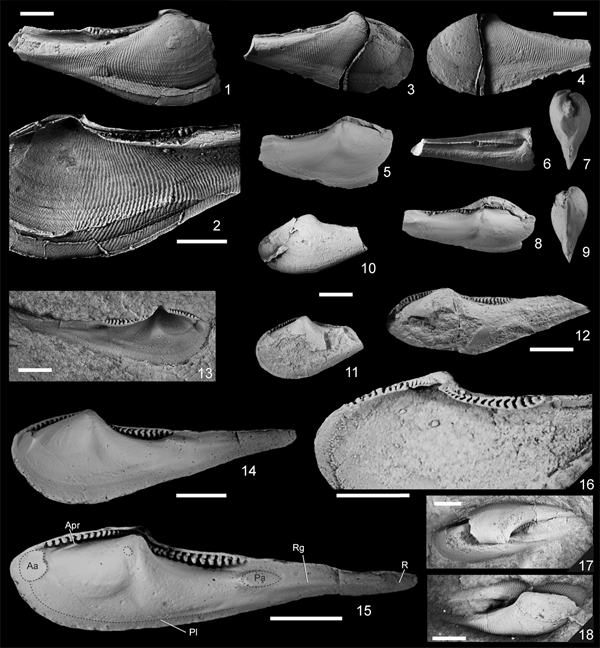
Ryderia tehuelchana new species. (1, 2) MPEF-PI 2976, holotype, right valve, (1) latex cast and (2) external mold showing ornamentation; (3–9) MPEF-PI 2862, almost complete specimen preserved as external and internal molds of both valves; (3, 4, 6, 7, 9) right, left, posterior dorsal, posterior, and anterior views of latex casts of external molds; (5, 8) right lateral view and dorsally tilted view of internal mold; (10, 11) MPEF-PI 3358, left valve, latex cast of external mold and internal mold; (12), MPEF-PI 3363, left valve internal mold; (13–15) MPEF-PI 3001, paratype, complete internal mold of left valve, (13) latex cast, (14) internal mold, (15) slightly tilted to show rostrum (R) with rostral groove (Rg), and muscle scars: Aa = anterior adductor; Apr = pedal retractor, Pa = posterior adductor; Pl = pallial line; (16) MPEF-PI 6572, latex cast of internal mold of right valve showing hinge; (17) MPEF-PI 3890, internal mold of both valves open and slightly displaced; (18) MPEF-PI 3902, latex cast of external mold of both valves open and slightly displaced. Scale bars = 5 mm.

Holotype
MPEF-PI 2976 (Fig. 5.1, 5.2), specimen with both valves closed, but slightly displaced, preserved as an external mold of the right valve showing ornamentation, and part of the internal mold of the left valve showing hinge details.
Diagnosis
Ryderia with fine divaricate striae on the anterior portion of the shell and undulose, oblique, mostly vertical, ribs on the posterior part of the shell and rostrum, with ~17 anterior and 20 posterior teeth. Rostrum long with central rostral groove.
Occurrence
Aguada Loca, Tehuelches Department (AL 35, 35 + 36, 37, 39, 40), Pampa de Agnia, Paso de Indios Department (sample level PA02), Chubut Province (Fig. 2).
Description
Shell very inequilateral, about three times longer than high, with a very long posterior rostrum. Small opisthogyrate umbos anteriorly placed, at about ¼ of total shell length. Valves only moderately inflated (Fig. 5.7, 5.9). Anterior and antero-ventral margins rounded, postero-ventral margin almost straight and convergent with dorsal margin, end of rostrum straight and narrow, posterior dorsal margin widely concave. Escutcheon wide and long, limited by a faint ridge, with a smooth surface (Fig. 5.6, 5.18).
Hinge slightly gradidentate with convexodont teeth (Fig. 5.16). Anterior part of hinge slightly dorsally convex, with ~17 chevron-like teeth and sockets, pointing and decreasing in size towards the umbo. Posterior part of hinge dorsally concave, with laminated triangular teeth and sockets, ~20 in number and slightly larger than those on the anterior part. Hinge teeth series interrupted below umbos with a small triangular ligamental pit, anteriorly directed (Fig. 5.16).
Anterior adductor scar kidney-shaped, placed just in front of distal end of hinge in a relatively deep depression, posteriorly limited by a low ridge (Fig. 5.14, 5.15). Posterior adductor scar elongated and placed in a shallow depression just below and posterior to the hinge end (Fig. 5.13–5.15). At about half length between the anterior adductor and the umbo, and below the hinge platform, there is a deep punctiform scar that continues anteriorly into a neat sulcus parallel to the hinge platform, up to just to the back of the anterior adductor muscle scar, possibly corresponding to the pedal retractor muscle (Fig. 5.15). Visceral muscle scars are also evident, and the main cavity of the shell is divided into two areas, anterior and posterior to a low and wide median ridge extending from the umbo to about half shell height. A small rounded umbonal scar with a smaller punctiform anterior impression appears in the umbonal region anterior to the ridge, and there is another small muscle scar in the umbonal region posterior to the ridge (Fig. 5.15). The pallial line is slightly impressed and appears to be continuous. A shallow internal rostral groove (siphonal groove?) extends from the posterior adductor to the end of the rostrum (Fig. 5.15).
Ornament of undulose oblique ribs covering shell posteriorly from umbonal region to the end of rostrum. Anterior region of the shell covered by very fine, chevron- and V-shaped, divaricate striae (Fig. 5.1–5.4). Escutcheon smooth with growth lines only. Inner shell margin smooth.
Etymology
The specific name refers to a group of native people from southern Patagonia.
Materials
Four specimens with both valves, in three of them the valves are preserved slightly displaced; 22 isolated right and left valves, preserved as internal or external molds, MPEF-PI 2852, 2862, 2976 (holotype), 2983, 3001 (paratype), 3145, 3151, 3358, 3363, 3888, 3890, 3891, 3892, 3902, 5769, 6459, 6472, 6473, 6475, 6494, 6552, 6572, 6573, 6582, 6588, 6590.
Measurements
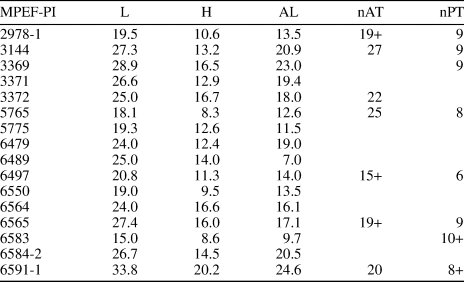
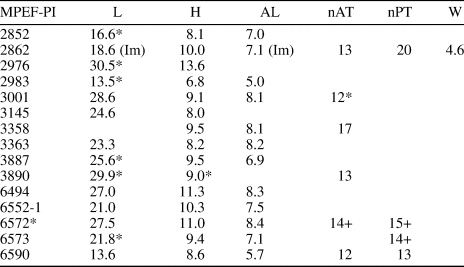
See Table 7.
Measurements (in mm) of Ryderia tehuelchana new species. * = incomplete specimen, Im: internal mold.

Remarks
The oblique and divaricate ribs that characterize this species are special features found in many nuculoid and nuculanoid shells, which often show a high intraspecific variability regarding this character (Seilacher, Reference Seilacher1972). Nevertheless, species of Ryderia with an ornamentation pattern similar to the material from Chubut are few.
The most similar species is Ryderia texturata (Terquem and Piette, Reference Terquem and Piette.1865), from Rhaetian to Toarcian beds of England, Ireland, Germany, and France, and probably also Caucasus and Japan (Terquem and Piette, Reference Terquem and Piette.1865, pl. 11, figs. 5–7; Tate, Reference Tate1870a, pl. 26, pl. 12; Reference Tate1870b, pl. 1, fig. 5; Tate and Blake, Reference Tate and Blake1876, pl. 12, fig. 8, pl. 13, fig. 4; ?Pcelincev, Reference Pcelincev1937, pl. 3, fig. 8; ?Hayami, Reference Hayami1961, pl. 16, fig. 1; Hodges, Reference Hodges2000, pl. 3, figs. 5, 8–11, 13–17, text-figs. 46, 47; Aberhan et al., Reference Aberhan, Scholz and Schubert2011, pl. 1, fig.7). This species has undulose vertical ornament on the rostrum, but only commarginal striae on the anterior part of the shell. Ryderia doris (d´Orbigny, Reference d´ Orbigny1849), often occurring at the same localities and levels, has a similarly long-rostrate shape, but is ornamented by fine commarginal striae only (Goldfuss, Reference Goldfuss1837, pl. 125, fig. 11, as Nucula complanata; d´Orbigny, Reference d´ Orbigny1849, p. 253; Chen, Reference Chen1982, pl. 1, figs. 8, 9; Pedersen, Reference Pedersen1986, pl. 6, fig. A; Hollingworth et al., Reference Hollingworth, Ward, Simms and Clothier1990; Hodges, Reference Hodges2000, pl. 3, figs. 1–4, 6, 7 and references therein; Aberhan et al., Reference Aberhan, Scholz and Schubert2011, pl. 1, figs. 5, 6).
Another very closely related taxon is R. vexillata (Marwick, Reference Marwick1953, p. 88, pl. 10, fig. 7; see also Trechmann, Reference Trechmann1923, pl. 15, fig. 5), from the Aratauran (Early Jurassic) of New Zealand. This species differs from R. tehuelchana n. sp. by having a posterior ridge extending from the umbo to the ventral end of the rostrum, and by details of the ornamentation pattern, especially on the rostrum, which is smooth.
The only previous certain record of the genus from South America corresponds to a specimen identified as Ryderia sp. nov.? from the early Norian of the Biobío region, Chile (Pérez-Barría, Reference Pérez-Barría2004, Reference Pérez-Barría2005), which is an internal mold of a left valve with a shape similar to the species here described, but without any trace of ornamentation. Although the description of the Chilean material remains unpublished, the material was examined in Concepción University, Chile.
The Triassic Peruvian Ryderia? oxyrhyncha (Jaworski, Reference Jaworski1922, p. 114, pl. 4, fig. 7) has a shorter rostrum and a different ornamentation pattern. Nuculana divaricata Zapfe, Reference Zapfe1967 (pl. 2, fig. 1) from the Late Triassic of Austria, has a similar ornament pattern to R. tehuelchana n. sp., but the shell has a much shorter rostrum, and probably does not belong to Ryderia. On the other hand, Nuculana curvirostris Alencaster, Reference Alencaster de Cserna1961 (p. 11, pl. 1, figs. 5, 6) from the Carnian of Sonora, Mexico, has a similarly long-rostrate shape and size, but it is ornamented only by regular commarginal lines.
Ryderia sp. A (Aberhan, Reference Aberhan1998, pl. 1, fig. 8), from the Late Pliensbachian of the Stikinia Terrane, western Canada, has a much shorter rostrum and its external shell surface is unknown. The shell ornamentation and shape of the rostrum are also very poorly known in Ryderia kenyana Cox (Reference Cox1965, pl. 1, fig. 6) from the Toarcian of Kenya.
Costinuculana magharensis Ayoub-Hanna et al., Reference Ayoub-Hannaa, Abdelhady and Fürsich2017 (figs. 4.1–4.9, 5.1–5.21; see also Abdelhady and Fürsich, Reference Abdelhady and Fürsich2014, fig. 6A, 6B), from the Bathonian of Sinai (Egypt), has thicker and more globose shells, shorter than those of R. tehuelchana n. sp., and differs by its strong oblique posterior ribs, which are asymmetrical in cross-section and may bifurcate ventrally.
Ryderia guangdongensis (Zhang in Zhang et al., Reference Zhang, Wang and Zhou1977), the type species of Teinonuculana, from the latest Triassic to Early Jurassic of China (see Zhang et al., Reference Zhang, Wang and Zhou1977, pl. 1, figs. 13–15; Chen et al., Reference Chen, Liu and Lan1983, pl. 2, figs. 1–2; Chen, Reference Chen1987, pl. 1, figs. 2, 8, 9 under several specific names; Yin and McRoberts, Reference Yin and McRoberts2006, figs. 3.1–3.7, 3.8a), has a narrower rostrum and a posterior carina.
Several living species referred to Nuculana have a long rostrum and live as shallow burrowers, such as Nuculana extenuata (Dall, Reference Dall1897); see Coan et al. (Reference Coan, Valentich Scott and Bernard2000, pl. 6).
Ryderia tehuelchana n. sp. was most probably a fast shallow burrower, as proposed for R. texturata and R. doris from Europe by Hodges (Reference Hodges2000, p. 45), who suggested that in life the tip of the rostrum most probably was just below the sediment surface. Divaricate ornamentation is present on the anterior part of the shell of several bivalves, many of which are very active burrowers, such as some nuculoids and tellinoids. This feature was given a high systematic significance by some authors (Chen et al., Reference Chen, Liu and Lan1983; Hautmann et al., Reference Hautmann, Aghababalou and Krystyn2011), but others regarded this as a very variable character (e.g., Seilacher, Reference Seilacher1972; Squires and Saul, Reference Squires and Saul2006). Ryderia texturata (which has oblique ribs in part of the shell) is frequently found in association with similarly shaped specimens only ornamented by fine commarginal striae (usually referred to R. doris, see for instance Hodges, Reference Hodges2000; Aberhan et al., Reference Aberhan, Scholz and Schubert2011), and internal molds cannot be undoubtedly referred to one of them. For this reason, Hodges (Reference Hodges2000, p. 46) argued that perhaps this difference reflects intraspecific variation instead.
Family Malletiidae Adams and Adams, Reference Adams and Adams1858
Remarks
Malletiidae have an external ligament, resilium absent or small, submarginal; hinge teeth paleotaxodont; shells porcelaneous, not nacreous; shells generally posteriorly extended; no permanent dorsoposterior shell gape (Carter et al., Reference Carter, Altaba, Anderson, Campbell, Fang, Harries and Skelton2015); sculpture absent. Phaenodesmia and the problematic genus Palaeoneilo are placed within this group by most authors.
Genus Phaenodesmia? Bittner, Reference Bittner1894
Type species
Phaenodesmia klipsteiniana Bittner, Reference Bittner1894, p. 188 (see also Bittner, Reference Bittner1895, p. 145), from the Carnian of the Alps, by subsequent designation by Diener, Reference Diener1923, p. 156.
Remarks
The species here described extends the previously known stratigraphic range of the genus (Anisian to Rhaetian, see discussion in Ros et al., Reference Ros, Márquez-Aliaga and Damborenea2014) well into the Early Jurassic. Most of the Jurassic species referred to Phaenodesmia by Borissjak (Reference Borissjak1904) are nuculanid taxa. Phaenodesmia was originally diagnosed by Bittner as a nuculid with external ligament having medially placed prosogyrous umbones. During the Middle and Late Triassic the genus had a relatively wide geographic distribution in the Tethys and circum-Pacific areas, including South America (Jaworski, Reference Jaworski1922 ; Körner, Reference Körner1937; Nielsen, Reference Nielsen2005).
Rostrate Jurassic species have usually opisthogyrous umbos and are referred to Nuculana Link, distinguished from Dacryomya Agassiz by its longer rostrum and presence of ridges bordering the escutcheon (Hodges, Reference Hodges2000, p. 21). Nevertheless, some species are imperfectly known and particularly difficult to identify, and could belong to Phaenodesmia instead.
Phaenodesmia? piatnitzkyi new species
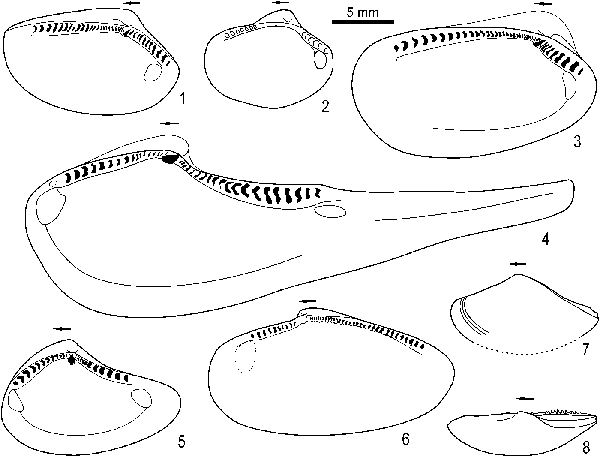
Figures 6.7–6.9, 7.7, 7.8
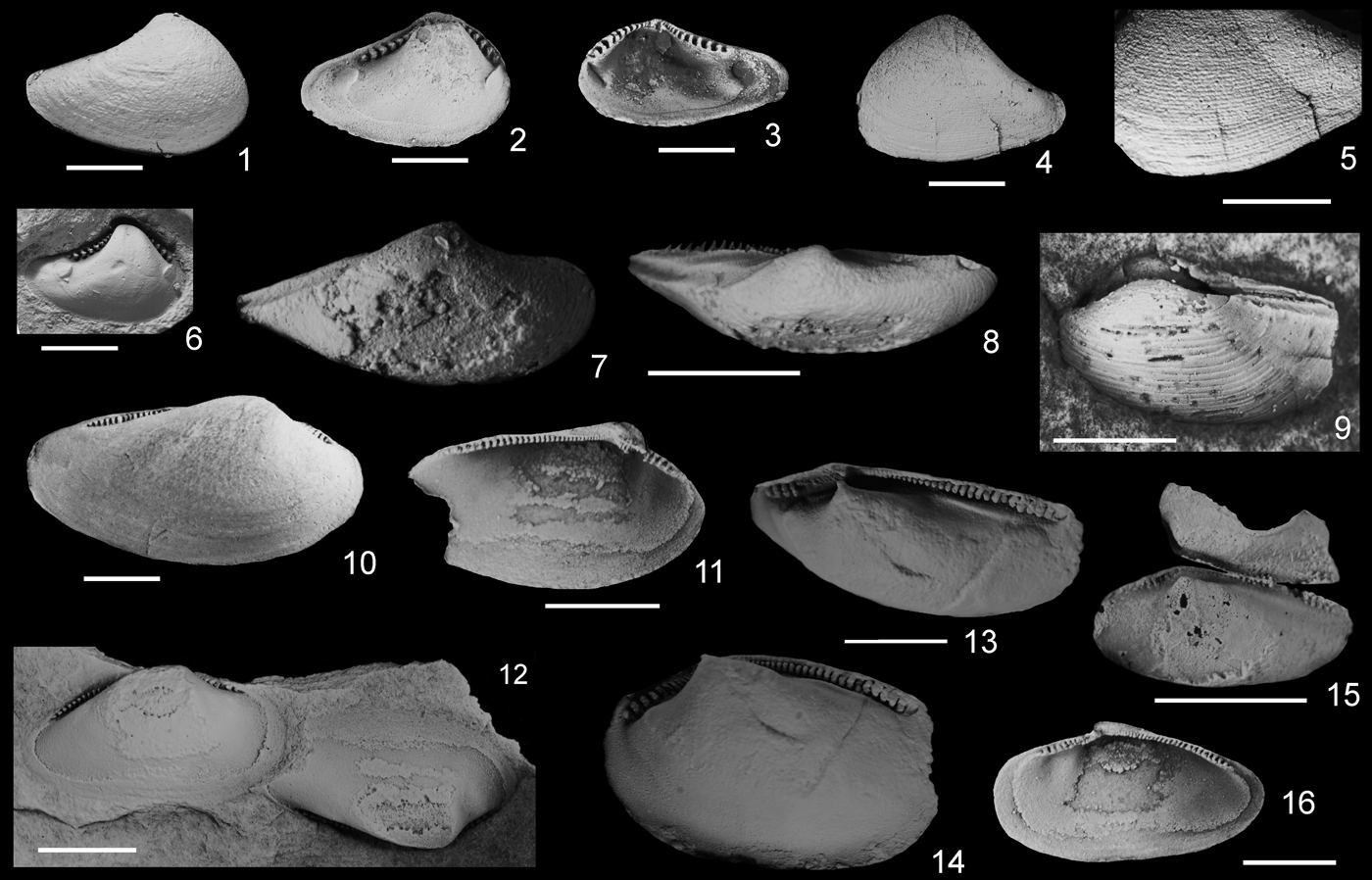
(1–6) Praesaccella ovum (J. de C. Soweby), (1–3) MPEF-PI 6577-1, right valve, (1) latex cast of lateral external view, (2, 3) internal mold and its latex cast (slightly tilted to show resilifer), (4, 5) MPEF-PI 6578, lateral view and detail of ornamentation of latex cast of left valve; (6) MPEF-PI 6571, right valve internal mold. (7–9) Phaenodesmia? piatnitzkyi new species, (7, 8) MPEF-PI 3004, right valve latex cast in lateral and dorsal views, (9) MPEF-PI 6488, incomplete specimen with valves closed, showing carina and ornamentation. (10–16) Palaeoneilo? patagonidica (Leanza), (10) lectotype, MLP 6251a, internal mold of right valve, from Piedra Pintada, Neuquén, (11, 12, 16) MPEF-PI 3357, latex casts (11, 16) and internal mold (12) of left and right valves from probably the same individual; (13, 14) MPEF-PI 2939, right valve internal mold, (13) dorsal views to show muscle scars, and (14) lateral view; (15) MPEF-PI 2845, internal mold of juvenile specimen with valves open in butterfly position. Scale bars = 5 mm.

Sketches of right valves showing hinge. (1) Palaeonucula feruglioi new species, internal view based on specimens MPEF-PI 3897 and 3898; (2) Palaeonucula sp., internal view based on specimen MPEF-PI 2934; (3) Palaeonucula? sp., internal view based on specimens MPEF-PI 2978, 6485 and 5765; (4) Ryderia tehuelchana new species, internal view based on specimens MPEF-PI 3001 and MPEF-PI 2862; (5) Praesaccella ovum (J. De C. Sowerby), based on specimen MPEF-PI 6577-1; (6) Palaeoneilo? patagonidica (Leanza), internal view based on specimen MPEF-PI 3357; (7, 8) Phaenodesmia? piatnitzkyi new species, dorsal and external view based on specimen MPEF-PI 3004. All to the same scale, scale bar = 5 mm.

Holotype
MPEF-PI 3004, external/internal mold of an almost complete isolated right valve.
Diagnosis
Nuculanoid shell with wide prosogyrate subcentral umbo and clearly limited escutcheon; rostrum limited by sharp posterior carina and sulcus, ornamented by commarginal, closely spaced regular threads.
Occurrence
Aguada Loca, Tehuelches Department (sample levels AL39, AL40), Pampa de Agnia, Paso de Indios Department (sample levels PA06, PA07), Chubut Province (Fig. 2).
Description
Shell small (~1 cm long), inequilateral, tear-shaped in lateral view, rostrate, with wide but low prosogyrate umbo and clearly delimited long and narrow escutcheon. Shell longer than high. Posterior end ventral of mid-height. Shell moderately inflated, with maximum width near mid-length. Umbo placed slightly anterior to mid length. Anterior margin evenly rounded, ventral margin gently convex, postero-dorsal margin nearly straight. Relatively sharp posterior carina from umbo to end of rostrum, accompanied by a sulcus on its dorsal side, which is deeper posteriorly. Rostrum short.
Dentition paleotaxodont, only posterior series of convexodont teeth is partially seen in the specimen, on a long dorsally concave series. There are at least 15 narrow chevron-shaped teeth, which gradually increase in size posteriorly and in dorsal view point to the umbo. Ligamental and muscle characters unknown. Shell thin, ornamented by commarginal, closely spaced, regular threads. The commarginal threads have steep dorsal slopes and gentle ventral slopes, and some of them become scaly when reaching the carina (Fig. 6.9). Escutcheon smooth, with a shallow and short postumbonal slit, which may correspond to an external ligament.
Etymology
Dedicated to Alejandro Piatnitzky (1879–1959), who made early comprehensive geological surveys of northern Patagonia for YPF (Yacimientos Petrolíferos Fiscales).
Materials
Six specimens preserved as internal or external molds, MPEF-PI 3004 (holotype), 6455, 6458, 6464, 6478, 6488.
Measurements
Holotype: L = 12.2 mm; H = 6.5 mm.
Remarks
Among Mesozoic protobranchs, the Chinese Norian genus Eleganuculana Chen and Yang (Reference Chen and Yang1983) has prosogyrous umbones, but it differs from the material here described by its short inflated shells with strong commarginal regular costae, and a wide truncated, non-rostrate, posterior margin limited by a carina and sulcus.
Prosogyrate umbos are very rare in rostrate shells (see Echevarría et al., Reference Echevarría, Damborenea and Manceñido2017). This species is referred to Phaenodesmia? because it has prosogyrate umbos, which distinguish it from other rostrate Jurassic protobranchs, usually referred to Nuculana or Praesacella. This species is different from Dacryomya species by its prosogyrate umbos and by having a conspicuous posterior carina.
Phaenodesmia peruana Jaworski (Reference Jaworski1922, p. 116, pl. 5, figs. 1–3), from the Peruvian Triassic, has a similar shape, but the umbones are more anteriorly placed than in the species from Chubut; it also has a less sharp carina without sulcus. The other Peruvian material referred to Phaenodesmia, described by Körner (Reference Körner1937, p. 176, pl. 11, fig. 10) as P. sp., is less rostrate and lacks a carina.
Phaenodesmia? piatnitzkyi n. sp. can be compared with the type species, P. klipsteiniana Bittner (Reference Bittner1895, pl.18, fig. 12) and with Phaenodesmia laubeana Bittner (Reference Bittner1895, pl. 18, fig. 15; Broili, Reference Broili1904, pl. 24, fig. 15), from the European Late Triassic, but these two species have more anterior umbones and a less-developed posterior sulcus.
This species differs from Ryderia tehuelchana n. sp., from the same levels and locality, by its prosogyrate umbos, short rostrum, and commarginal ornamentation.
Several living nuculanid species have a posterior carina and sulcus comparable to the species here described, for instance Nuculana minuta (Müller, Reference Müller1776); see Coan et al. (Reference Coan, Valentich Scott and Bernard2000, pl. 6); and especially those referred to the subgenus Costelloleda, such as N. (C.) costellata (G.B. Sowerby I, Reference Sowerby1833; see Coan and Valentich-Scott, Reference Coan and Valentich Scott2012, pl. 22), but they have low opisthogyrate umbos and compressed shells with stronger commarginal sculpture. Saccella species have a well-defined posterior keel and a shallow posterior sulcus—see for instance S. impar (Pilsbry and Lowe, Reference Pilsbry and Lowe1932) in Coan and Valentich-Scott (Reference Coan and Valentich Scott2012, pl. 25)—and they are also comparable with the species here described in inflation and position of posterior end in relation to midline, but they bear an anterior keel or fold which is lacking in our material.
Genus Palaeoneilo? Hall and Whitfield, Reference Hall and Whitfield1869
Type species
Nuculites constricta Conrad, Reference Conrad1842, p. 249, from the Middle Devonian of New York State (see McAlester, Reference McAlester1968; see comments and synonymy in Damborenea, Reference Damborenea1987a, p. 53–54; Hodges, Reference Hodges2000, p. 27; and Ros et al., Reference Ros, Márquez-Aliaga and Damborenea2014).
Remarks
There is a long standing and yet unresolved discussion about the generic affiliation of elongate compressed Mesozoic shells with long, apparently uninterrupted series of taxodont teeth, such as the species described below, and most authors (e.g., Damborenea, Reference Damborenea1987a; Hodges, Reference Hodges2000; Wasmer et al., Reference Wasmer, Hautmann, Hermann, Ware, Roohi, Ur-Rehman, Yaseen and Bucher2012) followed Borissjak (Reference Borissjak1904) and Cox (Reference Cox1937) in referring them to Palaeoneilo Hall and Whitfield, Reference Hall and Whitfield1869, a genus typified by a Devonian species. Nevertheless, recognition of Palaeoneilo in Mesozoic beds (Cox, Reference Cox1937), and its relationships with Mesosaccella Chavan, Reference Chavan1946 was never satisfactory, especially since the type species of Palaeoneilo (Nuculites constricta Conrad, Reference Conrad1842, p. 249, from the Middle Devonian of New York State; see McAlester, Reference McAlester1968) is very poorly known. Wasmer and Hautmann (in Wasmer et al., Reference Wasmer, Hautmann, Hermann, Ware, Roohi, Ur-Rehman, Yaseen and Bucher2012) pointed out that Triassic species referred to Palaeoneilo lack overlap of teeth rows, and also lack a posterior shell constriction, as is characteristic of Paleozoic species. Other authors prefer to refer Mesozoic species to Mesosaccella without further discussion, though admitting that this last genus has become a “bucket taxon” (see for instance Duff, Reference Duff1978; Hryniewicz et al., Reference Hryniewicz, Little and Nakrem2014).
Some of the Triassic malletiids previously referred to Palaeoneilo were separated as new genera, and should be discussed in this context. Kurushin (in Dagys and Kurushin, Reference Dagys and Kurushin1985) proposed the new genus Lapteviella for small elongated compressed shells previously referred to Palaeoneilo, based on material from the Middle Triassic of Siberia. More recently, very large shells with a cuneate outline from the Norian of Yunnan (China), also previously referred to Palaeoneilo, were assigned to the new genus Yongshengia by Chen and Stiller (Reference Chen and Stiller2008).
The presence or absence of resilifer is one of the key discussion points, yet in most Mesozoic species this character is imperfectly known. Hinge features were well illustrated by Moberg (Reference Moberg1888, pl. 1, fig. 49b) and Troedsson (Reference Troedsson1951, text-fig. 39) on a right valve of Palaeoneilo bornholmiensis (Seebach, Reference Seebach1865) from the Pliensbachian of Sweden; and by Borissjak (Reference Borissjak1904, text-fig. 1) on a left valve of Palaeoneilo amygdala Borissjak, Reference Borissjak1904 from the late Jurassic of Russia. These specimens have a continuous series of taxodont teeth, no ligament pit below the umbo, and a shallow furrow along the posterior hinge margin, interpreted as the attachment of an external ligament. Carter (Reference Carter and Carter1990) observed that P. elliptica (Goldfuss, Reference Goldfuss1837) has a very small resilifer on right valves only, and this was also reported for adult shells of the Late Triassic genus Yongshengia by Chen and Stiller (Reference Chen and Stiller2008, p. 362).
For the reason stated above, it seems inappropriate to continue using Palaeoneilo for Mesozoic species, but the subject cannot be settled without a thorough revision, which is well beyond the possibilities of this paper, thus we prefer to refer the species of this group to Palaeoneilo? rather than proposing a new generic taxon for them. The shell features of the species here described do not fit either into the broad diagnosis of Mesosacella (Chavan, Reference Chavan1946, p. 197) provided by Duff (Reference Duff1978, p. 27) because they lack the depression or fossette beneath the umbones between anterior and posterior rows of teeths, which are gently concave in our material. This gap separating the taxodont dentition series is also a key character of the genus Malletia des Moulins.
Palaeoneilo? patagonidica (Leanza, Reference Leanza1942)
Figures 6.10–6.16, 7.6
- Reference Leanza1942
Nucula patagonidica Leanza, p. 151; pl. 1, figs. 1, 2, 4 (non fig. 3).
- Reference Levy1966
Nucula patagonidica Leanza; Levy, p. 237.
- Reference Franchi and Page1980
Nuculoma patagonídica [sic]; Franchi and Page, p. 217.
- Reference Damborenea1987a
Palaeoneilo patagonidica (Leanza); Damborenea, p. 54; pl. 1, figs. 1–3; text-fig. 6.
- Reference Damborenea1996
Palaeoneilo patagonidica (Leanza); Damborenea, p. 158.
- Reference Pagani, Manceñido, Damborenea and Ferrari2012
Palaeoneilo? sp.; Pagani et al., p. 413, fig. 3.b.
Lectotype
MLP 6251a, an internal mold of a right valve, designated by Damborenea (Reference Damborenea1987a, p. 54), from Pliensbachian beds at Subida a Sañicó, Neuquén. This specimen was figured by Leanza (Reference Leanza1942, pl. 1, fig. 1) and Damborenea (Reference Damborenea1987a, pl. 1, fig. 1), and here (Fig. 6.10).
Occurrence
New collections from Aguada Loca (sample levels AL35-36, AL39), Pampa de Agnia (sample levels PA01, PA06), and Betancourt (sample level Bet 33); also from Lomas de Plate (Piatnitzky collection), and probably Pocitos de Quichaura (collection Franchi and Page).
Description
Shell ovally elongated in shape, compressed to only moderately inflated, inequilateral, with low umbones. Shell appears to have been thin, and ornamented only by faint commarginal growth lines. The hinge plate is narrow, and the numerous teeth are small. Adductor muscle scars not impressed, pallial line entire.
Materials
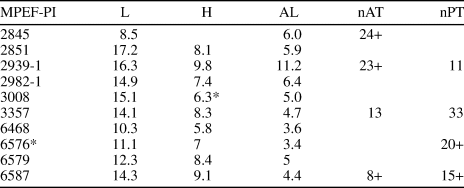
Twenty-three right and left valves preserved as internal or external molds: MPEF-PI 2845, 2851, 2893, 2939, 2982, 2984?, 3008, 3357, 3370, 3896, 5764, 5782, 6468, 6490, 6491, 6551, 6558, 6559, 6576, 6579, 6587; some specimens collected by Piatnitzky (MLP18190, 29246 to 29248). The material listed by Levy (Reference Levy1966, p. 237) and by Franchi and Page (Reference Franchi and Page1980, p. 217) from the Pampa de Agnia region, could not be located in the SNGM collections at Buenos Aires.
Measurements
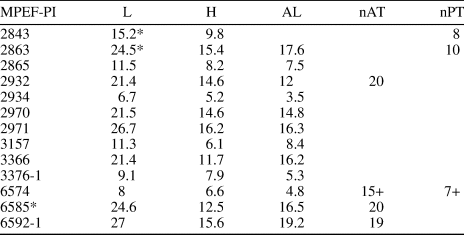
See Table 8.
Measurements (in mm) of Palaeoneilo? patagonidica (Leanza). * = incomplete specimen.

Remarks
This species was already mentioned from Chubut by Levy (Reference Levy1966, p. 237) based on material collected by E. Barreneche, and by Damborenea (Reference Damborenea1987a, p. 54) on the basis of material collected by Piatnitzky. Specimens from Chubut are usually preserved as internal molds of left and right isolated valves, only a few external molds are available. The reference to Nuculoma patagonídica by Franchi and Page (Reference Franchi and Page1980, p. 217) from Quichaura (E in Fig. 1) probably belongs here, but the material could not be located at SNGM. The specimens from Chubut show great variability in shell shape, but they agree with the known variability within Palaeoneilo? patagonidica (Leanza).
Palaeoneilo? patagonidica was described in detail by Leanza (Reference Leanza1942, p. 151–152; pl. 1, figs. 1, 2, 4) and Damborenea (Reference Damborenea1987a, p. 54–56, pl. 1, figs. 1–3; text-fig. 6), where comparisons with similar species were made. This species was regarded as a junior synonym of Palaeoneilo? elliptica (Goldfuss, Reference Goldfuss1837) by Hodges (Reference Hodges2000, p. 28), but is here maintained as a different taxon. According to Hodges (Reference Hodges2000), the widespread Carnian to Pliensbachian species Palaeoneilo? elliptica (Goldfuss) had a very variable shell shape with anteriorly placed umbos, but is characterized by a set of 10 anterior teeth and 22 posterior teeth, and a shallow pallial sinus. Well preserved specimens from Chubut have up to 13 anterior teeth but always more than 25 posterior teeth, and the pallial line is not visible.
The species here described has a shell form and hinge comparable to Malletia pseudopraecursor Kurushin (in Dagys and Kurushin, Reference Dagys and Kurushin1985, pl. 5, figs. 5–8), from the Siberian Triassic, but it differs for having a dorsally convex hinge line and narrower umbones.
The type species of Lapteviella, L. prontchistshevi Kurushin (in Dagys and Kurushin, Reference Dagys and Kurushin1985, pl. 6, fig. 9, pl. 7, figs. 1–6), from the Siberian Anisian, has a narrower posterior region of the shell and a straight posterior hinge line. On the other hand, Late Triassic shells from Chile and Argentina referred to P. elliptica (Cecioni and Westermann, Reference Cecioni and Westermann1968) by Damborenea in Damborenea and Manceñido (Reference Damborenea and Manceñido2012) have a more rounded posterior margin than the material here described.
The species Yongshengia cuneata (Chen in Ma et al., Reference Ma, Chen, Lan, Gu, Chen and Lin1976), from the Late Triassic of Yunnan (China) has a superficial similarity of shell shape with the Argentine species, but it reaches a much larger size, has far more numerous teeth, and its shell is very thick, with two orders of commarginal and faint radial ornamentation (Chen and Stiller, Reference Chen and Stiller2008, figs. 3–5).
Paleoecology
Protobranch bivalves are restricted to normal marine environments, and due to their detritivorous feeding habits they only live in organic-rich bottoms as very active shallow burrowers. Living protobranchs are diverse in a variety of marine settings, but especially in high latitude regions and deep waters (Allen, Reference Allen1978; Whittle et al., Reference Whittle, Quaglio, Crame and Linse2012). In littoral environments, the preferred type of substrate is variable depending on species (Allen, Reference Allen1954).
A similar habit was inferred for extinct species, supported by taphonomic evidence. The protobranch diversity at some of the Chubut localities is equivalent to that recorded by Pedersen (Reference Pedersen1986) in Early Jurassic mudstones from Denmark, and includes both very active burrowers that fed from the sediment while moving (e.g., Palaeonucula, Palaeoneilo?) and very shallow burrowers that remain stationary once in place (e.g., Praesaccella, Ryderia, Phaenodesmia?).
According to Hodges (Reference Hodges2000) the species of Ryderia, for instance, were fast burrowers, living stationary with the tip of the long rostrum just below the sediment surface, and most probably fed from the sediment surface. In Chubut, Early Jurassic protobranch records are concentrated in localities along the southern part of the basin, especially Aguada Loca and Betancourt (Fig. 1; Table 2). Some levels (AL35 + 36 and AL39) are particularly rich both with regard to abundance and diversity, suggesting optimum conditions of bottom grain-size and organic contents.
It is interesting to note that in Chubut the beds with protobranch bivalves also contain a low diversity invertebrate fauna, including other bivalves, ammonoids, gastropods, and serpulids (Table 2). Conspicuous bivalves of this recurrent association are (apart from the protobranchs): Kolymonectes weaveri Damborenea, Reference Damborenea, Johnston and Haggart1998, Parainoceramya apolo (Leanza, Reference Leanza1942), Agerchlamys wunschae? (Marwick, Reference Marwick1953), and Grammatodon costulatus (Leanza, Reference Leanza1942), with occasional Pseudolimea sp., Praechlamys sp., trigoniids, astartids and lucinids. The most abundant elements are either free epifaunal or shallow infaunal, and the proportion of detritivorous vs. suspensivorous bivalves is high. This association can be closely compared with Biofacies B, recognized for the Early Jurassic beds in Piedra Pintada (Damborenea et al., Reference Damborenea, Manceñido and Riccardi1975), which is the only region of the Neuquen Basin s.s. where protobranch bivalves are common, although less diverse than in Chubut.
Paleobiogeography
Most of the species described belong to cosmopolitan or nearly cosmopolitan genera and can be compared to species from other regions. Of special interest is the new species referred to Ryderia, a genus that was only known from South America for the Late Triassic, from a doubtfully referred species from Peru (Jaworski, Reference Jaworski1922) and an unpublished record from southern Chile (Pérez-Barría, Reference Pérez-Barría2004, Reference Pérez-Barría2005). We also include in this genus a species from New Zealand previously referred to Nuculana, R. vexillata (Marwick), which, together with the Chilean record just mentioned and the species from Chubut here described, point to high paleolatitude abundance and diversity between Rhaetian and Toarcian times on both hemispheres for this widely distributed genus, which was rare in the Tethys s.s.
From the paleobiogeographical point of view, this revision of Protobranchia confirms that these bivalves were relatively more diverse in Chubut than in Neuquén during late Pliensbachian–early Toarcian times (Table 1). Only two species were described from northern Chile (Aberhan, Reference Aberhan1994), four species are known from the southern areas of the Neuquén Basin, and seven species are here described from Chubut, belonging to the families Nuculidae, Nuculanidae, Polidevciidae, and Malletiidae. At the species level, this is a significant trend for the SE Paleo-Pacific (Damborenea and Echevarría, Reference Damborenea and Echevarría2015, fig. 6E), opposed to the general latitudinal gradient of decreasing diversity towards higher latitudes shown by most other bivalve groups. It is interesting to note that this trend is known at a global level for living Nuculanoidea (Crame, Reference Crame2000; Roy et al., Reference Roy, Jablonski and Martien2000) and for Late Jurassic protobranchs (Crame, Reference Crame2002), and thus our data suggest a sustained biogeographic pattern of very old origin.
Acknowledgments
The Museo Paleontológico Egidio Feruglio (MEF) technical staff, L. Reiner, P. Puerta, L. Canessa and E. Ruigomez, efficiently aided during field-work, specimen preparation and rubber casts. The thorough revisions by K Hryniewicz, P. Hodges and S. Schneider are greatly acknowledged. This research was financed by several grants from CONICET (Consejo Nacional de Investigaciones Científicas y Técnicas, Argentina), grants PIP 112-200801-01567 and 112-201101-01088; and ANPCyT (Agencia Nacional de Promoción Científica y Tecnológica, Argentina), projects PICT 33080 and PICT 2011-1589. We also thank MEF for field financial support and logistic facilities.